─ 208 ─ elSSN 2287-1683
plSSN 1738-8767
Journal of Trauma and Injury Vol. 27, No. 4, December, 2014
� Case Report �
� Address for Correspondence : Young Il Choi, M.D.
Department of Surgery, Kosin University College of Medicine, 34 Amnam-dong, Seo-gu, Busan 602-703, Korea
Tel : 82-51-990-6462, Fax : 82-51-246-6093, E-mail : [email protected]
Submitted : July 15, 2014 Revised : August 6, 2014 Accepted : August 10, 2014
젊은 남자 환자에서 발생한 자발적 비장 파열: 증례보고
국군수도병원 외과, 1고신의대 복음병원 외과
이성배, 최영일1
- Abstract -
Spontaneous Normal Splenic Rupture: A Case Report
Sung Bae Lee, M.D., Young Il Choi, M.D.
1Department of Surgery, The Armed Forces Capital Hospital, Seongnam, Korea,
1
Department of Surgery, Kosin University Gospel Hospital, Kosin University College of Medicine
Rupture of the spleen is relatively common, both immediately and in a delayed fashion following significant blunt abdominal trauma. However, atraumatic splenic rupture rarely occurs. Multiple underlying pathologies have been asso- ciated with splenic rupture without trauma, including hematological, neoplastic, inflammatory and infectious condi- tions. In our case, a 21-year-old male without prior medical history visited the hospital with left upper quadrant abdom- inal pain that had started one day earlier. He had no history of trauma. An abdominal computed tomography (CT) scan found a collection of perisplenic fluid, accompanying a splenic rupture. Due to the patient’s stable vital signs and lack of clinical progression of hemorrhage, he underwent conservative treatment. The patient was discharged at day 14 with- out complication.
Rupture of a normal spleen without a history of trauma is not often reported, and it has long been a subject of debate. Ruptures of normal spleen almost always follow some kind of trauma, such as a car accidents or a fall from sig- nificant heights. Here, we report a case of spontaneous rupture of a normal spleen in the absence of other medical pathologies or triggering factors. [ J Trauma Inj 2014; 27: 208-10 ]
Key Words: Splenic rupture, Spontaneous
I. Introduction
Rupture of the spleen is relatively common both immediately and in a delayed fashion following signif-
icant blunt abdominal trauma.(1) However, atraumatic splenic rupture rarely occurs. Multiple underlying pathologies have been associated with splenic rupture without trauma, including hematological, neoplastic,
─ 209 ─
Sung Bae Lee, et al.: A case of normal Splenic rupture
inflammatory and infectious conditions.(2-5)
Rupture of a normal spleen without a history of trauma is reported less often, and it has long been a debating problem.(6) Normal spleen ruptures almost always following some kind of trauma, such as car accidents or fall down from significant heights. Now we are reporting a case of spontaneous rupture of normal spleen in the absence of other medical pathologies and triggering factor.
II. Case
A 21-year-old male was transferred to the emer- gency department with a chief complaint of left upper quadrant abdominal pain of one day. He denied any history of recent trauma. He had no medical history or examination regarding coagulation disorder.
The patient visited other local hospital and was checked by computer tomography. Then he was diagnosed splenic rupture and transferred to our hospital. On arrival, physical examination showed left upper quadrant tenderness and rebound tender- ness. Conjunctival pallor and abdominal distension were noted. The blood pressure was 131/63 mmHg, pulse 85/min, and body temperature 37.3�C.
Laboratory test revealed hemoglobin 10.1 g/dL, platelet count 145,000 μl, aspartate aminotrans- ferase 21 IU/L, alanine aminotransferase 20 IU/L, blood urea nitrogen 22.6 mg/dL, and creatinine 1.1 mg/dL and prothrombin time 13.1 sec (international normalized ratio 1.36).
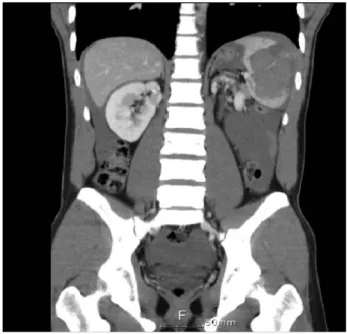
Abdominal computed tomography (CT) scan found
perisplenic fluid collection, accompanied with splenic rupture (Fig. 1, 2). He was seronegative for malaria antigen and Widal test. Blood test for Epstein-Barr virus was negative and Ecchinococcus Ab was also negative. Due to the patient’ s stable vital sign and lack of clinical progression of hemorrhage, the patient was put to conservative treatment. The patient underwent intensive treatment for 3 days in the intensive care unit. Abdominal tenderness started to improve and disappeared at day 5, and a follow-up CT scan performed at the 7th hospital day found diminution of hemoperitoneum and improvement of the damaged spleen. The patient was discharged at day 14th hospital day without complication.
III. Discussion
A non-traumatic ruptured spleen is a condition less common in patients presenting with acute abdominal pain and can result in severe morbity and mortality when diagnosed late due to doctor’ s delay.
Overall mortality rate is 10~15%.(7) Pain is a fre- quent presenting symptoms of splenic rupture. As the differential diagnosis of this kind of pain is wide and many patients have no known backgroud dis- ease, important time may be wasted waiting for the result of diagnostic tests.(8)
The diagnosis of splenic rupture is a clinical one,
Fig. 1. Abdominal compute tomography finding reveal splenic rupture, perisplenic and perihepatic fluid collection, and large amount of hematoma.
Fig. 2. Abdominal compute tomography finding reveals
perisplenic fluid collection and splenic hematoma.
confirmed by either CT scan or laparotomy (in hemodynamically unstable patients). Several grading systems based on CT or ultrasound findings have been established for splenic rupture and each has been shown to be useful for guiding management decisions. Use of imaging procedures such as abdominal ultrasound or computed axial tomography can minimize this diagnostic difficulty.(9) We have found abdominal CT to be very helpful for diagnosis and follow up. It helped not only in the proper selection of patients for surgery or observation but also in focusing operative intervention in the face of massive hemoperitoneum.
Historically the treatment of choice for all kinds of splenic rupture used to be splenectomy; however, nowadays due to recent advances in surgical tech- niques and conservative treatment, it is now more common apply conservative treatment in the setting of stable vital sign and lack of progression of hem- orrhage. Nonoperative management consists of observation for 7~14 days in the hospital, strict bed rest, and administration of fluid and blood as need- ed. Delayed rupture rarely occurs. Splenectomy remains the treatment of choice in patients with a hemoperitoneum and severe hypovolemic shock.(10) The clinical situation should be the most important factor in deciding management plans.
The three commonest causes of spontaneous splenic rupture are malignant hematological disor- der, viral infectious disorders and local inflammato- ry and neoplastic disorders. Malignant hematological disorder include acute leukemia and non-Hodgkin’ s lymphoma. Among infectious disorder, infectious mononucleosis is considered the most likely to cause spontaneous splenic rupture and the second cause is malaria infection.(7)
According to the statistics provided by Korea Centers for Disease Control and Prevention, the annual incidence of malaria has increased since 1993, reaching a peak in 2000 with 4,142 cases, which then decreased until 2004 and has since increased again. During that same period, a large number of malaria infection occurred in military camps.(11) Plasmodium vivax that is especially prevalent in Korea is characterized by mild clinical progression, and occasional splenic complications
are known to occur.(12) For our patient was young soldier who perform military service around the 38th parallel line of South Korea, we speculated malarial infection. However, peripheral blood smear and malaria antigen test showed that there was no evidence for malarial infection. There was no evi- dence of infection or malignant disease in our case.
We have reported on a unique case of spontaneous rupture of a normal spleen. We showed the success- ful management of severe splenic ruptured patient with conservative treatment. Physicians should con- sider the diagnosis of spontaneous splenic rupture in patient with abdominal pain and hypotension even without a history of trauma.
REFERENCES