• 검색 결과가 없습니다.

Spontaneous Splenic Rupture as a Paradoxical Reaction during Treatment for Splenic Tuberculosis

N/A
N/A
Protected

Academic year: 2021

Share "Spontaneous Splenic Rupture as a Paradoxical Reaction during Treatment for Splenic Tuberculosis"

Copied!
4
0
0

로드 중.... (전체 텍스트 보기)

전체 글

(1)

Spontaneous Splenic Rupture as a

Paradoxical Reaction during Treatment for Splenic Tuberculosis

Hye Ju Yeo, M.D.

1

, Soo Yong Lee, M.D.

1

, Eunyoung Ahn, M.D.

1

, Eun Jung Kim, M.D.

1

, Dae Gon Rhu, M.D.

1

, Kyoung Un Choi, M.D.

2

, Seung Eun Lee, M.D.

1

, Woo Hyun Cho, M.D.

1

, Doosoo Jeon, M.D.

1

and Yun Seong Kim, M.D.

1

Departments of

1

Internal Medicine and

2

Pathology, Pusan National University Yangsan Hospital, Pusan National University School of Medicine, Yangsan, Korea

This report describes a rare case of a patient with splenic tuberculosis (TB) who developed spontaneous splenic rupture after 10 weeks of antituberculous chemotherapy. The patient responded well to the antituberculous regimen prior to the spontaneous splenic rupture. We considered a paradoxical reaction as a cause of the splenic rupture. The patient underwent splenectomy and continuously received initial antituberculous drugs without change. To the best of our knowledge, this is the first report of spontaneous splenic rupture as a paradoxical reaction to antituberculous chemotherapy in an immunocompetent host with splenic TB.

Keywords: Tuberculosis; Tuberculosis, Splenic; Splenic Rupture; Disease Progression

administration of antituberculous chemotherapy

3-5,8,9

. Spon- taneous rupture as a paradoxical reaction during successful chemotherapy has not been reported in an immunocompe- tent patient. We report this case in light of rarity and clinical importance of early recognition for this phenomenon.

Case Report

A 33-year-old woman (married, homemaker) presented with frequent high-grade fever and left-sided abdominal pain that had lasted for 1 month. There was no history of cough, sputum, or any other respiratory symptoms. She had no his- tory of diabetes, hypertension, TB, or other significant illness.

Physical examination showed that her body temperature was 38

o

C, pulse rate 105 beats/min, and blood pressure 100/60 mm Hg. Abdominal examination revealed an enlarged and tender spleen. Routine examinations of other systems showed unremarkable findings. The patient’s laboratory data showed a white blood cell count of 11,590/mm

3

, hemoglobin con- centration 9.4 g/dL, erythrocyte sedimentation rate 30 mm/

hr, and C-reactive protein concentration 9.02 mg/dL. Other biochemical parameters, including liver functions and levels Copyright © 2013

The Korean Academy of Tuberculosis and Respiratory Diseases.

All rights reserved.

Introduction

Splenic tuberculosis (TB) is a rare form of extra-pulmonary TB

1

. It usually occurs in the disseminated or miliary form of TB, especially in human immunodeficiency virus (HIV)- infected patients

2

. Very few studies have reported spontane- ous splenic rupture in splenic TB

3-10

. The majority of these cases occurred in immunocompromised patients

3-7

or before

CASE REPORT

http://dx.doi.org/10.4046/trd.2013.75.5.218

ISSN: 1738-3536(Print)/2005-6184(Online) • Tuberc Respir Dis 2013;75:218-221

218

Address for correspondence: Doosoo Jeon, M.D.

Department of Internal Medicine, Pusan National University Yangsan Hospital, Pusan National University School of Medicine, 20 Geumo-ro, Yangsan 626-787, Korea

Phone: 82-55-360-1415, Fax: 82-55-360-1757 E-mail: [email protected]

Received: May 10, 2012 Revised: Jun. 19, 2012 Accepted: Jul. 19, 2012

cc
It is identical to the Creative Commons Attribution Non-Commercial

License (http://creativecommons.org/licenses/by-nc/3.0/).

(2)

Spontaneous rupture in splenic TB

http://dx.doi.org/10.4046/trd.2013.75.5.218 219

www.e-trd.org

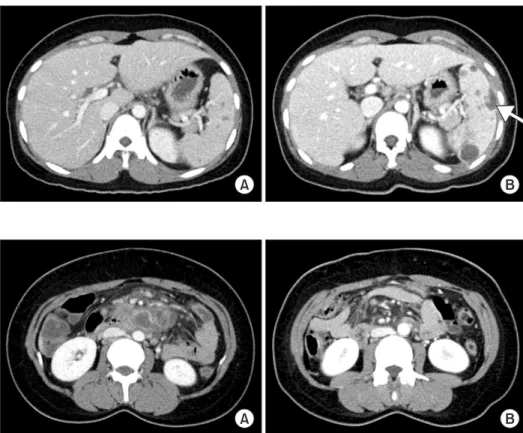
of blood sugar, blood urea, and serum creatinine, were within normal limits. T-SPOT.TB assay (Oxford Immunotec, Oxford, UK) showed positive result and enzyme-linked immunosor- bent assay showed that the patient was seronegative for anti- HIV antibodies. Chest radiography revealed no remarkable abnormalities. Computed tomography (CT) of the abdomen revealed multiple low-density lesions of variable size, with some septations, in the spleen (Figure 1A). We also observed several enlarged mesenteric lymph nodes, which showed central low attenuation with a peripheral rim enhancement, suggestive of TB lymphadenitis (Figure 2A). An ultrasound- guided splenic biopsy revealed inflammatory cells with focal necrosis, and results of acid-fast bacilli (AFB) staining and TB-polymerase chain reaction were negative. Laparoscopic biopsy of the small bowel mesentery was performed for differ- ential diagnosis and to exclude malignancy. However, biopsy of abdominal lymph nodes could not be performed, because profuse bleeding was expected as a result of severe adhesion of small bowel mesentry. Histopathological examination of the biopsy specimen revealed evidence of both acute and chronic inflammation without granuloma. Our initial im- pression, based on the clinical and radiological findings, was splenic TB accompanied with abdominal TB lymphadenitis.

We initiated antituberculous chemotherapy with isoniazid, ri- fampicin, ethambutol, and pyrazinamide. After 1 week of che- motherapy, the patient became afebrile and did not complain of abdominal pain. She was subsequently discharged.

After 10 weeks of chemotherapy, the patient returned to the emergency department of our hospital with sudden-onset dull and aching pain in the abdominal upper left quadrant.

Abdominal CT scan showed more increase in the size and Figure 1. Computed tomography (CT) findings of the abdomen. (A) Initial CT shows multiple hypodense lesions in the spleen. (B) After 10 weeks of chemother- apy, CT shows more increase in the size and number of splenic abscesses with intraperitoneal rupture (arrow).

Figure 2. Computed tomography (CT) findings of the abdomen. (A) Initial CT shows several central low density with peripheral rim enhanced lymph nodes enlargement around small bowel mesen- tery. (B) After 10 weeks of chemotherapy, CT shows decreased interval in the size and number of those lymph node lesions.

Figure 3. Explanted spleen. By gross appearance, the spleen was

enlarged, measuring approximately 14×9×4 cm in dimension and

232.8 g in weight. The specimen shows multiple yellow necrotic

nodules (arrows) and foci of hemorrhage.

(3)

HJ Yeo et al.

220 Tuberc Respir Dis 2013;75:218-221 www.e-trd.org

number of splenic abscesses with intraperitoneal rupture (Figure 1B), whereas more decrease in the size and number of abdominal lymph nodes than were previously observed (Figure 2B). The patient did not report occurrence of recent trauma. The patient was admitted for emergency splenec- tomy. Gross findings included multiple yellow necrotic nod- ules and hemorrhagic foci with a lacerated splenic capsule (Figure 3). Histopathological examination showed epithelioid granulomas composed of epithelioid cells, lymphocytes, and Langerhans giant cells with variable degree of central case- ous necrosis, consistent with TB (Figure 4). AFB staining and culture for TB from the splenectomy specimen were nega- tive. Considering the clinical improvement of the patient and radiological improvement of concomitant abdominal lymph nodes, we assumed that the splenic rupture was precipitated by paradoxical reaction. Antituberculous chemotherapy was continued postoperatively without regimen change, for a total treatment time of 9 months. The patient is currently clinically disease-free for 3 months after completion of chemotherapy.

Discussion

Splenic TB is an extremely rare cause of spontaneous splenic rupture

11,12

. Nearly 90% of splenic ruptures are caused by trauma. The remaining 10% are due to underlying diseases, such as splenic angiomas, infarctions, neoplasms, and infec- tious diseases

11

.

A few cases of spontaneous rupture of splenic TB have been reported previously in a single case report

3-10

. The majority of these cases occurred in immunocompromised patients. These patients had HIV infection

3,4,7

, longstanding sarcoidosis

5

, or chronic renal disease requiring hemodialysis

6

. Thus far, 3 cases have been reported in immunocompetent patients

8-10

. Splenic hemangioma was a factor in one of these cases

8

.

Most spontaneous ruptures in splenic TB were reported as

initial manifestations, occurring before initiation of antituber- culous chemotherapy

3-5,8,9

. This suggests that the diagnosis of splenic TB is often delayed due to the lack of specific symp- toms and signs. Three cases of spontaneous splenic rupture have been reported during antituberculous chemotherapy.

The first case occurred 1 week after initiation of chemo- therapy in an immunocompetent patient

10

. The second case occurred as a result of treatment failure in a patient with long- standing sarcoidosis

5

. The third case occurred after 4 weeks of chemotherapy as a manifestation of immune reconstitution inflammatory syndrome in an HIV-infected patient

7

. Spon- taneous splenic rupture occurring as a paradoxical reaction during successful chemotherapy has not been reported in an immunocompetent patient.

In the present case, splenic rupture occurred after 10 weeks of chemotherapy. Before splenic rupture, the patient’s condi- tion was improving. The initial symptoms of fever and abdom- inal pain had resolved. In addition, abdominal CT performed at the time of splenic rupture showed improvement of lymph node lesions. Postoperatively, the patient was continuously treated with initial antituberculous drugs and successfully completed treatment. Therefore, we consider paradoxical re- action as the cause of spontaneous splenic rupture.

A paradoxical reaction is defined as radiological and clini- cal worsening of a previous lesion or the development of new lesions after initial improvement during antituberculous treatment

13,14

. This has been observed in cases of intracranial tuberculoma, TB lymphadenitis, and pleural and pulmonary TB

13,14

.

The pathogenesis of paradoxical reaction is generally re- garded as the hypersensitivity response to mycobacterial antigens rather than high bacillary load. This immunological hypothesis is supported by a relatively low mycobacterial culture rate and significant response after the use of cortico- steroids

13,14

. In our case, AFB staining and culture for TB from the splenectomy specimen were negative. We presumed that negative microbiological result related with the paradoxical Figure 4. Histopathological findings of the spleen. (A) Large granuloma with central necrosis is noted (H&E stain, ×40). (B) Epithelioid and Langhans giant cells (box:

arrow) are identified at the peripheral portion of the granuloma (H&E stain,

×100).

(4)

Spontaneous rupture in splenic TB

http://dx.doi.org/10.4046/trd.2013.75.5.218 221

www.e-trd.org

reaction as well as 10 weeks of antituberculous theapy prior to the splenectomy.

Paradoxical reactions in TB may be localized or systemic phenomena. Different responses of multiple lesions to anti- tuberculous therapy were reported as a result of paradoxical reaction

15

. Our case showed different response of spleen and abdominal lymph nodes to antituberculous treatment. By contrast to the splenic lesions, we could not obtain microbio- logical or histological evidences for TB in abdominal lymph node lesions. However, the CT scan demonstrated typical radiological findings suggestive of TB lymphadenitis and improvement of those lesions during treatment. Therefore, presumptive diagnosis for abdominal TB lymphadenitis could be allowed based on these findings. In addition, different re- sponses of spleen and abdominal lymph nodes might be one of the findings to support the paradoxical reaction as a cause of splenic rupture.

It is not clear how paradoxical reaction results in splenic rupture. We propose that subcapsular localization of granulo- matous TB lesions causes tearing of the splenic capsule. Rapid mycobacterial killing following successful chemotherapy may release mycobacterial products, which stimulate production of cytokines. These cytokines then enhance focal immune responses with accumulation of inflammatory exudates, ulti- mately resulting in spleen rupture.

Despite the rarity of this condition, this case has clinical im- portance because it encourages awareness for this phenom- enon. It is clinically important to distinguish paradoxical reac- tions from treatment failures because paradoxical responses usually do not require changes in therapy. Even occult rupture is associated with high mortality if unrecognized; therefore, spontaneous rupture of the spleen usually requires surgical intervention. All but one

7

reported cases of splenic rupture in splenic TB have been treated with splenectomy.

In summary, we described a case of spontaneous splenic rupture as a paradoxical reaction in an immunocompetent patient with splenic TB. The patient was successfully treated with splenectomy and continuing antituberculous chemo- therapy with initial drugs. To the best of our knowledge, this is the first case report of splenic rupture during successful anti- tuberculous therapy in an immunocompetent host.

References

1. Peto HM, Pratt RH, Harrington TA, LoBue PA, Armstrong LR.

Epidemiology of extrapulmonary tuberculosis in the United States, 1993-2006. Clin Infect Dis 2009;49:1350-7.

2. Sharma SK, Smith-Rohrberg D, Tahir M, Mohan A, Seith A.

Radiological manifestations of splenic tuberculosis: a 23-pa- tient case series from India. Indian J Med Res 2007;125:669- 78.

3. Pramesh CS, Tamhankar AP, Rege SA, Shah SR. Splenic tuber- culosis and HIV-1 infection. Lancet 2002;359:353.

4. Rathore S, George P, Deodhar M, Calton N, George U, Pawar B, et al. Spontaneous rupture of tuberculous spleen in a HIV seropositive patient on maintenance hemodialysis. Saudi J Kidney Dis Transpl 2009;20:822-5.

5. Lam KY, Ng WF, Chan AC. Miliary tuberculosis with splenic rupture: a fatal case with hemophagocytic syndrome and possible association with long standing sarcoidosis. Pathol- ogy 1994;26:493-6.

6. Ram R, Swarnalatha G, Prasad N, Murty KV. Pathological rup- ture of spleen in a haemodialysis patient due to tuberculosis.

Nephrol Dial Transplant 2006;21:2994-5.

7. Weber E, Gunthard HF, Schertler T, Seebach JD. Spontaneous splenic rupture as manifestation of the immune reconstitu- tion inflammatory syndrome in an HIV type 1 infected pa- tient with tuberculosis. Infection 2009;37:163-5.

8. Rao RC, Ghose R, Sawhney S, Berry M. Hemangioma of spleen with spontaneous, extra-peritoneal rupture, with asso- ciated splenic tuberculosis: an unusual presentation. Austra- las Radiol 1993;37:100-1.

9. Safioleas MC, Stamatakos MC, Safioleas CM, Diab AI, Agapi- tos EB. Co-existence of spontaneous splenic rupture and tuberculosis of the spleen. Saudi Med J 2006;27:1588-90.

10. Fegan D, Butcher C, Rees C, Glennon J. Tuberculosis and ab- dominal pain. Intern Med J 2005;35:437-8.

11. Sterlacci W, Heiss S, Augustin F, Tzankov A. Splenic rupture, beyond and behind: a histological, morphometric and follow- up study of 254 cases. Pathobiology 2006;73:280-7.

12. Renzulli P, Hostettler A, Schoepfer AM, Gloor B, Candinas D. Systematic review of atraumatic splenic rupture. Br J Surg 2009;96:1114-21.

13. Breen RA, Smith CJ, Bettinson H, Dart S, Bannister B, Johnson MA, et al. Paradoxical reactions during tuberculosis treat- ment in patients with and without HIV co-infection. Thorax 2004;59:704-7.

14. Carvalho AC, De Iaco G, Saleri N, Pini A, Capone S, Manfrin M, et al. Paradoxical reaction during tuberculosis treatment in HIV-seronegative patients. Clin Infect Dis 2006;42:893-5.

15. Park KY, Lee HJ, Jung JW, Choi YH, Nam SB, Ahn SH, et al.

A case of different response of miliary lung and intracra-

nial nodules to antituberculous therapy. Tuberc Respir Dis

2008;64:153-7.

수치

Figure 2. Computed tomography (CT)  findings of the abdomen. (A) Initial CT  shows several central low density with  peripheral rim enhanced lymph nodes  enlargement around small bowel  mesen-tery

참조

관련 문서

 Thermodynamics does not tell us how fast a reaction occur or how the rate depends on the

Further to our letter of 14 th instant, we have been successful in obtaining a small trial order for Lighters you sent us some time back, as per particulars given in the

(A) Interestingly, this has often been the case with English animal expressions.. As you may have observed, they make irregular twists and turns in their

reaction mixture, e.g., hydrogenation of ethene to ethane, a gas phase reaction, in the presence of a solid catalyst such as palladium, platinum... The

As a contemporary genre of music in the late 20th century, minimal music has been reputed as a contributor that reconnected composers and the audience.

As a result of comparing the number of treatments per person by treatment behavior, the fluoride application during the preventive dental operation period was significantly

2) polymer reactions using a polymer as a carrier or support for some component of a reaction system (polymeric brominating and Wittig reagents, the Merrifield

- The standard enthalpy of an overall reaction is the sum of the standard enthalpies of the individual reactions into which a reaction may be divided - - The individual steps