INTRODUCTION
Aging-related changes in the nervous system can reduce the balance ability of the elderly by affecting their stimulus response time and nerve conduction velocity (Lee, Lee, & Song, 2014). The ability to maintain balance, which also refers to the ability to continue to maintain sta- bility, is an essential element of performing basic activities of daily living (Cohen, Blatchly, & Gombash, 1993; Wade & Jones, 1997; Woo & Park, 2015). The most frequent accidents that are most closely related to the balance ability of the elderly in daily life are falls, which is defined as an accident where the body unexpectedly ends up on the ground or the posture changes to a low position. Moreover, the occurrence of falls in the elderly tends to continue to increase with the passing of time, which can lead to serious injuries that cause various complications (Kim
& Im, 2017). Zecevic, Salmoni, Speechley, & Vandervoort (2006) reported that motor control aspects, such as physical coordination, slow physical response time, low agility, and sudden postural change account for 50%
of falls in the elderly and that they occur as a result of deviation from physical balance and other environmental factors, such as unexpected perturbation.
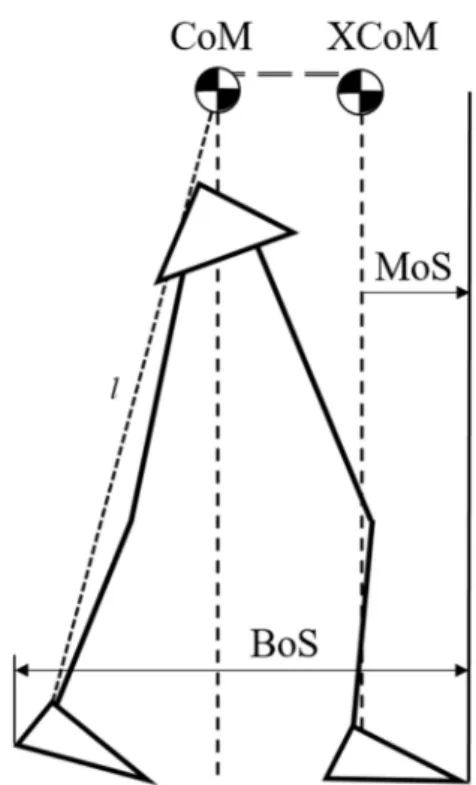
Numerous studies have investigated the dynamic balance abilities of the elderly using perturbation that causes sudden postural change and sudden environmental factors for identifying the dynamic move- ment of the elderly in relation to falls (Pai, Rogers, Patton, Cain, & Hanke, 1998; Schulz, Ashton-Miller, & Alexander, 2006). In particular, instead of analyzing the center of pressure (CoP) to investigate changes in postural maintenance, quantification of dynamic balance ability in the field of kinematics has involved analyzing the margin of stability (MoS) on the basis of extrapolated center of mass (xCoM), which is known to be more suitable for predicting the direction of movement, as the center of mass (CoM) includes information on velocity at dynamic posture, leg length, and gravitational acceleration (Hasson, Van Emmerik, & Caldwell, 2008; Hof, Gazendam, & Sinke, 2005). Such a method can quantify dynamic stability that allows for spatiotemporal analysis (Bierbaum, Peper, Karamanidis, & Arampatzis, 2010; Barrett, Cronin, Lichtwark, Mills, &
Carty, 2012; Jang, Hong, & Jang, 2016).
From a motor control aspect, one of the characteristics of aging is non-regularity where a consistent pattern does not appear when a motion or movement is performed owing to the lack of cognitive and sensory motor resources (Eskofier, Federolf, Kugler, & Nigg, 2013). The
http://e-kjsb.org eISSN 2093-9752 ORIGINAL
Analysis of the Dynamic Balance Recovery Ability by External Perturbation in the Elderly
Da Won Park 1,2 , Kyung Koh 2,3 , Yang Sun Park 1,2 , Jae Kun Shim 3,4,5
1
Department of Physical Education, Hanyang University, Seoul, South Korea
2
The Movement Science Center of Research Institute for Sports Science and Sports Industry, Hanyang University, Seoul, South Korea
3
Department of Kinesiology, University of Maryland, College Park, MD, USA
4
Fischell Department of Bioengineering/ Neuroscience and Cognitive Science (NACS) Program, University of Maryland, College Park, MD, USA
5