남조류의 염소처리에 따른 미량의 염소 소독부산물 생성에 관한 연구
손희종*․정종문․염훈식․최진택․장성호1)
부산광역시 상수도사업본부 수질연구소, 1)부산대학교 지역환경시스템공학과
(2012년 5월 31일 접수; 2012년 6월 21일 수정; 2012년 7월 18일 채택)
Formation of Disinfection By-Products from Blue-green Algae by Chlorination
Hee-Jong Son*, Jong-Moon Jung, Hoon-Sik Yeom, Jin-Taek Choi, Seong-Ho Jang1) Water Quality Institute, Water authority, Busan 614-854, Korea
1)Department of Environment System Engineering, Pusan National University, Miryang 627-706, Korea (Manuscript received 31 May, 2012; revised 21 June, 2012; accepted 18 July, 2012)
Abstract
Formation of disinfection by-products (DBPs) including trihalomethans (THMs), haloacetic acid (HAAs), haloacetonitriles (HANs) and others from chlorination of algogenic organic matter (AOM) of Microcystis sp., a blue-green algae. AOM of Microcystis sp. exhibited a high potential for DBPs formation. HAAs formation potential was higher than THMs and HANs formation potential. The percentages of dichloroacetic acid (DCAA) and trichloroacetic acid (TCAA) formation potential were 43.4% and 51.4% in the total HAAs formation potential. In the case of HANs formation potential, percentage of dichloroacetonitrile (DCAN) formation potential was 97.7%. Other DBPs were aldehydes and nitriles such as acetaldehyde, methylene chloride, isobutyronitrile, cyclobutanecarbonitrile, pentanenitrile, benzaldehyde, propanal, 2-methyl, benzyl chloride, (2-chloroethyl)-benzene, benzyl nitrile, 2-probenenitrile and hexanal.
Key Words : Algae, Microcystis sp., Algogenic Organic Matter (AOM), Chlorination, Disinfection By-Products (DBPs)
1)
1. 서 론
강이나 호소 같은 상수원에 서식하는 조류는 수중 에 조류 개체수가 적을 경우에는 정수처리에 영향을 미치지 않지만 여러 가지 요인으로 인해 수중에 조류 개체수가 증가하면 정수처리 공정의 운영측면에서 응 집약품 사용량 증가, 응집플록의 침전능 저하, 모래
*Corresponding author : Hee-Jong Son, Water Quality Institute, Water authority, Busan
614-854,
KoreaPhone: +82-51-669-4635 E-mail: [email protected]
여과지 폐색 유발 및 역세척 주기 단축 등 많은 문제를 유발한다(Choi 등, 2006; Jun 등, 2001; Joh 등, 2011; Ma 등, 2007). 또한, 처리수질 측면에서는 조류 가 분비하는 독소물질과 이취 유발물질이 문제시되 어 이에 대한 다양한 연구들이 진행되었다(Ando 등, 1992; Fleming 등, 2002). 최근에는 조체를 구성하는 intracellular organic matter (IOM) 및 조류가 생장하 면서 수중으로 방출하는 다양한 대사산물들(metabolic substances)로 구성된 extracellular organic matter (EOM)과 같은 조류유래 유기물질(algogenic organic matter, AOM)들이 정수처리에서 사용되는 소독제인
염소와 반응하여 인체에 유해한 다양한 소독부산물 (disinfection by-products, DBPs)들을 생성시킨다고 보고되었다(Bond 등, 2011; Henderson 등, 2008;
Huang 등, 2008; Huang 등, 2009; Plummer와 Edzwald, 2001). 조류가 함유된 원수에 염소처리를 할 경우, 조체(조류의 세포벽) 파괴로 인해 조류의 체 내 구성물질들인 IOM이 수중으로 용출되어 수중에 잔존하는 잔류염소와 반응하여 소독부산물 생성량은 더욱 증대된다.
국내 정수장의 경우는 상수원수를 취수하는 취수 장에서 도수관의 유지관리 등의 목적으로 일정 농도 로 염소(전염소)를 처리하여 정수장으로 공급하고 있 기 때문에 상수원수 중에 함유된 조류의 농도가 높을 경우에는 염소 소독부산물들에 의한 사람의 건강등에 영향을 미치는 등의 문제가 야기될 수 있다(Fang 등, 2010a; Hong 등, 2008; Huang 등, 2009).
본 연구에서는 실제 호소수에 서식하는 Microcystis sp.를 채집하여 수중의 조류 농도별로 염소처리에 의 해 극미량으로 생성되는 다양한 소독부산물들을 gas chromatograph/electron capture detector (GC/ECD) 와 gas chromatograph/mass selective detector (GC/MSD)를 이용하여 분석하였으며, 이를 양질의 수돗물을 공급하기 위한 정수장 운전의 기초자료로 활용하고자 하였다.
2. 재료 및 방법
2.1. 조류 채집 및 분취
본 연구에 사용된 조류는 2011년 10월 4일에 부산 시 M정수장의 상수원으로 이용되고 있는 회동호에서 채집하였다. 채집한 조류시료는 냉장보관하면서 실험 실로 이송하여 초순수(Millipore)로 여러 번 깨끗이 세 정한 후 조류 여과망으로 조체만 분리하여 조류 농축 액을 만들었다. 조류 농축액에서 조체의 분취는 초순 수가 300 mL 담긴 300 mL BOD병들에 조류 농축액 을 0, 0.4, 1.0 및 2.0 mL씩 주입하여 조류 혼합액을 만들었으며, 초기의 조류농도를 chlorophyll-a (Chl-a) 농도로 측정하였고, Chl-a 농도가 각각 0, 46.7, 116.8 및 225.5 mg/m3이였다.
2.2. 염소 소독부산물 생성능 및 염소 소독부산물 분석 조류가 일정 농도로 투입된 각각의 BOD병들에 대해 10,000 mg/L의 차아염소산 나트륨(Junsei chemical, Japan)을 조제하여 조류가 함유되어 있는 각각의 BOD병들에 초기 염소농도가 10 mg/L가 되도록 차아 염소산 나트륨을 주입하였으며, 차아염소산 나트륨 주입 후 10% NaOH와 (1+10) H3PO4를 사용하여 pH 를 7.0±0.2 범위로 조절한 후 20℃ 항온배양기에서 24시간 동안 염소접촉을 시켰다. 24시간 염소접촉 후 에 Na2S2O3를 이용하여 잔류염소를 고정한 후 THMs, HAAs, HANs의 경우는 GC/μECD (6890, Agilent, USA)를 이용하여 분석하였으며, 극미량 생성되는 부 산물들은 purge & trap 전처리 장치가 부착된 GC (7890, Agilent, USA)/MSD (5975C, Agilent, USA) 를 사용하여 분석하였다.
3. 결과 및 고찰
3.1. 조류 투입농도별 염소 소독부산물 생성
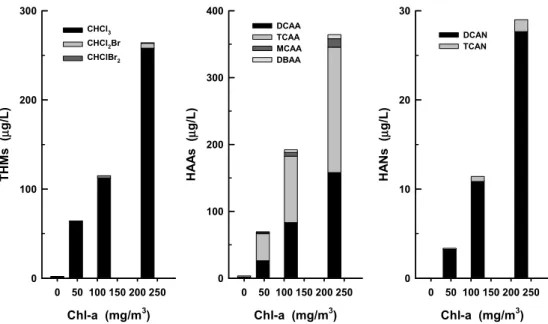
수중의 조류농도별(Chl-a) 염소처리에 의해 생성되 는 THMs, HAAs 및 HANs 농도 변화를 Fig. 1에 나타 내었다. Fig. 1에서 볼 수 있듯이 THMs, HAAs 및 HANs 모두 수중의 조류농도(Chl-a)의 증가에 따라 이들의 생성농도 또한 선형적으로 증가하고 있으며, 염소처리시 조체에 의한 DBPs 생성능의 경우는 HAAs가 가장 높은 것으로 나타났고, 다음으로 THMs 와 HANs로 나타났다. HANs의 경우는 수중의 조류농 도(Chl-a)가 225.5 mg/m3일 때 HANs 생성능은 29.0 μg/L로 나타났으며, 생성된 대부분의 HANs는 DCAN 이었으며, 총 HANs 생성능의 95.5%를 차지하였다.
THMs의 경우는 수중의 조류농도(Chl-a)가 225.5 mg/m3일 때 264.2 μg/L의 생성능을 나타났으며, chloroform (CHCl3)이 총 THMs 생성능에서 차지하 는 비율이 97.7%로 나타났다. 또한, 가장 높은 생성능 을 나타낸 HAAs의 경우는 수중의 조류농도(Chl-a)가 225.5 mg/m3일 때 364.3 μg/L의 생성능을 나타내었으 며, DCAA와 TCAA가 총 HAAs 생성능의 43.4%와 51.4%를 차지하는 것으로 나타났다.
Microcystis aeruginosa에서의 염소 소독부산물 생
성 특성에 대해 조사한 Fang 등의 연구결과(2010b)에Chl-a (mg/m3) 0 50 100 150 200 250 THMs (μg/L)
0 100 200 300
Chl-a (mg/m3) 0 50 100 150 200 250 HAAs (μg/L)
0 100 200 300 400
Chl-a (mg/m3) 0 50 100 150 200 250 HANs (μg/L)
0 10 20 30 CHCl3
CHCl2Br CHClBr2
DCAA TCAA MCAA DBAA
DCAN TCAN
Fig. 1. Variations of various DBP formation potential species according to increasing Chl-a concentration.
서 조체(cell+IOM)를 염소처리한 후 HAN 생성농도 를 비교한 결과, TCAN에 비해 DCAN의 생성농도가 월등히 높은 것으로 보고하고 있다. AOM과 같이 다 양한 종류의 아미노산들과 지방성 아민들로 구성된 유기성 질소 화합물들이 염소와 반응하면 mono- chloramine (RNHCl)과 di-chloramine (RNCl2)과 같은 다양한 유기성 chloramine들이 생성되며, 이러한 일련 의 반응 결과로 halo-aldehyde류와 DCAN 등의 반응 중간생성물들이 생성된다(Joo와 Mitch, 2007; Yang 등, 2010). Halo-aldehyde류의 경우는 dihaloacetaldehyde 의 경우는 유리 염소와 반응하여 trihaloacetaldehyde 를 형성하며, 이것은 상대적으로 안정된 생성물이다 (Reckhow 등, 2001). 또한, DCAN의 경우는 반응 중 간생성물(intermediate)로서 추가적으로 염소와 반응 하여 반응조건에 따라 dihaloacetamide 또는 DCAA와 같은 dihaloacetic acid를 생성하지만 반응시간이 수일 정도로 비교적 긴 것으로 보고되고 있다(Reckhow 등, 2001).
3.2. 조류 투입농도별 미량의 염소 소독부산물의 생성 및 종류
조류 투입농도별로 염소 처리에 의해 생성되는 다양한 염소 소독부산물들을 GC/MSD로 분석한 total
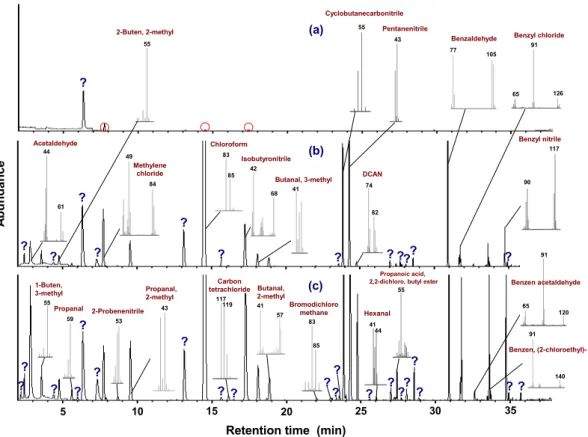
ion chromatogram (TIC)을 Fig. 2 (a)∼(c)에 나타내 었다. Fig. 2 (a)의 경우는 순수에 염소를 10 mg/L의 농도로 투입하여 20℃ 항온배양기에 24시간 동안 염 소와 반응시킨 시료로 순수 중에 잔존하는 미량의 용 존 유기물질들에 의해 생성된 것으로 보이는 6.5분대 의 미확인 물질과 ○로 표시된 7.7분대의 methylene chloride, 14.5분대의 chloroform과 17.4분대의 iosbutyronitrile이 극미량 생성되었다. 그러나 순수에 조류를 일정농도로 투입한 후 염소처리를 한 Fig. 2(b) 와 2(c)의 경우를 보면 매우 다양한 염소 소독부산물 들의 peak들을 확인할 수 있다. 우선 Microcystis sp.
농도(chlorophyll-a 농도)를 55.2 mg/m3로 투입하여 염소처리한 Fig. 2(b)를 보면 미확인 물질 12종을 포 함하여 총 31종의 소독부산물들이 생성되었다. 비교 적 고농도로 생성된 peak들을 살펴보면 14.5분대의 chloroform, 23.8분대의 cyclobutanecarbonitrile, 23.8 분대의 pentanenitrile, 30.9분대의 benzaldehyde 등이 생성되었고, 7.7분대의 methylene chloride, 9.6분대의 propanal, 2-methyl, 17.4분대의 isobutyronitrile, 31.7 분대의 benzyl chloride, 33.6분대의 benzene, (2-chloroethyl)-, 34.7분대의 benzyl nitrile 등이 미량 으로 생성되었다. 또한, 2.8분대의 acetaldehyde를 포 함한 8종이 극미량으로 생성되었으며 미확인 물질이
1000000
Retention time (min)
Abundance
Chloroform
DCAN 74
82
5 10 15 20 25 30 35
77 105
Benzaldehyde Benzyl chloride
83 85
41 57
65 91
126
90 117 Benzyl nitrile
91
140 Benzen, (2-chloroethyl)-
91
65 120 Benzen acetaldehyde Propanoic acid,
2,2-dichloro, butyl ester 55 55 Cyclobutanecarbonitrile
43 Pentanenitrile
42
68 Isobutyronitrile
41 Butanal, 3-methyl
43 Propanal, 2-methyl 55
1-Buten, 3-methyl
55 2-Buten, 2-methyl
44
61 Acetaldehyde
?
?
?
?
?
?
?
49
84 Methylene
chloride
4144 Hexanal
?
?
?
??
? (b)
(a)
(c)
117119 Carbon tetrachloride
? ?
?
?
?
?
Butanal, 2-methyl
83 85 Bromodichloro
methane 59
Propanal 53 2-Probenenitrile
??
? ? ?
? ?
? ? ? ?
? ?
?
Fig. 2. Total ion chromatograms (TIC) of formed DBPs according to chlorination of Microcystis sp. cells (a: Chl-a conc.: 0 mg/m3, b: Chl-a conc.: 116.8 mg/m3, c: Chl-a conc.: 225.5 mg/m3).
12종을 차지하였다.
Microcystis sp. 농도(chlorophyll-a 농도)를 225.5
mg/m3로 투입하여 염소처리한 Fig. 2(c)를 살펴보면 Fig. 2(b)에서 생성된 대부분의 peak들의 abundance 값들이 증가된 것을 알 수 있으며, 이것은 Fig. 2(b)의Microcystis sp. 농도에 비해 증가된 Microcystis sp.의
농도부분의 AOM에서 염소에 의해 추가적인 소독부 산물들이 생성되어 peak들의 abundance값들이 증가 된 것으로 판단할 수 있다. 우선 생성된 총 peak들의 개수는 미확인 물질 20개를 포함하여 총 43개의 peak 들이 생성되었으며, Fig. 2(b)에서는 검출되지 않고 새 롭게 생성된 물질로는 8.7분대의 2-probenenitrile, 22.0분대의 bromodichloromethane과 26.0분대의 hexanal 등 3종과 unknown 물질 8종이었다.전체적으로 조류 투입농도별 미량의 염소 소독부
산물 생성특성을 보면 보편적으로 잘 알려진 trihalo- methanes류(THMs)와 haloacetonitriles류(HANs)를 제외하면 생성된 미량의 염소 소독부산물들 대부분이 aldehyde류와 nitrile류들이며, 이들의 경우 수중에서 독특한 이취를 유발하는 특성을 가지고 있다(Brosillon 등, 2009; Froese 등, 1999). 일반적으로 조류 세포를 구성하는 물질들은 탄수화물, 지방 및 단백질로 조류 종에 따라 구성비율에는 다소 차이를 나타내지만 아 미노산과 같은 단백질이 차지하는 비율이 매우 높은 것으로 알려져 있다(Becker, 2007; Brown 등, 1997).
Brosillon 등의 연구결과(2009)에서는 다양한 아미노 산류들을 염소 처리하였을 경우 이취를 유발하는 다 양한 aldehyde류와 nitrile류들이 생성되는 것으로 보 고하고 있다.
조류 투입농도별로 염소 처리에 의해 생성되는 다
2 4 6 1000
Chloroform
(a)
8 10
(b)
(c)
Carbon tetrachloride (CCl4)
Retention time (min)
1,1-dichloro ethylene
Bromodichloromethane
?
?
? ?
?
?
?
Intensity (Hz)
?
TCE PCE
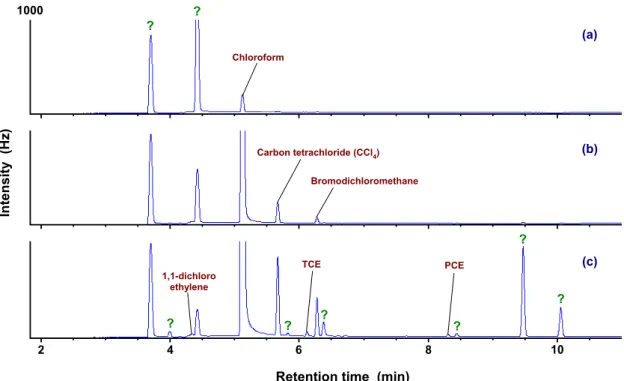
Fig. 3. Chromatograms of formed DBPs according to chlorination of Microcystis sp. cells (a: Chl-a conc.: 0 mg/m3, b: Chl-a conc.: 116.8 mg/m3, c: Chl-a conc.: 225.5 mg/m3).
양한 염소 소독부산물들을 GC/ECD로 분석한 chromatogram들을 Fig. 3(a)∼(c)에 나타내었다. Fig.
2에서와 같이 조류를 투입하지 않은 시료(Fig. 3(a))의 경우 순수에 잔존하는 미량의 용존 유기물질에 의해 생성된 chloroform과 2종의 미확인 물질을 제외하면 다른 소독부산물들의 생성은 없었으며, 조류 농도가 55.2 mg/m3인 Fig. 2(b)를 보면 carbon tetrachloride (CCl4)와 bromodichloromethane (CHCl2Br)이 새로 운 부산물로 생성되었으며, RT 9.5분대에 극미량의 미확인 물질이 생성된 것을 볼 수 있다. 조류 농도가 225.5 mg/m3인 Fig. 3(c)의 경우는 Fig. 3(b)에 비해 1,1-dichloro ethylene, TCE (trichloroethylene)와 PCE (tetrachloroethylene) 및 5종의 unknown 물질이 새로 운 부산물들로 생성되었다. 이러한 경향은 Fig. 2와 매우 유사하며, Fig. 2의 경우는 GC/MSD의 scan mode로 분석 후 willey library를 사용하여 정성하였 으나, GC/ECD의 경우는 calibration에 사용된 9종 이 외의 물질들 이외에는 정성이 불가능하다.
Fig. 2와 3에서와 같이 수중의 조류(Microcystis sp.) 농도 증가에 따라 염소와 반응하여 생성되는 소독 부산물들의 개수 및 농도(peak abundance 또는 peak intensity)가 급격히 증가하는 것을 알 수 있다. 이것은 조류유래 유기물질(AOM)들은 탄수화물(carbohydrate), 지질(lipid) 및 단백질(protein)로 구성(Becker, 2007;
Brown 등, 1997)된 다양한 유기성 세포 구성성분 (algal biomolecules)들로 이루어져 있기 때문에 염소 와 같은 산화제와 반응시에는 다양한 산화 부산물들 을 생성하기 때문이다. Hong 등(2008)은 강이나 호소 수에 함유되어 있는 대표적인 염소 소독부산물 전구 물질인 humic acid 및 fulvic acid와 여러 종의 조류들 의 조류유래 유기물질(AOM)에 대해 단위 탄소농도 당 chloroform 생성능과 DCAA 생성능을 조사한 결 과, 거의 유사한 생성능을 나타내는 것으로 보고하였 다. 따라서 수중의 조류농도가 염소 소독부산물 생성 에 미치는 영향은 매우 크다고 볼 수 있다.
4. 결 론
Microcystis sp.의 염소처리시 미량으로 생성되는
염소 소독부산물들을 GC/MSD와 GC/ECD를 이용하 여 조사한 결과 다음과 같은 결론을 얻을 수 있었다.1. Microcystis sp. 농도별로 염소처리에 의해 생성 되는 DBPs는 수중의 조류농도 증가에 따라 선형적으 로 증가하였으며, HAAs가 가장 높은 생성능을 나타 내었으며, 다음으로 THMs, HANs 순이었다.
2. DBPs 구성종은 HAAs의 경우 DCAA와 TCAA 가 총 HAAs 생성능의 43.4%와 51.4%를 차지하였으 며, HANs의 경우는 DCAN이 총 HANs의 95.5%, THMs의 경우는 chloroform (CHCl3)이 97.7%를 차 지하였다.
3. Microcystis sp.의 염소처리시 GC/MSD로 분석 한 극미량 생성된 DBPs는 acetaldehyde, methylene chloride, isobutyronitrile, cyclobutanecarbonitrile, pentanenitrile, benzaldehyde, propanal, 2-methyl, benzyl chloride, (2-chloroethyl)-benzene, benzyl nitrile, 2-probenenitrile, hexanal 등 20여 종이었으며, 대부분이 aldehyde류와 nitrile류들이었으며, GC/MSD 로 정성이 불가능한 unknown 물질들이 20종 생성되 었다.
참 고 문 헌
Ando, A., Miwa, M., Kajino, M., Tatsumi, S., 1992, Removal of musty-odorous compounds in water and retained in algal cells through water purification processes, Water Sci. Technol., 25(2), 299-306.
Becker, E. W., 1997, Micro-algae as a source of protein, Biotechnology Advances, 25(2), 207-210.
Becker, E. W., 2007, Micro-algae as a source of protein, Biotechnology Advances, 25(2), 207-210.
Bond, T., Huang, J., Templeton, M. R., Graham, N., 2011, Occurrence and control of nitrogenous disinfection by-products in drinking water - a review, Water Res., 45, 4341-4354.
Brosillon, S., Lemasle, M., Renault, E., Tozza, D., Heim, V., Laplanche, A., 2009, Analysis and occurrence of odorous disinfection by-products
from chlorination of amino acids in three different drinking water treatment plants and corresponding distribution networks, Chemosphere, 77, 1035-1042.
Brown, M. R., Jeffrey, S. W., 1997, Volkman, J. K., and Dunstan, G. A., “Nutritional properties of microalgae for mariculture, Aquaculture, 151(1∼4), 315- 331.
Brown, M. R., Jeffrey, S. W., Volkman, J. K., Dunstan, G. A., 1997, Nutritional properties of microalgae for mariculture, Aquaculture, 151(1∼4), 315-331 Choi, S. K., Lee, J. Y., Kwon, D. Y., Cho, K. J., 2006,
Settling characteristics of problem algae in the water treatment process, Water Sci. Technol., 53(7), 73-119.
Fang, J., Ma, J., Yang, X., Shang, C., 2010b, Formation of carbonaceous and nitrogenous disinfection by-products from the chlorination of Microcystis aeruginosa, Water Res., 44, 1934-1940
Fang, J., Yang, X., Ma, J., Shang, C., Zhao, Q., 2010a, Characterization of algal organic matter and formation of DBPs from chlor(am)ination, Water Res., 44, 5897-5096.
Fleming, L. E., Rivero, C., Burns, J., Williams, C., Bean, J. A., Shea, K. A., Stinn, J., 2002, Blue green algal (cyanobacterial) toxins, surface drinking water, and liver cancer in Florida, Harmful Algae, 1, 157-168.
Froese, K. L., Wolanski, A., Hrudey, S. E., 1999, Factors governing odorous aldehyde formation as disinfection by-products in drinking water, Water Res., 33(6), 1355-1364.
Henderson, R. K., Baker, A., Parsons, S. A., Jefferson, B., 2008, Characterization of algogenic organic matter extracted from cyanobacteria, green algae and diatoms, Water Res., 42, 3435-3445.
Hong, H. C., Mazumder, A., Wong, M. H., Liang, Y., 2008, Yield of trihalomethanes and haloacetic acids upon chlorinating algal cells, and its prediction via algal cellular biochemical composition, Water Res., 42, 4941-4949.
Huang, J., Graham, N. J. D., Templeton, M. R., Zhang, Y., Collins, C., Nieuwenhuijsen, M., 2008, Evaluation of Anabaena flos-aquae as a precursor for trihalomethane and haloacetic acid formation,
Water Sci. Technol. Water Suppl., 8(6), 653-662.
Huang, J., Graham, N. J. D., Templeton, M. R., Zhang, Y., Collins, C., Nieuwenhuijsen, M., 2009, A comparison of the role of two blue-green algae in THM and HAA formation, Water Res., 43, 3009- 3018.
Joh, G., Choi, Y. S., Shin, J, K. Lee, J., 2011, Problematic algae in the sedimentation and filtration process of water treatment plants, J.
Water Suppl. Res. Technol. Aqua, 60(4), 219-230.
Joo, S. H., Mitch, W. A., 2007, Nitrile, aldehyde and halonitroalkane formation during chlorination/
chloramination of primary amines, Environ. Sci.
Technol., 39, 3811-3818.
Jun, H. B., Lee, Y. J., Lee, B. D., Knappe, D. R. U., 2001, Effectiveness of coagulants and coagulant aids for the removal of filter-clogging Synedra, J.
Water Suppl. Res. Technol. Aqua, 50(3), 135-148.
Ma, J., Lei, G., Fang, J., 2007, Effect of algae species population structure on their removal by coagulation and filtration processes - a case study, J. Water Suppl. Res. Technol. Aqua, 56(1), 41-54.
Plummer, J. D. Edzwald, J. K., 2001, Effect of ozone on algae as precursors for trihalomethane and haloacetic acid production, Environ. Sci. Technol., 35(18), 3661-3668.
Reckhow, D. A., Platt, T. L., MacNeill, A. L., McClellan, J. N., 2001, Formation and degradation of dichloro- acetonitrile in drinking waters, Aqua, 50, 1-13.
Yang, X., Fan, C., Zhao, Q., Shang, C., 2010, Nitrogeneous disinfection byproducts formation and nitrogen origin exploration during chloramination of nitrogeneous organic compounds, Water Res., 44, 2691-2702.