Print ISSN: 2288-4637 / Online ISSN 2288-4645 doi:10.13106/jafeb.2021.vol8.no4.0665
Shadow Economy, Corruption and Economic Growth:
An Analysis of BRICS Countries
Diep Van NGUYEN
1, My Tien Ha DUONG
2Received: December 20, 2020 Revised: March 07, 2021 Accepted: March 15, 2021
Abstract
The paper examines the impact of shadow economy and corruption, along with public expenditure, trade openness, foreign direct investment (FDI), inflation, and tax revenue on the economic growth of the BRICS countries. Data were collected from the World Bank, Transparency International, and Heritage Foundation over the 1991–2017 period. The Bayesian linear regression method is used to examine whether shadow economy, corruption and other indicators affect the economic growth of countries studied. This paper applies the normal prior suggested by Lemoine (2019) while the posterior distribution is simulated using Monte Carlo Markov Chain (MCMC) technique through the Gibbs sampling algorithm. The results indicate that public expenditure and trade openness can enhance the BRICS countries’ economic growth, with the positive impact probability of 75.69% and 67.11%, respectively. Also, FDI, inflation, and tax revenue positively affect this growth, though the probability of positive effect is ambiguous, ranging from 51.13% to 56.36%. Further, the research’s major finding is that shadow economy and control of corruption have a positive effect on the economic growth of the BRICS countries. Nevertheless, the posterior probabilities of these two factors are 62.23% and 65.25%, respectively. This result suggests that their positive effect probability is not high.
Keywords: Bayesian Linear Regression, BRICS, Economic Growth, Gibbs Sampling, Shadow Economy JEL Classification Code: C11, H26, O47
Although there are various studies on the impact of shadow economy on economic growth, the results are still mixed and inconclusive. Loayza (1996) introduces an endogenous growth model whose production technology hinges on congestible public services. Using a sample of Latin American countries in the early 1990’s, the author finds that a rise in the size of shadow economy has a negative effect on growth through decreasing the availability of public services and raising activities “that use some of the existing public services less efficiently” (Loayza, 1996, p. 154).
In contrast, other authors confirm a positive association between these two factors. For instance, Williams (2006) suggests that shadow economy can enhance economic growth through providing an environment with improved overall competitiveness and less stringent government regulations.
Moreover, there is disagreement over the definition of shadow economic activities. Smith (1994, p. 18) defines the shadow economy as “market-based production of goods and services, whether legal or illegal, that escapes detection in the official estimates of GDP.” Dell’Anno (2007) refers the shadow economy as “non-observed economy,” which includes
1
First Author. Faculty of Finance and Banking, Ho Chi Minh City Open University, Ho Chi Minh City, Vietnam. Email: [email protected]
2
Corresponding Author. Faculty of Economics and Public Management, Ho Chi Minh City Open University, Ho Chi Minh City, Vietnam [Postal Address: 35-37 Ho Hao Hon, Co Giang Ward, District 1, Ho Chi Minh City, 71013, Vietnam]
Email: [email protected]
© Copyright: The Author(s)
This is an Open Access article distributed under the terms of the Creative Commons Attribution Non-Commercial License (https://creativecommons.org/licenses/by-nc/4.0/) which permits unrestricted non-commercial use, distribution, and reproduction in any medium, provided the original work is properly cited.
1. Introduction
Shadow economy is a fact of life that happens around the world. A study by Medina and Schneider (2018) shows that, on average, the size of the shadow economy of 157 countries examined for the period 1991–2017 is approximately 30.9% of gross domestic product (GDP).
While the shadow economy is below 20% of GDP in the OECD countries, this figure in Latin America and Sub-Saharan Africa is much larger, averaging nearly 38%
and 39% of GDP, respectively.
three areas, namely, underground production, informal production, and illegal production. Meanwhile, Schneider (2010) suggests that the shadow economy comprises all production activities of goods and services based on the market and intentionally concealed from public authorities.
Another issue that gains growing attention among researchers is corruption. Different authors may have different definitions of corruption. However, “the most popular and simplest definition of corruption is that it is the abuse of public power for private benefit” (Tanzi, 1998, p. 8). The relationship between corruption and economic growth is still controversy. While many authors indicate that corruption is negatively affected economic growth (Hodge, Shankar, Rao, & Duhs, 2011; d’Agostino, Dunne, & Pieroni, 2016; Baklouti & Boujelbene, 2019; Gründler & Potrafke, 2019), other studies suggest that corruption can “grease the wheels” rather than “sand the wheels” in certain countries.
The research aims to shed light on the impact of shadow economy and corruption on the economic growth of the BRICS countries. The BRICS emerge as a multilateral group and comprise the five major emerging economies, namely, Brazil, Russia, India, China, and South Africa. These countries account for nearly 24% of the world’s real GDP in 2018 (Li, 2019). The BRICS countries along with other emerging economies have become an important driving force behind the global economic growth.
The reminder of the paper is organized as follows.
Section 2 reviews the literature while section 3 describes the measurement method and sources of data as well as the methodology of the research. Section 4 presents the results from Bayesian linear regression and the discussion on the relevant topic. Finally, section 5 offers the conclusion.
2. Literature Review
2.1. Economic Growth and Shadow Economy The relationship between the shadow economy and the economic growth remains controversial. Some studies report that the former has a significant negative impact on the latter (Loayza, 1996; Borlea, Achim & Miron, 2017; Baklouti &
Boujelbene, 2019). For instance, Baklouti and Boujelbene (2019) show that an increase in the informal economy can lead to a reduction in the tax base, which negatively affects the investment in public infrastructure and the efficiency of public services. These factors may harm the economic growth of a country.
In contrast, other authors suggest the shadow economy is positively associated with the economic growth. Notably, Asea (1996) claims that such a sector may contribute
“to the creation of markets, increase financial resources, enhance entrepreneurship, and transform the legal social, and economic institutions necessary for accumulation”
(Asea, 1996, p. 166). Schneider and Enste (2000) argue that in some countries, most of the income earned in the shadow economy is used in the formal economy, which can foster the growth of the formal sector. Also, Bhattacharyya (1999) reports such positive spillovers in the United Kingdom.
Afterward, Schneider (2011) adds that the effect of the shadow economy differs across countries. Specifically, a rise in the shadow economy’s size may be beneficial for the growth in the developed and transition economies. However, in developing countries, a larger size of the shadow economy can prevent the economic growth. Meanwhile, Goel, Saunoris, and Schneider (2017) investigate the impact of the shadow economy on economic growth in the Unites States over more than a century. The authors conclude that prior to World War II, the shadow economy is negatively related to the economic growth; whereas, the shadow economy in post- World War II enhances such growth.
2.2. Economic Growth and Corruption
The impact of corruption on economic growth is an ongoing topic that has caused debates among researchers.
Many studies indicate that corruption can have adverse effects on the growth of economy (Hodge, Shankar, Rao,
& Duhs, 2011; Dridi, 2013; d’Agostino, Dunne, & Pieroni, 2016; Cieślik & Goczek, 2018; Baklouti & Boujelbene, 2019). Notably, Hodge, Shankar, Rao, and Duhs (2011) claim that corruption adversely affects investment, human capital, and political instability, which in turn hinders economic growth. Gründler and Potrafke (2019) analyze data from 175 countries during the period 2012–2018 to find the relationship between corruption and economic growth.
The authors conclude that one standard deviation increase in the reversed Transparency International’s Perception of Corruption Index leads to an approximately 17% decrease in the real per capita GDP. They add that corruption negatively influences growth by reducing FDI and raising inflation.
Nevertheless, some other authors argue that this relationship can be positive in certain countries (Paul, 2010; Jiang &
Nie, 2014; Nguyen & Luong, 2020). Particularly, Nguyen and Luong (2020) claim that “corruption does not sand, but greases the wheels of economic growth” (Nguyen & Luong, 2020, p. 92). Also, Huang (2016) argues that in South Korea, corruption and economic growth may be positively associated.
Meanwhile, Acemoglu and Verdier (1998) suggest that there may exist an optimum threshold of corruption. In this regard, Dzhumashev (2014) examines the impact of governance, public expenditure, and economic development on the relationship between corruption and economic growth.
The author indicates that “corruption improves economic
efficiency only when the actual government size is above the
optimal level. It implies that a growth-maximizing level of
corruption is possible” (Dzhumashev, 2014, p. 202).
2.3. Economic Growth and Public Expenditure Public expenditure is a vital determinant of economic growth for any nation. Studies by different authors in different countries suggest that public expenditure can enhance the growth of an economy. For instance, Jiranyakul and Brahmasrene (2007) investigate the relationship between government expenditures and economic growth in Thailand.
They show that government spending has a strong positive effect on economic growth. Danladi, Akomolafe, Olarinde, and Anyadiegwu (2015) analyze the impact of government expenditure on Nigeria’s economic growth over the period 1980–2013. The authors conclude that government expenditure significantly and positively influences the growth of the country.
Likewise, Sasmal and Sasmal (2016) explore the effect of public expenditure on economic growth and poverty alleviation of the major states in India. The authors indicate that states which invest more in infrastructure, including roads, irrigation, electricity, transport, and communication are prone to have higher per capita income. Therefore, the study concludes that public expenditure on infrastructure development is essential for economic growth.
Meanwhile, Pula and Elshani (2018) apply a Johansen Co-Integrated test and a Granger Causality test to discover the causal nexus between public expenditure and economic growth in Kosovo for the period 2004–2016. The authors posit that there exists a unidirectional causality between these two factors. Notably, public expenditure can promote economic growth in the country. Based on this finding, the authors propose that public expenditure should be used to enhance the environment for economic reform and infrastructure, which in turn can facilitate the private sector (Pula & Elshani, 2018).
2.4. Economic Growth and Trade Openness
Some studies show that trade openness positively impacts economic growth (Shahbaz, 2012; Tahir & Azid, 2015; Leyaro, 2015; Hye, Wizarat, & Lau, 2016; Keho, 2017). For instance, Tahir and Azid (2015) analyze data from 50 developing countries from 1990–2009. They find a positive correlation between trade openness and economic growth. Therefore, they suggest that the developing countries should speed up trade liberalization to boost economic growth. Also, Hye, Wizarat, and Lau (2016) discover the relationship between trade openness and economic growth in China for the period 1975–2009. The authors claim that trade openness is crucial for sustainable economic growth in this country. A study by Keho (2017) using data from Cote d’Ivoire over the period 1965–2014 reports similar results.
In contrast, other findings show that there is a negative relation between trade openness and economic growth.
Yanikkaya (2003) argues that trade restrictions can positively affect economic growth, especially for developing countries. Vlastou (2010) analyzes a sample of 34 African countries during the period 1960–2003. The author claims that trade openness may deteriorate economic growth in these countries. Abbas (2014) indicates that one unit increase in trade liberalization can reduce the economic growth of developing and least developing countries by US$280.86 million and US$3555.09, respectively.
2.5. Other Factors Affecting Economic Growth In this study, based on the availability of research data and the review of previous literature, we also examine other factors that can affect economic growth, namely FDI, inflation, tax revenue. Some studies indicate that FDI benefits economic growth (Mustafa & Santhirasegaram, 2013; Neto
& Veiga, 2013; Pegkas, 2015; Erum, Hussain, & Yousaf, 2016). For instance, Neto and Veiga (2013) analyze data from 139 countries between 1970–2009. The authors find that FDI can enhance economic growth through the diffusion of technology and innovation. Similarly, Erum, Hussain, and Yousaf (2016) examine the impact of FDI using the sample of South Asian Association of Regional Cooperation countries over the period 1990–2014. The authors conclude that FDI positively affects economic growth of these countries.
Another factor that will be investigated in the study is tax revenue. Several studies show a positive relationship between tax revenue and economic growth (Okafor, 2012;
Akwe, 2014; Ojong, Anthony, & Arikpo, 2016; Egbunike, Emudainohwo, & Gunardi, 2018; Nguyen, 2019). For instance, Akwe (2014) examines the effect of non-oil tax revenue on economic growth in Nigeria between 1993–2012. The author states that such tax revenue has a positive impact on economic growth in Nigeria. Also, Egbunike, Emudainohwo, and Gunardi (2018) report a positive relationship between tax revenue and Nigeria’s and Ghana’s GDP. Nguyen (2019) discovers the effect of tax on Vietnam’s economic growth over the 2003–2017 period. The author suggests that indirect tax positively affects the growth in the country.
Other authors investigate the connection between infla-
tion and economic growth. Umaru and Zubairu (2012) explore
the effect of inflation on economic growth and development
in Nigeria for the 1970–2010 period. The authors show that
inflation is statistically significant and positively affects the
country’s economic growth by improving productivity and
output level. In contrast, Vinayagathasan (2013) analyzes
the impact of inflation using a sample of 32 Asian countries
between 1980–2009. The author finds that a rate above a
threshold of 5.43% can deteriorate the growth, whereas a rate
below this threshold does not affect the growth. Meanwhile,
Bick (2010) investigates data from 40 developing countries
between 1960–2004. The author claims that at a low inflation rate, specifically less than 12%, inflation has a significant positive effect on growth. Baharumshah, Slesman, and Wohar (2016) examine 94 emerging and developing countries and conclude that high inflation rates hinder growth while low inflation rates can enhance growth.
3. Data and Methodology 3.1. Data
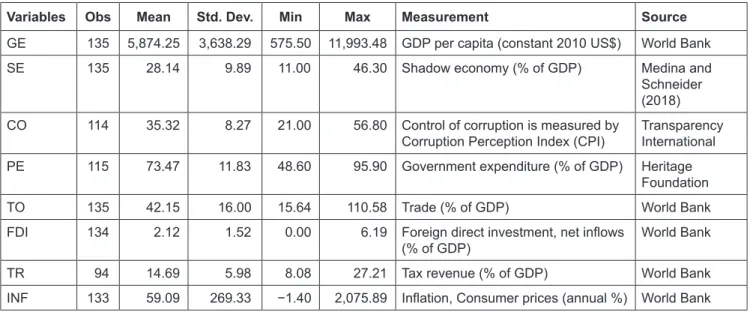
The research uses the BRICS countries’ sample to examine the impact of shadow economy and corruption on economic growth over the 1991–2017 period. The dependent variable, namely, economic growth, is measured as via GDP per capita (constant 2010 US$) and collected from World Development Indicators. The main independent variables, namely, shadow economy and control of corruption, are collected from Medina and Schneider (2018) and Heritage Foundation. Moreover, public expenditure, trade openness, foreign direct investment, tax revenue, and inflation are also added in the empirical model as control variables in the empirical analysis. The research model is constructed as follows:
GE SE CO PE TO FDI
TR INF
0 1 2 3 4 5
6 7