ORIGINAL ARTICLE
국립공원의 훼손지 유형과 개선방안에 대한 기초적 연구
염성진*
넥서스환경디자인연구원
Basic Study on Damaged Area Types and Improvement Idea of the National Park
Sung-Jin Yeom*
NEXUS Environmental Design Center, Gwacheon 13820, Korea
Abstract
This study is conducted to determine the damage, distinguish the types and identify the restoration by that type for 13 Korea national parks out of 21. There are 21 Korea national parks are in Korea covering 6.67% of the country or 6,656 km2 (3,902 km2 on land and 2,754 km2 in the sea) currently since the area around Jirisan (440 km2) was designated as the first Korea national parks in 1967. With the cancellation of entrance admission on Korea national parks since 2007, annual visitors to the Korea national parks have grown from 37 millions in 2008 to 46 millions by 2013 and continue to grow due to numerous leisure activities, alpine activities and social changes. As such, Korea national parks are natural resource with high value to be conserved and are attracting significant attention as recreational spaces for people at the same time. On the other hand, there have been issues of soil erosions or disturbed vegetation due to increased number of visitor to the national parks.
Korea national parks area damage to its type and damage characteristics to analyse the 13 Korea national parks out of 21 on July 2012 March, Korea national parks over the subjects of the National Park from damaged area status Survey analysis by the Korea National Park Service.
As a result, 203 million units in the 16 Korea national parks damaged land of the reform package during ecological trail (including non-regular hiking trails) 153 (77.66%), damaged valleys 20(9.14%) independent damaged area, 13 disconnected ecological axis(7.61%), closed trail(2.03%) (3.55%), and line type damage(like a non-regular hiking trails) appears to be a high ratio.
Korea national parks damaged land of the results identified, by contrast ratio and the annual number of visitors Bukhansan national park(49.26%), Gyeongju national park(23.65%) damaged land rates, such as Seorasan national park(4.93%), Songnisan national park (4.43 %), Gyeryongsan national park(3.45%), and the annual number of visitors be similar result.
The National Park Service has been reporting on damages and restorations but damages and their types have not been established yet. Damages have been generally studied and categorized on hiking trails due caused by heavy traffic on them but the reports were limited on hiking trails only. Since damage to the Korea national parks are not limited on the hiking trails, it is necessary to determine damages in various aspects. Thus, in this study, damage types, spatial characteristics, causes and restorations are analyzed based on the survey results of damages to national parks in order to provide a basis for the efficient management and operation of the Korea national parks.
Key words : Damages by national parks, Damaged area types, Causes of damage, Restorations 1)
Received 19 August, 2015; Revised 19 August, 2015;
Accepted 18 November, 2015
*Corresponding author : Sung-Jin Yeom, NEXUS Environmental Design Center, Gwacheon 13820, Korea
Phone:+82-2-578-2930 E-mail:[email protected]
ⓒ The Korean Environmental Sciences Society. All rights reserved.
This is an Open-Access article distributed under the terms of the Creative Commons Attribution Non-Commercial License (http://
creativecommons.org/licenses/by-nc/3.0) which permits unrestricted non-commercial use, distribution, and reproduction in any medium, provided the original work is properly cited.
1. 서 론
국제자연보존연맹(International Union for Conser -vation and Natural Resources, IUCN))은 국립공원을
‘자연생태계의 보호와 레크리에이션을 위해 관리되는 보 호지역으로 현재 뿐 아니라 미래세대를 위하여 하나 이 상의 생태계를 원상태로 보호해야 한다’고 정의하고 있 다. 우리나라의 자연공원법에서는 국립공원은 ‘우리나라 의 자연생태계나 자연 및 문화경관을 대표할 만한 지역’
으로 이들의 보전과 지속가능한 이용에 최선을 다해야 한다고 규정하고 있으며, 자연생태계와 자연 및 문화경 관 등을 보전하고 지속 가능한 이용을 도모함을 목적(자 연공원법 제1장 제1조)으로 하고 있다. 이는 1980년 이 전 초기의 국립공원의 주요 목적이 ‘도로의 신설이나 집 단시설지구에 휴양·위락·숙박시설을 대규모로 개발하여 이용 부지를 수용하고 그에 따른 수익금을 통한 지역경 제의 활성화’이였다면, 2000년대 중반 이후로는 국립공 원에 대한 기본적인 보전 지향적 정부의 정책기조는 우 수한 생태계를 보유하고 있는 국립공원의 보전과 동시 에 지속가능한 이용을 도모하기 위한 것(Ministry of Environment, 2008)으로 볼 수 있다.
우리나라의 국립공원은 1967년 지리산일대(440 km2) 가 최초의 국립공원으로 지정된 이후, 현재는 국토면적 의 6.67%에 해당하는 6,656 km2(육상 3,902 km2, 해상 2,754 km2)의 21개소가 국립공원이 지정되어 있다.
2007년부터 실시된 국립공원 입장료폐지와 더불어 여가 활동 범위의 확대, 등산저변의 확장 등의 사회적 변화와 더불어 국립공원의 연간 이용객은 2008년 약 3,700만 명에서 2013년에는 4,600만 명으로 지속적인 증가추세 를 보이고 있다(Korea National Park Service, 2013).
이는 웰빙(Well-Being)과 로하스(Lifestyle of health and Sustainability : LOHAS)로 대표되는 우리사회 일 련의 변화와 도시화의 반작용으로 볼 수 있는 그린 (Green) 욕구의 증대와 생활수준 향상에 따른 국민의 여 가 행태가 변화하면서 자연을 찾는 사람들이 급증하고 있는 현실을 반영하고 있다. 더욱이 산행이 건강을 위한 일상 스포츠로서 인식(Jeong et al., 2012)이 확대된 것 도 작용하고 있다고 판단된다. 이렇듯 현대의 국립공원 은 보전가치가 높은 자연 자원임과 동시에 국민의 여가 활동 공간으로서 크게 주목받고 있으나 국립공원의 이용
증가로 인한 토양침식, 식생파괴 등의 훼손에 의한 유지 관리에 있어서의 문제점이 제기되고 있다. 이러한 국립 공원 내 훼손 실태의 심각성이 대두됨과 더불어 탐방로, 야영장의 과도한 이용 및 그에 따른 훼손, 답압의 영향, 식생 및 토양에 미치는 영향, 침식 등에 관한 연구가 지속 적으로 진행되고 있다(Korea National Park Service, 2001). 1980년대부터 아고산 지대 및 야영장, 탐방로 등 을 중심으로 산림 훼손 지역 복원의 방향에 관한 연구 (Kwon et al., 1991; Oh et al., 1991; Kwon et al., 1993; Lee et al., 1997; Kwon et al., 1993) 지리산국립 공원의 등산로 및 야영장 주변의 환경 훼손과 이용 영향 에 대하여 연구(Kwon et al., 1991), 국립공원을 대상으 로 등산로 및 야영장의 환경 훼손과 이용 영향에 대하여 주로 연구(Oh et al., 1992; Kwon et al., 1993; 1994; Lee et al., 1997; Kim, 2011)를 하는 등 초기 훼손 및 복원에 관한 연구는 현황에 대한 실태 파악에 중점을 둔 연구가 주를 이룬다. 이와 더불어 국립공원의 유지 관리를 담당 하고 있는 국립공원관리공단에서는 1994년 지리산국립 공원 노고단 훼손지의 복원 공법에 대한 연구를 시작으로 1996년 설악산 대청봉지구 훼손지 복구 설계를 토대로 1996년부터 훼손지 복원 사업을 실시하는 등 훼손된 국 립공원의 복원 및 공법에 대하여 연구하였다. 또한, 국립 공원관리공단에서는 2000년 지리산국립공원 세석평전, 장터목 훼손지 복구지역에 대한 식생피복도 연구와 국립 공원 탐방로 훼손 및 세굴 유형 분석과 복원 대책에 관한 연구를 수행하였고, 국립공원별 식생 변화와 정밀 조사 연구를 통해 훼손복구 후 모니터링에 대한 연구도 진행하 고 있다. 아울러 훼손지 유형에 대한 연구로는 산지 훼손 실태를 바탕으로 자연적 훼손과 인위적 훼손으로 유형을 구분한 연구(Korea Forest Conservation Association, 2005)가 진행되었고, 백두대간 훼손 사례를 바탕으로 10 개의 유형으로 구분하여 훼손지를 유형화(Green Korea, 2005)한 연구, 토양의 물리적·화학적 특성 분석을 바탕 으로 훼손지 유형을 등산로 주변 침식지, 계류변, 땅밀림 지, 풍충지 또는 풍화암 노출지, 암설지로 구분(Lee et al., 2006)한 연구, 기존 점적·선적·면적 유형구분 체계를 훼손지 특성에 따라 세분화하여 훼손 유형을 구분(Kim et al., 2010)한 연구가 있으며, 국립공원에서는 훼손지 역 유형을 크게 백두대간 및 정맥 생태축, 도서·연안 생 태축, 계곡 생태축으로 구분하여 총 8가지 유형으로 구분
Investigative items Description Remarks Group name Group who conducted the damaged area by Korea National Parks Analyzing item
Investigated by One who actually have investigated
Date investigated Actual date of investigation
Damaged area type Fill in with a damage type out of 6 damaged areas1) Analyzing item
Subject area
Relative location Name of area
Starting point latitude, longitude (00°00′00.00″) Ending point latitude, longitude (00°00′00.00″)
Average altitude m
Damaged amount Damabed area, length, number of sites (㎡, km, sites)
Damage types and restoration
Current status Add description of damages
Caused by Describe the cause of damage Analyzing item
Restoration measures Add a restoration plans to be introduced Analyzing item Cost of restoration Add the calculation of the restoration cost calculations
Remarks Location diagram
and images
Location diagram Add diagram with the damaged area indicated
Pictures taken at site Add pictures
* 1): Damage types of damaged areas in Table 2 are independent damaged area, non-regular hiking trails (short cuts), disconnected ecological trails (roads), closed trails, coastal dunes, eroded area and damaged valleys.
Table 1. Investigative items on the damages in Korea National Parks
(Korea National Park Service, 2012) 한 바 있다.
이처럼 다양한 측면에서 국립공원의 훼손지 현황과 유형 분류를 통해 훼손지에 대한 복원 방법 및 방향을 제 안하려는 연구가 활발히 진행되고 있으나 국립공원이라 는 대규모 자연을 대상으로 훼손의 유형과 훼손의 특성 에 대해 파악하기 위해서는 다수의 국립공원에 대한 훼 손 현황을 조사하여 훼손지 유형과 특성을 분석할 필요 가 있다. 그러므로 본 연구에서는 국내의 국립공원 21개 소 중 13개소에 대해 국립공원관리공단이 실시한 국립공 원 훼손지 현황조사를 바탕으로 유형 분류 및 훼손의 특 징을 분석하여 향후, 국립공원의 효율적인 관리운영을 위한 기초자료를 마련하고자 연구를 진행하였다.
2. 연구 범위 및 방법
2012년 3월부터 7월에 걸쳐 국립공원 21개소 중 13
개소(가야산, 경주, 계룡산, 내장산, 덕유산, 북한산, 설악 산, 소백산, 속리산, 오대산, 월악산, 주왕산, 지리산)를 대상으로 국립공원관리공단이 실시한 국립공원 훼손지 현황 조사 야장을 바탕으로 분석하였다. 현장조사는 각 관리사무소의 전문가가 현장을 육안으로 확인하여 9가 지의 조사 항목(사무소명, 조사자, 조사일자, 훼손지 유 형, 대상 지점, 훼손량, 훼손 현황 및 복원 방안, 특이 사 항, 위치도 및 현황 사진)에 대해 실측과 사진촬영을 통 해 조사일지를 작성하는 형식으로 조사를 진행되었다 (Table 1).
조사된 결과를 바탕으로 각 국립공원의 훼손지를 국 립공원 훼손지역 유형(Table 2)으로 유형 분류를 실시하 였다. 국립공원 훼손지 유형은 매우 광범위하며 행태 및 원인도 불규칙적이므로 국립공원관리공단에서 활용하고 있는 유형을 이용하여 대분류하였다. 또한 국립공원관리
Category of damaged area Description Remark
Ecological axis on Baekdudaega
n and mountain
ranges
Independent damaged
area Damages in independent areas on top of mountain or ridge plane Non-regular hiking
trails (short cuts)
Encroached or exposed areas around non-regular hiking trails and
areas around them line
Disconnected ecological trails
(roads)
Ecological trails or major migration trails disconnected due to roads within Korea National Parks
point line Closed trails Sites losing their functions due to roads going through them line
Ecological axis in islands
and coastal areas
Coastal dunes and eroded area
Eroded or damaged coastal area and coastal dunes due to waves and
wind plane
Disconnected ecological trails in
coastal area
Areas with damaged habitat in the area connecting the coast~estuary~rivers and streams~land
line plane
Damaged islands Areas on island suffering from man-made damages or damages
caused by livestock plane
Ecological axis in valleys
Damaged valleys Ecological damages around valleys due to man-made structures (reservoir or illegal restaurants)
point line plane Table 2. Types of damage in Korea National Parks
공단의 2008년~2012년까지 탐방로 및 탐방객 통계 수 치를 이용하여 5년간의 추이와 대조하여 훼손 유형과 훼 손 특성을 파악하기 위해 Microsoft Excel과 SPSS (17.0) 프로그램을 활용하여 데이터 코딩 및 빈도분석을 실시하였다.
3. 결과 및 고찰
3.1. 국립공원별 탐방로 및 탐방객 현황
2008년부터 2012년까지 5년간 국립공원별로 조성된 탐방로는 2008년에 219개, 2009년 222개, 2010년 229 개, 2011년 348개, 2012년 349개로 5년 사이에 130개 가 조성되었다. 5년간 가장 많은 탐방로가 조성된 국립공 원은 경주 32개, 지리산 24개, 북한산 22개순이며, 국립 공원간 탐방로 총 개소도 북한산 96개소(27.51%), 지리 산 51개소(14.61%), 경주 39개소(11.17%)로 나타났다.
탐방객의 변화를 살펴보면, 2008년 29,258,004명, 2009년 28,580,009명, 2010년 30,602,478명, 2011년 28,876,674명, 2012년 28,625,251명으로 소백산 760,119 명, 월악산 370,431명, 설악산 274,546명이 늘어났으나,
5년 평균치보다 탐방객이 늘어난 국립공원은 월악산 265,329명, 소백산 246,634명, 경주 61,013명으로 나타 났다.
탐방로는 해마다 증가하고 있으나 탐방객의 경우 탐 방행태가 봄, 가을에 집중되고, 휴식년제 도입으로 인해 2006년 입장료 폐지 이후 증가한 수치가 큰 변동 없이 유지되고 있음을 알 수 있다.
3.2. 국립공원별 훼손지 유형 현황
2012년도의 국립공원 훼손지 현황을 파악한 결과, 13 개소의 국립공원에서 203개소의 훼손지가 확인되었다.
훼손지 유형을 살펴보면 비정규 탐방로(샛길 포함) 153 개(77.66%), 계곡 훼손지 20개(9.14%), 독립 훼손지 13 개(7.61%), 단절 생태축 7개(3.55%), 폐도 4개(2.03%) 의 훼손이 확인되었으며 그중에서도 샛길을 포함하는 비 정규 탐방로와 같은 선적인 공간에서의 훼손 유형이 가 장 비중이 높은 것으로 나타났다.
국립공원별로는 북한산이 100개소로 가장 많은 훼손 지가 확인되었으며 경주 48개소, 속리산 9개소, 오대산, 덕유산 각 6개소 순으로 나타났다. 가장 많은 훼손지가
Korea National Parks
2008 2009 2010 2011 2012
X Y X Y X Y X Y X Y
Gayasan 8 726,592 8 842,212 9 972,932 9 1,107,026 9 885,902
Gyeongju 7 3,515,394 7 2,870,006 11 3,106,903 39 3,003,517 39 3,200,221
Gyeryongsan 14 2,019,782 14 1,727,316 14 1,804,438 21 1,678,445 21 1,637,099
Naejangsan 15 1,716,552 15 1,654,624 15 1,875,059 19 1,678,676 19 1,704,073
Deogyusan 11 1,627,333 11 1,742,759 11 1,822,378 13 1,589,162 13 1,607,376
Bukhansan 74 8,966,541 74 8,653,807 75 8,508,054 96 8,145,676 96 7,740,610
Seoraksan 15 3,265,168 15 3,537,016 15 3,791,952 17 3,756,737 18 3,539,714
Sobeaksan 12 426,470 12 463,287 12 1,324,482 18 1,298,947 18 1,186,589
Songnisan 12 1,338,859 12 1,402,830 12 1,422,479 22 1,131,916 22 1,187,840
Odaesan 5 1,260,642 5 1,194,247 5 1,153,085 9 1,112,061 9 1,179,450
Woraksan 12 676,843 13 722,090 14 733,049 19 730,470 19 1,047,274
Juwangsan 7 990,977 7 1,025,190 7 1,043,808 15 1,016,715 15 1,037,046
Jirisan 27 2,726,851 29 2,744,625 29 3,043,859 51 2,627,326 51 2,672,057
Total 438 29,258,004 444 28,580,009 458 30,602,478 696 28,876,674 698 28,625,251
* X: Number of hiking trail.
Y: Number of visitor.
Table 3. Number of hiking trail and visitor by Korea National Parks
확인된 북한산의 경우 샛길을 포함하는 비정규 탐방로의 훼손이 90개소, 독립 훼손지가 4개소로 선적인 훼손의 비중이 높은 것으로 확인되었다. 경주의 경우 비정규 탐 방로의 훼손이 48개소, 독립 훼손지가 12개소, 설악산의 경우는 단절 생태축이 3개소, 독립 훼손지 3개소, 비정규 탐방로 3개소, 폐도 1개소로 다양한 유형의 훼손지가 확 인되었다. 속리산의 경우 비정규 탐방로 5개소, 계곡 훼 손지 3개소, 폐도 1개소로 선적인 훼손지의 비중이 높았 다. 계룡산의 경우 계곡 훼손지가 6개소, 비정규 탐방로 가 1개소로 계곡부의 훼손 비중이 높은 것으로 확인되었 다(Table 4).
국립공원별 훼손 유형이 다르게 나타난 원인은 지리 적 위치, 탐방객들의 이용 행태, 편의시설, 안내판 등 공 원 시설 유무 그리고 기후변화로 인한 국지성 호우, 산사 태 등으로 광범위하게 유추할 수 있다. 그러나 훼손지가 많이 파악된 국립공원 중, 설악산과 계룡산을 제외한 대 부분이 샛길을 포함한 비정규탐방로가 국립공원의 훼손
지 현황 중 77.66%에 해당하는 높은 비중을 차지하는 것 을 통해 국립공원의 훼손지의 공간적 특징은 선적인 공 간에서의 훼손이 가장 심각하다고 해석할 수 있다.
3.3. 탐방로 및 관광객 현황과 훼손지
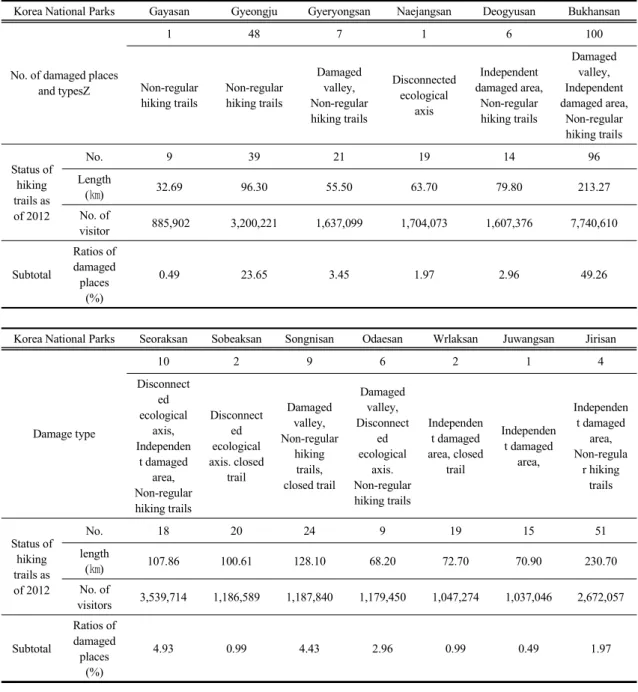
국립공원의 훼손지 비율과 연간탐 방객수를 대조하여 파악한 결과, 훼손지 비율은 북한산(49.26%), 경주(23.65
%), 설악산(4.93%), 속리산(4.43%), 계룡산(3.45%)의 순으로 전체 훼손지 비율 중 85.72%에 해당하는 높은 비 중을 차지하고 있는 것을 확인할 수 있었으며 연간 탐방 객 수에 있어서는 북한산, 설악산, 경주, 지리산, 내장산, 덕유산, 소백산, 속리산, 오대산, 월악산, 주왕산, 가야산 순으로 확인되었다.
탐방로 현황을 살펴보면 북한산이 96개구간, 지리산 이 51개구간, 경주가 39개구간, 속리산이 24개구간, 계 룡산이 21개구간으로 전체 12개 국립공원의 총 탐방로 354개구간 중 약 73%에 해당하는 258개구간의 탐방로
Korea National
Parks Gayasan Gyeongju Gyeryongsan Naejangsan Deogyusan Bukhansan Seoraksan
Damaged valley - - 6 - 6
Disconnected
ecological axis - - - 1 3
Independent
damaged area - - - - 3 4 3
Non-regular hiking
trails 1 48 1 - 3 90 3
Closed trails - - - - 1
Total 1 48 7 1 6 100 10
Ratio (%) by parks 0.51 24.37 3.55 0.51 3.05 50.76 5.08
Korea National
Parks Sobeaksan Songnisan Odaesan Woraksan Juwangsan Jirisan Total
Damaged valley 3 3 20
(9.14) Disconnected
ecological axis 1 2 7
(3.55) Independent
damaged area 1 1 3 13
(7.61) Non-regular hiking
trails 5 1 1 153
(77.66)
Closed trails 1 1 1 4
(2.03)
Total 2 9 6 2 1 4 203
Ratio (%) by parks 1.02 4.57 3.05 1.02 0.51 2.03 100
Table 4. Damaged areas by Korea National Parks
가 조성되어 있는 것이 확인되었다. 그 중에서도 북한산, 경주의 경우 연간 탐방객수, 탐방로, 훼손지 비율에 있어 서 높은 비중을 차지하고 있는 것을 확인 할 수 있었다.
이를 통해 국립공원의 훼손지 비율에 있어 가장 높은 비중을 차지하고 있는 비정규 탐방로와 같은 선적인 유 형의 훼손지 비중과 조성된 탐방로와 이를 통해 국립공 원을 이용하는 탐방객수간의 관계성을 추론할 수 있다 (Table 5).
3.4. 훼손 원인 및 복원 방안
훼손지 유형별 훼손 원인과 복원 방안을 살펴보면 직 접적으로 구조를 개선하려는 적극적 방안과 최소한의 간 섭을 통해 훼손지를 최소화하기 위한 소극적 방안으로
구분할 있다.
각각의 훼손지 유형별 복원 방안을 살펴보면 계곡 훼 손지는 노후에 따른 관리 부재(6), 어류 이동 교란(3), 취 수보 기능 상실에 따른 관리 부재(3) 순으로 관리의 미흡 으로 인한 훼손이 나타났으며 이에 대한 복원 방안으로 적극적인 방법으로 인공 구조물을 철거(9)하거나, 콘크 리트 보 철거(3), 수문을 크게 만들어 보를 낮추어 완만 하게 개선(1)하거나, 자연친화적 하천 복원과 생태 단절 해소 등의 소극적 대안도 제시하였다. 단절 생태축의 훼 손 원인은 주로 도로로 인한 생태축 단절(6)로 복원 방안 으로 생태통로를 조성(5)하거나, 육상통로와 수로를 혼 합한 터널형 생태통로로 구조를 개선(1)하는 적극적인
Korea National Parks Gayasan Gyeongju Gyeryongsan Naejangsan Deogyusan Bukhansan
No. of damaged places and typesZ
1 48 7 1 6 100
Non-regular hiking trails
Non-regular hiking trails
Damaged valley, Non-regular hiking trails
Disconnected ecological
axis
Independent damaged area,
Non-regular hiking trails
Damaged valley, Independent damaged area,
Non-regular hiking trails
Status of hiking trails as of 2012
No. 9 39 21 19 14 96
Length
(㎞) 32.69 96.30 55.50 63.70 79.80 213.27
No. of
visitor 885,902 3,200,221 1,637,099 1,704,073 1,607,376 7,740,610
Subtotal
Ratios of damaged places
(%)
0.49 23.65 3.45 1.97 2.96 49.26
Korea National Parks Seoraksan Sobeaksan Songnisan Odaesan Wrlaksan Juwangsan Jirisan
Damage type
10 2 9 6 2 1 4
Disconnect ed ecological
axis, Independen
t damaged area, Non-regular hiking trails
Disconnect ed ecological axis. closed
trail
Damaged valley, Non-regular
hiking trails, closed trail
Damaged valley, Disconnect
ed ecological
axis.
Non-regular hiking trails
Independen t damaged area, closed
trail
Independen t damaged
area,
Independen t damaged
area, Non-regula
r hiking trails
Status of hiking trails as of 2012
No. 18 20 24 9 19 15 51
length
(㎞) 107.86 100.61 128.10 68.20 72.70 70.90 230.70
No. of
visitors 3,539,714 1,186,589 1,187,840 1,179,450 1,047,274 1,037,046 2,672,057
Subtotal
Ratios of damaged places
(%)
4.93 0.99 4.43 2.96 0.99 0.49 1.97
Table 5. No. of damaged places and their types and status of hiking trails
방법을 제시하였다. 독립 훼손지는 면적 훼손 유형으로 샛길 이용자의 답압에 의한 훼손과 탐방객 집중 이용으 로 인한 훼손(11)이 주된 원인으로 나타났으며, 복원 방 안으로 지반 안정 및 식생 복원(7) 방안과 출입통제시설 설치(5)를 통해 탐방객들의 샛길 이용 제한과 복원 대상
지의 원활한 보호를 도모하도록 하였다. 무분별한 탐방 객 이용(77)과 샛길 이용자의 답압에 의한 훼손(71)에 의 해 비정규 탐방로(샛길)가 발생하는 것으로 나타났으며 지반 안정 및 식생 복원(78) 방안, 계도 안내판 및 통제시 설 설치(70)를 통한 복원을 주로 실시하는 것으로 나타
Damaged
area type Causes of damage (No. of place) Restoration measures (No. of place)
Damaged valley
-Absence of maintenance due to old age (6) -Polluted water due to swimming, inhibition of
water flow and deterioration in water quality due to dam or reservoir, obstruction of view due to man-made structures, disconnected ecological axis (1)
-Sediment deposited within reservoir due to small or broken floodgate, blocked fish moving route due to dam installed in perpendicular (1) -fish moving route disrupted (3)
-Absence of maintenance due to loss of dam function (3)
-Increasing the size of floodgate and improving by lowering the reservoir dam (1)
-Restoring streams to be eco-friendly, removing causes of ecological disconnection (1)
-Demolition of man-made structure (9) -Demolition of concrete dam (3)
Disconnecte d ecological
axis
-Disconnected ecological axis due to road (6)
-Making new ecological moving route (5)
-Improving with tunnel type ecological moving routs structurally in combination of land and water routes (1)
Independent damage
-Damage due to foot traffic and sheep grazing (1) -bivouac(1)
-Damage due to foot traffic in non-regular hiking trails or heavy foot traffic (11)
-No follow-up after demolished (1)
-Damage due to indiscrete foot traffic after the operation of cable car, lost soil and vegetation (1)
-Stabilizing soil foundation and restoring vegetation (7) -Placing access control structures (5)
-Rerouting the hiking trails (1)
-Removal of concrete and replanting indigenous vegetation (1)
Non-regular hiking trail
-Damage due to indiscrete foot traffic (77) -Damage due to foot traffic in non-regular hiking
trails (71)
-Newly developed short-cut (3)
-Stabilizing soil foundation and restoring vegetation (78) -Adding more soil and stabilizing, and restoring
vegetation (1)
-Placing instructional billboards and access control structure (70)
-Blocking non-regular hiking trails by planting (2)
Closed trail
-Neglected after Route 5 has been rerouted (1) -Closed and lost its function with construction of
tunnel (1)
-Environmental hinderance due to wasted asphalt and concrete around closed road (1)
-Laying foundation to be restored naturally after demolition of asphalt and concrete wall (2) -Eliminating closed road and replanting, and placing
bench and convenience building for visitors (1) Table 6. Causes of damage by type
났다. 도로의 방치(1) 또는 기존 도로 기능 상실(1)로 인 하여 발생하는 폐도의 경우 직접적인 복원 방안으로 아 스팔트 및 콘크리트 옹벽 등을 철거 한 후 복원(2)하거나 탐방객 편의시설 설치(1)하는 것으로 나타났다(Table 6). 훼손 원인을 파악하고 복원 방안을 마련하는 관리방 법은 훼손의 직·간접적인 문제를 해결하는데에 무리는 없으나, 국립공원은 지리적 특성상 해발고가 높아 여름 철 많은 강우와 봄철 동결융해 작용으로 자연적인 침식 현상이 진행되고 또한 탐방객에 의한 탐방압이 지속적으 로 가해지는 인위적인 요인 등으로 일반 산림지역의 탐
방로에 비해 훼손이 빠르게 확산 및 심각한 상태에 도달 할 가능성이 높다(Jung et al., 2012). 국립공원과 같은 대규모 자연자원의 훼손을 복원하기 위해서는 시간적, 공간적으로 고려하여 장기적이고 구체적인 복원방안의 제시가 필요하다.
4. 결론
본 연구는 국립공원별 탐방로 및 탐방객 현황과 훼손 유형, 훼손 원인 및 복원 방안을 파악하고자 2012년 3월 부터 7월에 걸쳐 국립공원 21개소 중 13개소(가야산, 경
주, 계룡산, 내장산, 덕유산, 북한산, 설악산, 소백산, 속 리산, 오대산, 월악산, 주왕산, 지리산)를 대상으로 국립 공원관리공단이 실시한 국립공원 훼손지 현황 조사 야장, 국립공원기본통계를 분석하였다.
2008년부터 2012년까지 5년간 국립공원별로 조성된 탐방로와 탐방객 수치를 분석하여 훼손 유형, 원인에 대 한 고찰을 통해 시간적인 정량추이를 비교하였다.
5년간 가장 많은 탐방로가 조성된 국립공원은 경주 32 개, 지리산 24개, 북한산 22개순이며, 국립공원간 탐방 로 총 개소도 북한산 96개소(27.51%), 지리산 51개소 (14.61%), 경주 39개소(11.17%)로 나타났다. 탐방객의 변화를 살펴보면, 소백산 760,119명, 월악산 370,431명, 설악산 274,546명이 늘어났으나, 5년 평균치보다 탐방 객이 늘어난 국립공원은 월악산 265,329명, 소백산 246,634명, 경주 61,013명으로 나타났다.
훼손지는 북한산이 100개소로 가장 많은 훼손지가 확 인되었으며 경주 48개소, 속리산 9개소, 오대산, 덕유산 각 6개소 순으로 나타났다. 가장 많은 훼손지가 확인된 북한산의 경우 샛길을 포함하는 비정규 탐방로의 훼손이 90개소, 독립 훼손지가 4개소로 선적인 훼손의 비중이 높은 것으로 확인되었다. 경주의 경우 비정규 탐방로의 훼손이 48개소, 독립 훼손지가 12개소, 설악산의 경우는 단절 생태축이 3개소, 독립 훼손지 3개소, 비정규 탐방 로 3개소, 폐도 1개소로 다양한 유형의 훼손지가 확인되 었다.
국립공원별 훼손 유형이 다르게 나타난 원인은 지리 적 위치, 탐방객들의 이용 행태, 편의시설, 안내판 등 공 원 시설 유무 그리고 기후변화로 인한 국지성 호우, 산사 태 등으로 광범위하게 유추할 수 있다. 그러나 비정규탐 방로가 국립공원의 훼손지 현황 중 77.66%에 해당하는 높은 비중을 차지하는 것을 통해 국립공원의 훼손지의 공간적 특징은 선적인 공간에서의 훼손이 가장 심각하다 고 해석할 수 있다. 북한산의 경우 탐방로가 96개소로 가 장 많으며 그 훼손지 또한 100개소로 가장 많으나 지리 산의 경우 탐방로가 51개소로 두 번째로 많으며, 훼손지 는 4개소로 나타났다. 이를 통해 국립공원별로 탐방로와 훼손지간의 관계를 유추하기는 어려우나, 국립공원내에 서 탐방로가 많을수록 선적인 훼손 유형이 많아짐은 유 추할 수 있겠다.
사계의 기후적 특징을 갖는 우리나라의 국립공원은
연간 약 4,600만 명이 이용하고 있으며 봄나들이, 단풍 구경, 눈축제와 같이 한 계절에 이용이 집중되기도 하는 이용 측면의 특성을 가지고 있다. 그와 더불어 다양한 자 연자원을 연계하여 이용을 허용한 탐방로의 신설, 재정 비가 진행되고 있으나 급속도로 증가하는 이용객의 증 가추세에 대응하기는 쉽지 않다. 그로 인해 탐방객의 이 용행태가 탐방로를 벗어나 이루어지거나 휴식 공간 이외 의 장소에서의 휴식행위가 무분별하게 이루어지고 있는 실정이다.
특히 전국의 소규모 산악회 중심으로 추진되는 이른 바 ‘묻지마 산행’은 국립공원의 아름다운 가치를 외면한 채 ‘30∼40명이 새벽에 산을 오르기 시작해서, 허겁지겁 단시간 내에 정상을 정복’하는 행태를 보이고 있다. 이러 한 산행의 표적이 되고 있는 설악산, 소백산, 지리산, 속 리산 등 주요 국립공원의 탐방로는 이미 나지화가 진행 되었고, 뿌리노출이 진행되고 있는 실정이다(Kim, 2009). 그 결과, 정해진 탐방로 및 휴게 시설 이외의 장소 에서 훼손지가 발생하는 문제점이 본 연구의 결과에 의 해 명확히 나타났다. 이러한 인위적 훼손지는 집중강우 와 같은 기상변화에 대한 안전성의 결여, 자연식생 및 생 태계의 훼손으로 이어지는 위험요소로 작용하고 있다 (Korea National Park Service, 2005).
현재는 그 대응책으로 훼손지에 대한 조사와 복구를 통해 훼손지를 복원하는 사업을 실시하여 훼손의 확산을 최소화 하려는 노력을 하고 있으나 일시적인 대책으로 광범위한 자연자원인 국립공원 전체에서 훼손지를 복구 하기에는 재정적, 시간적 소요재원을 고려할 때 장기적 인 측면에서의 궁극적인 대응책이라 단언 할 수 없다. 국 립공원관리공단이 관련학계에 연구한 ‘국립공원 탐방로 훼손·세굴유형 분석과 복원대책에 관한 연구’에 의하면 이러한 인위적 요인으로 전국 국립공원(한라산, 경주 제 외)내 총 87만 평의 탐방로와 그 주변이 훼손되었고, 이 를 복구하기 위해서는 약 3,700억 원이 소요될 것으로 나타났다. 이는 현재 연간 30억 원이 투자된다는 것을 감 안할 때 100년간 추진해야 할 사업량(Kim, 2009)으로 발생된 훼손을 복원하는 반복된 과정을 거치는 것만으로 는 한계가 있다.
그럼으로 기본적으로 이용객의 이용행태와 성향을 고 려하여 탐방객의 이용행태를 유도할 수 있는 탐방객관 리가 필요하겠다. 이를 바탕으로 단기적으로는 이용자
인식제고, 기반재정비(탐방로 및 휴식시설, 샛길통행금 지 안내판 등의 설치), 국립공원 자원봉사자 발굴 등을 통한 국립공원의 지속적 이용기반 정착이 우선적으로 필요하며, 장기적으로는 1991년부터 부분적으로 시행 중인 자연휴식제 또는 북한산국립공원의 우의령에 도입 되고 있는 예약제와 같은 제한적 이용 등의 제도를 훼손 정도에 따라 국립공원 전역에 확대하여 적극적으로 도 입하는 방안을 고려할 필요가 있다. 또한 공간적인 분석 이 이루어지지 못하고 시간적인 정량의 추이를 비교하 여 나타난 결과이므로 탐방객 집중으로 인한 훼손지가 많은 것인지, 과거로부터 중첩된 훼손지역인지는 본 연 구에서는 밝혀내기 어려우나 향후 지리정보시서템 (Geographic Information System:GIS)을 활용한 공간 적 분석을 통해 보다 구제척이고 체계적인 연구가 진행 되어야 할 것이다. 이러한 기반재정비와 제도의 도입과 더불어 탐방객이용으로 인한 훼손을 최소화 할 수 있도 록 관리자 및 탐방객의 교육과 홍보를 지속적으로 실시 하여 관리자의 전문성과 이용객의 의식수준 향상을 통한 지속가능한 이용의 저변확대가 절실히 필요하다고 할 수 있겠다.
REFERENCE
Ann, T. W., Kanh, H. J., Kim, M. G., 2004, Study on the injury of Trails of Nak-young Mt in Song-ni Mt National Park, Mt. Songni of Korea National Park Service, 47.
Green Korea, 2005, Korea Forest '60, Now it's Ecological Restoration, 3-5.
Jeong, S. J., Oh, K. K., and Oh, J. G., 2001, A Study on Restoration Measures of Vegetation for Devastated Ridge Line Area in National Park, Korea, Kor. J. Env., Eco., 15(1), 69-78.
Jeong, W. O., Ma, H. S., and Kang, W. S., 2012, Analysis of Physical Characteristics and Deterioration Type of Trail in National Parks, 46(1), 17-27.
Kim, S. K., 2005, National Park tour suggestions for improvement culture-The use of the climbing culture center in Nature, eco-friendly hiking culture symposium.
Kim, Y. K., Lee, Y. G., Lim, J. H., Cheon, J. H., Hyeon, J.
S., Kwon, T. S., Gwon, J. O., Oh, J. H., Park, C. Y., Yang, H. M., Yoon, H. J., Choi, H. T., Kim, K. H.,
Kim, C. M., Cho, J. H., Kim, N. C., Yoon, C. W., Kim, S. G., Shin, J. H., Park, J. H., Kim, W. S., Kim, T. H., 2011, Typology of Deteriorated Hiking Trails in Mountain National Parks of Korea, Kor. J. Korean association of regional geographers, 17(4), 416-431.
Korea Forest Conservation Association, 2005, Large mountain damage Survey, cause analysis and monitoring plan for sustainable mountain conservation, 69-105.
Korea Forest Research institute, 2010, Geographical Range of Baekdudaegan Mountain System and Development of Restoration Model for It's Deteriorated Ecosystem, 59-60.
Korea National Park Service, 2000, Jirisan national park monitoring report, 89-114.
Korea National Park Service, 2001, Analysis by type of damage scour National Park Trail and Restoration measures, 161.
Korea National Park Service, 2008, Best Practices of National Park Service, 136-145.
Korea National Park Service, 2010, Best Practices of National Park Service, 146-156.
Korea National Park Service, 2011, Best Practices of National Park Service, 152-171.
Korea National Park Service, 2012, Best Practices of National Park Service. 126-145.
Kwon, T. H., Oh, K. K., and Kim, B. H., 1998, Use Impacts on Environmental Deteriorations on and around Trails in Naesorak District of Soraksan National Park. Kor. J. Env., Eco., 11(4), 523-534.
Kwon, T. H., Oh, K. K., and Lee, J. W., 1991, Use Impact on Environmental Deteriorations of Trail and Campsite in Chirisan National Park. Kor. J. Env., Eco., 5(1), 91-103.
Kwon, T. H., Oh, K. K., and Lee, J. W., 1993, Use Impacts on Environmental Deteriorations of Trail in Sobaeksan National Park. Kor. J. Env., Eco., 6(2), 168-179.
Lee, D. G., Seo, M. H., 1987, Effects of Soil Compaction upon the Vegetation Environment around the Trails in Pukhansan National Park, Journal of Korean institute of Forest science and technology, 76(2), 127-137.
Lee, J. W., Oh, K. K., Kwon, T. H., 1997, Use Impacts on Environmental Deteriorations on and around Trails in Soraksan National Park, Kor. J. Env., Eco., 10(2), 191-204.
Lee, K. J., Oh, K. K., 1994, Crisis of Korea National Park.
Citizens of keeping the National Park and Applied Ecology Research Group, 135.
Lee, S. K., Kim, C. S., Go, J. G., Lim, J. H., Cheon, J. H., Jeong, J. H., Byeon, G. O., Jeong, Y. G., Gang, B. S., Hwang, S. I., Son, S. G., 2006, Stabilization of Halla mountain top, Korea Forest Research institute, 69.
Ministry of Environment, 2008, National Park Feasibility Criteria and Nature park system improvements pro -vided, 11-14.
Nam, S. J., 2005, Ecological Restoraton and Revegetation of the Disturbed Slopes, Ph.D. thesis, Univ. of Dan kook, Cheonan, Korea.
Oh, K. K., 1991, Studies on restoration of forest-floor vegetation devastated by recreational trampling, Ph. D.
thesis, Univ. of Seoul National, Seoul, Korea, 86.
Oh, K. K., Gwon, T. H., and Jeon, Y. J., 1987, Trail Damage and Vegetational Change of Trail Side in Bukhan Mountain National Park, Kor. J. Env., Eco., 1(1), 46-65.
Oh, K. K., Heo, S. H., 1990, Environmental Deterioration of and around Trail in Hallasan National Park, Kor, J, Env., Eco., 6(1), 55-71.
Oh, K. K., Heo, S. H., 1992, Environmental Deterioration of and around Trail in Hallasan National Park, Kor. J.
Env., Eco., 6(1), 55-71.
Oh, K. K., Kwon, T. H., Ryu, K. J., Lee, J. W., Choi, S. H., 2004, Forest Road Maintenance Manual, Su-Moon Publisher.
Oh, K. K., Park, S. G., 2002, Vegetation Structure of Mountain Ridge from Pijae to Doraegijae in the Baekdudaegan, Korea, Kor. J. Env., Eco., 15(4), 330- 343.
Oh, K. K., Woo, B. M., Kim, D. H., 1997, Rehabilitation Measures for Disturbed Subalpine Meadows in Chirisan National Park, Republic of Korea, Kor.J.
Env., Eco., 11(1), 37-45.
Park, E. H., Kim, D. I., Joung, W. O., Kwon, H. K., and Joung, P. H., 2010, Trail Characteristics and Deterio -ration Type of Jirisan National Park Chilseon Valley, Journal of Korean institute of forest recreation, 14(2), 9-15.
Watanabe, T., Fukasawa, K., 1998, Seven-year Deterio -ration of a Hiking Trail and Measures to Mitigate Soil Erosion, Mount Kurodake, Daisetsuzan National Park, Hokkaido, Northern Japan, Geographical review of Japan, Ser. A, 71(10), 753-764.
http://www.knps.or.kr