Res. Plant Dis. 17(1) : 13-18 (2011) © The Korean Society of Plant Pathology
양배추 시들음병에 대한 효율적인 저항성 검정법 개발
백송이·김진철·장경수·최용호·최경자*
한국화학연구원 산업바이오화학연구센터
Development of Efficient Screening Method for Resistance of Cabbage to Fusarium oxysporum f. sp. conglutinans
Song-Yi Baik, Jin-Cheol Kim, Kyoung Soo Jang, Yong Ho Choi and Gyung Ja Choi* Chemical Biotechnology Research Center, Korea Research Institute of Chemical Technology, Daejon 305-600, Korea
(Received on January 5, 2011; Accepted on January 11, 2011)
This study was conducted to establish the efficient screening method for resistant cabbage to Fusarium wilt caused by Fusarium oxysporum f. sp. conglutinans. The resistance degrees of nine commercial cabbage cultivars to the disease were evaluated. Among them, five cultivars (YR-honam, Ogane, Greenhot, Redmat, and Ccoccoma) showing different resistance to the fungus were selected. Then development of Fusarium wilt of the cultivars according to several conditions including root wounding, dipping period of roots in spore suspension, inoculum concentration, and incubation temperature to develop the disease was investigated.
Highly resistant cultivars such as ‘YR-honam’ and ‘Ogane’ hardly showed change of resistance to the disease by root wounding, dipping period, and inoculum concentration, while disease severity of Fusarium wilt on the cultivars was changed with incubation temperatures (20oC, 25oC and 30oC). When the cabbage cultivars were incubated at 25oC, they represented the most difference of resistance and susceptibility to Fusarium wilt.
From above results, we suggest that an efficient screening method for resistant cabbage to F. oxysporum f. sp.
conglutinans is to dip the non-cut roots of 14-day-old seedlings in spore suspension of 1×10⁷ conidia/ml for 0.5 hr and to transplant the seedlings to plastic pots with a fertilized soil, and then to cultivate the plants in a growth chamber at 25oC for 3 weeks to develop Fusarium wilt.
Keywords : Brassica oleracea, Breeding, Fusarium wilt, Resistant screening, Yellows 십자화과 작물에 속하는 양배추(Brassica oleracea var.
capitata)의 재배면적은 우리나라에서 2003년도에 5,401 ha 로, 고추(57,502 ha)나 배추(47,686 ha), 무(35,158 ha) 등 에 비하여 극히 적다. 하지만 국내에서 육성한 양배추 품 종들은 외국에서 상당히 인기가 있어 종자 수출액이 2003 년에 약 220만 달러로 고추와 무 다음으로 많은 양을 수 출하고 있으며, 종자 수출은 점차 증가하고 있다(나 등, 2008). 현재까지 양배추에 발생하는 병해로는 시들음병, 뿌리혹병, 검은썩음병 및 무름병 등 14종이 보고되어 있 다(한국식물병리학회, 2009). 오늘날 종자를 수출하기 위 한 양배추 품종들은 병 저항성을 반드시 필요로 하고 있
어 종자회사들은 저항성 품종 개발을 위해 노력하고 있다.
양배추의 연작지에서 발생하여 큰 피해를 주고 있는 시 들음병은 Fusarium oxysporum f. sp. conglutinans에 의해 발생한다(문 등, 2001). 이 병원균은 작물의 뿌리로 침입 하여 도관을 통해 상부로 이동하여 물관의 기능을 저해 한다(Deese와 Stahmann, 1962). 따라서 감염되면 양배추 잎은 노랗게 변하고 또 잎이 떨어지며 더 나아가 식물 전 체가 말라죽게 된다(Peterson과 Pound, 1960). Armstrong 과 Armstrong(1952, 1966, 1981)과 Ramirez-Villupadua 등 (1985)은 F. oxysporum f. sp. conglutinans는 양배추를 포 함한 배추과 작물에 시들음병을 일으키며, 기주에 대한 병원성에 따라 5종의 계통(strains)이나 레이스로 구분하 였다. 양배추, 케일, 브로콜리, 컬리플라워, 순무, 머스타 드, 평지, 무, 구경양배추 및 스톡 등을 감염하는 균주를 레이스 1, 양배추와 컬리플라워를 제외한 위의 모든 기주
*Corresponding author
Phone) +82-42-860-7434, Fax) +82-42-861-4913 Email) [email protected]
DOI: 10.5423/RPD.2011.17.1.013 보문 Open Access
를 공격하지만 일반적으로 무에 가장 많이 발생하는 균 주를 레이스 2, 캘리포니아 지방의 스토크를 침해하는 레 이스 3 그리고 뉴욕 지방의 스토크로부터 분리한 레이스 4로 명명하였다. 이 후 A type 저항성 양배추를 감염하는 시들음병균을 분리하고 이를 레이스 5로 명명하였다. 그 러나 Bosland와 Williams(1987, 1988)는 양배추와 무를 감 염하는 균주를 각각 F. oxysporum f. sp. conglutinans와 F.
oxysporum f. sp. raphani로 구분하였으며, 기주에 대한 병 원성은 발병 환경에 따라 변할 수도 있으나, 이 분류 방 법은 오늘날 널리 이용되고 있다.
Fusarium 시들음병을 방제하기 위한 방법으로 methyl bromide(MBr)를 이용한 토양소독이 널리 이용되어 왔으 나, MBr은 오존층을 파괴하는 물질로 간주되어 현재 사 용이 중지된 상태이다(Yagi 등, 1993). 그 외에 배추과 식물이외의 작물과 윤작, 종자 소독 후 파종, 석회 시용 및 질소비료의 과용 금지 등이 사용되고 있으나, 이들 방법으로는 효과적인 방제효과를 나타내지 못하고 있으 며 시들음병 방제를 위하여 등록된 살균제도 거의 없는 실정이다. 양배추 시들음병을 방제하기 위한 방법으로 저항성 품종의 재배는 친환경 농산물을 생산할 수 있는 가장 최선의 방법이다. Fusarium 시들음병에 대한 양배 추의 저항성은 A type과 B type 저항성이 알려져 있으 며, A type 저항성은 온도 등의 환경조건에 관계없이 저 항성을 나타내는 단인자 우성 유전을 하는 반면에, B type 저항성은 다인자의 지배를 받아 25oC까지는 저항성 을 나타내나, 그 이상의 고온에서는 저항성을 나타내지 못하여 높은 시들음병 발생을 보이므로 저항성 품종 개 발을 위한 상업육종에서는 이용하기 어려운 저항성 유 전자이다(Walker, 1930, 1958). 양배추 A type 저항성 품 종이 개발되어 50여 년 동안 사용한 후 이들 저항성 품 종을 침해하는 새로운 레이스의 보고가 있었다(Ramirez- Villupadua 등, 1985). 현재 시들음병에 저항성인 양배추 품종은 국내의 다수 회사에서 판매하고 있으나, 저항성 유전자 규명 및 분자마커 개발에 대하여 거의 보고된 바 없다. 이들 연구를 그리고 새로운 저항성 유전자원 탐색 을 위해서는 양배추 시들음병에 대한 효율적인 저항성 검정법이 필요하다.
본 연구에서는 효율적인 양배추 시들음병 저항성 검정 방법을 확립하고자 현재 시판되고 있는 9종 양배추 품종 의 저항성 정도를 실험하고, 이들 중 시들음병에 대한 저 항성 정도가 다른 5종 품종을 선발하여 접종원 농도, 포 자현탁액에 침지하는 시간, 재배 온도 및 뿌리 상처 유무 등 다양한 발병 조건에 따른 양배추 품종들의 시들음병 발생을 조사하였다.
재료 및 방법
양배추 재배. 양배추 품종의 종자를 8×16 연결 폿트 (폿트 당 토양 20 ml, (주)범농)에 원예용상토 5호(부농사) 를 넣고 양배추 종자를 폿트 당 1립씩 파종하여 온실 (25±5oC)에서 14일 동안 재배한 양배추 유묘를 실험에 사 용하였다.
접종원 준비. 양배추 시들음병을 일으키는 F. oxysporum f. sp. conglutinans KR3 균주는 강릉원주대학으로부터 분 양받아 실험에 사용하였다. KR3 균주를 potato dextrose agar(Becton, Dickinson and Co.) 배지에 접종하고 25oC에 서 7일 동안 배양한 균총으로부터 균사조각을 떼어 malt extract broth(Becton, Dickinson and Co.) 배지에 접종하고 이를 25oC 암 상태에서 7일 동안 150 rpm으로 진탕배양 하였다. 배양한 KR3 균주는 4겹의 거즈로 걸러 균사를 제거하고, 광학현미경하에서 hematocytometer를 이용하여 포자(소형분생포자)의 농도를 측정하였다. 접종원 농도를 제외한 모든 발병 조건 실험의 경우에는 1.0×10⁷ conidia/
ml가 되도록 멸균수로 희석하여 접종원으로 사용하였으 며, 접종원 농도실험을 위해서 3.0×106,1.0×107,3.0×107 conidia/ml로 조정하였다. 그리고 9종 양배추 품종의 시들 음병에 대한 저항성 정도를 조사하는 실험의 경우에는 3.0×10⁷ conidia/ml 농도로 준비하였다.
시들음병균 접종. 온실에서 재배한 양배추의 뿌리를 물로 세척하여 흙을 제거한 후 포자현탁액에 30분 동안 침지하여 접종하였다. 5×8 연결 폿트(폿트 당 토양 68 ml, (주)범농)에 원예용상토 5호를 넣고 접종한 양배추 유묘 를 이식하였다. 그 외 뿌리 상처 유무에 따른 양배추 품 종의 시들음병 발생 실험에서의 뿌리 상처는 앞에서와 같 은 방법으로 준비한 양배추 뿌리를 2 cm 정도 남도록 가 위로 자른 후에 동일한 방법으로 포자현탁액에 침지하여 접종하였다. 또한 침지시간에 따른 양배추 시들음병 발생 의 경우에는 F. oxysporum f. sp. conglutinans 포자현탁액 에 각각 0시간, 0.5시간, 1시간, 2시간 및 3시간 동안 침 지하여 접종하였다. 0시간 처리를 위해서는 준비한 양배 추 뿌리를 시들음병균 포자현탁액에 담근 즉시 꺼내 토 양에 이식하였다. 한편 양배추 9품종의 시들음병 저항성 정도를 조사하는 실험은 포자현탁액에 2시간 동안 침지 하여 접종하였다.
발병 및 병조사. 접종한 양배추 유묘는 1일 동안 25oC 습실상에서 배양한 후 온실(25±5oC)로 옮겨 3~4주 동안 시들음병 발생을 관찰하면서 재배하였다. 재배 온도 실험 은 접종한 양배추 유묘를 20oC, 25oC 및 30oC 생육상에 서 하루에 12시간씩 광을 조사하면서 3주일 동안 재배한
후에 병조사를 하였다. 양배추 시들음병의 병조사는 식물 체의 뿌리를 뽑아 세척한 후 도관을 잘라 발병 정도를 조 사하였다. 발병 정도는 0=건전, 1=지하부 도관은 갈변되 나 지상부는 병징이 없는 것, 2=지하부는 갈변되고 지상 부는 약간 생육이 억제되는 것, 3=지하부는 갈변되고 지 상부는 생육이 억제되며 약간 황화된 것, 4=지하부는 갈 변되고 지하부와 지상부의 생육은 모두 심하게 억제되며 심하게 황화된 것, 5=고사 등 6단계로 하였으며, 평균 발 병도가 1.0 이하인 경우에는 저항성, 1.1~2.5는 중도저항 성, 2.5 초과는 감수성으로 판정하였다. 모든 실험은 10 반복으로 2회 실시하였으며, SAS(SAS Institute, Inc., 1989, Cary, NC) 프로그램을 이용하여 ANOVA 분석을 하고 처 리 평균간 비교를 위하여 Duncan’s multiple range test (P=0.05)를 실시하였다.
결과 및 고찰
양배추 품종의 시들음병에 대한 저항성. 현재 시판중 인 9종 양배추 품종의 F. oxysporum f. sp. conglutinans에 의한 시들음병에 대한 저항성을 조사하였다. 조사방법은 백 등(2010)이 보고한 무 시들음병(병원균: F. oxysporum f. sp. raphani)에 대한 저항성 검정 방법에 따랐다. 조사
한 9종 품종 중 각 회사에서 시들음병에 대한 저항성 품 종으로 공시한 ‘오가네’, ‘YR호남’, ‘YR호걸’, ‘그랜드마 트’ 등 4종은 모두 1.0 이하의 낮은 발병도를 보여 저항 성임을 확인했다(Table 1). 그 외 시들음병 저항성 품종으 로 공시되지 않은 5종 품종 중 ‘아시아볼’과 ‘대박나’는 0.3 이하의 발병도를 보여 시들음병에 대하여 높은 저항 성 반응을 보였고 ‘그린핫’은 중도저항성을 나타냈다. 그 렇지만 ‘레드마트’와 ‘꼬꼬마’는 4.5 이상의 높은 발병도 를 나타내어 감수성 품종임을 알 수 있었다. 백 등(2010) 의 무 시들음병균(F. oxysporum f. sp. raphani)에 대한 무 품종들의 저항성 결과와 마찬가지로 시판되고 있는 9종 양배추 품종 중 감수성 품종은 2종뿐으로 현재 판매되고 있는 품종들은 대부분 육종과정에서 시들음병에 대한 저 항성 유전자가 도입되었음을 알 수 있었다.
양배추 시들음병에 대한 효율적인 저항성 검정 방법을 확립하기 위하여, 위의 결과로부터 F. oxysporum f. sp.
conglutinans에 대한 저항성 정도가 다른 5종 품종 즉, 저 항성인 ‘YR호남’과 ‘오가네’, 중도저항성인 ‘그린핫’ 그리 고 감수성 품종인 ‘레드마트’와 ‘꼬꼬마’ 등을 선발하였다.
뿌리 상처에 따른 시들음병 발생. YR호남 등 5종 양 배추 품종들은 뿌리에 가한 인위적인 상처에 의해 시들 음병 발생이 무상처 양배추보다 약간 증가하거나 동일하 였다. 하지만 각 품종의 상처 유무에 따른 시들음병 발생 은 통계적으로 유의차가 없었다(Fig. 1). 즉, 뿌리 상처와 Table 1. Resistance degree of the nine commercial cabbage
cultivars to Fusarium wilt caused by Fusarium oxysporum f. sp.
conglutinansa
Cultivar Company Traitb Disease indexc
Asiaball Asiaseed 0.1
Ogane Koregon YR 0.1
YR-honam Asiaseed YR 0.2
YR-hogirl Koregon YR 0.2
Daebakna Asiaseed 0.3
Grandmat Asiaseed YR 0.5
Greenhot Asiaseed 1.2
Redmat Asiaseed 4.5
Ccoccoma Asiaseed 4.9
aFourteen-day-old seedlings of each cabbage cultivar were inoculated with F. oxysporum f. sp. conglutinans KR3 by dipping the roots in spore suspension of 3.0×10⁷ conidia/ml for 2 hr. The inoculated plants were incubated in a dew chamber at 25oC for 24 hr and then transferred to a greenhouse at 25±5oC. After 3-4 weeks, disease severity of the plants was investigated.
bResistant cultivars to Fusarium wilt were kindly supplied by seed companies.
cDisease severity of the diseased plants was rated on a scale of 0-5, where 0=no symptoms in tops or roots; 1=darkening of roots, no stunting or symptoms in tops; 2=darkening of roots, slightly top stunting, no chlorosis; 3=dark stunted roots, tops stunted, slight chlorosis; 4=severe stunting of roots and tops, severe chlorosis; and 5=death.
Fig. 1. Development of Fusarium wilt on five cabbage cultivars when cut and non-cut roots were dipped in the spore suspension of Fusarium oxysporum f. sp. conglutinans. Fourteen-day-old seedlings of each cultivar were inoculated with F. oxysporum f.
sp. conglutinans KR3 by dipping the roots of seedlings in spore suspension of 1.0×10⁷ conidia/ml for 0.5 hr. The inoculated plants were incubated in a dew chamber at 25oC for 24 hr and then transferred to a greenhouse at 25±5oC. After 3-4 weeks, disease severity of the diseased plants was rated on a scale of 0-5, where 0=no symptoms in tops or roots; 1=darkening of roots, no stunting or symptoms in tops; 2=darkening of roots, slightly top stunting, no chlorosis; 3=dark stunted roots, tops stunted, slight chlorosis; 4=severe stunting of roots and tops, severe chlorosis;
and 5=death. Each value represents the mean disease index of two runs with ten replicates each. Values in the labeled with the same letter are not significantly different in Duncan's multiple range test at P=0.05.
관계없이 ‘YR호남’과 ‘오가네’는 고도의 저항성이었으며
‘레드마트’와 ‘꼬꼬마’는 높은 감수성을 나타냈다. 송 등 (1996)은 양배추 시들음병에 대한 저항성 검정을 위하여 양배추의 뿌리를 자르고 실험하였으나, Ramirez-villupadua 등(1985)은 F. oxysporum f. sp. conglutinans의 레이스를 판별하기 위한 실험에서 뿌리를 자르지 않고 1×10⁶ conidia/
ml 농도의 포자현탁액에 침지하여 기주 간의 저항성 차 이를 볼 수 있었다. 본 연구에서 양배추 품종의 시들음병 에 대한 저항성 정도는 뿌리를 자른 양배추와 자르지 않 는 양배추의 저항성 정도가 거의 유사하므로, 양배추 시 들음병에 대한 저항성 검정을 위해서는 양배추 유묘의 뿌 리로부터 흙을 제거한 후 뿌리를 자르지 않고 F. oxysporum f. sp. conglutinans의 포자현탁액에 침지하는 것이 적절하 리라 판단되었다.
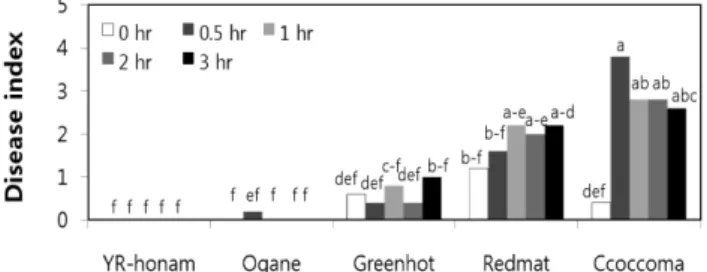
침지시간에 따른 시들음병 발생. 양배추 뿌리를 포자 현탁액에 30분내지 3시간 동안 침지하여 5종 양배추 품 종의 시들음병 발생 정도를 실험한 결과, 침지하는 시간 에 관계없이 저항성 품종인 ‘YR호남’과 ‘오가네’는 시들 음병이 거의 발생하지 않았으며, 감수성 품종인 ‘레드마 트’와 ‘꼬꼬마’는 높은 시들음병 발생을 보였다(Fig. 2).
그러나 각 품종에서 침지하는 시간 간에는 큰 차이가 없 었다. 그러나 양배추 뿌리를 포자현탁액에 담근 즉시 꺼 낸 경우에는 저항성 품종들뿐만 아니라 감수성 품종인
‘레드마트’와 ‘꼬꼬마’에서도 낮은 시들음병 발병도를 나 타냈다(Fig. 2). 송 등(1996)은 양배추 시들음병 저항성 검
정을 위하여 양배추 뿌리를 포자현탁액에 5초 동안 침지 하여 접종하고 토양에 이식하였으나, 본 연구에서는 침지 한 직후에 꺼내어 토양에 이식한 경우에는 감수성 품종 에서도 낮은 발병도를 나타냈다. 따라서 효율적인 양배추 시들음병 저항성 검정을 위해서는 양배추 뿌리를 포자현 탁액에 30분 정도 침지하여 접종하는 것이 바람직하다고 생각되었다.
접종원 농도에 따른 시들음병 발생. 양배추 뿌리를 F.
oxysporum f. sp. conglutinans의 세 가지(3×10⁶, 1×10⁷및 3×10⁷ conidia/ml) 농도의 포자현탁액에 침지하여 접종한 5종 양배추 품종들의 시들음병 발생은 모든 품종에서 접 종원의 포자 농도가 증가함에 따라 시들음병 발병도도 증 가하였다(Fig. 3). 하지만 저항성 품종인 ‘YR호남’과 ‘오 가네’ 그리고 감수성인 ‘꼬꼬마’는 접종원의 포자 농도 증 가에 따는 시들음병 발병도의 증가는 미미하였다. 하지만 중도저항성 품종인 ‘그린핫’의 경우에는 3×10⁶ conidia/ml 접종구는 저항성을 1×10⁷ conidia/ml와 3×10⁷ conidia/ml 접종구는 중도저항성을 나타냈다. 그리고 감수성인 레드 마트도 접종원의 포자 농도가 증가함에 따라 시들음병 발 생은 크게 증가하였으나, 모두 감수성 품종으로 판정되는 범위 이내였다. Kuc(1987, 1994)는 병원균을 고농도로 접 종하였을 시 조기 낙엽되어 저항성을 유도할 수 있는 잎 이 없어지기 때문에 저항성 검정을 하기가 어렵다고 보 고한 바 있다. 따라서 저항성 품종과 감수성 품종들 간에 시들음병에 대한 저항성 정도의 차이가 가장 큰 1×10⁷
Fig. 2. Fusarium wilt occurrence of five cabbage cultivars according to root dipping period. Fourteen-day-old seedlings of each cultivar were inoculated with F. oxysporum f. sp.
conglutinans KR3 by dipping the roots of seedlings in spore suspension of 1.0×10⁷ conidia/ml. The inoculated plants were incubated in a dew chamber at 25oC for 24 hr and then transferred to a greenhouse at 25±5oC. After 3-4 weeks, disease severity of the diseased plants was rated on a scale of 0-5, where 0=no symptoms in tops or roots; 1=darkening of roots, no stunting or symptoms in tops; 2=darkening of roots, slightly top stunting, no chlorosis; 3=dark stunted roots, tops stunted, slight chlorosis;
4=severe stunting of roots and tops, severe chlorosis; and 5=death. Each value represents the mean disease index of two runs with ten replicates each. Values in the labeled with the same letter are not significantly different in Duncan's multiple range test at P=0.05.
Fig. 3. Fusarium wilt occurrence of five cabbage cultivars according to inoculum concentration. Fourteen-day-old seedlings of each cultivar were inoculated with F. oxysporum f. sp.
conglutinans KR3 by dipping the roots of seedlings in each spore suspension for 0.5 hr. The inoculated plants were incubated in a dew chamber at 25oC for 24 hr and then transferred to a greenhouse at 25±5oC. After 3-4 weeks, disease severity of the diseased plants was rated on a scale of 0-5, where 0=no symptoms in tops or roots; 1=darkening of roots, no stunting or symptoms in tops; 2=darkening of roots, slightly top stunting, no chlorosis; 3=dark stunted roots, tops stunted, slight chlorosis;
4=severe stunting of roots and tops, severe chlorosis; and 5=death. Each value represents the mean disease index of two runs with ten replicates each. Values in the labeled with the same letter are not significantly different in Duncan's multiple range test at P=0.05.
conidia/ml 농도의 포자현탁액에 침지하여 접종하는 것이 효과적이라 생각되었다.
재배 온도에 따른 시들음병 발생. F. oxysporum f. sp.
conglutinans의 기주에 대한 병원성은 토양 온도에 따라 변할 수 있다고 보고되었다(Nomura와 Ishii, 1989; Pound 와 Fowler, 1953). 따라서 양배추 품종들의 시들음병에 대 한 저항성도 발병 온도에 따라 차이를 나타내는지를 조 사하기 위하여 저항성 정도가 다른 5종 품종을 20oC, 25oC 및 30oC에서 시들음병 발생을 실험한 결과, 25oC에서 실 험한 양배추 품종들 중 저항성 품종인 ‘YR호남’, ‘오가네’
및 ‘그린핫’은 더 높은 저항성 반응을 그리고 감수성 품 종인 ‘레드마트’와 ‘꼬꼬마’는 더 높은 감수성 반응을 나 타냈다. 그러나 30oC에서는 감수성 품종들은 25oC와 유 사한 발병도를 나타내었으나, 저항성 품종들은 25oC보다 높은 발병도를 나타냈다. 상업용 양배추 품종들은 모든 온도에서 병 저항성을 나타내는 A-type 저항성 유전자를 가진다고 알려져 있다(Walker, 1930, 1958). 하지만 본 연 구에서 30oC의 고온에서는 저항성 양배추 품종의 시들음 병에 대한 저항성이 다소 감소함을 알 수 있었다. 그러므 로 양배추 품종의 시들음병에 대한 저항성 정도를 조사 하기 위해서는 접종한 후에 25oC에서 재배하는 것이 적 당하리라 판단되었다.
이상의 결과로부터 양배추 품종들의 F. oxysporum f. sp.
conglutinans에 의한 시들음병에 대한 저항성을 검정하기 위한 방법으로 양배추 종자를 원예용 상토에 파종하고 온
실(25±5oC)에서 14일 동안 재배한 양배추 뿌리를 물로 씻어 뿌리의 흙을 제거한 후에 1×10⁷ conidia/ml 농도의 F. oxysporum f. sp. conglutinans의 포자현탁액에 30분 동 안 침지하고 원예용 상토에 이식하고, 접종한 양배추는 25oC 생육상에서 하루에 12시간씩 광을 조사하면서 3주 일 동안 재배한 후에 시들음병 발생을 조사하는 것을 제 안하고자 한다.
요 약
Fusarium oxysporum f. sp. conglutinans에 의해 발생하 는 양배추 시들음병에 대한 효율적인 저항성 검정법을 확 립하기 위하여, 시판 중인 9종 양배추 품종의 시들음병에 대한 저항성을 실험하고 이로부터 저항성 정도가 다른 5종 품종(YR호남, 오가네, 그린핫, 레드마트, 꼬꼬마)을 선발하여 뿌리 상처 유무, 포자현탁액에 침지하는 시간, 접종원 농도 및 재배 온도에 따라 이들 품종의 시들음병 에 대한 저항성 반응의 변화를 조사하였다. YR호남과 오 가네와 같은 고도의 저항성 품종들은 뿌리 상처 유무, 접 종원 농도 및 포자현탁액 침지 시간에 따라 시들음병 발 생에 큰 차이를 보이지 않았다. 그러나 이들은 재배 온도 에 따라 시들음병 발병도에 큰 변화를 나타냈으며, 25oC 에서 재배하였을 때 저항성과 감수성의 차이가 가장 컸 다. 따라서 양배추 시들음병에 대한 저항성을 효과적으로 검정하는 방법으로 양배추 종자를 파종하여 14일 동안 재 배한 양배추 유묘의 뿌리로부터 흙을 제거하고, 이들을 F. oxysporum f. sp. conglutinans의 포자가 ml 당 1×10⁷개 농도의 포자현탁액에 30분 동안 침지한 후 원예용 상토 에 이식하고, 25oC 생육상에서 3주 동안 재배하는 방법 을 제안한다.
Acknowledgements
This study was supported by a grant (Project No.
609002-5) from the Screening Center for Disease Resistant Vegetable Crops of Technology Development Program for Agriculture and Forestry, Ministry for Food, Agriculture, Forestry and Fisheries, Republic of Korea.
참고문헌
나종현. 2008. 채소 품종 발달사: 양배추와 브로콜리. 한국채소 종자산업발달사, 서울대학교출판부, pp. 271-280.
문윤기, 김완규, 조원대, 성재모. 2001. 십자화과 채소작물에서 Fig. 4. Development of Fusarium wilt on five cabbage cultivars
incubated at some temperatures. Fourteen-day-old seedlings of 5 cabbage cultivars were inoculated with F. oxysporum f. sp.
conglutinans KR3 by dipping the roots of seedlings in spore suspension of 1.0×10⁷ conidia/ml for 0.5 hr. The inoculated plants were cultivated at 20oC, 25oC and 30oC, respectively. After 3 weeks, disease severity of the diseased plants was rated on a scale of 0-5, where 0=no symptoms in tops or roots; 1=darkening of roots, no stunting or symptoms in tops; 2=darkening of roots, slightly top stunting, no chlorosis; 3=dark stunted roots, tops stunted, slight chlorosis; 4=severe stunting of roots and tops, severe chlorosis; and 5=death. Each value represents the mean disease index of two runs with ten replicates each. Values in the labeled with the same letter are not significantly different in Duncan's multiple range test at P=0.05.
의 후사리움 시들음병 발생과 그 원인균의 병원성 분화. 식 물병연구 7: 93-101.
백송이, 김진철, 장경수, 최용호, 최경자. 2010. 효율적인 무 시 들음병 저항성 검정법 개발 및 무 품종들의 병 저항성 평가.
식물병연구 16: 148-152.
송준호, 김영욱, 조준형. 1996. 양배추 위황병 저항성의 품종간 차이 및 유전. 한국육종학회지 28: 171-177.
한국식물병리학회. 2009. 한국식물병목록 제5판. pp. 130-132.
Armstrong, G. M. and Armstrong, J. K. 1952. Physiological races of the fusaria causing wilts of the Cruciferae. Phytopathology 42: 255-257.
Armstrong, G. M. and Armstrong, J. K. 1966. Races of Fusarium oxysporum f. conglutinans; race 4, new race; and a new host for race 1, Lychnis chalcedonica. Phytopathology 56: 525- 530.
Armstrong, G. M. and Armstrong, J. K. 1981. Formae speciales and races of Fusarium oxysporum causing wilt diseases. In : Fusarium Diseases, Biology and Taxonomy, ed. by P. E.
Nelson, T. A. Toussoun and R. J. Cook, pp. 391-399. The Pennsylvania State University Press, University Park, USA.
Bosland, P. W. and Williams, P. H. 1987. An evaluation of Fusarium oxysporum from crucifers based on pathogenicity, isozyme polymorphism, vegetative compatibility, and geographic origin. Can. J. Bot. 65: 2067-2073.
Bosland, P. W. and Williams, P. H. 1988. Pathogenicity of geographic isolates of Fusarium oxysporum from crucifers on a differential set of crucifer seedlings. J. Phytopathol. 123: 63- 68.
Deese, D. C. and Stahmann, M. A. 1962. Pectic enzymes and cellulase formation by Fusarium oxysporum and F. cubense on stem tissues from resistant and susceptible banana plants.
Phytopathology 52: 247-255.
Kuc, J. 1987. Plant immunization and its applicability for disease control. In : Innovative Approaches to Plant Disease Control, ed. I. Chet, pp. 255-274. John Wiley, New York.
Kuc, J. 1994. Induced systemic resistance, a non-pesticide technology for disease control in plant. In : Proc. 4th. Nat.
Conf. Pesticides, ed. D. L. Weigmann, pp. 511-518. Blacksburg, Virginia.
Nomura, K. and Ishii, K. 1989. Effect of environmental conditions on pathogenicity and host range of yellow fusaria, Fusarium oxysporum f. sp. conglutinans and f. sp. raphani.
Bull. Coll. Agric. Vert. Med. Nihon Univ. No. 46: 48-56.
Peterson, J. L. and Pound, C. S. 1960. Studies on resistance in radish to Fusarium oxysporum f. sp. conglutinans race 2.
Phytopathology 50: 807-816.
Pound, G. S. and Fowler, D. L. 1953. Fusarium wilt of radish in Wisconsin. Phytopathology 43: 277-280.
Ramirez-Villupadua, J., Endo, R. M., Bosland, P. and Williams, P.
H. 1985. A new race of Fusarium oxysporum f. sp.
conglutinans that attacks cabbage type A resistance. Plant Dis.
69: 612-613.
Walker, J. C. 1930. Inheritance of Fusarium resistance to cabbage yellows. J. Agric. Res. 40: 721-745.
Walker, J. C. 1958. Progress and problems in controlling plant disease by host resistance. In : Plant Pathology Problems and Progress 1908-1958, ed. by C. S. Holton, G. W. Fischer, R. W.
Fulton, H. Hart and S. E. A. MeCallan, pp. 32-41. American Phytopathological Society, St. Paul, MN, 588 pp.
Yagi, K., Williams, J., Wang, N. Y. and Cicerone, R. J. 1993.
Agricultural soil fumigation as a source of atmospheric methyl bromide. Proc. Natl. Acad. Sci. USA 90: 8420-8423.