≪연구논문≫
Journal of the Korean Magnetics Society, Volume 19, Number 3, June 2009
−
85
−다결정 Ge
1 − xMn
x박막에서 Ge
3Mn
5상의 형성과 특성
임형규·찬티난안·유상수1,2·백귀종1,3·임영언1*·김도진1·김효진1
1충남대학교 재료공학과, 대전 유성구 궁동 220, 305-764
2삼성테크윈(주), 경남 창원시 성주동 42, 641-120
3테크노세미켐(주), 충남 공주시 검상동 725-15, 314-240
김창수
한국표준과학연구원, 대전 유성구 도룡동, 305-600
(2009년 4월 14일 받음, 2009년 5월 29일 최종수정본 받음, 2009년 6월 5일 게재확정)
다결정
Ge
1 − xMn
x 박막의자기적상들에관한연구가이루어졌다. Molecular beam epitaxy(MBE)
장비를이용해400
oC
에서
Ge
1 − xMn
x 박막을 성장시켰다. Ge
1 − xMn
x 박막의 캐리어 유형은P
타입 이였고,
전기 비저항 값은4.0 × 10
−2~1.5 ×
10
−4ohm-cm
이었다.
자기적인특성과미세구조의분석에기초하여Ge
1 − xMn
x/SiO
2/Si(100)
박막에310 K
이내의큐리에온 도를지닌 강자성의Ge
3Mn
5 상이형성되었음을알수있었다.
게다가, Ge
3Mn
5상이 형성된Ge
1 − xMn
x 박막은20 K, 9 T
의자기장에서약
9 %
의음의자기저항을 보였다.
주제어 : 자성반도체
,
스핀트로닉스재료, Ge-Mn
금속간화합물,
자기저항Formation of Ferromagnetic Ge
3Mn
5Phase in MBE-grown Polycrystalline Ge
1 − xMn
xThin Films
Hyeong Kyu Lim
1, Tran Thi Lan Anh
1, Sang Soo Yu
2, Kui-Jong Baek
1,3, Young Eon Ihm
1* , and Dojin Kim1, Hyojin Kim
1
1
School of Materials Engineering, Chungnam National University, Daejeon 305-764, Korea
2
Digital solution R&D Center, Core Tech. Development Group, Plant#1, 42, Sungju-dong, Chang won city, Kyeungnam 641-120, Korea
3
Techno Semichem Co., Ltd, Geomsang-dong, Kongju-city, Chungnam-province 725-6, Korea
Chang Soo Kim
Korea Research Institute of Standards and Science, Daejeon 305-600, Korea (Received 14 April 2009, Received in final form 29 May 2009, Accepted 5 June 2009)
Magnetic phases of polycrystalline Ge
1 − xMn
xthin films were studied. The Ge
1 − xMn
xthin films were grown at 400
oC by using a molecular beam epitaxy. The Ge
1 − xMn
xthin films were p-type and electrical resistivities were 4.0 × 10
−2~1.5 × 10
−4ohm-cm. Based on the analysis of magnetic characteristics and microstructures, it was con- cluded that the ferromagnetic phase formed on the Ge
1 − xMn
x/SiO
2/Si(100) thin films was Ge
3Mn
5phase which has about 310 K of Curie temperature. Moreover, the Ge
1 − xMn
xthin film which had Ge
3Mn
5phase showed the negative magnetoresistance to be about 9 % at 20 K when the magnetic field of 9 T was applied.
Keywords : spintronic materials, Ge-Mn compounds, magnetoresistance, magnetic phase
*Tel: (042) 821-6635, E-mail: [email protected]
−
86
− 한국자기학회지제19
권3
호, 2009
년6
월I. Introduction
Recently, IV-group, Ge
1 − xMn
xDiluted Magnetic Semi- conductor (hereafter referred to as DMS) has been reported [1]. This introduced interests to the DMS fields converged by III-V or II-VI groups [2-4]. However, low Curie temperatures (
TC) have not risen yet. So, many scientists have been studying to find various kinds of methods in which the
TCcan increase. Among them, now, we are taking interest in intermetallic compounds. There are many intermetallic compound phases that have magnetic properties in Ge-Mn system. It has been investigated that some intermetallic compounds, such as Ge
3Mn
5, Ge
8Mn
11, GeMn
3.4and Ge
2Mn
5,have ferromagnetic properties at near room temperature. Especially, Ge
3Mn
5have the hexagonal Si
3Mn
5type of structure, strong ferromagnetism about 150 emu/cm
3at 5 K and relatively low T
Caround room temperature about 296 K~320 K. Ge
8Mn
11has the orthorhombic structure, 274 K of relative low T
C, and spin flopping transition at near 140 K. On the other hand, Ge
4Mn, which does not exist in the Ge-Mn phase diagram, have ferromagnetic properties up to 340 K [5- 10]. In this study, Ge
1 − xMn
xthin films were grown on Si(100) wafer using a Molecular Beam Epitaxy (hereafter referred to as MBE). Then, formation conditions of the Ge
3Mn
5on the Ge
1 − xMn
xthin films was studied and their spin electronic properties were analyzed in order to study the potential of spin injection materials.
II. Experimental
Ge
1 − xMn
xthin films were grown on Si(100) wafer using MBE. Native oxide layer on Si(100) wafer was not removed intentionally in order to provide nucleation sites for various phases seen in the Ge-Mn phase diagram.
Working pressure was maintained greater than 10
−8torr.
Growth rate was ~100 Å/min and final thickness of film was about 5,000 Å. Substrate temperature was controlled at 400
oC. Mn concentration on Ge
1 − xMn
xthin films was 0 <
x< 0.9. Composition of Ge
1 − xMn
xthin films was analyzed using the Energy Dispersive X-ray Spectroscopy (EDS) and thickness was measured by using alpha-step ET5000 (Kosaka Laboratory Ltd.). Hall effect measurement was done by applying the van der Pauw configuration in a magnetic field up to 0.5 T to examine the type and concentration of carriers at room temperature. Electrical resistivity at room temperature was measured by a standard four-probe. Structural analysis was carried out using X- ray Diffractometer (XRD). Magnetization behaviors were measured by using the vibrating sample magnetometer
(VSM) and the superconducting quantum interference device (SQUID) magnetometer. The temperature denpen- dence of resistivity and magnetic field dependence of magnetoresistacne were studied by means of a physical properties measurement system (PPMS) with external applied magnetic field up to 9 T.
III. Results and Discussion
Electrical resistivities of Ge
1 − xMn
xthin films were meas- ured at room temperature. The electrical resistivities of Ge
1 − xMn
xthin films were 4 × 10
−2~5 × 10
−4ohm-cm, and decreasd with increasing Mn concentration. Hall effect measurement showed Ge
1 − xMn
xthin films had p-type major carriers. Some of Ge
1 − xMn
xthin films followed anomalous Hall phenomena. Carrier concentration was estimated to be 10
18~10
21/cm
3and increasd with Mn at%.
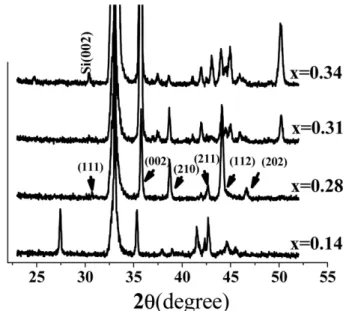
Fig. 1 shows XRD patterns of Ge
1 − xMn
xthin films grown at 400
oC. In the XRD patterns, it was confirmed that Ge
1 − xMn
xthin films were poly crystals. Moreover, in case of 28 at% grown samples at 400
oC, high magnetiza- tion values were detected at room temperature (as reported by us in Ref.7) and all peaks were indexed by Ge
3Mn
5phase without any other extra magnetic phases like single crystal. In the XRD patterns, it was detected that samples having 31 and 34 % of increased Mn contents had peaks of Ge
3Mn
5with unknown intermetallic com- pounds, in which the intensity of Ge
3Mn
5slightly decreased.
In order to understand the details of magnetic behaviors of Ge
1 − xMn
xthin films which have Ge
3Mn
5phases, magnetization characteristics were measured at low tem-
Fig. 1.
XRD patterns of Ge
1 − xMn
xthin films grown at 400
oC,
diffraction peaks indicated by arrows are those Ge
3Mn
5phase.
≪연구논문≫ 다결정 Ge1 - xMnx 박막에서 Ge3Mn5 …… − 임형규·찬티난안·유상수·백귀종·임영언·김도진·김효진·김창수 −
87
−perature by using a SQUID. Fig. 2 shows temperature dependence of the magnetization for the Ge
0.72Mn
0.28film grown at 400
oC with the magnetic field of 2 T is applied parallel to the film surface. The results of SQUID analysis implied that there was only one strong ferromagnetic phase, which has far bigger magnetization value than other phases in Ge
1 − xMn
xsystem. Also,
TCof the ferromagnetic phase was above room temperature. The M-H curves in Fig. 3, also display hysteresis loops at temperatures below 330 K.
However, the M-H curve at 330 K shows paramagnetic behavior. It could be ferromagnetic Ge
3Mn
5phases trans- formed to paramagnetic phases.
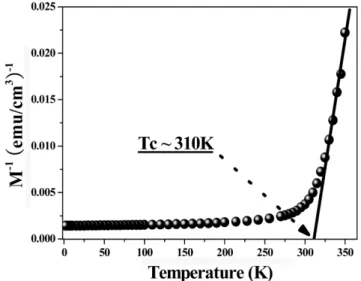
The Curie temperature was estimated from a Curie-Weiss fit to the data as the magnetization approaches to zero. As Shown in Fig. 4, it was confirmed that Ge
0.72Mn
0.28thin film exhibited ferromagnetic behavior with around 310 K of
TC.
We carefully measured the change of resistance that depends on temperature and magnetoresistance for the Ge
0.72Mn
0.28thin film. Fig. 5 shows a temperature de- pendence of ressistance curves without and with applied magnetic field of 9 T. The resistance decreased in the range of low temperature (T < 110 K), while the resistance increased in the range of high temperature (T > 110 K)
Fig. 4.
Temperature dependence of the inverse magnetization for Ge
0.72Mn
0.28film at grown 400
oC. Applied field was 2 T.
The solid line represents the fit of the Curie-Weiss law to the high temperature data.
Fig. 2.
Temperature dependence of the magnetization for the Ge
0.72Mn
0.28film grown at 400
oC using SQUID. Applied field was 2 T.
Fig. 3.
Magnetization hysteresis loops of Ge
0.72Mn
0.28film
grown at 400
oC using SQUID.
Fig. 5.Transport data for Ge
0.72Mn
0.28film at grown 400
oC:
Resistance vs. temperature for 0 T and 9 T.
−
88
− 한국자기학회지제19
권3
호, 2009
년6
월with applied field. In addition, at temperatures in the range of 0 < T < 250 K, the resistance increases with increasing of temperature, which is indicating metallic behavior. However at higher temperatures (T > 250 K) the resistance decreased like a behavior of semiconductors.
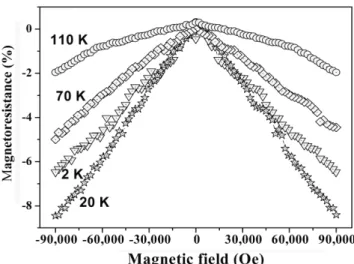
Magneto-transport measurements were performed with the current perpendicular to the applied field (± 9 T) at temperatures from 2 to 110 K. Significant magnetoresistance (
MR) is observed as shown in Fig. 6. It shows negative magnetoresistance (
MR) at temperatures below 110 K of Ge
0.72Mn
0.28thin film. When we applied field at each temperture, MR curves look like symmetry and the magnitude of MR ratio decreased as temperture increased.
The negative MR reaches to ~9 % at 20 K. This behavior is similar to the nano scale ferromagnetic cluster/semi- conductor systetm such as MnAs feromangetic cluster/
GaAs and Ge
8Mn
11cluster/Ge
1 − xMn
xmatrix [9, 11].
Therefore, the origin of negative MR in Ge
0.72Mn
0.28film at grown 400
oC could be explained by the spin dependent scattering of carriers by the ferromagntic Ge
3Mn
5cluster, where the scattering probality decrease as the direction of
the magnetization of cluster aligns with increasing external magnetic field.
In conlusion, we have grown and investigated mangetic and electrical propeties of Ge
1 − xMn
xthin films with the formation of Ge
3Mn
5magnetic phase. The XRD measure- ment reveals the formation of Ge
3Mn
5phase in Ge
0.72Mn
0.28film at grown 400
oC without any extra phases. Magnetic measurement reveals that the Ge
0.72Mn
0.28films show ferromangetic properties at room temperature, which is atributed to the formation of Ge
3Mn
5phase in the film.
The Curie temperature of Ge
0.72Mn
0.28thin film was de- termined around 310 K. The Ge
0.72Mn
0.28thin film shows negative magnetoresistance (
MR) at temperatures below 110 K. The negative MR at low temperature was observed due to the spin-dependent scattering of carriers by Ge
3Mn
5clusters.
Acknowledgement
This work was supported by the Brain Korea 21 Program (BK21, the Science And Technology & Human Resource Development, Korea).
References
[1] Y. D. Park,
et al., Science,
295, 651 (2002).
[2] H. Ohno,
et al., Nature,
408, 944 (2000).
[3] J. K. Furdyna,
et al., J. Appl. Phys.,
61(8), 15, 3526 (1987).
[4] P. J. Wellmann,
et al., Appl. Phys. Lett.,
71, 2532 (1997).
[5] N. Yamada,
et al., J. Phys. Soc. Japan.,
55(11), 3721 (1986).
[6] Y. M. Cho,
et al., J. Magn. Magn. Mater.,
282, 385 (2004).
[7] Y. E. Ihm, S. S. Yu,
et al., J. Magn. Magn. Mater.,
272, E1539 (2004).
[8] N. Yamada,
et al., J. Phys. Soc. Japan.,
59, 273 (1990).
[9] Y. D. Park,
et al., Appl. Phys. Lett.,
718, 2739 (2001).
[10] H. Takizawa,
et al., J. Solid State Chemistry,
88, 384 (1990).
[11] H. Aakinaga,
et al., Appl. Phys. Lett.,
72, 3368 (1998).
Fig. 6.