www.earticle.net
목초액의 급여가 이유자돈의 분 중 미생물과 가스성상에 미치는 영향
최재용․Prashant Shinde․권일경․송영한․채병조* 강원대학교 동물생명과학대학
Effect of Dietary Wood Vinegar on the Fecal Microbes and Gas Emission in Weaned Pigs
Jae Yong Choi, Yu Xin Yang, Prashant Shinde, Ill Kyung Kwon and Byung Jo Chae*
College of Animal Life Sciences, Kangwon National University
ABSTRACT
Two experiments were conducted to determine the effect of wood vinegar (WV) on the fecal
microbes and gas emission in weaned pigs. In Exp. 1, 224 weaned piglets (L×Y×D, 21 d-old, initial BW 6.02 ± 0.52 kg) were assigned to four treatments of different WV levels in randomized completely block design with four replicates (14 piglets/pen) for 28 days, including phases I (0-2 wk) and phase II (3-4 wk). The dietary treatments were 0, 0.1, 0.2 and 0.3% of WV added to a corn-soybean meal basal diet. The concentration of ammonia measured at 0 h and 24 h in feces did not differ among dietary treatments (p>0.05), but it was linearly decreased (p<0.05) in 0.2% and 0.3% addition level measured at 48 h and 72 h. The concentration of hydrogen sulfide had no significant change (p>0.05) within treatments measured at different time. The fecal total bacteria (TBC),Lactobacilli(LAB) and E. coli were measured on 14 d and 28 d. TBC were higher (p>0.05) in WV added treatments than the control. Similar results were obtained for LAB. ButE. coli populations were decreased (p<0.05) in treatments added WV compared to control measured on 14 d and 35 d. In Exp. 2, 288 weaned piglets (L×Y×D, 21 d-old, initial BW 6.62 ± 0.31 kg) were assigned to four treatments in a randomized completely block design with four replicates (18 piglets/pen) for 28 days. The dietary treatments were basal diet (negative control, NC), 0.2% organic acid (positive control, PC), 0.2% antibiotic (AT) and 0.2% WV added to a corn-soybean meal basal diet. The fecal total bacteria (TBC),Lactobacilli(LAB) and E. coli were measured on 14 d and 28 d. TBC, LAB andE. coli showed lower counts in pigs fed AT diets than others. In conclusion, these results indicated that wood vinegar could reduce the NH3 concentration of feces and inhibited the growth of harmful bacteria.Keywords: wood vinegar, gas concentration, fecal microbiology, weaned pigs
Ⅰ. 서 론
어린 자돈의 조기 이유는 이유 후 질병에 쉽게 감염되 어 생산성을 감소시킨다고 하였다(Pluske 등, 1997). 지난 몇 년 동안 항생제는 병원성 미생물에 의한 질병발생을 저 하시킴으로서 자돈의 생산성을 향상시키는데 효과적 이었 다(Visek, 1978). 그러나 오늘날 항생제의 오남용으로 인하
여 기존 항생제에 대한 내성을 지닌 미생물 유래의 항생제에 대한 저항 유전자가 무수히 출현하는 부작용이 초래되었다 (Aarestrup, 2000). 설파치아졸 및 클로로테트라싸이클린 (CTC) 등을 포함한 7개종이 감축되어질 것이며 아울러 2010 년까지 항생제 사용을 전면 규제한다는 정부방침이 확정되 어진 상태이다. 이러한 상황에서 항생제를 대체하기 위하여 생균제, 각종 생리활성 물질 및 유기산제들이 사용되어 지고
* Corresponding author: Byung Jo Chae, Tel: 82-33-250-8616, Fax: 82-33-244-4946, E-mail: [email protected]
[Provider:earticle] Download by IP 118.70.52.165 at Monday, December 20, 2021 8:12 PM
www.earticle.net
있다(Kamel, 2001). 일부 과학자들은 연구결과를 바탕으로 유기산제가 항생제의 궁극적인 대체 사료첨가제라고 하였으 나 이 항생제와의 비교를 통한 정확한 연구결과는 아직까지 명확하게 제시되어지지 않았기 때문에 보다 다양한 항생제 대체 비교실험이 수행되어져야 한다고 하였다(Jensen, 1998;
Partannen과 Mroz, 1999).
목초액이란, 주로 참나무나 뽕나무를 공기 중에서 가열 하는 산화과정이 아닌 숯가마와 같이 공기가 차단된 상태에 서 나무를 숯가마에 넣고 500~700℃로 탄화시킬 때 발생하 는 연기와 수증기를 냉각, 응축시켜 만든 것으로, 이 응축물 을 일정기간 동안 정치하면 3개의 층으로 분리되는데 보통 상층(경층류)과 하층(타르)을 분리․제거한 중간층의 수용액 을 말한다. 목초액의 주성분은 acetic acid를 포함한 유기산 과 광물질로 구성되어 있고, pH는 3.2~3.5정도로 알려져 있 다. 정제된 목초액을 상온에서 1개월 이상 보관하였을 때 대 장균이나 일반 세균이 전혀 검출되지 않았다. 이는 정제된 목초액 자체에 균 성장을 억제하는 기능이 있음을 나타내는 것으로 기존의 유기산과 동일한 혹은 그 이상의 효과가 있을 것으로 기대되어 천연 유기산제 라고도 하나 성장 촉진제로 서 목초액에 대한 가치를 평가하기에는 연구결과들이 부족 한 실정이다.
따라서 본 연구에서는 천연유기산제로서의 목초액을 이 유자돈 사료내 수준별로 첨가하고 기존의 유기산제 및 항생 제와의 비교실험을 실시함으로서 분 중 미생물과 가스 성상 에 어떠한 영향을 미치는지 알아보고자 실시하였다.
Ⅱ. 재료 및 방법
1) 시험설계 실험동물 및 시험사료
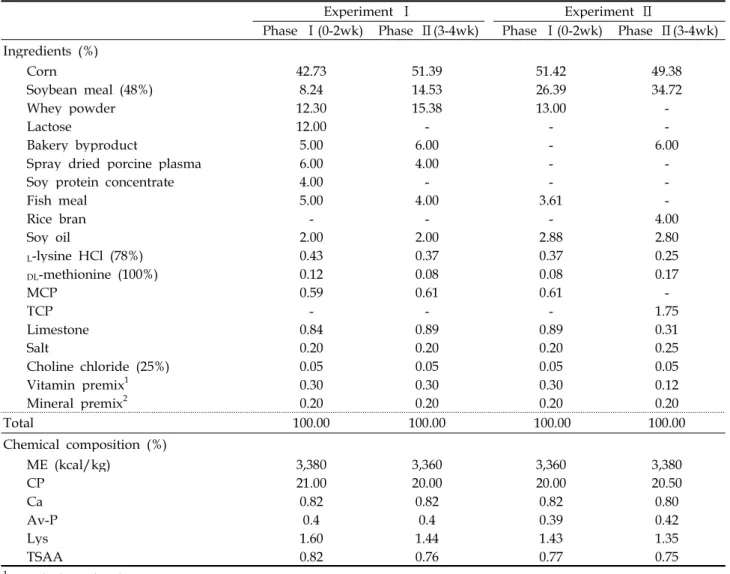
시험 1에서는 이유자돈(Landrace×Yorkshire×Duroc, 21±2일령, 6.02±0.52kg) 320두를 공시하여 성별과 체중에 따 라 4처리 4반복(반복 당 20두)에 완전임의 배치하였다. 시험 기간은 이유 후 2주(phase Ⅰ, 0~2wk)와 3~5주(phase Ⅱ, 3~4wk)로 나누어 총 4주(28일)간 실시하였다. Phase Ⅰ과 phase Ⅱ의 시험사료는 옥수수-대두박 위주의 사료에 목초 액(Wood vinegar, WV) 0, 0.1, 0.2 그리고 0.3% 첨가하여 배 합하였으며 시험사료의 영양소 수준은 NRC(1998)에서 제시 된 영양소 요구량을 충족하거나 초과하도록 배합하였으며 Table 1에서 보는 바와 같다.
시험 2에서는 이유자돈(Landrace×Yorkshire×Duroc, 21±1일령, 6.62±0.3kg) 320두를 공시하여 성별과 체중에 따 라 4처리 4반복(반복 당 20두)에 완전임의 배치하였다. 시험
기간은 2주(phase Ⅰ, 0~2wk)와 2주(phase Ⅱ, 3~4wk)로 나 누어 총 4주(28일)간 실시하였다. Phase Ⅰ과 Ⅱ의 시험사료 는 옥수수-대두박 위주의 사료에 0(negative control; NC), 0.2% 유기산(positive control, PC), 0.2% 항생제(Antibiotics, AT) 그리고 0.2% 목초액(Wood vinegar, WV)하여 배합하였 다. 본 시험에 사용된 유기산제는 phosphoric acid 21%, propionic acid 3.25%, formic acid 2.8%, calcium formate 10%와 calcium propionate 5%가 함유된 제제이고 항생제는 apramycin을 사용하였으며 장내 미생물 균총에 영향을 미치 는 산화아연(ZnO)은 시험사료에서 함유되지 않도록 하였다.
시험사료의 영양소 수준은 NRC(1998)에서 제시된 영양소 요구량을 충족하거나 초과하도록 배합하였으며 Table 2에 나타낸 바와 같다.
2) 조사항목
(1) 분 중 미생물
분 내 미생물을 분석하기 위하여 실험 개시 2주령과 4주 령에 설사를 하지 않는 돼지의 항문에서 배설되는 분을 직접 받아 공기와의 접촉을 최대한 줄이면서 채취한 후 밀봉하였 다. 모든 분은 채취 후 비닐팩에 밀봉하여 냉각된 아이스박 스에 저장하여 채취당일 즉시 실험실로 옮겨 분석하였다.
(2) 가스 농도
분 중 암모니아(NH3)와 황화수수(H2S) 농도를 측정하기 위하여 phase Ⅰ 종료시 각 반복으로부터 돼지의 항문에서 배설되는 분을 직접 받아 공기와의 접촉을 최대한 줄이면서 채취한 후 밀봉하였다. 모든 분은 채취 후 비닐팩에 밀봉하 여 냉각된 아이스박스에 저장하여 채취당일 즉시 실험실로 옮겨 분석하였다.
3) 실험적 측정 및 분석
분 내 미생물 검사는 분 5 g씩을 수거하여 45 ml 희석액 에 넣고 균질하게 1차 현탁액을 만들어 현탁액 1 ml를 9 ml 희석액에 연속 희석하였다. 희석 중 혐기 상태를 유지해 주 기위해 희석액 표면을 파라핀 오일로 코팅하였고 질소 가스 로 충진하며 실험하였다. 제조된 희석액 중 원하는 희석액에 서 1 ml를 페트리디쉬에 분주하여 배양하였다. 이 때 사용한 희석액은 peptone과 L-cysteine․HCl을 각각 0.5%, 0.05%씩 첨가한 용액을 사용하였다. 미생물 중 총균수(total anaerobic bacterial counts, TBC)는 Gas Pak System (BBL)을 사용하여 혐기상태로 배양하였고, Lactobacillus spp. counts(LAB)와 E.
coli counts는 호기 상태로 배양한 후 세균의 수는 각 plate의
[Provider:earticle] Download by IP 118.70.52.165 at Monday, December 20, 2021 8:12 PM
www.earticle.net
colony-forming unit (CFU)로 계산 후 log10으로 환산하였 다. 배양조건은 37℃, 48시간 이였다.
분 중 NH3와 H2S 농도 측정은 NIOSH(1998)에서 제시 한 방법을 응용하였다. 각 샘플(40g)은 증류수(120㎖)와 혼합 하여 gas sampling bag (Polyester bag, 200×150, Japan)에 넣은 후 밀봉하였다. 밀봉된 gas sampling bag에 air sampling pump (Handy Sampler, HS-7, Kimoto electronic Corp, Ltd. Japan)을 이용하여 공기(1ℓ/min)를 주입하였다.
Water bath 온도를 30℃로 설정하고 공기가 주입된 gas sampling bag을 water bath에 넣어 1시간 정도 교반한 후 3
0℃의 incubator에서 보관하였다. 보관된 샘플들로 부터 24 시간 간격으로 3일간 가스 측정기(iTX Multi-Gas Monitor, P/N 1810-4307, Industrial scientific Corp., USA)를 이용하 여 NH3와 H2S 농도를 측정하였다.
4) 통계적 분석
본 실험에서 측정된 분 중 미생물과 가스 농도 측정 데 이터는 SAS 프로그램(1998)을 이용하여 분산분석을 실시하 였고 처리평균간의 유의성 검정은 Duncan의 다중검정법 (Snedecor와 Cochran, 1980)을 이용하였다.
Table 1. Formula and chemical composition of diets for a feeding trial
Experiment Ⅰ Experiment Ⅱ
Phase Ⅰ(0-2wk) Phase Ⅱ(3-4wk) Phase Ⅰ(0-2wk) Phase Ⅱ(3-4wk) Ingredients (%)
Corn 42.73 51.39 51.42 49.38
Soybean meal (48%) 8.24 14.53 26.39 34.72
Whey powder 12.30 15.38 13.00 -
Lactose 12.00 - - -
Bakery byproduct 5.00 6.00 - 6.00
Spray dried porcine plasma 6.00 4.00 - -
Soy protein concentrate 4.00 - - -
Fish meal 5.00 4.00 3.61 -
Rice bran - - - 4.00
Soy oil 2.00 2.00 2.88 2.80
L
-lysine HCl (78%) 0.43 0.37 0.37 0.25
DL
-methionine (100%) 0.12 0.08 0.08 0.17
MCP 0.59 0.61 0.61 -
TCP - - - 1.75
Limestone 0.84 0.89 0.89 0.31
Salt 0.20 0.20 0.20 0.25
Choline chloride (25%) 0.05 0.05 0.05 0.05
Vitamin premix
10.30 0.30 0.30 0.12
Mineral premix
20.20 0.20 0.20 0.20
Total 100.00 100.00 100.00 100.00
Chemical composition (%)
ME (kcal/kg) 3,380 3,360 3,360 3,380
CP 21.00 20.00 20.00 20.50
Ca 0.82 0.82 0.82 0.80
Av-P 0.4 0.4 0.39 0.42
Lys 1.60 1.44 1.43 1.35
TSAA 0.82 0.76 0.77 0.75
1
Supplied per kg diet: 9,600IU vitamin A, 1,800IU vitamin D
3, 24mg vitamin E, 1.5mg vitamin B
1, 12mg vitamin B
2, 2.4mg vitamin B
6, 0.045mg vitamin B
12, 1.5mg vitamin K
3, 24mg pantothenic acid, 45mg niacin, 0.09mg biotin, 0.75mg folic acid, 18mg ethoxyquin.
2
Supplied per kg diet: 162mg Fe, 96mg Cu, 72mg Zn, 46.49mg Mn, 0.9mg I, 0.9mg Co, 0.3mg Se.
[Provider:earticle] Download by IP 118.70.52.165 at Monday, December 20, 2021 8:12 PM
www.earticle.net
Ⅲ. 결 과
시험 1
1) 분 중 미생물
Table 2는 목초액의 급여수준이 분 중 total bacteria count(TBC), lactobacillus bacteria(LAB) count 및 Escherichia coli(E. coli) count에 미치는 영향에 대한 실험결과를 나타낸 것이다. Phase Ⅰ 동안의 TBC는 0.2% 첨가구까지 유의적으 로 증가하다가 다시 감소하는 경향을 나타내었다(p<0.05).
LAB는 WV의 첨가수준이 증가할수록 유의적으로 증가하였 으나(p<0.05)E. coli는 감소하는 경향을 나타내었다(p<0.05).
Phase Ⅱ 동안의 TBC, LAB 그리고 E. coli는 phase Ⅰ과 동 일한 경향을 나타내었다.
Table 2. Effect of wood vinegar on fecal microbial populations (log
10CFU/g ) in weaned pigs
Level, %
SEM
1P-values
20 0.1 0.2 0.3 L Q
Day 14
TBC 7.69 8.10 8.22 7.96 0.0701 0.1060 0.0143 LAB, 8.42 8.66 8.71 8.74 0.0527 0.0386 0.3044
E. coli7.44 7.33 7.23 7.10 0.0585 0.0396 0.9243 Day 28
TBC 7.95 8.13 8.23 7.78 0.0756 0.5374 0.0411 LAB 8.69 8.60 9.09 9.09 0.0846 0.0221 0.7645
E. coli6.33 6.15 5.89 6.03 0.0655 0.0463 0.1955
1Pooled standard error means.
2L: Linear effect, Q: Quadratic effect.
Table 3. Ammonia and hydrogen sulfide emission in fresh feces from pigs fed diets containing different levels of dietary wood vinegar extract (day 14)
Level, %
SEM
1P-values
20 0.1 0.2 0.3 L Q
NH
3,ppm
Hr, 0 ND
3ND ND ND - - -
24 16.42 16.26 16.24 16.29 0.0870 0.6221 0.5908 48 21.52 21.15 20.75 20.75 0.1465 0.0458 0.5135 72 18.38 18.21 17.81 17.52 0.1487 0.0303 0.8315 H
2S, ppm
Hr, 0 ND ND ND ND - - -
24 ND ND ND ND - - -
48 4.50 4.06 4.36 4.36 0.1134 0.9263 0.3760 72 5.18 5.11 5.45 5.365 0.0952 0.3250 0.9753
1
Pooled standard error means.
2
L: Linear effect, Q: Quadratic effect.
3
Not detected.
2) 분 중 NH3와 H2S 농도
Table 3은 목초액의 첨가수준에 따른 분 중 NH3및 H2S 의 농도를 나타낸 것이다. 분 중 NH3 농도를 0시간 그리고 24시간 후에 측정한 결과에서는 처리구간에 유의적인 차이 가 나타나지 않았다(p>0.05). 48시간과 72시간 후에는 0.2와 0.3% 처리구에서 유의적으로 감소하는 경향을 나타냈으나 (p<0.05) 두 처리간에는 유의적인 차이가 나타나지 않았다 (p>0.05). 분 중 H2S 농도는 각 처리구에서 유의적인 차이가 나타나지 않았다(p>0.05).
시험 2
1) 분 중 미생물
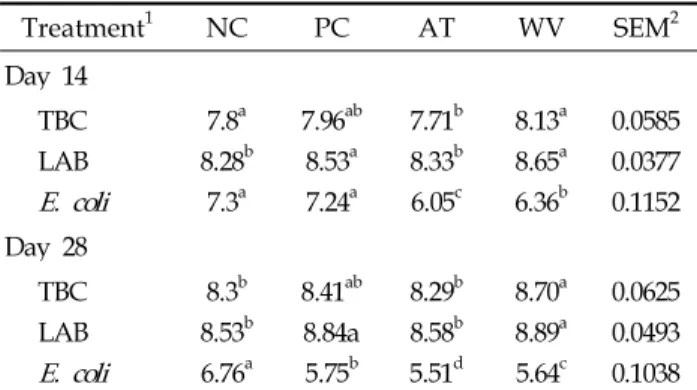
Table 4는 organic acid(PC), antibiotics(AT) 및 wood vinegar(WV) 첨가에 따른 분 중 미생물 변화를 나타낸 것이 다. Phase Ⅰ에서 TBC는 WV 첨가구에서 유의적으로 높게 (p<0.05) 나타났으며 LAB는 WV에서 높게 나타났으나 PC와 비교시 유의적인 차이는 나타나지 않았다(p>0.05).E. coli는 AT에서 유의적으로 낮게 나타났으며(p<0.05) WV 첨가구는 AT보다는 높으나(p<0.05) NC와 PC보다는 유의적으로 낮게 나타났다(p<0.05). Phase Ⅱ에서 TBC, LAB 및 E. coli는 phase Ⅰ과 동일한 경향을 나타내었다.
Table 4. Effect of dietary antibiotics and wood vinegar on the fecal microbial populations (log
10CFU/g ) in weaning pigs
Treatment
1NC PC AT WV SEM
2Day 14
TBC 7.8
a7.96
ab7.71
b8.13
a0.0585 LAB 8.28
b8.53
a8.33
b8.65
a0.0377
E. coli7.3
a7.24
a6.05
c6.36
b0.1152 Day 28
TBC 8.3
b8.41
ab8.29
b8.70
a0.0625 LAB 8.53
b8.84a 8.58
b8.89
a0.0493
E. coli6.76
a5.75
b5.51
d5.64
c0.1038
abcd
Values with different superscripts of the same row are significantly differ (p<0.05).
1
NC: negative control, PC: positive control (organic acid), AT: antibiotic, WV: wood vinegar
2
Pooled standard error means.
[Provider:earticle] Download by IP 118.70.52.165 at Monday, December 20, 2021 8:12 PM
www.earticle.net
Ⅳ. 고 찰
양돈 사료에 사용되어지는 항생제의 효과에 대한 연구 결과들은 항생제의 긍정적인 효과만을 강조하고 있다(Doyle, 2001). 하지만 최근에는 항생제 내성 E. coli(Doyle, 2001), campylobacter(Beilei 등, 2003), 그리고 enterococci(Aarestrup 등, 2002) 등과 같은 미생물들이 발견되어지고 있어 오히려 항생제 사용에 따른 부작용에 대한 문제점이 대두되고 있다. 이에 따라 항생제를 대체할 새로운 대체물질 개발에 관하여 많은 연구가 진행되어지고 있다.
이유자돈은 위내 적정 pH(3.4)를 유지할 만큼 충분한 위 산을 분비하지 못하기 때문에 유기산을 급여함으로써 위내 pH를 낮출 수 있다. 위내 pH가 적정수준으로 유지되면 단백 질 분해효소 분비가 활발하여(Canibe 등, 2001) 단백질 소화 능력이 증가하고 lactobacilli와 같은 유익한 미생물 균총이 장내에 우점하게 되어 자돈이 건강하게 성장할 수 있다 (Blanchard 등, 2000). 또한, 유기산은 박테리아 활동에 우선 적으로 관여하는 항미생물작용을 하는 것으로 알려져 있으 며, Cole 등(1968)은 이유자돈 사료내 0.8%의 유기산을 첨가 하여 급여했을 때 십이지장과 공장내 E. coli의 수가 효과적 으로 감소하였고, 병원성 E. coli의 번식을 억제하여 설사 발 생율을 감소시킨다고 하였다(Thompson과 Lawrence, 1981).
유기산의 항미생물작용은 유기산제의 종류에 따라 작용하는 대상 미생물 또한 다르다고 하였으나 formic acid(Bolde 등, 1988; Gedek 등, 1992)와 lactic acid(Geary 등 1999;
knarreborg 등, 2002) 모두 Escherichia coli와 salonella 같은 박 테리아를 억제한다고 하였다. 이러한 연구결과들은 본 시험 에서 WV의 첨가수준이 증가함에 따라 TBC와 LAB는 증가하 였고 E. coli는 감소한 결과와 일치하는 것으로 나타났다. 분 중 NH3농도는 WV의 첨가수준에 따라 감소하였는데 아마도 장내 병원성 미생물을 감소시켜 영양소 흡수를 원활하게 하 여 단백질 소화율을 향상시킴으로서(Dibner and Buttin, 2002) 질소 배출을 감소시키고 악취 유해 미생물을 억제하였 기 때문이라 판단된다.
항생제는 장내 병원성 미생물이나 바이러스들에 직접적 으로 작용하여 장내 균총을 변화시키고 병원성 박테리아와 세균을 통제함으로서 자돈의 설사 및 돼지 출혈성 장 질환을 치료하거나 clostridium perfringens 감염을 예방한다(Hays, 1981; SOU, 1997; Thomke 등, 1997; Thomk 등, 1998; Corpet 등, 2000). Collier 등(2003)과 Dibner 등(2007)은 어린자돈에 게 항생제를 5주간 급여하였을 때 장내 미생물 균총에 영향 을 미쳐 TBC,E. coli와 lactobacilli(Gaskins 등, 2002)을 감소
시킨다고 하였다. 이러한 연구결과는 본 시험의 결과와도 일 치하는 것으로 나타났다. 본 연구결과에서는 항생제 (Aantibiotics, AT) 처리구의 TBC, LAB 및 E. coli는 WV, PC 보다 낮은 것으로 나타났다. 즉 AT 첨가는 유해균(E. coli)을 억제하지만 유익균인 LAB도 억제하는 것으로 나타났다. WV 에서 TBC와 LAB가 증가하였고 E. coli는 감소하였는데, 천연 유기산제인 WV는 장내 유익 미생물이 잘 성장할 수 있도록 pH와 같은 조건을 잘 조절해주었기 때문이라 판단된다.
본 연구결과 목초액(wood vinegar, WV)은 장내 미생물 균총에 변화를 미침으로서 분 중 유익 미생물을 증가시키고 유해 미생물을 억제하였으며 그 결과 악취가스 발생이 감소 하는 것으로 나타났다. 또한 항생제는 선택적 미생물 억제를 하지 못하였지만 WV는 유해 미생물을 억제하고 유익 미생 물을 증가시키는 선택적 조절작용을 하는 것으로 나타났다. 하지만 천연 유기산제로서의 목초액을 사료 첨가제로 사용 하기 위해서는 보다 많은 연구가 수행되어져야 할 것이다.
Ⅴ. 요 약
본 시험은 목초액의 급여가 이유자돈의 분 중 미생물과 가스 발생에 미치는 영향에 대하여 알아보고자 실시하였다. 시험 1에서는 목초액(wood vinegar, WV)의 첨가수준에 따 른 분 중 미생물 및 가스 발생량을 조사하였는데, 시험 결과 목초액의 급여수준이 증가할수록 TBC와 LAB가 유의적으로 증가하였으며(p<0.05),E. coli는 유의적으로 감소하는 경향을 나타내었다(p<0.05). 그리고 목초액은 분 중 H2S 발생에는 영향을 미치지 못하였으나(p>0.05). NH3농도는 목초액의 첨 가수준이 증가함에 따라 감소하는 것으로 나타났다(p<0.05).
시험 2에서는 organic acid(PC), antibiotics(AT) 및 wood vinegar(WV) 첨가에 따른 분 중 미생물 변화를 조사하였다.
분 중 TBC와 LAB는 WV 첨가구에서 유의적으로 높게 (p<0.05) 나타났으나 PC와 비교시 유의적인 차이는 나타나 지 않았다(p>0.05). 그러나 E. coli는 AT에서 유의적으로 낮게 나타났다(p<0.05).
감사의 글
본 연구는 중소기업청의 중소기업 기술혁신 개발 사업 으로 수행된 연구결과의 일부이며, 강원대학교 동물자원공 동연구소의 일부 연구비 지원하에 수행되었습니다.
[Provider:earticle] Download by IP 118.70.52.165 at Monday, December 20, 2021 8:12 PM
www.earticle.net
Ⅵ. 인용문헌
1. Aarestrup, F. M. 2000. Occurrence, selection and spread of resistance to antimicrobial agents used for growth promotion for food animals in Denmark. APMIS.
108(Suppl101): 5-48.
2. Aarestrup, F. M., H. Hasman, L. B. Jensen, M. Moreno, I. A. Herrero, L. Domínguez, M. Finn and A. Franklin.
2002. Antimicrobial resistance among Enterococci from pigs in three European countries. Appl. Environ.
Microbiol. 68:4127-4129.
3. Anderson, D. B., V. J. McCracken, R. I. Aminov, J. M.
Simpson, R. I. Mackie, M. W. A. Verstegen and H. R.
Gaskins. 1999. Gut microbiology and growth- promoting antibiotics in swine. Pig News Inform. 20:
115N–122N.
4. AOAC. 1990. Official method of analysis (15th ed).
Association of Official Analytical Chemists. Arlington.
VA.
5. Beilei, G., D. G. White, P. F. McDermott, W. Girard, S.
Zhao, S. Hubert and J. Meng. 2003. Antimicrobial resistant campylobacter species from retail raw meats.
Appl. Environ. Microbiol. 69:3005-3007.
6. Blanchard, P and F. Wright. 2000. Less buffering....more enzymes and organic acids. Pig Progr. 16:23-25.
7. Bolduan, G., H. Jung, R. Schneider, J. Block and B.
Klenke. 1988. Die Wirkung von Propion- und Ameisensӓure in der Ferkelaufzucht. Journal of Animal Physiology and Animal Nutrition 59:72–78.
8. Canibe, N., S. H. Steien, M. Øverland and B. B. Jensen.
2001. Effect of K-diformate in starter diets on acidity, microbiota, and the amount of organic acids in the digestive tract of piglets, and on gastric alterations. J.
Anim. Sci. 79:2123-2133.
9. Cole, D. J. A., R. M. Beal and J. R. Luscombe. 1968.
Observations on the stomach contents of the suckling pig. Proc. Nutr. Soc. 27: 6A(Abstr.).
10. Collier, C. T., M. R. Smiricky-Tjardes, D. M. Albin, J.
E. Wubben, V. M. Gabert, B. Deplancke, K. Bane, D.
B. Anderson and H. R. Gaskins. 2003. Molecular ecological analysis of porcine ileal micorbiota responses to antimicorbial growth promoters. J. Anim.
Sci. 81:3035-3045.
11. Corpet, D. E. 2000. Mechanism of antimicrobial growth promoters used in animal feed (French). Rev Med Vet. 151:99–104.
12. Dibner, J. J and P. Buttin. 2002. Use of organic acids as a model to study the impact of gut microflora on nutrition and metabolism. J. Appl. Poult. Res. 11:
453-463.
13. Doyle, M. E. 2001. Alternatives to antibiotics use for growth promotion in Animal Husbandry. University of Wisconsin Madison 2001 Food Research Institute Briefings. pp. 1-17.
14. Gaskins, H. R., C. T. Collier and D. B. Anderson. 2002.
Antibiotics as growth promotants: mode of action.
Anim. Biotechnol. 13:29-42.
15. Geary, T. M.; Brooks, P. H.; Beal, J. D.; Campbell, A., 1999: Effect on weaner pig performance and diet microbiology of feeding a liquid diet acidified to pH 4 with either lactic acid or through fermentation with Pediococcus acidilacti. Journal of Science Food and Agriculture 79:633–640.
16. Gedek, B., M. Kirchgessner, U. Eidelsburger, S.
Wiehler, A. Bott and F. X. Roth. 1992: Zum Einfluss von Ameisensa Ameisensӓure auf die Keimzahlen der Mikroflora und deren Zusammensetzung in verschiedenen Segmenten des Gastrointestinaltktes: 5.
Mitteilung. Untersuchungen zur nutritiven Wirksamkeit von organischen Sӓuren in der Ferkelaufzucht. Journal of Animal Physiology and Animal Nutrition 67:206–214.
17. Jensen, B. B. 1998. The impact of feed additives on the microbial ecology of the gut in young pigs. Jounal of Animal Feed Science 7:45–64.
18. Kamel, C. 2001. Tracing modes of action and the roles of plant extracts in non-ruminants. Recent Adv. Anim.
Nutr. 135-150.
19. Knarreborg, A., N. Miquel, T. Granli and B. B. Jensen.
2002: Establishment and application of an in vitro methodology to study the effects of organic acids on coliform and lactic acid bacteria in the proximal part of the gastrointestinal tract of piglets. Animal Feed Science and Technology 99:131–140.
[Provider:earticle] Download by IP 118.70.52.165 at Monday, December 20, 2021 8:12 PM
www.earticle.net
20. Mosenthin, R., W. C. Sauer, F. Ahrens, C. F. M.
DeLange and U. Bornholdt. 1992. Effect of dietary supplements of propionic acid, siliceous earth or a combination of these on the energy, protein and amino acid digestibilities and concentrations of microbial metabolites in the digestive tract of growing pigs. Anim. Feed Sci. Technol. 37:245-255.
21. NIOSH (National Institute for Occupational Safety and Health). 1998. Sampling and characterization of bioaerosols. In: Paul, J. J and M. P. Schafer (Eds.), SManual of Analytical Method. Cincinnati, Ohio, USA.
22. NRC. 1998. Nutrient requirements of swine (10th Ed).
National Academy Press, Washington, D.C.
23. Partanen, K. H and Z. Mroz. 1999. Organic acids for performance enhancement in pig diets. Nutrition Research Reviews. 12:1-30.
24. Pluske, J. R., D. J. Hampson and I. H. Williams. 1997.
Factors influencing the structure and function of the small intestine in the weaned pig: A review. Livest.
Prod. Sci. 51:215-236.
25. SOU. 1997. Antimicrobial Feed Additives. Swedish Government Official Report. Stockholm: Fritzes Bookshop.
26. Thomke S and K. Elwinger. 1998. Growth promotants in feeding pigs and poultry. II Mode of action of antibiotic growth promotants. Ann. Zootech. 3:153–
167.
27. Thompson, J. L and M. Hinton. 1997. Antibacterial activity of formic and propionic acids in the diet of hens on salmonellas in the crop. British Poultry Science 38:59-65.
28. Visek, W. J. 1978. The mode of growth promotion by antibiotics. J. Anim. Sci. 46:1447-1469.
(Received: 2007.11.5, Accepted: 2007.12.10)