산림분야 온실가스 인벤토리 산정을 위한 산림활동 자료 구축 및 산림경영률 산정
함보영*⋅송철호*⋅박은빈**⋅최솔이**⋅이우균***†
*고려대학교 환경 GIS/RS센터 연구원, **고려대학교 환경생태공학과 박사과정학생, ***고려대학교 환경생태공학부 교수
Development of Forest Activity Data and Forest Management Rate for National Greenhouse Gas Inventory in the Forest Sector
Ham, Boyoung
*․Song, Cholho
*․Park, Eunbeen
**․Choi, Sol-E
**and Lee, Woo-Kyun
***†*
Researcher, Environmental GIS/RS Center, Korea University, Seoul, Korea
**
Ph.D. Student, Department of Environmental Science and Ecological Engineering, Korea University, Seoul, Korea
***
Professor, Division of Environmental Science and Ecological Engineering, Korea University, Seoul, Korea
ABSTRACT
After the Paris Agreement, the Republic of Korea also has own Nationally Determined Contributions (NDCs), and forest sector has to sequestrate 22 million tons of CO2 eq. by 2030 and to develop a national inventory and Land‐Use, Land Use Change, and Forestry (LULUCF) system. However, forest activity data have been neglected in the assessment process, because they have been partially recorded from various data sources. Therefore, this study collects available data to represent forest activity data and integrates them considering spatial availability based on Intergovernmental Panel on Climate Change (IPCC) guidelines and approaches from the Kyoto Protocol.
National and private spatial data were collected, and the available data as forest activity data were selected.
Subsequently, forest management records on address‐based locations were converted to spatial data by spatial joining and overlying. As a result, around 1.25 million forest management and afforestation recodes are available.
Based on these records, the estimated average forest management rate considering regional distribution is 31.2%
during 2013‐2017, and the estimated forest management rate reflecting average values for missing management recodes is 43.1% during 2003‐2017. This study suggests a spatial approach to develop proper calculation of forest management rate despite differences in forest management rate caused by missing data from filed activities and limitation of spatial data during overlaying analysis. Therefore, more forest data are needed to secure the future development of a national forest inventory.
Key words: Forest inventory, Forest activity data, Forest management rate, Forest statistics
†
Corresponding author: [email protected] (145 Anamro,
Seonbukgu, Seoul, 02841, Republic of Korea, Tel.+82-2-3290- 3470)ORCID 함보영 0000-0002-3303-0201 송철호 0000-0002-8491-9545 박은빈 0000-0002-0442-7621 최솔이 0000-0002-9465-8174 이우균 0000-0002-2188-359X
Received December 16, 2019 / Revised January 3, 2020 / Accepted January 15, 2020
1. 서 론
신기후체제의 기반이 되는 파리협정 (Paris Agreement) 채 택 이후, 각 국가는 자국의 환경 및 사회적 상황을 고려한 온 실가스 감축 (Mitigation)과 기후변화 적응 (Adaptation) 목표 인 자발적국가기여 (Nationally Determined Contributions, NDCs)를 스스로 설정하였다 (Lee and Park, 2017). 이는 기 존 교토의정서 (Kyoto Protocol) 체제에서 의무감축국
(Annex 1)이 온실가스 감축 의무를 하향식 (Top-down)으로 부여받는 것에 비해, 각 선진국과 개도국 등을 포함한 195개 국가들이 스스로 감축 의무를 설정하는 상향식 (Bottom-up) 방식으로의 체제 전환을 의미한다 (Bae and Seol, 2019). 따 라서, 신기후체제 달성을 위한 각 국가의 자발적 이행과 평 가 시스템 강화가 중요한 의제로 떠오르고 있다. 그리고 자 발성이 강화됨에 따라서 국제사회에 NDCs 이행 및 보고를 위한 국가 온실가스 인벤토리 (National Greenhouse Gas
Inventory) 산정이 중요해졌다 (IPCC, 2000).
온실가스 흡수량 산정은 파리협정 전문에 언급된 온실가 스의 흡수원 (Sink)과 저장소 (Reservoirs)의 적절한 보존 및 강화의 중요성을 인식하는 활동 중의 하나로 풀이된다. 이에 각 국가는 온실가스 배출량과 흡수량을 건전하고 투명하며 과학적으로 정확한 방법으로 산정하여 국제사회에 보고해야 한다 (IPCC, 2006). 특히, 파리협정 4조와 5조에는 온실가스 흡수원과 저장소를 보전하고 증진해야 하며, 이를 위한 평가 에는 환경적 건전성, 투명성, 정확성, 완전성, 비교가능성, 일 관성 등을 고려할 것을 명시하고 있다. 그리고 기존 방법론과 지침을 적절히 고려한 평가를 수행할 것을 권고하고 있다 (UNFCCC, 2015). 따라서 1996년부터 2006년까지 발간된 기 후변화에 관한 정부간 패널 (Intergovernmental Panel on Climate Change, IPCC)의 가이드라인들을 활용하는 것이 중 요하게 인식되고 있다.
산림은 여러 인벤토리 중 온실가스를 흡수하고 저장하는 역할을 한다 (Kim et al., 2014). 산림은 인벤토리 산정 부문 중 하나인 토지이용 및 토지이용변화와 산림 (Land-Use and Land Use Change and Forestry, LULUCF)에 포함되어 있고, 평가 방식에 따른 Tier 수준 향상 및 LULUCF 내 토지이용 간 정확한 면적 산정을 위한 Approach 방법론 설정이 필요한 것으로 알려져 있다 (Yu et al., 2019; Park et al., 2018). 특히, 우리나라는 2030년 기준 배출전망치 (Business As Usual, BAU) 대비 37% 감축 목표를 갖고 있으며, 산림 부문은 현재 의 이산화탄소 순 흡수량인 연간 약 4천 5백만톤에서 추후 NDCs 달성을 위한 이산화탄소 순흡수량으로 연간 2천 2백만 톤을 유지해야 하는 상황이다 (GIR, 2019; ME, 2018). 이에 따라 국내에서 산림부분의 온실가스 순흡수량 추계를 산정하 기 위하여 통계적인 분석과 기후 인자를 반영한 다양한 산림 생장 모형 등이 개발되고 제시되어왔다 (Piao et al., 2018;
Kim et al., 2017). 하지만 현재 분석들은 교토의정서 2조 4항 에 따른 탄소배출권의 인정을 위한 산림경영활동 내용 및 Tier 3 수준의 온실가스 인벤토리 산정의 고도화에 해당하는 산림경영활동 (Forest Management Rate, FMR)에 따른 임분 변화를 반영하지 못하고 있다. 이는 산림부문의 고도화된 (Tier 3) 온실가스 인벤토리 산정에 있어서 IPCC의 가이드라 인이 제시하는 활동자료 (Activity Data)의 누락이 있음을 의 미한다 (Park et al., 2018). 이러한 문제점을 인식하고 국내에 서도 교토의정서에 따른 산림경영률 추정이 수행되어진 바 있지만 지역수준의 분석으로 전국 적용에는 한계점이 있다 (Kim, et al., 2013).
따라서 국가 온실가스 인벤토리 산정의 고도화를 위하여
전국 수준에서의 산림 경영 활동에 대한 추정이 필요하며, 이 러한 산림경영 활동 내용은 IPCC 가이드라인과 교토의정서 하에 인정되는 흡수원 활동인 신규조림 (Afforestation), 재조 림 (Reforestation) 및 산림 전용지 (Deforestation)에 대한 파 악과 함께 산림경영 (Forest Management) 등에 대한 활동자 료를 반영해야 한다 (Yim et al., 2015; Bae, 2009). 따라서 본 연구는 기 구축된 산림공간정보를 활용하여 우리나라 산림경 영률을 계산하는 방법을 제시하고 보다 정확한 산림경영률을 추정하고자 하였다. 이를 통해 현행 산림부문의 온실가스 인 벤토리 산정 체계 개선 및 고도화를 위한 기반을 마련하는 것 을 목표로 하였다.
2. 연구 재료 및 방법
2.1 산림분야 온실가스 흡수량 및 활동자료 산정 체계
산림분야 산림경영활동의 온실가스 흡수량 산정의 기준 설정에 있어서 교토의정서 1차 공약기간에 적용된 방법은 기 간 내 배출량을 평가하는 Gross-net 방식이었다. 이는 교토의 정서 체제 내의 기준연도 배출량과 공약기간 배출량 차이를 계산하는 Net-net 방식과 차이가 있었으며, 기준 시점과의 비 교가 없으므로 공약기간 내의 일부 활동에 따라 큰 폭으로 흡 수량 산정이 변할 수 있다는 약점을 갖고 있었다 (KFS, 2016). 따라서 교토의정서 2차 공약기간에 적용될 방법론으 로 산림경영기준선 (Forest Management Reference Level, FMRL)을 설정하도록 제18차 기후변화협약 당사국총회에서 논의가 이루어졌다. 각 국가별로 FMRL은 UNFCCC (United Nations Framework Convention on Climate Change) 기술검 토를 통해 인정을 받게 되는데, BAU (Business As Usual)를 통한 평균 흡수량과 과거 통계를 활용하는 방식, 1차 공약기 간의 기준년도인 1990년 기준을 활용하는 방식, 산림경영기 준선을 0으로 하여 배출권을 인정받는 Gross-net을 그대로 인 정하는 방식 등이 존재한다. 이렇게 설정된 산림경영기준선 과 2차 공약기간 내의 흡수량을 비교하여 기준선에 따라 배 출권 할당 및 차감을 달리하는 것이 활동자료와 온실가스 흡 수량 산정 기준 설정의 기본 체계이다 (Bae and Seol, 2019).우리나라 대부분의 산림시업활동은 IPCC에서 정의하는 지속가능한 방식으로 산림을 관리․이용하기 위한 시업시스 템에 해당한다. 우리나라의 산림은 일본과 유사하게 지속가 능한 산림경영을 수행하고 있음에도 불구하고 임분의 고령화 로 인한 산림의 이산화탄소 흡수량이 감소하고 있는 추세이 다 (KOFPI, 2017). 그렇기 때문에 FMRL 산정에 있어서 현재
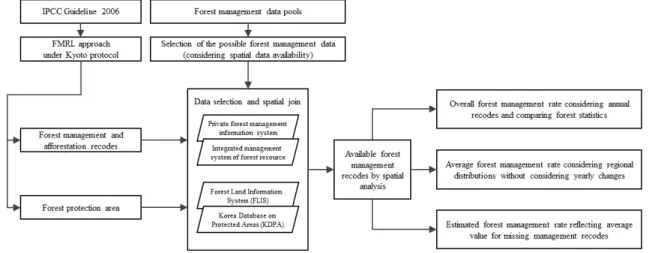
Fig. 1. Research flow for estimating forest management rate.
의 산림 상태를 지속적인 산림경영의 결과로 인식하고 이를 모두 인정받는 방식인 Gross-net 방식이 우리나라에 유리하 다고 할 수 있다. 이에 본 연구에서는 보호림에 대해서는 Gross-net 방식이 타당하다고 가정하며, 실제로 산림경영이 일어난 산림을 대상으로는 FMRL 값을 0으로 설정하는 방식 을 적용하여 분석을 수행하였다.
기본적으로 산림경영률은 전체 산림 중에서 산림경영활동 정보가 존재하는 산림의 면적 비율을 의미한다. 그리고 공간 자료를 기반으로 하여 FMRL 설정 방식을 따라 산림경영률 을 구분하여 선정해야 한다. FMRL을 보호림과 육성림으로 구분한다고 설정하였을 시의 보호림은 산림보전 및 보호를 위한 산림경영활동이 진행 중인 산림으로, 우리나라의 산림 내 각종 보호구역 및 행위제한 지역과 유사한 형태에 해당한 다. 반대로 육성림은 조림지 정리, 숲가꾸기, 간벌 및 벌채를 통한 수확 등의 모든 산림경영활동이 일어나는 산림으로, 우 리나라 산림경영 단계별 프로세스와 유사한 형태를 갖는다.
따라서 본 연구에서는 우선적으로 산림경영에 따른 활동 자료를 기 구축된 국가공간자료를 기반으로 수집하며, 이를 활용하여 산림경영률을 산정하였다. 산정을 위한 산림경영활 동은 크게 조림과 숲가꾸기로 구분하였으며, 공간자료의 정 합을 통해 해당 활동 건수를 우선 파악하였다. 전체 산림면적 대비 산림경영활동 면적의 산정이 필요하기 때문에 시업의 종류나 시업 내 작업 종류 (조림갱신, 보완조림, 보식, 큰나무 숲가꾸기, 어린나무 숲가꾸기, 조림지 숲가꾸기 등)를 고려하 지 않고 최대면적 시업법을 적용하였다. 이는 일본에서 산림 경영률을 계산하는 주된 방식이며, 국가차원의 시스템적 산 림경영활동 관리에 있어서 중복되는 계산을 방지하기 위한 현실적인 방식이다 (Seo et al., 2015). 이렇게 도출된 산림경
영활동 정보를 바탕으로 산림경영활동에 대한 추세를 파악하 기 위해 연도를 고려한 산림경영률과 일부 누락된 자료를 대 체하여 산림경영률을 추정한 결과를 순서대로 산출하였다 (Fig. 1).
2.2 산림 공간자료 수집 및 전처리
산림분야 공간자료 또한 FMRL에 맞게 육성림 등에서 구 축되는 산림경영활동 관련 자료와 보호구역과 관련된 공간정 보를 수집하였다 (Kim et al., 2013). 산림경영활동 자료 구축 에는 사유림 및 국유림 경영정보 시스템, 새올산림행정시스 템, 산림자원 통합관리시스템, 조림 숲가꾸기 이력 관리시스 템을 이용하였으며, 수집된 각 공간자료는 다른 시기의 시계 열 정보를 갖고 있었다. 보호구역 관련 정보는 산지정보시스 템, 토지이용 규제정보서비스, 한국보호지역 통합 데이터베 이스 관리시스템 등에서 수집하였다. 수집된 자료는 공통적 으로 IPCC가 설정한 산림경영활동에 해당하였다. 그러나 공 간적 측면에서는 일부 자료만이 활용 가능했으며, 경우에 따 라서 해당 자료를 공간정보로 전환해야 해야 했다 (Table 1).
본 연구에서는 산림자원 통합관리시스템의 경우에 2018년 3월 기준 자료를 활용하였다. 수집된 자료들에는 총 180만여 건의 숲가꾸기, 조림, 벌채지에 대한 자료가 국유림과 사유림 에 걸쳐 기록되어 있었다. 국유림의 경우에는 2003년부터 자 료의 확보가 가능한 것으로 나타났으나, 사유림의 경우에는 2012년부터 자료가 가용한 것으로 파악되었다 (Table 2).
한국보호지역 통합 데이터베이스 관리시스템 (Korea Database on Protected Areas, KDPA)은 환경부․해양수산 부․국토교통부․문화재청․산림청 등 5개 부처에서 14개의
Category System Data IPCC standard Spatial data
availability Unit Year of data
Information of forest management activity data
Private forest management
information system
Forest management deforestation, forest fire,
afforestation, conversion
Narrow definition of forest management
Not provided possible to
modify
Plot Provided 2003-2017
National forest management
information system
Forest management deforestation, forest fire,
afforestation, conversion
Narrow definition of
forest management Not provided Forest compartment
Provided before 2012
Saeol forest governance
system
Forest management deforestation, forest fire,
afforestation, conversion
Narrow definition of
forest management Not provided Plot Provided 2003-present Integrated
management system of forest resource
Forest management deforestation, forest fire,
afforestation, conversion
Narrow definition of
forest management Provided
Forest compartment
&plot
Provided after 2012
(national forest) Afforestation,
forest management
history management
system
Afforestation, forest management
Narrow definition of
forest management Not provided Plot Provided 1962-2002
Information of Protection
Area
Forest Land Information System (FLIS)
Regulated regional information based on 28 relevant legislation
(public interest / forestry forest) Narrow definition of forest management
Provided Area Not provided (present)
Permission of forest conversion Not provided Plot Provided after 2007 Land Use
Regulation Information System (LURIS)
All regulatory information services in the country
Narrow definition of forest management
(information of land)
Provided Area Not provided
Korea Database on Protected Areas (KDPA)
Protection area by Ministry of Environment / Ministry of Oceans and Fisheries / Ministry
of Land, Infrastructure and Transport / Cultural Heritage Administration / Korea Forest
Service and their laws
Narrow definition of
forest management Provided Area
Provided (after 1962, according to type of data) Table 1. List of forest management activity data
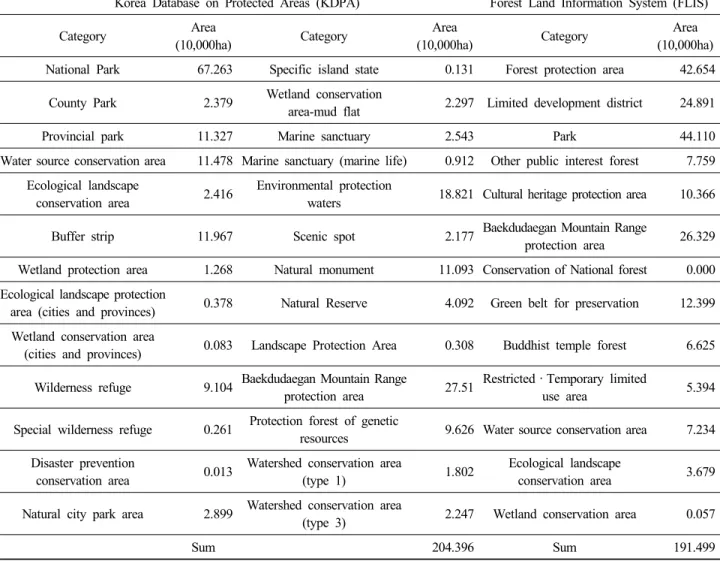
법률에 의해 지정된 총 28개 유형의 2,073개소 보호지역 현 황을 한 번에 확인할 수 있는 시스템으로 산림 관련 법령과 관련하여서는 산림보호구역만 탑재되어 있어 이를 본 연구에 서는 활용하였다. 또한, 산지정보시스템 (Forest Land Information System, FLIS)은 우리나라는 국토의 효율적인 이 용과 관리를 위한 용도지역․지구 등을 기반으로 하여 제시된
토지이용행위에 대한 제한사항과 산림보호구역외에도 자연휴 양림, 산지전용․일시사용제한구역 등 산림관련 법령에 따른 기타 구역에 대한 정보를 제공하여 있는 것으로 확인되어 이 를 본 연구 분석 대상으로 활용하였다 (Table 3 and Fig. 2).
산림경영 데이터베이스는 경영활동 주소지를 중심으로 기 록된 것에 따라 주소정보 구분, 주소정보 코드화, 지적도와
Category Sum Forest management Afforestation Year of data
Private forest 1,729,034 1,541,212 187,822 2003-2017
National forest 75,882 63,552 12,330 2012-2017
Total 1,804,916 1,604,764 200,152
Table 2. Forest management and afforestation recodes
Korea Database on Protected Areas (KDPA) Forest Land Information System (FLIS) Category Area
(10,000ha) Category Area
(10,000ha) Category Area (10,000ha) National Park 67.263 Specific island state 0.131 Forest protection area 42.654
County Park 2.379 Wetland conservation
area-mud flat 2.297 Limited development district 24.891
Provincial park 11.327 Marine sanctuary 2.543 Park 44.110
Water source conservation area 11.478 Marine sanctuary (marine life) 0.912 Other public interest forest 7.759 Ecological landscape
conservation area 2.416 Environmental protection
waters 18.821 Cultural heritage protection area 10.366 Buffer strip 11.967 Scenic spot 2.177 Baekdudaegan Mountain Range
protection area 26.329 Wetland protection area 1.268 Natural monument 11.093 Conservation of National forest 0.000 Ecological landscape protection
area (cities and provinces) 0.378 Natural Reserve 4.092 Green belt for preservation 12.399 Wetland conservation area
(cities and provinces) 0.083 Landscape Protection Area 0.308 Buddhist temple forest 6.625 Wilderness refuge 9.104 Baekdudaegan Mountain Range
protection area 27.51 RestrictedㆍTemporary limited
use area 5.394 Special wilderness refuge 0.261 Protection forest of genetic
resources 9.626 Water source conservation area 7.234 Disaster prevention
conservation area 0.013 Watershed conservation area
(type 1) 1.802 Ecological landscape
conservation area 3.679 Natural city park area 2.899 Watershed conservation area
(type 3) 2.247 Wetland conservation area 0.057
Sum 204.396 Sum 191.499
Table 3. Protection area by available spatial data
병합, 공간정보로 변환, 숲가꾸기, 조림, 보호구역의 중첩분석 이후 중복지를 제거하는 방식으로 진행하였다. 일부 산림경 영정보의 데이터베이스가 지적에서 제시한 주소 면적과 차이 가 있는 경우에는 해당 조건에 따라 시업 면적을 조정하였다.
지적면적보다 작업면적이 큰 경우에는 지적의 최대값으로, 지적 면적이 누락된 경우에는 현재 지적 정보로, 작업면적 및 주소가 누락된 경우에는 산정이 불가능한 것으로 설정하였
다. 이는 지적 정보가 누락되는 경우나 단일 지목이 아닌 경 우에 확인이 어렵다는 단점이 있으나, 공간자료와의 정합하 는 과정에서 산림경영률을 가장 보수적으로 평가하는 방식이 라고 할 수 있다.
(a) Forest management information system (b) Forest Land Information System (FLIS) (c) Korea Database on Protected Areas (KDPA) Fig. 2. Modification of the available data for estimating forest management rate.
(a) Protection area (b) Forest management (c) Afforestation Fig. 3. Results of forest management and afforestation recodes by spatial overlaying.
3. 결과
활동자료 중 공간자료를 통해 도출된 적합 면적은 180만 여 건 중 1,247,967건에 해당하였다. 산림관리 측면에서 국유 림과 사유림을 포함하여 공간자료로 도출된 총 기록은 1,069,107건에 해당하였으며, 조림의 경우에는 17,860건에 해 당하였다. 이는 공간자료를 통해서 주소지 등에 대한 기록들 을 병합하고 면적에 대한 보정을 수행한 결과이다 (Fig. 3).
최대면적 시업법을 적용하여 연도를 고려한 산림경영면적 을 산출한 결과 조림지 97,194구역에 대해 181,859 ha의 데 이터베이스가 구축되었으며, 숲가꾸기의 경우 961,249 구역 에 대해 2,054,333 ha의 숲가꾸기가 수행된 것으로 나타났다.
이는 조림은 임업통계연보 대비 62.2%, 숲가꾸기는 49%에 해당되는 수치로 공간자료와 통계자료 간의 정합 차이가 나
타난 것이라고 할 수 있다 (Table 4).
연도를 고려하지 않은 도별 산림경영면적의 경우에 연도 를 고려하지 않고 적용한 결과 조림은 161,115 ha 숲가꾸기 는 1,472,134 ha 수행된 것으로 나타났다. 국유림과 사유림 모두 정보가 구축 가능했으며, 국유림과 사유림의 공간정보 의 가용 시기가 겹치는 2013년부터 2017년까지를 교토의정 서 제2차 공약기간으로 인식하였을 시의 평균 산림경영률은 31.2%로 나타났다 (Table 5).
산림시업 관련 공간자료는 각각 상이한 시점에 작성되어 있으며, 최대면적 시업법을 적용하였을 시 일부 자료가 누락 되는 경우도 발생한다. 따라서 부분적으로 평균자료를 대입 하여 순수 산림경영 면적과 제한림 151만 ha 등을 적용한 총 산림경영면적은 388만 ha로 추산하였을 시의 산림경영률은 전체 기간 동안 평균 43.1%로 도출되었다. 또한, 최근 5년간
Year
Afforestation
Statistical Yearbook of Forestry
Forest management
Statistical Yearbook of Forestry
Total
Private forest National forest
Area Rate (%)
Private forest National forest
Area Rate
(%) Area Site Area Number
of plot Area Site Area Number
of plot Area Site
2003 11,273 6,287 54,714 19,857 65,987 26,144
2004 11,211 6,264 65,050 23,199 76,261 29,463
2005 10,751 6,365 133,969 55,015 144,720 61,380
2006 11,659 6,478 112,605 47,301 124,265 53,779
2007 11,133 6,741 126,204 56,735 137,338 63,476
2008 11,168 6,268 155,372 70,272 166,541 76,540
2009 11,421 6,238 187,520 83,243 198,940 89,481
2010 10,905 6,026 166,742 80,462 177,647 86,488
2011 11,273 6,156 158,876 85,250 170,150 91,406
2012 11,610 7,056 20,039 57.9 197,846 95,667 415,215 47.6 209,456 102,723 2013 14,312 6,972 331 45 21,780 67.2 171,224 76,724 1,874 157 370,617 46.7 187,741 83,898 2014 12,464 7,276 410 48 23,048 55.9 155,336 79,769 3,345 332 293,337 54.1 171,556 87,425 2015 14,907 8,088 3,442 350 23,178 79.2 148,964 75,308 18,383 2,089 279,157 59.9 185,695 85,835 2016 9,404 4,804 2,755 328 23,917 50.8 90,437 53,053 18,420 2,082 283,592 38.4 121,016 60,267 2017 8,794 5,072 2,636 332 72,030 53,104 15,422 1,630 98,883 60,138 Sum 172,285 96,091 9,574 1,103 1,996,889 954,959 57,444 6,290 2,236,196 1,058,443 Mean 11,486 6,406 1,915 221 22,392 62.2 133,126 63,664 11,489 1,258 328,384 49.3 149,080 70,563 Table 4. Overall forest management rate considering annual recodes and comparing forest statistics
평균 산림면적 633만 ha 대비 산림경영률은 2017년 기준 61.3%로 계산되었다. 이는 평균 산림경영률 증가량인 2.6%
를 적용하였을 시 2030년까지 33.6% 증가 예상되는 것으로 추후 총 경영률 94.9%를 기대할 수 있는 수치이다 (Table 6).
4. 고찰
본 연구에서는 연도를 고려하여 교토의정서 2차 공약기간 의 평균 산림경영률은 31.2%로 산정하였으며, 누락 자료를 바탕으로 한 전체기간의 평균 산림경영률은 43.1%로 확인되 었으며, 2017년 기준 산림경영률은 61.3%로 산정되었다. 본 연구는 기존에 파편화된 자료로 존재한 산림관리 및 조림 사 업 등 산림 내 다양한 활동자료를 공간적으로 분석하였고, 국 내 데이터베이스를 포괄적으로 검토하여 산림경영률을 산정 하였다는 의의가 있다. 본 연구에 따르면 우리나라 산림경영
률은 계속 높아지는 추세이며, 이는 우리나라 산림에서의 흡 수량이 지속된 산림경영의 결과라는 것을 증빙하는 것이라 할 수 있다. 따라서 이러한 산림경영률 산정 방식을 통해 우 리나라에 보다 유리한 선에서 FMRL이 제시할 수 있다는 강 점이 있다.
이렇게 산림경영률에 대한 산정량의 차이가 발생하는 이 유는 평가 시점, 자료의 정합성 등의 차이가 존재하기 때문으 로 추정된다 (Kim et al., 2010). 그러나 전반적으로 산림 정 책 및 산림자원 관리 측면에서 이미 산림 시업이 수행된 임분 에서 중복적으로 산림 시업이 이루어진다는 점과 국유림 경 영계획과 사유림 경영계획의 산림관리 목표 차이로 인한 경 영률 차이가 발생한다는 점은 향후 기후변화에 대응 지속가 능한 산림관리 차원에서 고려되어야 할 사항이다 (Kim et al., 2015; Kim et al., 2017).
또한, 시업 대상지에 대한 공간 및 위치정보의 확보도 시
Category afforestation Forest management
Total Area (ha) Private forest National forest Private forest National forest
Seoul 212 1,073 5 1,290
Busan 233 6,106 0 6,339
Daegu 12 1,115 1,127
Incheon 510 11,152 11,662
Gwangju 54 1,227 1,281
Daejeon 198 2,832 286 3,316
Ulsan 436 16 7,384 384 8,219
Sejong 210 35 1,232 227 1,704
Gyeonggi 8,489 535 53,073 2,851 64,949
Gangwon 25,876 3,937 209,745 22,363 261,921
Chungbuk 15,977 667 103,689 2,977 123,309
Chungnam 19,662 288 128,420 1,623 149,992
Jeonbuk 22,784 451 89,663 2,397 115,294
Jeonnam 28,695 325 297,670 1,551 328,241
Gyeongbuk 16,837 1,041 301,369 11,887 331,134
Gyeongnam 12,635 343 198,916 1,261 213,155
Jeju 660 0 9,647 8 10,315
Sum 153,478 7,637 1,424,315 47,819 1,633,248
Calculation of 2nd Kyoto protocol periods
Year Total forest area (ha) National and private forest management area (ha) Net rate of management area (%)
2013 6,339,368 1,659,045 26
2014 6,342,194 1,830,601 29
2015 6,334,615 2,016,297 32
2016 6,326,285 2,137,312 34
2017 6,318,007 2,236,196 35
Mean 6,332,094 1,975,890 31.2
including restricted and protected forest area recodes in 2017; 1,514,135 ha Table 5. Average forest management rate considering regional distributions without considering yearly changes
급하다. 본 연구에서는 지적도를 통해 시업지에 대한 정보를 연계하였으나, 시업지의 정확한 면적이나 위치는 하나의 지 적 내에서도 변화가 있을 수 있는 부분이다. 그리고 국유림과 사유림 등 대부분의 시업 대상지에 대한 정보가 공유되고 있 지 않아 기후변화 측면에서 산림 탄소흡수량 유지를 위한 적 절한 산림경영률을 산정하고 효율적인 경영계획을 수립하는 데 많은 어려움이 있다 (Ryu et al., 2016). 산림경영활동자료
간의 지속적인 관리도 필요한 것으로 확인되었다. 부정확한 정보 기입으로 시업정보가 누락되는 지역, 작업면적과 지적 면적의 불일치, 시업의 중복 기록, 주소지 불명 등 자료 내에 서 보이는 문제들은 향후 개선되어야 할 것이다. 특히, 새올 산림행정시스템, 사유림경영정보, 산림자원통합관리시스템 등은 시공간 정보를 갖는 시스템으로 개선되어야 한다.
이러한 부분이 개선된다면 IPCC가 강조하고 있는 온실가
Year
Afforestation area (ha)
Forest management
area (ha) Sum (ha) Accumulated forest management
area (ha)
Management area including restricted forest (ha)
Rate (%)
Rate var.
Private (%) forest
National
forest Sum Private forest
National
forest Sum Private forest
National forest Sum
2003
1,273 1,915 13,188 54,714 11,489 66,203 65,987 13,404 79,391 79,391 1,593,526 25.2
20041,211 1,915 13,126 65,050 11,489 76,539 76,261 13,404 89,665 169,056 1,683,191 26.6 1.4
200510,751 1,915 12,666 133,969 11,489 145,458 144,720 13,404 158,124 327,180 1,841,315 29.1 2.5
200611,659 1,915 13,574 112,605 11,489 124,094 124,264 13,404 137,668 464,848 1,978,983 31.3 2.2
200711,133 1,915 13,048 126,204 11,489 137,693 137,337 13,404 150,741 615,589 2,129,724 33.6 2.4
200811,168 1,915 13,083 155,372 11,489 166,861 166,540 13,404 179,944 795,533 2,309,668 36.5 2.8
200911,421 1,915 13,336 187,520 11,489 199,009 198,941 13,404 212,345 1,007,878 2,522,013 39.8 3.4
201010,905 1,915 12,820 166,742 11,489 178,231 177,647 13,404 191,051 1,198,929 2,713,064 42.8 3.0
201111,273 1,915 13,188 158,876 11,489 170,365 170,149 13,404 183,553 1,382,482 2,896,617 45.7 2.9
201211,610 1,915 13,525 197,846 11,489 209,335 209,456 13,404 222,860 1,605,342 3,119,477 49.3 3.5
201314,312 331 14,643 171,224 1,874 173,098 185,536 2,205 187,741 1,793,083 3,307,218 52.2 3.0
201412,464 410 12,874 155,336 3,345 158,681 167,800 3,755 171,555 1,964,638 3,478,773 54.9 2.7
201514,907 3,442 18,349 148,964 18,383 167,347 163,871 21,825 185,696 2,150,334 3,664,469 57.9 2.9
20169,404 2,755 12,159 90,437 18,420 108,857 99,841 21,175 121,016 2,271,350 3,785,485 59.8 1.9
20178,794 2,636 11,430 72,030 15,422 87,452 80,824 18,058 98,882 2,370,232 3,884,367 61.3 1.6
Sum172,285 9,574 181,859 1,996,889 57,444 2,054,333 2,169,174 201,058 2,370,232
Mean11,486 1,915 13,401 133,126 11,489 144,615 144,612 13,404 158,015 1,213,058 2,727,193 43.1 2.6
Table 6. Estimated forest management rate reflecting average value for missing management recodes스 인벤토리 산정의 정확성, 일관성, 완전성, 비교가능성, 투 명성 있는 활동자료 구축을 위한 산림경영 자료의 축적이 가 능할 것이다. 따라서 국가 온실가스 산정․보고․검증 (MRV) 체계 확립, 시공간 데이터베이스를 활용한 산림경영 률 계산 등이 이루어질 수 있을 것이다 (Moon et al., 2017).
또한, 산림부문 온실가스 인벤토리 산정을 위한 활동자료의 시스템 등록이 의무화 되거나 다양한 보호지역에 대한 정보 가 통합된다면, 우리나라 국가인벤토리보고서 (National Inventory Report, NIR), 격년갱신보고서 (Biennial Update Report, BUR), 공통보고서양식 (Common Reporting Format, CRF) 등의 질적 향상이 기대된다 (Lee et al., 2018). 특히, 가 장 신뢰도 높은 Tier 3 수준의 신뢰성 있고 검증 가능한 온실 가스 인벤토리 구축이 이루어질 것이다.
5. 결론
신기후체제에는 온실가스 감축에 대한 목표를 스스로 설 정하고 이를 이행해야 한다. 따라서 산림의 조림 및 재조림과 산지 전용 등과 산림 내의 관리 행위들이 온실가스 흡수량 및 배출량에 미치는 영향을 보다 자세하게 정량해나가는 과정은 계속 강조되고 있다. 산림경영활동자료의 구축은 현재의 인 벤토리 보고 시스템뿐만 아니라 향후 자발적 감축 목표에 대 한 설정에도 큰 영향을 줄 수 있다. 기존에 우리나라는 산림 경영활동을 다양하게 수행했으며, 관리에 많은 노력을 기울 여왔다. 그러나 시공간정보 기반 분석이 이루어지지 않아 산 림경영률 산정 등에 많은 한계를 갖고 있었다. 인벤토리 고도 화 차원에서 본 연구에서 제시된 시공간 자료의 병합 과정을 통해 도출된 평균 31.2-43.1% 수준의 산림경영활동률은 향후 우리나라 임분의 고령화와 임분 갱신 과정에 따라서 크게 변 할 수 있다. 이러한 상황에서 자료의 일관성 및 공간적 명확
성을 확보하기 위하여 정보 기록이 누락된 시업지의 활동자 료 구축이 필요하며, 다양한 산림 공간자료의 통합이 필요하 다고 할 수 있다. 이를 통해 효과적인 산림경영률 계산이 가 능할 것이며, 산림부문에서 Tier 3 수준의 신뢰성 있는 국가 온실가스 인벤토리 구축에 기여할 수 있을 것이다.
사 사
본 연구는 산림청 (한국임업진흥원) 산림과학기술연구개 발사업 ´2019044B10-1919-BB01´의 지원과 환경부 기후변화 대응환경기술개발사업 ‘2014001310008’의 지원으로 수행되 었습니다.
REFERENCES
Bae JS. 2009. Assessment of Negotiation Options Regarding Post-2012 Rules for Land Use, Land-Use Change and Forestry (LULUCF) -With a Focus on the Forest Management Activities under the Kyoto Protocol-. Journal of Korean Forest Society, 98 (1):
55-65.
Bae JS., Seol AR. 2019. Contribution of the national greenhouse gas reduction target and the new opportunity of forest management, National Institute of Forest Science. Seoul, Republic of Korea
Bhagabati NK, Ricketts T, Sulistyawan TBS, Conte M, Ennaanay D, Hadian O, McKenzie E, Olwero N, Rosenthal A, Tallis H, Wolny S. 2014. Ecosystem services reinforce Sumatran tiger conservation in land use plans. Biological Conservation 169: 147-156.
GIR (Greenhouse Gas Inventory and Research Center of Korea). 2019. 2019 National Greenhouse Gas Inventory Report. Greenhouse Gas Inventory and Research Center of Korea. Seoul: Greenhouse Gas Inventory and Research Center of Korea.
IPCC. 2006. IPCC Guidelines for national greenhouse gas inventory. IPCC/IGES. Hayama, Japan.
IPCC. 2003. Good Practice Guideline for Land Use, Land-Use Change and Forestry. Hayama: IPCC/IGES IPCC. 2000. Good practice and uncertainty management in
national greenhouse gas inventories. Chapter 7.
Methodological Choice and Recalculation. Paris:
IPCC/OECD/IEA
Kim D, Lim CH, Lee WK, Song C. 2015. A study on the improvement of evaluation system for implementation of national forest management. Journal of Korean Forest Society, 104 (4): 640-648.
Kim ES, Kim KM, Kim CC, Lee SH, Kim SH. 2010.
Estimating the spatial distribution of forest stand volume in Gyeonggi Province using National Forest Inventory data and forest type map. Journal of Korean Society of Forest Science, 99 (6): 827-835.
Kim H, Kang H, Kim RH, Kim CM, Koh KC, Lee KH.
2013. Estimation of Forest Management Ratio under Article 3.4 of the Kyoto Protocol: A Case Study on the Chungcheongbuk-do. Journal of Korean Society of Forest Science, 102 (4): 608-616.
Kim KM, Roh YH, Kim ES. 2014. Comparison of Three Kinds of Methods on Estimation of Forest Carbon Stocks Distribution Using National Forest Inventory DB and Forest Type Map. Journal of the Korean Association of Geographic Information Studies, 17 (4): 69-85.
Kim M, Lee WK, Son Y, Yoo S, Choi GM, Chung DJ.
2017. Assessing the impacts of topographic and climatic factors on radial growth of major forest forming tree species of South Korea. Forest ecology and management, 404: 269-279.
Kim M, Yoo S, Kim N, Lee W, Ham B, Song C, Lee WK.
2017. Climate change impact on Korean forest and forest management strategies. Korean Journal of Environmental Biology, 35 (3): 413-425.
KFS (Korea Forest Service). 2016. A study on utilization of national and international forest carbon on 2030 National GHG Reduction Objectives. Daejeon: Korea Forest Service.
KOFPI (Korea Forestry Promotion Institute). 2017. Korea Forest Resources by Numbers. Seoul: Korea Forestry Promotion Institute.
Lee M, Park SK. 2017. Assessment of Korea’s GHG Reduction Targets through Comparative Analysis of OECD Countries’ Nationally Determined Contributions (NDCs). Journal of Climate change Research, 8 (4):
313-327 (in Korean with English abstract).
Lee SJ, Yim JS, Son YM, Son Y, Kim R. 2018. Estimation of forest carbon stocks for national greenhous gas inventory reporting in South Korea. Forests, 9 (10): 625.
Seo YO, Lumbres RIC, Jung SC, Won HK, Lee YJ. 2015.
Application of national forest inventory data to estimate management ratios for private forests in Chungnam province. J Agirc Life Sci, 49 (4): 31-37.
ME (Ministry of Environment). Revised basic roadmap of 2030 National Greenhouse Gas Reduction target.
Daejeon: Korea Environment Institute.
Moon J, Kim N, Song C, Lee SG, Kim M, Lim CH, Cha SE, Kim G, Lee WK, Son Y, Yang S, Jin S, Son YM.
2017. Analysis on the linkage between SDGs framework and forest policy in Korea. Journal of Climate Change Research, 8 (4): 425-442.
Park E, Song C, Ham B, Kim J, Lee J, Choi S, Lee WK.
2018. Comparison of Sampling and Wall-to-Wall Methodologies for Reporting the GHG Inventory of the LULUCF Sector in Korea. Journal of Climate Change Research, 9 (4): 385-398 (in Korean with English abstract).
Piao D, Kim M, Choi GM, Moon J, Yu H, Lee WK, Wang SW, Jeon SW, Son Y, Son YM, Cui G. 2018.
Development of an Integrated DBH Estimation Model Based on Stand and Climatic Conditions. Forests, 9 (3):
155.
Ryu D, Lee WK, Song C, Lim CH, Lee SG, Piao D. 2016.
Assessing effects of shortening final cutting age on future CO2 absorption of forest in Korea. Journal of climate change research, 7 (2): 157-167.
UNFCCC (United Nations Framework Convention on Climate Change). 2016. Paris Agreement. Denmark:
Phoenix Design Aid.
Yim JS, Kim RH, Lee SJ, Son YM. 2015. Land-use Change Assessment by Permanent Sample Plots in National Forest Inventory. Journal of Climate Change Research, 6 (1): 33-40 (in Korean with English abstract).
Yu SC, Shin DB, & Ahn JW. 2019. Analysis of Land Use, Land-use Change, and Forestry (LULUCF) and Construction of Statistics in Korea. Sensors and Materials, 31 (10): 3215-3228.