Labrys sp. KNU-23 is a Gram-negative, aerobic, rod-shaped, tryptophan-producing, urea-decomposing bacterium that was isolated from ginseng soil in Bonghwa-gun, Republic of Korea.
This study reports the complete genome sequence of strain KNU-23. The complete genome comprises two circular chro- mosomes of 5,388,854 bp and 2,162,438 bp with a GC content of 64 and 62.1%, respectively. The whole genome was pre- dicted to have 6,868 protein coding genes. In addition, urea- decomposing and tryptophan-producing genes that are associated with plant growth-promoting activity were identified. There- fore, Labrys sp. KNU-23 is likely to be an agriculturally useful strain.
Keywords: Labrys sp., tryptophan, urease
Labrys species are Gram-negative, aerobic capsulated, non- motile, non-sporulating, and morphologically different bacteria (Nguyen et al., 2015). Some members of the genus Labrys have previously been isolated from rhizospheric ecosystem (Chou et al., 2007; Nguyen et al., 2015). Labrys sp. has been reported to
have potential plant growth-promoting activity (Visioli et al., 2018). In this study, Labrys sp. KNU-23 was isolated from gin- seng soil in Bonghwa-gun, Republic of Korea (N 37.0036.8°, E 128.4950.9°).
A single colony of this strain was inoculated in R2A medium and incubated at 30°C for 24 h at 200 rpm. Subsequently, manual extraction of genomic DNA was performed (Sambrook et al., 1989). Quantity and quality of the extracted DNA was analyzed using a Qubit 3.0 fluorometer (Thermo Fisher Scientific) and a Nanodrop One spectrophotometer (Thermo Fisher Scientific), respectively. Whole-genome sequencing was performed using the PacBio RSII system (Park et al., 2019) at Macrogen Inc.. In addition, the genome was annotated using the NCBI Prokaryotic Genome Annotation Pipeline (PGAP) (Tatusova et al., 2016) and the Rapid Annotations using Sub- system Technology server (Aziz et al., 2008).
The 16S rRNA sequence of strain KNU-23 was compared with 16S rRNA sequences available by the BLAST search (Fig.
1). The total number of subreads from the raw sequencing reads following adapter removal was 9,841 with a mean length of 7,258 bp. De novo assembly of the subreads was conducted
Korean Journal of Microbiology (2020) Vol. 56, No. 4, pp. 410-412 pISSN 0440-2413
DOI https://doi.org/10.7845/kjm.2020.0101 eISSN 2383-9902
Copyright ⓒ 2020, The Microbiological Society of Korea
Complete genome sequence of Labrys sp. KNU-23 isolated from ginseng soil in the Republic of Korea
Min-Ji Kim
1, Yeong-Jun Park
1, Min-Kyu Park
1, Chang Eon Park
1,2, YoungJae Jo
1, Setu Bazie Tagele
1, and Jae-Ho Shin
1,3*
1
Department of Applied Biosciences, College of Agriculture and Life Sciences, Kyungpook National University, Daegu 41566, Republic of Korea
2
Insitute of Ornithology, Association of Ex-situ Conservation, Daegu 41566, Republic of Korea
3
Department of Integrative Biotechnology, Kyungpook National University, Daegu 41566, Republic of Korea
한국의 인삼 토양에서 분리한 Labrys sp. KNU-23의 완전 해독된 게놈 서열
김민지
1・ 박영준
1・ 박민규
1・ 박창언
1,2・ 조영재
1・ 세투 바지에 태글
1・ 신재호
1,3*
1
경북대학교 응용생명과학과,
2경북대학교 조류생태환경연구소,
3경북대학교 농생명융합공학과
(Received October 8, 2020; Revised November 12, 2020; Accepted November 12, 2020)
*For correspondence. E-mail: [email protected];
Tel.: +82-53-950-5716; Fax: +82-53-953-7233
Complete genome sequence of Labrys sp. KNU-23∙
411
Korean Journal of Microbiology, Vol. 56, No. 4 using the HGAP 4.0 program (Chin et al., 2013). The complete
genome of strain KNU-23 was deposited in GenBank under accession numbers CP043488.1 and CP043489.1. The genome comprised two chromosomes, one 5,388,854 bp in length and the other 2,162,438 bp in length. A total of 6,868 genes were predicted, and 64 RNA genes (9 rRNAs and 51 tRNAs) were identified (Table 1).
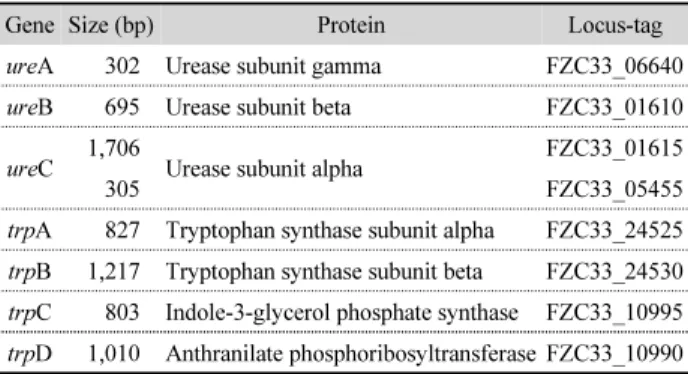
The genome contains several coding genes related to plant growth-promoting activity, such as tryptophan and urease biosynthesis which are the important features as plant growth promoting bacteria (Ibal et al., 2018). The strain KNU-23 has the ability to catalyze the hydrolysis of urea into ammonia
because ureA, ureB, and ureC genes were found in the genome, which encode the quaternary structured urease (Table 2).
Furthermore, the genome contains trpA, trpB, trpC, and trpD, which encode subunits of tryptophan synthase and anthranilate phosphoribosyltransferase, which are related to tryptophan synthesis (Table 2). These findings indicate that the strain KNU-23 can synthesize tryptophan as a precursor of auxin for plant growth hormone (Spaepen et al., 2011). These findings indicate that Labrys sp. KNU-23 is a highly potent bacterial strain for agricultural purposes.
Nucleotide sequence data and strain accession number The complete genome sequence was deposited in GenBank under accession numbers CP043488.1 and CP043489.1. The strain is available in Korean Collection for Type Cultures under the accession number KCTC 13849BP.
적 요
한국 봉화의 인삼 경작지에서 분리된 Labrys sp. KNU-23 균주는 그람 음성의 호기성 균이며, 우레아 분해 및 트립토판 생합성능을 가지고 있다. 이 균주의 유전체는 두 개의 원형 chromosome으로 이루어져 있었다. 각각의 chromosome은 64.0%와 62.1%의 GC 비율을 가지며, 길이는 5,388,854 bp와 2,162,438 bp인 것으로 확인되었다. 이 균주의 유전체에는 총 6,868개의 단백질 코딩 유전자가 있는 것으로 예측되었다. 또 한 식물 생장 촉진 활성과 관련된 우레아 분해 및 트립토판 생 산 관련 유전자가 있었다. 따라서 인삼 경작지에서 분리된 Labrys sp. KNU-23 균주는 농업 유용 미생물로서 활용 가능성 이 있다.
Table 1. Genome features of Labrys sp. KNU-23 chromosomes Genome feature Chromosome 1 Chromosome 2
Genome size (bp) 5,388,854 2,162,438
GC content (%) 63.96 62.13
Total number of genes 4,945 1,923
Number of
protein-coding genes 4,803 1,911
rRNA 3 6
tRNA 45 6
Table 2. The list of plant growth promoting genes in the genome of Labrys sp. KNU-23
Gene Size (bp) Protein Locus-tag
ureA 302 Urease subunit gamma FZC33_06640
ureB 695 Urease subunit beta FZC33_01610
ureC 1,706
Urease subunit alpha FZC33_01615
305 FZC33_05455
trpA 827 Tryptophan synthase subunit alpha FZC33_24525 trpB 1,217 Tryptophan synthase subunit beta FZC33_24530 trpC 803 Indole-3-glycerol phosphate synthase FZC33_10995 trpD 1,010 Anthranilate phosphoribosyltransferase FZC33_10990
Fig 1. Phylogenetic tree based on 16S rRNA sequences of Labrys species and strain KNU-23.
412
∙ Kim et al.미생물학회지 제56권 제4호
Acknowledgments
This work was carried out with the support of “Cooperative Research Program for Agriculture Science and Technology Development (Project No. PJ013383)” Rural Development Administration, Republic of Korea.
References
Aziz RK, Bartels D, Best AA, DeJongh M, Disz T, Edwards RA, Formsma K, Gerdes S, Glass EM, and Kub al M. 2008. The RAST server: rapid annotations using subsystems technology.
BMC Genomics 9, 75.
Chin CS, Alexander DH, Marks P, Klammar AA, Drake J, Heiner C, Clum A, Copeland A, Huddleston J, Eichler EE, et al. 2013.
Nonhybrid, finished microbial genome assemblies from long- read SMRT sequencing data. Nat. Methods 10, 563–569.
Chou YJ, Elliott GN, James EK, Lin KY, Chou JH, Sheu SY, Sheu DS, Janet IS, and Chen WM. 2007. Labrys neptuniae sp. nov., isolated from root nodules of the aquatic legume Neptunia oleracea. Int. J. Syst. Evol. Microbiol. 57, 577–581.
Ibal JC, Jung BK, Park CE, and Shin JH. 2018. Plant growth-promoting
rhizobacteria used in South Korea. Appl. Biol. Chem. 61, 709–
716.
Nguyen NL, Kim YJ, Hoang VA, Kang JP, Wang C, Zhang J, Kang CH, and Yang DC. 2015. Labrys soli sp. nov., isolated from the rhizosphere of ginseng. Int. J. Syst. Evol. Microbiol. 65, 3913–
3919.
Park MK, Park YJ, Kim MC, Kang GU, Kim MJ, Jo YJ, Kwon HJ, Kang MS, Kim MH, Kim SY, et al. 2019. Complete genome sequence of Pseudarthrobacter sp. NIBRBAC0005 02771 isolated from shooting range soil in Republic of Korea. Korean J. Microbiol. 55, 419–421.
Sambrook J, Fritsch EF, and Maniatis T. 1989. Molecular cloning: a laboratory manual, pp. 19–20. Cold Spring Harbor Laboratory Press, Cold Spring Harbor, New York, N.Y., USA.
Spaepen S and Vanderleyden J. 2011. Auxin and plant-microbe inter- actions. Cold Spring Harb. Perspect. Biol. 3, a001438.
Tatusova T, DiCuccio M, Badretdin A, Chetvernin V, Nawrocki EP, Zaslavsky L, Lomsadze A, Pruitt KD, Borodovsky M, and Ostell J. 2016. NCBI prokaryotic genome annotation pipeline. Nucleic Acids Res. 44, 6614–6624.
Visioli G, Sanangelantoni AM, Vamerali T, Dal Cortivo C, and Blandino M. 2018. 16S rDNA profiling to reveal the influence of seed-applied biostimulants on the rhizosphere of young maize plants. Molecules 23, 1461.