Brucella anthropi strain T16R-87 was isolated from the rhizo- sphere of tomato plants. This bacterium showed plant growth- promoting activity under abiotic and biotic stress conditions, including drought, salinity, and bacterial wilt disease. Its genome consists of two circular chromosomes with 2,645,855 bp and 2,090,924 bp. The genomic G + C content was 55.96%. In total, the genome includes 4,501 genes, 12 rRNAs, and 59 tRNAs.
Genes related to antioxidant activity, proline and siderophore biosynthesis, and phosphonate degradation, which may contribute to the promotion of plant growth under environmental stresses, were also found in the genome.
Keywords: Brucella, abiotic stress, genome sequence, plant growth-promoting rhizobacteria
Brucella anthropi was first described by Holmes et al. (1988) as a species belonging to the novel genus Ochrobactrum within the family Brucellaceae. Recently, Hördt et al. (2020) proposed the reclassification of Ochrobactrum to Brucella based on genome analysis of type strains. Brucella species have been isolated from various sources, including soil, plants, rhizosphere, industrial environments, animals, and humans (Hu et al., 2020).
Among them, B. lupini strain LUP21
T, which was isolated from
the root nodules of Lupinus honoratus and induces nodulation in lupinus plant, was reclassified as a heterotypic synonym of B. anthropi based on whole-genome sequences (Trujillo et al., 2005; Gazolla Volpiano et al., 2019). Brucella anthropi strain T16R-87 was isolated from the rhizosphere of tomato plants cultivated in a greenhouse in Buyeo, Republic of Korea (36°17'36.34"N 126°55'54.19"E) (Lee et al., 2016). Strain T16R-87 conferred plant tolerance to salinity and drought stresses and enhanced the resistance to bacterial wilt disease caused by Ralstonia solanacearum (unpublished data). To understand the molecular mechanisms of B. anthropi strain T16R-87 beneficial functions for plant growth and health, we analyzed its whole-genome sequence.
Strain T16R-87 was cultured on Reasoner’s 2A (R2A) agar medium and its genomic DNA was extracted using a QIAamp DNA mini kit (Qiagen), according to the manufacturer’s protocols. Whole-genome sequencing was performed using the PacBio RSII and Illumina HiSeq platforms at Macrogen Inc.
The sequences generated by PacBio RSII were assembled de novo using RS HGAP assembly version 3.0 (Chin et al., 2013) and HiSeq reads were subsequently used for error correction of the draft genome assemblies using Pilon version 1.21 (Walker et al., 2014). Gene prediction and functional annotations were carried out using the NCBI Prokaryotic Genomes Annotation
Korean Journal of Microbiology (2020) Vol. 56, No. 4, pp. 430-432 pISSN 0440-2413
DOI https://doi.org/10.7845/kjm.2020.0116 eISSN 2383-9902
Copyright ⓒ 2020, The Microbiological Society of Korea
Complete genome sequence of Brucella anthropi strain T16R-87 isolated from tomato (Solanum lycopersicum L.) rhizosphere
Shin Ae Lee, Mee Kyung Sang, Jaekyeong Song, Soon-Wo Kwon, and Hang-Yeon Weon*
Agricultural Microbiology Division, National Institute of Agricultural Sciences, Rural Development Administration (RDA), Wanju 55365, Republic of Korea
토마토 근권에서 분리된 Brucella anthropi T16R-87 균주의 유전체 염기서열
이신애 ・ 상미경 ・ 송재경 ・ 권순우 ・ 원항연*
국립농업과학원 농업생물부 농업미생물과
(Received November 9, 2020; Revised December 15, 2020; Accepted December 16, 2020)
*For correspondence. E-mail: [email protected];
Tel.: +82-63-238-3042; Fax: +82-63-238-3834
Complete genome sequence of Brucella anthropi T16R-87
∙431
Korean Journal of Microbiology, Vol. 56, No. 4 Pipeline (Tatusova et al., 2016) and Rapid Annotation Sub-
system Technology (RAST server) (Aziz et al., 2008). Genes involved in secondary metabolite production were analyzed using antiSMASH version 4.0.0 (Blin et al., 2017).
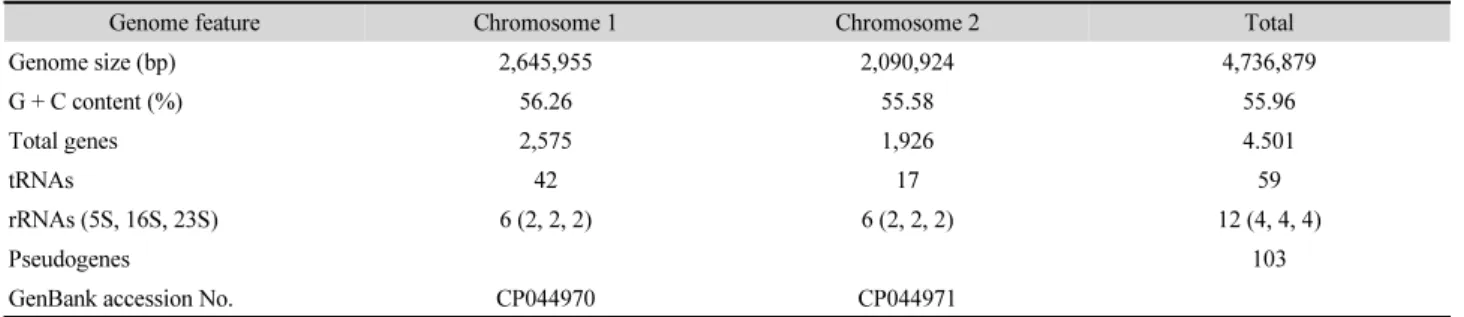
The complete genome of the B. anthropi T16R-87 consists of two circular chromosomes with 2,645,855 and 2,090,924 bp, respectively. The secondary chromosome contains a repABC origin similar to the type strain B. anthropi ATCC 49188
T. The G + C content of the strain T16R-87 is 55.96%. A total of 4,501 genes, 12 rRNAs (4 each of 5S, 16S, and 23S rRNAs), 59 tRNAs, 4 ncRNAs, and 102 pseudogenes were predicted (Table 1). This genome possesses four genes encoding antioxidant enzymes, including superoxide dismutase (SOD) and catalase (CAT), which can reduce reactive oxygen species (ROS) that are produced under various stress conditions and cause cell damage. The gene cluster phnGHJKL, related to a carbon- phosphorus (C-P) lyase was identified in the T16R-87 genome.
C-P lyase degrades phosphonate into phosphate and alkane, increasing biologically available phosphate for plants (Shariati et al., 2017). Moreover, strain T16R-87 contains three genes involved in proline biosynthesis (proA, proB, and proC), suggesting that proline, an effective osmolyte, may protect plants from abiotic stresses, such as drought, salinity, and extreme temperatures (Ashraf and Foolad, 2007). Based on antiSMASH analyses, seven gene clusters related to the biosyn- thesis of secondary metabolites, including terpenes, arylpolyenes, β-lactones, acyl amino acids, N-acetylglutaminylglutamine amide, ectoine, and a siderophore, were predicted. The siderophore identified in the T16R-87 genome was ochrobactin, which may act as a biocontrol agent in plants by reducing the iron availability for phytopathogens (Ahmed and Holmstrom, 2014).
In conclusion, the genome sequence of T16R-87 provides information on the molecular mechanisms underlying the
beneficial effects of plant growth-promoting bacteria on plants and may lead to the development of biotechnical applications in agriculture.
Nucleotide sequence accession numbers
Brucella anthropi T16R-87 has been deposited in the Korean Agricultural Culture Collection under accession number KACC 92178P and the complete genome sequence has been deposited in NCBI under the GenBank accession numbers CP044970 and CP044971.
적 요
토마토 근권에서 분리한 Brucella anthropi T16R-87 균주 는 가뭄과 고염 등의 환경 스트레스 조건에서 토마토 생육을 촉진시키고, 풋마름병에 대한 저항성을 나타내었다. 이 균주 는 2,645,855 bp와 2,090,924 bp 크기의 2개의 원형 염색체로 구성되어 있으며, G + C 함량은 55.96%이다. 유전체는 4,501 개 유전자를 포함하고 있으며 항산화 활성, 프롤린 생합성, 유 기인 분해, 시드로포어 생성 등에 관여하는 유전자를 확인하 였다. 이들 유전자는 식물 생육 촉진과 관련되어 있을 것으로 판단된다.
Acknowledgments
This study was carried out with the support of “Research Program for Agricultural Science & Technology Development (Project No. PJ01351901)” from the National Institute of Agricultural Sciences, Rural Development Administration, Republic of Korea.
Table 1. Genome features of Brucella anthropi T16R-87
Genome feature Chromosome 1 Chromosome 2 Total
Genome size (bp) 2,645,955 2,090,924 4,736,879
G + C content (%) 56.26 55.58 55.96
Total genes 2,575 1,926 4.501
tRNAs 42 17 59
rRNAs (5S, 16S, 23S) 6 (2, 2, 2) 6 (2, 2, 2) 12 (4, 4, 4)
Pseudogenes 103
GenBank accession No. CP044970 CP044971
432
∙Lee et al.
미생물학회지 제56권 제4호
References