Korean Journal of Microbiology (2020) Vol. 56, No. 1, pp. 101-102 pISSN 0440-2413
DOI https://doi.org/10.7845/kjm.2020.9126 eISSN 2383-9902
Copyright ⓒ 2020, The Microbiological Society of Korea
Complete genome sequence of Novosphingobium ginsenosidimutans FW-6 T , a ginsenoside-converting bacterium, isolated from fresh water
Qing Mei Liu
1,2, Byoung Hee Lee
3, Ki-Eun Lee
3, Sang Yong Kim
4, Ji-Hyang Wee
4, and Wan-Taek Im
1,2*
1
Department of Biotechnology, Hankyong National University, Anseong 17579, Republic of Korea
2
AceEMzyme Co., Ltd., Academic Industry Cooperation, Anseong-si 17579, Republic of Korea
3
Microorganism Resources Division, National Institute of Biological Resources, Incheon 22689, Republic of Korea
4
Department of Food Science & Bio Technology, Shinansan University, Ansan 15435, Republic of Korea
담수에서 분리한 진세노사이드 전환능력이 있는
Novosphingobium ginsenosidimutans FW-6 T 의 유전체 서열 분석
류청매
1,2・ 이병희
3・ 이기은
3・ 김상용
4・ 위지향
4・ 임완택
1,2*
1
국립한경대학교 농업생명과학대학 생명공학과,
2(주)에이스엠자임,
3국립생물자원관,
4신안산대학교
(Received October 28, 2019; Revised March 7, 2020; Accepted March 17, 2020)
*For correspondence. E-mail: [email protected];
Tel.: +82-31-670-5335; Fax: +82-31-670-5339
According to the previous study, a Gram-stain-negative, rod- shaped, non-spore-forming, non-motile bacterium, Novosphingo- bium ginsenosidimutans FW-6
Twas isolated from fresh water.
Strain FW-6
Tpossessed β-glucosidase activity, which was responsible for its ability to convert ginsenoside Rb1 to ginseno- side Rd. In this study the whole genome of Novosphingobium ginsenosidimutans FW-6
Twas sequenced, which consisted of one circular chromosome of 3,118,872 bp, with a DNA G + C content of 64.3%. Of the 3,073 predicted genes, 2,996 protein- coding genes, 50 RNA genes and 27 pseudogenes were identified.
The whole genome analysis of strain FW-6
Tshowed several genes including glycoside hydrolase, antitoxin genes, and DNA repair genes.
Keywords: Novosphingobium ginsenosidimutans, complete genome, fresh water, glycoside hydrolase, PacBio RS II
The genus Novosphingobium was proposed in 2001 (Takeuchi et al., 2001). It belongs to the family Sphingomonadaceae and phylum Proteobacteria. The genus Novosphingobium was
established as a consequence of the dissection of the genus Sphingomonas (Yabuuchi et al., 1990), based on phylogenetic and chemotaxonomic analyses (Takeuchi et al., 2001). The major menaquinone of strain FW-6
Twas Q-10 and the major fatty acids were summed feature 7 (comprising C
18:1ω9c/ω12t/
ω7c), summed feature 4 (comprising C
16:1ω7c/iso-C
15:02OH), C
16:0, and C
14:02OH (Kim et al., 2013).
During a screening for β-glucosidase activity, a Gram-negative, aerobic, non-spore-forming, non-motile, rod-shaped bacterium, Novosphingobium ginsenosidimutans FW-6
Twas isolated from fresh water of Duck Lake, KAIST, Daejeon, South Korea.
The ginsenoside conversion ability of N. ginsenosidimutans FW-6
Twas also determined by Kim et al. (2013). Therefore, in this study the complete genome of strain FW-6
Twas sequenced to enable further genetic studies.
Genomic DNA of N. ginsenosidimutans FW-6
Twas extracted
using a MagAttract HMW DNA kit (Qiagen) and was purified
with the chloroform wash method (shared protocol; Pacific
Biosciences). Genome sequencing was analyzed using a Pacific
Biosciences RSII sequencing platform with a 20 kb SMRTbell
TMtemplate library at DNA Link Inc. Sequences were assembled
102 ∙ Liu et al.
미생물학회지 제56권 제1호
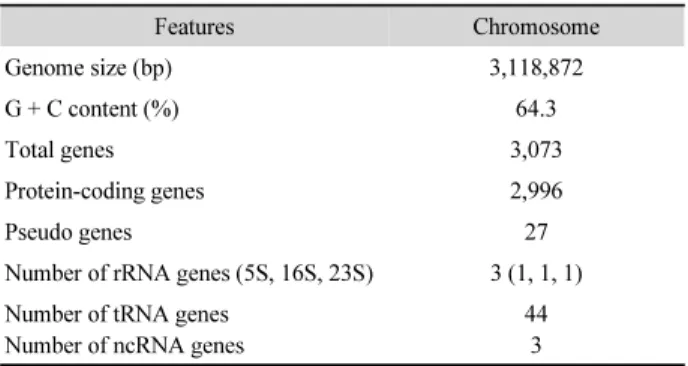
Table 1. General features of N. ginsenosidimutans FW-6
TFeatures Chromosome
Genome size (bp) 3,118,872
G + C content (%) 64.3
Total genes 3,073
Protein-coding genes 2,996
Pseudo genes 27
Number of rRNA genes (5S, 16S, 23S) 3 (1, 1, 1) Number of tRNA genes
Number of ncRNA genes 44
3
using the HGAP3 protocol (Pacific Biosciences) and the sequencing depth was 311.4×. The genome sequence was annotated using the NCBI Prokaryotic Genome Automatic Annotation Pipeline (http://www.ncbi.nlm.nih.gov/books/NBK 174280/). rRNAs and tRNAs were predicted using rRNAmmer and tRNAscan-SE, respectively.
The complete genome of N. ginsenosidimutans FW-6
Tconsisted of a single circular chromosome of 3,118,872 bp, with 64.3% G + C content. Of the 3,073 predicted genes, 2,996 protein-coding genes, 3 rRNA genes (5S, 16S, and 23S), 44 tRNA genes and 27 pseudogenes were identified. The genome statistics are presented in Table 1.
Analysis of the complete genome of N. ginsenosidimutans FW-6
Tshowed that it encoded glycoside hydrolases, including 3 β-glucosidases and 1 α-glucosidase, which may be respon- sible for its ability to convert ginseng saponins (Siddiqi et al., 2017). In addition, genome annotation revealed other genes of interest, including cobalamin B12-binding genes; antibiotic biosynthesis monooxygenase; antitoxin system genes, such as type II toxin-antitoxin system (RelE, ParE, HicA, HicB, VapC) genes; polymer decomposition genes, such as α-amylase;
excinuclease ABC subunit system genes (UvrA, UvrB, UvrC);
iron reductase genes; and DNA repair genes, such as those encoding DNA mismatch repair proteins (MutL, MutS) and DNA repair proteins (RadA, RadC, RecF, RecN).
Nucleotide sequence accession number
The complete genome sequence of Novosphingobium gin- senosidimutans FW-6
Thas been deposited in DDBJ/EMBL/
GenBank under the accession number CP042345. The strain was deposited at the Japan Collection of Microorganisms and the Korean Agricultural Culture Collection with the preservation
numbers, JCM 18202
Tand KACC 16615
T, respectively.
적 요
담수로부터 분리한 Novosphingobium ginsenosidimutans
FW-6
T는 진세노사이드 Rb1를 진세노사이드 Rd로 전환하는
능력을 가지고 있었다. 본 연구에서 FW-6
T균주의 전체 염기 서열을 분석한 결과, 균주 FW-6
T의 G + C 비율이 64.3%이며, 3,073개의 유전자와 2,996개의 단백질 코딩 유전자, 27개의 위유전자 그리고 50개의 RNA 유전자를 포함한 단일 원형 염 색체로 구성되었으며 그 크기는 3,118,872 bp였다. 균주 FW-6
T는 인삼사포닌의 당 분해에 관여하는 여러 타입의 글라이코시 다제 유전자, 항독소 유전자와 DNA 복구 관련 유전자를 가지 고 있었다.
Acknowledgments
This work was supported by grants from the National Institute of Biological Resources, funded by the Ministry of Environment (No. NIBR201801106).
References