Effects of Corporate Social Responsibility on Financial Performancein the U.S. Hotel Industry
Woo-Hyuk Kim*
목 차
Abstract1. Introduction 2. Literature Review
2.1 The Multidimensionality of CSR 2.2 Effects of CSR Dimensions on
Profitability 3. Method
3.1 Sources of Data 3.2 Variables and models 4. Results
4.1 Descriptive Statistics 4.2 Main Analysis 5. Discussion
Abstract
ㄴ
Initiatives for corporate social responsibility (CSR) have often served as sources of competitive advantage in the business world. Although the adoption of CSR practices in the hotel industry continues to increase, empirical research on the relationship between them and financial performance in the industryremains scarce. The purpose of this study was to ascertain the effects of various dimensions of CSR on the financial performance of corporations in the U.S. hotel industry. Data include Kinder, Lydenburg & Domini social performance scores and Compustat data of hotels from 1991 to 2015 identified using a Standard Industrial Classification code. Results of ordinary least squares regression using Stata revealed that efforts toward CSR have significantly affected the financial performance of numerous hotels. Such findings can initiate discussions and inspire future research on CSR in the hospitality industry.
Keywords: Corporate social responsibility, Performance, Compustat, Kinder, Lydenburg & Domini social performance ratings, Hotel industry.
접수일 (2018년 4월 26일), 수정일(1차: 2018년 6월 2일, 2차: 2018년 8월 29일), 게재확정일(2018년 9월 15일)
* Ph.D., Department of Hospitality Management, Kansas State University, USA, [email protected]
1. Introduction
As companies are increasingly evaluatedin terms ofnot only their financial success but also their compliance with social and ethical norms, corporate social responsibility (CSR) has become a strategic goal for a growing number of business managers (Singal, 2012). Although many firms take socially responsible actions to gain legitimacy and competitive advantage among potential customers, consumers are more likely to positively evaluate firms in industries that face demands related to consumer discretionary expenditures than firms not facingsuch demands(Servaes and Tamayo, 2013). For instance, in the field of tourism, CSR has become a considerable concern for managers of firms and, in turn, an essential feature of literature on tourism practices in recent decades (Holden, 2000). At present, as tourism industries worldwide face the exciting challenge of satisfying a greaternumber of socially conscious travelers concerned with CSR issues, tourism businesses have responded by developing and implementing various socially responsible practices to meet their demands (Bremner, 2009).
Two types of strategies canaffect a company’s financial performance: market strategies and non-market strategies (Kang, Lee, and Huh, 2010).
As a significant element of non-market strategies, CSR is a commonfocus of today’s tourism company managers. By definition, CSRrefers to a corporate quality achieved when a company assumes responsibility for its actions and encourages company practices that benefit the environment, consumers, employees, communities, and stakeholders, as well all members of the public
sphere who might represent stakeholders now or in the future. Executives of companies that seek to maximize profit often pursue the potential financial benefits of initiating activities of CSR. However, if investments in such activitiesare not determined to yield any long-term financialbenefits for their companies, then they will cease pursuing CSR (Godfrey and Hatch, 2007).
Despite that trend, very few scholars have investigated how efforts toward CSR affect the financial performance of firms’in tourism-related industries (Lee and Heo, 2009). They and other researchers have proposed, however, that CSR can be a source of competitive advantage (Porter and Kramer, 2006) and have confirmed that realizing CSR positively affects various aspects of firm performance, including reputation, customer satisfaction, attractiveness to potential employees (Brammer and Millington, 2005; Turban and Greening, 1997), and commitment to current employees (Peterson, 2004).
Although aspirations toward CSR have taken hold
in the hotel industry, empirical research on the
relationship between actual activities of CSR and
overall hotel performance remain scant (Gao and
Mattila, 2014; Lee and Park, 2009). Likewise,
scholars have only begun to examine the role of
CSR in the industry. Nevertheless, their preliminary
findings suggest that a hotel’s efforts toward
achieving CSR influence consumers’decisions about
whether or not to book rooms there, which
subsequently affects the hotel’s financial
performance. The purpose of this study was to
determine the effects of various dimensions of CSR
on the financial performance of corporations in the
U.S. hotel industry.
2. Literature Review
2.1 The Multidimensionality of CSR
To demonstrate CSR, a company needs to voluntarily pursue activities that aim to realize or sustain some form of social good beyond what the interests of the firm and legal requirements prescribe (McWilliams and Siegel, 2001). Examples of CSR practices include maintaining a diverse workforce, reducing the use and production of environmentally hazardous substances, and undertaking philanthropic activities. Although empirical researchers interested in CSR initially employed a one-dimensional measurement to aggregate CSR activities, scholars soon began to adopt a more realistic approach in which CSR encompassed multiple dimensions, each consisting of various types of different voluntary activities (Clarkson, 1995; Waddock and Graves, 1997). For example, Carrol (1999) argued that a firm’s voluntary activities toward CSR could be dividedinto two dimensions: those responding to ethical responsibilities and those responding to philanthropic responsibilities. Whereas the first are activities not required by law butexpected by society, the former are discretionary actions that seek outcomes beyond those expectations (Carroll, 1999).
Despite being frequently cited, the results of Carroll’s (1999) research have rarely been applied in empirical studies due to the difficulty of distinguishing and operationalizing the dimensions and their related issues. In response to that
problem, Carroll (1999) developed and employed a stakeholder framework for calculating how company executives manage their relationships with primary stakeholders, which consequentlydemonstrated the multidimensionality of CSR. Among its innovations, the stakeholder framework conceives primary stakeholders as individuals, groups, and institutions that a corporation needs in order toprosper and survive (Carroll, 1991).
In time, the framework became the basis for many studies on CSR whose researchers used data from the consulting firm Kinder, Lydenburg, &
Domini (KLD), commonly called KLD Stats, which generally help scholars to analyze corporate attention to various stakeholder-related issues. Some of the oldest, most significant, and by far most commonly analyzed data by academics, the social and environmental ratings in KLD Stats include scores in several dimensions of CSR, four of which
—community relations, diversity, (3) employee
relations, and product quality —researchers frequent
use. First, scores for community relations have
helped researchers to determine the extent to
which companies support communities by giving
charitably, pursuing educational initiatives, and
developing volunteer programs. Second, scores for
diversity show the extent to which companies
integrate a diverse workforce into their
management and operations by hiring, contracting,
and promoting women and minority executives
(KLD, 2018). Third, scores for employee relations
support companies’degree of involvement in, for
example, ensuring the health and safety of
employees, providing them with retirement benefits,
and maintaining favorable relations with labor
unions. Fourth and last, scores for product quality
indicate the degree to which company executives value consumer relations, support product quality, andinnovation, and ensure the safety of their companies’products and services (KLD, 2018).
Overall, in order toexplore the relationship between CSR and financial performance, we utilized six dimensions including community, corporate, diversity, employee, human, and product (Clarkson, 1995; Hillman and Keim, 2001; Kacperczyk, 2009).
2.2 Effects of Dimensions of CSR on Profitability
Berman et al. (1999) have suggested that some dimensions of CSR can differ in their effects on short-term profitability. According to their results, whereas efforts in the employee relations and product quality benefita financialsuccess, efforts in community relations and diversity do not. Although they did not offer an adequate theoretical justification for those differential effects, they did attribute their results, at least to some extent, to their use of multiple industry datasets.
By contrast, drawing from the perspective of neoclassical economics, other researchers have concluded that a company’s efforts in each of the four dimensions of CSR (i.e., community relations, diversity, employee relations, and product quality) are likely to exert a positive effect on its short-term profitability by lowering operational costs and increasing revenues (Brammer and Millington, 2008).
Among them, Berman et al. (1999) indicated that corporate activities that enhanceemployee relations positivelyaffect a firm’s efficiency, largely because applying advanced human resource practices boosts
productivity, reduces employee turnover and absenteeism, and fosters employees’loyalty to organizations (Berman et al., 1999). Similarly, positive perceptions among consumers of product quality are likely to drive sales, which increases firm profitability in the long term (Waddock and Graves, 1997). For firms in the hotel industry in particular, as Backhaus et al. (2002) have argued, actively supporting the environment, diversity, and community relations havesignificant benefits.
Regarding the other two dimensions, corporate attention to community relations can support tax legislation or deregulation on the local level that allows companies to decrease their operational costs (Waddock and Graves, 1997). Moreover, corporate support of women and minorities can boost profitability by gaining footholds in those consumer segments, increasing productivity, and saving on costs (Robinson and Dechant, 1997).
Given the findings and implications of the cited research, this study divided CSR into six dimensions
—community relations, corporate governance, diversity, employee relations, human relations, and product quality —each of which the study examined to determine whether it influences corporate profitability.
3. Method
3.1 Sources of Data
This study tested thementioned hypothesesin the
context of the U.S. hotel industry, specifically
regarding publicly traded hotel firms that the study
identified using the Standard Industrial Classification
code 7011 for the period 1991-2015. The study
collected CSR-related information about the firms from two sources: Compustat and KLD Stats, the database of KLD, an investment research company that focuses on and assesses businesses regarding their social, environmental, and governance activities (KLD, 2018). On the on hand, Compustat is a database of annual financial figures, including total assets, total revenues, total liabilities, and some outstanding shares (Johnson and Greening, 1999). On the other, the publicly accessible KLD Stats offers complete multidimensional CSR measurements and annual rations of approximately 3,600 publicly traded U.S. companies on the S&P 500 and Russell 3000 indexes. The study accessed KLD Stats to assess the hotel firms’consideration of stockholders and their performance in the six dimensions of CSR. Similar to previous studies, the study focused on the stated six dimensions of CSR.
Last, the study chose 1991-2015 as a sample period given the availability of CSR data for that period in KLD Stats.
3.2 Variables and models
The dependent variables were returnedon assets (ROA) and return on equity (ROE). Whereas the value of a firm refers to its immediate performance during a specific accounting period, firm value embodies longer-term value concerning probable economic outcomes. The study performed multiple regression analysis to examine the effects of efforts in each of the six dimensions of CSR — community relations, corporate governance, diversity, employee relations, human relations, and product quality —on the financial performance of the hotels studied (Hillman and Keim, 2001;
Kacperczyk, 2009). In that analysis, the study used ROA as the dependent variable, which the study estimated by dividing the net income by the total assets, as follows:
lnROA = α0 + α1lnCOMMUNITY + α2lnCORPORATE + α3lnDIVERSITY +
α4lnEMPLOYEE + α5lnHUMAN + α6lnPRODUCT + ɛ
lnROE = α0 + α1lnCOMMUNITY+
α2lnCORPORATE + α3lnDIVERSITY +
α4lnEMPLOYEE + α5lnHUMAN + α6lnPRODUCT + ɛ
Regarding the six dimensions, the study measured community relations according to community relations scores available in KLD Stats, which represent the level of voluntary corporate activities undertake in support of the community. The study also measured corporate governance and diversity according to scores in those dimensions in KLD Stats, the latter of which the study used as a proxy for the extent of voluntary corporate activities in support of women and minorities. By contrast, employee relations, measured according to employee relations scores in KLD Stats, represented the level of voluntary cooperation from employees. By some contrast, human relations represented the extent of voluntary corporate activities in support of human rights. Last, the study used product quality, measured according to scores in that dimension in KLD Stats, as a proxy for the level of voluntary corporate activities in support of consumer relations (Wooldridge, 2009).
4. Results
4.1 Descriptive Statistics
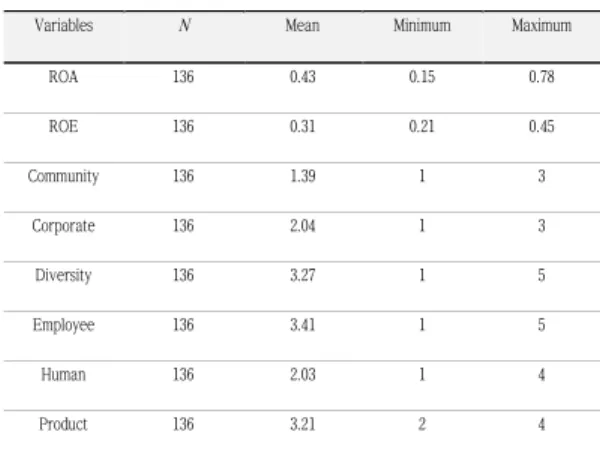
<Tab. 4-1> provides the descriptive statistics of the results. Whereas the ROA for the hotels ranged from 0.15 to 0.78 (M= 0.43), their ROE ranged more narrowly, from 0.21 to 0.45 (M= 0.31). Scores for community relations and corporate governance, both ranging from 1 to 3, had mean values of 1.39 and 2.04, respectively, whereas scores for diversity and employee relations, both ranging from 1 to 5, and mean values of 3.27 and 3.41, also respectively.
Last, in the range of 1 to 4, scores for human relations had a mean value of 2.03, and scores for product quality, ranging from 2 to 4, had a mean value of 3.21.
Tab. 4-1 Summary of Descriptive Statistics
4.2 Analysis
<Tab. 4-2> and <Tab. 4-3> present the results of regression analysis for the hotel industry in general.
Regarding the individual effects of the independent variables, efforts in community relations (tvalue = 3.563), diversity (tvalue = 2.435, and product quality
(tvalue= 3.970) exerted significant positive effects on ROA, whereas efforts in community relations (tvalue = 3.111), diversity (tvalue = 3.990, and product quality (tvalue = 2.942), exerted significant positive effects on ROE.
Tab. 4-2 Summary of Regression Analysis
Tab. 4-3 Summary of Regression Analysis
5. Discussion
Toexamine the effects of pursing CSR activities on the financial performance of firms in the U.S.
hotel industry, the study examined six dimensions of CSR (i.e., community relations, corporate
Variables N Mean Minimum Maximum
ROA 136 0.43 0.15 0.78
ROE 136 0.31 0.21 0.45
Community 136 1.39 1 3
Corporate 136 2.04 1 3
Diversity 136 3.27 1 5
Employee 136 3.41 1 5
Human 136 2.03 1 4
Product 136 3.21 2 4
lnROA = α0 + α1lnCOMMUNITY + α2lnCORPORATE + α3lnDIVERSITY + α4lnEMPLOYEE + α5lnHUMAN + α6lnPRODUCT + ɛ
Variables Community Corporate Diversity Employee Human Product
Coefficient 8.325 1.432 5.346 1.435 1.903 6.546
t-value 3.563* 0.292 2.435* 0.322 0.593 3.970*
Adjusted R
20.45
Note:*p < .05
lnROE = α0 + α1lnCOMMUNITY + α2lnCORPORATE + α3lnDIVERSITY + α4lnEMPLOYEE + α5lnHUMAN + α6lnPRODUCT+ ɛ
Variables Community Corporate Diversity Employee Human Product
Coefficient 6.534 1.133 7.985 .902 .872 5.190
t-value 3.111* 0.145 3.990* 0.122 0.111 2.942*
Adjusted R2 0.49
Note:*p < .05
governance, diversity, employee relations, human relations, and product quality) and evaluated the effect of efforts in each dimension on the firms’performance during 1991-2015.
In the industry, investments in activities that support market strategies seemed to increase corporate profitability and financial performance.
Profitability, however, indicates only short-term financial performance, whereas investment in CSR activities can help to enhance firm value and financial performance in the long term. Managers of firms in the hotel industry can respond to those findings by diversifying their companies’financial strategies and expanding from simply investing in the market to balancing both market and non-market investments.
The results also revealed which dimensions of CSR had the most significant impact on the hotel firms’financial performance and how they related to firm value. The study found that a greater level of involvement in the community more positively affected ROA as well as ROE for the firms.
Activities spearheaded by firms that worked to support the community closely related to the firms’financial performance and helped the firms generate larger profits and benefits. According to the findings, if hotel managers increase their investment in community relations, then their companies can gain a competitiveadvantage and, in turn, improve their profitability.
Moreover, the results suggest that investments among hotel firms to maintain or improve diversity in the workforce negatively affected their ROA.
That outcome counters findings that such efforts have positively affected financial variables for hotels as well as restaurants (Porter and Kramer,
2006), which leaves the usefulness of such investments for hotel firms debatable. Interestingly, however, the results also suggest that diversity positively affected the ROE of hotel firms (Porter and Kramer, 2006).
Similarly, to investments in maintaining or improving employee diversity, investments in product quality negatively affected the corporate financial performance of hotel firms in the sample, particularly their ROA. Arguably, the likelihood that hotels will implement activities to improve product quality and production methods to achieve CSR and thereby increase their profitability is slim.
In sum, CSR-oriented activities in the dimensions of community relations, diversity, and product quality all significantly affected the financial performance of U.S. hotel firms from 1991 to 2015.
In particular, efforts in community relations bore a significantly positive effect on profitability, which suggests that hotel executives can increase their firms’profitability by investing in community-supporting or-oriented activities.
Conversely, efforts toward maintainingor improving employee diversity and product quality correlated negatively with hotels’financial performance.
Therefore, hotel firms should lower their investment in both dimensions. Among other results, efforts to improve corporate governance, employee relations, and human relations had no particular impact on the hotel firms’financial performance.
This study entailed several limitations. First, although several researchers have used KLD Stats, the construct validity of such use is questionable because some indicators from the database may inaccurately reflect the multifaceted nature of CSR.
Since that issue of the constructis complex and not
be easily overcome, researchers should focus more on exploring potential solutions. Second, the study used a small sample. Data from KLD Stats represent companies from the S&P 500 and the Russell 3000 Indexes only. In the future, scholars should, therefore, collect more data and provide findings based on larger samples. Third, they should consider factors other than the six dimensions that the studied that might also affect CSR and financial performance. For example, brand image and consumers’product preferences could influence the relationship between firms’CSR-oriented activities and their financial performance. However, because the dimensions that the study used apply tomany industries, researchers might also consider developing CSR-related dimensions specific to the hotel industry that are likely to increase the validity and reliability of their findings and thereby provide more useful information for hotel managers.
Last, this study focused on the U.S. hotel industry only, meaning that the findings might not be generalizable to hotels in other national and regional contexts. In the years ahead, scholars could expand the scope of their research to generate findings regarding the CSR activities and financial performance of the hotel industries in other countries to reveal more global implications of the relationship between CSR and financial performance for hotels.
Reference
[1] Backhaus, K. B., Stone, B. A. and Heiner, K. (2002), ExploringtheRelationshipBetweenCorporateSocialPe rformanceandEmployerAttractiveness.Business&So
ciety,41(3),292-318.
[2] Berman, S., Wicks, A. and Jones, T. (1999), Does stakeholder orientation matter? The relationshipbetween stakeholder management models and firm financial performance. Academy of Management Journal, 42(5), 488-506.
[3] Brammer, S., & Millington, A. (2005), Corporate Reputation and Philanthropy: An Empirical Analysis.
Journal of Business Ethics, 61(1), 29-44.
[4] Brammer, S., & Millington, A. (2008), Does it pay to be different? An analysisof the relationship between corporate social and financial performance.
Strategic Management Journal, 29(12), 1325-1343.
[5] Bremner, C. (2009). Sustainable tourism moves slowly in the right direction.
[6] Carroll, A. (1991), The pyramid of corporate social responsibility: toward the moral management of organizational stakeholders. Business Horizon, 34, 39-48.
[7] Carroll, A. (1999), A three-dimensional model of corporate social performance. Academy of Management Review, 20(1), 92-117.
[8] Clarkson, M. (1995), A stakeholder framework for analyzing and evaluating corporate social performance. Academy of Management Review, 20(1), 92-117.
[9] Gao, Y. and Mattila, A. S. (2014), Improving consumer satisfaction in green hotels: The roles of perceived warmth, perceived competence, and CSR motive.
International Journal of Hospitality Management, 42, 20-31
[10] Godfrey, P. C. and Hatch, N. W. (2007), Researching Corporate Social Responsibility: An Agenda for the 21st Century. Journal of Business Ethics, 70(1), 87-98.
[11] Hillman, A. and Keim, G. (2001), Shareholder value,
stakeholder management, and social issues: what’s the bottom line? Strategic Management Journal, 22, 125-139.
[12] Holden, A. (2000), Environment and tourism:
London: Routledge.
[13] Johnson, R., and Greening, D. (1999), The Effects of Corporate Governance and Institutional Ownership Types on Corporate Social Performance.
Academy of Management Journal, 42(5), 564-576.
[14] Kacperczyk, A. (2009), With greater power comes greater responsibility? takeoverprotection and corporate attention to stakeholders. Strategic Management Journal, 30(3), 261-285.
[15] Kang, K. H., Lee, S. and Huh, C. (2010), Impacts of positive and negative corporate social responsibility activities on company performance in the hospitality industry. International Journal of Hospitality Management, 29(1), 72-82.
[16] KLD.(n.d.). (2018), http://www.kld.com/
[17] Lee, S. and Heo, C. Y. (2009), Corporate social responsibility and customer satisfaction among USpublicly traded hotels and restaurants.
International Journal of Hospitality Management, 28(4), 635-637.
[18] Lee, S. and Park, S.-Y. (2009), Do socially responsible activities help hotels and casinos achieve their financial goals? International Journal of Hospitality Management, 28(1), 105-112.
[19] McWilliams, A. and Siegel, D. (2001), Corporate social responsibility: a theory of the firm perspective. Academy of Management Review, 26(1), 117-127.
[20] Peterson, D. K. (2004), The Relationship between Perceptions of Corporate Citizenship and Organizational Commitment. Business & Society, 43(3), 296-319.
[21] Porter, M. and Kramer, M. (2006), Strategy and society: the link between competitive advantage and corporate social responsibility. Harvard Business Review, 84(12), 78-92.
[22] Robinson, G. and Dechant, K. (1997), Building a business case for diversity. Academyof Management Executive, 11(3), 21-31.
[23] Servaes, H. and Tamayo, A. (2013), The Impact of Corporate Social Responsibility on Firm Value: The Role of Customer Awareness. Management Science, 59(5), 1045-1061.
[24] Singal, M. (2012), Effect of consumer sentiment on hospitality expenditures and stock returns.
International Journal of Hospitality Management, 31(2), 511-521.
[25] Turban, D. and Greening, D. (1997), Corporate social performance and organizational attractiveness to prospective employees. Academy of Management Journal, 40(3), 658-672.
[26] Waddock, S. and Graves, S. (1997). The corporate social performance-financial performance link.
Strategic Management Journal, 18(4), 303-319.
[27] Wooldridge, J. (2009), Introductory Econometrics:
A modern approach: Mason, OH: South-Wester.
Strategic Management Journal, 18(4), 303-319
Kim, Woo-Hyuk([email protected])
Woo-Hyuk Kim is a Ph.D. in the Department of Hospitality Management at
Kansas State University. His academic interest includes hospitality management,
hospitality analytics marketing, big data, and consumer behavior.
미국 호텔의 사회적 책임이 재무적 성과에 미치는 영향
김우혁*
요약
ㄴ
기업의 사회적 책임 (CSR)을 위한 관행은 비즈니스 세계에서 경쟁우위의 원천이 되었습니다. 이에 따라 호 텔 산업에서 이러한 관행의 계속적으로 증가하고 있지만, 이러한 관행과 기업의 재무적 성과 간의 관계에 관 한 실증적 연구는 아직 많이 부족한 실정입니다. 따라서 이 연구의 목적은 미국 호텔 산업에서 기업의 사회 적 책임의 다양한 차원의 영향이 미국 호텔산업의 재무적 성과에 미치는 영향을 확인하는데 있습니다. 이를 검증하기 위해서 본 연구는 KLD 통계 및 1991-2015년 SIC 코드를 사용하여 얻은 COMPUSTAT 데이터를 이용합니다. STATA를 이용한 OLS 회귀분석방법은 호텔의 사회적 책임이 호텔의 재무적 성과에 유의한 영향 을 미친다는 것을 보여줍니다. 본 연구의 연구결과는 호텔산업의 사회적 책임에 관한 마케팅활동에 활용할 수 있는 유용한 정보를 제공하는데 의의가 있습니다.
표제어: 사회적책임, 환대산업, 재무적성과, COMPUSTAT, KLD, 호텔
* 캔자스주립대학교 호텔외식경영학과 박사. [email protected]