Ⅰ. 서 론
일반적으로 아동은 환경 안에서 다양한 요소들과 적절 히 상호 작용하며, 일련의 양적 혹은 질적 성장을 한다
(Bendixen & Kreider, 2011). 그러나 뇌성마비(Cerebral Palsy) 아동은 뇌에 발생한 비진행성 병변 또는 손상으로 운동과 자세 조절 등의 어려움을 겪게 되며, 상호작용에 제 한을 가진다(Case-Smith, 2015; Robert, Guberek,
대한감각통합치료학회지 제19권 1호
The Journal of Korean Academy of Sensory Integration 2021 Vol. 19. No. 1
http://dx.doi.org/10.18064/JKASI.2021.19.1.54
뇌성마비 아동의 신체기능 및 일상생활 향상을 위해 적용된 과제 중심 훈련의 체계적 고찰
박아름
*, 이재신
***전주기전대학 작업치료과 조교수
**건양대학교 의과학대학 작업치료학과 교수
국문초록
목적 : 본 연구는 뇌성마비 아동의 신체기능과 일상생활 향상을 위해 적용된 과제 중심 훈련 방법에 대해 정리하고 효과를 제시하고자 하였다.
연구방법 : 검색 기간은 2008년 1월부터 2020년 8월까지로 하였으며, 자료 검색을 위해 CINAHL, MEDLINE, PubMed의 데이터베이스를 이용하였다. 총 18편이 선정되었으며, PICO(Patient, Intervention, Comparison, Outcome) 방법을 적용하여 체계적으로 정리하였다. 과제 중심 훈련은 선행연구를 참고하여 운동학습 및 운동조절 이론의 전략인 과제(Task), 실행(Practice), 피드백(Feedback)으로 분류하여 제시하였다.
결과 : 그 결과 13편의 연구가 운동기술 영역에서 유의한 결과를 보였으며, 그 중 2편의 연구에서 일상생활 영역에서 유의한 결과를 보였다. 과제는 개별 과제(discrete task)와 닫힌 과제(closed task) 형태가 가 장 많이 사용되었다. 실행은 전체 실행(whole practice) 유형이 가장 많이 사용되었으며, 부분 실행 (part practice), 차단 실행(blocked practice) 순으로 사용되었다. 마지막으로 피드백은 구체적으로 제 시하지 않은 경우가 가장 많았으며, 외재적 피드백(extrinsic feedback)이 사용되었다.
결론 : 본 연구를 바탕으로 향후에는 뇌성마비 아동의 운동조절을 촉진하는 기술의 체계적인 선택과 구체적 인 방법의 제시를 통하여 과제 중심 훈련이 임상에서 더욱 효과적으로 사용될 수 있을 것이라 기대한다.
주제어 : 과제 중심 훈련, 뇌성마비, 작업치료
교신저자: 이재신([email protected])
접수일: 2021.01.13 ∥심사일: (1차: 2021.02.04. / 2차: 2021.03.17.) ∥게재확정일: 2021.06.14.
Sveistrup, & Levin, 2013). 이러한 문제는 생활 전반에 걸쳐 일상생활이나 학교, 놀이, 지역사회 등의 참여를 제한 시키므로 아동이 최대한 독립적인 수행을 할 수 있는 활동 들의 중재가 이루어져야 한다(Bae, 2012; Kemp, 2015).
뇌성마비 아동의 효율적인 움직임을 위해 적용되는 운 동학습(motor learning)과 운동조절(motor control) 이 론은 목적 있는 활동을 통하여 운동과 자세 조절 능력을 향상시켜 복잡한 신경 체계가 적응하도록 하는 것이다 (Latash & Anson, 1996; Lederman, 1997; Valvano &
Newel, 1998). 전략에는 과제의 형태, 실행의 유형, 피드 백, 모델링, 학습의 전이, 인지 시연 등을 사용하며, 치료 사는 클라이언트에 따라 어떠한 과제의 유형을 사용할지 와 언제, 어떻게 피드백을 제공하고 학습을 전이시켜 일반 화를 촉진할 것인지 등의 적절한 전략을 사용하는 것이 중요하다(Hubbard, Parsons, Neilson, & Carey, 2009;
Thelen & Smith, 2007; Thorpe & Valvano, 2002;
Toovey, Bernie, Harvey, McGinley, & Spittle, 2017).
그 중 과제 중심 훈련(task-oriented training)은 운동 학습의 개념을 고려한 중재법으로 클라이언트가 상황에 맞는 특정 과제를 반복적으로 연습하고 기술획득에 적절한 피드백을 받게 된다(Bang, 2003; Case-Smith, 2015).
훈련으로는 앉았다 일어서기, 걷기, 뻗기 등의 과제, 같은 과제라도 상황을 조금씩 다르게 제공한 과제 등 넓은 의미의 다양한 방법부터 기능적 과제를 이용한 훈련도 포함된다 (Rensik, Schuurmans, Lindeman, & Hafsteinsdottir, 2009). 이는 일상적인 환경 내에서의 운동학습을 촉진시켜 움직임을 경험하도록 하기 때문에 운동 조절의 어려움을 겪는 뇌성마비 아동에게 효과적인 중재 방법이라고 볼 수 있다(Blundell, Shepherd, Dean, Adams, & Cahill, 2003; Rensink et al., 2009; Salem & Godwin, 2009).
이와 관련된 선행 연구를 살펴보면 뇌성마비 아동이 패턴을 반복적으로 연습할 때보다 일상생활에 필요한 활 동을 반복하는 것, 하고 싶은 활동을 집중적으로 수행할 때 더욱 향상된 운동기능과 능동적인 수행을 보였으며, 기능적 자기공명영상(functional Magnetic Resonance Imaging; fMRI) 상에서도 뇌가 활성화되었다(Kim &
Choi, 2017; Van de Wincke et al., 2013). 또한 성인 뇌성마비를 대상으로 한 Bang(2007)의 연구에서도 실제 환경이나 다양한 환경에서 수행할 수 있는 일상생활 활 동을 제공하였을 때 효과적이라고 보고하였다. 즉 뇌성
마비 대상에게 과제 중심 훈련이 신체기능과 일상생활에 서 긍정적인 영향을 미치는 것을 확인할 수 있었다 (Salem, & Godwin, 2009; Lee & Choi, 2013; Kwon, Ahn, & Kim, 2014).
이에 본 연구는 뇌성마비 아동의 신체기능과 일상생활 향상을 위해 적용된 다양한 방식의 과제 중심 훈련 방법 에 대해 분석하고 고찰하여 아동이 일상생활에서의 수행 을 향상시킬 수 있는 기초자료로 제시하고자 한다.
Ⅱ. 연구 방법 1. 연구대상 및 자료수집 방법
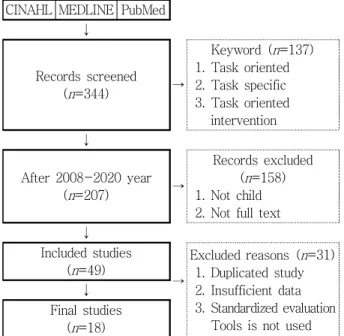
본 연구는 2008년 1월부터 2020년 8월까지 뇌성마비 아동에게 적용된 과제 중심 훈련 연구를 대상으로 하였 다. 데이터베이스는 Cumulative Index to Nursing and Allied Health Literature; CINAHL, MEDLINE, PubMed 를 이용하였다. 검색에 사용한 주제어는 연구대상에 대 해 Cerebral palsy, 독립요인은 Task-oriented OR Task specific OR Intervention, 종속요인 Activity daily living OR Physical function OR Motor skills OR Motor functions OR Fine motor skills OR Hand functions을 사용하였다. 전체 344편의 연구에서 선정 과 배제 기준에 따라 최종 18편의 연구를 선정하였다 (Figure 1).
1) 연구의 선정 기준
첫째, 18세 이하의 뇌성마비 진단을 받은 아동을 대상 으로 한 연구
둘째, 과제 중심(task-oriented), 과제 지향(task specific) 중재를 포함한 연구
셋째, 논문 내에서 평가도구를 사용하여 결과를 제시 한 연구
2) 연구의 배제 기준
첫째, 비디오 제시, 관찰, 자기 보고로 결과를 제시한 연구
둘째, 학위논문, 논평, 도서, 고찰 등의 연구
2. 분석 내용
1) 연구의 일반적 특성 제시
선정된 18편의 연구를 PICO(Patient, Intervention, Comparison, Outcome) 방법을 적용하여 체계적으로 정리하고 제시하였다. 순서는 저자, 게재년도, 대상자,
중재 유형, 중재 기간, 질적 수준으로 나열하였다. 질적 수준은 Arbesman, Scheer와 Lieberman(2008)의 분류 기준을 사용하였으며, Level 1은 메타분석, 체계적 고 찰, 무작위 대조연구, Level 2는 두 집단 비 무작위 연 구, Level 3은 단일 집단 비 무작위 연구, Level 4는 개 별실험연구와 조사연구, Level 5는 사례연구로 나누어 진다.
2) 연구의 출판 동향 및 평가 영역 제시
본 연구에서는 연구 동향을 분석하기 위해 Arbesman, Scheer와 Lieberman(2008)의 질적 수준 분류 기준과 출판 년도와 함께 제시하였다. 또한 향상된 효과를 측정 하기 위해 사용한 평가도구를 영역에 따라 사용 횟수를 제시하였다.
3) 연구 중재 방법 분석 결과 제시
연구의 중재 방법은 선행연구를 바탕으로 과제, 연습, 피드백으로 분류하여 제시하였다(Case-Smith, 2015;
Muratori, Lamberg, Quinn, & Duff, 2013; Shim &
Park, 2012)(Table 1). 선정된 연구를 연구자 1명이 분 류하였고, 다른 연구자 1명이 재확인하였다. 이를 다시 CINAHL MEDLINE PubMed
↓
Records screened
(
n
=344) →Keyword (
n
=137) 1. Task oriented 2. Task specific 3. Task orientedintervention
↓
After 2008-2020 year
(
n
=207) →Records excluded (
n
=158) 1. Not child 2. Not full text↓ Included studies
(
n
=49)→
Excluded reasons (
n
=31) 1. Duplicated study 2. Insufficient data 3. Standardized evaluationTools is not used
↓ Final studies
(
n
=18)Figure 1. Process for identification of included studies
Classification Contents
Task
· Discrete task · Beginning and an end task
· Ex) pick-up
· Serial task · Continuing challenges task
· Ex) walk, running
· Closed task · Environment is fixed while the task is being perform
· Ex) scribbling on paper
· Open task · Environment changes and includes variability
· Ex) follow with a moving target pen on your computer
Practice
· Blocked practice · Ordering tasks from easy to difficult
· Ex) cup grasp->pencil grasp->coin grasp
· Random practice · Various training at the same time
· Ex) random of cup, pencil, coin grasp
· Part practice · Intensive repetitive exercises with difficult
· Ex) a part of difficult movement in dressing
· Whole practice · Practice the whole process over and over again
· Ex) clothing activity repetition exercise
Feedback · Extrinsic feedback · Feedback from outside
· Ex) knowledge of result, knowledge of performance
· Intrinsic feedback · Feedback from sensory experience Table 1. Classification and definition of task-oriented training
임상 경력 5년 이상의 치료사가 검토하였으며, 일치하지 않는 경우 토의 과정을 거쳐 수정 보완하였다.
Ⅲ. 연구 결과 1. 연구의 일반적 특성
연구의 대상자는 총 364명이었다. 성별은 제시하지 않 은 Speth 등(2015)의 대상자 35명을 제외하고 남자 176명 여자 153명이었으며, 연령은 만 2세부터 17세까지였다.
선정된 18편 모두 경직형(spastic) 뇌성마비를 포함하였
으며, 4편의 연구에서 무정위형(athetoid), 또는 실조형 (ataxia), 혼합형(mixed)이 추가적으로 포함되어 있었다.
손상 위치에 따라서는 양하지마비(diplegia)가 171명으로 가장 많았으며, 다음으로 편마비(hemiplegia) 147명, 사 지마비(quadriplegia) 25명, 불완전마비(paraplegia) 12 명, 단마비(monoplegia) 1명 순이었다. 실험군은 과제 중 심 훈련만 사용한 연구, 몸통 억제, 현수 장치, 불안정한 표면 제공과 결합한 연구, 약물치료와 결합한 연구, 전통 적인 작업치료 또는 물리치료와 결합한 연구가 포함되었 다. 대조군은 전통적인 작업치료 및 물리치료, 신경발달치 료, 다른 치료와 결합되지 않은 과제 중심 훈련을 받은 중재가 포함되었다(Table 2).
Author (year)
Participants Intervention
Quality level
N
Age Type Training Session/Experimental / Control week 1 Salem et al.
(2009) 5/5 4-12y Spastic Task-oriented strength training
/ Conventional physical therapy 10/5 RCT
Ⅰlevel 2 Schneiberg et al.
(2010) 6/6 6-12y Spastic Task-oriented training + trunk restraint
/ Task-oriented training 15/5 RCT
Ⅰlevel 3 Choi et al.
(2011) 5/5 2-9y Spastic Task-oriented training
/ Neurodevelopmental treatment 30/6 RCT
Ⅰlevel 4 Kumar et al.
(2013) 15/15 6-12y Spastic Task oriented circuit training
/ Conventional PT training 20/4 RCT
Ⅰlevel 5 Lee et al.
(2013) 6/5 8.45±2.2y Spastic Task-oriented training + suspension device
/ Task-oriented training 16/8 RCT
Ⅰlevel
6 Kumban et al.
(2013) 10/11 6-15y
Spastic ataxia, athetoid
Physical therapy + sit-to-stand task training
/ Physical therapy 18/6 RCT
Ⅰlevel
7 Kim et al.
(2013) 26 11.80y
Spastic mix, athetoid
Child-centered task-oriented training 30/15
One group
Ⅲ level
8 Song et al.
(2014) 12 7-12y Spastic Task-oriented arm training
+ conventional OT training 30/6
One group
Ⅲ level 9 Kwon et al.
(2014) 7/7/7 4-7y Spastic Task-oriented training / High-variability practice
/ Neurodevelopmental treatment 20/10 RCT
Ⅰlevel 10 Speth et al.
(2015) 13/5/11/6 2.5-12y Spastic BoNT-A + BITT, BoNT-A, BITT
/ Neurodevelopmental treatment 24/12 RCT
Ⅰlevel 11 Elhinidi et al.
(2016) 15/15 9-15y Spastic Dual-task training + conventional PT training
/ Conventional PT training 18/6 RCT
Ⅰlevel 12 Kwon et al.
(2016) 4/4 3-8y Spastic Task-oriented training
/ Neurodevelopmental treatment 16/8 Non-RCT
Ⅱ level 13 Han et al.
(2016) 12/12 7-15y Spastic Task-oriented training
/ Neurodevelopmental treatment 20/4 RCT
Ⅰlevel Table 2. General characteristics of study
2. 연구의 출판 동향 및 평가 영역
1) 연구의 출판 동향
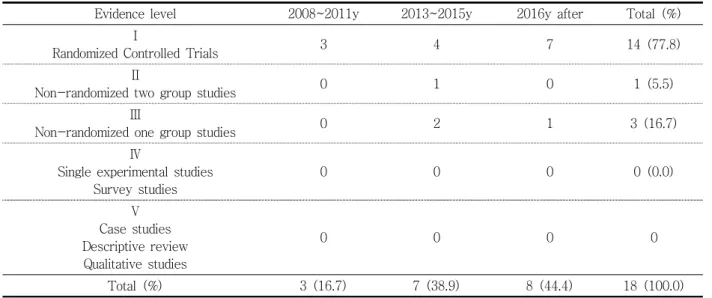
2008년에서 2011년도에 출판된 연구는 총 3편으로 모 두 Ⅰ단계 수준인 무작위 대조 연구였다. 2013년에서 2015년도에는 총 7편으로 Ⅰ단계 수준의 무작위 대조 연 구 4편, Ⅱ단계 수준의 두 집단 비 무작위 연구 1편, Ⅲ
단계 수준의 단일 집단 비 무작위 연구 2편이었다. 마지 막으로 2016년 이후의 연구는 총 8편으로Ⅰ단계 수준의 무작위 대조 연구 7편, Ⅲ단계 수준의 단일 집단 비 무작 위 연구 1편이었다. 그 결과Ⅰ단계 수준에 해당하는 연 구는 총 14편으로 전체 연구의 77.8%였고, Ⅱ단계 수준 의 연구는 1편으로 5.5%, Ⅲ단계 수준에 해당하는 연구 는 3편으로 16.7%를 차지하였다(Table 3).
Author (year)
Participants Intervention
Quality level
N
Age Type Training Session/Experimental / Control week 14 Moon et al.
(2017) 6/6 5-13y Spastic Task-oriented training + conventional OT training
/ Conventional OT training 8/4 RCT
Ⅰlevel
15 Han et al.
(2017) 9/9 9-17y Spastic
ataxia
Task-oriented training + stable support surface / Task-oriented training + unstable support
surface
18/6 RCT
Ⅰlevel
16 Yang et al.
(2019) 10 7-13y Spastic
ataxia Task-oriented training 24/8
One group
Ⅲ level
17 Sah et al.
(2019) 22/22 7-15y Spastic
Task-oriented activities based on neurodevelopmental therapy / Conventional PT
training
36/6 RCT
Ⅰlevel
18 Heneidy et al.
(2020) 15/15 5-8y Spastic Task-oriented training + conventional PT training
/ Conventional PT training 36/12 RCT
Ⅰlevel PT: Physical Therapy, OT: Occupational Therapy, BoNT-A: Botulinum toxin A, BITT: Bimanual task-oriented therapy, RCT: Randomized Controlled Trials
Table 2. General characteristics of study (Cont.)
Evidence level 2008~2011y 2013~2015y 2016y after Total (%)
Ⅰ
Randomized Controlled Trials 3 4 7 14 (77.8)
Ⅱ
Non-randomized two group studies 0 1 0 1 (5.5)
Ⅲ
Non-randomized one group studies 0 2 1 3 (16.7)
Ⅳ
Single experimental studies Survey studies
0 0 0 0 (0.0)
Ⅴ Case studies Descriptive review Qualitative studies
0 0 0 0
Total (%) 3 (16.7) 7 (38.9) 8 (44.4) 18 (100.0)
Table 3. Levels of evidence for research
2) 연구의 사용된 평가 영역 및 도구
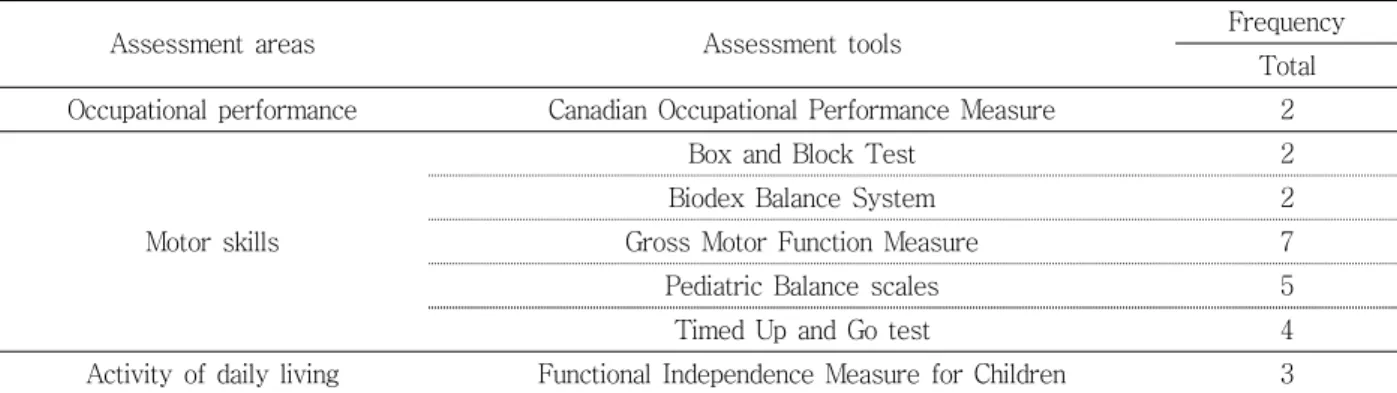
18편의 연구에서 사용한 평가도구는 총 27개였으며, 그 중 연구 간 중복으로 사용한 평가도구는 7개였다. 평가 영역으로는 작업수행 영역, 운동기술 영역, 일상생활 영역 이었다. 그 결과 대동작 기능 평가(Gross Motor Function Measure; GMFM)가 7편으로 가장 많이 사용되었다. 다음 으로 아동 균형 척도(Pediatric Balance Scales; PBS)가 5편, 일어서서 걷기 검사(Timed Up and Go test; TUG)가 4편, 아동용 기능 독립성 평가(Functional Independence Measure for Children; weeFIM)가 3편이었으며, 마지막으 로 작업수행 측정(Canadian Occupational Performance Measure; COPM)과 상자와 나무토막 검사(Box and Block Test; BBT), Biodex 균형 시스템 검사(Biodex Balance System) 2편에서 사용되었다(Table 4).
3. 연구 중재 방법 분석 결과
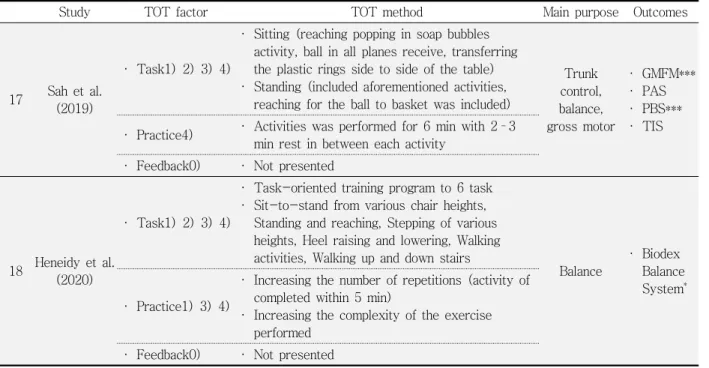
선정된 18편의 연구 중 13편의 연구가 운동기술 영역 에서 유의한 결과를 보였으며, 그 중 2편의 연구에서 일 상생활 영역에서 유의한 결과를 보였다. 과제는 개별 과 제(discrete task)와 닫힌 과제(closed task)가 유의한 결과를 보인 13편의 중 12편의 연구에서 가장 많이 사용 되었다. 실행은 전체 실행(whole practice)이 유의한 결 과를 보인 9편의 연구에서 가장 많았고 다음으로 부분 실행(part practice)과 차단 실행(blocked practice)이 4 편에서 사용되었다. 마지막으로 피드백(feedback)은 구 체적으로 제시하지 않아 알 수 없는 경우가 9편으로 가장 많았으며, 다음으로는 외재적 피드백(extrinsic feedback) 이 4편에서 사용되었다(Table 5, 6).
Assessment areas Assessment tools Frequency
Total Occupational performance Canadian Occupational Performance Measure 2
Motor skills
Box and Block Test 2
Biodex Balance System 2
Gross Motor Function Measure 7
Pediatric Balance scales 5
Timed Up and Go test 4
Activity of daily living Functional Independence Measure for Children 3 Table 4. Number of times evaluation tools used
Classification Motor skills Motor skills & ADL Frequency Total
Task
· Discrete task 10 2 12
· Serial task 8 2 10
· Closed task 10 2 12
· Open task 7 2 9
Practice
· Blocked practice 4 0 4
· Random practice 0 0 -
· Part practice 4 0 4
· Whole practice 7 2 9
Feedback · Extrinsic feedback 3 1 4
· Intrinsic feedback 1 0 1
: showed the highest point ADL: Activity Daily of Living
Table 5. Task-oriented training factor to analysis
Study TOT factor TOT method Main purpose Outcomes
1 Salem et al.
(2009)
· Task1) 2) 3) 4)
· Walking, ramps and stairs, stepping, standing balance, standing up from a chair, single leg
stance, kicking a ball Mobility
function
· GMFM**
· TUG*
· Practice1) · Repetition of individual, increasing exercise challenge (difficulty)
· Feedback0) · Not presented
2
Schneiberg et al.
(2010)
· Task1) 3)
· Using the tabletop workspace in Sessions were divided into five blocks (preparatory activity, uni- and bi manual activities, rest, virtual reality,
practising a challenging activity chosen) Upper limb movement
·Melbourne Assessment
· Practice3) · Practising chosen, child or his or her family
· Feedback1)
· During virtual reality children received feedback as sounds and game scores, therapists could guide arm movement or motivate
3 Choi et al.
(2011)
· Task1) 3)
· Pelvis&lower limbs stretching, muscle power training with a ring, ring-holding, standing up
from a sitting position, using balls Sitting posture
· GMFM
· EMG
· Practice4) · Follow the training protocol
· Feedback0) · Not presented
4 Kumar et al.
(2013)
· Task0)
· Circuit training (low-resistance, high repetition exercises) real-life tasks, with the intention of
acquiring or reacquiring Mobility
balance (L/E)
· TUG*
· PBS*
· Practice4) · Whole circuit was completed twice each session
· Feedback0) · Not presented
5 Lee et al.
(2013)
· Task1) 3)
· Arm reaching activity using suspension device
· Motivated by oneself for a purposeful and meaningful task
Trunk stability, gross motor,
reaching activity
· GMFM*
· TIS
· Practice3) · Repeated performed of arm reach activities
· Feedback0) · Not presented
6 Kumban et al.
(2013)
· Task1) 3)
· Sit-to-stand task training consisted of two parts of according to GMFCS level (chair
independently, needed assistance to perform) Sit-to-stand
· MAS
· PBS
· FRT
· FTSST
· Practice3) 4) · Whole or part of the sit-to-stand
· Feedback1) · Verbal guidance, visual feedback
7 Kim et al.
(2013)
· Task1) 2) 3) 4)· Child-centered task-oriented training program to 26 tasks
Balance ability · PBS*
· Practice3) · Child choose various activities training program
· Feedback1) 2)
· Therapist provided verbal cues and physical activity guidance
· Mirror use, correct his or her posture as well
8 Song et al.
(2014)
· Task1) 2) 3) 4)
· Conventional OT + activities similar to the daily tasks
· Bilateral manipulation, unilateral activities
(playing and basic ADL) Motor function (affected arm)
· BBT***
· MAM
· WeeFIM***
· Practice4) · Follow the training protocol
· Feedback0) · Not presented Table 6. Task oriented training method and effect of study
Study TOT factor TOT method Main purpose Outcomes
9 Kwon et al.
(2014)
· Task1) 2) 3) 4)
· Task-oriented training program to 5 tasks (boccia game & gymball, wear and take, pick up an object and then stand. kick the ball rolled,
walk various obstacles) Gross motor
performance, ADL
· GMFM*
· GMPM*
· PBS*
· WeeFIM*
· Practice4) · Each task was given to be performed (within 10 minutes)
· Feedback0) · Not presented
10 Speth et al.
(2015)
· Task1) 2) 3) 4)
· Pulling up pants, closing the button, cutting paper, pulling apart LEGO bricks, tried
shoelaces, closing the zip of a jacket Upper extremity
· AHA
· OSAS
· COPM
· GAS
· Practice2) 4) · Practiced these activities several times a day (in home)
· Feedback0) · Not presented
11 Elhinidi et al.
(2016)
· Task1) 2) 3) 4)· Primary (Balance) activities + Secondary
(Cognitive) activities Postural
stability
· Biodex Balance System*
· Practice4) · Follow the training protocol
· Feedback0) · Not presented
12 Kwon et al.
(2016)
· Task1) 2) 3) 4)
· Task-oriented training program to 5 tasks (boccia or roll a gym ball, dressing or undressing, sit to standing or kneeling to half kneeling or standing on the tool, cruising or walking, stair ambulation)
Mobility, balance,
ADL
· GMPM*
· WeeFIM*
· Practice4) · 7 min for each task
· Feedback1) · Verbal feedback to completed motion
13 Han et al.
(2016)
· Task1) 2) 3) 4)
· Treadmill (independent walking), balance training included the one-legged standing, performed on
a wooden staircase (maintained for 10 seconds) Gait, balance
· GMFM*
· GAITRite
· PDM
· Practice4) · Follow the training protocol
· Feedback0) · Not presented
14 Moon et al.
(2017)
· Task1) · Tasks focused on improving the upper limb function Hand dexterity,
strength
· BBT
· Grip strength
· Practice3) · Repeated reaching, ring activity, and stacking cup
· Feedback1) 2) · Providing feedback for children's volition
15 Han et al.
(2017)
· Task1) 3)
· Perform on a chair with a balance board.
(switch push, plastic bottle transfer, pegboard,
bead transfer) Arm,
balance
· MFRT
· TUG*
· Jebsen- Talyer hand function
· Practice1) 4) · 5 min for each task
· Feedback1) · Providing commands from specific tasks (randomly press during switch push)
16 Yang et al.
(2019)
· Task1) 2) 3)
· Select 8 tasks from the ICF (mobility) Activities (d4103, d4452, d4454, d4454&d4455, d4351,
d4500, d4502, d4551) Body
function, activity, participation
· GMFM*
· TUG*
· BOTMP
· MAS
· Practice1) 3) · Follow the training protocol
· Improve level depending on task situations
· Feedback1) · Minimal assistance in case of failure Table 6. Task oriented training method and effect of study (Cont.)
Ⅳ. 고 찰
아동은 움직임에 의해 발달하며, 효과적으로 움직이 기 위해 환경에 대한 지각을 해야 한다. 뇌성마비 아동은 장애로 인하여 운동기술과 기능적인 활동이 제한되므로 사회활동에 어려움을 가진다(Campbell, 1991). 이러한 기능적 제한점은 다양한 환경에서 집중적인 기회를 제공 하면 향상될 가능성이 있으며, 치료 중재는 아동의 장애 수준을 고려하여 목표 지향적이고 의미 있는 활동을 제 공하는 것이 중요하다(Cameron & Monroe, 2007). 과 제 중심 훈련은 일상생활 활동을 향상시키기 위하여 목 적 지향적인 과제를 연습 및 반복시키는 방법인데 이러 한 반복적이고 집중적인 과제는 뇌성마비 아동의 기능을
향상시키는데 효과적이며, 동기부여를 장려하는 훈련 방 법이다.
운동 학습에 영향을 끼치는 과제의 형태는 다양하게 분류할 수 있으며(Schmidt & Lee, 2005), 그 중 개별 과제와 연속 과제는 종종 구분하기가 어려울 수 있다고 보고하였다(Hogan & Sternad, 2007). 정의하자면 개별 과제는 시작과 끝이 있는 과제를 말할 수 있으며, 예를 들어 물건 집기, 불을 켜기, 스위치를 누르는 것 등을 말 한다. 연속 과제는 시작과 끝이 뚜렷하지 않은 것으로 걷 는 것, 달리는 것, 드럼치는 것, 수영하는 것 등의 지속 적인 과제를 말한다.
또한 과제는 수행되는 환경의 특성에 따라 열린 과제 또는 닫힌 과제로 분류할 수 있다. 닫힌 과제는 환경이
Study TOT factor TOT method Main purpose Outcomes
17 Sah et al.
(2019)
· Task1) 2) 3) 4)
· Sitting (reaching popping in soap bubbles activity, ball in all planes receive, transferring the plastic rings side to side of the table)
· Standing (included aforementioned activities, reaching for the ball to basket was included)
Trunk control, balance, gross motor
· GMFM***
· PAS
· PBS***
· TIS
· Practice4) · Activities was performed for 6 min with 2–3 min rest in between each activity
· Feedback0) · Not presented
18 Heneidy et al.
(2020)
· Task1) 2) 3) 4)
· Task-oriented training program to 6 task
· Sit-to-stand from various chair heights, Standing and reaching, Stepping of various heights, Heel raising and lowering, Walking activities, Walking up and down stairs
Balance
· Biodex Balance System*
· Practice1) 3) 4)
· Increasing the number of repetitions (activity of completed within 5 min)
· Increasing the complexity of the exercise performed
· Feedback0) · Not presented
Task: 0) not presented, 1) discrete task, 2) serial task, 3) closed task, 4) open task
Practice: 0) not presented, 1) blocked practice, 2) random practice, 3) part practice, 4) whole practice Feedback: 0) not presented, 1) extrinsic feedback, 2) intrinsic feedback
*
p
<.05, **p
<.01, ***p
<.001GMFM: Gross Motor Function Measure, EMG: Electromyography, TUG: Timed Up and Go test, PBS: Pediatric Balance Scales, TIS: Trunk Impairment Scale, MAS: Motor Assessment Scale, FRT: Functional Reach Test, FTSST: Five Times Sit-to-Stand Test, BBT: Box and Block Test, MAM: Manual Ability Measure, weeFIM: Functional Independence Measure for Children, GMPM: Gross Motor Performance Measure, AHA: Assisting Hand Assessment, OSAS:
Observational Skills Assessment Score, COPM: Canadian Occupational Performance Measure, GAS: Goal Attainment Scaling, MFRT: Modified Functional Reaching Test, BOTMP: Bruininks-Oseretsky Test of Motor Proficiency, PAS:
Postural Assessment Scale
: showed the significant results
Table 6. Task oriented training method and effect of study (Cont.)
변화하지 않고 유지되기 때문에 자유롭게 시작하고 멈출 수 있다. 반면에 열린 과제는 과제를 성공시키기 위해 환 경의 변화에 적응해야 하며, 예측하는 능력이 필요하다 (Gentile, 2000). 임상에서는 정해진 환경에서 과제를 제공하는 경우이므로 닫힌 과제가 대부분이지만 개인의 독립성을 향상시키기 위해서는 열린 과제의 환경을 점진 적으로 제공하는 것이 필요하다고 제안하였다(Muratori, Lamberg, Quinn, & Duff, 2013).
본 연구에서는 다양한 과제의 형태가 제공되었으며, 그 중 유의한 결과를 보인 12편의 연구에서 개별 과제와 닫힌 과제가 주로 사용되었다. 이는 과제의 형태가 아동 이 자유롭게 시작하고 멈출 수 있는 활동에 초점이 맞춰 졌다고 볼 수 있으며, 또한 임상에서 주로 제공하다보니 닫힌 과제가 대부분이었다고 사료된다. 그러나 아동의 독립적인 향상을 위해서는 선행 연구에서 제안하였듯이 열린 과제의 환경을 점진적으로 제공하는 것도 고려해야 한다.
기술을 촉진하고 습득하기 위해서는 장기적인 학습이 이루어질 수 있도록 해야 하며, 반복적으로 기술을 실행 하는 것이 중요하다(Magill & Anderson, 2011). 어떤 과제를 수행할지 예측하는 능력에 따라 차단 실행과 무 작위 실행으로 구분할 수 있으며, 차단 실행은 예측 가능 성이 높고 주변 간섭이 적으며, 무작위 실행은 예측 가능 성이 낮고 주변의 간섭이 많다(Lee, Wulf, & Schmidt, 1992). 선행 연구에 따르면 무작위 실행은 다양한 변수 로 인해 수행이 저하될 수는 있지만 차단된 실행에 비해 학습이 더욱 촉진될 수 있다(Wu et al., 2011). 그러나 무작위 실행은 복잡한 구성과 작업 수행으로 인하여 장애 를 가진 환자에게 처음부터 시도하기에는 효과적이지 않 을 수 있으므로 처음 과제를 실행할 때는 계속적인 연습 이 가능하고 동기를 제공하는 성공 가능성이 비교적 높은 차단된 실행이 좋다고 보고하였다(Lin, Fisher, Winstein, Wu, & Gordon, 2008).
또한 과제를 부분적으로 실행해야 하는지 전체적으로 실행해야 하는지는 다양한 요소를 반영해야 한다. 따라 서 부분 실행을 결정하기 위해서는 먼저 과제를 부분으 로 나눌 수 있는지를 고려하여 분석해야 한다(Schmidt, 2005). 연속적인 과제는 방금 완료한 활동에 의존하여 진행되므로 전체 실행에 적합하며, 이러한 과제는 인위 적으로 분리하여 실행을 할 때 더욱 수행을 방해할 수 있
다(Jeannerod, 1984). 부분 실행은 많은 실행을 한다는 것에는 이점이 있지만 어떤 방식으로 구성해야 하는지에 대해서는 명확하지 않아 오히려 운동학습의 과정을 방해 할 수 있다(Magill & Anderson, 2011). 또한 과제에 따 라 차이가 있지만 부분 실행보다는 전체 실행으로 수행하 는 하는 것이 기술을 촉진시킨다고 보고하였다(Schmidt
& Lee, 1988).
이에 본 연구에서는 선행 연구에서 제안한 것처럼 과 제에 따라 차이는 있지만 수행을 촉진시킬 수 있는 전체 실행이 가장 많이 사용되었다. 그러나 수행에 어려움을 가진 아동의 특성상 문제가 되는 동작을 집중적으로 반 복 연습할 수 있는 부분 실행과 지속적인 연습이 가능하 고 비교적 성공이 쉬워 운동학습의 초기 단계에 제공해 야 한다고 제안된 차단 실행을 사용한 것이라 사료된다.
피드백은 과제 수행과 관련하여 제공받는 정보를 말한 다. 크게 내재적 피드백과 외재적 피드백으로 분류할 수 있으며, 내재적 피드백은 감각, 시각, 청각 등에 의해 얻 어지는 정보를 말한다(Schmidt & Lee, 2005). 외재적 피드백은 외부로부터 얻어지는 정보를 말하며, 지식만 제공해주는 결과 지식(knowledge of result)과 정보를 제공해주는 수행 지식(knowledge of performance)이다 (Vander Linden, Cauraugh, & Greene, 1993).
외재적 피드백을 제공하는 방법으로는 수행 후 바로 제공하는 법과 실행을 완료한 후 제공하는 방법 등으로 다양하게 제공될 수 있으며(Gentile, 1972), 감각 시스 템에 손상이 있는 경우 더 중요한 역할을 할 수 있고 대 체의 역할을 할 수 있다. 운동학습은 피드백 없이도 가능 하지만 선행 연구에서 기술을 유지하거나 향상시키기 위 해서는 외재적 피드백의 사용이 효과적이라고 보고하였 다(Cirstea, Ptito, & Levin, 2006). 또한 클라이언트가 수행할 때 적절한 기술을 획득할 수 있도록 외재적 피드 백을 지속적으로 제공해야한다고 보고하였다(Shim &
Park, 2012).
본 연구에서는 피드백 제공에 대한 내용이 구체적으로 제시하지 않았던 경우가 가장 많았으며, 그 다음으로 외 재적 피드백의 제공이 많았다. 외재적 피드백이 초기 단 계에 기술을 습득하기 위해 효과적이라는 선행연구의 결 과를 뒷받침하지만 구체적으로 제시하지 않아 분석하지 못한 것이 제한점이라고 생각된다.
Ⅴ. 결 론
본 연구는 뇌성마비 아동의 신체기능과 일상생활 향상 을 위해 적용된 과제 중심 훈련 방법에 대해 운동학습 및 운동조절을 촉진하는 기술인 과제, 실행, 피드백으로 분 류하여 제시하였다. 그 결과 다양한 방법의 과제 중심 훈 련이 분석되었다. 과제의 형태로는 개별 과제와 닫힌 과 제가 가장 많이 사용되었으며, 실행의 유형은 전체 실행 이 가장 많이 사용되었다. 마지막으로 피드백은 구체적 으로 제시하지 않은 경우가 가장 많았다. 이에 향후에는 각 아동의 수준과 상황에 맞는 운동학습 및 운동조절을 촉진하는 기술의 체계적인 선택과 구체적인 방법이 제시 되어야 과제 중심 훈련이 더욱 임상에서 효과적으로 사 용될 수 있을 것이라 기대한다.
참고 문헌
Arbesman, M., Scheer, J., & Lieberman, D. (2008).
Using AOTA's critically appraised topic and critically appraised paper series to link evidence to practice. OT Practice Magazine, 13(5), 18-22.
Bae, S. O. (2012). Analysis of the effect of application of psychomotricity and physical activity program for children with intellectual disability. Master's thesis, Hanshin University, Gyeonggi-do.
Bang, Y. S. (2003). The change of activity of daily living on task-oriented learning program in young adult with Cerebral Palsy. Journal of Korean Society of Occupational Therapy, 11(2), 87-99.
Bang, Y. S. (2007). The effects of task-oriented activities on the cognitive function and performance of activities of daily living in stroke patients. Journal of Korean Society of Occupational Therapy, 15(3), 49-61.
Bendixen, R. M., & Kreider, C. M. (2011). Review of occupational therapy research in the practice area of children and youth. American Journal of Occupational Therapy, 65(3), 351-359.
https://dx.doi.org/10.5014/ajot.2011.000976 Blundell, S. W., Shepherd, R. B., Dean, C. M., Adams,
R. D., & Cahill, B. M. (2003). Functional strength training in cerebral palsy: A pilot study of a group circuit training class for children aged 4-8 years.
Clinical Rehabilitation, 17(1), 48-57. http://dx.doi.
org/10.1191/0269215503cr584oa
Cameron, M. H., & Monroe, L. (2007). Physical rehabilitation-e-book: Evidence-based examination, evaluation, and intervention. USA: Elsevier Health Sciences.
Campbell, S. K. (1991). Framework for the measurement of neurologic impairment and disability. In Contemporary Management of Motor Control Problems Proceedings of the II STEP Conference, Alexandria. Physical Therapy, 143-154.
Case-Smith, J. (2015). Foundations and practice models for occupational therapy with children.
In J. T. Case-Smith, & C. O'Brien (Eds.), Occupational therapy for children and adolescents (7th ed., pp. 27-64). St. Louis: Elsevier Mosby.
Choi, M., Lee, D., & Ro, H. (2011). Effect of task-oriented training and neurodevelopmental treatment on the sitting posture in children with Cerebral Palsy. Journal of Physical Therapy Science, 23(2), 323-325. https://dx.doi.org/10.
1589/jpts.23.323
Cirstea, C. M., Ptito, A., & Levin, M. F. (2006).
Feedback and cognition in arm motor skill reacquisition after stroke. Stroke, 37(5), 1237-1242. https://dx.doi.org/10.1161/01.str.00 00217417.89347.63
Elhinidi, E. I. M., Ismaeel, M. M. I., & El-Saeed, T. M. (2016). Effect of dual-task training on postural stability in children with infantile hemiparesis. Journal of Physical Therapy Science, 28(3), 875-880. https://dx.doi.org/10.1589/jpts.
28.875
Gentile, A. M. (1972). A working model of skill
acquisition with application to teaching. Quest, 17(1), 3-23. https://dx.doi.org/10.1080/00336297.
1972.10519717
Gentile, A. M. (2000). Skill acquisition: Action, movement, and neuromotor processes. In J. H.
Carr, & R. D. Shepherd (Eds.), Movement science: Foundations for physical therapy (2nd ed., pp. 111-187). Rockville: Aspen.
Han, H. K., & Chung, Y. J. (2016). Effects of task-oriented training for Gross Motor Function Measure, balance and gait function in persons with Cerebral Palsy. Physical Therapy Rehabilitation Science, 5(1), 9-14. https://dx.doi.org/10.14474/
ptrs.2016.5.1.9
Han, Y. G., & Yun, C. K. (2017). The effect of a task-oriented upper arm exercise on stable and unstable surfaces on dynamic balance and hand function in patient with Cerebral Palsy. The Journal of Korean Physical Therapy, 29(2), 55-61. https://dx.doi.org/10.18857/jkpt.2017.29.
2.55
Heneidy, W., Eltalawy, H., Kassem, H., & Zaky, N.
(2020). Impact of task-oriented training on balance in spastic hemiplegic cerebral palsied children. Physiotherapy Quarterly, 28(2), 52-56.
https://dx.doi.org/10.5114/pq.2020.89808 Hogan, N., & Sternad, D. (2007). On rhythmic and
discrete movements: Reflections, definitions and implications for motor control. Experimental Brain Research, 181(1), 13-30. https://dx.doi.org/
10.1007/s00221-007-0899-y
Hubbard, I. J., Parsons, M. W., Neilson, C., & Carey, L. M. (2009). Task-specific training: Evidence for and translation to clinical practice.
Occupational Therapy International, 16(3-4), 175-189. http://dx.doi.org/10.1002/oti.275 Jeannerod, M. (1984). The timing of natural prehension
movements. Journal of Motor Behavior, 16(3), 235-254. http://dx.doi.org/10.1080/00222895.
1984.10735319
Kemp, K. A. (2015). Teaching social skills to students with Autism Spectrum Disorders and students with intellectual disabilities. Doctoral dissertation, Columbia University, New York.
Kim, J. H., & Choi, Y. E. (2017). The effect of task-oriented training on mobility function, postural stability in children with cerebral palsy.
Korean Society of Physical Medicine, 12(3), 79-84. https://dx.doi.org/10.13066/kspm.2017.12.
3.79
Kim, Y., & Lee, B. H. (2013). Clinical usefulness of child-centered task-oriented training on balance ability in Cerebral Palsy. Journal of Physical Therapy Science, 25(8), 947-951.
https://dx.doi.org/10.1589/jpts.25.947
Kumar, C., & Kataria, S. (2013). Effectiveness of task oriented circuit training on functional mobility and balance in Cerebral Palsy. Indian Journal of Physiotherapy and Occupational Therapy, 7(4), 23-28. https://dx.doi.org/10.5958/j.0973- 5674.7.4.116
Kumban, W., Amatachaya, S., Emasithi, A., &
Siritaratiwat, W. (2013). Effects of task-specific training on functional ability in children with mild to moderate Cerebral Palsy. Developmental Neurorehabilitation, 16(6), 410-417. https://dx.doi.
org/10.3109/17518423.2013.772672
Kwon, H. Y., & Ahn, S. Y. (2016). Effect of task-oriented training and high-variability practice on gross motor performance and activities of daily living in children with spastic diplegia.
Journal of Physical Therapy Science, 28(10), 2843-2848. https://dx.doi.org/10.1589/jpts.28.
2843
Kwon, H. Y., Ahn, S. Y., & Kim, B. J. (2014). Effects of task-oriented training program on mobility, balance and activities of daily living in children with spastic diplegia. Korean Journal of Sports Science, 23(2), 1167-1182.
Latash, M. L., & Anson, J. G. (1996). What are
"normal movements" in atypical populations?
Behavioral and Brain Sciences, 19(1), 55-68.
https://dx.doi.org/10.1017/s0140525x00041467 Lederman, E. (1997). Fundamentals of manual
therapy: Physiology. Churchill Livingstone, London: Neurology and Psychology.
Lee, M. S., & Choi, J. D. (2013). The effects of task oriented training with suspension device on trunk stability and gross motor function of children with spastic diplegia Cerebral Palsy. Journal of Korean Society of Physical Medicine, 8(4), 637-645. https://dx.doi.org/10.13066/kspm.2 013.8.4.637
Lee, T. D., Wulf, G., & Schmidt, R. A. (1992).
Contextual interference in motor learning:
Dissociated effects due to the nature of task variations. Quarterly Journal of Experimental Psychology Section A, 44(4), 627-644.
https://dx.doi.org/10.1080/14640749208401303 Lin, C. H., Fisher, B. E., Winstein, C. J., Wu, A.
D., & Gordon, J. (2008). Contextual interference effect: Elaborative processing or forgetting- reconstruction? A post hoc analysis of transcranial magnetic stimulation-Induced effects on motor learning. Journal of Motor Behavior, 40(6), 578-586. https://dx.doi.org/
10.3200/jmbr.40.6.578-586
Magill, R. A., & Anderson, D. (2011). Motor learning and control: Concepts and applications. USA:
McGraw-Hill Publishing.
Moon, J. H., Jung, J. H., Hahm, S. C., & Cho, H.
Y. (2017). The effects of task-oriented training on hand dexterity and strength in children with spastic hemiplegic Cerebral Palsy: A preliminary study. Journal of Physical Therapy Science, 29(10), 1800-1802. https://dx.doi.org/10.1589/
jpts.29.1800
Muratori, L. M., Lamberg, E. M., Quinn, L., & Duff, S. V. (2013). Applying principles of motor learning and control to upper extremity rehabilitation.
Journal of Hand Therapy, 26(2), 94-103. http://dx.
doi.org/10.1016/j.jht.2012.12.007
Rensik, M., Schuurmans, M., Lindeman, E., &
Hafsteinsdottir, T. (2009). Task oriented training in rehabilitation after stroke: Systematic review.
Journal of Advanced Nursing, 65(4), 737-754.
http://dx.doi.org/10.1111/j.1365-2648.2008.04 925.x
Robert, M. T., Guberek, R., Sveistrup, H., & Levin, M. F. (2013). Motor learning in children with hemiplegic cerebral palsy and the role of sensation in short‐term motor training of goal‐
directed reaching. Developmental Medicine &
Child Neurology, 55(12), 1121-1128. http://dx.
doi.org/10.1111/dmcn.12219
Sah, A. K., Balaji, G. K., & Agrahara, S. (2019).
Effects of task-oriented activities based on neurodevelopmental therapy principles on trunk control, balance, and gross motor function in children with spastic diplegic cerebral palsy: A single-blinded randomized clinical trial. Journal of Pediatric Neurosciences, 14(3), 120-126.
https://dx.doi.org/10.4103/jpn.jpn_35_19 Salem, Y., & Godwin, E. M. (2009). Effects of
task-oriented training on mobility function in children with cerebral palsy. NeuroRehabilitation, 24(4), 307-313. http://dx.doi.org/10.3233/nre- 2009-0483
Schmidt, R. A., & Lee, T. D. (1988). Motor control and learning: A behavioral emphasis. Champaign.
IL: Human Kinetics.
Schmidt, R. A., & Lee, T. D. (2005). Motor control and learning: A behavioral emphasis. Champaign, IL: Human Kinetics.
Schneiberg, S., Mckinley, P. A., Sveistrup, H., Gisel, E., Mayo, N. E., & Levin, M. F. (2010). The effectiveness of task oriented intervention and trunk restraint on upper limb movement quality in children with Cerebral Palsy. Developmental Medicine & Child Neurology, 52(11), e245-e253.
https://dx.doi.org/10.1111/j.1469-8749.2010.0 3768.x
Shim, S. H., & Park, J. H. (2012). Motor learning concepts applied to occupational therapy with adults with hemiplegia. Therapeutic Science for Rehabilitation, 1(2), 14-22.
Song, C. S. (2014). Effects of task-oriented approach on affected arm function in children with spastic hemiplegia due to Cerebral Palsy. Journal of Physical Therapy Science, 26(6), 797-800.
https://dx.doi.org/10.1589/jpts.26.797
Speth, L., Janssen-Potten, Y., Rameckers, E., Defesche, A., Winkens, B., Becher, J., et al.
(2015). Effects of botulinum toxin A and/or bimanual task-oriented therapy on upper extremity activities in unilateral Cerebral Palsy:
A clinical trial. BMC Neurology, 15(1), 1-15.
https://dx.doi.org/10.1186/s12883-015-0404-3 Thelen, E., & Smith, L. B. (2007). Dynamic systems
theories. Handbook of Child Psychology, 1.
Thorpe, D. E., & Valvano, J. (2002). The effects of knowledge of performance and cognitive strategies on motor skill learning in children with cerebral palsy. Pediatric Physical Therapy, 14(1), 2-15. http://dx.doi.org/10.1097/00001577-2002 04000-00002
Toovey, R., Bernie, C., Harvey, A. R., McGinley, J.
L., & Spittle, A. J. (2017). Task-specific gross motor skills training for ambulant school-aged children with cerebral palsy: A systematic review. BMJ Paediatrics Open, 1(1), 1-13.
http://dx.doi.org/10.1136/bmjpo-2017-000078 Valvano, J., & Newell, K. M. (1998). Practice of a
precision isometric grip-force task by children with spastic cerebral palsy. Developmental Medicine & Child Neurology, 40(7), 464-473.
http://dx.doi.org/10.1111/j.1469-8749.1998.tb1 5397.x
Van de Winckel, A., Klingels, K., Bruyninckx, F., Wenderoth, N., Peeters, R., Sunaert, S., et al.
(2013). How does brain activation differ in children with unilateral cerebral palsy compared to typically developing children, during active and passive movements, and tactile stimulation?
An fMRI study. Research in Developmental Disabilities, 34(1), 183-197. http://dx.doi.org/
10.1016/j.ridd.2012.07.030
Vander Linden, D. W., Cauraugh, J. H., & Greene, T. A. (1993). The effect of frequency of kinetic feedback on learning an isometric force production task in nondisabled subjects. Physical Therapy, 73(2), 79-87. https://dx.doi.org/10.1 093/ptj/73.2.79
Wu, W. F., Young, D. E., Schandler, S. L., Meir, G., Judy, R. L., Perez, J., et al. (2011). Contextual interference and augmented feedback: Is there an additive effect for motor learning? Human Movement Science, 30(6), 1092-1101.
http://dx.doi.org/10.1016/j.humov.2011.02.004 Yang, H. Y., & Kang, S. H. (2019). Changes in body
function, activity and participation following task-oriented training in children with Cerebral Palsy. Korean Society of Physical Medicine, 14(4), 71-80. https://dx.doi.org/10.13066/kspm.2019.14.
4.71
A Systematic Review of Task-Oriented Training to Improve the Physical Function and Activities of Daily of Living of Children With
Cerebral Palsy
Bak, Ah-Ream*, M.S., O.T., Lee, Jae-Shin**, Ph.D., O.T.
*Dept, of Occupational Therapy, Jeonju Kijeon College
**Dept, of Occupational Therapy, Konyang University
Objective : This study aimed to analyze and classify the task-oriented training methods used to improve the daily lives of children with cerebral palsy.
Methods : The search period from January 2008 to August 2020, and the CINAHL, MEDLINE and PubMed was databases were used. A total of 18 studies was selected, and the PICO method was applied to conduct the systematic review. The training methods were then classified according to task, practice, and feedback as strategies to learn or to exercise control based on prior research.
Results : Of the selected studies, 13 reported significant results in the area of motor skills, two of which related to Activities of Daily Living. Discrete and closed were the most common forms of task, and the most used types of practice were whole, part, and blocked, in that order. Finally, feedback was not specifically provided in most studies, followed by extrinsic feedback.
Conclusion : Based on this review, task-oriented training for children with cerebral palsy can be made more effective in clinical practice in the future through the systematic selection of techniques that promote exercise control and the presentation of specific methods.
Key words : Cerebral Palsy, Occupational Therapy, Task-Oriented Training