재활치료과학 제 10 권 제 2 호
Therapeutic Science for Rehabilitation Vol. 10. No. 2. 2021. https://doi.org/10.22683/tsnr.2021.10.2.053
아동의 운동기능 평가 및 중재방법에 관한 문헌 고찰
사재덕
*, 박혜연
** *가톨릭대학교 은평성모병원 소아작업치료실 작업치료사
**연세대학교 소프트웨어디지털헬스케어융합대학 작업치료학과 교수
국문초록
목적 : 본 연구는 아동을 대상으로 하는 운동기능 평가 및 중재방법에 대한 국외 문헌들을 중심으로
분석하고자 하였다.
연구방법 : 본 연구는 2010년 1월부터 2020년 3월까지의 국외 학술지에 게재된 문헌을 PubMed, Cochrane
library(Embase)를 통하여 검색하였으며, 주요 검색용어는 motor function test, motor function
measure, movement assessment, motor proficiency test, motor scale, motor skill, children을 사용하
여 검색하였다.
결과 : 총 37편의 연구 중 14편의 평가, 23편의 중재로 분석되었으며, 중재에 관한 연구 디자인은 모두
RCT design이었다. 운동기능 중재보다 평가 연구가 증가하는 추세를 보였다. 연구분야는 재활분야에서
가장 빈번하였으며, 평가에 관한 연구는 AIMS와 MABC-Ⅱ, 중재에서는 GMFM이 가장 많이 사용되었다.
중재 종류는 Task-oriented training(6편)이 가장 많이 사용되었다.
결론 : 본 연구는 국외에서 실시된 아동의 운동기능 중재와 평가에 관련된 연구를 분석함으로써 국내
치료사들이 임상에서 효과적인 운동기능 평가와 중재를 선택할 수 있도록 근거를 제공하고자 하였다.
주제어 : 문헌 고찰, 운동기능, 중재 방법, 평가도구
교신저자 : 박혜연([email protected]) || 접수일: 2020.07.13 || 심사일: 2020.07.31 || 게재승인일: 2020.09.18Ⅰ. 서 론
아동의 발달과 성장과 건강을 위해서는 신체적 활동
이 중요하며(Strong, Malina, & Blimkie, 2005), 신체적
활동을 통한 운동의 경험은 신체와 운동기능에 영향을
준다(Bjarnason-Wehrens et al., 2007). 운동기능은 움
직임에 영향을 주는 역학적, 생물학적 요소들을 말하
며, 분석하고자 하는 관점에 따라 다양한 정의로 표현된
다(Garcia & Garcia, 2006; Goodway, Ozmun, &
Gallahue, 2019). 그 중 운동기능을 일반적으로 사용하
는 근육 사용부위의 측면으로 분류하였을 때 대근육
운동과 소근육 운동으로 나누어 볼 수 있다. 대근육 운
동은 달리기, 점프, 던지기, 잡기 등과 같은 큰 관절 및
근육의 움직임을 수행하는 것을 말하며, 소근육 운동은
글쓰기, 작은 사물집기, 실꿰기 등과 같은 작은 관절
및 근육의 움직임을 수행하는 것이다(Goodway et al.,
2019).
대근육 운동은 아동의 사회정서, 인지, 소근육 운동
등의 발달에 영향을 주는 영역으로 강조되고 있으며
(Han, 1991; Iverson, 2010; Piek, Dawson, Smith, &
Gasson, 2008; Saigal, Pinelli, Hoult, Kim, & Boyle,
2003), 소근육 운동은 아동의 옷입기, 신발신기, 식사하
기, 글쓰기와 같은 일상생활활동과 학교생활, 학업성취
에 영향을 준다(Bos et al., 2013). 그러나 아동 시기에
운동발달 지연이 있을 경우에는 다양한 지각의 경험이
제한되고, 인지와 정서발달에 부정적인 영향을 준다
(Diamond, 2000; Dwyer, Sallis, Blizzard, Lazarus, &
Dean, 2001). 운동발달의 지연으로 인한 부정적인 영향
은 운동장애를 가지고 있는 뇌성마비, 발달성 협응장
애, 지적장애, 발달지연 등에서 주로 나타나며, 연령에
맞는 활동, 참여, 운동기술(Motor skills)뿐만 아니라 가
족들의 삶의 질과도 관련이 있다(Mishraa et al., 2019).
이러한 영향으로 인해 조기개입의 중요성은 지속적으
로 강조되고 있으며, 조기에 운동기능의 평가를 통해
문제를 식별하고, 아동의 현재 상태를 파악하여 적절한
중재를 제공하는 것이 중요하다(Majnemer, 1998).
평가는 치료의 효과 검증과 아동의 현재 상태를
진단하고 목표를 설정할 수 있는 지표를 제공하며
(Brenneman, 1999; Spittle, Spencer-Smith, & Eeles,
2013), 참여와 수행을 통해 활동 제한에 대한 유무를
판단하기 위한 목적을 가지고 있다(AOTA, 2014). 의료
분야 전문가와 연구자들은 아동의 문제점을 식별하고
분류 및 진단하기 위해 표준화된 평가도구를 사용해야
하며, 정확한 평가를 위해 다양한 언어, 문화, 인종에
대해 고려할 필요가 있다고 보고하였다(Hilton &
Skrutkowski, 2002; Sperber, 2004), 평가도구들은 임
상과 연구 환경에서 전문가의 목적에 따른 편의성, 표준
치에 따라 다양하게 사용되고 있다(Logan, Robinson,
& Getchell, 2011). 그러나 아동들마다 개인의 요인, 환
경과의 상호작용, 경험에 따라 개인적인 차이를 가지고
있으며(Kathleen, Haywood, & Nancy, 2019), 다양한
평가도구 중에서 아동의 운동기능 평가도구는 기준이
되는 평가도구(Gold standard)가 없다(Kim, Kim, Ko,
Kang, & Han, 2005). 이러한 특성으로 인해 객관적인
평가도구의 적용과 검사방법의 숙지, 검사결과의 올바
른 해석 등에 대한 정확한 지식을 습득한 다음 대상자에
게 맞는 적절한 평가도구를 선택하는 것이 중요하다
(Kim et al., 2005).
즉, 정확하고 객관적인 평가도구의 선택과 적용을 통
해 아동의 현재 상태를 파악하고, 그에 따른 목표설정을
통해 적합한 중재를 제공할 수 있을 것이다. 그러므로
재활분야 전문가 및 연구자가 평가도구를 선택하기 위
해 객관적이고 목적에 맞는 평가도구를 확인하는 것은
필요한 과정이며, 나아가 운동기능을 평가하기 위해 대
상과 연령, 운동기능의 종류에 따라 평가도구들을 세분
화하여 제시한다면 각 대상자별 평가도구 선택 및 적용
에 도움이 될 것으로 판단된다.
따라서 본 연구는 체계적 문헌고찰을 통해 운동기능
평가의 특성과 문화적 차이의 이해를 돕고, 운동기능
향상을 위한 중재는 어떤 것들이 있는지 알아보고자
한다. 각 평가와 중재의 특성들을 파악하여 치료사들이
임상에서 효과적인 평가와 중재를 선택할 수 있도록
돕고자 한다.
Ⅱ. 연구 방법
1. 연구 설계
본 연구는 국외 아동의 운동기능 평가 및 중재에 대
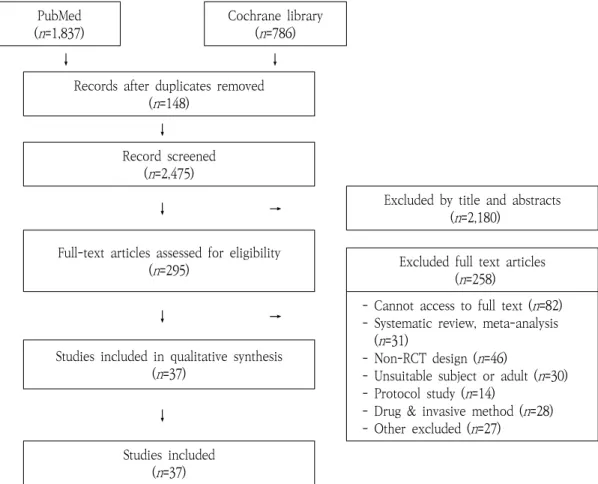
PubMed (n=1,837)
Cochrane library (n=786)
↓ ↓
Records after duplicates removed (n=148)
↓ Record screened
(n=2,475)
↓ → Excluded by title and abstracts
(n=2,180)
Full-text articles assessed for eligibility
(n=295) Excluded full text articles
(n=258)
↓ → - Cannot access to full text (n=82) - Systematic review, meta-analysis (n=31)
- Non-RCT design (n=46)
- Unsuitable subject or adult (n=30) - Protocol study (n=14)
- Drug & invasive method (n=28) - Other excluded (n=27)
Studies included in qualitative synthesis (n=37)
↓
Studies included (n=37)
Figure 1. The Search Process
한 선행 연구들을 다음의 기준으로 문헌 고찰하였다.
1) 포함 기준
(1) 영어로 된 연구
(2) 전문보기가 가능 연구
(3) 아동을 대상으로 하는 평가도구를 사용한 연구
(4) 운동기능에 대한 중재가 실시된 연구
(5) 평가도구의 문화 간 교차연구를 실시한 연구, 평
가도구의 분석연구
(6) 무작위 대조군 실험연구(Randomised controlled
Trial design)
2) 배제 기준
(1) 고찰논문(Systematic review, Meta-analysis)
(2) 사례연구(Case study) 및 개별실험연구(Single-
subject designs)
(3) 운동기능을 위해 평가도구를 사용하지 않은 연구
(4) 아동을 대상으로 하지 않은 연구
(5) 약물중재 및 침습적 중재 연구
(6) 언어(Speech motor skills), 구강운동(Oral motor),
안구운동(Oculomotor) 중재 연구
2. 문헌검색 및 자료선정
본 연구는 아동들의 운동기능 평가와 중재에 관해
연구들을 검토 및 문헌을 수집하였다. 2010년 1월부터
2020년 3월까지 국외 학술지에 게재된 논문을
PubMed, Cochrane library(Embase)를 통하여 검색
하였다. 주요 검색용어는 (“motor function test” OR
“motor function measure” OR “movement assessment”
OR “motor proficiency test” OR “motor scale” OR
“motor skill”) AND “children”을 사용하여 검색하였다.
각 데이터베이스에 검색된 총 2,623의 문헌 중 중복된
논문은 목록에서 제외하였다(Figure 1).
3. 분석 내용
1) 연구의 질적 수준
본 연구에 포함된 논문 37편 중 중재연구를 진행한
23편은 Physiotherapy Evidence Database(PEDro)
Scale을 사용하여 질적 평가를 실시하였다(McCluskey
et al., 2005). 질적 평가도구인 PEDro Scale은 총 11개
의 내부타당도 항목으로 구성된 평가도구이다.
2) 분석 방법
본 연구의 분석은 각 문헌들의 특성들에 대해 조사하
고 연구의 동향, 운동기능을 평가하기 위해 사용된 평가
도구들의 종류, 문화 간 교차연구, 교차연구가 진행된
평가도구들의 특성, 운동기능의 중재방법, 대상자의 특
성에 따라 분석하여 기술하였다.
Ⅲ. 연구 결과
1. 분석대상 연구의 질적 수준과 동향
총 37편 중 중재연구 23편에 대한 분석대상 논문의
질적 수준을 분석한 결과는 아래의 표와 같다(Table 1).
PEDro Scale 질적 평가 결과 8편의 연구가 9점을 받은
것으로 평가되었다. 가장 높은 점수인 10점을 받은 연
구는 1편이었다.
2010년부터 2020년까지 11년간 국외저널에 게재된
운동기능 평가도구와 중재에 관한 연구의 동향을 분석
하였다. 37편 모두 학술지에 게재된 연구이며, 운동기
능 평가도구에 관한 연구는 14편, 운동기능 중재에 관
한 연구는 23편이다. 운동기능 평가도구와 중재의 연도
별 추이를 살펴보면, 평가도구는 총 14편 중 2018년에
서 2020년 사이에 9편의 연구가 진행되었으며, 운동기
능 중재는 총 23편 중 2015년에서 2017년 사이에 19편
의 연구가 진행되었다. 운동기능 중재에 관한 대부분의
연구는 평가도구에 관한 연구가 주로 이루어진 시기에
비해 이전 연도에 연구가 주로 진행되었다. 이를 통해
평가와 중재의 연구 동향을 비교해보았을 때, 평가도구
의 연구는 증가하는 반면, 운동기능 중재의 연구는 감소
하는 경향을 보였다.
2. 운동기능 평가도구
1) 운동기능 중재 시 평가도구의 종류
선정된 37편의 연구 중 23편의 운동기능 중재 연구
에 사용된 평가도구들을 수집한 결과 총 61개의 평가도
구가 사용되었음을 알 수 있다. 운동기능 평가도구는
Gross Motor Function Measure 66/88(GMFM)을 사용
한 연구가 16편(26.2%)으로 가장 많았으며, 다음으로는
Pediatrics Evaluation of Disability Inventory(PEDI)가
5편(8.2%)이었다. Movement Assessment Battery for
Children-Ⅱ(M-ABC), Pediatric Balance Scale(PBS), 6
minute walk test, Peabody Developmental Motor
Scales-Ⅱ(PDMS-Ⅱ)가 각각 3편(4.9%)에 사용된 것으
로 분석되었다. 나머지 평가도구들은 각각 1~2회씩 사
용되었으며, 구체적인 평가도구의 종류 및 빈도는
Table 2에 제시하였다.
2) 문화 간 교차 연구된 평가도구
선정된 연구 중 운동기능 평가도구에 대해 도구의
종류와 교차 연구된 나라, 신뢰도와 타당도의 종류, 번
역방법에 대해 분석하였으며, 번역방법에 대해 구체적
으로 제시하지 않은 연구는 번역(translation)으로 분류
하였다. 그 결과 Alberta Infant Motor Scale과
MABC-Ⅱ가 각각 5편으로 가장 빈번하게 연구되었다. 문화 간
교차연구를 진행한 국가는 중국이 총 3편으로 가장 많
이 연구되었다. 각각 평가도구의 신뢰도와 타당도 결과
는 모두 긍정적인 결과를 보였으며, 필수적으로 진행되
No . A u th o r Ite m PE D ro Sca le Qu al it y 123456789 10 11 1 A iz aw a et a l. (2 01 7) N Y N YYYYYYYY 9 Ex ce lle n t 2 A ki n o la e t al . (2 01 9) N Y N Y N N N YYYY 6 G o o d 3 A lS ai f & A ls en an y (2 01 5) Y Y NNNNN YYYY 6 G o o d 4 B en-P az i et a l. (2 018) Y Y N Y Y N N N Y Y Y 7 G oo d 5 B le ye n h eu ft e t al . (2 01 5) YYYYY N N YYYY 9 Ex ce lle n t 6 B le ye n h eu ft e t al . (2 01 7) YY N YY N N YYYY 8 G o o d 7 Em ar a et a l. (2 01 6) YY N Y N YYYYYY 9 Ex ce lle n t 8 Fo n g et a l. (2 01 6) YYYYYYY N YYY 10 Ex ce lle n t 9 H ar b o u rn e et a l. (2 01 0) YY N Y N N N YYYY 7 G o o d 10 H o lm st ro m e t al . (2 01 9) YYYYY N N YYYY 9 Ex ce lle n t 11 H u ng et al . (2 010) Y Y N Y Y N N YYYY 8 G o o d 12 Ib ra hi m et a l. (2 014) Y Y NNNNN YYYY 6 G o o d 13 Jo h n st o n e t al . (2 01 1) YYYYY N Y N YYY 9 Ex ce lle n t 14 K im e t al . (2 01 6) YY N Y N N N YYYY 7 G o o d 15 K o rd i et a l. (2 01 6) YYYY N N N YYYY 8 G o o d 16 Low e et al . (2 015) Y Y Y N N YYYYYY 9 Ex ce lle n t 17 M ahm ood et al . (2 019) Y Y N Y N N YYYYY 8 G o o d 18 M at te rn -Baxt er et a l. (2 013) Y Y N Y N N YYYYY 8 G o o d 19 M o rg an e t al . (2 01 6b ) Y Y N Y NNNN Y Y Y 6 G o o d 20 Sah et a l. (2 019) YYYY N Y N YYYY 9 Ex ce lle n t 21 Sg an du rr a et a l. (2 01 7) YY N YY N YYYYY 9 Ex ce lle n t 22 T em ch ar o en su k et a l. (2 01 5) YY N Y N N N YYYY 7 G o o d 23 W u e t al . (2 01 7) YY N Y N N N YYYY 7 G o o d N=no; Y =y es Tab le 1. PEDro Scale for Res e arches
Assessment tools Frequency(%)
ABILHAND-Kids 2(3.3)
ABILOCO-kids 2(3.3)
Alberta Infant Motor Scale (AIMS) 1(1.6)
Assisting Hand Assessment (AHA) 1(1.6)
Bayley Scales of Infant and Toddler Development (BSID-III) 1(1.6)
Box and Block Test (BBT) 1(1.6)
Bruininks‐Oseretsky Test of Motor Proficiency (BOTMP) 2(3.3)
Center of Pressure (COP) 1(1.6)
Functional Movement System (FMS) 1(1.6)
Gross Motor Function Classification System (GMFCS) 2(3.3)
Gross Motor Function Measure-66/88 (GMFM) 16(26.2)
Infant Motor Profile (IMP) 1(1.6)
Jebsen-Taylor Hand Function Test (JTHFT) 1(1.6)
Manual Ability Classification System (MACS) 1(1.6)
Modified Ashworth Scales (MAS) 2(3.3)
Movement Assessment Battery for Children (MABC-Ⅱ) 3(4.9)
Peabody Developmental Motor Scales-Ⅱ (PDMS-Ⅱ) 3(4.9)
Pediatric Balance Scale (PBS) 3(4.9)
Pediatric evaluation of disability inventory (PEDI) 5(8.2)
Postural Assessment Scales (PAS) 1(1.6)
Quality of Upper Extremity Skills Test (QUEST) 1(1.6) Segmental Assessment of Trunk Control (SATCo) 1(1.6)
Time Up and Go (TUG) 2(3.3)
1m walk test 1(1.6)
5 time sit to stand 1(1.6)
6 Minute Walk Test (6MWT) 3(4.9)
10m walking test 2(3.3)
Total 61(100)
Table 2. Applied Assessment Tools for Motor Intervention
는 번역 방법에 대해서는 역번역(Backward translation)
을 가장 빈번하게 사용하였다(Table 3).
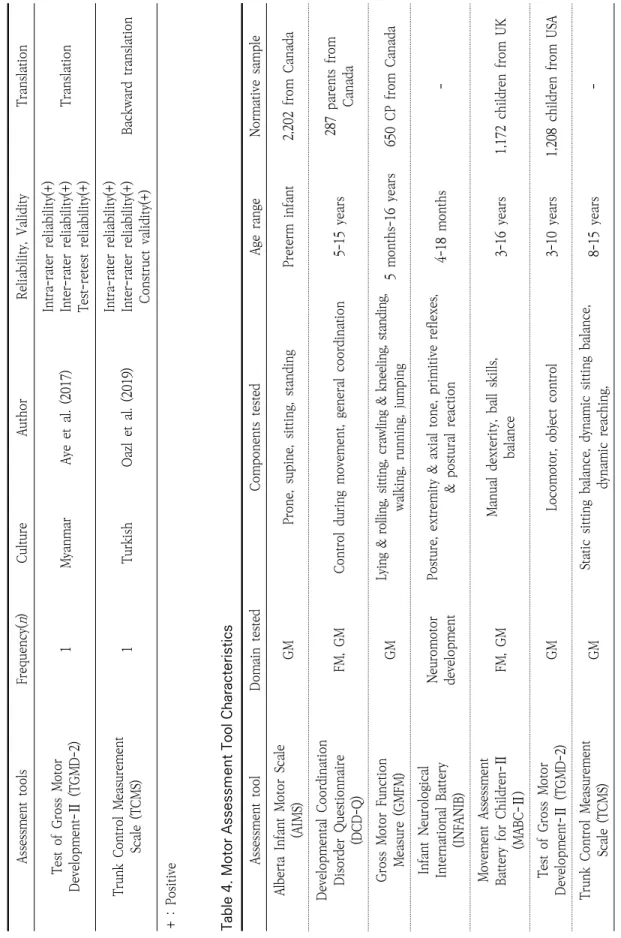
문화 간 교차 연구된 평가도구는 총 7개이며, 평가도
구들의 영역, 구성, 표준치에 대해 분석하였다. 분석된
평가도구들의 영역은 대운동(Gross motor)을 모두 포
함하고 있었으며, MABC-Ⅱ와 DCD-Q는 소운동(Fine
motor)도 함께 포함하고 있었다. 평가도구들의 적용가
능 연령은 각각 2개월부터 16세까지 가능하였다. 표준
A ssessm en t to ols Freq uen cy ( n ) C u ltu re A u th o r R eli ab il ity , V al id ity T ra n sla ti o n A lbe rt a In fa nt M o tor Sca le ( A IM S) 5 Ser b ia n Lac ko vi c et a l. (202 0) In tr a-ra te r re li ab il it y( + ) Inte r-ra te r re li ab il it y( + ) B ack w ard t ra n sl atio n Chi n ese W an g et a l. (2018) In tr a-ra te r re li ab il it y( + ) Inte r-ra te r re li ab il it y( + ) Conc ur re nt v al id it y( + ) Tr ans lat io n B ra zil ia n Sa cc an i & V ale n tin i (2 013) Cont ent val idi ty (+ ) T ra ns la ti on G reek Cont ent val idi ty (+ ) T ra ns la ti on C anadi an Cont ent val idi ty (+ ) T ra ns la ti on D evel o pm en ta l Coor di nat ion Di so rd er Q u es ti o n n ai re ( DC D-Q ) 1 Fr en ch Ra y-Ka es er e t al . (201 9) In te rn al c ons is te ncy (+ ) Te st -r et es t re li abi li ty (+) C o n stru ct va li di ty( + ) C o n ve rg en t va li di ty( + ) Tr ans lat io n C anadi an W il son et a l. (2 015) Te st -r et es t re li abi li ty (+) C o n stru ct va li di ty( + ) Tr ans lat io n G ross M o tor Fu n ctio n M ea su re (G MF M) 1 P o rtug u ese -B ra zi li an A lm ei da et a l. (201 5) In tr a-ra te r re li ab il it y( + ) Inte r-ra te r re li ab il it y( + ) Tr ans lat io n Inf ant N eu rol o gi cal I n te rnat ion al Ba tt er y (I N FA N IB ) 1 C hi nes e Li ao et al . (201 2) Te st -r et es t re li abi li ty (+) P re dic tiv e va li dit y( + ) B ack w ard t ra n sl atio n M o ve m en t A ssess m en t B attery fo r C h ild re n -Ⅱ (M A B C -Ⅱ ) 5 Th ai Ja ik ae w & Sa ti ans u kp ong (20 19) C o n te n t va li di ty( + ) Inte r-ra te r re li ab il it y( + ) Fo rw ar d tr an sl at io n , B ack w ard t ra n sl atio n Cro at ian Ser b et ar e t al . (2 019) Inte r-ra te r re li ab il it y( + ) Ret es t re li abi li ty (+ ) Tr ans lat io n Col o m b ia Spa n is h N io -cruz e t al . (2 01 9) In tr a-ra te r re li ab il it y( + ) Inte r-ra te r re li ab il it y( + ) Tr ans lat io n Ja pa n es e H ir at a et . al . (2 018) In te rn al c ons is te ncy (+ ) Fa ct o ri al va li di ty (+ ) B ack w ard t ra n sl atio n Cz ec h K o kš te jn e t al . (20 18) C o n stru ct va li di ty( + ) Fa ct o ri al va li di ty (+ ) Tr ans lat io n Table 3. Assessme n t Tool of C ross-Cu ltural Rese arch
As se ss m ent t ool s Fr eq u en cy ( n ) C u ltu re A u th o r R el ia b il it y, V al id it y T ra n sla ti o n T est o f G ro ss M o to r De ve lo p m en t-Ⅱ (T G M D -2 ) 1 M yanm ar A ye et a l. (201 7) In tra -ra te r re li ab il it y( + ) In te r-ra te r re li ab il it y( + ) Te st -r et es t rel iabi li ty (+) Tr ans lat ion Tr unk C ont ro l M eas u rem en t Sc al e (T C M S) 1 T ur ki sh O azl e t al . (2 019 ) In tra -ra te r re li ab il it y( + ) In te r-ra te r re li ab il it y( + ) C o n str u ct v alid ity (+ ) B ack w ard t ra n sl atio n + : P o sit iv e Tabl e 3. Assess ment Too l of C ross-Cu ltural Res earch (con tinu e 1 ) A sse ssm en t to o l D o m ai n t est ed C om p o ne nts te st ed A ge ra n ge N orm at ive s am p le A lbe rta In fa n t M otor Sca le (A IM S) G M Pr one, s upi ne, s it ti ng, s ta ndi n g P re te rm i nf ant 2, 202 fr o m Ca n ada D evel o pm ent al C o o rdi nat ion D is o rd er Q u es ti onnai re (D C D -Q ) FM , G M C o n tr o l du ri ng m ovem ent , gener al coor di nat ion 5-15 year s 28 7 par ent s fr o m Cana da G ro ss M o to r Fu n ctio n Me as u re ( G M FM) GM Ly in g & r ol lin g, s ittin g, cra w lin g & k ne el in g, s ta nd in g, wa lk in g, r unni ng, j u m p in g 5 m o n ths -1 6 ye ar s 65 0 C P fr o m C an ada In fa nt N eu ro lo gi cal In te rn at ional Ba tt er y (I N FA N IB ) N eurom o tor de ve lo pm en t P o st u re , e xt re m it y & a xi al t o n e, p ri m it iv e re fl ex es , & po st u ra l rea ct io n 4-18 m ont hs -M o ve m en t A ssessm en t Ba tt er y fo r C h il dr en -Ⅱ (M A B C -Ⅱ ) FM , G M M an u al d ex te ri ty , b all sk ills , ba la nce 3-1 6 year s 1, 172 chi ldr en fr o m UK T est o f G ross M o tor De ve lo p m en t-Ⅱ (T G M D -2 ) G M Lo co m o tor, o bj ect co n tro l 3-10 ye ar s 1, 20 8 ch ild re n from U SA Tr un k Cont rol M eas u rem ent Sca le ( T C M S) GM St at ic si tt in g b al anc e, dynam ic si tt in g b al anc e, dy nam ic re achi ng, 8-1 5 year s -C P =Cer ebr al pa ls y; F M =F ine m ot o r; G M =G ro ss m ot o r; U K =Uni te d K in gd om ; U SA =U n it ed St at es of A m er ica
Table 4. Motor Ass
essme
n
t Tool Charact
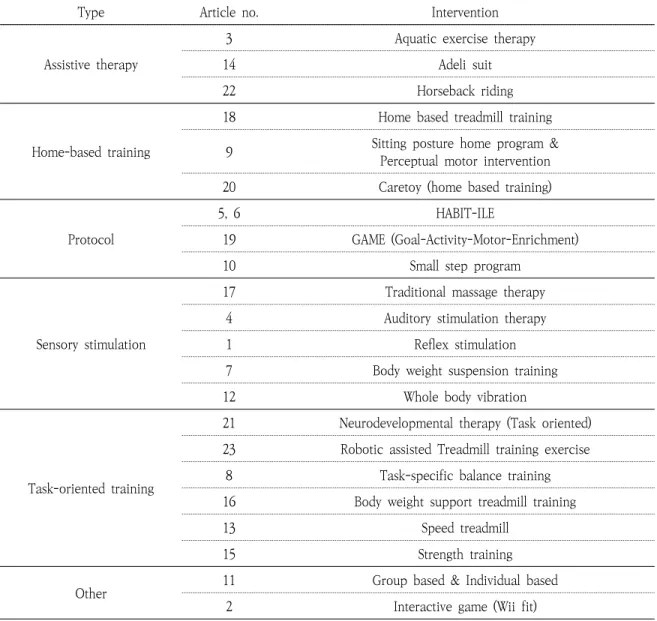
Type Article no. Intervention
Assistive therapy
3 Aquatic exercise therapy
14 Adeli suit
22 Horseback riding
Home-based training
18 Home based treadmill training
9 Sitting posture home program & Perceptual motor intervention
20 Caretoy (home based training)
Protocol
5, 6 HABIT-ILE
19 GAME (Goal-Activity-Motor-Enrichment)
10 Small step program
Sensory stimulation
17 Traditional massage therapy
4 Auditory stimulation therapy
1 Reflex stimulation
7 Body weight suspension training
12 Whole body vibration
Task-oriented training
21 Neurodevelopmental therapy (Task oriented) 23 Robotic assisted Treadmill training exercise
8 Task-specific balance training
16 Body weight support treadmill training
13 Speed treadmill
15 Strength training
Other 11 Group based & Individual based
2 Interactive game (Wii fit)
Table 5. Type of Intervention
치는 총 7개 중 3개의 평가도구가 캐나다에서 진행되었
다(Table 4).
3. 운동기능 향상을 위한 중재
1) 중재의 종류 및 효과
각 논문에서 제시하고 있는 아동의 운동기능 향상을
위한 중재들을 6가지로 분류하였다. 그 결과 가정기반
훈련(Home-based training) 3편, 과제중심훈련(Task-
oriented training) 6편, 감각자극(Sensory stimulation)
5편, 프로토콜(protocol) 4편, 보조치료(Assistive
therapy) 3편으로 분석되었다(Table 5). 아동을 대상으
로 하는 운동기능 중재방법에 대해 통계적으로 유의미
한 향상이 있었는지 각각의 논문을 분석해본 결과 23편
의 연구 중 16편의 연구에서 운동기능이 통계적으로
유의미하게 향상되었다고 보고하였다. 각각의 연구별
로 운동기능들의 중재방법에 따른 효과에 대해서는
Appendix 1에 제시하였다.
Participants Article no. Age(yr) 0 1 2 3 4 5 6 7 8 9 10 11 12 13 14 15 16 17 18 CP 20 CP 17 CP 3 Infant 21 CP 4 CP 23 CP 5 Myelomeningocele 1 Prematurity 10 CP 7 CP 14 DCD 8 CP 19 DCD 15 CP 6 CP 2 CP 12 DD 16 CP 22 CP 18 CP 13 CP 9 DCD 11
CP=Cerebral palsy; DCD=Developmental coordination disorder; DD=Delayed development Table 6. Feature of Participants (Intervention)
2) 중재 대상의 특성
선정된 연구 37편 중 운동기능 중재에 관한 23편의
연구들을 중재 적용 대상과 적용 가능한 연령을 알아보
기 위해 각 연구들을 분석해본 결과 뇌성마비 16편, 발
달성 협응장애 3편, 그 외 4편의 연구가 실시되었다.
연구들에서 대상자의 연령은 3개월에서 18세까지로 분
석되었다. 그 중에서 중재 대상의 연령은 학령기와 학령
기 이후의 연령이 포함되어있는 연구가 23편 중 18편으
로 가장 많았다(Table 6).
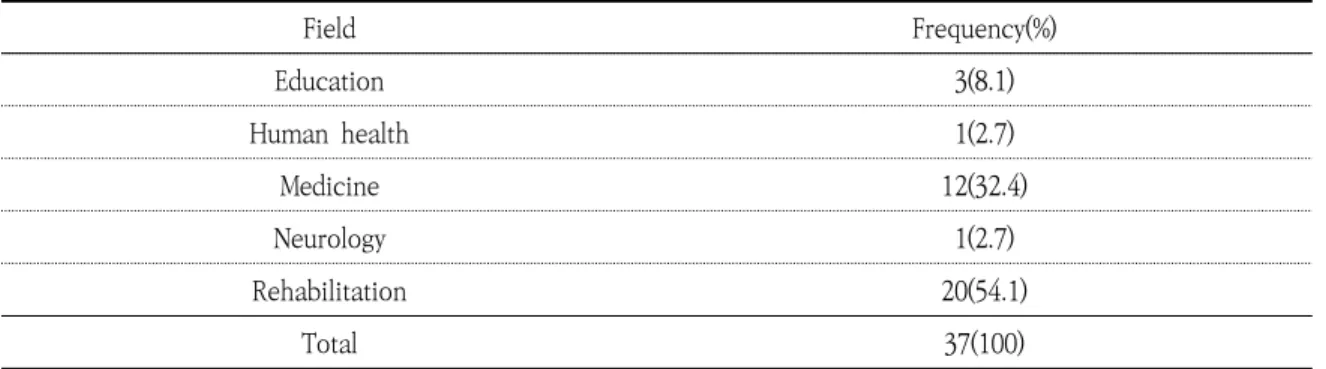
Field Frequency(%) Education 3(8.1) Human health 1(2.7) Medicine 12(32.4) Neurology 1(2.7) Rehabilitation 20(54.1) Total 37(100)
Table 7. Research Field
4. 연구가 진행된 분야
최근 10년 동안 아동을 대상으로 운동기능 평가도구
와 중재가 어느 분야에서 연구되었는지 알아보기 위해
주저자 또는 중재 제공자의 전공분야를 토대로 하여
분석하였다. 재활 분야에서 20편(54.1%)으로 평가도구
연구보다 중재에 대한 연구가 많았다. 의학분야에서는
12편(32.4%)으로 2번째로 많은 연구가 진행되었으며,
중재에 대한 연구가 많았다(Table 7).
Ⅳ. 고 찰
본 연구는 아동을 대상으로 실시한 국외의 평가 및
중재에 대한 고찰을 통해 국내 임상 현장에서의 평가와
중재에 적용할 수 있는 근거를 마련하고자 하였다.
2010년 1월부터 2020년 3월까지 국외 학술지에 게재된
연구들 중 포함 및 배제 기준에 따라 총 37편의 연구가
선정되었다. 이 중 운동기능 중재는 23편, 운동기능 평
가에 대한 연구는 14편이다. 선정된 연구들은 질적 수
준 및 동향, 운동기능 평가도구, 문화 간 교차연구가
진행된 평가도구, 평가도구의 특성, 운동기능 향상을
위한 중재로 분석하였다.
중재 방법에 대한 연구들의 PEDro Scale 평가에 대
한 질적 수준을 분석해보면 23편 중 20편 이상의 연구
가 7점 이상의 점수를 나타내었다. 10점의 연구는 1편
으로 연구결과에는 큰 영향을 미치지 않았다.
본 연구에서 선정된 연구의 동향을 살펴보면 최근에
는 운동기능 향상을 위한 중재보다는 운동기능평가에
관심을 가지고 연구들을 진행하고 있다는 점을 확인할
수 있으며, 반대로 새로운 운동기능 향상을 위한 중재가
고려되어져야 할 것으로 해석할 수 있다. 연구 분야는
재활분야가 54.1%로 가장 높은 비율을 차지하였다. 재
활분야(54.1%) 중에서 중재방법에 대한 연구가 평가에
대한 연구보다 비율이 높았으나, 선정된 전체 연구에서
도 중재방법에 대한 연구가 평가에 대한 연구보다 많은
비율이 높았기에 나타나는 것으로 해석할 수 있다. 이
결과는 논문 선정 시, 강직(spasticity)을 감소시키는 목
적으로 사용되는 보툴리늄 독소(Botulinum toxin)와 같
은 약물중재를 배제한 기준을 적용하였으며 운동기능
에 대한 연구가 재활분야에서 가장 활발히 이루어졌다
고 해석할 수 있다.
운동기능 평가도구에서는 중재에 대해 어떤 평가도
구를 사용하였는지 보면 GMFM이 16건으로 가장 많았
고, PEDI가 5건으로 그 다음으로 많이 사용되었다. 키
워드를 운동에 초점을 맞추어 연구를 진행하였기 때문
에 가장 보편적으로 사용되는 평가가 GMFM인 것으로
해석할 수 있다, PEDI는 미국에서 Haley(1992)가 개발
하였으며 자조관리, 이동, 사회적 기능의 3가지 영역으
로 나누어져 있다. 이 평가도구는 일상생활활동과 관련
된 아동의 기능적 능력과 보호자의 도움 정도를 통해
아동의 수행정도를 평가한다. 하지만 본 연구에서 선정
된 연구들은 일상생활활동과 관련된 평가도구인 PEDI
중 운동영역만을 사용하여 평가가 진행되었으며, 운동
영역에 포함되어 있는 내용들은 대근육 운동을 평가한
다. 이는 운동기능의 중재가 주로 소근육보다는 대근육
에 초점이 맞추어져 있다고도 해석할 수 있다. 또한 운
동기능 평가에 대표적인 대근육 운동의 평가도구로
GMFM을 주로 사용하고 있으나 운동기능과 관련하여
대표적인 소근육 운동의 평가도구가 부족함으로 해석
할 수 있다. 또한 본 연구에서 선정된 중재 연구의 저자
들도 작업치료사 보다는 물리치료사 또는 의사에 의한
연구가 대부분이었다. 운동기능에서는 대근육 운동 외
에 소근육 운동도 포함되어 있는 요소이며, 이후 국내에
서는 작업치료사들이 주로 평가하는 영역인 소근육 운
동 및 손기능의 평가도구에 대한 연구도 진행된다면
폭넓은 아동의 운동기능을 평가하기 위한 정보가 제공
될 수 있을 것으로 사료된다.
Hilton과 Skrutkowski(2002), Sperber(2004)의 연구
에서 평가도구에서는 문화 간 교차연구의 중요성과 정
확한 평가를 위해 다양한 언어, 문화, 인종에 대해 고려
할 필요가 있으며, 문화 간 교차연구를 통해 동일한 문
화와 환경의 표준대상의 결과를 수립하는 것이 중요하
다고 보고했다(Beaton, Bombardier, Guillemin, &
Ferraz, 2002; Bracken & Barona, 1991). 본 연구에
선정된 운동기능 평가도구 중 문화 간 교차연구가 진
행된 평가도구는 총 7개이며, 그 중 중국에서 3개의
평가도구에 대한 문화 간 교차연구가 진행되어 다른
문화권과 비교하여 가장 활발히 연구를 진행하였다.
또한 Alberta Infant Motor Scale(AIMS), Movement
Assessment Battery for Children(MABC)의 문화 간 교
차연구가 각각 5개국에서 진행되어 다른 평가도구보다
가장 활발히 연구가 진행되었다. Kim, Seo와 Lee(2009)
는 AIMS에 대한 타당도와 신뢰도 연구를 진행하였으
나, 문화 간 교차연구에서 필요한 한글화 번역이 이루어
지지 않았다. MABC-Ⅱ는 Choi(2018)의 학위논문에서
우리나라 아동을 대상으로 체크리스트에 대한 신뢰도
와 타당도 연구가 진행되었으나, 아동의 직접적인 수행
을 관찰하는 평가영역의 문화 간 교차연구가 이루어지
지 않았다. 또한 MABC-Ⅱ는 우리나라에서 발달성 협응
장애(DCD)를 진단하기 위한 DSM-5 기준을 충족하는
평가도구로 사용되고 있음에도 문화 간 교차연구가 진
행되지 않았다. 이와 같이 국외에서는 이루어진 평가도
구의 문화 간 교차연구가 우리나라에서는 활발히 진행
되지 않고 있음을 알 수 있었다. 그렇기에 문화적 특성
을 반영할 수 있는 국내의 대상자들로 진행하는 운동기
능 평가도구의 문화 간 교차연구가 고려되어져야 할
것이다.
운동기능 중재에 대한 연구들에서는 종류, 효과, 대
상자 특성을 분석하였다. 분석한 결과, 중재는 과제중
심 훈련(Task-oriented training)이 6편으로 전통적인
중재가 가장 많음을 알 수 있었다. 6편 중 4편이 유의한
향상을 나타냈으며, 효과가 없다고 보고된 연구는 과제
특이적 균형훈련(Task-specific balance training), 트
레드밀훈련(Speed treadmill training)이다. Fong 등
(2016)의 과제특이적 균형훈련(Task-specific balance
training)은 발달성 협응장애(DCD)아동을 대상으로
기능적 움직임 훈련과 일반적인 근력운동 및 균형훈련
을 비교한 연구로 그룹 간에 유의한 차이가 없었으나,
대조군에 비해 체성감각의 증진을 나타냈다. Johnston
등(2011)의 트레드밀 훈련(Speed treadmill training)
은 강직성 하지마비(Spastic diplegia), 강직성 편마
비(Spastic hemiplegia), 강직성 사지마비(Spastic
quadriplegia) 뇌성마비 아동을 대상으로 근력운동과
비교하여 보행능력의 효과에 대해 연구되었으나, 그룹
간에 차이를 보이지 않았다. 그렇지만 두 중재 모두 평
가점수의 향상이 있었고, 트레드밀(Speed treadmill
training)은 근력운동과 비교하여 운동학습(Motor
learning)에 의해 더 오래 유지되는 결과를 나타냈다.
운동기능 중재로 선정된 연구들의 저자 및 중재제공자
들이 물리치료사, 의사가 많은 비중을 차지하고 있지만
소아작업치료사들에게 타 분야의 지식을 공유할 수 있
을 것이다. 또한 소아작업치료 임상에서도 본 연구에
제시된 중재 외의 운동기능 향상을 위한 중재가 적용되
어지고 있으며, 작업치료 분야를 포함한 체계적인 연구
가 필요하다고 사료된다.
선정된 연구에서 대상자들의 일반적 특성으로는 뇌
성마비가 가장 많은 비중을 차지하였는데, Morgan 등
(2016a)은 뇌성마비는 태생 초기에 생기게 되는 신경발
달학적 장애이며, 아동기 가장 흔한 신체적 장애 중 하
나라고 하였다. 또한 뇌성마비는 중추신경계의 기능부
전으로 비정상적인 움직임과 자세를 나타내는 것이 특
징이다(Woollacott & Burtner, 1996). 1861년 최초로
뇌성마비의 연구가 시작되었고, 이때부터 뇌성마비에
대한 진단이 사용되었다(Baxter et al., 2007). 이는 뇌성
마비가 운동기능의 문제점을 특징으로 하며, 아동에게
서 가장 흔한 신체적 장애이므로 본 연구에서 가장 많은
비중을 차지하는 것으로 해석된다. 중재연구 대상자의
연령은 3개월에서 18세까지의 범위로 광범위하게 분석
되었으며, 학령기와 학령기 이후의 대상자가 23편 중
18편이었다. 이른 시기부터 중재가 시작이 되지만 학령
기와 학령기 이후의 대상자가 많은 것으로 보아 운동기
능 향상을 위한 중재가 아동의 성장에 따라 지속해서
제공될 수 있다는 것으로 해석할 수 있다. 이를 통해
운동기능의 평가, 중재의 시작연령 및 적정시기에 대해
알 수 있었다. Diamond(2000)에 따르면 운동발달지연
은 인지, 정서 등 다른 요소들의 발달에도 영향을 미친
다고 하였다. 즉, 발달은 서로 연관을 가지고 있으며
지속해서 발달에 대한 중재 제공과 평가를 통해 관찰해
야한다고 할 수 있다. 이와 같이 중재의 적정시기와
시작 연령을 통한 아동의 운동 발달 개입을 위해 뇌성
마비 이외의 다른 진단의 운동기능과 발달을 위한 평가
도구 및 중재에 대한 연구가 필요하며, 뇌성마비에 대
해서도 특성에 따른 문헌 고찰 연구가 필요할 것으로
사료된다.
본 연구의 제한점으로는 국외 학술지에 게재된 선행
연구의 조사로 연구 결과를 국내에 적용하는 것이 어려
울 수 있고, 선정된 연구 중 중재연구의 대상자가 주로
뇌성마비인 아동이 많은 비중을 차지하고 있어 다른
운동 기능에 어려움을 보이는 아동들에게 적용하는 것
에 한계가 있을 수 있다. 또한 운동기능만의 키워드를
사용하였기 때문에 대근육 운동 외에도 구체적으로 표
현되는 손기능, 소근육 운동, 운동협응 및 운동조절 등
이 포함되지 않은 제한된 연구를 분석했을 수 있으며
본 연구에서 제시된 운동기능에 대한 평가 및 중재 외에
다른 운동기능이 있을 수 있다. 추후 연구에서는 국내에
서 이루어진 연구 중 아동의 운동기능에 대한 평가와
중재에 대한 연구가 진행되면 유용할 것으로 사료되며,
또한 본 연구에서 많은 비중을 차지하는 대근육 운동기
능 외의 다른 운동기능에 포함되는 하위 기능에 대한
연구가 진행된다면 각 아동의 세분화된 운동 기능에
대한 연구가 이루어지게 되어 임상적으로 유용할 것으
로 사료된다. 또한 운동기능에서도 작업치료 측면에서
중점을 둔 운동기능 중재에 대한 연구가 필요할 것으로
사료된다.
Ⅴ. 결 론
본 연구는 아동의 운동기능 평가 및 중재에 대한 특
성과 동향을 파악하여 임상에서의 운동기능 평가와 중
재를 선택할 수 있는 근거를 제공하는 것을 목적으로
2010년부터 2020년까지 최근 11년 동안 국외에서 연구
된 아동의 운동기능 평가와 중재에 대한 문헌 고찰을
실시하였다. 연구를 통해 뇌성마비, 발달성 협응장애,
조산아 등의 운동기능 평가 및 중재에 대한 동향 및
특성, 중재방법 및 효과에 대해 알 수 있었다.
중재방법에 대한 문헌 고찰에서 다수의 연구가 대근
육 운동에 대한 중재였으며 이에 대한 효과를 검증하기
위해 사용된 평가도구는 다수의 연구들이 GMFM을 적
용하였다. 또한 대상자가 뇌성마비로 다수 분석되었으
며, 평가에 대한 문헌 고찰에서는 문화 간 교차 연구를
진행한 평가도구는 AIMS, MABC-Ⅱ가 대부분이었다.
추후 연구에서는 대근육 운동기능 외의 다양한 운동기
능에 관한 문헌고찰 연구가 필요할 것이며, 국외의 평가
도구를 국내에 보다 적절하게 적용하기 위한 MABC-Ⅱ
의 문화 간 교차 연구를 진행할 필요가 있을 것이다.
본 연구에서 분석된 결과를 바탕으로 치료사들이 임상
에서 효과적인 운동기능 평가와 중재를 선택할 수 있도
록 도움이 되길 기대한다.
References
Aizawa, C. Y., Morales, M. P., Lundberg, C., Moura, M. C., Pinto, F. C., Voos, M. C., & Hasue, R. H. (2017). Conventional physical therapy and physical therapy based on reflex stimulation showed similar results in children with myelomeningocele. Arquivos de Neuro-Psiquiatria, 75(3), 160-166. doi:10.1590/0004- 282X20170009
Akinola, B. I., Gbiri, C. A., & Odebiyi, D. O. (2019). Effect of a 10 week aquatic exercise training program on gross motor function in children with spastic cerebral palsy. Global Pediatric Health, 6, 1-7. doi:10.1177/ 2333794X19857378
Almeida, K. M., Albuquerque, K. A., Ferreira, M. L., Aguiar, S. K., & Mancini, M. C. (2015). Reliability of the Brazilian Portuguese version of the gross motor function measure in children with cerebral palsy. Brazil Journal of Physical Therapy, 20(1), 73-80. doi:10.1590/bjpt-rbf.2014.0131
AlSaif, A. A., & Alsenany, S. (2015). Effects of interactive games on motor performance in children with spastic cerebral palsy. Journal of Physical Therapy Science, 27(6), 2001-2003. doi:10.1589/jpts.27.2001
American Occupational Therapy Association. (2014). The occupational therapy practice framework: Domain and process (3rd ed.). American Journal of Occupational Therapy, 68(1), 16-18. doi:10.5014/ ajot.2014.682006
Aye, T., Oo, K. S., Khin, M. T., Kuramoto-Ahuja, T., & Maruyama, H. (2017). Reliability of the Test of Gross Motor Development second edition (TGMD-2) for kindergarten children in Myanmar. Journal of Physical Therapy Science, 29(10), 1726-1731. doi:10. 1589/jpts.29.1726
Baxter, P., Morris, C., Rosenbaum, P., Paneth, N., Leviton, A., Goldstein, M., ... Brien, G. O. (2007). The definition and classification of cerebral palsy. Developmental Medicine & Child Neurology, 49(109), 1-44. doi:10. 1111/j.1469-8749.2007.00001.x
Beaton, D., Bombardier, C., Guillemin, F., & Ferraz, M. B. (2002). Recommendations for the cross-cultural adaptation of health status measures. American Academy of Orthopaedic Surgeons, 1-9.
Ben-Pazi, H., Aran, A., Pandyan, A., Gelkop, N., Ginsberg, G., Pollak, Y., & Elnatan, D. (2018). Auditory stimulation improves motor function and caretaker burden in children with cerebral palsy: A randomized double blind study. PLoS One, 13(12), 1-12. doi:10. 1371/journal.pone.0208792
Bjarnason-Wehrens, B., Dordel, S., Schickendantz, S., Krumm, C., Bott, D., Sreeram, N., & Brockmeier, K. (2007). Motor development in children with congenital cardiac diseases compared to their healthy peers. Cardiology in the Young, 17(5), 487–498. doi:10.1017/S1047951107001023
Bleyenheuft, Y., Arnould, C., Brandao, M. B., Bleyenheuft, C., & Gordon, A. M. (2015). Hand and arm bimanual intensive therapy including lower extremity (HABIT-ILE) in children with unilateral spastic cerebral palsy: A randomized trial. Neurorehabilitaion and Neural Repair, 29(7), 645- 657. doi:10.1177/1545968314562109
Bleyenheuft, Y., Ebner-Karestinos, D., Surana, B., Paradis, J., Sidiropoulos, A., Renders, A., ... Gordon, A. M. (2017). Intensive upper and lower extremity training for children with bilateral cerebral palsy: A quasi-randomized trial. Developmental Medicine and Child Neurology, 59(6), 625-633. doi:10.1111/dmcn. 13379
Bos, F. A., Koenraad, N. J., Van-Bbrakel, A., Marrit, M. H., Jozien, C. T., & Elise, R. (2013). Development of fine motor skills in preterm infants. Developmental Medicine & Child Neurology, 55(4), 1-4. doi:10.1111/ dmcn.12297
Bracken, B. A., & Barona, A. (1991). State of the art procedures for translating, validating and using psychoeducational tests in cross cultural assessment. School Psychology International, 12(1–2), 119–132. doi:10.1177/0143034391121010
Brenneman, S. K. (1999). Test of infant and child development. In Tecklin, J. S. (Ed.). Pediatric physical
therapy (3rd ed., pp. 28-70). Philadelphia, PA:
Lippincott.
Choi, J. S. (2018). Reliability and validity of the Movement Assessment Battery for Children-2 checklist (Doctoral
dissertation). Chungnam National University, Daejeon. Diamond, A. (2000). Close interrelation of motor
development and cognitive development and of the cerebellum and prefrontal cortex. Child Development, 71(1), 44-56. doi:10.1111/1467-8624. 00117
Dwyer, T., Sallis, J. F., Blizzard, L., Lazarus, R., & Dean, K. (2001). Relation of academic performance to physical activity and fitness in children. Pediatric Exercise Science, 13(3), 225-237. doi:10.1123/pes.13. 3.225
Emara, H. A., El-gohary, T. M., & Al-johany, A. A. (2016). Effect of body-weight suspension training versus treadmill training on gross motor abilities of children with spastic diplegic cerebral palsy. European Journal of Physical and Rehabilitation, 52(3), 356-363. Fong, S. S., Guo, X., Liu, K. P., Ki, W. Y., Louie, L. H., Chung,
R. C., & Macfarlane, D. J. (2016). Task-specific balance training improves the sensory organisation of balance control in children with developmental coordination disorder: A randomized controlled trial. Scientific Reports, 6, 1-8. doi:10.1038/srep20945 Garcia, D., & Garcia, L. (2006). A motor development and
motor learning perspective. Journal of Physical Education, Recreation & Dance, 77(8), 31-33. doi:10. 1080/07303084.2006.10597923
Goodway, J. D., Ozmun, J. C., & Gallahue, D. L. (2019). Understanding motor development (8th ed., pp. 1-63). Burlington, MA: Jones & Bartlett.
Haley, S. M., Coster, W. I., Ludlow, L. H., Haltiwanger, J. T., & Andrellos, P. J. (1992). Pediatric Evaluation of Disability Inventory: Development, standardization, and administration manual. Boston, MA: New England Medical Center.
Han, K. J. (1991). Special education for children. Seoul, KR: Special education publishing.
Harbourne, R. T., Willett, S., Kyvelidou, A., Deffeyes, J., & Stergiou, N. (2010). A comparison of interventions for children with cerebral palsy to improve sitting postural control: A clinical trial. Physical Therapy, 90(12), 1881-1898. doi:10.2522/ptj.2010132
Hilton, A., & Skrutkowski, M. (2002). Translating instruments into other languages: Development and testing processes. Cancer Nursing, 25(1), 1–7. doi:10. 1097/00002820-200202000-00001
Hirata, S., Kita, Y., Yasunaga, M., Suzuki, K., Okumura, Y.,
Okuzumi, H., ... Nakai, A. (2018). Applicability of the Movement Assessment Battery for Children-second edition (MABC-2) for Japanese children aged 3-6 years: A preliminary investigation emphasizing internal consistency and factorial validity. Frontiers in Psychology, 9, 1-9. doi:10.3389/fpsyg.2018.01452 Holmstrom, L., Eliasson, A., Almeida, R., Furmark, C., Weiland, A., Tedroff, K., & Lowing, K. (2019). Efficacy of the small step program in a randomized controlled trial for infants under 12 months old at risk of cerebral palsy (CP) and other neurological disorders. Journal of Clinical Medicine, 8(7), 1-18. doi:10.3390/ jcm8071016
Hung, W. W., & Pang, M. Y. (2010). Effects of group-based versus individual-based exercise training on motor performance in children with developmental coordination disorder: A randomized controlled study. Journal of Rehabilitation Medicine, 42(2), 122-128. doi:10.2340/16501977-0496
Ibrahim, M., Eid, M., & Moawd, S. (2014). Effect of whole-body vibration on muscle strength, spasticity, and motor performance in spastic diplegic cerebral palsy children. Egyptian Journal of Medical Human Genetics, 15(2), 173-179. doi:10.1016/j.ejmhg.2014. 02.007
Iverson, J. M. (2010). Developing language in a developing body: The relationship between motor development and language development. Journal of Child Language, 37(2), 229-261. doi:10.1017/S0305000909 990432
Jaikaew, R., & Satiansukpong, N. (2019). Movement Assessment Battery for Children-second edition (MABC-2): Cross-cultural validity, content validity, and interrater reliability in Thai children.
Occupational Therapy International, 2019, 1-5.
doi:10.1155/2019/4086594
Johnston, T. E., Watson, K. E., Ross, S. A., Gates, P. E., Gaughan, J. P., Lauer, R. T., ... Engsberg, J. R. (2011). Effects of a supported speed treadmill training exercise program on impairment and function for children with cerebral palsy. Developmental Medicine and Child Neurology, 53(8), 742-750. doi:10.1111/j. 1469-8749.2011.03990.x
Kathleen, M., Haywood., & Nancy, G. (2019). Life span
motor development (7th ed., pp. 4-5). Champaign:
Kim, J. S., Kim, T. H., Ko, D. Y., Kang, Y. K., & Han, Y. K. (2005). Correlation of GMFM and BSID-Ⅱ for children with developmental disabilities. The Journal of Korean Society of Occupational Therapy, 13(1), 79-87.
Kim, M. R., Lee, B. H., & Park, D. S. (2016). Effects of combined Adeli suit and neurodevelopmental treatment in children with spastic cerebral palsy with gross motor function classification system levels I and
II. Hong Kong Physiotherapy Journal, 34, 10-18.
doi:10.1016/j.hkpj.2015.09.036
Kim, M. S., Seo, J. H., & Lee, H. J. (2009). Interrater reliability of Alberta Infant Motor Scale. The Journal of Korean Society for Neurotherapy, 14(1), 23-34. Kokštejn, J., Muslek, M., & Tufano, J. J. (2018). Construct
validity of the Movement Assessment Battery for Children-second edition test in preschool children with respect to age and gender. Frontiers Pediatrics, 6, 1-8. doi:10.3389/fped.2018.00012
Kordi, H., Sohrabi, M., Saberi-Kakhki, A., & Attarzadeh- hossini, S. R. (2016). The effect of strength training based on process approach intervention on balance of children with developmental coordination disorder. Archivos Argentinos de Pediatria, 114(6), 526-533, doi:10.5546/aap.2016.eng.526
Lackovic, M., Nikolic, D., Filimonovic, D., Petronic, I., Mihajlovic, S., Golubovic, Z., Pavicevic, P., & Cirovic, D. (2020). Reliability, consistency and temporal stability of Alberta Infant Motor Scale in Serbian infants. Children (Basel), 7(3), 1-9. doi:10.3390/ children7030016
Liao, W., Wen, E. Y., Li, C., Chang, Q., Lv, K. L., Yang, W., ... Zhao, C. M. (2012). Predicting neurodevelopmental outcomes for at-risk infants: Reliability and predictive validity using a Chinese version of the INFANIB at 3, 7 and 10 months. BMC Pediatrics, 14(12), 1-8. doi:10.1186/1471-2431-12-72
Logan, S. W., Robinson, L. E., & Getchell, N. (2011). The comparison of performances of preschool children on two motor assessments. Perceptual and Motor Skills, 113(3), 715–723. doi:10.2466/03.06.25.PMS.113. 6.715-723.
Lowe, L., McMillan, A. G., & Yates, C. (2015). Body weight support treadmill training for children with developmental delay who are ambulatory. Pediatric Physical Therapy, 27(4), 386-394. doi:10.1097/PEP.
0000000000000172
Mahmood, Q., Habibullah, S., & Babur, M. N. (2019). Potential effects of traditional massage on spasticity and gross motor function in children with spastic cerebral palsy: A randomized controlled trial. Pakistan Journal of Medical Science, 35(5), 1210- 1215. doi:10.12669/pjms.35.5.478
Majnemer, A. (1998). Benefits of early intervention for children with developmental disabilities. Seminars in Pediatric Neurology, 5(1), 62-69. doi:10.1016/s1071- 9091(98)80020-x.
Martin, B., Murray, G., Peter, R., Alan, L., & Nigel, P. (2005). Proposed definition and classification of cerebral palsy. Developmental Medicine & Child Neurology, 47, 571-576.
Mattern-Baxter, K., McNeil, S., & Mansoor, J. K. (2013). Effects of home-based locomotor treadmill training on gross motor function in young children with cerebral palsy: A quasi-randomized controlled trial. Archives Physical Medicine and Rehabilitation, 94(11), 2061-2067. doi:10.1016/j.apmr.2013.05.012 McCluskey, A., Lovarini, M., Bennett, S., McKenna, K.,
Tooth, L., & Hoffmann, T. (2005). What evidence exists for work-related injury prevention and management? Analysis of an occupational therapy evidence database (OTseeker). British Journal of Occupational Therapy, 68(10), 447–456. doi:10.1177/ 030802260506801003
Mishraa, K., Siddhartha, V., Elhenceb, A., Jalanb, D., Kherac, D., & Yasi, M. (2019). Effectiveness of individualized, goal directed institutional based rehabilitation programme in children with developmental delay disorders, in a region with limited rehabilitation accessibility. Journal of Pediatric Rehabilitation Medicine, 12(1), 49-56. doi: 10.3233/PRM-170521
Morgan, C., Darrah, J., Gordon, M. A., Harbourne, R., Spittle, A., Johnson, R., & Fetters, L. (2016a). Effectiveness of motor interventions in infants with cerebral palsy: A systematic review. Developmental Medicine & Child Neurology, 58(9), 900-909. doi: 10.1111/dmcn.13105
Morgan, C., Novak, I., Dale, R. C., Guzzetta, A., & Badawi, N. (2016b). Single blind randomized controlled trial of GAME (Goals-Activity-Motor-Enrichment) in infants at high risk of cerebral palsy. Research in
Developmental Disabilities, 55, 256-257. doi:10.1016/ j.ridd.2016.04.005
Nio-cruz, G. I., Camargo-Lemos, D. M., Velsquez-Escobar, L. I., Rodriguez-Ortiz, J. K., & Patio-segura, M. S. (2019). Age band 1 of the movement assessment battery for children-2: Reliability of the spanish version. Revista Chilena de Pediatroa, 90(5), 522-532. doi:10.32641/rchped.v90i5.881
Ozal, C., Ari, G., & Gunel, M. K. (2019). Inter-intra observer reliability and validity of the Turkish version of trunk control measurement scale in children with cerebral palsy. Acta Orthopaedica et Traumatologica Turcica, 53(5), 381-384. doi:10.1016/j.aott.2019.04.013 Piek, J. P., Dawson, L., Smith, L. M., & Gasson, N. (2008).
The role of early fine and gross motor development on later motor and cognitive ability. Human Movement Science, 27(5), 668-681. doi:10.1016/j. humov.2007.11.002
Ray-Kaeser, S., Thommen, E., Martini, R., Jover, M., Gurtner, B., & Bertrand, A. M. (2019). Psychometric assessment of the French European developmental coordination disorder questionnaire (DCDQ-FE). PLoS One, 14(5), 1-13. doi:10.1371/journal.pone. 0217280
Saccani, R., & Valentini, N. C. (2013). Cross-cultural analysis of the motor development of Brazilian, Greek and Canadian infants assessed with the Alberta Infant Motor Scale. Revista Paulista de Pediatria, 31(3), 350-358. doi:10.1590/S0103-05822013000300012 Sah, A. K., Balaji, G. K., & Agrahara, S. (2019). Effects of
task-oriented activities based on neurodevelopmental therapy principles on trunk control, balance, and gross motor function in children with spastic diplegic cerebral palsy: A single-blinded randomized clinical trial. Journal of Pediatrics Neuroscience, 14(3), 120-126. doi:10.4103/jpn.JPN_35_19
Saigal, S. Pinelli, J., Hoult, J., Kim, M. M., & Boyle, M. (2003). Psychopathology and social competencies of adolescents who were extremely low birth weight. Pediatrics, 111(5), 969-975. doi:10.1542/peds.111.5. 969
Serbetar, I., Loftesnes, J. M., & Mamen, A. (2019). Reliability and structural validity of the movement assessment battery for children-2 in Croatian preschool children. Sports(Basel), 7(12), 1-11. doi:10.3390/sports7120248 Sgandurra, G., Lorentzen, J., Inguaggiato, E., Bartalena, L.,
Beani, E., Cecchi, F., ... CareToy Consortium. (2017). A randomized clinical trial in preterm infants on the effects of a home-based early intervention with the ‘CareToy System’. PLoS One, 12(3), 1-13. doi:10.1371/ journal.pone.0173521
Sperber, A. D. (2004). Translation and validation of study instruments for cross-cultural research. Gastroenterology, 126(1), 124-128. doi:10.1053/j. gastro.2003.10.016.
Spittle, A. J., Spencer-Smith, M. M., & Eeles, A. L. (2013). Does the Bayley-III motor scale at 2 years predict motor outcome at 4years in very preterm children? Developmental Medicine & Child Neurology, 55(5), 448–452. doi:10.1111/dmcn.12049
Strong, W. B., Malina, R. M., & Blimkie, C. J. (2005). Evidence based physical activity for school-age youth. Journal of Pediatrics, 146(6), 732–737. doi:10. 1016/j.jpeds.2005.01.055.
Temcharoensuk, P., Lekskulchai, R., Akamanon, C., Ritruechai, P., & Sutcharitpongsa, S. (2015). Effect of horseback riding versus a dynamic and static horse riding simulator on sitting ability of children with cerebral palsy: A randomized controlled trial. Journal of Physical Therapy Science, 27(1), 273-277. doi:10. 1589/jpts.27.273
Wang, H., Li, H., Wang, J., & Jin, H. (2018). Reliability and concurrent validity of a Chinese version of the Alberta Infant Motor Scale administered to high-risk infants in China. BioMed Research International, 2018, 1-11. doi:10.1155/2018/2197163
Wilson, B. N., Creighton, D., Crawford, S. G., Heath, J. A., Semple, L., Tan, B., & Hansen, S. (2015). Psychometric properties of the canadian little developmental coordination disorder questionnaire for preschool children. Physical and Occupational Therapy in Pediatrics, 35(2), 16-31. doi:10.3109/01942638.2014. 980928
Woollacott, M. H., & Burtner, P. (1996). Neural and musculoskeletal contributions to the development of stance balance control in typical children with cerebral palsy. Acta Paediatrica Supplement, 85(416), 58-62. doi:10.1111/j.1651-2227.1996.tb14279.x Wu, M., Kim, J., Gaebler-Spira, D. J., Schmit, B. D., & Arora,
P. (2017). Robotic resistance treadmill training improves locomotor function in children with cerebral palsy: A randomized controlled pilot study.
Archives Physical Medicine and Rehabilitation, 98 (11), 2126-2133. doi:10.1016/j.apmr.2017.04.022
Abstract
A Literature Review on the Evaluation of and Interventions for
Children’s Motor Function
Sa, Jae-Deok
*, B.H.Sc., O.T., Park, Hae Yean
**, Ph.D., O.T.
*
The Catholic University of Korea Eunpyung St. Mary’s Hospital, Occupational Therapist
**
Dept. of Occupational Therapy, College of Software Digital Healthcare Convergence,
Yonsei University, Professor
Objective : The purpose of this study was to examine foreign literature on the evaluation and
interventions for motor functions in children.
Methods : Studies in this review were identified by searching the PubMed, Cochrane Library (Embase)
databases from those published form January 2010 to March 2020 using the following keywords:
“motor function test” or “motor function measure” or “movement assessment” or “motor proficiency
test” or “motor scale” or “motor skill” and children.
Results : Of the total 37 identified studies, 14 analyzed evaluations, 23 analyzed interventions, all
of which were randomized control trials. Studies on evaluations were increasingly more common,
in contrast to studies on interventions for motor functions. The most frequent field of research
was rehabilitation. The studies on evaluations included the AIMS and MABC-Ⅱ, and GMFM was
the most frequently used intervention. Interventions were most commonly used in task-oriented
training (six studies).
Conclusion : This study aimed to provide a basis for therapists to choose effective motor function
evaluation and interventions for clinical trials by analyzing studies related to interventions for
and evaluation of motor function in children.
N o . A u thor P ar ti ci pa nt s Int er vent io n D ep enden t var iabl e M eas u re Res u lt 1 Ai za wa e t al . (2 017) Chi ldr en w it h m yel om eni n goce le (3 m -4 y) C o n vent ional PT, R efle x stim u la tio n M o to r ab il it y fu n ct ional i n dep enden t GMF M , P EDI Se lf -care , mo b il it y dom ai n s im pr ovem ent , No di fferen ce s be tw ee n t h e gr ou ps 2 Al Sai f et al . (2 015) Spasti c di pl eg ia C P ( 6-10y ) N in te n do W ii f it g am es M o to r p er fo rm an ce BO TM P , MA B C -Ⅱ , 1m w al k te st Si gn if ic an t im pr ovem ent s 3 Ak in o la e t al . (2 019) C P ( 1-12y ) Aq ua ti c ex er ci se Func ti onal t ra ini ng Ma n u al p as si ve s tr et ch in g G ro ss m ot or f u nc ti on G M FM Si gn if ic an t im p rovem ent 4 Be n -P az i et a l. (2 018) C P ( 2-17 y) A u dio s ti m u la tio n G ross m o to r fu n ctio n CC HQ , GAS , GMF M , QU ES T Si gn if ic an t im p rovem ent 5 Bl eyenhe uf t et a l. (2 017) Bi la te ra l C P ( 6-15y ) HABI T-IL E U ppe r an d lo w er ext rem it y fu nct ion AB IL H AN D -K id s, AB IL OCO-Ki ds , B B T , CO PM , GMF M , JT H FT , P ED I Si gn if ic an t im p rovem ent 6 Bl eyenhe uf t et a l. (2 015) U n il at er al sp ast ic C P (6 -13y ) H A BI T-IL E, P T, O T Upper E xt re m it y Perf or m an ce, Lo w er Ex tr em it y Fun ct ion, So ci al par ti ci p at ion AB IL H AN D -K id s, A B IL OC O-Ki ds , AHA, B B T , Li fe H , M A CS , PE D I (m o b il it y dom ai n) , 6M W T Si gn if ic an t im pr ovem ent s (A H A , 6M W T ) 7 Em ar a et a l. (2 016) Spasti c di pl eg ia CP (6-8y ) Su sp en sio n t ra in in g, Tr eadm il l tr ai ni ng Fu nc ti o n al gr oss m o to r sk il ls 5 t im e s it t o s ta n d, 10 m w al ki n g te st Stan di n g, wal ki n g: n o sig n ifica n t di fferen ce Ap pen dix 1. Su mmary of I ntervent ion
N o . A ut ho r P ar ti ci pa n ts Int er ve nt io n D epen dent v ar ia b le M eas ur e Res u lt 8 Fong et al . (201 6) DCD (5 -9 y) Ta sk -s p eci fi c bal anc e tr ai n ing (f u n ctio n al -m o ve m en t tra in in g, FM T) Bal anc e M A B C W it h in -g ro u p ; n o t si gn ifi ca n t 9 H arb o u rn e et a l. (201 0) In fa n t C P (5 m -2 y) Ho me p ro gr am , p er cept u al -m ot or i nt er vent ion Si tt in g p osture C O P, G M FM Si gn ifi ca n t D if fer ence s b et w een gr oup 10 Ho lm st ro m et a l. (201 9) In fa nt (4 -9 m ) Sm al l Ste p w ith S ta n da rd C are M o b il it y, h an d u se , an d com m uni cat io n PD M S-Ⅱ , P ED I (m o b ili ty s ca le ) In te ra ct ion bet w een gr ou p a n d PD M S-2 11 Hu n g et al . (201 0) DC D (6 -1 0y ) Gr o u p-b as ed an d in di vi dual -base d m otor s ki ll tr ai n in g Ho me e xe rc is e co m p li anc e, p ar ent al s at is fa ct io n MA B C -Ⅱ N o si gni fi ca nt be tw ee n -gr ou p di ff er en ce 12 Ib ra h im e t al. (201 4) Spa sti c di pl egi a CP (8-12y ) W h ol e b o dy v ib ra ti on St re ng th, w al ki ng sp ee d, w al ki n g b al an ce , sp asticity Dy na mo me te r, G MF M, M A S, TU G, 6M W T N o si gni fi ca nt be tw ee n -gr ou p di ff er en ce 13 Johns ton et a l. (201 1) Spa sti c di pl eg ia , tri p le gi a, quadr ipl egi a CP (7-11y ) Sup p or te d sp ee d tr ea dm il l tr ai ni ng exer ci se pr ogr am (SSTT EP ) Ga it GM FM N o si gni fi ca nt di ff er en ce 14 Ki m e t al . (201 6) C P ( 4-7y ) A ST , N D T G ro ss m o to r, b al an ce , g ai t G M FM , P B S, T U G Th e G M FM , PBS, T U G te st (b o th g ro u p s) st at is ti ca lly si gn ifi ca n t i n cr ea se 15 Ko rd i et a l. (201 6) DCD (7 -9 y) St re n gth t ra in in g u sin g fl ex ib le T h er a-b an d e la st ic e xe rc is e St at ic and dynam ic bal anc e BO TM P -2 St at ic b al an ce i m p ro ve 16 Lo w e et a l. (201 5) DD (2 -5 y) B o dy w ei gh t-su p p o rte d tr ea dm ill tr ai n ing (BW STT) G ait ve lo city , Gr o ss m o to r GM FM 10 M W T Si gn if ic an t i mp ro ve me n ts Appe ndi x 1. S umm ary o f Inte rve ntio n (co ntin ue 1 )
N o . A ut ho r P ar ti ci pa n ts Int er ve nt io n D epen dent v ar ia b le M eas ur e Res u lt 17 Ma h m o o d et a l. (201 9) Spa sti c di pl egi a CP (2-10y ) Conven ti on al P T, T ra dit io n al m as sa ge Sp as ti ci ty , gr o ss mo to r fu n ct io n MA S, G MF M, G MF C S R ed u ct io n S p as tic ity , no si gni fi ca n t di ff er en ce (G MF M, GMF C S) 18 M atte rn -B ax te r et a l. (201 3) CP (9 m -3 y) Int ensi ve h o m e-ba sed p ro gr am o f tr ea dm ill tr ai n in g M o to r sk ills r el at ed t o w alk in g FM S, GM FM , PD M S-Ⅱ , (loc om oti o n) , PE D I( m obi li ty do m ai n ), 10 M W T Si gn if ic an t di ff er en t b et w ee n gr ou p( PD M S, PE D I, FM S) 19 Mo rg an e t al . (2 016b) CP (2m -6 m ) GAM E (Go al -A ct iv it y-M o to r -E nr ic hm en t) M o to r sk ills BSI D -Ⅲ , COP M , PD M S-Ⅱ , GMF M -6 6 Si gn if ic an t be tw ee n -gr ou p di ff er en ce 20 Sah et al . (201 9) Sp ast ic di pl eg ia , CP (7-15y ) T ask -o rie n te d acti vi ti es b as ed o n neu rodevel opm ent al t her apy (T O A -N D T ) Tr un k con tr ol , b al anc e, gr o ss m ot or f u nc ti on GM FM , P A S, P B S, Si gn if ic an t im p ro ve m en t 21 Sg an du rra e t al . (201 7) Pre term In fa nt (3 -5 m ) Ho me ‐ba se d earl y in te rven ti on w ith ca re to y system M o to r an d vi su al de ve lo pm en t AI M S, I M P Si gn if ic an t im pr ovem ent s 22 Temch ar o en su k et a l. ( 20 15 ) Bi lat er al sp as ti c C P (8-12y ) Dy n ami c h o rs eb ac k ri di n g (DHS ), H o rse b ac k rid in g (H R ), St at ic h o rs eb ac k r id in g ( SH S) Si tt in g ab il it y GM FM -6 6, SA T C o Si gn if ic an t im pr ovem ent s 23 Wu e t al . (201 7) CP (6-14y ) R o b ot ic t re ad m il l tr ai ni n g W al ki n g sp eed gr oss m o to r fu n cti o n 6-m in u te wa lk t es t, GM FM 6-m inut e w al k di st ance : si gn ifi ca n t cha n ge ga it s p ee d and 6-m inut e w al k dista nce : no si gn ifi ca nt cha n ges Appe ndi x 1. S umm ary o f Inte rve ntio n (co ntin ue 2 )