• 검색 결과가 없습니다.

The Changes of Gross Motor Function and Balance Ability in Children with Spastic Diplegic Cerebral Palsy by Trunk Muscle Strengthening Exercise : Single Group Repeated Measure Study

N/A
N/A
Protected

Academic year: 2021

Share "The Changes of Gross Motor Function and Balance Ability in Children with Spastic Diplegic Cerebral Palsy by Trunk Muscle Strengthening Exercise : Single Group Repeated Measure Study"

Copied!
9
0
0

로드 중.... (전체 텍스트 보기)

전체 글

(1)

교신저자 김종순, E-mail: [email protected]

논문접수일20110413 / 수정접수일20110430 / 게재승인일20110508 1)

체간근력 강화운동에 의한 경직성 양하지 뇌성마비 아동의 대단위 운동 및 균형 능력 변화 단일그룹 반복측정 연구:

이은정 김종순 1

울산광역시장애인종합복지관, 1부산가톨릭대학교 보건과학대학 물리치료학과

The Changes of Gross Motor Function and Balance Ability in Children with Spastic Diplegic Cerebral Palsy by Trunk Muscle

Strengthening Exercise : Single Group Repeated Measure Study

Eun-Jung Lee, PT, MS, Jong-Soon Kim, PT, PhD

1 Ulsan Community Rehabilitation Center

1Department of Physical Therapy, College of Health Sciences, Catholic University of Pusan

<Abstract>

PurposeTrunk muscle weakness in the children with cerebral palsy can lead to postural and alignment problems, breathing difficulties, and so on. Therefore, children with cerebral palsy can benefit from exercises that strengthen the muscles in their trunks. The purpose of this study was to investigate the effects of trunk muscle strengthening exercise on functional gross movement and balance ability in children with spastic diplegic cerebral palsy.

MethodsWe used single group repeated measure design in 8 children(four males, four females; aged 6~12 years; mean 8.3 years) with diplegia. The functional gross motor outcome measured by using the GMFM and balance ability of all children was measured by pediatric balance scale. All participants were alternately received trunk strengthening exercise and neurodevelopment treatment for 40 minutes twice per week during 8 weeks.

ResultsSignificant and clinical meaningful improvement in functional gross motor and balance ability were shown.

Conclusion The results indicate that trunk strengthening exercise has a positive effect on both functional gross motor and balance ability in children with spastic diaplegic cerebral palsy.

(2)

Ⅰ . 서 론

뇌성마비는 뇌의 비 진행적 적응성 손상으로 위 치 자세 그리고 움직임의 따라 변하는 경직과 과긴 , 장 균형과 협응 장애 근력의 약화 근 활동 조절의 , , , 변화 근육의 동시 수축 등과 같은 신경근의 유해한 , 변화가 발생한다 (Damiano 등 , 2001; Ikeda 등 , 1998;

등 이로 인

Papavasiliou, 2009; Stackhouse , 2005).

해 2 차적으로 뇌성마비 아동의 기능적인 일상생활 동작들이 제한을 받게 된다 따라서 이러한 기능적 . 문제들을 해결하기 위해 물리치료 영역에서는 대단 위 운동 능력과 가동성 증진을 위해 다양한 방법 등이 동원되어 오고 있다.

대단위 운동 능력과 가동성을 증진시키기 위해 물리치료 영역에서 사용되는 방법들 중 비교적 최 근 활발한 연구가 이루어지고 있는 것은 근력강화 운동 이다 과거 근력강화 운동은 근골격계 문제에 . , 주로 사용되는 방법으로 인식되었으며 뇌성마비와 같은 상위 운동신경원 손상 환자들의 치료에는 명 백한 과학적인 근거가 없어서 사용이 기피되어왔다.

즉 상위 운동신경원 손상에서의 주된 문제는 근력 , 의 문제가 아닌 비정상적인 근긴장도의 문제이기 때문에 경직이 감소하면 기능은 자연적으로 개선될 것 이라고 믿었다 (Fosano 등 , 1978). 따라서 근력강 화 운동 필요하지 않으며 이러한 운동이 경직이나 비정상적인 움직임을 증가시킬 것이라고 생각하였 다(Bobath, 1969).

그러나 신경생리학적으로 한 근육의 긴장도가 증 가하면 그 근육의 길항근은 상반억제에 의해 억제 되며 이후 약증이 일어나게 된다는 것이 일반적인 사실이다 이러한 신경생리학적 기전의 임상적 현상 . 은 상위 운동신경원 손상 환자의 말기에 볼 수 있는 근 약증 및 선택적 후근 절제술(selective posterior 을 받은 환자가 경직은 감소하였으나 기 rhizotomy)

능적 개선은 크지 않았다는 연구 보고로도 알 수 있다 (Hodgkinson 등 , 1997). 또한 많은 연구에서 근

력강화 운동이 경직을 증가 시켰다는 증거는 나타 나지 않았으며 오히려 근력강화 운동을 통해 기능 적 동작이 개선되었다는 연구들이 보고되고 있다

와 등

(Damiano Abel, 1998; Dodd , 2003; MacPhail 과 Kramer, 1995).

경직성 뇌성마비에서 흔히 나타나는 운동조절의 문제는 체간근육의 저긴장증과 약증 팔다리의 근긴 , 장도 증가 자세반사의 소실이나 지연 그리고 기능 , , 적 행동을 하는 동안 적절한 속도로 팔다리를 유연 하게 움직이는 능력이 상실되는 것이다(Styer-Acevedo, 이러한 문제들 중 체간근육의 약화는 체간 1994).

안정성 상실을 초래하게 되는데 체간 안정성은 팔 다리의 움직임에 필수적인 요소로서 체간의 안정성 은 체간근육의 약증을 보이는 양하지 뇌성마비에게 는 휠체어 생활의 유지 앉은 자세에서의 놀이 및 , 식사 등 기능적인 손동작을 쉽게 하는데 매우 중요 한 요소일 뿐 아니라 손을 통한 풍부한 정보의 유 입이 이루어지도록 하는데도 중요한 작용을 한다.

그러나 본 연구의 연구자들이 여러 문헌 검색 엔 진을 통해 체간근력 강화운동(Trunk Muscle Streng- 에 의한 대단위 운동의 변화 thening Exercise; TSE)

및 균형능력의 변화를 검색한 결과 많은 연구들이 ,

등 등 등

(Eek , 2008; Lee , 2008; Liao , 2007; McNee 등 , 2009; Stackhouse 등 , 2007; van der Linden 등 , 하지 근력강화에 의한 기능의 변화를 분석하 2008)

였으나 체간근력 강화운동에 의한 양하지 뇌성마비 의 기능 변화에 대한 연구는 거의 이루어지지 않고 있는 실정이었다 따라서 본 연구는 불안정한 지면 . 에서의 체간근력 강화운동에 의한 양하지 뇌성마비 아동의 균형 및 대단위 운동의 변화를 장기적인 관 점에서 연구하고자하였다.

Ⅱ . 연구 방법

연구 대상 및 절차

1.

Key WordsTrunk muscle strengthening exercise, Gross motor function, Balance ability

(3)

1) 연구대상

본 연구는 보호자 및 본인이 자발적으로 연구 참 여를 희망한 양하지 뇌성마비 아동 중 대단위 운동 기능 분류 체계(Gross Motor Function Classification 단계에 속하는 명을 대 System; GMFCS) Ⅰ∼Ⅲ 8 상으로 하였다 연구에 참여한 아동은 남자 명 여 . 4 , 자 4 명 이었고 평균 연령 , 8.38±1.84 , 세 평균 신장

평균 체중은 이었다

125.97±11.66cm, 27.81±7.59kg .

에 따른 수준은 단계 명 단계 명 단

GMFCS 1 1 , 2 3 , 3

계 명 이었다 4 (Table 1).

2) 연구절차

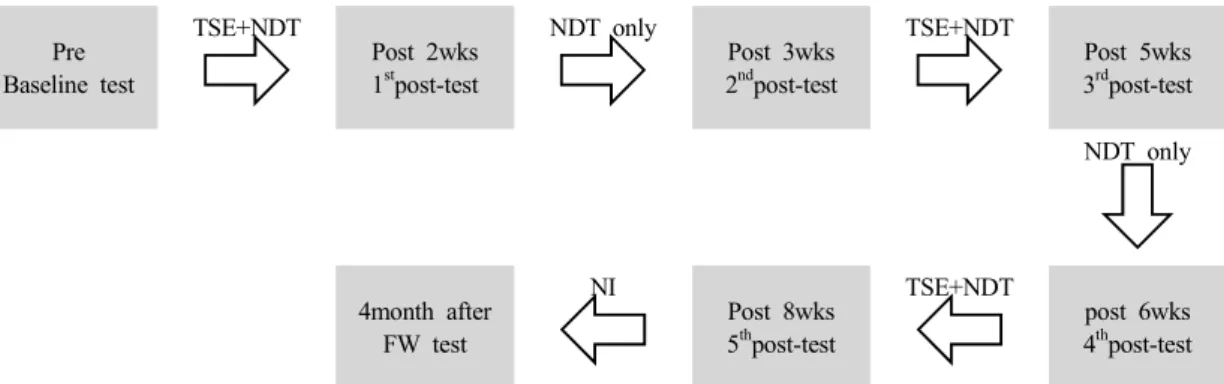
본 연구는 주간 주 회 각 8 , 2 , 40 분 총 , 16 회 TSE 와 신경발달학적 치료(Neurodevelopental Treatment;

를 반복 실시하여 각 운동이 대단위 운동기능 NDT)

및 균형능력에 미치는 영향을 조사하였으며 TSE 효

과의 유지 여부를 알아보기 위하여 개월 후 추수 4 관찰 (follow-up) 하였다 전반적인 연구의 절차는 그 . 림 과 같다 1 .

연구 도구 및 측정방법 2.

체간근력 강화운동 1)

본 연구에서는 TSE 를 위해 Swiss ball 을 이용하 였다 . Swiss ball 의 크기는 대상 아동이 앉았을 때 발이 바닥에 닿을 수 있는 직경 45cm 의 Swiss ball 을 사용하였다 대상 아동에게 . TSE 에 대하여 사전 에 충분히 설명하고 연구자가 시범을 통해 대상 아 , 동의 이해를 높였다 . TSE 는 주로 복부근 체간신전 , 근 대둔근의 근력강화에 주안점을 두었다 , .

바로 누운 자세에서는 바로 누운 자세에서 공을 다리 아래에 두고 엉덩이 들기를 실시하였다 . 네발

No Gender Gestational age

(Weeks)

Age (years)

Height (cm)

Weight

(kg) GMFCS Prior medical

intervention

1 F 35 6 109.3 19.5 level Ⅰ Botox

2 M 29 8 124.0 36.8 level Ⅲ -

3 M 33 8 122.0 21.7 level Ⅲ -

4 M 40 12 147.7 36.8 level Ⅱ Bilateral myotenotomy, Botox

5 F 33 8 126.0 26.0 level Ⅲ Bilateral myotenotomy, Botox

6 M 36 8 124.5 23.2 level Ⅱ Bilateral myotenotomy

7 F 35 10 136.6 36.5 level Ⅲ Bilateral myotenotomy

8 F 30 7 117.7 21.9 level Ⅱ Bilateral myotenotomy

Table 1. Participants demographics

Pre Baseline test

TSE+NDT

Post 2wks1stpost-test NDT only

2Post 3wksndpost-test TSE+NDT

3Post 5wksrdpost-test

NDT only

4month after FW test

NI Post 8wks5thpost-test TSE+NDT

4post 6wksthpost-test

Fig. 1. Flow of study. TSE, Trunk Strengthening Exercise; NDT, Neurodevelopmental Treatment; NI, No intervention; FW, Follow up.

(4)

기기 자세에서는 공을 체간 아래에 두고 상호교대 , 로 팔 다리 오른팔과 왼발 왼팔과 오른발 들기 공 , ( , ) , 을 체간 아래에 두고 손 짚고 앞으로 나가 다리를 뻗고 5 초간 유지하기를 실시하였다 앉은 자세에서 . 의 운동은 공에 앉아 고관절 슬관절을 , 90 도로 굴곡 한 자세로 발은 바닥에 닿게 하고 체간은 바른 정 렬로 하여 20 초 유지하기 공에 앉아 연구자의 저항 , 에 대응하여 전 후 좌 우 각 방향 초씩 안정성 , , , 5 유지하기 공에 앉아 균형을 잡으면서 골반 경사 전 , ( - 후 좌 우 운동과 회선운동하기 공에 앉아 체간을 , - ) , 신전하면서 한 팔씩 들기와 양팔 같이 들기를 실시 하였다(Table 2).

기능의 평가 2)

에 의한 대단위 운동의 변화를 관찰하기 위 TSE

해 본 연구에서는 대단위 운동 기능 평가(Gross 를 사용하였다 Motor Function Measure; GMFM-88) . 대단위 운동 기능 평가는 치료 결과 또는 시간경과 에 따른 운동 수준을 기록하기 위해 고안된 도구로 서 타당도 .91, 검사자간 신뢰도 .99 의 매우 유용한 도구로 알려져 있다 (Damiano 와 Abel, 1996; Palisano 등 , 2000). 본 연구에서는 대상자들이 대단위 운동 기능 분류 체계상 Ⅰ Ⅲ ~ 단계에 해당되어 눕고 구르 기 (lying and rolling; dimention A) 와 앉기 (sitting;

를 제외한 네발기기와 무릎서기

dimention B) (crawling

and kneeling; dimension C), 서기 (standing; dimension 걷기 달리기 도약하기

D), , , (walking, running and 의 가지 영역을 사용하였다 jumping; dimension E) 3 . 본 연구에서는 균형 능력의 변화를 분석하기 위 하여 아동균형척도 (Pediatric Balance Scale; PBS) 를

Position Exercise Method Time

(minutes)

Lying back over Swiss ball

Step 1. Lying on back with feet on a Swiss ball. Keeping the Swiss ball still, slowly lift bottom pushing through ankles and heels.

Perform. 3 sets of 10 repetitions.

2

Lying prone over Swiss ball

Step 2. Lying prone over the Swiss ball with hands on the floor. Raise one arm in front of subject to shoulder height. At the same time, raise the opposite leg.

Repeat this on the other side.

Perform. 3~4 sets of 10 repetitions.

3

Step 3. Lie face down with subject's stomach on a Swiss ball, hands on the ground out in front of subject and feet on the ground behind subject. Slowly walk subject's hands forward as subject's body peels off the ball and subject's feet rise off the ground. Keep walking subject's hands forward until subject's shins are on the ball.

Perform. Hold for 5 seconds. Rest for 10 seconds.

3

Sit tall on Swiss ball

Step 4. Sit tall on a Swiss ball(hip and knee 90° flexion) and take subject's feet on the ground. Keeping back straight.

Perform. Hold for 20 seconds. Rest for 20 seconds.

3

Step 5. Sit tall on a Swiss ball(hip and knee 90° flexion) and take subject's feet on the ground. Then the therapist applies resistance to the subject in all direction.

Perform. Hold position for 5 seconds. Rest for 10 seconds.

3

Step 6. Sit tall on a Swiss ball(hip and knee 90° flexion) and take subject's feet on the ground. Slowly perform the pelvic tilt and circumduction exercise.

Perform. 3~4 sets of 10 repetitions.

3

Step 7. Sit tall on a Swiss ball(hip and knee 90° flexion) and take subject's feet on the ground. Slowly raise subject's one and/or both arms overhead with back extension.

Perform. 3~4 sets of 10 repetitions.

3 Table 2. Exercise protocol for trunk strengthening

(5)

사용하였다 아동균형척도는 뇌병변 질환과 발달장 . 애로 인한 경도 또는 중등도의 운동장애를 가진 학 령기 하동에게 적용 할 수 있는 도구로서 측정자내 신뢰도 .99, 측정자간 신뢰도 .99 를 보이는 매우 신 뢰도가 높은 평가도구로 알려져 있다(Franjoine, 2003).

통계 처리 3.

연구 과정에서 수집된 자료는 부호화한 후 자료 처리는 유의 수준 α 를 0.05 로 하여 통계 패키지 를 이용하여 PASW statics for Windows(ver. 18.0)

분석하였다 먼저 대상 아동들의 일반적 특성은 평 . 균 표준편차로 산출하였으며 ± TSE 와 NDT 의 반복적 용에 따른 대단위 운동 기능 및 균형능력 변화는 프리드만 검정 (Friedman test) 로 분석하였으며 각 시 기별 변화를 비교하기 위해 Wilcoxon 부호순위 검

정 (Wilcoxon singed rank test) 을 실시하였다 .

Ⅲ . 연구 결과

대단위 운동 기능의 변화 1.

대단위 운동 기능의 경우 네발기기와 무릎서기

서기 그리고 걷기 달리기 도약하기

(p<.05), (p<.00) , , 에서 모두 유의한 변화를 보였다

(p<.00) (Table 3).

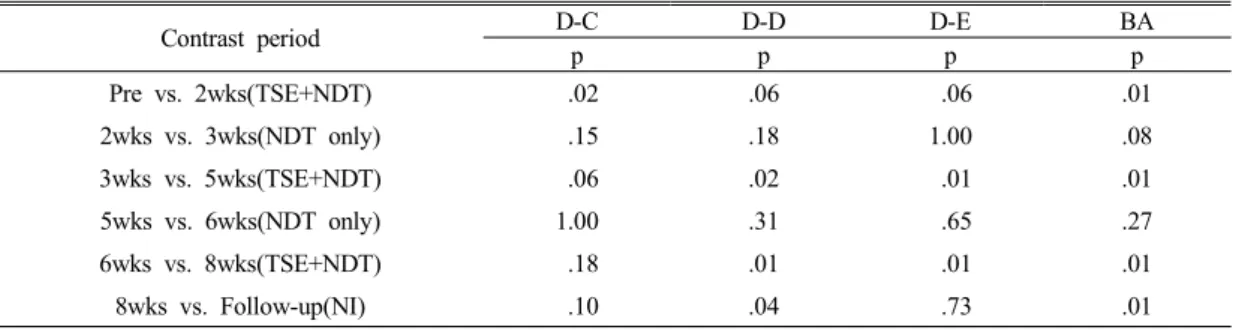
이러한 변화의 각 시기별 차이를 살펴보면 TSE 를 적용한 후에는 대단위 운동 기능들이 호전되는 경 향을 보였으나 TSE 를 소거하는 경우에는 유의한 변 화를 보이지 않았다 . TSE 를 소거한 개월 후 추수 4 관찰 결과를 보면 네발기기와 무릎서기 서기 그리 , , 고 걷기 달리기 도약하기는 평균값에서는 약간의 , , 감소 소견을 보였으나 통계적인 별다른 변화를 보

Period D-C§ X2 D-Dʃ X2 D-Eɛ X2 BAλ X2

Pre 90.47±8.34

28.37*

68.54±21.55

36.48*

48.20±30.09

45.78*

36.62±11.04

45.21*

2wks 92.26±7.61 71.40±19.81 50.17±28.66 38.62±10.44

3wks 92.85±7.74 70.71±20.81 50.16±28.66 38.25±10.62

5wks 94.93±7.68 77.03±14.75 55.03±26.76 42.06±9.48

6wks 94.91±7.71 76.73±15.28 54.85±26.17 41.75±9.45

8wks 95.53±6.66 78.95±14.90 58.85±26.52 44.50±8.88

FW 94.31±7.18 75.31±16.72 56.94±26.14 42.00±9.92

Values are expressed as mean±SD.

§ ; Dimension C(crawling and kneeling) ʃ ; Dimension D(standing)

ɛ ; Dimension E(walking, running and jumping) λ ; Balance ability

* ; p<.05

Table 3. Changes of the GMFM and the balance ability during the study period

Contrast period D-C D-D D-E BA

p p p p

Pre vs. 2wks(TSE+NDT) .02 .06 .06 .01

2wks vs. 3wks(NDT only) .15 .18 1.00 .08

3wks vs. 5wks(TSE+NDT) .06 .02 .01 .01

5wks vs. 6wks(NDT only) 1.00 .31 .65 .27

6wks vs. 8wks(TSE+NDT) .18 .01 .01 .01

8wks vs. Follow-up(NI) .10 .04 .73 .01

Table 4. Comparison of the GMFM and the balance ability between the each period

(6)

이지 않았다(Table 4).

균형 능력의 변화 2.

균형능력은 유의한 변화를 보였다(Table 3, p=.00).

균형능력의 각 시기별 차이의 검정은 Table 4 와 같 다 . TSE 를 적용한 후에는 균형 능력이 호전되는 경 향을 보였으나 TSE 를 소거하는 경우에는 균형능력은 유의한 변화를 보이지 않았다 (p=.08~.27). TSE 를 소 거한 개월 후 추수관찰 결과를 보면 균형능력은 4 8 주 후 검사에 비해 유의한 차이를 보였다(p=.01).

Ⅳ . 고 찰

뇌성마비 아동의 주된 문제는 근 약화로서(Wiley 와 , Damiano, 1998) 근 약화는 대단위 운동이나 보 행과 같은 기능적 움직임의 문제를 유발하는데 근력이 클수록 기능 수준이 높다 (Fetters, 1991)

와 따라서 뇌성마비 아동의

(Ross Engsberg, 2007).

주된 치료 목표인 기능 개선을 위해 최근 근력강화 , 운동을 많이 이용하고 있다 뇌성마비 아동의 문제 . 를 연구한 많은 연구 (Elder 등 , 2003; Rose 와 McGill,

와 에서 특히 다리의 약

2005; Wiley Damiano, 1998)

증을 보고하고 있다 그러나 뇌성마비 아동의 경우 . 팔다리 근육의 약증뿐 아니라 체간근육의 약증도 나타난다 (Burtner 등 1998). 뇌성마비 아동은 체간근 육의 약증으로 인해 균형 있는 앉기의 어려움을 흔 히 보인다 (Hulme 등 , 1983; Park 등 , 2001). 앉기는 아동이 중력을 이기고 몸을 바로세운 자세(upright 를 취하도록 할 뿐 아니라 팔의 기능적 움 posture)

직임에 매우 중요한 단계로서 바른 앉기의 결여는 휠체어나 의자 생활에서 손의 사용을 제한하는 것 으로 이어져 (Redstone 과 West, 2004) 손을 통한 풍 부한 감각입력의 차단과 학습의 어려움을 초래하며 독립적인 일상생활에 문제를 야기한다 또한 체간근 . 육의 약화는 균형 유지를 어렵게 하여 보행이나 몸 을 바로 세운 자세에서의 동작에 문제를 야기한다.

따라서 뇌성마비 아동이 인격체로서 품위를 유지하 며 사회 구성원으로서 독립적인 생활을 할 수 있도 록 하는데 목적을 두는 물리치료 영역에서 약화된

체간근육을 효과적으로 강화시키는 것은 매우 중요 하다고 할 수 있다.

본 연구의 결과 스위스 볼을 이용한 TSE 를 적용 하는 경우가 TSE 를 소거한 경우에 비해 모든 시점 에서 유의하게 대단위 운동의 개선이 이루어짐을 알 수 있었다 그리고 개월 후의 추수관찰 결과 약 . 4 간의 감소 소견을 보였으나 TSE 를 소거한 4 개월 후의 결과가 사전 평가에 비해 GMFM 의 변화가 4.24 높게 나타나 근력강화 운동을 개월간 실

18.13% 4

시하지 않았음을 고려하면 비교적 대단위 운동의 유지 효과도 있는 것으로 사료된다 뇌성마비 아동 . 은 길항근의 동원은 증가되어 있고 체간근육의 활 동은 감소되어 있는데 (Burtner 등 , 1998) 체간과 골 반의 안정성 문제로 뇌성마비 아동은 머리의 안정 성이 결여되고 이로 인해 움직임의 폭 (amplitude) 은 증가된다 (Coluccini 등 , 2007; Redstone 과 West, 2004).

따라서 본 연구의 결과에서 보인 대 단위 동작과 균형의 개선은 체간근력 강화의 효과로 생각해 볼 수 있을 것이다.

일반적으로 스위스 볼은 움직임의 개선을 위한 저항 운동에 사용되 며 (Lehman 등 , 2006) 선행 연 구들 (Behm 등 , 2005; Lehman 등 , 2006; Marshall 과 에서 스위스 볼을 이용한 불 Murphy, 2005, 2006)

안정한 지면의 운동이 안정한 지면에서의 운동보 다 체간근육의 근력강화에 효과적이라고 보고되었 다 또한 스위스 볼과 유사한 불안정한 지면을 제 . 공하여 체간근육의 많은 동원을 유발하는 승마치료

연구들 등 등

(hippotherapy) (Snider , 2007; Sterba , 에서도 대단위 운동의 개선을 보 2002; Sterba, 2007)

고하고 있다 따라서 본 연구에서와 같이 스위스 볼 . 을 이용한 불안정한 지면에서의 운동이 보다 많은 체간근육의 동원을 유도한 결과 체간의 동시 수축 과 관절의 안정성을 개선하고 효과적 (co-contraction)

인 체간근력 강화 향상이 이루어져 대단위 운동의 개선이 이루어진 것으로 사료된다.

본 연구에서 균형능력의 경우 TSE 를 적용하는 경우가 이러한 운동을 소거한 경우에 비해 모든 시 점에서 유의하게 균형능력의 개선 소견을 보였다.

그러나 개월 후의 추수관찰 결과 통계적으로 의미 4

있는 감소 소견을 보였으나 근력강화 운동을 소거

(7)

한 개월 후의 결과가 사전 평가에 비해 4 14.69% 높 게 나타나 TSE 를 개월간 실시하지 않았음을 고려 4 하면 비교적 균형능력의 유지 효과도 있는 것으로 사료된다.

비정상적인 움직임을 보이는 아동의 주된 문제들 중 하나는 부적절한 감각 정보인데(Harris, 1971) 뇌성마비 아동의 체간 안정성은 특히 체성감각 을 사용 할 수 없는 상황에서 정상 (somatosensory)

아동보다 저하된다 (Liao 등 , 1997). 특히 고유수용 , 성 감각은 신체의 인식 대단위 운동과 섬세한 운 , 동 운동 계획 움직임의 조절 자세 안정성 그리고 , , , , 감정적 안정감에 영향을 주어 신체의 다양한 움직 임과 협응 움직임에 대한 자신감의 기본이 된다 , . 관절과 근육으로부터 유입되는 고유수용성 감각은 촉각 및 전정계로부터의 감각과 통합되어 아동이 다양한 활동으로 움직일 때 머리로부터의 감각과 신체의 자세 감각이 동시에 뇌로 전달되도록 하며 이들 감각을 효과적으로 자극하는 방법으로 불안정 한 지면에서의 운동이 권장되고 있다 이러한 운동 . 은 신경근의 요구를 증가시켜 관절의 고유수용성 감각과 근육의 반응시간 (reaction time) 을 개선시키 고 근육 활동을 크게 만든다 (Ashton-Miller 등 , 2001;

등 등 등

Lehman , 2006; Naughton , 2005; Sheth , 따라서 본 연구에서 보인 균형능력의 개선은 1997).

스위스 볼의 지속적인 불안정이 전정계 체성감각 , 그리고 시각계를 자극하여 신체의 정렬과 무게 중 심을 지각하는 능력을 증가시킨 결과로 사료된다

과 이러한 연구

(Shumway-Cook Woollacott, 2001).

결과는 스위스 볼에서의 운동의 체간의 균형을 효 과적으로 개선한다고 보고한 Cosio-Lima 등 (2003) 의 연구 그리고 Sekendiz 등 (2010) 의 연구와 같은 결과 로서 스위스 볼과 같은 불안정한 지면에서의 운동은 효과적으로 감각을 자극하고 체중의 이동을 조장하 여 자세 반응과 균형 반응을 효과적으로 유도하여 동적 안정성을 촉진 할 수 있을 것으로 사료된다.

본 연구는 경직성 양하지 뇌성마비 아동을 대상 으로 체간근력 강화운동의 효과를 대단위 운동 기 능과 균형 능력의 변화를 통해 검증하고자 하였으 나 다수의 경직성 양하지 뇌성마비 아동을 대상으 로 연구를 수행하기 어려운 임상 연구의 한계로 인

해 효율적인 연구를 위해 대조군 설정을 하지 않는 단일 그룹 반복측정 연구를 진행하였다 또한 경직 . 성 양하지 뇌성마비 아동에 적용한 체간근력 강화 운동의 효과에 대한 선행 연구의 부족으로 연구에 참여한 아동들에게 체간근력 강화운동만을 적용할 수 없는 연구 윤리적 측면을 고려하여 일반적으로 경직성 양하지 뇌성마비 아동에게 임상에서 적용하 는 신경발달학적 치료를 완전히 배제할 수 없었던 연구의 제한점이 존재한다 따라서 본 연구의 결과 . 를 일반화하기 위해서는 보다 많은 피검자를 대상 으로 하고 통제된 연구를 통한 다각적 분석 연구가 필요할 것으로 사료된다.

Ⅴ . 결 론

본 연구의 결과 스위스 볼을 이용한 체간근력 강 화운동은 경직성 양하지 뇌성마비 아동의 대단위 운동과 균형 능력을 의미 있게 개선시키는 것으로 나타났다 따라서 본 연구에서와 같이 스위스 볼을 . 이용한 체간근력 강화운동 방법뿐 아니라 다양한 운동도구를 이용한 체간근력 강화 운동프로그램의 개발과 연구가 필요하다고 여겨진다 또한 뇌성마비 . 아동의 특성에 맞는 스위스 볼을 이용한 체간근력 강화운동의 운동 강도 빈도 기간 등의 연구도 필 , , 요할 것으로 사료된다.

참 고 문 헌

Ashton-Miller JA, Wojtys EM, Huston LJ et al.

Can proprioception really be improved by exercises?

Knee Surg Sports Traumatol Arthrosc. 2001;9(3):

128-36.

Behm DG, Leonard AM, Young WB et al. Trunk muscle electromyographic activity with unstable and unilateral exercises. J Strength Cond Res.

2005;19(1):193-201.

Bobath B. The treatment of neuromuscular disorders by improving patterns of co-ordination. Physiotherapy.

1969;55(1):18-22.

Burtner PA, Qualls C, Woollacott MH. Muscle

(8)

activation characteristics of stance balance control in children with spastic cerebral palsy. Gait Posture. 1998;8(3):163-74.

Coluccini M, Maini ES, Martelloni C et al.

Kinematic characterization of functional reach to grasp in normal and in motor disabled children.

Gait Posture. 2007;25(4):493-501.

Cosio-Lima LM, Reynolds KL, Winter C et al.

Effects of physioball and conventional floor exercises on early phase adaptations in back and abdominal core stability and balance in women. J Strength Cond Res. 2003;17(4):721-5.

Damiano DL, Abel MF. Relation of gait analysis to gross motor function in cerebral palsy. Dev Med Child Neurol. 1996;38(5):389-96.

Damiano DL, Abel MF. Functional outcomes of strength training in spastic cerebral palsy. Arch Phys Med Rehabil. 1998;79(2):119-25.

Damiano DL, Quinlivan J, Owen BF et al. Spasticity versus strength in cerebral palsy: relationships among involuntary resistance, voluntary torque, and motor function. Eur J Neurol. 2001;8(Suppl 5):40-9.

Dodd KJ, Taylor NF, Graham HK. A randomized clinical trial of strength training in young people with cerebral palsy. Dev Med Child Neurol.

2003;45(10):652-7.

Eek MN, Tranberg R, Zügner R et al. Muscle strength training to improve gait function in children with cerebral palsy. Dev Med Child Neurol. 2008;50 (10):759-64.

Elder GC, Kirk J, Stewart G et al. Contributing factors to muscle weakness in children with cerebral palsy. Dev Med Child Neurol. 2003;45(8):542-50.

Fetters L. Measurement and treatment in cerebral palsy: an argument for a new approach. Phys Ther. 1991;71(3):244-7.

Fosano VA, Broggi G, Barolat-Romana G et al.

Surgical treatment of spasticity in cerebral palsy.

Childs Brain. 1978;4(5):289-305.

Franjoine MR, Gunther JS, Taylor MJ. Pediatric balance scale: a modified version of the berg balance scale for the school-age child with mild to moderate motor impairment. Pediatr Phys Ther.

2003;15(2):114-28.

Harris FA. Inapproprioception: a possible sensory basis for athetoid movements. Phys Ther. 1971;51 (7):761-70.

Hodgkinson I, Bérard C, Jindrich ML et al. Selective dorsal rhizotomy in children with cerebral palsy.

Results in 18 cases at one year postoperatively.

Stereotact Funct Neurosurg. 1997;69(1-4 Pt 2):

259-67.

Hulme JB, Poor R, Schulein M et al. Perceived behavioral changes observed with adaptive seating devices and training programs for multihandi- capped, developmentally disabled individuals.

Phys Ther. 1983;63(2):204-8.

Ikeda AJ, Abel MF, Granata KP et al. Quanti- fication of cocontraction in spastic cerebral palsy.

Electromyogr Clin Neurophysiol. 1998;38(8):497- 504.

Lee JH, Sung IY, Yoo JY. Therapeutic effects of strengthening exercise on gait function of cerebral palsy. Disabil Rehabil. 2008;30(19):1439-44.

Lehman GJ, MacMillan B, MacIntyre I et al.

Shoulder muscle EMG activity during push up variations on and off a Swiss ball. Dyn Med.

2006;5:7.

Liao HF, Jeng SF, Lai JS et al. The relation between standing balance and walking function in children with spastic diplegic cerebral palsy. Dev Med Child Neurol. 1997;39(2):106-12.

Liao HF, Liu YC, Liu WY et al. Effectiveness of loaded sit-to-stand resistance exercise for children with mild spastic diplegia: a randomized clinical trial. Arch Phys Med Rehabil. 2007;88(1):25-31.

MacPhail HEA, Kramer JF. Effect of isokinetic

strength training on functional ability and walking

efficiency in adolescents with cerebral palsy. Dev

(9)

Med Child Neurol. 1995;37(9):763-75.

Marshall PW, Murphy BA. Core stability exercises on and off a Swiss ball. Arch Phys Med Rehabil.

2005;86(2):242-9.

Marshall P, Murphy B. Changes in muscle activity and perceived exertion during exercises performed on a swiss ball. Appl Physiol Nutr Metab.

2006;31(4):376-83.

McNee AE, Gough M, Morrissey MC et al. Increases in muscle volume after plantarflexor strength training in children with spastic cerebral palsy.

Dev Med Child Neurol. 2009;51(6):429-35.

Naughton K, Adams L, Maher H. Upper-body wobbleboard training effects on the post-dislocation shoulder. Phys Ther Sport 2005;6(1):31-7.

Palisano RJ, Hanna SE, Rosenbaum PL et al.

Validation of a model of gross motor function for children with cerebral palsy. Phys Ther.

2000;80(10):974-85.

Papavasiliou AS. Management of motor problems in cerebral palsy: A critical update for the clinician.

Eur J Paediatr Neurol. 2009;13(5):387-96.

Park ES, Park CI, Lee HJ et al. The effect of electrical stimulation on the trunk control in young children with spastic diplegic cerebral palsy. J Korean Med Sci. 2001;16(3):347-50.

Redstone F, West JF. The importance of postural control for feeding. Pediatr Nurs. 2004;30(2):

97-100.

Rose J, McGill KC. Neuromuscular activation and motor-unit firing characteristics in cerebral palsy.

Dev Med Child Neurol. 2005;47(5):329-36.

Ross SA, Engsberg JR. Relationships between spasticity, strength, gait, and the GMFM-66 in persons with spastic diplegia cerebral palsy. Arch Phys Med Rehabil. 2007;88(9):1114-20.

Sekendiz B, Cuğ M, Korkusuz F. Effects of Swiss- ball core strength training on strength, endurance, flexibility, and balance in sedentary women. J Strength Cond Res. 2010;24(11):3032-40.

Sheth P, Yu B, Laskowski ER et al. Ankle disk training influences reaction times of selected muscles in a simulated ankle sprain. Am J Sports Med. 1997;25(4):538-43.

Shumway-Cook A, Woollacott M.. Motor control theory and practical applications. 2nd ed. Baltimore.

Lippincott Williams and Wilkins. 2001.

Snider L, Korner-Bitensky N, Kammann C et al.

Horseback riding as therapy for children with cerebral palsy: is there evidence of its effectiveness?

Phys Occup Ther Pediatr. 2007;27(2):5-23.

Stackhouse SK, Binder-Macleod SA, Lee SC.

Voluntary muscle activation, contractile properties, and fatigability in children with and without cerebral palsy. Muscle Nerve. 2005;31(5):594-601.

Stackhouse SK, Binder-Macleod SA, Stackhouse CA et al. Neuromuscular electrical stimulation versus volitional isometric strength training in children with spastic diplegic cerebral palsy: a preliminary study. Neurorehabil Neural Repair. 2007;21(6):

475-85.

Sterba JA, Rogers BT, France AP et al. Horseback riding in children with cerebral palsy: effect on gross motor function. Dev Med Child Neurol.

2002;44(5):301-8.

Sterba JA. Does horseback riding therapy or therapist-directed hippotherapy rehabilitate children with cerebral palsy? Dev Med Child Neurol.

2007;49(1):68-73.

Styer-Acevedo J. Physical therapy for the child with cerebral palsy. In: Techlin JS, eds, Pediatric physical therapy. 2nd ed. Philadelphia. JB Lippincott. 1994.

van der Linden ML, Hazlewood ME, Hillman SJ et al. Functional electrical stimulation to the dorsiflexors and quadriceps in children with cerebral palsy.

Pediatr Phys Ther. 2008;20(1):23-9.

Wiley ME, Damiano DL. Lower-extremity strength

profiles in spastic cerebral palsy. Dev Med Child

Neurol. 1998;40(2):100-7.

수치

Fig. 1. Flow of study. TSE, Trunk Strengthening Exercise; NDT, Neurodevelopmental Treatment; NI, No intervention; FW, Follow up.
Table 4. Comparison of the GMFM and the balance ability between the each period

참조

관련 문서

Comparison between the Effect of Aquatic Exercise Program and Land Exercise Program in Spastic Cerebral Palsy on Motor Function and Balance.. Sung-Hoon Kang, PT, MS 1 ,

PURPOSE: This study aimed to quantify the effects of whole body vibration (WBV) stimulation training on the muscle thickness and gross motor function in children with

Purpose: This study investigated the correlation between isometric muscle strength, gross motor function, and gait parameters in patients with spastic cerebral palsy and to find

The purpose of this study was to evaluate the influence of respiratory capacity(forced vital capacity), EMG of rectus abdominal muscle, phonation by respiratory

Abstract The present study aimed to identify the effects of the trunk stability exercise on functional movement, dynamic balance, and trunk stability in patients

Purpose:This study aimed to examine the Influence of muscle strengthening exercise and stretching exercise of trunk extensor muscles on muscular strength

Purpose :The purpose of this study was to examine the effects of lower trunk muscles strengthening in athetosis children with cerebral palsy.. Methods :One children

Effects of task-oriented activities based on neurodevelopmental therapy principles on trunk control, balance, and gross motor function in children with spastic diplegic