INTRODUCTION
Kawasaki disease (KD) is an acute febrile, multisystemic vas- culitis syndrome, occurring mainly in children younger than 5 years of age. It leads to inflammation that affects the small or medium-sized arteries, and this mechanism has clinical man- ifestations.1 The most serious complications that can occur in KD are aneurysms or ectasia of the coronary artery and myo- cardial infarction that can develop due to invasion of the coro- nary artery.2
The standard treatment in the acute phase of KD includes
high-dose intravenous immunoglobulin (IVIG) and aspirin.3 The mechanism of IVIG action is still under investigation; how- ever, IVIG appears to have a generalized anti-inflammatory ef- fect involving the inhibition of the interaction between cyto- kines and endothelial cells. IVIG administration is known to reduce the incidence of coronary artery disease from 20−25%
to 2−4%.4 However, 10−15% of patients with KD show persistent fever despite the administration of initial standard treatments.
These patients are considered to be resistant to high-dose IVIG therapy, which in turn increases the risk of coronary artery le- sions (CALs) and necessitates more aggressive treatment.5
The standard treatment protocol for IVIG-resistant KD has not yet been decided. Corticosteroids are the second most commonly used medications to treat patients with KD who have a recurrent or persistent fever after IVIG treatment.6 Ad- ditional second-line drugs for IVIG-resistant KD including methylprednisolone, infliximab, cyclosporine, cyclophospha- mide, and methotrexate (MTX) have been reported. However, no standard medication has been established.3
In 2002, we first reported a patient who was successfully treated for IVIG-resistant KD with MTX.7 In 2005, MTX was found to be efficacious in four additional patients who were Received: July 7, 2017 Revised: October 13, 2017
Accepted: October 14, 2017
Corresponding author: Dr. Dong Soo Kim, Department of Pediatrics, Yonsei Uni- versity College of Medicine, Severance Children’s Hospital, 50-1 Yonsei-ro, Seo- daemun-gu, Seoul 03722, Korea.
Tel: 82-2-2228-2057, Fax: 82-2-393-9118, E-mail: [email protected]
•The authors have no financial conflicts of interest.
© Copyright: Yonsei University College of Medicine 2018
This is an Open Access article distributed under the terms of the Creative Com- mons Attribution Non-Commercial License (http://creativecommons.org/licenses/
by-nc/4.0) which permits unrestricted non-commercial use, distribution, and repro- duction in any medium, provided the original work is properly cited.
Clinical Outcomes of Low-Dose Methotrexate Therapy as a Second-Line Drug for Intravenous
Immunoglobulin-Resistant Kawasaki Disease
Hyejin Jang, Kyu Yeun Kim, and Dong Soo Kim
Department of Pediatrics, Yonsei University College of Medicine, Severance Children’s Hospital, Seoul, Korea.
Purpose: Intravenous immunoglobulin (IVIG) is the standard treatment for Kawasaki disease (KD). However, there is still no stan- dard treatment for IVIG-resistant KD. This study aimed to evaluate the efficacy of low-dose methotrexate (MTX) as a treatment for IVIG-resistant KD.
Materials and Methods: We retrospectively analyzed 10-year data for patients with IVIG-resistant KD who were administered MTX at Severance Children’s Hospital.
Results: The subjects included 75 patients with KD aged 5 months to 9.2 years who had been administered MTX. Their maximum body temperatures decreased significantly within 24 h of therapy. The patients’ C-reactive protein levels were significantly lower 1 week after administering the first dose of MTX than those before treatment. No adverse effect for MTX was observed.
Conclusion: MTX treatment of IVIG-resistant KD resulted in rapid defervescence, improvement of clinical symptoms, and nor- malization of acute-phase reactants in all patients. Thus, MTX could be a candidate treatment for IVIG-resistant KD.
Key Words: Kawasaki disease, immunoglobulin-resistant Kawasaki disease, methotrexate, coronary artery lesion
pISSN: 0513-5796 · eISSN: 1976-2437 Yonsei Med J 2018 Jan;59(1):113-118
https://doi.org/10.3349/ymj.2018.59.1.113
treated for IVIG-resistant KD.8 In 2008, we reported the use of MTX in 17 patients with a 5-year history of IVIG-resistant KD.9 Previous studies have shown that MTX is effective in treating IVIG-resistant KD, has no adverse effects, and has economic advantages. By analyzing the data for 10 years, we evaluated the effectiveness of IVIG-resistant KD as a secondary drug and consolidating its position.
MTX is the second most commonly used drug for rheuma- toid arthritis. As an inhibitor of dihydrofolate reductase, it is thought to play an anti-inflammatory role in the inflammatory responses of blood vessels in IVIG-resistant KD.9 In this study, we analyzed the clinical results of the administration of MTX as a therapeutic agent in patients with fever relapse or persis- tent fever for 10 years.
MATERIALS AND METHODS
Study subjects
We retrospectively studied the electronic medical records of 80 children admitted to Severance Children’s Hospital from July 2005 to November 2015. All the patients had fever for at least 5 days and fulfilled five of the six American Heart Associ- ation (AHA) criteria for diagnosing KD (bilateral conjunctivitis;
nonexudative mucosal change; erythema, peeling of the lips and strawberry tongue; cervical lymphadenopathy; single node
>1.5 cm in diameter or several smaller, firm, polymorphous rashes, commonly maculopapular, which may involve early desquamation in the perineal region as well; erythema and induration of the hands or feet or both). All patients were ini- tially administered high-dose IVIG (2 g/kg) and aspirin (100 mg/kg) within the first 10 days of fever onset. The patients were considered IVIG-resistant when the fever (37.5°C, axillary tem- perature) persisted or recurred 48 h after treatment with high- dose IVIG and aspirin. Among the 80 patients, five were ex- cluded because their final diagnoses were systemic juvenile rheumatic arthritis, Kikuchi disease, hemophagocytic lympho-
histiocytosis, gram-negative sepsis, and reactive arthritis. Fi- nally, 75 cases were included in this study.
This study was approved by the Institutional Review Board of Severance Hospital, Seoul, Korea.
MTX treatment
Patients with persistent fever despite an initial treatment with IVIG received repeat IVIG and IV dexamethasone (0.3 mg/kg for 2−3 days) at the same dose. Nonetheless, 75 patients con- tinued to have fever. We repeated the administration of IVIG, steroids, and additional MTX [10 mg/body surface area (BSA)]
orally once a week, which is equivalent to the therapeutic dose for juvenile rheumatoid arthritis. The administration of MTX was continued in all patients until the fever subsided and clini- cal symptoms were relieved. The steroid used at that time was discontinued for 2 to 3 days without tapering out. Day 1 was de- fined as the first day of MTX administration, and laboratory tests were performed in all patients before and 1 week after treat- ment. The response to treatment was determined to be non-re- currence of the initial clinical symptoms within 7 days and res- olution of fever (axillary temperature <37.5°C). The laboratory tests conducted were determination of white blood cell count, hemoglobin, hematocrit, platelet count, aspartate aminotrans- ferase, albumin, erythrocyte sedimentation rate (ESR), and C- reactive protein (CRP). Echocardiography was performed for each patient on admission and within 1 week of hospitalization and after the fever was absent.
Statistical analysis
The statistical analyses were conducted using the statistical package for the social sciences (SPSS) software, version 20.0 (IBM Corp., Armonk, NY, USA). Statistical analysis was per- formed using Wilcoxon matched pairs signed rank test. The categorical data were assessed using the chi-squared test. All p-values <0.05 were considered statistically significant. An in- dependent sample t-test was used to compare the results of two groups with and without CALs.
15
10
5
0
2005 2006 2007 2008 2009 2010 2011 2012 2013 2014 2015
Year Age: 36.6 months (5–110)
Gender M:F=1.8:1
Number of MTX treatment
Fig. 1. Annual distribution of methotrexate (MTX) treatment for intravenous immunoglobulin resistant Kawasaki disease.
RESULTS
Subjects characteristics
MTX was prescribed to 3 to 12 patients with IVIG-resistant KD annually for 10 years between 2005 and 2015 (Fig. 1). The pa- tient age at disease onset ranged from 5 months to 9.2 years (median, 36. 6 months). The sex distribution showed 1.8 times higher proportion of boys than girls (Table 1).
MTX treatment
The median value of the maximum body temperature de- creased significantly within 24 hours of MTX treatment (37.8 vs. 37.1°C, p<0.001) (Fig. 2). The patients’ body temperatures remained well below fever levels even 2 and 3 days (37.0 and 36.9°C, respectively) after MTX administration. The mean CRP level was significantly lowered from 40.5 mg/L to 17.2 mg/L as shown in the laboratory tests performed 1 week after the first dose of MTX (Fig. 3). In the laboratory tests, white blood cell counts, hemoglobin, and ESR levels were slightly improved, but this was not statistically significant (Table 2). There were no serious KD-related complications, such as hypertension or thrombosis, among the patients who participated in this study.
In addition, none of the patients administered MTX experi- enced side effects, such as stomach and intestinal bleeding, blood and bone marrow problems, or liver dysfunction.
Concomitant steroid use
In patients with recurrent or persistent fever after the initial IVIG treatment, a steroid [dexamethasone (0.3 mg/kg/day)] was administered with IVIG. Furthermore, when fever persisted, dexamethasone (0.3 mg/kg/day) was co-administered with MTX for an average of 3.2 days. Steroids administered with MTX were used only once and discontinued without loss of dose, with or without fever.
Table 1. Demographic and Laboratory Characteristics of the Patients Treated with MTX
Characteristics n=75
Age (month) 36.6 (±23)
Male gender (%) 48 (64)
Weight (kg) 23 (±5.5)
WBC (×103/μL) 16.7 (±10.8)
Hb (g/dL) 10.2 (±1.1)
Hematocrit (%) 30.08 (±3.4)
Platelet count (×103/μL) 664 (±229)
CRP (mg/L) 40.5 (±39.7)
ESR (mm/hr) 81.6 (±32.3)
AST (IU/L) 42.28 (±63.9)
Duration of fever before initial IVIG (days) 5.97 (±1.5)
Total dose of IVIG (g/kg) 3.53 (±1.5)
MTX, methotrexate; WBC, white blood cell; Hb, hemoglobin; CRP, C-reactive protein; ESR, erythrocyte sedimentation rate; AST, aspartate aminotransfer- ase; IVIG, intravenous immunoglobulin; SD, standard deviation.
Mean (±SD).
40
39
38
37
36 Before 1 day 2 days 3 days
Day after MTX treatment
Maximum body temperature (°C)
p<0.001
Fig. 2. Fever patterns of the patients with intravenous immunoglobulin resistant Kawasaki disease before and after MTX treatment. MTX, methotrexate.
160 140 120 100 80 60 40 20
0 Before MTX After MTX
CRP (mg/dL)
p<0.002
Fig. 3. Serum CRP level of the patients with intravenous immunoglobulin resistant Kawasaki disease before and 7 days after MTX treatment. CRP, C-reactive protein; MTX, methotrexate.
Coronary artery lesion
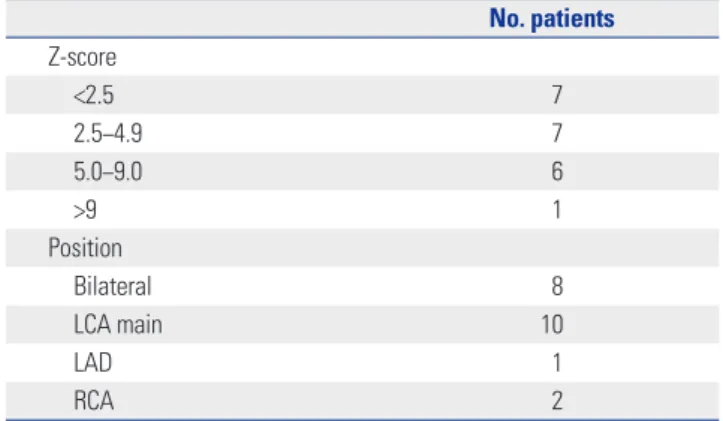
Echocardiography procedures were performed for all the pa- tients with IVIG-resistant KD who were treated with MTX on admission and 1 week after treatment. Of the 75 patients en- rolled in this study, 21 (28%) had CALs. Patients were classified based on coronary artery z-score classification according to the AHA criteria using the echocardiography results. Among the 75 patients treated with MTX, 7 and 6 patients had z-scores of 2.5−4.9 and 5.0−9.0, respectively, while 1 patient had a score of >9 points (Table 3). Twenty-one patients were classified ac- cording to the position of their coronary arteries. Coronary ar- tery complications were bilateral in eight cases, consisting of a right main coronary artery in two cases, left main coronary ar- tery in 10 cases, and left anterior descending artery in one case (Table 3).
Twenty-one patients with CAL were examined using echo- cardiography procedures after 2−3 months. The coronary ar- tery z-score ranged from 4.0 to 3.7 (p=0.076). The CALs did not progress, although the improvement was not statistically sig-
nificant following MTX treatment. This result indicates that MTX treatment did not prevent the aggravation or regression of CAL. There were no statistically significant blood test re- sults following MTX administration to 21 and 54 patients with and without CAL, respectively (Table 4).
DISCUSSION
Although the cause of KD is still unclear, it is speculated to be a hypersensitivity or abnormal immunological reaction in children with a genetic predisposition induced by offending
agents, which may be an infection or inflammation.10 These processes occur in small- to medium-sized arteries, and gen- eralized vasculitis occurs, invading the entire body and mani- festing various clinical symptoms.11 Approximately 7−9 days after the onset of fever, an influx of neutrophils occurs in the endothelial cells, vascular media, and elastic lamina, followed by the proliferation of CD8+ (cytotoxic) lymphocytes and im- munoglobulin A-producing plasma cells.
Mast cells secrete various cytokines [tumor necrosis factor (TNF), vascular endothelial growth factor (VEGF), and mono- cyte chemotactic and activating factor], interleukins (IL-1, IL- 4, and IL-6), and matrix metalloproteinases (MMP3 and MMP9) that target the endothelial cells and cause vascular damage.12,13 In severely affected vessels, the media develops inflammation with necrosis of smooth muscle cells, and the internal and ex- ternal elastic laminae can split, leading to aneurysms. Over the next few weeks to months, the active inflammatory cells are replaced by fibroblasts and monocytes, and fibrous con- nective tissue begins to form within the vessel wall.14 The intima proliferates and thickens while the vessel wall eventually nar- rows or occludes, owing to stenosis or a thrombus. Recent stud- ies have shown that features, including KD susceptibility, se- verity, immunopathogenesis, reactivity to IVIG treatment, and coronary artery complications, are associated with genetic susceptibility. It has been shown that innate immunity plays a more important role in immunopathogenesis of disease than acquired immunity, but there are still many areas to be studied.15
Initial treatment with IVIG (2 g/kg) and aspirin (100 mg·kg-1· day-1) reduces the incidence of coronary lesions in KD from 20% to 4%, leading to the rapid onset of the normalization of systemic inflammatory markers.16 IVIG is known to have a generalized anti-inflammatory effect, and its possible mecha- nism of action includes the regulation of cytokine production and neutralization of bacterial superantigen.17
Even with standard treatment with IVIG and aspirin, approx- imately 10−15% of patients with KD show persistent or recur- rent fever (IVIG-resistant KD), which increases their risk for CAL.18 Several co-treatments have been reported to be used Table 2. Laboratory Data before and 7 Days after MTX Treatment for
Patients with IVIG-Resistant KD
Lab Before After p value
WBC (×103/μL) 16.7 (±10.8) 14.6 (±11.6) 0.080
Hb (g/dL) 10.2 (±1.1) 10.0 (±1.2) 0.670
ESR (mm/hr) 81.6 (±32.3) 80.6 (±29.1) 0.765 CRP (mg/L) 40.5 (±39.7) 17.2 (±16.9) 0.002 MTX, methotrexate; IVIG, intravenous immunoglobulin; KD, Kawasaki dis- ease; WBC, white blood cell; Hb, hemoglobin; ESR, erythrocyte sedimenta- tion rate; CRP, C-reactive protein; SD, standard deviation.
Mean (±SD), independent t-test and chi-squared test, p<0.05.
Table 3. Z-score and Position of Coronary Artery Lesion No. patients Z-score
<2.5 7
2.5−4.9 7
5.0−9.0 6
>9 1
Position
Bilateral 8
LCA main 10
LAD 1
RCA 2
LCA, left coronary artery; LAD, left anterior descending; RCA, right coronary artery.
Table 4. Comparison of Demographic Characteristics and Laboratory Findings between CALs (-) and (+) Groups
Characteristics CALs (-) (n=54 ) CALs (+) (n=21) p value
WBC count (×103/μL) 16.9 16.0 0.738
Hb (g/dL) 10.3 10.0 0.262
CRP (mg/L) 33.0 44.6 0.302
ESR (mm/hr) 80.7 87.0 0.452
Duration of fever before initial IVIG (days) 6.33 5.05 0.069
Total dose of IVIG (g/kg) 3.42 3.82 0.292
Duration of fever before starting MTX (days) 4.38 6.05 0.072
Cumulative dose of MTX (mg/BSA) 4.13 3.74 0.416
Total fever days 11.1 11.8 0.621
CALs, coronary artery lesions; WBC, white blood cell; Hb, hemoglobin; CRP, C-reactive protein; ESR, erythrocyte sedimentation rate; IVIG, intravenous immuno- globulin; MTX, methotrexate; BSA, body surface area.
Mean, independent t-test and chi-squared test, p<0.05.
with repeated infusions of IVIG, including IV methylpredniso- lone, infliximab, abciximab, ulinastatin, MTX, cyclosporine, cyclophosphamide, and plasma exchange.15,19 IV methylpred- nisolone (30 mg/kg infused for 2 hours and 3 days) rapidly sup- presses cytokine levels and subsequently decreases capillary permeability, with outcomes similar to those of patients treat- ed with a second dose of IVIG.20,21 Infliximab (5 mg/kg, IV infu- sion) binds to TNF-α and prevents its activation. Thereby, IL and proinflammatory cytokines are reduced, and the activity of neutrophils and eosinophils is inhibited.22 Abciximab, a platelet glycoprotein IIb/IIIa receptor inhibitor, is associated with the resolution of thrombi and vascular remodeling in adults with acute coronary syndromes.23 Cyclosporine A (CyA) inhibits the assembly and release of IL-2, a cytokine signaling molecule, and inhibits the activation of T lymphocytes.24 Cy- closporine has not been associated with CAL, but has shown side effects, such as hyperkalemia, hypertension, hirsutism, tremor, and renal dysfunction.25
In 2002, we reported the successful treatment of a patient with IVIG-resistant KD with MTX, originally.7 A 6-year-old boy diagnosed with KD was administered IVIG four times; how- ever, the fever persisted even with co-treatment with dexa- methasone. On day 31 after the disease onset, MTX (10 mg/
BSA, PO once weekly) was initiated and successfully resolved the clinical symptoms. However, a massive bilateral coronary aneurysmal ectasia was confirmed 2 months later by echocar- diography, suggesting that MTX did not affect the progression of CALs. In 2005, MTX was reported to be effective in an addi- tional four cases of IVIG-resistant KD in patients with an age distribution ranging from 8 months to 8 years and 9 months.8 IVIG was administered 2−3 times, and dexamethasone was used for several days over 3−12 days; however, the fever per- sisted, and low-dose MTX was administered (PO). The fever was controlled in all four patients within 3 days, although there was no improvement of CAL with MTX in this study. In 2008, we reported the use of MTX in 17 patients with IVIG-resistant KD over 5 years. The age of the patients at the disease onset ranged from 4 months to 8 years (median, 2.7 years). All the pa- tients were controlled successfully with MTX, which showed no adverse effects in this study. Furthermore, the number and size of CALs did not decrease, as shown by the echocardiogra- phy procedure before and after MTX administration.
In this study, MTX (10 mg/m2 weekly PO) was used as a secondary agent for KD at the same low doses used in rheu- matoid arthritis and appeared to interfere with the hypersen- sitivity or abnormal immunological reaction.26 We have not elucidated the exact mechanism by which MTX shows efficacy in IVIG-resistant KD; however, the following mechanisms have been suggested. These include the inhibition of enzymes involved in purine metabolism, leading to the accumulation of adenosine, inhibition of T-cell activation and suppression of intercellular adhesion molecules by T-cells, and selective downregulation of B-cells.27,28 Another proposed mechanism
of action of MTX is the inhibition of methyltransferase activity, causing the inactivation of enzyme activity related to immune system function. These mechanisms may have contributed to the rapid fever resolution and improvement of inflammatory markers experienced by these patients treated with MTX. These results suggest that MTX is a potential candidate drug for sec- ond-line therapy of IVIG-resistant KD. The administration of MTX to children is challenging because of its various side ef- fects. In addition, MTX is used as an anticancer drug and, thus, it may create a sense of discomfort for patients and caregivers.
Nevertheless, none of the patients enrolled in this study showed the common side effects of MTX, such as leukopenia, hepato- toxicity, and ulcerative stomatitis.29
The most serious complication of KD is CAL, and we have considered this from two perspectives. First, in patients with CAL, MTX was used to confirm the improvement, but no sta- tistically positive results were obtained. Second, we observed that MTX could not prevent the development, formation, or aggravation of the observed CAL, which was not resolved. Our study had a few limitations including the concomitant use of steroids, which makes it difficult to assess the effect of MTX alone. In the case of recurrence of fever after initial IVIG treat- ment, MTX was administered to IVIG and steroid for an aver- age of 3.2 days, and the steroid used at that time was discontin- ued without tapering out. The steroids administered with MTX were discontinued after a single dose, and because MTX was administered weekly to treat fever and symptoms, we deter- mined that MTX played an important role in IVIG-resistant KD.
The use of steroids did not appear to improve symptoms be- cause MTX was added when the fever subsided. In addition to the clinical improvement described above, MTX has been ad- ministered for 10 years, confirming that no particular side ef- fect is associated with its use and, thus, it is superior as a second- line drug. In addition to steroids, we have used cyclosporine in patients with IVIG-resistant KD, although we did not con- tinue to do so because of poor results in the control of fever or improvement in the test. Second, this was not a controlled study. We retrospectively analyzed the data of patients admin- istered MTX obtained from an electronic medical record da- tabase. Therefore, there was no control in the design of subject recruitment and study. Third, this study was conducted in a single center and, therefore, MTX therapy should further be assessed in a multicenter, placebo-controlled trial.
In conclusion, MTX effectively treated IVIG-resistant KD, im- proved the patients’ clinical symptoms, and reduced the acute phase reactants. However, MTX did not affect the improvement or prevention of CAL. Finally, MTX could be a candidate for standard treatment for IVIG-resistant KD.
ORCID
Hyejin Jang https://orcid.org/0000-0002-8358-494X Dong Soo Kim https://orcid.org/0000-0002-3270-506X
REFERENCES
1. Dimitriades VR, Brown AG, Gedalia A. Kawasaki disease: patho- physiology, clinical manifestations, and management. Curr Rheu- matol Rep 2014;16:423.
2. Fukushige J, Takahashi N, Ueda K, Hijii T, Igarashi H, Ohshima A.
Long-term outcome of coronary abnormalities in patients after Kawasaki disease. Pediatr Cardiol 1996;17:71-6.
3. Rashid AK, Kamal SM, Ashrafuzzaman M, Mustafa KG. Kawasaki disease and its treatment - an update. Curr Rheumatol Rev 2014;
10:109-16.
4. Shulman ST. Intravenous immunoglobulin for the treatment of Kawasaki disease. Pediatr Ann 2017;46:e25-8.
5. Egami K, Muta H, Ishii M, Suda K, Sugahara Y, Iemura M, et al. Pre- diction of resistance to intravenous immunoglobulin treatment in patients with Kawasaki disease. J Pediatr 2006;149:237-40.
6. Zhu BH, Lv HT, Sun L, Zhang JM, Cao L, Jia HL, et al. A meta-analy- sis on the effect of corticosteroid therapy in Kawasaki disease. Eur J Pediatr 2012;171:571-8.
7. Lee MS, An SY, Jang GC, Kim DS. A case of intravenous immuno- globulin-resistant Kawasaki disease treated with methotrexate.
Yonsei Med J 2002;43:527-32.
8. Ahn SY, Kim DS. Treatment of intravenous immunoglobulin-re- sistant Kawasaki disease with methotrexate. Scand J Rheumatol 2005;34:136-9.
9. Lee TJ, Kim KH, Chun JK, Kim DS. Low-dose methotrexate therapy for intravenous immunoglobulin-resistant Kawasaki disease. Yon- sei Med J 2008;49:714-8.
10. Fischer P, Uttenreuther-Fischer MM, Naoe S, Gaedicke G. Kawa- saki disease: update on diagnosis, treatment, and a still controver- sial etiology. Pediatr Hematol Oncol 1996;13:487-501.
11. Rowley AH, Shulman ST. Pathogenesis and management of Ka- wasaki disease. Expert Rev Anti Infect Ther 2010;8:197-203.
12. Burns JC, Shimizu C, Shike H, Newburger JW, Sundel RP, Baker AL, et al. Family-based association analysis implicates IL-4 in sus- ceptibility to Kawasaki disease. Genes Immun 2005;6:438-44.
13. Lee TJ, Chun JK, Yeon SI, Shin JS, Kim DS. Increased serum levels of macrophage migration inhibitory factor in patients with Kawa- saki disease. Scand J Rheumatol 2007;36:222-5.
14. Leung DY, Schlievert PM, Meissner HC. The immunopathogenesis and management of Kawasaki syndrome. Arthritis Rheum 1998;
41:1538-47.
15. Kim KY, Kim DS. Recent advances in Kawasaki disease. Yonsei Med J 2016;57:15-21.
16. Kitamura S, Kameda Y, Seki T, Kawachi K, Endo M, Takeuchi Y, et
al. Long-term outcome of myocardial revascularization in patients with Kawasaki coronary artery disease. A multicenter cooperative study. J Thorac Cardiovasc Surg 1994;107:663-73.
17. Wong PH, White KM. Impact of immunoglobulin therapy in pe- diatric disease: a review of immune mechanisms. Clin Rev Allergy Immunol 2016;51:303-14.
18. Saneeymehri S, Baker K, So TY. Overview of pharmacological treatment options for pediatric patients with refractory Kawasaki disease. J Pediatr Pharmacol Ther 2015;20:163-77.
19. Kuo HC, Yang KD, Chang WC, Ger LP, Hsieh KS. Kawasaki dis- ease: an update on diagnosis and treatment. Pediatr Neonatol 2012;53:4-11.
20. Miura M, Kohno K, Ohki H, Yoshiba S, Sugaya A, Satoh M. Effects of methylprednisolone pulse on cytokine levels in Kawasaki dis- ease patients unresponsive to intravenous immunoglobulin. Eur J Pediatr 2008;167:1119-23.
21. Ogata S, Bando Y, Kimura S, Ando H, Nakahata Y, Ogihara Y, et al.
The strategy of immune globulin resistant Kawasaki disease: a comparative study of additional immune globulin and steroid pulse therapy. J Cardiol 2009;53:15-9.
22. Saji T, Takatsuki S, Kobayashi T. [Anti TNF-α (infliximab) treat- ment for intravenous immunoglobulin (IVIG) resistance patients with acute Kawasaki disease the effects of anticytokine therapy].
Nihon Rinsho 2014;72:1641-9.
23. Bachlava E, Loukopoulou S, Karanasios E, Chrousos G, Michos A.
Management of coronary artery aneurysms using abciximab in children with Kawasaki disease. Int J Cardiol 2016;220:65-9.
24. Okada S, Azuma Y, Suzuki Y, Yamada H, Wakabayashi-Takahara M, Korenaga Y, et al. Adjunct cyclosporine therapy for refractory Ka- wasaki disease in a very young infant. Pediatr Int 2016;58:295-8.
25. Suzuki H, Terai M, Hamada H, Honda T, Suenaga T, Takeuchi T, et al. Cyclosporin A treatment for Kawasaki disease refractory to ini- tial and additional intravenous immunoglobulin. Pediatr Infect Dis J 2011;30:871-6.
26. Wessels JA, Huizinga TW, Guchelaar HJ. Recent insights in the pharmacological actions of methotrexate in the treatment of rheumatoid arthritis. Rheumatology (Oxford) 2008;47:249-55.
27. Dabkowska B, Dabkowski J. [Methotrexate–mechanism of action and application]. Pol Merkur Lekarski 2001;11:452-5.
28. Cronstein BN. Molecular mechanism of methotrexate action in inflammation. Inflammation 1992;16:411-23.
29. Gülfe A, Sturfelt G. [Severe adverse effect of methotrexate in rheu- matoid arthritis. Don’t forget security routines in intercurrent dis- ease!]. Lakartidningen 1997;94:1811-2.