Nomenclature
AM1.5G : standard solar radiation of 100mW/cm
2intensity.
PCE : power conversion efficiency V
oc: open circuit voltage
J
sc: short circuit current density FF : fill factor
HJ-IBC : Heterojunction-Interdigitated back Contact PV : photovoltaic
a-Si:H : Amorphous silicon µc-Si:H : micro-crystalline silicon TRJ : tunnel-recombination junction DSSC : Dye-sensitized solar cells CIGS : Copper indium gallium selenide
a-SiC:H : hydrogenated amorphous silicon carbide
1. Introduction
Crystalline silicon solar cell is one of the oldest and most widely used devices until now. There are various reasons for its popularity, few of them are large scale availability, low level pollution and the device performance is relatively stable. However, limitation of c-Si solar cell is it lower output voltage. In order to
overcome this limit, several different device structures have been proposed and work is continuously going on to improve its efficiency further
1). Silicon solar cells have occupied nearly 80 to 90% of the entire market of the photovoltaics
2). In order to achieve higher efficiency, new device structures in combination with various other factors have been derived, for example HJ-IBC was developed by Kaneka in 2017, achieving 26.7% device efficiency
3). Recent advances in commercial single junction PV technologies are approaching a practical and theoretical limits of efficiency. Raising optical absorption by introducing various light trapping schemes is one of the factors. Tandem or multi- junction solar cells can be another alternative to maximize optical absorption of solar spectra. The key requirements for a high efficiency tandem solar cell are: 1) high efficiency of the top sub-cell with a wider bandgap materials, 2) compatibility with the lower cell and current matching, and 3) optimization of the tunnel-recombination junction (TRJ). Optimized multi-junction solar cells that combine low bandgap and high bandgap materials can have theoretical efficiency of as high as 44% in a tandem structure under 1 sun illumination
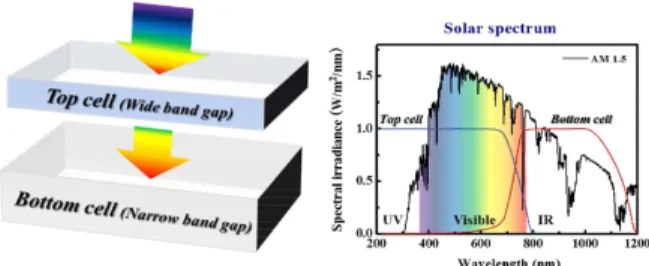
4). Fig. 1 shows approximate division of absorption spectra among the top and bottom sub-cells in a tandem solar cell. Low-cost multijunction solar cells have been studied based on thin film solar cells. Typical examples are amorphous and microcrystalline silicon solar cells
5-7)and Ⅲ-Ⅴ compound solar cells. Dye-sensitized solar
DOI:https://doi.org/10.21218/CPR.2018.6.2.031 eISSN 2508-125X
New Generation Multijunction Solar Cells for Achieving High Efficiencies
Sunhwa Lee
1)․ Jinjoo Park
1)․ Youngkuk Kim
1)․ Sangho Kim
2)․ S. M. Iftiquar
1)․ Junsin Yi
1,2)*
1)
School of Information and Communication Engineering, Sungkyunkwan University, Suwon 16419, Korea
2)
Department of Energy Science, Sungkyunkwan University, Suwon 16419, Korea
Received May 25, 2018; Revised June 7, 2018; Accepted June 7, 2018
ABSTRACT: Multijunction solar cells present a practical solution towards a better photovoltaic conversion for a wider spectral range.
In this review, we compare different types of multi-ijunction solar cell. First, we introduce thin film multijunction solar cell include to the thin film silicon, III-V material and chalcopyrite material. Until now the maximum reported power conversion efficiencies (PCE) of solar cells having different component sub-cells are 14.0% (thin film silicon), 46% (III-V material), 4.4% (chalcopyrite material) respectively.
We then discuss the development of multijunction solar cell in which c-Si is used as bottom sub-cell while III-V material, thin film silicon, chalcopyrite material or perovskite material is used as top sub-cells.
Key words: Tandem solar cells, Multijunction solar cells, Thin film solar cell, c-Si solar cell
*Corresponding author: [email protected]
ⓒ 2018 by Korea Photovoltaic Society
This is an Open Access article distributed under the terms of the Creative Commons Attribution Non-Commercial License (http://creativecommons.org/licenses/by-nc/3.0)
which permits unrestricted non-commercial use, distribution, and reproduction in any medium, provided the original work is properly cited.
31