서 언
산양삼은 두릅나무과(Araliaceae) 인삼속(Panax) 식물로서 영문명은 wild-simulated ginseng, 학명은 Panax ginseng C.A. Meyer로 표기한다. 산양삼은 [임업 및 산촌진흥 촉진에 관 한 법률]에 의거한 ‘특별관리임산물’로 관리되고 있으며, [산지 관리법] 제2조 1호에 의거 산지에서 차광막 등 인공시설을 설치 하지 않고 재배하는 삼으로 무농약, 무비료를 원칙으로 7년에서 20년 이상까지 장기적으로 재배한다(Kim et al., 2020a).
최근 코로나바이러스 감염증-19(COVID-19)가 세계적으로 유행하면서 국내에서도 면역증진에 관한 관심이 증가함에 따라 약리효능이 우수한 청정임산물인 산양삼과 고려인삼의 면역기
능성에 대한 관심 또한 높아지고 있다(Lee, 2020). 이전부터 고 려인삼은 심혈관계, 면역계, 신경계에 효능이 우수하고, 해독 작용, 항암작용, 항당뇨작용이 있다고 보고되고 있으며(Kang et al., 2008), 구성 성분인 사포닌, 페놀, 플라보노이드, 산성다 당체 등의 효과가 보고되고 있다(Jeong et al., 2019; Kim and Kim, 2005). 그리고 산양삼의 항암, 함염증, 항산화 등 다양한 기능적 특성에 관한 연구가 수행되고 있으며(Kim et al., 2011;
Lee et al., 2017, Park et al., 2018), 이와 같은 활성은 밭에서 재배하는 인삼에 비해 산양삼에서 높다고 보고되고 있다(Park et al., 2018; Xu et al., 2016). 특히 대식세포 활성화를 통한 산 양삼과 인삼의 면역강화 활성을 비교 분석한 연구에서 산양삼 이 인삼보다 면역조절물질 생산과 대식세포 활성화가 높다고 보고되었다(Um et al., 2020).
자연재배가 원칙인 산양삼에 발생되는 적변현상은 인삼처럼
적변에 따른 연근별 산양삼 생육특성과 진세노사이드 함량
김기윤1, 어현지1, 김현준2, 엄유리2, 정대희3, 허정훈3, 전권석4*
1
국립산림과학원 산림약용자원연구소, 박사연구원,
2임업연구사,
3석사연구원,
4임업연구관
The Growth Characteristics and Ginsenoside Contents of Wild-simulated Ginseng (Panax ginseng C.A. Meyer) with Different Years by Rusty Roots
Kiyoon Kim1, Hyun-Ji Eo1, Hyun-Jun Kim2, Yurry Um2, Dae-Hui Jeong3, Jeong-Hoon Huh3 and Kwon-Seok Jeon4*
1
Post-doc,
2Researcher,
3Master’s Degree Researcher and
4Senior Researcher,
Forest Medicinal Research Center, National Institute of Forest Science, Yeongju 36040, Korea
Abstract - The aim of this study was to investigate the growth characteristic and ginsenoside contents of 7 and 13 year-old wild-simulated ginseng (Panax ginseng C.A. Meyer) according to rusty root. The root growth characteristics of wild- simulated ginseng were did not shows significant difference according to the rusty root. The results of ginsenoside contents of wild-simulated ginseng according to rusty root, ginsenoside Rb1 and Rg1 of 7 year-old wild-simulated ginseng were had shows a significantly higher in rusty root compare to general root. On the other hand, ginsenodie Rc, Rd, Re and Rg2 were significantly higher in gerneral root. In the case of 13 year-old wild-simulated ginseng, the contents of ginsenoside did not shows to significant difference according to rusty root. The results of correlation analysis between growth characteristics and ginsenoside content of general root, the ginsenoside Rb2, Rc, Rd, Rf, Rg1 were positive correlation with root length, while as the ginsenoside Rd of rusty root was shows significantly negative correlation with root length. The results of this study was might be able to improve awareness of consumer related to rusty root of wild-simulated ginseng. Moreover, might be help to provide useful information on the establish quality standard and distribution system of wild-simulated ginseng.
Key words –
Ginsenoside contents, Growth characterisitics, Panax ginseng C.A. Meyer, Rusty root, Wild-simulated ginseng
*교신저자: E-mail [email protected] Tel. +82-54-630-5641
ⓒ 본 학회지의 저작권은 (사)한국자원식물학회지에 있으며, 이의 무단전재나 복제를 금합니다.
Original Research Article
표피가 붉은색, 황갈색, 적갈색으로 변색된 원형 또는 불규칙적 인 반점이 나타나고 점차 확대되는 현상을 말한다(Yang et al., 1997). 우리나라에서는 인삼의 적변현상을 ‘적변삼’ 또는 ‘황이 낀다’라고 표현하기도 하며, 영어로는 red-colored phenomena (RCP), rusty root 또는 red skin root으로 표기한다(Yoon and Yang, 2000). 인삼의 적변에 관한 최초의 기록은 1908년 전후에 개성지방의 인삼 뿌리에서 부분적으로 적갈색 반점형이 나타나 는 증상을 발견하였는데, 이를 적부병이라고 불렀고, 과습한 토 양이나 습윤한 기후에서 인삼을 재배하거나 Erwinia carotovora subsp. carotovora에 의한 병이라고 보고되었다(Lee et al., 2004, Park et al., 2006). 이러한 적변현상의 원인으로는 식물 병원균, 미생물 대사활성, 토양과습, 배수불량, 미부숙 유기질 비료 시비, 토양의 물리화학적 변화, 염류 피해 등이 보고되고 있으나 명확한 발병원인이나 기작이 구명되지 않아 효과적인 방제 또한 마련되어 있지 않은 실정이다(Lee et al., 1999; Yang et al., 1997). 발병기작이 불명확하므로 인삼의 적변현상을 병 해로 간주하여 이전부터 근부병, 적부병, 적병, 녹병, 적변삼, 썩음병, 무름병 등 인삼의 뿌리썩음병과 용어를 혼용하여 사용 하기도 하였다(Yoon and Yang, 2000).
인삼에 적변현상이 발생하면 뿌리의 비대성장이 저하되고, 고년근으로 갈수록 외피가 두꺼워지고 균열이 생기는 등 외관 적으로만 품질이 불량할 뿐 식용하여도 인체에는 해가 없는 것
으로 알려져 있다(Lee et al., 2000; 2004). 그러나 홍삼 제조 시 표피가 흑갈색이 되며 잔주름이 많아지는 등 상품성에 결정적 인 영향을 주어 인삼 재배농가에 손실을 주고 있는 실정이다 (Han et al., 2010). 실제로 적변 인삼의 가격은 일반 인삼에 비해 약 50% 이하로 판매한다고 보고되고 있다(Lee et al., 1999). 산 양삼의 경우도 산지에서 자연 친화적으로 재배하기 때문에 밭에 서 재배하는 인삼에 비해 적변 산양삼의 발생율은 적지만 10년 이상을 재배하여 수확한 후, 소비자들이 외관적으로 불량한 적 변 산양삼을 기피하면서 산양삼 재배농가도 심각한 피해를 보 고 있다.
따라서 본 연구는 산양삼의 판매량이 가장 많은 7년근과 판매 가격이 높은 13년근을 대상으로 실제 적변 여부에 따른 지하부 생육특성과 생리활성물질인 진세노사이드 함량을 비교·분석 하여 산양삼의 품질기준과 유통관리를 위한 기초자료로 활용하 고자 한다.
재료 및 방법
산양삼 시료 수집
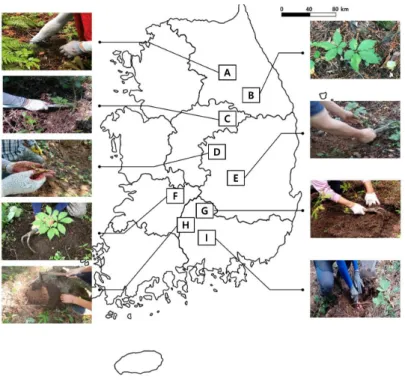
본 연구에서 사용한 공시시료는 2018년부터 2020년까지 전 국 산양삼에 재배지 9지역(A–I)에서 7년근과 13년근 산양삼을 각각 100본씩 채취하였다(Fig. 1). 채취한 산양삼 시료는 증류수
Fig. 1. Study area and sampling of wild-simulated ginseng. A to I are a wild-simulated ginseng cultivation sites of South Korea.
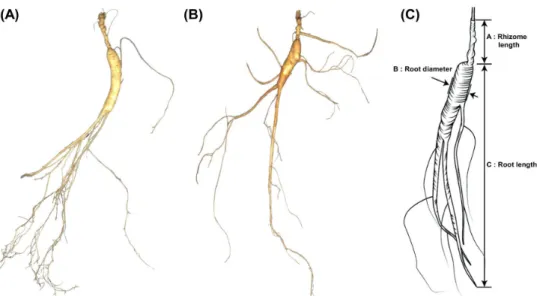
로 지하부 표면을 세척한 후 실온에서 자연건조하여 수분을 제거 하였다. 산양삼 시료의 형태학적 특성을 관찰하기 위해 산양삼 지하부 표면의 적변 여부에 따라 Fig. 2와 같이 일반(General root) 산양삼과 적변(Rusty root) 산양삼으로 분류하고, 동결건 조기(FD8518, Ilshin, Korea)에서 건조시킨 후 분쇄기로 분쇄 한 다음 80 mesh standard sieve를 통과한 분말을 –70℃에서 보 관하였다.
생육특성 조사
분류한 일반 산양삼과 적변 산양삼의 생육특성은 국립종자 원의 인삼 작물별 특성조사요령에 따라 지하부의 뇌두길이 (Rhizome length), 뿌리길이(Root length), 주근직경(Root dia- meter), 중량(Weight)을 조사하였다(Kim et al., 2019; KSVS, 2014).
분석시료 추출 및 시약
적변여부에 따른 산양삼의 진세노사이드 함량을 분석하기 위해 분쇄한 시료 0.2 g에 80% MeOH 10 mL를 가하고, 1시간 동안 초음파추출(JAC-5020, KODO, Korea), 다시 1시간 동안 상온교반추출(HG-15D, Daihan, Korea)을 실시하였다. 추출 액은 10분간 원심분리한 후 상층액을 0.2 ㎛ membrane filter (Whatma Syringe Filter, UK)로 여과하였다. 분석에 사용한 진 세노사이드 표준품(Ginsenoside standard)는 총 11종(G-Rb1, Rb2, Rc, Rd, Re, Rf, Rg1, Rg2, Rg3, Rh1, Rh2)의 구조식은
Fig. 3에 나타냈다. 추출 및 HPLC 분석에서 사용한 MeOH, Ace- tonitrile, Distilled water는 특급 및 HPLC 등급으로 J.T.Baker (USA) 제품을 사용하였다(Kim et al., 2020a).
진세노사이드 함량 분석
산양삼 시료의 진세노사이드 11종에 대한 분석은 Ultimate 3000 HPLC (Thermo Dionex, USA)를 사용하여 분석하였다 (Fig. 4). Column은 Inno C-18 column (4.6 × 250 ㎜, 5 ㎛, YoungjinBiochrom, Korea) 사용하였고, oven 온도는 50℃를 유지하였으며, 이동상으로 solvent A는 water, solvent B는 acetonitrile을 선정하였다. 시간에 따른 용매의 조건은 0-1 min, 5% B; 1-45 min, 70% B; 45-55 min, 95% B; 55-60 min, 5% B로 설정하여 기울기 용리법으로 분석하였고, 모든 시료에 대한 분석은 60분간 실시하였다. 유속은 1.0 mL/min, 주입량은 10 μL였으며, PDA 검출기는 UV 210 ㎚에서 측정하였다. 진세 노사이드 표준품 11종은 각 농도(10, 25, 50, 100 ㎍/mL)별로 분 석한 후, calibration curve를 작성하여 각 시료에 대한 성분 함 량을 정량하였다(Kim et al., 2020b).
통계분석
적변 여부에 따른 산양삼의 생육특성 및 진세노사이드 함량 데 이터 값은 평균 ± 표준오차(means ± standard error, S.E.) 값 으로 나타냈고, 실험값의 통계분석은 SAS (Statistical Analysis System ver. 7.1) software를 이용하여 일원배치분산분석(one- Fig. 2. Morphology characteristics of wild-simulated ginseng. (A) General root, (B) Rusty root, (C) Morphological characteristics measured in the study.
way ANOVA)과 t-test 검정을 통해 유의수준 5% (p<0.05)으로 검증하였다.
결과 및 고찰
산양삼 생육특성
적변에 따른 산양삼의 생육특성을 조사하기 위해 7년근과 13 년근 산양삼 지하부의 적변 여부를 확인한 결과, 7년근 산양삼 100본 중 25본의 산양삼 지하부에서 적변현상을 확인하였고, 13 년근 산양삼은 100본 중 31본에서 적변현상이 나타났다(Table 1). 인삼의 적변 발생율은 50% 이상으로 산양삼에 비해 높고, 연
근이 오래될수록 적변의 정도가 심해진다고 보고되고 있다(Lee et al., 1999). Lee et al. (2005)의 연구에서 인삼을 이식할 경우, 동체부위가 표토층에 가까워 표토에 집적된 염류 피해로 인해 적변이 발생하기 쉽고, 직파재배는 동체부위가 표토층 아래에 있어 상대적으로 염류의 피해를 적게 받아 적변 발생율이 적다 고 보고하였다. 산양삼은 주로 산지에 종자를 직파하여 재배하 기 때문에 묘삼을 이식하여 재배하는 인삼에 비해 적변의 발생 율이 적은 것으로 판단된다. 또한 Lee et al. (2008)는 인삼 품종 별로 적변 발생율을 비교한 결과, 자경종과 천풍에 비해 황숙종 과 연풍이 인삼 뿌리의 적변 발생율이 높아 인삼의 품종 간에도 적변 발생율의 차이가 있다고 보고하였다.
Fig. 3. Chemical structures of portopanaxadiol (PPT) and protopanaxatriol (PPT)-type ginsenoside (Glc: β-D-glucopyranosyl, Arp:
α-L-arabinopyranosyl, Araf: α-L-arabinofuranosyl, Rha: α-L-rhamnopyranosyl).
Fig. 4. HPLC chromatograms of 11 ginseosides.
적변 여부에 따른 산양삼 지하부의 생육특성을 비교 분석하 기 위해, 적변이 확인되지 않은 7년근과 13년근 산양삼 중에서 임의로 각각 25본, 31본을 선정하여 생육특성을 조사하였다. 그 결과, 7년근 산양삼은 뇌두길이 13.8 ~ 15.8 ㎜, 지하부 길이 18.9 ~ 20.1 ㎝, 주근직경 10.0 ~ 11.5 ㎜, 중량 3.24 ~ 3.89 g으 로 확인되었고, 13년근 산양삼은 뇌두길이 28.5 ~ 30.6 ㎜, 뿌리 길이 21.0 ~ 24.4 ㎝, 주근직경 11.4 ~ 12.1 ㎜, 중량 4.02 ~ 4.98 g으로 확인되었다(Table 2). 적변에 따른 산양삼의 생육특성을 비교한 결과, 7년근 산양삼은 지하부 길이, 주근직경, 중량이 적 변 산양삼에 비해 일반 산양삼이 높게 나타났으나 13년근 산양 삼은 적변 산양삼의 지하부 길이, 주근직경, 중량이 일반 산양 삼에 비해 높은 것을 확인하였다. Lee et al. (2004)는 인삼에 적 변이 발생하면 뿌리의 비대성장이 저해된다고 보고하였는데, 본 연구의 결과에서는 적변에 따른 지하부의 생육에 대한 유의 적인 차이는 확인되지 않았고, 13년근의 경우는 적변 산양삼의 지하부 생육이 일반 산양삼에 비해 높게 나타나 향후 적변과 연 근별 산양삼 생육특성에 관한 연구가 지속적으로 수행되어야 한다고 판단된다.
산양삼 진세노사이드 함량
연근별 산양삼 진세노사이드 11종의 함량을 분석한 결과, 7 년근 산양삼의 Rb1은 3.36 ~ 3.78 ㎎/g, Rb2는 2.84 ~ 3.76 ㎎ /g, Rc는 1.64 ~ 2.02 ㎎/g, Rd는 1.04 ~ 1.53 ㎎/g, Re는 3.84
~ 4.63 ㎎/g, Rf는 1.18 ~ 1.19 ㎎/g, Rg1은 3.35 ~ 3.15 ㎎/g, Rg2는 0.37 ~ 0.50 ㎎/g, Rg3는 0.01 ~ 0.01 ㎎/g, Rh1은 0.02
~ 0.03 ㎎/g으로 확인되었고, 13년근의 Rb1은 4.41 ~ 5.61 ㎎ /g, Rb2는 3.97 ~ 4.50 ㎎/g, Rc는 2.11 ~ 2.48 ㎎/g, Rd는 1.13
~ 1.16 ㎎/g, Re는 4.99 ~ 5.32 ㎎/g, Rf는 1.43 ~ 1.53 ㎎/g, Rg1은 4.16 ~ 4.18 ㎎/g, Rg2는 0.43 ~ 0.45 ㎎/g, Rg3는 0.01
~ 0.01 ㎎/g, Rh1은 0.02 ~ 0.04 ㎎/g으로 확인되었다(Table 3). 총 11종의 진세노사이드 함량 중에서 Rb1, Rb2, Rc, Re, Rg1 의 함량이 특히 높은 수치를 보였으며, Rh2는 검출되지 않았다.
Jeong et al. (2019)과 Kim et al. (2020a)의 연구에서도 연근별 산양삼 지하부의 진세노사이드 함량을 분석한 결과, Rh2가 검 출되지 않아 본 연구의 결과가 선행연구와 유사한 경향을 보이 는 것을 확인하였다.
적변에 따른 산양삼의 진세노사이드 함량을 비교한 결과, 7 년근 산양삼은 Rb1과 Rg1은 진세노사이드 함량이 일반 산양삼 에 비해 적변 산양삼에서 높았고, 진세노사이드 Rb2, Rc, Rd, Re, Rf, Rg2, Rh1은 일반 산양삼에서 높았으며, 이 중에서 Rc, Rd, Re, Rg2는 유의적으로 높은 것을 확인하였다. 적변에 따른 13년근 산양삼의 진세노사이드 함량을 분석한 결과, Rg2와 Rh1 를 제외한 진세노사이드 함량이 적변 산양삼에 비해 일반 산양 삼에서 높았으나, 적변에 따른 유의적인 차이는 확인할 수 없었 다. Lee et al. (2008)의 연구에서는 배수등급에 따라 인삼의 적 변 발생율과 진세노사이드 함량을 조사하였는데, 배수등급 보 Table 1. Ratio of rusty root of wild-simulated ginseng samples
Samples age Number of samples Rusty root Ratio of rusty root
7 year-old 100 25 25%
13 year-old 100 31 31%
Table 2. Growth characteristics of wild-simulated ginseng according to rusty root
Samples age Samples
Growth characteristics
Rhizome length Root length Root diameter Root weight
(㎜) (㎝) (㎜) (g)
7 year-old GRz 13.8 ± 1.37 ax 20.1 ± 1.08 a 11.5 ± 0.68 a 3.89 ± 0.59 a RRy 15.8 ± 0.91 a 18.9 ± 0.75 a 10.0 ± 0.40 a 3.24 ± 0.24 a 13 year-old GR 30.6 ± 2.42 a 21.0 ± 1.37 a 11.4 ± 0.53 a 4.02 ± 0.43 a RR 28.5 ± 1.55 a 24.4 ± 1.40 a 12.1 ± 0.64 a 4.98 ± 0.32 a
zGR (General root), yRR (Rusty root).
xValue in each column with different letters are statistically significant differences (p≤0.05) among the treatments according to least significant difference (LSD).
다 품종별로 인삼의 적변 발생율의 차이를 확인하였고, 적변 발 생율이 낮았던 천풍과 자경종에 비해 적변 발생율이 높았던 연 풍에서 진세노사이드 함량이 유의적으로 높다고 보고하였다.
Lee et al. (2009)과 Lee et al. (2013)의 연구에서도 인삼 3년근 과 6년근에서 적변의 발생율과 진세노사이드 함량 간의 유의적 인 차이는 확인할 수 없어 본 연구의 결과를 뒷받침한다.
Table 3. Comparison of ginsenoside content of wild-simulated ginseng according to rusty root
Samples
age Samples
Contents of ginsenoside (㎎/g)
PPDz PPT
Rb1 Rb2 Rc Rd Rg3 Rh2 Re Rf Rg1 Rg2 Rh1
7
GR
y3.36 ±
0.40 a
w3.76 ±
0.34 a 2.02 ±
0.09 a 1.53 ±
0.12 a 0.01 ±
0.00 a ND
v4.63 ±
0.17 a 1.19 ±
0.06 a 3.15 ±
0.20 a 0.50 ±
0.03 a 0.03 ± 0.01 a RR
x3.78 ±
0.50 a 2.84 ±
0.36 a 1.64 ±
0.12 b 1.04 ±
0.12 b 0.01 ±
0.00 a ND 3.84 ±
0.25 b 1.18 ±
0.07 a 3.35 ±
0.29 a 0.37 ±
0.03 b 0.02 ± 0.00 a
13
GR 5.61 ±
0.54 a 4.50 ±
0.62 a 2.48 ±
0.19 a 1.13 ±
0.11 a 0.01 ±
0.00 a ND 5.32 ±
0.41 a 1.53 ±
0.08 a 4.18 ±
0.22 a 0.45 ±
0.04 a 0.02 ± 0.01 a
RR 4.41 ±
0.50 a 3.97 ±
0.45 a 2.11 ±
0.14 a 1.16 ±
0.08 a 0.01 ±
0.00 a ND 4.99 ±
0.29 a 1.43 ±
0.08 a 4.16 ±
0.29 a 0.43 ±
0.04 a 0.04 ± 0.02 a
z
Ginsenoside types: PPD: protopanaxadiol-type ginsenoside, PPT: protopanaxatiol-type ginsenoside.
y
GR (General root),
xRR (Rusty root).
w
Value in each column with different letters are statistically significant differences (p≤0.05) among the treatments according to least significant difference (LSD).
v
ND: not detected
Table 4. Pearson’s correlation coefficient between ginsenoside content and growth characteristics of wild-simulated ginseng
Samples Growth characteristics
Contents of ginsenoside (㎎/g)
PPD
zPPT
Rb1 Rb2 Rc Rd Rg3 Re Rf Rg1 Rg2 Rh1
GR
yRhizome
length 0.246
(0.067) -0.009
(0.947) 0.236
(0.079) -0.231
(0.087) -0.106
(0.435) 0.029
(0.832) 0.156
(0.250) 0.278
*(0.038) -0.221
(0.102) -0.054 (0.691) Root length 0.105
(0.440) 0.316
*(0.018) 0.422
**(0.001) 0.292
*(0.029) -0.095
(0.486) 0.202
(0.136) 0.397
**(0.002) 0.344
**(0.009) 0.221
(0.102) -0.087 (0.522) Root diameter 0.098
(0.474) 0.097
(0.475) 0.073
(0.591) -0.212
(0.116) -0.223
(0.099) 0.194
(0.152) 0.143
(0.293) 0.117
(0.392) 0.207
(0.127) -0.024 (0.862) Root weight 0.065
(0.633) 0.073
(0.591) 0.079
(0.563) 0.006
(0.966) -0.034
(0.801) 0.223
(0.099) 0.231
(0.087) 0.089
(0.513) 0.273
*(0.042) 0.019 (0.887)
RR
xRhizome
length -0.043
(0.753) 0.172
(0.205) 0.044
(0.750 -0.028
(0.835) -0.034
(0.801) 0.010
(0.940) 0.023
(0.866) 0.069
(0.615) -0.164
(0.226) -0.024 (0.860) Root length -0.148
(0.278) 0.244
(0.069) 0.127
(0.351) 0.274
*(0.041) -0.145
(0.286) 0.178
(0.188) 0.100
(0.461) 0.073
(0.594) 0.062
(0.648) 0.023 (0.866) Root diameter -0.053 (0.699) 0.091
(0.504) -0.125
(0.359) -0.409
**(0.002) -0.244
(0.070) 0.143
(0.295) -0.024
(0.858) 0.019
(0.890) -0.048
(0.725) -0.009 (0.947) Root weight -0.055
(0.686) 0.073
(0.594) -0.049
(0.721) -0.154
(0.256) -0.183
(0.177) 0.238
(0.077) 0.064
(0.638) 0.063
(0.643) 0.025
(0.856) -0.010 (0.944)
z
Ginsenoside types: PPD: protopanaxadiol-type ginsenoside, PPT: protopanaxatiol-type ginsenoside.
y
GR (General root),
xRR (Rusty root).
w
Correlation coefficient (R) written are significantly correlated between the variables compared. Negative values denote negative
correlation and positive values denote positive correlation. Values in brackets means p value (
**p≤0.01,
*p≤0.05).
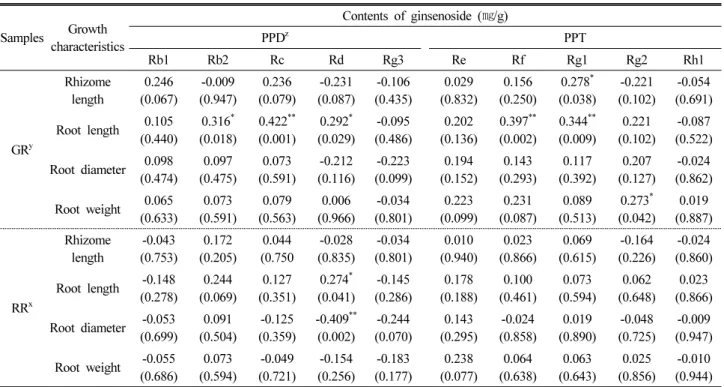
산양삼 생육특성과 진세노사이드 함량 간의 상관관계 Pearson’s 상관분석을 이용하여 일반 산양삼과 적변 산양삼 의 생육특성과 진세노사이드 함량 간의 상관관계를 분석한 결 과, 일반 산양삼의 경우 진세노사이드 Rb2(r = 0.316, p≤0.05), Rc(r = 0.422, p≤0.01), Rd(r = 0.292, p≤0.05), Rf(r = 0.397, p≤0.01), Rg1(r = 0.344, p≤0.01)은 지하부 길이와 유의적인 정의 상관관계를 보였고, 뇌두길이는 Rg1(r = 0.278, p≤0.05), 지하부 중량은 Rg2(r = 0.273, p≤0.05)와 유의적인 정의 상관 관계를 보였다(Table 4). Kim et al. (2020a)의 연구에서도 산양 삼의 지하부 길이는 진세노사이드 Rd, Rf의 함량과 유의적인 정 의 상관관계를 보였고, Kim et al. (2020b)의 연구에서도 지하 부 길이는 진세노사이드 Rb1, Rb2, Rc, Rd, Rf, Rg1과 유의적인 정의 상관관계를 보인다고 보고하였다. 적변삼의 생육특성과 진세노사이드 함량 간의 상관관계를 분석한 결과, 지하부 길이 가 진세노사이드 Rd(r = 0.274, p≤0.05)와 유의적인 상관관계 를 보였으나, 주근직경은 Rd(r = 0.409, p≤0.01)와 유의적인 부의 상관관계를 보이는 것으로 확인되었다. Li et al. (2009)의 연구에서 이식 재배한 인삼 6년근의 주근직경과 진세노사이드 함량은 높은 부의 상관관계를 보인다고 보고하였고, Kim et al.
(2020a)의 연구에서도 산양삼의 주근직경과 진세노사이드 Rd 함량은 부의 상관관계를 보이는 것으로 나타났다. 이와 같은 선 행연구는 본 연구의 산양삼의 생육특성과 진세노사이드 함량 간의 상관관계 결과를 뒷받침하고, 적변 산양삼 또한 일반 산양 삼의 선행연구와 유사한 결과를 보여 생육특성과 진세노사이드 함량은 적변의 유무와 관련이 없는 것으로 판단된다.
적 요
본 연구는 산양삼 7년근과 13년근을 대상으로 적변 유무에 따 라 분류하고 적변에 따른 이들의 생육특성과 진세노사이드 함 량을 조사하기 위해 수행되었다. 산양삼 재배지 9개소의 산양삼 지하부의 생육특성을 분석한 결과, 7년근과 13년근의 생육특성 은 적변에 따른 유의적인 차이는 확인되지 않았다. 적변에 따른 연근별 산양삼의 진세노사이드 함량을 비교 분석한 결과, 7년근 은 Rb1과 Rg1의 함량이 일반 산양삼에 비해 적변 산양삼에서 높 았고, Rc, Rd, Re, Rg2는 적변 산양삼에 비해 일반 산양삼에서 유의적으로 높은 것을 확인하였으나 13년근의 진세노사이드 함 량은 유의적인 차이를 확인할 수 없었다. 산양삼 생육특성과 진 세노사이드 함량 간의 상관관계를 분석한 결과, 일반 산양삼의 경우 진세노사이드 Rb2, Rc, Rd, Rf, Rg1이 산양삼의 지하부 길
이와 유의적인 정의 상관관계를 보였고, 적변 산양삼은 진세노 사이드 Rd가 지하부 길이와는 유의적인 정의 상관관계, 주근직 경과는 유의적인 부의 상관관계를 보였다. 본 연구에서는 7년근 과 13년근 모두 적변 여부에 따른 생육특성의 차이는 확인되지 않았고, 7년근의 진세노사이드 함량은 적변에 따라 유의적인 차 이를 보였지만 13년근은 유의적인 차이가 없는 것을 확인하였 다. 임가에서 산양삼은 7년근에 비해 13년근이 보다 고가에 거 래되는 만큼 본 연구의 결과를 통해 적변 산양삼에 대한 소비자 들의 인식을 개선하여 산양삼 재배농가의 소득증대에 도움을 주고, 향후 산양삼의 품질규격을 정립하고 유통체계를 수립함 에 유용한 정보를 제공할 수 있을 것으로 사료된다.
사 사
본 연구는 국립산림과학원 일반연구사업 “고품질 산양삼 생산 을 위한 친환경 재배기술 개발(Project No. FP0802-2017-01)”
의 지원에 의해 수행된 결과로서 이에 감사드립니다.
Conflicts of Interest
The authors declare that they have no conflict of interest.
References