서 언
산양삼은 [산지관리법] 제2조 제1호에 의거 산지에서 재배하 고, 이 법 제18조의 4에 따른 품질검사에 합격한 오갈피나무과 (科) 인삼속 식물로 차광막 등 인공시설을 설치하지 아니하고 생 산되며, [임업 및 산촌진흥 촉진에 의한 법률]에 의하여 관리되 는 ‘특별관리 임산물’을 말한다(Kim et al., 2018a). 산양삼의 학명은 Panax ginseng C.A. Mayer이고, 영명은 Wild-simulated ginseng으로 표기한다(Jeon et al., 2018). 삼(Cultivated ginseng) 은 농지에서 인위적인 토양개량과 시설물을 이용해 재배한 인
삼과 산지에 파종 또는 이식하여 인위적인 시설 없이 재배하는 산양삼으로 분류하였다(Kim et al., 2018b). [산양삼 표준재배 지침]에서는 산지에서 파종하거나 산지에서 양묘한 종묘를 이 식하여 농약을 사용하지 않고, 최대한 자연에 가깝게 재배하는 삼을 산양삼이라고 정의하고 있다. 농림식품부에서 조사한 통 계자료에 따르면 국내 전체 약용작물의 생산량이 2016년 기준 7만 8천여 ton이고, 전체 농업에서 2%로 낮은 비율을 차지한다 고 보고되고 있다(Park et al., 2019). 최근 국민소득이 향상되 고 약용작물에 대한 관심이 증가함에 따라 산양삼에 대한 소비 자의 관심 및 수요는 증가하고, 산양삼의 생산량 및 신고면적 또 한 증가하고 있는 추세이다. 산림청의 [산양삼 산업육성 대책]
보고에 따르면 산양삼의 생산량은 2013년 26 ton에서 2017년
직파 및 이식재배 유형에 따른 산양삼의 생육특성 연구
김기윤
1
, 정대희2
, 김현준3
, 전권석4
, 김만조4
, 엄유리3
*1
국립산림과학원 산림약용자원연구소, 박사연구원,
2국립산림과학원 산림약용자원연구소, 석사연구원,
3
국립산림과학원 산림약용자원연구소, 임업연구사,
4국립산림과학원 산림약용자원연구소, 임업연구관
A Study on Growth Characteristics of Wild-simulated Ginseng (Panax ginseng C.A. Meyer) by Direct Seeding and Transplanting
Kiyoon Kim
1
, Daehui Jeong2
, Hyun-Jun Kim3
, Kwonseok Jeon4
, Mahnjo Kim4
and Yurry Um3
*1
Ph.D. Researcher,
2Master’s Degree Researcher,
3Researcher and
4Senior Researcher,
Forest Medicinal Resources Research Center, National Institute of Forest Science, Yeongju 36040, Korea
Abstract - The this study was carried out to investigate the growth characteristics of wild-simulated ginseng by direct seeding and transplanting cultivation for develop standard cultivation techniques of wild-simulated ginseng. Bonghwa experimental field were confirm to be suitable location environment for cultivation of wild-simulated ginseng. As a result of this study, the germination rate of wild-simulated ginseng was significantly highest when seed size was over 6.5 ㎜ in the spot seeding cultivation. In the case of transplanting, survival rate was significantly increased when the diameter of root was over 10 ㎜, planting distance was 7 ㎝, and the thickness of soil covering was less then 2 ㎝. The result of growth characteristics of wild-simulated ginseng by cultivation type, growth of stem in spot seeding cultivation was showed significantly increased when seed size over 6 ㎜, seeding number was 3 grains, and the seeding distance was less then 5 ㎝.
Strip seeding cultivation was showed significantly increased in stem and root growth when seeding distance was 30 ㎝ grains and quantity of seeding was less then 23 g. In the case of transplanting cultivation, it’s was showed significantly increased in stem growth when diameter of root was over then 10 ㎜ and direction of rhizome was top and bottom. The results of this study was that to clearly establish the techniques of cultivation of managements and it’s will be suggest contribute to the industrial activation of wild-simulated ginseng.
Key words –
Cultivation type, Direct seeding cultivation, Growth characteristics, Panax ginseng C.A. Meyer, Transplanting cultivation, Wild-simulated ginseng
*교신저자: E-mail [email protected] Tel. +82-54-630-5648
ⓒ 본 학회지의 저작권은 (사)한국자원식물학회지에 있으며, 이의 무단전재나 복제를 금합니다.
Original Research Article
121 ton으로 증가하였으며, 산양삼 신고면적 또한 2013년 8,477 ha에서 2017년 10,104 ha로 증가하였다(KFS, 2019). 더욱이 웰 빙문화와 친환경 임산물에 대한 관심이 증가하면서 임간에서 재배한 무농약 임산물인 산양삼의 수요는 더욱 증가할 것으로 예상하고 있다(NIFoS, 2019). 그러나 현재 산양삼 임간재배는 거의 대부분 재배자의 경험에만 의존하고 있는 실정이며(Lee, 2010), 함양군청에서 실시한 산양삼 재배자 설문조사를 통해 산 양삼 재배상의 애로사항 및 희망사항을 조사한 결과, 동물피해, 도난, 노동력 부족, 판로부족과 더불어 재배기술 부족 등으로 산양삼 재배에 어려움이 많은 것으로 나타났다(Choi et al., 2016). 인삼의 경우는 [인삼 표준재배지침]에 따라 직파 및 이식 재배에 따른 재배방법 및 생육특성에 대한 연구가 이전부터 지속 적으로 수행되어 왔다(Lee et al., 2005; Li et al., 2010). 이에 산양삼도 대량생산과 재배 및 관리를 통해 고품질의 산양삼을 생산하는 기술에 대한 연구를 수행하고 있으나 아직까지 산양 삼 재배방법에 대한 연구 보고는 미흡한 실정이다. 따라서 본 연 구에서는 직파 및 이식과 같은 재배유형별 산양삼의 생육특성 을 구명하여 산양삼 표준재배기술 개발에 기여하고자 하였다.
재료 및 방법
입지환경 및 토양 이화학성 조사
본 연구가 수행된 시험포지는 국립산림과학원 산림약용자원 연구소에서 관리·운영하고 있는 경북 봉화군에 위치한 연구시 험림에 0.1 ha를 조성하였다. 시험포지의 입지환경을 조사하기
위해 20 m × 20 m 구획을 선정하여 GPS 좌표, 임상, 지형을 조 사하였다. 토양의 이화학적 특성 분석은 시험포지 조성 후 처리 구 내 토양의 표토를 제거하고 토양시료 100 g을 채취하여 농촌 진흥청 토양 표준분석법에 따라 분석하였다(NAAS, 2000).
실험재료 수집 및 재배유형별 처리구 선정
본 연구에 사용된 공시재료는 산양삼 종자와 종근을 사용하 였다. 종자는 충남 금산의 인삼재배 농가에서 채집한 재래종 종 자를 사용하였고, 종근은 함양군청에서 운영하는 산양삼 종자 공급단지로부터 채굴한 2년생 종근을 사용하였다. 산양삼 재배 유형별 처리구 선정을 위해 종자의 직파는 점파와 조파로 구분 하여 점파는 종자크기(종자 직경 6.5 ㎜ 이상은 대, 5.5~6.5 ㎜ 는 중, 5.5 ㎜ 이하는 소), 파종립수(1립, 2립, 3립), 파종간격(5
㎝, 10 ㎝, 20 ㎝), 조파는 조파간격(30 ㎝, 40 ㎝, 50 ㎝)과 파종 량(18 g, 23 g, 30 g)의 처리구를 선정하였다. 종근의 이식 처리 구는 종근크기(주근직경 10 ㎜ 이상은 대, 7~8 ㎜는 중, 6 ㎜ 이 하는 소), 재식거리(5 ㎝, 7 ㎝, 10 ㎝), 뇌두방향(상, 측, 하), 복 토두께(1 ㎝, 2 ㎝, 3 ㎝)로 구분하여 선정하였다. 모든 시험 처 리구는 3반복으로 수행하였다.
산양삼 종자 파종 및 종근 이식
재배유형별 산양삼의 생육특성을 조사하기 위해, 2018년 4 월 봉화연구시험림에 [산양삼 표준재배지침]의 재배관리법(Jeon et al., 2018)을 참고하여 처리구에 따라 종자 파종 및 종근을 식 재하였다(Fig. 1).
Fig. 1. Direct seeding and transplanting of Wild-simulated ginseng. A: Bonghwa experimental field; B, C: Direct seeding cultivation;
D, E: Transplanting cultivation.
재배유형별 산양삼 생육특성 조사
파종 및 이식 후 50일이 경과하였을 때, 종자 발아율 및 종근 활착율을 조사하였다. 산양삼의 생육특성 조사는 국립종자원 의 뺷인삼뺸 작물별 특성조사요령을 준수하였고(KSVS, 2014), 산양삼 종자 및 종근을 이식한지 120일 이후 과제의 연속성을 고려하여 점파는 지상부(삼대길이, 삼대직경, 소엽길이, 소엽 넓이)의 생육조사를 실시하였다. 조파의 경우는 지상부와 지하 부(전체길이, 주근길이, 주근직경)를 채취한 후 생육조사를 실 시하였다(Fig. 2). 이식재배는 삼대길이, 삼대직경, 소엽길이, 소엽넓이, 구(잎자루)길이를 조사하여 분석하였다.
통계처리
분석된 데이터 값은 평균 ± 표준오차(means ± standard error, S.E.) 값으로 나타냈고, 실험값의 통계처리 및 유의성 검 정은 SAS (Statistical Analysis System, ver. 7.1) Software를 이용하여 분산분석(ANOVA)과 Duncan’s Multiple Range Test (DMRT)로 유의성을 검증하였으며 각 처리구간의 최소유의차 는 P < 0.05 수준에서 통계처리 하였다.
결과 및 고찰
시험포지의 입지환경 및 토양 이화학성
입지환경을 조사한 결과를 Table 1에서 보면, 조성된 시험포
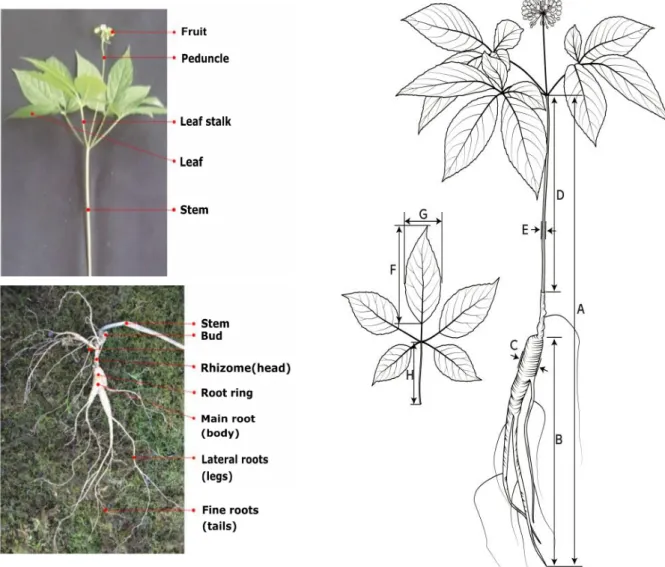
Fig. 2. The structure of Wild-simulated ginseng and investigate of growth characteristics. (A) Length of total plant; (B) Length of Root; (C): Diameter of Root; (D): Length of stem; (E): Diameter of stem; (H): Length of petiole; (F): Length of leaf; (G): Width of leaf (Jeon et al., 2018).
지는 침엽수림의 사면에 위치하였고, 사면방향은 북향, 평균경 사는 11°였으며, 해발고도는 302 m였다(Table 1). 시험포지의 임상조사 결과를 통해 우점수종 특성을 조사한 결과, 침엽수인 낙엽송이 100%로 우점 하였고, 평균 흉고직경은 25.8 ㎝, 평균 수고는 20.2 m였다. 자료에 따르면 산양삼 재배는 일조조건에 따라 북향, 북동향, 북서향, 동향이 좋고, 사면의 평균경사는 15~30°가 적당하며, 상층목의 흉고직경은 15 ㎜ 이상, 수고는 10 m 이상이 산양삼의 생육에 적합하다고 알려져 있다(Jeon et al., 2018). 이와 관련된 선행연구로는 Lim et al. (2003)이 인삼 의 임간재배에 있어 직파재배 시 인삼 종자의 생존율이 활엽수 림에 비해 침엽수림과 일반재배지에서 2배 더 생존한다고 보고 하였다. 출아율에서도 이식재배 시 침엽수림에서 활엽수림 보 다 높다고 보고되었다(농림부, 1998). Kwon et al. (2011)의 보 고에 의하면 침엽수림 산양삼 재배지의 경우 낙엽이 떨어지는 낙엽송 조림지가 대부분인데, 이는 산양삼의 생육기간 중 수광 량(Light requirement)이 풍부한 지역이 산양삼을 재배하기에 적합하다는 것을 알 수 있다. 시험포지 내 토양의 이화학적 특성 은 Table 2에 나타냈다. 그 결과 토성은 사질양토이고, pH는 5.2 로 약산성토양이며, 유기물 2.02%, 전질소 함량 0.11%, 유효인 산의 함량은 256.7 ㎎/㎏로 나타났다. 산양삼 표준재배지침에 는 양토, 미사질 양토 및 사질양토가 재배적지 기준이라고 제시 되어 있으며(Jeon et al., 2018), 인삼의 경우 재배적지의 토성 은 배수와 공기유통이 잘되는 사질양토 및 양질사토가 유리하 다고 하였고(Lee et al., 2010; Seo et al., 2010), 토양 이화학
성은 pH는 5.0~6.0, 유기물 10~20 g/㎏, 유효인산은 100~250
㎎/㎏으로 보고되었다(Chung and Choi, 2003; RDA, 2009).
이와 같은 결과를 통해 봉화 연구시험림 내 시험포지는 입지환 경 및 토양 이화학성이 산양삼의 재배에 적합할 것으로 판단하 였다.
직파재배 유형에 따른 발아율 및 생육특성
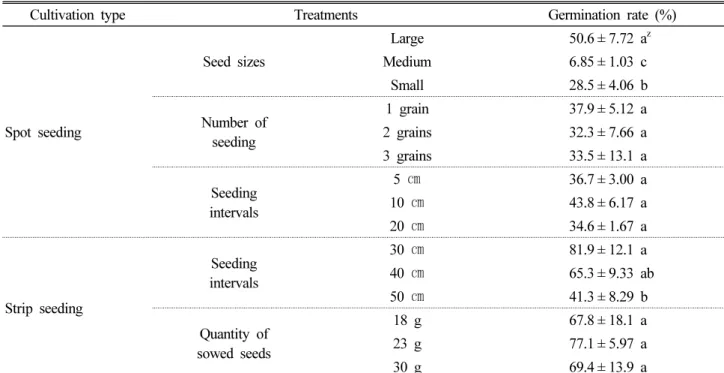
직파유형별 산양삼 종자의 발아율을 Table 3에서 보면, 점파 시 종자크기에서는 종자의 크기가 큰 처리구에서 발아율이 50.6% (P < 0.003)로 가장 높았으며, 대, 소, 중 순으로 유의적인 차이를 확인하였다. 파종량 처리구에서는 종자를 1립 파종한 처 리구에서 발아율이 37.9%로 가장 높았고, 파종간격에서는 간격 이 10 ㎝인 처리구에서 43.8%의 가장 높은 발아율을 보였으나, 파종량과 파종간격 간의 유의적인 차이는 확인할 수 없었다. 산 양삼 종자의 조파 시 파종간격 처리구에서는 줄 간격이 30 ㎝인 처리구에서 81.9%로 발아율이 가장 높았고, 파종량은 종자를 23 g 파종한 처리구에서 발아율이 높았으나 파종간격과 파종량 간의 유의적인 차이는 확인되지 않았다. Kim et al. (1981)의 보 고에 의하면 인삼의 경우, 인삼종자의 크기와 개갑 비율 조사에 서 종자의 크기가 클수록 발아율 및 발아세가 높았고, 묘삼의 생육도 양호하다고 하였다. 또한 Jung (2004)의 연구에서도 본 연구결과와 유사하게 고려인삼과 교잡인삼의 형질특성과 배 (Embryo) 생장을 조사한 결과, 종자의 크기가 클수록 인삼 종자 의 배 생장율이 양호하다고 보고한 바 있다. 이러한 결과로 미루
Table 1. Location environment of Bonghwa experimental forest
GPS coordinates
Topography Forest physiognomy
Slope ASLz Species of three
DBHy THx Percentage
° Aspect m ㎝ m %
N 36° 51’ 14.77”
E 128° 55’ 37.24” 11 North 302 Conifer
(Larch) 25.8 20.2 100
zASL: Above sea level, yDBH: Diameter at breast height, xTH: Tree height.
Table 2. Soil chemical characteristics of Bonghwa experimental forest
Soil type pH ECz OMy Avai. Px TNw Exchangeable cations
CECv
K Ca Mg Na
(1:5) dS/m % ㎎/㎏ % --- cmol+/㎏ ---
Sandy loam 5.22 0.06 2.02 256.7 0.11 0.46 1.60 0.53 0.11 8.32
zEC: Electric conductivity, yOM: Organic matter, xAvai. P: Available phosphate, wTN: Total nitrogen, vCEC: Cation exchange capacity.
어 볼 때, 산양삼 종자를 직파재배 할 경우에는 종자의 크기를 우선 고려하여 파종하는 것이 발아율 증가시키는데 도움이 될 것으로 판단된다.
직파재배 유형별 산양삼의 생육특성을 Table 4에서 보면 점 파 시 종자의 크기에 따른 산양삼의 생육특성은 소엽길이를 제
외한 생육특성에서 종자의 크기가 클수록 삼대길이(39.6 ㎝, P
< 0.004), 삼대직경(0.96 ㎜, P < 0.025), 소엽길이(2.65 ㎜, P
< 0.003)가 종자의 크기가 작은 처리구에 비해 유의적으로 높게 나타났다. 종자 파종립수에 따른 산양삼 생육특성에서는 종자 를 3립 파종한 처리구에서 삼대길이(3.18 ㎝, P < 0.009)가 다른
Table 3. Seed germination rate of wild-simulated ginseng by direct seeding cultivation
Cultivation type Treatments Germination rate (%)
Spot seeding
Seed sizes
Large 50.6 ± 7.72 az
Medium 6.85 ± 1.03 c
Small 28.5 ± 4.06 b
Number of seeding
1 grain 37.9 ± 5.12 a 2 grains 32.3 ± 7.66 a 3 grains 33.5 ± 13.1 a Seeding
intervals
5 ㎝ 36.7 ± 3.00 a
10 ㎝ 43.8 ± 6.17 a
20 ㎝ 34.6 ± 1.67 a
Strip seeding
Seeding intervals
30 ㎝ 81.9 ± 12.1 a
40 ㎝ 65.3 ± 9.33 ab
50 ㎝ 41.3 ± 8.29 b
Quantity of sowed seeds
18 g 67.8 ± 18.1 a
23 g 77.1 ± 5.97 a
30 g 69.4 ± 13.9 a
zValue in each column are the means of three replication ± S.E. Significant difference according to DMRT at P<0.05 levels are indicated by different letter.
Table 4. Growth characteristics of wild-simulated ginseng by spot seeding cultivation
Treatments Stem Small leaf
Length (㎝) Diameter (㎜) Length (㎝) Width (㎜)
Seed sizes
Large 3.96 ± 0.21 az 0.96 ± 0.06 az 2.65 ± 0.16 az 17.4 ± 0.69 az Medium 3.07 ± 0.20 b 0.78 ± 0.04 b 2.51 ± 0.07 a 14.7 ± 0.55 b
Small 3.85 ± 0.14 a 0.81 ± 0.05 b 2.57 ± 0.07 a 14.9 ± 0.37 b
Number of seeds
1 grain 2.46 ± 0.16 b 0.95 ± 0.02 a 2.57 ± 0.08 a 17.7 ± 0.78 a 2 grains 2.72 ± 0.17 b 1.05 ± 0.04 a 2.50 ± 0.08 a 16.6 ± 0.52 a 3 grains 3.18 ± 0.12 a 1.03 ± 0.04 a 2.54 ± 0.10 a 18.7 ± 0.95 a
Seeding intervals
5 ㎝ 3.82 ± 0.18 a 1.14 ± 0.02 a 2.86 ± 0.10 a 16.5 ± 0.65 b 10 ㎝ 2.91 ± 0.21 b 1.02 ± 0.07 a 2.77 ± 0.12 ab 19.3 ± 1.33 a 20 ㎝ 3.18 ± 0.18 b 1.08 ± 0.14 a 2.50 ± 0.13 b 15.9 ± 0.42 b
zValue in each column are the means of three replication ± S.E. Significant difference according to DMRT at P<0.05 levels are indicated by different letter.
파종립수에 비해 유의적으로 높은 것으로 나타났고, 이외의 생 육특성은 종자의 파종립수에 따른 유의적인 차이를 확인할 수 없었다. 파종간격이 산양삼의 생육특성에 미치는 영향을 조사 한 결과, 삼대길이(3.82 ㎝, P < 0.007)의 경우 파종간격이 5 ㎝ 일 때 유의적으로 높았고, 소엽직경(19.3 ㎜, P < 0.026)은 파종 간격이 7 ㎝일 때 유의적으로 높은 것으로 나타났다. 삼대직경 과 소엽길이는 파종간격이 5 ㎝인 처리구에서 가장 높았으나 파 종간격 간의 유의적인 차이는 확인할 수 없었다.
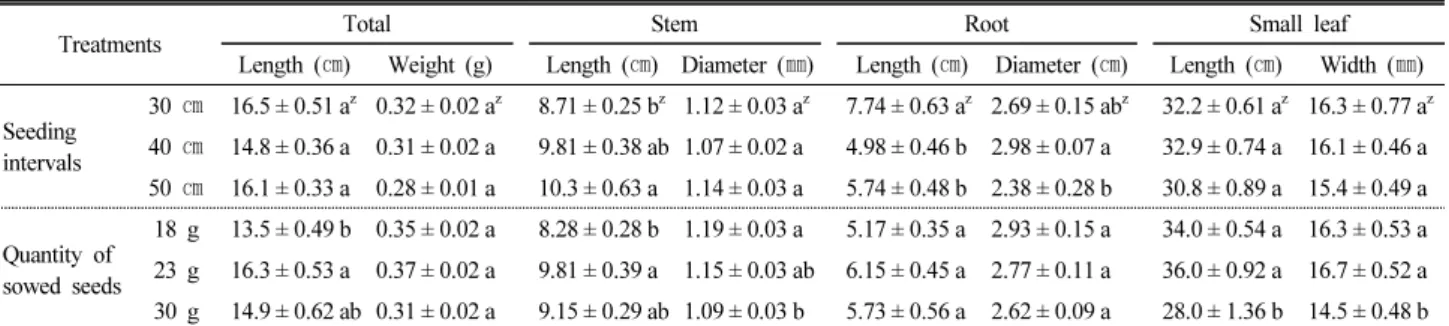
산양삼 종자 조파 시 재배유형별 생육특성을 Table 5에서 보 면, 파종간격 처리구에서는 주근길이(7.74 ㎝, P < 0.003)가 파 종간격이 30 ㎝인 처리구에서 다른 처리구에 비해 유의적으로 높은 것을 확인하였다. 파종량 처리구의 경우, 23 g이상의 파종 량에서 산양삼의 생육이 감소하는 것으로 나타났으며, 소엽의 길이(P < 0.0001)와 넓이(P < 0.012)는 30 g 처리구에서 유의적 으로 감소하는 것으로 나타났다. Lee (2007)의 보고에 따르면 인삼재배 시 종자의 크기가 큰 것이 인삼의 발아율, 발아세, 지 상부 및 지하부의 생육이 높아 직파재배 시 4 ㎜ 이상 크기의 종 자를 사용하는 것이 좋다는 선별기준을 설정한 바 있다. 또한 Lee et al. (2008)의 연구에서도 종자의 크기가 인삼의 생육에 미치는 영향을 확인하였으며 그 결과, 종자의 크기가 5 ㎜ 이상 에서 경장(삼대길이), 경직경(삼대직경), 소엽넓이의 생육이 우 수하였고, 종자의 크기가 작아질수록 지상부의 생육이 감소하 는 것으로 보고하였는데. 이는 종자의 크기가 클수록 배유의 저 장양분이 많아 초기생육이 우수하고 이후 인삼의 생육에도 영 향을 주는 것이라고 보고한 바 있다. 인삼 3년생의 경우, 파종밀 도(파종간격)가 높으면 엽장(식대길이)가 길어진다고 보고 된 바 있고(Won and Jo, 1999), Seong et al. (2010)의 연구에서도 직파재배 시 파종밀도와 인삼의 생육은 비례하여 파종밀도가 높을수록 인삼의 생육이 증가하였다고 보고한 바 있다. 파종립
수에 대한 연구에서는 Lee at al. (1998b)이 인삼의 파종립수가 적을수록 인삼의 생존율이 증가한다고 하였으며, Mo et al.
(2014)은 파종립수가 증가할수록 인삼의 경장(삼대길이)이 증 가하였고, 이는 밀식된 상태인 직파재배에서 지상부가 과번무 (Over-luxuriant growth)하게 웃자라 길이가 증가하는 것이라 고 보고 한 바 있다. Seo et al. (2018)의 보고에서도 파종밀도와 파종립수가 인삼의 경장에 영향을 주는 것은 밀식에 의한 과번 무와 근접 식물체와의 경쟁으로 인한 결과라고 보고 하였는데, 이는 산양삼 직파재배에 따른 본 연구의 결과와 유사한 결과로 보이며, 향후 산양삼 종자의 직파재배 파종 시에는 종자크기, 파종간격, 파종량을 고려하여 파종해야 할 것으로 사료된다.
이식재배 유형에 따른 생존율 및 생육특성
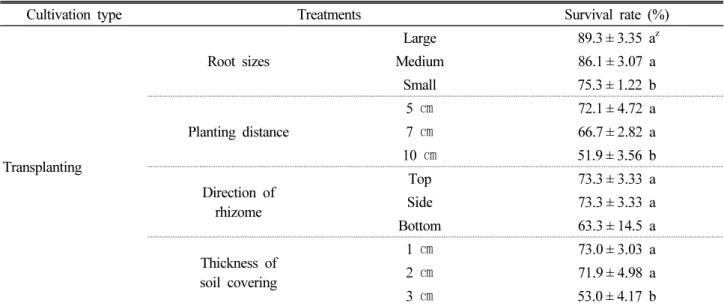
종근 크기에 따른 산양삼 종근의 생존율을 Table 6에서 보면, 종근의 크기가 ‘중’ 이상인 처리구에서 생존율이 유의적으로 증 가하였으며, 종근의 크기가 ‘대’ 처리구가 89.3% (P < 0.024)으 로 가장 높은 생존율을 보였다. 종근의 재식거리 처리구는 재식 거리가 7 ㎝이상인 처리구에서 간격이 10 ㎝인 처리구에 비해 종근의 생존율이 유의적으로 증가하였고 5 ㎝인 처리구에서 생 존율이 72.1% (P < 0.024)로 가장 높았다. 종근의 방향에 따른 생존율은 종근의 방향이 측 또는 위일 때 종근의 방향이 아래인 처리구보다 생존율이 유의적으로 높았으며, 종근의 방향이 위 인 처리구에서 73.0% (P < 0.024)로 가장 높은 생존율을 보였으 나, 종근 방향에 따른 생존율의 유의적인 차이는 확인할 수 없었 다. 이식재배 시 토양 복토두께에 따른 종근의 생존율을 조사한 결과, 복토두께에 따른 산양삼 종근의 생존율의 유의적인 차이 는 확인할 수 없었다.
산양삼 종근의 이식재배 유형별 생육특성을 Table 7에서 보 면, 종근 크기가 클수록 삼대길이를 제외한 삼대직경(2.13 ㎜,
Table 5. Growth characteristics of wild-simulated ginseng at strip seeding methods
Treatments Total Stem Root Small leaf
Length ( ㎝) Weight (g) Length ( ㎝) Diameter (㎜) Length ( ㎝) Diameter (㎝) Length ( ㎝) Width ( ㎜)
Seeding intervals
30 ㎝ 16.5 ± 0.51 a
z0.32 ± 0.02 a
z8.71 ± 0.25 b
z1.12 ± 0.03 a
z7.74 ± 0.63 a
z2.69 ± 0.15 ab
z32.2 ± 0.61 a
z16.3 ± 0.77 a
z40 ㎝ 14.8 ± 0.36 a 0.31 ± 0.02 a 9.81 ± 0.38 ab 1.07 ± 0.02 a 4.98 ± 0.46 b 2.98 ± 0.07 a 32.9 ± 0.74 a 16.1 ± 0.46 a 50 ㎝ 16.1 ± 0.33 a 0.28 ± 0.01 a 10.3 ± 0.63 a 1.14 ± 0.03 a 5.74 ± 0.48 b 2.38 ± 0.28 b 30.8 ± 0.89 a 15.4 ± 0.49 a
Quantity of sowed seeds
18 g 13.5 ± 0.49 b 0.35 ± 0.02 a 8.28 ± 0.28 b 1.19 ± 0.03 a 5.17 ± 0.35 a 2.93 ± 0.15 a 34.0 ± 0.54 a 16.3 ± 0.53 a 23 g 16.3 ± 0.53 a 0.37 ± 0.02 a 9.81 ± 0.39 a 1.15 ± 0.03 ab 6.15 ± 0.45 a 2.77 ± 0.11 a 36.0 ± 0.92 a 16.7 ± 0.52 a 30 g 14.9 ± 0.62 ab 0.31 ± 0.02 a 9.15 ± 0.29 ab 1.09 ± 0.03 b 5.73 ± 0.56 a 2.62 ± 0.09 a 28.0 ± 1.36 b 14.5 ± 0.48 b
z
Value in each column are the means of three replication ± S.E. Significant difference according to DMRT at P<0.05 levels are indicated by different
letter.
P < 0.001), 소엽길이(6.71 ㎜, P < 0.0001), 소엽직경(32.3 ㎜, P < 0.001), 구경(4.60 ㎜, P < 0.0001)이 유의적으로 증가하는 것으로 나타났다(Table 7). 재식거리에 대한 산양삼의 생육특 성은 간격이 좁을수록 생육이 증가하는 것으로 나타났으나 재 식거리 간의 유의적인 차이는 확인할 수 없었다. 뇌두방향에 따
른 산양삼의 생육특성은 비교 분석할 결과, 좌우 측 방향에 비해 뇌두의 방향이 위와 아래를 향하게 이식한 처리구에서 산양삼 의 삼대길이(P < 0.0002), 소엽길이(P < 0.009), 소엽직경(P <
0.046)이 유의적으로 높은 것을 확인하였다. 산양삼 이식재배 시 복토두께에 따른 산양삼의 생육특성의 유의적인 차이는 확 Table 6. Survival rate of wild-simulated ginseng at different transplanting methods
Cultivation type Treatments Survival rate (%)
Transplanting
Root sizes
Large 89.3 ± 3.35 az
Medium 86.1 ± 3.07 a
Small 75.3 ± 1.22 b
Planting distance
5 ㎝ 72.1 ± 4.72 a
7 ㎝ 66.7 ± 2.82 a
10 ㎝ 51.9 ± 3.56 b
Direction of rhizome
Top 73.3 ± 3.33 a
Side 73.3 ± 3.33 a
Bottom 63.3 ± 14.5 a
Thickness of soil covering
1 ㎝ 73.0 ± 3.03 a
2 ㎝ 71.9 ± 4.98 a
3 ㎝ 53.0 ± 4.17 b
zValue in each column are the means of three replication ± S.E. Significant difference according to DMRT at P<0.05 levels are indicated by different letter.
Table 7. Growth characteristics of wild-simulated ginseng at different transplanting methods
Treatments Stem Small leaf Petiole length
(㎝) Length (㎝) Diameter (㎜) Length (㎜) Width (㎜)
Root sizes
Large 6.93 ± 0.62 az 2.13 ± 0.11 az 6.71 ± 0.24 az 32.3 ± 1.64 az 4.60 ± 0.23 az Medium 4.84 ± 0.62 b 1.88 ± 0.10 a 5.45 ± 0.09 b 27.4 ± 0.58 b 3.99 ± 0.18 a
Small 5.56 ± 0.65 ab 1.58 ± 0.07 b 4.84 ± 0.22 c 25.6 ± 0.96 b 1.59 ± 0.67 b Planting
distance
5 ㎝ 5.20 ± 0.40 a 1.92 ± 0.15 a 5.68 ± 0.23 a 28.6 ± 0.92 a 3.00 ± 0.52 b 7 ㎝ 4.77 ± 0.58 a 1.73 ± 0.11 a 5.49 ± 0.36 a 27.0 ± 1.12 a 4.47 ± 0.27 a 10 ㎝ 4.03 ± 0.35 a 1.68 ± 0.16 a 5.25 ± 0.22 a 24.2 ± 2.76 a 3.69 ± 0.46 ab Direction
of rhizome
Top 13.5 ± 0.84 a 2.45 ± 0.13 a 6.02 ± 0.16 a 27.6 ± 0.68 a 4.59 ± 0.22 a Side 7.69 ± 2.46 c 2.04 ± 0.11 b 5.33 ± 0.19 b 25.3 ± 0.60 b 3.59 ± 0.15 b Bottom 10.9 ± 0.91 b 2.28 ± 0.15 ab 6.00 ± 0.15 a 27.5 ± 0.79 a 3.90 ± 0.49 ab Thickness of
soil covering
1 ㎝ 4.83 ± 0.32 a 1.93 ± 0.11 a 5.59 ± 0.41 a 27.2 ± 0.92 a 3.59 ± 0.22 a 2 ㎝ 5.05 ± 0.45 a 1.78 ± 0.11 a 5.88 ± 0.33 a 27.3 ± 1.18 a 3.37 ± 0.43 a 3 ㎝ 4.18 ± 0.47 a 1.93 ± 0.14 a 5.57 ± 0.38 a 28.0 ± 1.66 a 3.87 ± 0.15 a
zValue in each column are the means of three replication ± S.E. Significant difference according to DMRT at P<0.05 levels are indicated by different letter.
인되지 않았다.
이전부터 고려인삼은 뇌두부터 지근의 형태가 사람의 모양 과 유사할수록 우량한 인삼으로 평가되어 주근의 손실이 야기 되는 직파재배보다는 이식재배를 선호하였고, 재배기술도 이 식재배 위주로 발전하였다(Lee et al., 2005, Li et al., 2010).
Kwon et al. (2011)의 보고에 따르면 전국적으로 산양삼 재배는 이식재배를 주로 하면서 직파재배는 보조적인 수단으로 이용되 고 있다고 하였지만 현재까지 산양삼의 이식재배 유형에 따른 생육특성 연구는 미흡한 실정이다. 그러나 산양삼 외에 여러 약 용작물에서 이식재배에 대한 생육특성 연구가 활발히 진행되어 온 바, Lee et al. (1998a)은 인삼재배에서 농가별 차이는 있었지 만 큰 묘삼을 이식한 처리구에서 작은 묘삼을 이식한 처리구에 비해 오히려 결주율(Miss planted-rate)이 감소하는 것을 확인 하였고, Kim et al. (2004)은 백출(Atractylodes macrocephala Koidz)의 재배방법과 종근 중량에 따른 생육과 수량에 대해 연 구하였는데, 백출의 종근 이식 시 재식밀도가 높고 종근 중량이 무거울수록 출아율 및 생육이 증가한다고 보고한 바 있다. Nam et al. (2007)의 연구에서도 삼백초(Saururus chinensis Baill) 의 종근 크기별 이식재배 처리구에서 삼백초의 종근 크기가 클 수록 출아율과 생육이 증가한다고 보고한 바 있다. 이밖에도 당귀(Kim et al., 2009), 강활(Kim et al., 2009), 강황(Kim, 2018), 천궁(Choi et al., 2000) 등의 이식재배 시 종근의 크기가 클수록 작물의 생육이 증가되었다고 보고한 바 있다. 또한 이식 재배 시 뇌두방향에 대한 산양삼 생육특성의 경우, Jeon et al.
(2018)은 산양삼 종근의 식재작업 시 등고선 방향으로 골을 만 든 후 뇌두 방향을 아래로 향하게 하고 15° 비스듬히 눕혀 이식할 경우 생존율을 높일 수 있다고 하였다. 이와 같은 연구결과들은 본 연구에서 산양삼 이식재배 시 종근의 크기가 크고, 뇌두의 방 향이 위 또는 아래를 향하게 이식하였을 때 산양삼의 생육이 증 가하였다는 결과와 매우 유사한 것으로 판단된다.
적 요
본 연구는 고품질 산양삼의 표준재배기술 개발을 위해 직파 및 이식재배에 따른 산양삼의 생육특성을 조사하여 재배유형이 산양삼의 생육에 미치는 효과를 구명하고자 하였다. 재배유형 별 처리구에 따라 산양삼 종자를 점파 및 조파로 파종하고, 종근 을 이식하여 산양삼 종자의 발아율 및 종근의 생존율을 조사하 였다. 산양삼 종자는 점파재배 시 종자의 크기가 6.5 ㎜ 이상일 때 발아율이 유의적으로 가장 높았고, 이식재배는 주근직경이
10 ㎜ 이상, 재식거리는 7 ㎝ 이하, 복토두께는 2 ㎝ 이하 일 때 종근의 생존율이 유의적으로 증가하였다. 재배유형별 산양삼 의 생육특성은 점파재배 시 종자크기가 6.5 ㎜ 이상, 파종립수 는 3립, 파종간격은 5 ㎝ 이하일 때 산양삼의 지상부 생육이 유 의적으로 증가하였으며, 조파재배에서는 파종간격이 30 ㎝, 종 자의 파종량은 23 g 이하일 때 산양삼의 지하부 및 지상부의 생 육이 유의적으로 증가하였다. 이식배재에서는 주근직경이 10
㎜ 이상인 종근의 뇌두방향을 위 또는 아래를 향하도록 이식하 였을 때 산양삼의 지상부 생육이 유의적으로 높은 것을 확인하 였다. 향후 재배유형과 산양삼의 생육특성과 더불어 입지환경 과의 상관관계를 분석할 수 있다면 보다 정확한 산양삼의 최적 재배 및 환경조건의 확립이 가능할 것으로 판단된다. 이와 같은 연구결과를 통해 기존 재배자의 경험에만 의존하던 산양삼의 재배·관리 기술을 보다 명확하게 확립할 수 있었고, 나아가 고품 질 산양삼의 생산기술의 확립을 통해 임업인의 소득을 증대시 키고 산양삼의 산업 활성화에 기여할 수 있을 것으로 사료된다.
사 사
본 연구는 국립산림과학원 일반연구사업 “고품질 산양삼 생 산을 위한 친환경 재배기술 개발(Project No. FP0802-2017)”
연구의 지원에 의해 수행된 결과로서 이에 감사드립니다.
References