Introduction
Wild-simulated ginseng (Panax ginseng C.A. Meyer), belonging to Araliaceae, has been defined as a ginseng propagated in forest without the use of any artificial facilities such as light barriers from the Korea Forest Service (KOFPI, 2013). Additionally, wild-simulated ginseng is managed by the Korea Forest Service by selection of cultivation sites, seeds, seeding, cultivation management, quality inspection, and distribution (NIFoS, 2018). Recently, consumers are highly interested in clean forest products, and wild-simulated ginseng is in great demand among many forest products (Kim et al., 2019a). Therefore, the Korea Forest Service has established ‘The Industry Development Countermeasure of Wild-simulated Ginseng’ to carry out scientific research such as standard cultivation, processing, phytochemistry and pharmacology to enhance the cultivation (KFS, 2019).
Cultivation studies of wild-simulated ginseng have been carried out based on the correlation between direct seeding, transplanting, soil properties, soil bacterial community and growth characteristics (Kim et al., 2019a; Kim et al., 2019b, 2019c). The studies on ginsenoside have been reported based on the difference between its accumulation in wild-simulated ginseng and cultivated ginseng (Jeong et al., 2019; Moon, 2015). In addition, Kim et al. (2020) reported the content of ginsenoside were significantly higher in 13-year-old wild- simulated ginseng compare to 7-year-old wild-simulated ginseng. However, comprehensive studies of soil properties, growth characteristics, ginenoside contents of wild-simulated ginseng have not been studied till date.
Hence, in this study, we aimed to investigate the com- parative growth characteristics and ginenoside contents of wild-simulated ginseng based on different years by monitoring soil properties of cultivation regions.
The Comparative of Growth Characteristics and Ginsenoside Contents in Wild-simulated Ginseng (Panax ginseng C.A. Meyer) on Different Years
by Soil Properties of Cultivation Regions
Kiyoon Kim
1, Jeong-Hoon Huh
2, Yurry Um
3, Kwon Seok Jeon
4and Hyun-Jun Kim
3*
1
Post-doc,
2The Master’s Degree Researcher,
3Researcher and
4Senior Researcher, Forest Medicinal Research Center, National Institute of Forest Science, Yeongju 36040, Korea
Abstract - The aim of this study was to investigate the comparative growth characteristics and ginenoside contents of wild-simulated ginseng on different years (7 and 13-year-old) by monitoring soil properties of cultivation regions. Plant and soil samples were collected from 6 different cultivation regions. Soil organic matter (OM), total nitrogen (TN) and cation exchangeable capacity (CEC) were significantly higher in 13-year-old wild-simulated ginseng cultivation regions compared to 7-year-old wild-simulated ginseng cultivation regions. Growth characteristics of wild-simulated ginseng had shown significantly higher in 13-year-old wild-simulated ginseng compared to 7-year-old wild-simulated ginseng.
Ginsenoside G-Rb1, Rb2, Rc, Rd, Re, Rf, Rg1 were significantly higher in 13-year-old wild-simulated ginseng than 7-year-old wild-simulated ginseng. According to the results of correlation analysis, soil OM, TN and CEC of the cultivated regions were positively correlated with the growth of wild-simulated ginseng. In addition, the root length of wild-simulated ginseng showed positive correlation with ginsenoside content. Hence, this study was able to investigate the correlation between growth and ginsenoside content of wild-simulated ginseng based on soil characteristics of the cultivation regions.
Key words – Ginsenoside, Growth characteristics, Panax ginseng C.A. Meyer, Soil properties, Wild-simulated ginseng
*Corresponding author. E-mail : [email protected] Tel. +82-54-630-5639
Original Research Article
Materials and Methods
Plant materials
Seven and 13-year-old wild-simulated ginseng samples were collected in 3 replicates according to their age from six local provinces (Pyeongchang, Yeongwol, Danyang, Munkyeong, Hamyang, Sancheong) in South Korea during July to August 2019.
Soil analysis
Soil samples were collected from 6 different cultivation regions of wild-simulated ginseng in 3 replicates according to their age (7 and 13-year-old). Surface soil was removed and soil was collected at a depth within 20 ㎝. The soil samples were passed through 2 ㎜ sieve and air-dried at room temperature. The soil physico-chemical properties analysis such as soil pH, electric conductivity (EC), organic matter (OM), total nitrogen (TN), available phosphate (Avail. P
2O
5), exchangeable cation and cation exchange capacity (CEC) were performed following standard analysis manual of the Rural Development Administration (RDA), South Korea (RDA, 2013).
Morphology
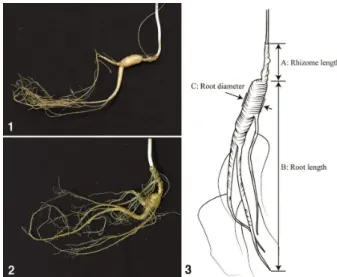
Quantitative characters of 7 and 13-year-old wild-simulated ginseng such as rhizome length, root length, root diameter and dry weight were measured using digital calipers and balance (Fig. 1). The cross-section area, surface area and volume of root were measured using an EPSON scanner (Expression 12,000XL) and WinRHIZO
TMPro software (version 2017, Regent Instruments, Canada) (Kim et al., 2019b; Wisam et al., 2018).
Ginsenoside analysis
Dried roots were pulverized with a grinder, and then sieved through a no. 80 mesh. The powdered from of 36 samples (ca.
0.2 g) were extracted with 10 mL of 80% (v/v) methanol in an ultrasonic bath (JAC-5020, KODO, Korea) for 60 min. After centrifugation, the supernatant was separated, and it was defatted through a 0.2 ㎛ membrane filter unit. An aliquot of 10 μL was analyzed using HPLC with a UV detector.
Standards of ginsenosides (G-Rb1, Rb2, Rc, Rd, Re, Rf, Rg1,
Rg2, Rg3, Rh1, Rh2, F2) were purchased from ChromaDex (USA). HPLC-grade acetonitrile, methanol, and distilled water were purchased from J.T.Baker (USA) (Fig. 2). Standard working solutions for HPLC-UV were prepared by diluting the stock solutions in methanol to obtain concentration range of 10, 25, 50, 100 ㎍/mL for 12 ginsenosides.
Ginsenoside data were obtained using an Ultimate 3000 HPLC (Thermo Dionex, USA) with a UV detector. The analytical conditions for recording chromatogram of the marker compounds were as follows: Quantitative analysis was carried out using a Inno C-18 column (4.6 × 250 ㎜, 5 ㎛, YoungjinBiochrom, Korea). The mobile phase was a binary eluent of water (A) and acetonitrile (B) with gradient conditions as follows: 0-1 min, 5% B; 1-45 min, 70% B; 45-50 min, 95%
50-55 min, 95% B; 55-57 min, 5% B; 57-60 min, 5% B; flow rate of 1.0 mL/min. The detection wavelength was 210 ㎚, and the injection volume was 10 μL.
Statistical analysis
Data are expressed as means ± standard error (S.E.). Statistical analysis was performed using the Statistical Analysis System (SAS, version 9.4, SAS Institute, Cary, NC, USA) software for one-way ANOVA and t-test, with statistical significance set at p < 0.05. The correlation between soil parameters, growth characteristics and ginsenoside contents of wild-
Fig. 1. Morphology characteristics of wild-simulated ginseng.
(1) 7-year-old, (2) 13-year-old, (3) morphological characteristics
measured in the study (1-3 were cited from Kim et al., 2020).
simulated ginseng was confirmed by Pearson’s correlation coefficient using IBM SPSS Statistics (version 25, IBM Corp., Armonk, New York, USA).
Results and Discussion
Soil properties
The soil physico-chemical properties of 6 different culti- vation regions based on the age of wild-simulated ginseng are summarized in Table 1. Soil samples were classified as sandy loam and sandy clay loam according to the soil texture. Soil pH of all cultivation regions has determinsed as acidic or slightly acidic soils, ranging from 4.73 to 5.69. Organic matter (OM), TN and CEC were significantly higher in 13-year-old wild-simulated ginseng cultivation regions compared to 7-year-old wild-simulated ginseng cultivation regions. On the other hand, the soil sodium content showed a significantly difference, but all soil samples were non-saline soil (EC < 2.0 dS/m). Soil EC, available P
2O
5, potassium (K), calcium (Ca) and magnesium (Mg) showed no significant difference according to the different ages of wild-simulated ginseng.
Morphological characteristics
According to a survey on the growth characteristics of wild-simulated ginseng, rhizome length was recorded 9.7 ± 0.31 ~ 32.8 ± 0.65 ㎜. Length, diameter and dry weight of
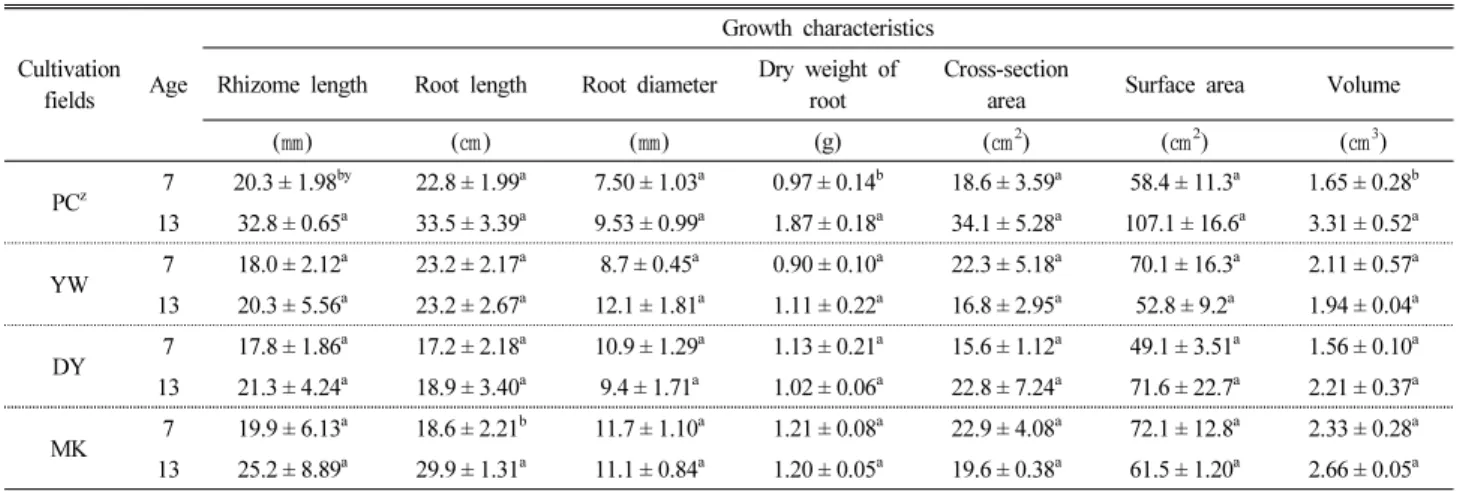
root were 16.7 ± 0.59 ~ 33.5 ± 3.39 ㎝, 7.50 ± 1.03 ~ 12.3 ± 0.67 ㎜, 7.50 ± 1.03 ~ 12.3 ± 0.67 ㎜, respectively. Cross- section area, surface area, volume of root were 9.7 ± 0.97 ~ 34.1 ± 5.28 ㎠, 30.6 ± 3.03 ~ 107.1 ± 16.6 ㎠, 1.21 ± 0.81 ~ 3.50 ± 0.33 ㎤, respectively (Table 2). Growth characteristics such as rhizome length, root length, root diameter, dry weight and volume were significantly higher in 13-year-old wild- simulated ginseng.
Ginsenoside contents
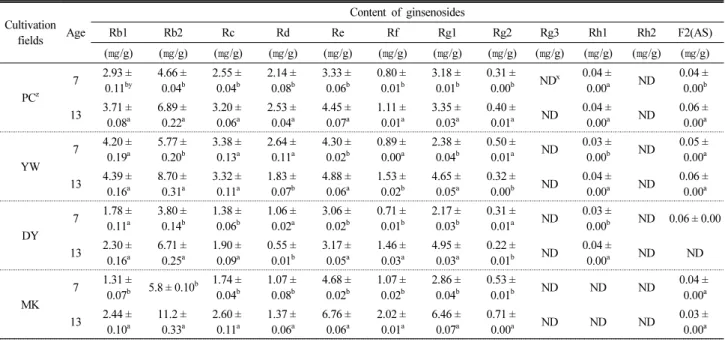
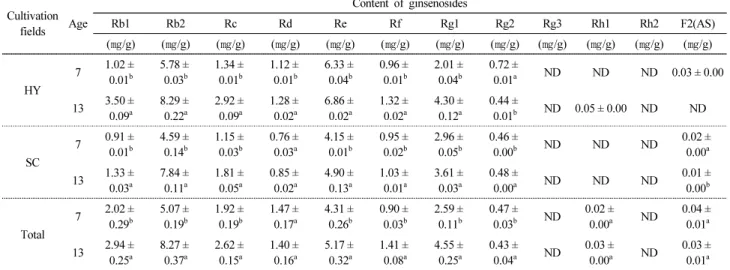
The HPLC-UV method was used for detecting 12 ginsenoside (G-Rb1, Rb2, Rc, Rd, Re, Rf, Rg1, Rg2, Rg3, Rh1, Rh2, F2) standards. Ginsenoside identities in the HPLC- UV chromatogram were confirmed by comparing retention times and UV spectra chromatograms of the peaks with those of the standards (Fig. 3). The analysis was conducted in triplicate and the results are shown in Table 3. Wild- simulated ginseng contained G-Rb1 at 0.91 ± 0.01 ~ 4.39 ± 0.16 ㎎/g, Rb2 at 3.80 ± 0.14 ~ 11.2 ± 0.33 ㎎/g, Rc at 1.15 ± 0.03 ~ 3.38
± 0.13 ㎎/g, Rd at 0.55 ± 0.01 ~ 2.64 ± 0.11 ㎎/g, Re at 3.33
± 0.06 ~ 6.86 ± 0.02 ㎎/g, Rf at 0.71 ± 0.01 ~ 2.02 ± 0.01 ㎎/g, Rg1 at 2.01 ± 0.04 ~ 6.46 ± 0.07 ㎎/g, Rg2 at 0.22 ± 0.01 ~ 0.72 ± 0.11 ㎎/g. In particular, G-Rb2, Re and Rg1 had high levels compared to the others. In contrast, G-Rg3 and Rh2 were not detected in any of the samples. According to the ginsenoside study based on the time of collection and Fig. 2. Chemical structures of portopanaxadiol (PPT) and protopanaxatriol (PPT)-type ginsenoside (Glc: β-D-glucopyranosyl, Arp:
α-L-arabinopyranosyl, Araf: α-L-arabinofuranosyl, Rha: α-L-rhamnopyranosyl).
Table 1. Soil chemical properties of 6 different cultivation regions according to age of wild-simulated ginseng
Cultivation
fields Age Soil
texture
pH EC
zOM
yTN
xAvail.
P
2O
5wExchangeable cation
CEC
vK Ca Mg Na
(1:5) (dS/m) (%) (%) (㎎/㎏) --- (cmol
+/㎏) --- (cmol
+/㎏) PC
u7 Sandy loam 5.26 ±
0.03
ar0.02 ±
0.00
b16.8 ±
1.36
a0.60 ±
0.06
a61.5±
6.24
b0.32 ±
0.03
a4.78 ±
1.02
a0.63 ±
0.14
a0.19 ±
0.11
a42.7 ± 3.26
a13 Sandy loam 5.43 ±
0.09
a0.03 ±
0.00
a16.9 ±
0.35
a0.65±
0.03
a268.9 ±
70.4
a0.60 ±
0.23
a7.22 ±
0.08
a0.70 ±
0.08
a0.05±
0.00
a40.9 ± 1.39
aYW
7 Sandy clay loam 5.34 ± 0.10
a0.03 ±
0.00
a6.45±
0.24
b0.23 ±
0.01
b11.9 ±
0.47
b0.24 ±
0.04
a3.02 ±
0.79
a0.72 ±
0.16
a0.27 ±
0.08
a22.5±
1.03
b13 Sandy clay loam 5.29 ±
0.09
a0.04 ±
0.01
a9.76 ±
0.86
a0.35±
0.03
a75.9 ±
7.84
a0.18 ±
0.03
a1.86 ±
0.46
a0.36 ±
0.04
a0.03 ±
0.01
b29.3 ± 1.49
aDY
7 Sandy clay loam 5.61 ±
0.14
a0.02 ±
0.00
a3.81 ±
0.41
b0.15±
0.01
b8.6 ±
0.31
b0.15±
0.0.4
b4.70 ±
0.39
a1.06 ±
0.02
a0.08 ±
0.02
a14.3 ± 1.77
a13 Sandy clay loam 5.69 ±
0.11
a0.02 ±
0.00
a5.03 ±
0.13
a0.20 ±
0.01
a108.0 ±
24.5
a0.31 ±
0.03
a4.86 ±
0.55
a0.71 ±
0.05
b0.02 ±
0.00
b17.8 ± 0.99
aMK
7 Sandy loam 5.53 ±
0.08
a0.03 ±
0.00
a9.2 ±
0.49
b0.35±
0.01
b115.7 ±
6.95
a0.23 ±
0.06
a3.65±
0.94
a0.63 ±
0.19
a0.23 ±
0.07
a28.7 ± 0.73
a13 Sandy loam 5.17 ±
0.04
b0.02 ±
0.00
a11.9 ±
0.43
a0.43 ±
0.01
a131.9 ±
3.80
a0.13 ±
0.01
a0.95±
0.08
b0.23 ±
0.02
a0.04 ±
0.01
a31.7 ± 1.08
aHY
7 Sandy loam 4.77 ±
0.04
b0.02 ±
0.00
b9.4 ±
0.49
b0.35±
0.02
b129.3 ±
15.2
a0.10 ±
0.01
b0.37 ±
0.03
b0.11 ±
0.01
a0.11 ±
0.08
a27.5±
1.11
b13 Sandy loam 5.29 ±
0.05
a0.05±
0.01
a12.8 ±
0.21
a0.48 ±
0.01
a78.4 ±
13.4
a0.30 ±
0.04
a6.99 ±
1.53
a1.07 ±
0.37
a0.07 ±
0.02
a33.5±
0.39
aSC
7 Sandy clay loam 4.75±
0.09
a0.02 ±
0.00
a3.29 ±
1.05
b0.14 ±
0.03
b12.1 ±
2.86
a0.08 ±
0.01
a0.24 ±
0.07
a0.05±
0.01
a0.05±
0.02
a12.7 ± 3.03
b13 Sandy clay loam 4.73 ±
0.04
a0.02 ±
0.00
a8.73 ±
1.06
a0.34 ±
0.04
a23.2 ±
9.62
a0.11 ±
0.02
a0.10 ±
0.02
a0.05±
0.01
a0.06 ±
0.02
a26.0 ± 2.22
aTotal
7 5.19 ±
0.09
a0.02 ±
0.00
a7.9 ±
0.99
b0.30 ±
0.04
b52.6 ±
12.7
a0.17 ±
0.02
a2.41 ±
0.45
a0.48 ±
0.09
a0.15±
0.03
a23.1 ± 1.94
b13 5.21 ±
0.08
a0.03 ±
0.01
a11.4 ±
1.17
a0.43 ±
0.05
a94.9 ±
20.5
a0.27 ±
0.05
a3.39 ±
0.70
a0.53 ±
0.10
a0.04 ±
0.01
b30.8 ± 2.16
az
EC: Electric conductivity;
yOM: Organic matter;
xTN: Total nitrogen;
wAvail. P
2O
5: Available phosphate;
vCEC: Cation exchange capacity;
u
Cultivation regions: PC (Pyeongchang), YW (Yeongwol), DY (Danyang), MK (Munkyeong), HY (Hamyang), SC (Sancheong).
r
Value in each column with different letters are statistically significant differences (p <0.05) among the treatments according to least significant difference (LSD).
Table 2. Growth characteristic according to age of wild-simulated ginseng in 6 different cultivation regions
Cultivation fields Age
Growth characteristics Rhizome length Root length Root diameter Dry weight of
root Cross-section
area Surface area Volume
(㎜) (㎝) (㎜) (g) (㎝
2) (㎝
2) (㎝
3)
PC
z7 20.3 ± 1.98
by22.8 ± 1.99
a7.50 ± 1.03
a0.97 ± 0.14
b18.6 ± 3.59
a58.4 ± 11.3
a1.65± 0.28
b13 32.8 ± 0.65
a33.5± 3.39
a9.53 ± 0.99
a1.87 ± 0.18
a34.1 ± 5.28
a107.1 ± 16.6
a3.31 ± 0.52
aYW 7 18.0 ± 2.12
a23.2 ± 2.17
a8.7 ± 0.45
a0.90 ± 0.10
a22.3 ± 5.18
a70.1 ± 16.3
a2.11 ± 0.57
a13 20.3 ± 5.56
a23.2 ± 2.67
a12.1 ± 1.81
a1.11 ± 0.22
a16.8 ± 2.95
a52.8 ± 9.2
a1.94 ± 0.04
aDY 7 17.8 ± 1.86
a17.2 ± 2.18
a10.9 ± 1.29
a1.13 ± 0.21
a15.6 ± 1.12
a49.1 ± 3.51
a1.56 ± 0.10
a13 21.3 ± 4.24
a18.9 ± 3.40
a9.4 ± 1.71
a1.02 ± 0.06
a22.8 ± 7.24
a71.6 ± 22.7
a2.21 ± 0.37
aMK 7 19.9 ± 6.13
a18.6 ± 2.21
b11.7 ± 1.10
a1.21 ± 0.08
a22.9 ± 4.08
a72.1 ± 12.8
a2.33 ± 0.28
a13 25.2 ± 8.89
a29.9 ± 1.31
a11.1 ± 0.84
a1.20 ± 0.05
a19.6 ± 0.38
a61.5± 1.20
a2.66 ± 0.05
aTable 2. Continued
Cultivation fields Age
Growth characteristics Rhizome length Root length Root diameter Dry weight of
root Cross-section
area Surface area Volume
(㎜) (㎝) (㎜) (g) (㎝
2) (㎝
2) (㎝
3)
HY 7 17.8 ± 0.97
a18.9 ± 1.51
a9.3 ± 0.69
a1.04 ± 0.10
b25.2 ± 3.33
a79.2 ± 10.4
a2.26 ± 0.25
a13 25.1 ± 2.85
a25.1 ± 3.17
a11.9 ± 1.33
a1.69 ± 0.13
a20.4 ± 2.30
a64.2 ± 7.2
a2.22 ± 0.24
aSC 7 9.7 ± 0.31
b16.7 ± 0.59
a10.4 ± 1.19
a0.79 ± 0.09
b9.7 ± 0.97
b30.6 ± 3.03
b1.21 ± 0.18
b13 30.5± 2.51
a21.6 ± 3.64
a12.3 ± 0.67
a1.87 ± 0.16
a28.9 ± 3.12
a90.7 ± 9.78
a3.50 ± 0.33
aTotal 7 15 .6 ± 1.5 5
b19.6 ± 0.89
b9.8 ± 0.48
a1.01 ± 0.05
b19.1 ± 1.72
a59.9 ± 5.40
a1.86 ± 0.15
b13 25.8 ± 2.00
a25.4 ± 1.59
a11.1 ± 0.53
a1.46 ± 0.10
a23.8 ± 2.03
a74.7 ± 6.37
a2.64 ± 0.18
az
Cultivation field: PC (Pyeongchang), YW (Yeongwol), DY (Danyang), MK (Munkyeong), HY (Hamyang), SC (Sancheong).
y
Value in each column with different letters are statistically significant differences (p <0.05) among the treatments according to least significant difference (LSD).
Fig. 3. HPLC chromatograms of ginsenosides in wild-simulated ginseng (A: 7-year-old, B: 13-year-old).
Table 3. Ginsenoside content according to age of wild-simulated ginseng in 6 different cultivation regions
Cultivation fields Age
Content of ginsenosides
Rb1 Rb2 Rc Rd Re Rf Rg1 Rg2 Rg3 Rh1 Rh2 F2(AS)
(㎎/g) (㎎/g) (㎎/g) (㎎/g) (㎎/g) (㎎/g) (㎎/g) (㎎/g) (㎎/g) (㎎/g) (㎎/g) (㎎/g)
PC
z7 2.93 ±
0.11
by4.66 ±
0.04
b2.55 ±
0.04
b2.14 ±
0.08
b3.33 ±
0.06
b0.80 ±
0.01
b3.18 ±
0.01
b0.31 ±
0.00
bND
x0.04 ±
0.00
aND 0.04 ±
0.00
b13 3.71 ±
0.08
a6.89 ±
0.22
a3.20 ±
0.06
a2.53 ±
0.04
a4.45±
0.07
a1.11 ±
0.01
a3.35±
0.03
a0.40 ±
0.01
aND 0.04 ±
0.00
aND 0.06 ±
0.00
aYW
7 4.20 ±
0.19
a5.77 ±
0.20
b3.38 ±
0.13
a2.64 ±
0.11
a4.30 ±
0.02
b0.89 ±
0.00
a2.38 ±
0.04
b0.50 ±
0.01
aND 0.03 ±
0.00
bND 0.05±
0.00
a13 4.39 ±
0.16
a8.70 ±
0.31
a3.32 ±
0.11
a1.83 ±
0.07
b4.88 ±
0.06
a1.53 ±
0.02
b4.65±
0.05
a0.32 ±
0.00
bND 0.04 ±
0.00
aND 0.06 ±
0.00
aDY
7 1.78 ±
0.11
a3.80 ±
0.14
b1.38 ±
0.06
b1.06 ±
0.02
a3.06 ±
0.02
b0.71 ±
0.01
b2.17 ±
0.03
b0.31 ±
0.01
aND 0.03 ±
0.00
bND 0.06 ± 0.00 13 2.30 ±
0.16
a6.71 ±
0.25
a1.90 ±
0.09
a0.55 ±
0.01
b3.17 ±
0.05
a1.46 ±
0.03
a4.95±
0.03
a0.22 ±
0.01
bND 0.04 ±
0.00
aND ND
MK
7 1.31 ±
0.07
b5.8 ± 0.10
b1.74 ±
0.04
b1.07 ±
0.08
b4.68 ±
0.02
b1.07 ±
0.02
b2.86 ±
0.04
b0.53 ±
0.01
bND ND ND 0.04 ±
0.00
a13 2.44 ±
0.10
a11.2 ±
0.33
a2.60 ±
0.11
a1.37 ±
0.06
a6.76 ±
0.06
a2.02 ±
0.01
a6.46 ±
0.07
a0.71 ±
0.00
aND ND ND 0.03 ±
0.00
acultivation conditions of mountain ginseng, it was reported that G-Rb1, Rb2, Rc and Re were mainly distributed (Chang, 1998; Nam, 1996). This study also confirmed that the results were consistent with previous studies because on the high content of Rb2, Re, and Rg1.
As for ginsenoside contents of wild-simulated ginseng, 13-year-old roots had significantly higher G-Rb1, Rb2, Rc, Rd, Re, Rf, Rg1 content compared to 7-year-old roots. In contrast, G-Rg2 was significantly higher in 7-year-old than 13-year-old. In another study based on the correlation between the ginsenoside contents and growth characteristics of wild-simulated ginseng, 13-year-old roots were found to be higher in G-Rb1, Rb2, Rc, Rd, Re, Rf, Rg1 and Rg2 content compared to 7-year-old roots (Kim et al., 2020). Therefore, the chemical composition of ginsenosides of wild-simulated gin- seng confirmed the results similar to those of previous studies.
Correlation between soil properties and growth characteristics of wild-simulated ginseng
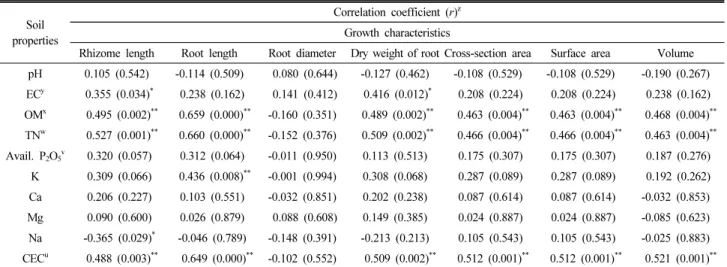
The results of correlation analysis between soil properties and growth characteristics of wild-simulated ginseng are represented in Table 4. Among the soil properties, OM, TN and CEC were shown to have a significantly positive correlation with growth characteristics of wild-simulated ginseng. Soil
organic matter had shown significant positive correlation with rhizome length (r = 0.495, p < 0.01), root length (r = 0.659, p <
0.01), root dry weight (r = 0.489, p < 0.01), cross-section area (r
= 0.463, p < 0.01), surface area (r = 0.463, p < 0.01) and root volume (r = 0.468, p < 0.01) of wild-simulated ginseng. Soil total nitrogen content had shown significant positive correlation with rhizome length (r = 0.527, p < 0.01), root length (r = 0.660, p < 0.01), root dry weight (r = 0.509, p < 0.01), cross-section area (r = 0.466, p < 0.01), surface area (r = 0.466, p < 0.01) and root volume (r = 0.463, p < 0.01) of wild-simulated ginseng. In case of CEC, it had shown significant positive correlation with rhizome length (r = 0.488, p < 0.01), root length (r = 0.649, p <
0.01), root dry weight (r = 0.509, p < 0.01), cross-section area (r
= 0.512, p < 0.01), surface area (r = 0.512, p < 0.01) and root volume (r = 0.521, p < 0.01) of wild-simulated ginseng. Soil organic matter and total nitrogen are essential nutrients during the growth of ginseng, and the organic matter content in the root layer of ginseng has correlation with the total nitrogen contents (Cheng et al., 2011). Kim et al. (2020) reported that the growth characteristics of wild-simulated ginseng had shown significant positive correlation with soil OM, TN and CEC. Hence, the previous studies support that the OM, TN and CEC have a significant correlation with growth of wild-simulated ginseng.
Table 3. Continued
Cultivation fields Age
Content of ginsenosides
Rb1 Rb2 Rc Rd Re Rf Rg1 Rg2 Rg3 Rh1 Rh2 F2(AS)
(㎎/g) (㎎/g) (㎎/g) (㎎/g) (㎎/g) (㎎/g) (㎎/g) (㎎/g) (㎎/g) (㎎/g) (㎎/g) (㎎/g)
HY
7 1.02 ±
0.01
b5.78 ±
0.03
b1.34 ±
0.01
b1.12 ±
0.01
b6.33 ±
0.04
b0.96 ±
0.01
b2.01 ±
0.04
b0.72 ±
0.01
aND ND ND 0.03 ± 0.00
13 3.50 ±
0.09
a8.29 ±
0.22
a2.92 ±
0.09
a1.28 ±
0.02
a6.86 ±
0.02
a1.32 ±
0.02
a4.30 ±
0.12
a0.44 ±
0.01
bND 0.05± 0.00 ND ND
SC
7 0.91 ±
0.01
b4.59 ±
0.14
b1.15±
0.03
b0.76 ±
0.03
a4.15±
0.01
b0.95±
0.02
b2.96 ±
0.05
b0.46 ±
0.00
bND ND ND 0.02 ±
0.00
a13 1.33 ±
0.03
a7.84 ±
0.11
a1.81 ±
0.05
a0.85±
0.02
a4.90 ±
0.13
a1.03 ±
0.01
a3.61 ±
0.03
a0.48 ±
0.00
aND ND ND 0.01 ±
0.00
bTotal
7 2.02 ±
0.29
b5.07 ±
0.19
b1.92 ±
0.19
b1.47 ±
0.17
a4.31 ±
0.26
b0.90 ±
0.03
b2.59 ±
0.11
b0.47 ±
0.03
bND 0.02 ±
0.00
aND 0.04 ±
0.01
a13 2.94 ±
0.25
a8.27 ±
0.37
a2.62 ±
0.15
a1.40 ±
0.16
a5.17 ±
0.32
a1.41 ±
0.08
a4.55 ±
0.25
a0.43 ±
0.04
aND 0.03 ±
0.00
aND 0.03 ±
0.01
az
Cultivation field: PC (Pyeongchang), YW (Yeongwol), DY (Danyang), MK (Munkyeong), HY (Hamyang), SC (Sancheong).
y
Value in each column with different letters are statistically significant differences (p < 0.05) among the treatments according to least significant difference (LSD).
x
ND: not detected.
Correlation between growth characteristics and ginsenoside contents of wild-simulated ginseng
The correlation analysis between growth characteristics and ginsenoside content of wild-simulated ginseng (7-year-old and 13-year-old) had shown a significant positive correlation (Table 5). Root length of wild-simulated ginseng had significant positive correlation with ginsenoside Rb1 (r = 0.491, p < 0.01), Rb2 (r = 0.507, p < 0.01), Rc (r = 0.611, p <
0.01), Rd (r = 0.502, p < 0.01), Rf (r = 0.383, p < 0.05) and Rg1 (r = 0.395, p < 0.05). Among the ginsenoside, Rb2 had
shown significant positive correlation with rhizome length (r
= 0.396, p < 0.05), root dry weight (r = 0.357, p < 0.05) and root volume (r = 0.467, p < 0.01). Kim et al. (2020) reported that the root length of wild-simulated ginseng has significant positive correlation with ginsenoside Rd and Rf. Alongside, ginsenoside Rb2 had shown significant positive correlation with root dry weight, cross-section area, surface area, volume of wild-simulated ginseng. Overall, soil OM, TN and CEC of the cultivated regions had a significantly positive correlation with the growth of wild-simulated ginseng. In addition, the Table 4. Correlation between soil properties and growth characteristics of wild-simulated ginseng
Soil properties
Correlation coefficient (r)
zGrowth characteristics
Rhizome length Root length Root diameter Dry weight of root Cross-section area Surface area Volume pH 0.105 (0.542) -0.114 (0.509) 0.080 (0.644) -0.127 (0.462) -0.108 (0.529) -0.108 (0.529) -0.190 (0.267) EC
y0.355 (0.034)
*0.238 (0.162) 0.141 (0.412) 0.416 (0.012)
*0.208 (0.224) 0.208 (0.224) 0.238 (0.162) OM
x0.495 (0.002)
**0.65 9 (0.000)
**-0.160 (0.351) 0.489 (0.002)
**0.463 (0.004)
**0.463 (0.004)
**0.468 (0.004)
**TN
w0.527 (0.001)
**0.660 (0.000)
**-0.152 (0.376) 0.509 (0.002)
**0.466 (0.004)
**0.466 (0.004)
**0.463 (0.004)
**Avail. P
2O
5v0.320 (0.057) 0.312 (0.064) -0.011 (0.950) 0.113 (0.513) 0.175 (0.307) 0.175 (0.307) 0.187 (0.276) K 0.309 (0.066) 0.436 (0.008)
**-0.001 (0.994) 0.308 (0.068) 0.287 (0.089) 0.287 (0.089) 0.192 (0.262) Ca 0.206 (0.227) 0.103 (0.551) -0.032 (0.851) 0.202 (0.238) 0.087 (0.614) 0.087 (0.614) -0.032 (0.853) Mg 0.090 (0.600) 0.026 (0.879) 0.088 (0.608) 0.149 (0.385) 0.024 (0.887) 0.024 (0.887) -0.085 (0.623) Na -0.365 (0.029)
*-0.046 (0.789) -0.148 (0.391) -0.213 (0.213) 0.105 (0.543) 0.105 (0.543) -0.025 (0.883) CEC
u0.488 (0.003)
**0.649 (0.000)
**-0.102 (0.552) 0.509 (0.002)
**0.512 (0.001)
**0.5 12 (0.001)
**0.5 21 (0.001)
**z
Correlation coefficient (r) written are significantly correlated between the variables compared. Negative values denote negative correlation and positive values denote positive correlation. Values in bracket means p value (
**p < 0.01,
*p < 0.05).
y
EC: Electric conductivity;
xOM: Organic matter;
wTN: Total nitrogen;
vAvail. P
2O
5: Available phosphate;
uCEC: Cation exchange capacity.
Table 5. Correlation between growth characteristics and ginsenoside contents of wild-simulated ginseng
Ginsenoside
Correlation coefficient (r)
zGrowth characteristics
Rhizome length Root length Root diameter Dry weight of root Cross-section area Surface area Volume Rb1 0.068 (0.694) 0.491 (0.002)
**-0.102 (0.555) 0.128 (0.456) 0.115 (0.506) 0.115 (0.505) 0.083 (0.630) Rb2 0.396 (0.017)
*0.507 (0.002)
**0.292 (0.084) 0.357 (0.032)
*0.186 (0.277) 0.186 (0.278) 0.467 (0.004)
**Rc 0.158 (0.359) 0.611 (0.000)
**-0.064 (0.710) 0.241 (0.157) 0.215 (0.209) 0.215 (0.208) 0.242 (0.154) Rd -0.004 (0.980) 0.502 (0.002)
**-0.305 (0.070) 0.072 (0.678) 0.214 (0.209) 0.215 (0.209) 0.115 (0.504) Re 0.199 (0.245) 0.312 (0.064) 0.275 (0.105) 0.280 (0.098) 0.122 (0.478) 0.122 (0.478) 0.285 (0.092) Rf 0.275 (0.104) 0.383 (0.021)
*0.230 (0.178) 0.101 (0.556) 0.003 (0.986) 0.003 (0.986) 0.233 (0.172) Rg1 0.324 (0.054) 0.395 (0.017)
*0.192 (0.261) 0.147 (0.392) -0.020 (0.910) -0.020 (0.910) 0.221 (0.195) Rg2 -0.016 (0.927) 0.124 (0.472) 0.106 (0.540) 0.033 (0.847) 0.107 (0.533) 0.107 (0.533) 0.228 (0.180) Rh1 0.060 (0.727) 0.243 (0.154) -0.169 (0.323) 0.113 (0.513) 0.081 (0.637) 0.082 (0.636) -0.076 (0.661) F2(AS) -0.122 (0.478) 0.209 (0.221) -0.099 (0.565) -0.088 (0.609) 0.054 (0.752) 0.055 (0.751) -0.030 (0.864)
z