비닐하우스와 관행재배 인삼의 생육특성 및 진세노사이드 함량 비교
이성우†·김금숙·현동윤·김용범·김장욱·강승원·차선우 농촌진흥청 국립원예특작학원 인삼특작부
Comparison of Growth Characteristics and Ginsenoside Content of Ginseng (Panax ginseng C. A. Meyer) Cultivated with Greenhouse
and Traditional Shade Facility
Sung Woo Lee
†, Gum Sook Kim, Dong Yun Hyun, Yong Burm Kim, Jang Wook Kim, Seung Won Kang and Seon Woo Cha
Ginseng Research Division, Department of Ginseng & Special Crops, NIHHS, RDA, Eumseong 369-873, Korea.
ABSTRACT : Growth characteristics, root yield and ginsenoside contents of 3-year-old ginseng in greenhouse shaded by 30
osloped-curtain made of aluminum were compared to traditional shade facility in order to develop cultural practice for organic ginseng. Light transmittance ratio in greenhouse with 30
osloped-curtain shade was distinctly lower than that of tra- ditional shade from sunrise to 9 a.m., while its ratio in greenhouse was higher than traditional shade since 9 a.m. due to the reflection of light. Air temperature of greenhouse was 1.3 ℃ higher than that of traditional shade on the first ten days of August due to more reflected light. Root yield of greenhouse was 44% higher than that of traditional cultivation because of the inflow of reflected light and the decrease of disease of Alternaria and Anthracnose by blocking rainfall. Dry matter par- titioning ratio of rhizome and lateral root were increased in ginseng cultivated at greenhouse due to longer survival time in leaf than traditional cultivation. Total ginsenoside contents cultivated at greenhouse was decreased in the part of taproot, while it was increased in the part of lateral and fine root compare to traditional cultivation. Individual ginsenoside contents between greenhouse and traditional cultivation showed significant difference more frequent in fine root than taproot and lateral root. Total ginsenoside contents including Rb
1,Rb
2,Rc, Rd, Re, Rf, Rg
1,and Rg
2in whole root of 3-year-old ginseng did not showed significant difference by greenhouse and traditional cultivation.
Key Words : Panax ginseng, Greenhouse, Shade, Root Yield, Ginsenoside
서 언
최근 친환경 유기농산물에 대한 소비자들의 관심 증가로 화 학농약의 사용을 억제하여 농약잔류가 없는 친환경 인삼을 생 산하고자 하는 농가들이 늘어나고 있다 . 그러나 인삼은 특히 ,
장마철 잦은 강우로 인해 잎에 점무늬병과 탄저병 발생이 많 아 무농약 재배가 어려운 단점이 있다 .
인삼은 장마기 때 습도가 높아지고 빗물에 잎이 젖어 있는 시간이 오래 지속되면 점무늬병과 탄저병의 발생이 많아지는 데 (Kim et al ., 1990), 이때 방제를 소홀히 할 경우 점무늬
병과 탄저병의 만연으로 8 월 중하순이면 지상부의 잎이 대부
분 고사되어 수량이 현저히 감소된다 (Mok, 2000). 화학농약
에 의한 방제가 일반화되어 있지 않았던 ‘80 년대 이전에는 점 무늬병과 탄저병으로 인한 조기낙엽으로 금산 , 풍기와 같은 4
년근 주산지에서는 8 월말부터 수확하는 경우가 많았다 . 그러 나 ‘80 년대 이후부터 화학농약에 의한 병해 방제기술이 일반
화되어 10 월 낙엽기까지 잎을 유지할 수 있게 됨에 따라 뿌리
비대가 촉진되어 수량이 획기적으로 증가되었지만 농약 남용 으로 인한 잔류문제가 발생하게 되었다 .
인삼은 보통 10 월 중하순에 단풍이 들며 , 단풍이 들기 전인
9 월경에는 기온이 인삼의 생육적온인 20 ℃ 내외를 보이므로
잎에서 광합성 작용이 일어나 뿌리의 비대가 지속된다 (John
et al ., 2004; Lee et al ., 2004a). 그러나 잎에 점무늬병 및
탄저병이 발생하여 일찍 낙엽이 지게 되면 수량이 크게 감소 되기 때문에 (Lee, 2007; Lee et al ., 2004b) 화학농약으로
방제하지 않고 잎의 생존기간을 늘려주는 방법을 찾을 필요가 있으며 , 이를 위해서는 비닐하우스를 이용하여 비가림 재배를 하는 것이 효과적이라 할 수 있다 .
†
Corresponding author: (Phone) +82-43-871-5505 (E-mail) [email protected]
Received 2011 May 12 / 1st Revised 2011 June 13 / Accepted 2011 May 14
그간 친환경 인삼을 생산하기 위해 비닐하우스를 이용한 비 가림 재배가 시도되어 묘삼생산이나 4~6 년근 재배가 가능하 게 되었다 . 그러나 비닐하우스 시설은 관행보다 기온이 높아 고온장해가 발생할 수 있으며 , 이를 예방하기 위해 차광을 두 껍게 할 경우 수광량과 산란광이 부족하게 되어 웃자라게 되 고 인삼뿌리 비대가 약화되어 수량성이 떨어지는 단점이 있다
(Lee et al ., 2007).
따라서 누수를 차단할 수 있는 비닐하우스 시설에서 기온상 승을 막고 산란광을 효과적으로 이용할 수 있도록 해가림 시 설을 개선하여 수량성과 품질을 향상시킬 수 있는 방법을 찾 아야 한다 . 본 시험에서는 비닐하우스 시설과 관행 해가림 시 설에서 투광율과 기온을 측정하고 비닐하우스 재배 인삼과 관 행 재배 인삼의 생육특성과 수량성 , 그리고 사포닌 성분함량 의 차이를 비교 분석하여 인삼 비가림 하우스 재배기술을 확 립하고자 하였다 .
재료 및 방법
본 시험은 3 년생 인삼 ( 자경종 ) 을 대상으로 충북 음성 소재 국립원예특작과학원 인삼특작부 시험포장에서 2009 년 3 월부 터 같은 해 10 월까지 수행하였다 . 이식 전 예정지관리를 위해 2008 년 수단그라스를 재배하고 경운하여 토양에 환원하였다 .
시험포장은 배수등급 “ 배수약간불량 ” 의 논토양 ( 지산통 ) 이었 다 . 시험포장의 토양 화학성은 Table 1 과 같은데 , 유기물 함량 과 가리 함량이 적정치보다 약간 적고 염류농도는 다소 높았
으나 기타 성분은 인삼재배 적정범위 내에 있었다 . 2009 년 3
월 중순경 관행으로 재배되고 있는 2 년근 묘삼을 채굴하여 3
월 하순경 비닐하우스 재배 시험구와 관행재배 시험구에 재식 밀도 7 행 10 열 (70 주 /3.3 ㎡ ) 로 이식하였다 .
하우스 재배시설은 동서방향이었으며 , 측면높이 2.1 m, 천장 높이 3 m, 너비 12 m, 길이 75 m 이었다 . 온도 조절 및 누수 방지를 위해 강우·온도센서를 부착하여 천창과 측창을 자동 개폐하였다 . 하우스 내에서 두둑을 만들기 위해 나침반을 놓 고 NE 120
°와 NW 300
°를 연결하는 지점 즉 , 관행 해가림과 같은 방향으로 두둑을 만들었다 . 하우스 내로 들어오는 투광
율을 높이기 위해 폭 3 m, 길이 7 5m 의 알루미늄 스크린 ( 차
광율 95%) 을 관행의 해가림 설치방법처럼 남쪽은 낮고 북쪽
은 높게 하여 약 30
o의 경사가 지도록 설치하였다 . 즉 , 알루미 늄 차광커튼의 시작부위를 하우스 시설의 상단에 연결하고 차
광커튼의 끝 부분을 수직 기둥의 1/3 지점에 약 30
°각도로
경사지게 연결하여 북쪽의 열린 공간으로 산란광이 들어오도 록 하였다 .
시험구 배치는 난괴법 3 반복이었고 시험구 면적은 구당
9.9 ㎡이었다 . 관행재배의 해가림 유형은 A-1 형이었고 투광량 과 기온은 기상측정장치 (LI-1400, LI-COR, USA) 를 이용하 여 측정하고 하우스 시설재배와 비교하였다 . 관행의 해가림 피 복재료는 4 중직 ( 청 3 + 흑 1) 차광망 이었는데 , 6 월 10 일부터 9
월 10 일까지는 흑색 2 중직 차광망을 기존 해가림 위에 추가
로 피복하여 고온장해를 예방하였다 .
지상부 생육특성은 8 월 하순에 조사하였고 지하부 생육 및 수량성은 10 월 하순에 조사하였다 . 수확한 인삼을 세척하고 동체 , 지근 및 세근으로 나눈 다음 동결건조하고 300 mesh
이하로 곱게 분쇄하여 진세노사이드 분석시료로 이용하였는 데 , 진세노사이드 분석은 Lee 등 (2009) 의 방법에 준하여 분 석하였다 .
결과 및 고찰
1. 비닐하우스와 관행재배 인삼의 생육특성 및 수량성 비교 비닐하우스 내에서 알루미늄 커튼을 북쪽을 높게 하고 남쪽 을 낮게 하여 약 30
o각도로 경사지게 설치한 후 관행의 해
가림과 투광율의 일변화를 비교한 결과는 Fig. 1 과 같다 . 비닐
하우스에서 오전의 투광율은 18~35% 수준으로 관행해가림의 투광율 15~68% 보다 떨어졌다 . 특히 , 오전 9 시 이전에 비닐 하우스의 투광율이 떨어진 것은 하우스 외곽에 피복된 비닐과 하우스를 지지해주는 파이프가 광을 차단했기 때문이었다 (Lee
et al ., 2007). 그러나 오전 9 시 이후의 투광율은 관행 해가림 보다 다소 높았으며 , 일평균 투광량도 비닐하우스가 80.8 µ㏖ / ㎡ /sec 이었고 관행 해가림은 71.0 µ㏖ / ㎡ /sec 로 비닐
하우스가 다소 높았는데 , 이는 비닐하우스에 사용한 알루미늄 차광커튼의 반사율이 관행 해가림의 4 중직 ( 청색 3 + 흑색 1 중 직 ) 차광망보다 더 높아 하우스 내로 더 많은 산란광이 들어 왔기 때문으로 생각된다 . 관행 해가림은 일출 후부터 오전 9
시까지 투광율이 현저히 높아 강한 햇빛으로 인해 광 스트레 스를 받은 것으로 생각되며 (Lee et al ., 2008; Oh et al .,
2010), 오전 9 시 이후에는 산란광으로 인해 비닐하우스의 투
광율이 관행보다 약간 더 높았는데 , 이는 인삼의 근비대에 유 리하게 작용한 것으로 생각된다 .
비닐하우스의 경사식 알루미늄 커튼과 관행의 4 중직 차광망 을 이용한 해가림에서 기온의 일변화를 비교한 결과는 Fig. 2
Table 1.
Soil chemical properties in the experiment field.
pH (1 : 5) EC (dS/m) OM (g/
㎏) P
2O
5(
㎎/
㎏) Ex. Cation (cmol
+/
㎏)
K Ca Mg
5.1 0.86 11.8 87 0.26 4.57 1.33
와 같다 . 비닐하우스의 투광량이 관행 해가림보다 많은 관계
로 비닐하우스의 기온도 관행 해가림보다 다소 높았다 . 즉 , 8
월 상순의 평균기온은 관행 해가림이 25.4 ℃인데 비해 비닐하 우스는 26.7 ℃로 관행 해가림 보다 1.3 ℃ 더 높았다 . 그러나 비닐하우스 시설은 기온 상승을 억제하기위해 천장에 통풍구 를 설치하였으므로 한 낮의 최고기온이 30 ℃를 넘지 않아 고 온장해로 인한 생육억제 효과는 크지 않았던 것으로 생각된다 .
비닐하우스의 경사식 알루미늄 커튼 해가림과 관행의 4 중직
차광망 해가림에서 재배된 3 년생 인삼의 생육 및 수량성을 조
사한 결과는 Table 2 와 같다 . 비닐하우스에서는 강우가 차단
되어 잎에 발생하는 점무늬병과 탄저병의 발생이 현저히 감소 되었다 . 즉 , 비닐하우스 재배 인삼 잎의 고사율은 5.7% 로 관
행 해가림의 77.9% 보다 매우 낮았다 . 지하부 생존율은 처리
간에 차이가 없었으나 비닐하우스 재배는 경장 , 엽장 및 엽폭
등 지상부 생육이 양호하고 주당근중도 무거워 관행에 비해
44% 증수되는 결과를 보였다 . Kim 등 (1990) 과 Lee 등
(2010) 에 의하면 장마철 점무늬병과 탄저병의 발생은 잎 생존
율에 큰 영향을 미치며 , 생육후기 잎 생존율의 저하는 뿌리비 대를 억제시킨다고 하였다 . 이 (2007) 도 차광망 해가림보다 비 누수를 막아주는 은박코팅차광지 해가림의 수량성이 더 높다 고 하였다 .
비닐하우스 시설재배와 관행재배에 따른 3 년생 인삼의 부위
별 건물중 및 건물분배율을 비교한 결과는 Table 3 과 같다 .
비닐하우스 재배 인삼의 부위별 건물중은 관행재배 인삼보다 뚜렷이 증가되었는데 , 이중 지근중의 증가가 가장 뚜렷하였으 며 , 뇌두와 지근의 건물분배율은 관행보다 더 큰 반면 동체의 건물분배율은 관행보다 작았다 . 따라서 비닐하우스 재배 인삼 처럼 잎의 생존기간이 길어 근 비대가 양호해지면 뇌두와 지
Fig. 1.Comparison of light-transmitted-ratio for daytime between traditional shade facility and vinyl greenhouse with 30
osloped-curtain
made of aluminum.
Fig. 2.
Comparison of air temperature for daytime between traditional shade facility and vinyl greenhouse with 30
osloped-curtain
made of aluminum.
근의 발달이 촉진되는 특성을 보였는데 , 이 등 (2004a) 도 연근 이 증가되어 생육기간이 길어지면 뇌두와 지근의 발달이 뚜렷 이 증가된다고 하였다 .
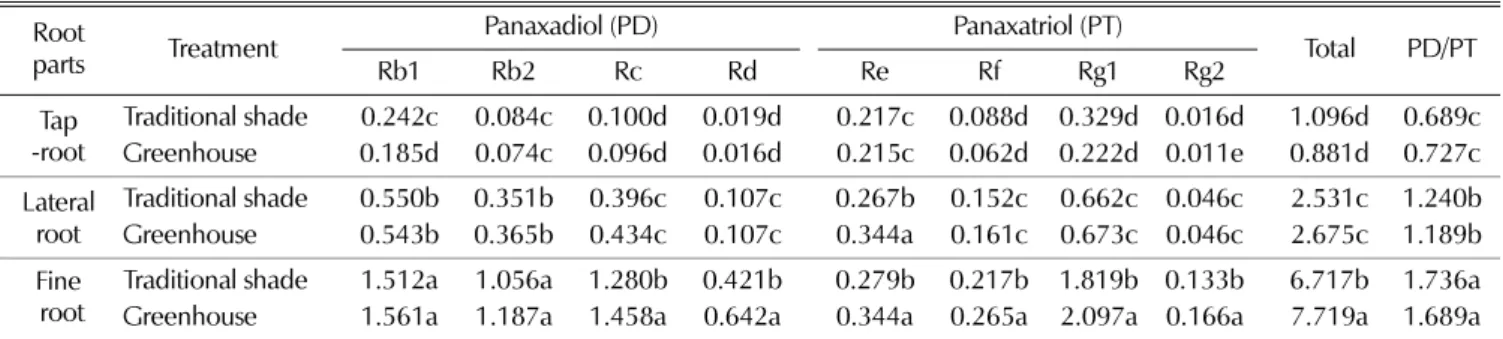
2. 비닐하우스와 관행재배 인삼의 진세노사이드 함량 비교 비닐하우스 시설재배와 관행재배에 따른 인삼의 부위별 진 세노사이드 함량을 비교한 결과는 Table 4 와 같다 . 먼저 동체 부위에서 개별 진세노사이드들의 함량차이를 보면 Rb
1과 Rg
2에서만 처리간에 유의적인 차이가 인정되었고 나머지 진세노 사이드들에서는 유의적인 차이가 없었으며 , 총함량에서도 유
의적인 차이가 인정되지 않았다 . 지근 부위에서는 Re 에서만 처리 간 유의적인 차이가 인정되었고 나머지 진세노사이드들 이나 총함량에서는 처리 간 유의적인 차이가 없었다 . 세근 부 위에서는 Rc, Rd, Re, Rf, Rg
1, Rg
2및 총함량에서 처리 간 유의적이 차이를 보였고 Rb
1과 Rb
2는 유의적인 차이를 보이
지 않았다 . 위 사실을 종합해 보면 동체나 지근보다 세근부위 에서 더 많은 개별 진세노사이드 함량들이 처리 간에 유의적 인 차이를 보였다 . 한편 , 비닐하우스 재배 인삼의 진세노사이
드 총함량을 보면 지근과 세근 부위에서는 관행보다 증가되었 으나 건물중의 대다수를 차지하는 동체부위에서는 관행보다 약간 감소되었다 . 이와 같이 인삼뿌리에서 가장 높은 비율을 차지하고 있는 동체 부위의 총진세노사이드 함량은 감소되었 는데 , 안 등 (2002) 과 John 등 (2004) 는 가을철에 수확기가 늦어질수록 잎의 생존기간이 길어져 근중은 증가되나 진세노 사이드 함량은 감소된다고 하였으며 , Li 등 (2009) 은 인삼뿌리
의 직경이 클수록 총진세노사이드 함량은 감소된다고 하였다 .
뇌두를 제외하고 동체 , 지근 및 세근으로 나누어 분석한 진 세노사이드 함량 (Table 4) 을 인삼 한 뿌리당 총진세노사이드
함량으로 환산한 결과 (Table 5) 하우스재배와 관행재배는 유
의적 차이를 보이지 않았다 . 이는 하우스 재배가 관행보다 동
Table 2.
Comparison of growth characteristics and root yield of 3-year-old ginseng between traditional shade facility and vinyl greenhouse with 30
osloped-curtain made of aluminum.
Treatment Infected leaf ratio
(%)
†Survived root ratio
(%)
length Stem (
㎝)
length Leaf (
㎝)
width Leaf (
㎝)
Tap root diameter (
㎜)
length Root (
㎝)
weight Root (g/plant)
Root yield (g/3.3
㎡)
Traditional shade 77.9a 82.1a 16.4b 58.9b 4.3b 15.2b 27.2a 19.9b 5,746 (100)b
Greenhouse 55.7b 82.0a 25.3a 11.8a 5.2a 19.3a 28.3a 29.6a 1,072 (144)a
*Mean with same letters are not significantly different in DMRT (p = 0.05).
†Rate of infected plant by Alternaria blight and Anthracnose on August 28
‡Variety: Jagyeongjung, Soil type: paddy soil, Drainage class: imperfectly drained class.
Table 3.
Comparison of dry matter partitioning ratio of 3-year-old ginseng cultivated with traditional shade facility and vinyl greenhouse.
Treat. Dry matter weight (g/plant) Dry matter partitioning ratio (%)
Rhizome Tap-root Lateral root Fine root Rhizome Tap-root Lateral root Fine root
Traditional shade 0.17b 5.74b 0.39b 0.59b 2.5b 83.2a 55.6b 8.7a
Greenhouse 0.40a 9.17a 1.64a 1.05a 3.3a 74.9b 13.3a 8.5a
*Mean with same letters are not significantly different in DMRT (p = 0.05).
†Variety: Jagyeongjung, Soil type: paddy soil, Drainage class: imperfectly drained class.
Table 4.
Ginsenoside composition of 3-year-old ginseng cultivated with traditional shade facility and vinyl greenhouse (d.w %).
Root parts Treatment Rb1 Panaxadiol (PD) Rb2 Rc Rd Re Panaxatriol (PT) Rf Rg1 Rg2 Total PD/PT -root Tap Traditional shade 0.242c 0.084c 0.100d 0.019d 0.217c 0.088d 0.329d 0.016d 1.096d 0.689c Greenhouse 0.185d 0.074c 0.096d 0.016d 0.215c 0.062d 0.222d 0.011e 0.881d 0.727c Lateral
root Traditional shade 0.550b 0.351b 0.396c 0.107c 0.267b 0.152c 0.662c 0.046c 2.531c 1.240b Greenhouse 0.543b 0.365b 0.434c 0.107c 0.344a 0.161c 0.673c 0.046c 2.675c 1.189b root Fine Traditional shade 1.512a 1.056a 1.280b 0.421b 0.279b 0.217b 1.819b 0.133b 6.717b 1.736a Greenhouse 1.561a 1.187a 1.458a 0.642a 0.344a 0.265a 2.097a 0.166a 7.719a 1.689a
*Mean with same letters are not significantly different in DMRT (p = 0.05).
†Variety: Jagyeongjung, Soil type: paddy soil, Drainage class: imperfectly drained class.
체에서의 총진세노사이드 함량은 떨어지지만 지근과 세근 부 위에서는 관행보다 높고 지근의 비율도 높았기 때문으로 생각 된다 .
LITERATURE CITED
Ahn YN, Lee YS, Choung MG, Choi KJ and Kang KH. (2002).
Ginsenoside contentration and chemical component as affected by harvest time of four-year Ginseng. Korean Journal of Crop Science. 47:216-220.
John MF, John TAP, Eric FW, Helen LB, Catherine M, and James AD. (2004). Carbohydrate and ginsenoside changes in ginseng roots growth in the Bay of Plenty, New Zealand.
Journal of Ginseng Research. 28:165-172.
Kim YH, Yu YH and Lee JH. (1990). Effect of shading on the quality of raw, red and white ginseng and the contents of some minerals in ginseng roots. Journal of Ginseng Research. 14:36- Lee CY. (2007). Effects of shading material of rain shelter on 43.
growth and quality in
Panax ginsengC. A. Meyer. Korean Journal of Medicinal Crop Science. 15:291-295.
Lee SW, Kang SW, Kim DY, Seong NS and Park HW. (2004a).
Comparison of growth characteristics and compounds of ginseng cultivated by paddy and upland cultivation. Korean
Journal of Medicinal Crop Science. 12:10-16.
Lee SW, Kang SW, Seong NS, Hyun GS, Hyun DY, Kim YC and Cha SW. (2004b). Seasonal changes of growth and extract content of roots in
Panax ginsengC. A. Meyer. Korean Journal of Medicinal Crop Science. 12:483-489.
Lee SW, Yeon BY, Hyun DY, Hyun GS, Park CG, Kim TS, and Cha SW. (2007). Effect of compost application level on seedling growth of
Panax ginsengC. A. Meyer. Korean Journal of Medicinal Crop Science. 15:138-141.
Lee SW, Kim GS, Hyun DY, Kim YB, Kang SW and Cha SW.
(2010). Effects of spraying lime-bordeaux mixture on yield, ginsenoside, and 70% ethanol extract contents of 3-year-old ginseng in
Panax ginsengC. A. Meyer. Korean Journal of Medicinal Crop Science. 18:244-247.
Lee SW, Kim GS, Yeon BY, Hyun DY, Kim YB, Kang SW and Kim YC. (2008). Comparison of growth characteristics and ginsenoside contents by drainage class and varieties in 3-year- old ginseng (
Panax ginsengC. A. Meyer). Korean Journal of Medicinal Crop Science. 17:346-351.
Lee, SW, Kim GS, Yeon BY, Hyun DY, Shin YS, Kang SW and Cha SW. (2009). Varietal difference in growth response and ginsenoside contents of two-year-old ginseng grown in paddy field with different drainage conditions. Korean Journal of Crop Science. 53:401-406.
Li Xiangguo, Kang SJ, Han JS, Kim JS and Choi JE. (2009).
Effects of root diameter within different root parts on ginsenoside composition of Yunpoong cultivars in
Panax ginsengC. A. Meyer. Korean Journal of Medicinal Crop Science. 17:452-457.
Mok SK. (2000). Standard cultivation method for ginseng. Rural Development Adminstration Press. Suwon, Korea. p. 166-169.
Oh DJ, Lee CY, Kim SM, Li GY, Lee SJ, Hwang DY, Son HJ and Won JY. (2010). Effects of chlorophyll fluorescence and photosynthesis characteristics by planting position and growth stage in
Panax ginsengC. A. Meyer. Korean Journal of Medicinal Crop Science. 18:65-69.
Table 5.