배수약간불량 논토양에서 품종 및 해가림 피복물 종류가 2년생 인삼의 생육과 진세노사이드 함량에 미치는 영향
이성우†·연병열·김충국·신유수·현동윤·강승원·차선우 농촌진흥청 국립원예특작과학원 인삼특작부
Effect of Variety and Shading Material on Growth Characteristics and Ginsenoside Contents of 2-Year-Old Ginseng (Panax ginseng C. A. Meyer)
Grown in Imperfectly Drained Paddy Soil
Sung Woo Lee†,Byeong Yeol Yeon, Chung Guk Kim, Yoo Su Shin, Dong Yun Hyun, Seung Won Kang, and Seon Woo Cha
Ginseng Research Division, Department of Herbal Crop Research, National Institute of Horticultural and Herbal Science, RDA, Eumseong 369-873, Korea.
ABSTRACT : To selection of optimal shading material, two-year-old ginseng (Panax ginseng C. A. Meyer) of new cultivar, 'Cheonpoong' (CP), and native species 'Hwangsookjong' (HS) were cultured under three kinds of shading materials such as three-layered blue and a one-layered black PE (polyethylene) net (TBSB), blue PE sheet (BS), and aluminium coated PE sheet (AS) in imperfectly drained paddy soil. Growth characteristics, yield and ginsenoside contents were investigated under three shading materials. Yield and ginsenoside contents of ginseng were distinctly affected by intensity and quality of sun- light penetrated through shading materials. Light transmission ratio, air and soil temperature according to shading materi- als were higher in order of BS, AS, and TBSB. However, ratio of aerial phase and porosity of the soil were higher in order of AS, BS, and TBSB, respectively. There was no significantly difference in the ratio of rusty colored root by shading materials.
CP showed higher stem length, leaf area, and root weight than that of HS, while the former showed distinctly lower discol- ored leaf ratio than that the other. Eight kinds of ginsenosides content of CP were higher than that of HS in Rg1, Re, Rf, Rb1 and Rc except Rg2, Rb2, and Rb3. Total ginsenoside contents of CP was distinctly higher than that of HS. Total ginsenoside contents as affected by shading materials was higher in order of BS, TBSB, and AS in CP, while TBSB, BS, and AS in HS.
Key Words : Ginseng, Shading Material, Variety, Growth Characteristics, Ginsenoside, Paddy soil
서 언
인삼에서 뿌리썩음병원균 (Cylindrocarpon destructans)은 토 양에 후벽포자 상태로 10년 이상 생존이 가능하여 연작장해를 일으키는 주원인이 되고 있다. 그런데, 인삼을 재배한 논에 벼 를 3~4년간 재배하면 병원균의 밀도가 낮아져 인삼의 연작장 해를 어느 정도 경감시킬 수 있기 때문에 풍기, 금산, 진안 등 주산지에서는 예전부터 논토양을 이용한 인삼재배가 성행 하고 있다. 그러나 지대가 낮고 지하수위가 높은 논토양에서 는 배수 불량으로 인하여 뿌리에 적변발생이 심하고 (Lee et al., 2004), 벼 재배시 수도용 복비의 연용으로 인한 토양 염 류농도의 증가 (Park et al., 1994)로 잎에 생리장해 (황증)가
발생되는 경우가 많다 (Jo et al., 1996).
이 등(1995)에 의하면 인삼 4년근 논재배 포장 76개소의 배수등급비율은 배수양호 18.4%, 약간양호 36.8%, 약간불량 42.1%, 불량 2.6%이었는데, 인삼재배가 어느 정도 가능하다고 판단되는 배수약간불량지에서는 배수불량으로 인한 습해발생 이 우려된다. 인삼 재배에 적절한 토양 수분함량은 용수량의 63% (절대수분함량 19.8%) 수준이며 (Lee et al., 2007a), 인 삼수량을 지배하는 중요한 인자는 토양수분이고 (Park et al.,
1982), 토양수분이 인삼의 생육에 미치는 영향은 뚜렷하여 통
기성을 제한하지 않는 한 지상부 생육은 토양 수분함량이 다 소 많은 편이 좋다고 하였다 (Nam et al., 1980).
해가림 피복물 종류에 따라 미기상과 토양환경이 변화되어
†Corresponding author: (Phone) +82-43-871-5543 (E-mail) [email protected]
Received October 6, 2008 / Revised November 12, 2008 / Accepted December 8, 2008
인삼의 생육 및 품질에 영향을 미치는데, 관행 볏짚해가림과 PE 차광망 해가림의 차이 (Kim et al., 1990), 해가림 색상 (Mok et al., 1994; Lee et al., 2006) 및 PE 차광망의 투광 율별 생육반응 (Lee et al., 1980)에 관한 보고가 있으나 배수 가 다소 불량한 논토양에서 차광망, 차광지 및 은박코팅지를 이용한 해가림별 생육특성 및 사포닌 성분함량 변화에 관한 연구는 찾아보기 어렵다. 따라서 습해발생이 우려되는 논토양 에서 해가림 종류별 인삼 품종의 생육특성과 진세노사이드 함 량을 조사하여 논재배 안정생산 기술개발을 위한 기초자료로 활용하고자 본시험을 수행하였다.
재료 및 방법
본 시험은 평균 지하수위가 75 ㎝인 “배수약간불량지” 논 토양 (사촌통)을 이용하여 2007년 3월부터 2008년 3월까지 음 성 소재 인삼약초연구소 시험포장에서 수행하였다. 시험에 사 용된 품종은 천풍과 황숙종의 1년생 묘삼이었으며, 해가림 피 복물로 4중직 차광망 (청색3 + 흑색1중직), 청색 차광지 및 은 박코팅지 등 3종류를 사용하였다. 묘삼 이식 전 예정지관리를 위해 2006년 5월 상순경 녹비작물로 수단그라스를 파종하고 출수기에 예취, 경운하여 토양을 관리한 후 2007년 3월 27일 두둑 폭 90 ㎝, 골 사이 90 ㎝ 의 이랑에 1년생 묘삼을 칸 (90 × 180㎝)당 7행 × 9열의 간격으로 3.3 ㎡당 63주를 정식 하였다. 예정지관리 후 토양화학성은 Table 1과 같은데, 유기 물함량과 마그네슘 함량은 인삼재배 기준치보다 약간 낮았으 며, 유효인산, 가리, 석회함량은 적정 범위 내에 있었고 염류 농도는 적정범위보다 높았다.
해가림 구조는 후주연결식 A-1형이었는데, 4월 하순경 해가 림 시설을 설치하였으며, 고온장해를 예방하기위해 6월 16일 에서 9월 10일까지 흑색 2중직 차광망 추가로 피복하였다. 기 타 재배관리는 인삼표준경작법 (농촌진흥청, 2000)에 준하였
다. 시험구 배치는 난괴법 3반복이었으며, 시험구당 면적은 13.2㎡ 이었다. 투광량, 기온 및 지온은 Li-1400 data logger (Licor, USA)를 이용하여 측정하였는데, 투광량과 기온은 지상 15㎝ 부위를, 지온은 지하 15 ㎝ 부위를 조사하였다. 이중차 광전 투광량, 기온 및 지온 측정은 6월 8일에서 6월 13일까 지, 이중차광 후에는 7월 21에서 7월 25일까지 측정하여 평균 값을 이용하였다. 토양 삼상 및 공극율 등 토양물리성은 해가 림 설치 후 8월 25일에 코어를 이용하여 측정하였다. 지상부 생육 및 잎의 생리장해 (황증) 발생율은 7월 상순에 조사하였 고 지하부 생육 및 수량성은 이듬해인 2008년 3월 하순에 조 사하였다. 수확한 인삼뿌리를 세척하고 동결건조한 후 분쇄하 여 진세노사이드 분석에 이용하였다. 진세노사이드 분석을 위 한 전처리 방법 및 분석조건은 Lee et al.(2007b)의 방법과 같다.
결과 및 고찰
1. 해가림 피복물 종류별 미기상 및 토양 물리성
4중직 차광망 (청색3+흑색1중직), 청색 차광지 및 은박코팅 지와 같이 세 종류의 해가림 피복물을 설치한 후 해가림 밑의 투광량, 기온 및 지온을 조사한 결과는 Table 2와 같다. 투광 량은 차광지 > 은박코팅지 > 차광망 순으로 차광지가 가장 높 고 차광망이 가장 낮았다. 기온과 지온도 투광율의 영향을 받 아 차광지가 가장 높고 차광망이 가장 낮았는데, 이중차광 후 에는 투광율이 작아져 이중차광 전에 비해 해가림 피복물 종 류간 기온 및 지온의 차이가 상대적으로 크지 않았다.
해가림 피복물 종류별 토양의 물리성을 조사한 결과 (Table 3) 토양의 물리적 환경은 해가림 피복물 종류 간에 큰 차이를 보이지 않았지만 대체로 은박코팅지가 차광망이나 차광지에 비해 비교적 양호한 특징을 보였다. 차광망에서 가비중, 액상 및 고상의 비율이 가장 높고 기상과 공극율이 가장 낮았는데, Table 1. Soil chemical properties of the experiment field before transplanting of ginseng seedling.
pH (1 : 5) OM (g/㎏) P2O5 (㎎/㎏) K Ex. Cation (c㏖Ca +/㎏) Mg EC (dS/m)
5.14 14.7 98 0.48 2.7 0.97 1.75
Table 2. Quantum, and the temperature of air and soil by shading materials.
Shading
materials Quantum (µ㏖/s/㎡) Air temp. (℃) Soil temp. (℃)
Single layer Double layer‡ Single layer Double layer Single layer Double layer
TBSB† 108.4( 100) 36.5 (100) 21.8 25.8 17.0 23.8
BS 321.5 (297) 44.5 (122) 23.4 26.2 19.1 24.0
AS 156.5 (144) 38.5 (105) 22.0 26.0 18.9 24.0
†Shading materials (TBSB: polyethylene shade net with threefold blue and onefold black color, BS: polyethylene shade sheet with blue color, AS:
shade sheet coated with aluminium)
‡Period of double shading: June 16~September 10
§Investigated date: single layer (June 8~13), double layer (July 21~25)
이는 누수가 되는 차광망의 특성 때문으로 생각된다. 한편, 강 우시 누수가 차단되는 차광지와 은박코팅지를 상호비교해 보 면 은박코팅지는 차광지보다 가비중과 고상의 비율이 낮고 공 극율과 기상의 비율이 높아 대체로 은박코팅지의 토양 물리성 은 차광지보다 좋았다. 이는 Table 2에서와 같이 차광지의 투 광율이 은박코팅지보다 상대적으로 높아 토양수분 증발에 의 한 토양물리성의 악화 때문으로 생각된다.
2. 품종 및 해가림 피복물 종류별 생육특성
먼저 천풍과 황숙종의 지상부 생육특성을 비교해 보면 (Table 4) 천풍은 황숙종보다 황증 발생이 약간 많았으나 생존율이 높 고 경장, 엽장 및 엽폭이 커 지상부 생육이 더 좋은 특징을 보 였다. 한편, 해가림 종류별 생육특성을 비교해 보면 두 품종 모 두 차광망에서 엽장이 가장 크고 황증 발생율이 가장 낮았으 며, 차광지에서는 생존율이 가장 높고 경장, 엽장 및 엽폭이 가 장 작았다. 본 시험에서 2년근의 지하부 생존율이 비교적 낮았 던 원인은 논토양으로 배수가 약간 불량하고 토양염류가 허용 범위 (1.0 dS/m)보다 높았기 때문으로 보인다. 그리고 은박코팅 지에서는 생존율이 가장 낮았으나 경장, 엽장 및 엽폭이 가장 컸다. 이와 같이 차광망과 차광지가 은박코팅지보다 생존율이
높았던 원인은 청색광의 투입으로 인한 병해발생 억제 (Kim and Chung, 1992) 때문으로 보이며, 차광망과 차광지에서 지상 부 생육이 억제되었는데, Lee et al. (2006)도 청색광의 투입이 증가할수록 잎과 줄기의 신장이 억제된다고 하였다.
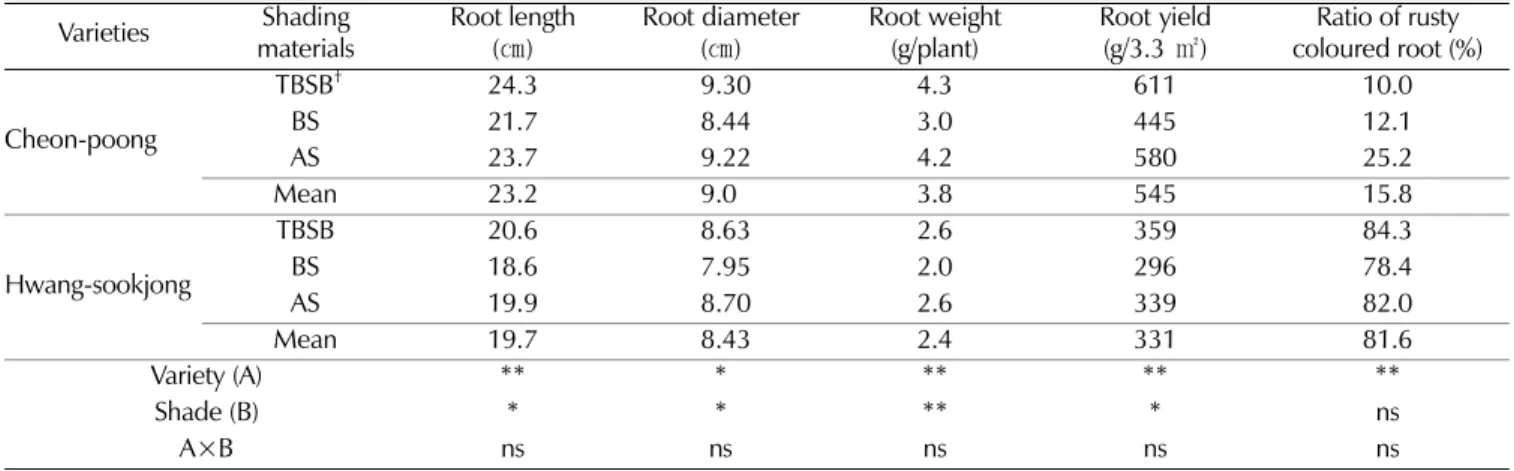
천풍과 황숙종의 지하부 생육특성을 비교해 보면 신품종인 천풍은 재래종인 황숙종보다 근장, 근직경, 주당근중 및 수량 성이 더 양호하였으며, 뿌리의 적변 발생율도 뚜렷이 낮은 특 징을 보였는데, Chung et al. (1995)도 황숙종의 적변율이 매 우 높다고 하였다. 한편, 해가림 피복물 종류별 지하부 생육특 성을 비교해 보면 두 품종 모두 차광망에서는 근장, 주당근중 및 수량성이 가장 크고 차광지에서는 주당근중 및 수량성이 가장 작은 특징을 보여 해가림 피복물 종류별 2년근의 수량성 은 차광망 > 은박코팅지 > 차광지 순이었다. 차광망의 수량성 이 가장 높았던 원인은 생존율이 비교적 높고 황증 발생율이 가장 낮았기 때문이며, 차광지의 수량성이 가장 낮았던 원인 은 지나친 투광량의 증가로 인한 엽면적의 감소와 황증 발생 율의 증가 때문으로 판단된다.
적변율은 토양의 과습과 과건, 미숙 유기물 시용, 높은 토양 염류농도 조건에서 발생이 증가되는데 (Park et al., 2006), 해 가림 피복물 종류 간에는 유의적인 차이를 보이지 않았다. 이 Table 3. Comparison of soil physical properties by shading materials in paddy soil.
Shading
materials Bulk density
(g/㎤) Three phase (%) Porosity
Aerial Liquid Solid (%)
TBSB† 1.246 36.9 16.1 47.0 53.0
BS 1.237 37.5 15.8 46.7 53.3
AS 1.214 38.4 15.8 45.8 54.2
†Shading materials (TBSB: polyethylene shade net with threefold blue and onefold black color, BS: polyethylene shade sheet with blue color, AS:
shade sheet coated with aluminium)
‡Investigated date: October 25
Table 4. Growth characteristics of two-year-old ginseng by varieties and shading materials in paddy soil.
Varieties Shading
materials Ratio of
Survived root (%) Stemlength
(㎝) Leaf length
(㎝) Leaf width
(㎝) Ratio of
discolored leaf (%)
Cheon-poong
TBSB† 72.0 5.4 7.0 3.3 8.3
BS 73.3 4.7 6.3 3.0 9.2
AS 68.7 5.5 6.9 3.4 11.2
Mean 71.3 5.2 6.7 3.2 9.6
Hwang-sookjong
TBSB 68.0 3.8 5.7 2.8 6.1
BS 71.5 3.6 5.4 2.7 10.8
AS 65.0 3.9 5.6 2.8 8.2
Mean 68.2 3.8 5.6 2.8 8.4
Variety(A) ns ** ** ** ns
Shade(B) ns ns ** ** ns
A×B ns ns ns * ns
*,** Significant at 0.05 and 0.01 levels, respectively
†Shading materials (TBSB: polyethylene shade net with threefold blue and onefold black color, BS: polyethylene shade sheet with blue color, AS:
shade sheet coated with aluminium)
‡Investigated date: July 10, 2007
는 본 시험이 수행된 논포장의 지하수위가 높은 관계로 해가 림 피복물 종류에 따라 Table 3에서와 같이 토양수분함량의 차이가 크지 않았기 때문으로 생각된다.
3. 품종 및 해가림 피복물 종류별 진세노사이드 함량 천풍과 황숙종의 진세노사이드 함량을 비교해 보면 (Table 6) 대체로 천풍의 개별 진세노사이드 함량들은 황숙종보다 높은 특징을 보였다. 즉, 천풍의 Rg1, Re, Rf, Rb1, Rc는 황숙종보 다 높았고, Rg2와 Rb3는 황숙종과 비슷하였으며, 단지 Rb2만 이 황숙종보다 약간 낮았다. 따라서 총 진세노사이드 함량은 천풍이 황숙종보다 매우 높았다. 한편, 해가림 피복물 종류별 진세노사이드 함량을 보면 Re와 Rb1만이 해가림 피복물 종 류에 따라 유의적인 차이를 보였다. 총 진세노사이드 함량은
해가림 피복물 종류에 따라 유의적인 차이를 보였는데, 천풍 에서는 차광지 > 차광망 > 은박코팅지 순이었고, 황숙종에서는 차광망 > 차광지 > 은박코팅지 순으로 품종에 따라 그 순서는 조금 달랐지만 대체로 차광지와 차광망에서 가장 높고 은박코 팅지에서 가장 낮은 특징을 보였다. 차광지에서 총 진세노사 이드 함량이 가장 높았던 원인은 투광량의 지나친 증가로 인 한 근 비대생장의 억제와 사포닌 생합성량의 증가 때문으로 보이는데, Lee et al. (1983)도 지나친 투광량의 증가는 근중 을 감소시키나 사포닌 함량을 증가시킨다고 하였다. 또한 본 시험에서 차광망이 은박코팅지보다 수량은 약간 떨어지나 사 포닌 함량이 증가되었는데, 이는 토양물리성의 악화로 인한 근 생장의 감소와 청색광의 해가림 내 투입으로 인한 영향 (Lee et al., 2007b) 때문으로 생각된다.
Table 5. Root growth characteristics and yield of two-year-old ginseng by varieties and shading materials in paddy soil.
Varieties Shading
materials Root length
(㎝) Root diameter
(㎝) Root weight
(g/plant) Root yield
(g/3.3 ㎡) Ratio of rusty coloured root (%)
Cheon-poong
TBSB† 24.3 9.30 4.3 611 10.0
BS 21.7 8.44 3.0 445 12.1
AS 23.7 9.22 4.2 580 25.2
Mean 23.2 9.0 3.8 545 15.8
Hwang-sookjong
TBSB 20.6 8.63 2.6 359 84.3
BS 18.6 7.95 2.0 296 78.4
AS 19.9 8.70 2.6 339 82.0
Mean 19.7 8.43 2.4 331 81.6
Variety (A) ** * ** ** **
Shade (B) * * ** * ns
A×B ns ns ns ns ns
*,** Significant at 0.05 and 0.01 levels, respectively
†Shading materials (TBSB: polyethylene shade net with threefold blue and onefold black color, BS: polyethylene shade sheet with blue color, AS:
shade sheet coated with aluminium)
‡Investigation date: March 20, 2008
Table 6. Ginsenoside contents of two-year-old ginseng by varieties and shading materials in paddy field.
Varieties Shading materials
Rg1 Re Rf Rg2 Rb1 Rc Rb2 Rb3 Rd Total
(%)
Cheon-poong
TBSB† 0.18 0.41 0.08 0.03 0.18 0.24 0.05 0.01 0.04 1.23
BS 0.18 0.45 0.08 0.04 0.21 0.27 0.07 0.01 0.05 1.37
AS 0.17 0.39 0.08 0.03 0.15 0.21 0.05 0.01 0.04 1.13
Mean 0.18 0.43 0.08 0.04 0.20 0.26 0.06 0.01 0.04 1.30
Hwang-sookjong
TBSB 0.09 0.32 0.05 0.03 0.15 0.09 0.09 0.02 0.03 0.88
BS 0.08 0.30 0.05 0.03 0.15 0.08 0.08 0.01 0.03 0.80
AS 0.07 0.26 0.04 0.02 0.12 0.07 0.07 0.01 0.02 0.68
Mean 0.12 0.35 0.06 0.03 0.17 0.14 0.08 0.01 0.03 0.99
Variety (A) ** ** ** ** ** ** ** ns ** **
Shade (B) ns * ns ns ** ns ns ns ns **
A×B ns ns ns ns ns ns ns ns ns ns
*,** Significant at 0.05 and 0.01 levels, respectively
†Shading materials (TBSB: polyethylene shade net with threefold blue and onefold black color, BS: polyethylene shade sheet with blue color, AS:
shade sheet coated with aluminium)
‡Investigated date: March 20, 2008
LITERATURE CITED
Chung YY, Chung CM, Ko SR and Choi KT. (1995).
Comparison of agronomic characteristics and chemical component of Panax ginseng C. A. Meyer and Panax quinquefolium L.. Journal of Ginseng Research. 19:160-164.
Jo JS, Kim CS and Won JY. (1996). Crop rotation of the Korean ginseng (Panax ginseng C. A. Meyer) and the rice in paddy field. Korean Journal of Medicinal Crop Science. 4:19-26.
Kim CH and Chung HS. (1992). Differential growth response of Rhizoctonia solani, causal organism of ginseng damping-off, to light irradiation. Research Report. Rural Development Adminstration (C. P.). 34:20-27.
Kim YH, Yu YH and Lee JH. (1990). Effect of shading on the quality of raw, red and white ginseng and the contents of some minerals in ginseng roots. Journal of Ginseng Research. 14:36- 43.
Lee JC, Cheon SK, Kim YT and Ahn SB. (1980). Studies on the effect of shading materials on the temperature, light intensity, photosynthesis and the root growth of the Korean ginseng. Korean Journal of Crop Science. 25:91-98.
Lee JC, Choi JH, Cheon SK, Lee CH and Jo JS. (1983).
Studies on the optimal light intensity for growth of Panax ginseng. Effect of light intensity on the contents of saponin and free sugar in the ginseng leaf. Korean Journal of Crop Science.
28:497-503.
Lee, IH, Kim MS, Park CS, Byen JS and Oh SH. (1995). Study on improvement of paddy-soil cultivation in ginseng. Korean Ginseng & Tobacco Research Institute Annual Report (cultural part). p. 299-317.
LeeSW,Cha SW, Hyun DY, Kim YC, Kang SW and Seong NS. (2006). Shading effect of different colored polyethylene net on seeding growth of Panax ginseng C. A. Meyer. Korean Journal of Medicinal Crop Science. 14:113-116.
Lee SW, Hyun DY, Park CG, Kim TS, Yeon BY, Kim CG and
Cha SW. (2007a). Effect of soil moisture content on photosynthesis and yield of ginseng seedling (Panax ginseng C.
A. Meyer) in Yangjik seedbed cultivation. Korean Journal of Medicinal Crop Science. 15:367-370.
Lee, SW,Kang SW, Seong NS, Hyun GS, Hyun DY, Kim YC and Cha SW. (2004). Variation of growth characteristics and quality of ginseng(Panax ginseng C. A. Meyer) grown under upland and paddy field. Korean Journal of Crop Science.
49:389-393.
Lee SW,Kim GS, Lee MJ, Hyun DY, Park CG, Park HK and Cha SW. (2007b). Effect of blue and yellow polyethylene shading net on growth characteristics and ginsenoside contents in Panax ginseng C. A. Meyer. Korean Journal of Medicinal Crop Science. 15:194-198.
Park BG, Jeon TH, Kim YH and Ho QS. (1994). Status of farmers' application rates of chemical fertilizer and farm manure for major crops. Korean Society of Soil Science and Fertilizer. 27:238-246.
Park H, Mok SK and Kim KS. (1982). Relationship between soil moisture, organic matter and plant growth in ginseng plantations. Korean Society of Soil Science and Fertilizer.
15:156-161.
Park HW, Lim TK, Choi CH and Choi JE. (2006). Factors and cause of rusty-ginseng occurrence. Korean Journal of Crop Science. 51:396-400.
Mok SK. (2000). Standard operation practice of Ginseng cultivation. SammiKihoek Press. Suwon. Republic of Korea.
77-190.
Mok SK, Cheon SK, Lee SS and Lee TS. (1994). Effect of shading net colors on the growth and saponin content of Korean ginseng(Panax ginseng C. A. Meyer). Journal of Ginseng Research. 18:182-186.
Nam KY, Park H and Lee IH. (1980). Effect of soil moisture on growth of Panax ginseng. Korean Society of Soil Science and Fertilizer. 13:71-76.