논토양에서 해가림 유형별 3년생 인삼의 생육과 진세노사이드함량 비교
이성우† ・ 김금숙 ・ 현동윤 ・ 김용범 ・ 연병열 ・ 강승원 ・ 김영철 농촌진흥청 국립원예특작과학원 인삼특작부
Comparison of Growth Characteristics and Ginsenoside Contents of 3-Year-Old Ginseng ( Panax ginseng C. A. Meyer) by Drainage Class
and Shade Material in Paddy Soil
Sung-Woo Lee†, Gum-Sook Kim, Dong-Yun Hyun, Yong-Burm Kim, Byeong-Yeol Yeon, Seung-Won Kang, and Young-Churl Kim
Ginseng Research Division, Department of Herbal Crop Research, National Institute of Horticultural and Herbal Science, RDA, Eumseong 369-873, Korea
390
†
Corresponding author: (Phone) +82-43-871-5505
(E-mail) [email protected] <Received August 23, 2009>
ABSTRACT To select optimal shade material in paddy
soil, growth characteristics and ginsenoside contents were investigated in new cultivar, 'Cheonpoong' of three-year-old ginseng cultured under three kinds of shade materials such as three-layered blue and one-layered black PE (polyethylene) net (TBPN), blue PE sheet (BPSS), and aluminium-coated PE sheet (APSS). The order of light transmission ratio and air temperature by shade materials were BPSS > APSS >TBSB among three shade materials. Average soil water tension in PDC and IDC was 64 mbar (absolute soil moisture, 25%) and 123 mbar (absolute soil moisture, 17%), respecti- vely, and soil water tension in IDC was changed more distinctly than that of PDC by season and shade materials.
Yield in PDC was distinctly decreased more than that in IDC because of the increase of discolored-leaf and rusted- root ratio. BPSS and TBPN among three shade materials were the most effective on the increase of yield in PDC and IDC, respectively. Ratio of rusty-colored root showed not significant difference by drainage class and shade materials.
Contents of panaxatriol ginsenoside (Rg1, Re and Rf) were decreased in PDC, while it of panaxadiol ginsenoside (Rb1, Rc and Rd) were increased in IDC. Total ginsenoside contents of IDC was distinctly higher than that of PDC, and BPSS showed the highest contents among three shade materials regardless of poorly and imperfectly drainage class.
Keywords : Ginseng, Shade material, Root yield,
Ginsenoside, Paddy soil, Drainage class인삼은 토양전염성 병원균인 뿌리썩음병원균(Cylindrocarpon
destructans)의 피해로 인해 연작장해가 심한 작물로 알려져
있으며(Cho et al., 1995; Rahman & Punja, 2005), 인삼 재 배 후 10~15년이 경과되어야지만 비로소 재경작이 가능하 므로(Kang et al., 2007) 뿌리썩음병원균에 오염되지 않은 초작지를 찾기란 쉽지 않다. 따라서 부족한 초작지를 대체 하기 위해 뿌리썩음병원균의 오염이 적은 논토양에서 인삼 재배을 늘려갈 수밖에 없는 실정에 있다.인삼을 재배한 논에 벼를 3~4년간 재배하면 토양전염성 병원균의 밀도가 낮아져 인삼을 재경작할 수 있기 때문에 풍기, 금산, 진안 등은 예전부터 논토양을 이용한 인삼재배 를 계속 해오고 있다. 그러나 인삼은 습해에 약한 작물이기 때문에 논에서 인삼을 재배하려면 무엇보다도 먼저 배수가 양호해야 한다. 지대가 낮고 지하수위가 높은 논토양에서는 배수 불량으로 인하여 뿌리에 적변발생이 심하고(Lee et
al., 2004), 벼 재배시 화학비료의 사용으로 인한 토양 염류
농도의 증가로(Park et al., 1994) 하부층에 집적된 비료성 분이 해가림 설치 후 모세관을 타고 표토층으로 이동, 염류 장해를 일으켜 적변삼과 뇌두부패가 일어나기 쉽게 된다(Joet al., 1996).
국내 논토양의 배수등급별 면적비율은 배수불량지 14.0%, 배수약간불량지 48.6%, 배수약간양호지 35.8%, 배수양호 지 1.6%로 배수약간불량지 이상의 등급에서는 인삼재배가 가능할 것으로 예상되어 논토양에서의 인삼 재배면적은 늘 어날 전망이다. 인삼 재배에 적절한 토양 수분함량은 용수 량의 63%(절대수분함량 19.8%) 수준인데(Lee et al., 2007a), 우량 논재배 포장의 토양수분은 평균 19.5%이나 불량포장
Table 1. Soil chemical properties and groundwater table in the experiment field of 3-year-old ginseng.
Drainage class
pH (1:5)
OM (g/kg)
P
2O
5(mg/kg)
Ex. Cation (cmol
+/kg) EC (dS/m)
Groundwater table(cm)
K Ca Mg
Poorly 5.0 15.4 105 0.47 3.60 0.97 1.36 47
Imperfectly 5.1 14.7 98 0.48 2.70 0.97 1.75 75
은 26%로 과습이 문제가 된다(Lee et al., 1995).
해가림 피복물 종류에 따라 미기상과 토양수분함량 등이 변화되어 인삼의 생육 및 품질에 영향을 미치는데, 밭토양 에서 해가림의 색상 및 투광율에 따른 인삼 생육과 사포닌 함량 변화(Mok et al., 1994; Lee et al., 2007b), 차광망과 은박차광판 해가림별 인삼 생육과 사포닌 함량 비교에 대한 보고(Lee, 2007)가 있으나 논토양에서의 연구는 미흡한 실 정이다. 따라서 배수등급이 다른 논토양에서 해가림 종류별 인삼의 생육특성과 진세노사이드 함량을 조사하여 논재배 안정생산 기술개발을 위한 기초자료로 활용하고자 본시험 을 수행하였다.
재료 및 방법
본 시험은 배수불량지(예천통)와 배수약간불량지(사촌통) 논토양에서 3종의 피복자재(청3+흑1중직 차광망, 청색 차 광지, 은박차광판)로 해가림을 설치하고 천풍 품종을 이용 하여 2007년 3월에서 2009년 3월까지 음성 소재 인삼특작 부 시험포장에서 수행하였다. 배수등급이 다른 포장을 선정 하기위해 바로 인접한 논토양에서 지하수위의 높낮이를 기 준으로 배수불량지와 배수약간불량지 논토양을 선정하였는 데, 연평균 지하수위는 배수불량지 47 cm, 배수약간불량지 75 cm 이었다.
묘삼 정식 전 2006년 5월 상순경 수단그라스를 파종하고 출수기(7월 하순)에 예취, 경운하여 예정지를 관리하였다.
2007년 3월 27일 두둑 폭 90 cm, 골사이 90 cm의 이랑에 1년생 천풍 품종의 묘삼을 7행 × 9열의 간격으로 3.3 m2 당 63주 정식하였다. 이랑방향을 설정하기 위해 나침반을 놓고 120°와 300° 지점을 연결하는 선을 긋고 이와 평행하게 이 랑을 만들었다. 3년생 인삼이 생육중인 시험포장의 토양화 학성은 표 1과 같은데, 유기물과 Mg함량은 인삼 재배 기준 치보다 낮았으며, 유효인산, 가리 및 석회함량은 적정 범위 내에 있었고 염류농도는 다소 높은 수준이었다.
해가림 유형에 따른 인삼 생육특성을 구명하기위해 후주 연결식 A형 해가림 구조위에 4중직 차광망(청색 3 + 흑색 1), 청색 차광지 및 은박차광판으로 4월 하순에 해가림 피 복물을 설치하였다. 6월 15일에서 9월 10일까지 기존 해가
림 위에 흑색 2중직 차광망을 추가로 피복하여 고온장해를 예방하였다. 기타 재배관리는 농촌진흥청 인삼표준경작법 에 준하였다. 시험구 배치는 난괴법 3반복이었으며, 시험구 당 면적은 33 m2 이었다. 해가림별 투광량 및 기온은 Li-1400 data logger(Licor, USA)를 이용하여 측정하였는데, 투광량 과 기온은 지상 15cm 부위를 조사하였다. 이중차광전 투광 량 및 기온 측정은 6월 8일에서 6월 13일까지, 이중차광 후 에는 7월 21에서 7월 25일까지 측정하여 평균값을 이용하 였다. 배수등급 및 해가림 유형별 토양수분장력을 조사하기 위해 35cm의 석고막대를 15cm 깊이로 묻고 6월 하순부터 9월 하순까지 Tensiometer(Soil Management System, USA) 로 측정하였으며, 인근 양질사토의 밭토양(청색 차광지 해 가림구)에도 동일하게 센서를 설치하여 논토양과 상대비교 하였다. 지상부 생육 및 잎의 생리장해(황증) 발생율은 208 년 7월 20일에 조사하였고 지하부 생육 및 수량성은 2009 년 3월 하순에 조사하였다. 뿌리의 적변율은 공식(X1×0)+
(X2×1)+(X3×2)+(X4×3)/(X1+X2+X3+X4), (X1: 무증상, X2: 경미한 적변, X3: 중간정도의 적변, X4: 심한 적변)를 이용하여 계산하였다. 수확된 인삼뿌리를 세척 후 동결 건 조하여 진세노사이드 분석에 이용하였는데, 진세노사이드 분석을 위한 전처리 방법 및 분석조건은 Lee et al.(2007b) 의 방법과 같다. 배수등급, 해가림 유형 및 상호작용에 대한 통계분석은 SAS 통계 프로그램을 이용하였다.
결과 및 고찰
해가림 유형별 투광량, 기온 및 토양수분함량
4중직 차광망, 청색 차광지 및 은박차광판 등 3종의 해가 림 밑에서 투광량 및 기온을 조사한 결과는 표 2와 같다. 해 가림 유형별 투광량은 차광지 > 은박차광판 > 차광망 순으 로 차광지에서 가장 많고 차광망에서 가장 적었다. 은박차 광판는 직사광선이 투과되지 않으나 산란광이 많이 들어와 차광망보다 투광량이 더 높았다. 여름철 흑색 2중직 차광망 으로 이중피복한 후에는 전체적으로 투광량이 줄어들어 해 가림 유형별 광량의 차이가 크지 않았다. 해가림 밑의 기온 은 투광율의 영향을 받아 차광지에서 가장 높고 차광망에서 가장 낮았는데, 이중차광 후에는 투광율이 작아져 해가림
Table 2. Quantum and air temperature by shade materials.
Shade materials
Quantum (μmol/s/m
2) Air temp.(℃)
Single layer Double layer
‡Single layer Double layer
TBPN
†108.4(100)
§36.5(100) 21.8 25.8
BPSS 321.5(297) 44.5(122) 23.4 26.2
APSS 156.5(144) 38.5(105) 22.0 26.0
Outdoor 865.7 273.7 26.6 30.1
†
Three-layered blue and one-layered black PE (polyethylene) net (TBPN), blue PE sheet (BPSS), and aluminium-coated PE sheet (APSS)
‡
Period of twofold shade: June 16 ~ September 10.
§Investigated date: single layer (June 8~13), double layer (July 21~25),
♩ Investigated date: July 7
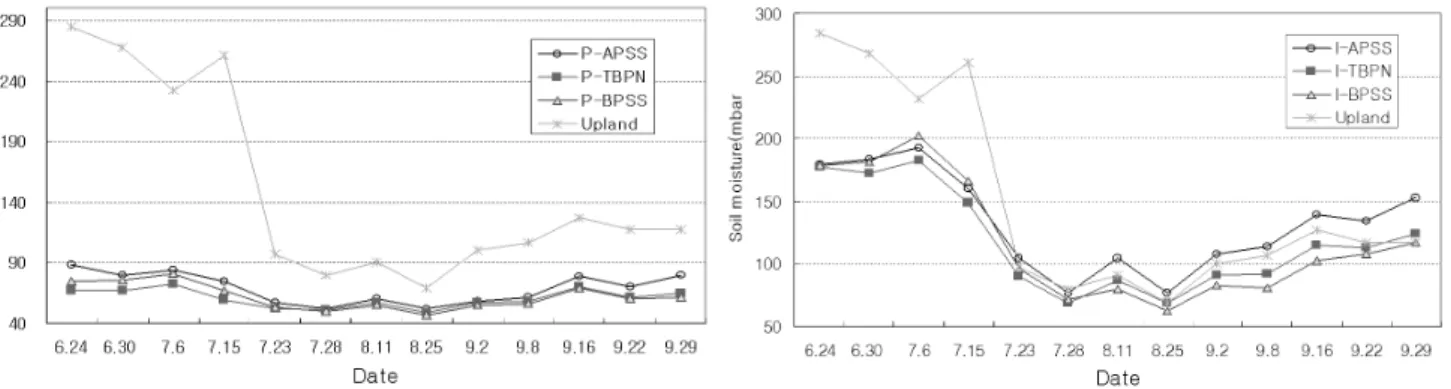
Fig. 1. Change of soil water tension (mbar) by shade materials in poorly drained class(upper) and imperfectly drained class(under). TBPN: Three-layered blue and one-layered black PE (polyethylene) net, BPSS: blue PE sheet, APSS:
aluminium-coated PE sheet
유형별 기온 차이가 크지 않았으며, 차광망과 은박차광판은 그 차이가 크지 않았다.
배수등급과 해가림 유형별 토양수분장력의 변화는 그림 1과 같다. 대체로 논토양에서는 봄·가을에 토양수분장력이 크고 여름철에는 작았는데, 배수불량구에서 토양수분장력 은 평균 64 mbar(절대토양수분함량 25%)로 계절에 따라 그 변화의 폭이 작아 과습상태를 유지하였으나 배수약간불 량지에서는 평균 123 mbar(절대수분함량 17%)의 60~200 mbar의 범위에서 계절적 변화를 보였으며, 토양수분조건은 배수불량지보다 양호한 편이었다. Lee et al. (2007a)에 의 하면 묘삼은 100 mbar 수준에서 가장 높은 수량성을 보였 다고 하였다. 한편, 배수불량지에서는 해가림 유형별 토양 수분장력의 차이가 뚜렷하지 않았는데, 배수가 불량한 논토 양에서는 토양수분이 주로 상하이동보다 횡으로 이동하는 특성이 강하기 때문으로 판단된다(Hur et al., 2009). 배수 약간불량지에서의 토양수분장력은 해가림 유형별로 다소 차이를 보였지만 그 차이는 크지 않아 과습하기 쉬운 논토 양에서 해가림 유형에 따른 토양수분함량의 변화는 적은 것 으로 보인다.
배수등급과 해가림 유형별 지상부 생육특성
배수등급과 해가림 유형별 지상부 생육특성을 조사한 결 과는 표 3과 같다. 먼저 배수등급에 따른 생육특성을 비교 해 보면 배수불량지에서는 경장, 엽장 및 엽폭이 작아지고 엽록소함량과 황증 발생율은 유의적으로 증가되었는데, Lee et al.(2008b)도 배수불량지 논토양에서 황증발생이 많 다고 하였다. 해가림 유형에 따라 생존율, 엽록소함량 및 황 증 발생율은 유의적인 차이를 보였으나 경장, 엽장 및 엽폭 은 유의적 차이를 보이지 않았다. 한편, 배수등급과 해가림 유형의 교호작용을 보면 엽록소함량과 황증 발생율은 유의 성이 인정되었고 생존율, 경장, 엽장 및 엽폭은 유의성이 인 정되지 않았다.
청색 차광지에서 배수등급에 관계없이 생존율이 높았던 원인은 청색광의 투입으로 인한 병해발생 억제(Kim & Chung, 1992) 때문으로 보인다. 또한, 청색 차광지에서 지상부 생 육이 억제되었는데, Lee et al. (2006)도 청색광의 투입이 증가할수록 인삼 잎과 줄기의 신장이 억제된다고 하였다.
Table 3. Growth characteristics of three-year-old ginseng by drainage classes and shade materials in paddy soil.
Drainage classes
Shade materials
Ratio of Survived root
(%)
Stem length
(cm)
Leaf length
(cm)
Leaf width
(cm)
Chlorophyll content (mg/g, FW)
Ratio of discolored
leaf(%)
Poorly
TBPN
†76.8 20.4 9.6 4.2 2.25 58.0
BPSS 92.9 16.5 8.6 3.8 2.52 32.1
APSS 80.7 19.2 9.2 4.3 2.12 64.6
Aver. 84.85 18.45 9.10 4.00 2.38 45.05
Imperfectly
TBPN 87.9 22.7 10.6 4.6 2.21 27.4
BPSS 90.1 21.2 9.8 4.3 2.02 30.0
APSS 64.6 24.8 11.0 4.9 2.19 25.0
Aver. 87.62 20.78 9.83 4.30 2.20 34.15
Drainage(A) ns ** * * ** **
Shade(B) ** ns ns ns * **
A×B ns ns ns ns ** **
*, ** Significant at 0.05 and 0.01 levels, respectively
†
Three-layered blue and one-layered black PE (polyethylene) net (TBPN), blue PE sheet (BPSS), and aluminium-coated PE sheet (APSS)
‡
Variety: Cheonpoong, Investigated date: July 20, 2008
Table 4. Unerground growth and root yield of three-year-old ginseng by drainage classes and shade materials in paddy soil.
Drainage classes
Shade materials
Tap root length
(cm)
Tap root diameter (mm)
Root length
(cm)
Root weight (g/plant)
Root yield (g/3.3m
2)
Rusty root indexz
Poorly
TBPN
†6.9 13.7 23.4 5.5 302.4 1.37
BPSS 8.3 15.9 28.0 12.3 839.5 1.33
APSS 7.7 10.5 20.5 4.4 264.0 1.13
Aver. 7.6 13.4 24.0 7.40 468.6 1.28
Imperfectly
TBPN 8.6 16.3 25.9 16.1 1014.5 1.27
BPSS 9.7 14.4 24.9 14.3 902.0 1.12
APSS 8.4 22.1 21.1 13.6 612.6 1.41
Aver. 8.9 17.6 24.0 14.7 843.0 1.27
Drainage(A) ** ** ** ** ** ns
Shade(B) ** * ns ** ** ns
A×B ns ns ** ** * **
*, ** Significant at 0.05 and 0.01 levels, respectively
†
Three-layered blue and one-layered black PE (polyethylene) net (TBPN), blue PE sheet (BPSS), and aluminium-coated PE sheet (APSS)
‡
Variety: Cheonpoong, Investigated date: March 20, 2009
z Rusty coloured root index: (X1×0)+(X2×1)+(X3×2)+(X4×3)/(X1+X2+X3+X4), X1: no visible lesions, X2: slight lesions, X3:
medium lesions, X4: serious lesions
배수등급 및 해가림 유형별 수량성
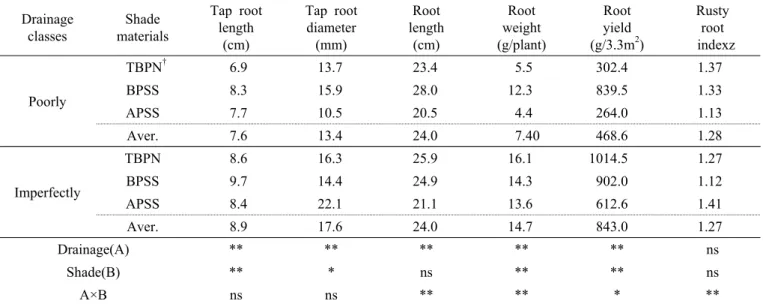
배수등급과 해가림 유형별 지하부 생육 및 수량성을 조사 한 결과는 표 4와 같다. 먼저 배수등급에 따른 지하부 특성
을 비교해 보면 배수불량지에서는 동체장, 동체직경, 주당 근중, 수량성이 유의적으로 감소하였으나 적변 발생율은 유 의적인 차이를 보이지 않았다. 해가림 유형에 따라 동체장,
Table 5. Ginsenoside contents of three-year-old ginseng by drainage classes and shade materials in paddy field.
Drainage classes
Shade materials
Rg
1Re Rf Rg
2Rb
1Rc Rb
2Rd Total
(%)
Poorly
TBPN
†0.71 0.33 0.13 0.04 0.40 0.54 0.10 0.10 2.35
BPSS 0.79 0.34 0.17 0.05 0.42 0.64 0.14 0.13 2.68
APSS 0.66 0.27 0.13 0.04 0.31 0.45 0.11 0.07 2.04
Aver. 0.75 0.34 0.15 0.04 0.41 0.59 0.12 0.12 2.52
Imperfectly
TBPN 0.86 0.37 0.17 0.05 0.31 0.46 0.13 0.08 2.43
BPSS 0.89 0.43 0.19 0.05 0.39 0.52 0.15 0.09 2.71
APSS 0.87 0.39 0.21 0.05 0.33 0.46 0.12 0.08 2.51
Aver. 0.83 0.38 0.17 0.05 0.37 0.52 0.13 0.10 2.55
Drainage(A) ** ** ** ns * ** ns ** *
Shade(B) ns ** ns ns ** ** ** ** **
A×B ns ns ns ns * * ns ** ns
*, ** Significant at 0.05 and 0.01 levels, respectively
†Three-layered blue and one-layered black PE (polyethylene) net (TBPN), blue PE sheet (BPSS), and aluminium-coated PE sheet (APSS)
‡Variety: Cheonpoong, Investigated date: March 20, 2009 동체직경, 주당근중, 수량성은 유의적인 차이를 보였으나 근장과 적변 발생율은 유의적인 차이를 보이지 않았다. 한 편, 배수등급과 해가림 유형의 교호작용을 보면 근장, 주당 근중, 수량성 및 적변 발생율은 유의성이 인정되었고 동체 장과 동체직경은 유의성이 인정되지 않았다. 적변은 토양의 과습과 과건, 미숙 유기물 시용, 높은 토양염류농도에서 증 가되는데 (Park et al., 2006), 본 시험에서 적변율이 배수등 급에 따라 유의적인 차이를 보이지 않은 것은 토양수분과 토양염류농도 및 인산함량 등이 복합적으로 작용하여 적변 을 일으키기 때문으로 생각된다 (Lee et al., 2008c).
배수불량지에서 수량성은 청색 차광지가 가장 양호하였 는데, 그 이유는 엽록소함량이 높고 황증과 적변 발생율이 낮았기 때문으로 생각된다. 본 시험에서 배수불량지처럼 토 양수분함량이 높은 곳에서는 차광지처럼 투광율이 높을 경 우 수량도 뚜렷이 증가되었는데, 토양수분이 충분한 조건에 서는 투광량이 높을수록 광합성량이 증가하고 고온장해율 도 감소된다는 보고와 비슷한 결과를 보였다 (Lee et al., 2007a; Lee et al., 2008c).
배수약간불량지에서 수량성은 차광망이 가장 양호하였는 데, 이는 엽록소함량이 가장 높고 황증 발생율이 적었기 때 문으로 생각된다. 또한, 차광망은 수분을 가장 많이 요구하 는 봄철에 토양수분함량이 가장 많아 차광지보다 한발피해 가 적었다 (그림 1). 은박차광판은 지하부 생존율의 저하와 적변율 증가로 인한 주당근중의 감소로 가장 낮은 수량성을
보였는데, 그 원인은 A형 해가림의 특성상 전주높이가 180cm으로 너무 높아 2년근에서 고온피해를 받았을 것으 로 추측할 수 있지만 금후 더 자세한 원인 분석이 필요할 것으로 생각된다.
배수등급 및 해가림 유형별 진세노사이드 함량
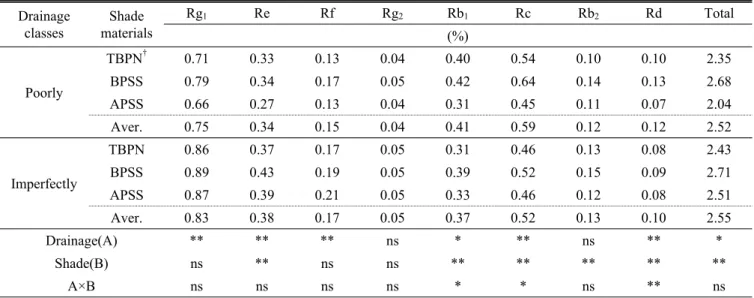
배수등급 및 해가림 유형에 따른 진세노사이드 함량을 비 교한 결과는 표 5와 같다. 먼저 배수등급에 따른 함량을 비 교해 보면 배수불량지는 배수약간불량지보다 총 진세노사 이드 함량이 더 낮았는데, 진세노사이드 Rg2와 Rb2을 제외 한 6종의 개별 진세노사이드 성분들은 모두 배수등급에 따 라 유의성이 인정되었다. 배수불량지는 Panaxatriol계열의 Rg1, Re 및 Rf 함량이 감소되고 Panaxadiol계열의 Rb1, Rc 및 Rd 함량은 증가되었다. 해가림 유형에 따라 Re, Rb1, Rc, Rb2, Rd 및 총진세노사이드 함량은 유의성이 인정되었 으나 Rg1, Rf 및 Rg2는 유의성이 인정되지 않았다. 배수등 급과 해가림 유형의 교호작용은 Rb1, Rc, Rd에서만 유의성 이 인정되었다.
배수불량지에서 해가림 유형별 총 진세노사이드 함량은 차광지 > 차광망 > 은박차광판 순이었고 배수약간불량지에 서는 차광지 > 은박차광판 > 차광망 순으로 배수등급에 관 계없이 차광지에서 가장 높은 특징을 보였다. 청색 차광지 에서 총진세노사이드 함량이 가장 높았던 원인은 차광지의 투광량이 가장 많고 황증 발생율도 낮아 잎에서의 사포닌
생합성량이 많았기 때문으로 생각되는데, Lee et al. (1983) 와 Lee et al. (2008a)도 투광량의 증가는 사포닌 함량을 증 가시킨다고 하였다.
적 요
인삼 논재배 안전생산기술을 개발하기 위해 배수불량지 와 배수약간불량지 논토양에서 청3+흑1중직 차광망, 청색 차광지 및 은박차광판 해가림을 처리하여 3년생 천풍의 생 육특성 및 진세노사이드 함량을 조사한 결과는 다음과 같 다. 해가림 유형별 투광량과 기온은 차광지 > 은박차광판 >
차광망 순이었다. 배수불량지의 토양수분장력은 평균 64 mbar (절대토양수분함량 25%)로 과습한 조건이었으며, 배 수약간불량지에서는 평균 123 mbar (절대수분함량 17%) 이었다. 배수불량지의 토양수분장력은 계절과 해가림 유형 별 뚜렷한 차이를 보이지 않았지만 배수약간불량지에서는 60~200 mbar의 범위에서 계절적 변화를 보였으며, 해가림 유형에 따라 약간의 차이를 보였다. 배수불량지의 수량성은 황증과 적변 발생율의 증가로 배수약간불량지보다 현저히 감소되었다. 해가림 유형별 수량성은 배수불량지에서 차광 지가, 배수약간불량지에서 차광망이 가장 높았다. 적변 발 생율은 배수등급과 해가림 유형에 따라 일정한 경향이 없었 다. 배수불량지는 Panaxatriol 계열 (Rg1, Re 및 Rf)의 진세 노사이드 함량이 감소되고 Panaxadiol 계열 (Rb1, Rc 및 Rd)의 함량이 증가되었다. 총 진세노사이드 함량은 배수불 량지보다 배수약간불량지에서 높았으며, 해가림 유형별 총 진세노사이드 함량은 배수등급에 관계없이 차광지에서 가 장 높았다.
인용문헌