• 검색 결과가 없습니다.

Isolated, Broad-Based Apical Diverticulum: Cardiac Magnetic Resonance Is a “Terminator” of Cardiac Imaging Modality for the Evaluation of Cardiac Apex

N/A
N/A
Protected

Academic year: 2022

Share "Isolated, Broad-Based Apical Diverticulum: Cardiac Magnetic Resonance Is a “Terminator” of Cardiac Imaging Modality for the Evaluation of Cardiac Apex"

Copied!
3
0
0

로드 중.... (전체 텍스트 보기)

전체 글

(1)

702 Copyright © 2013 The Korean Society of Cardiology Korean Circulation Journal

Introduction

Since its first description in 1838,

1)

cardiac diverticulum has been rarely reported, particularly when first diagnosed in adulthood.

2)3)

Although classic clinical features include congenital malformations involving the abdominal wall, sternum, diaphragm, pericardium, limb and myocardium, isolated left ventricular (LV) diverticulum is also described in about 30% of the cases. The differentiation of isolated apical diverticulum from apical aneurysm is a great challenge, par- ticularly when it is first found in adulthood. We describe here an adult case of isolated left apical diverticulum that could not have been accurately diagnosed in the absence of cardiac magnetic res- onance (CMR) technique.

Case Report

http://dx.doi.org/10.4070/kcj.2013.43.10.702 Print ISSN 1738-5520 • On-line ISSN 1738-5555

Isolated, Broad-Based Apical Diverticulum: Cardiac Magnetic Resonance Is a “Terminator” of Cardiac Imaging Modality for the Evaluation of Cardiac Apex

Hyo-Suk Ahn, MD 1,2 , Hyung-Kwan Kim, MD 1,2 , Eun-Ah Park, MD 3 , Whal Lee, MD 3 , Jae-Hyung Park, MD 3 , and Dae-Won Sohn, MD 1,2

1

Cardiovascular Center, Seoul National University Hospital, Seoul,

2
Departments of Internal Medicine and

3

Radiology, Seoul National University College of Medicine, Seoul, Korea

In spite of the frequent involvement of many cardiac diseases, it is difficult to evaluate the left ventricular apex in detail with transtho- racic echocardiography, a first-line imaging modality in cardiovascular diseases, because the apex is very closely located at the echocar- diographic probe. Cardiac magnetic resonance enables us to evaluate the cardiac apex without any limitation to the image acquisition.

We here present a case regarding a broad-based apical diverticulum, which was initially confused with apical aneurysm. (Korean Circ J 2013;43:702-704)

KEY WORDS: Diverticulum; Heart aneurysm, magnetic resonance imaging.

Received: February 27, 2013 Revision Received: May 14, 2013 Accepted: May 22, 2013

Correspondence: Hyung-Kwan Kim, MD, Division of Cardiology, Depart- ment of Internal Medicine, Seoul National University College of Medicine, 101 Daehak-ro, Jongno-gu, Seoul 110-744, Korea

Tel: 82-2-2072-0243, Fax: 82-2-762-2253 E-mail: [email protected]

• The authors have no financial conflicts of interest.

This is an Open Access article distributed under the terms of the Creative Commons Attribution Non-Commercial License (http://creativecommons.

org/licenses/by-nc/3.0) which permits unrestricted non-commercial use, distribution, and reproduction in any medium, provided the original work is properly cited.

Case

A 30-year-old woman was referred to our center with complaints of headache and right side weakness. Her medical history was unre- markable except for intermittent migraine attacks. She had no clini- cal risk factors for cerebrovascular disease. Small multifocal cerebral infarctions were found in her brain through brain magnetic reson- ance imaging. With suspicion of a cardiac source of embolism, tr- ansthoracic echocardiography was performed, which revealed api- cal akinetic movement with a band-like structure (arrow in Fig. 1A) in the LV. LV opacification with echocardiographic contrast showed no evidence of apical thrombi (Fig. 1B).

4)

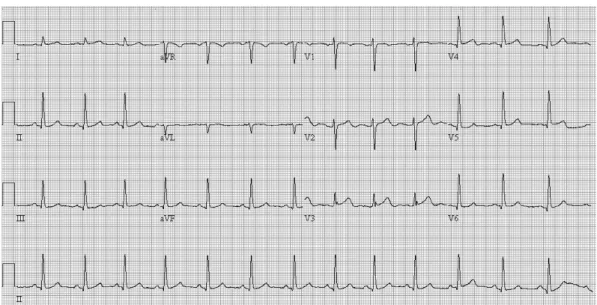
Initial electrocardiogram did not suggest any sign of apical aneurysm, like ST elevation in ante- rior leads (Fig. 2). Computed tomographic thoracoabdominal angio- graphy revealed normal findings, including no atherosclerosis (Fig.

3). In addition, she was young and had no risk factors for coronary

artery disease, suggesting the impression that the chance for myo-

cardial infarction was not high. For further evaluation of LV apex,

CMR was ordered. The CMR identified a broad-based apical diver-

ticulum (2.6×3.0 cm-sized) with mechanical activity, nearly synch-

ronous with LV activity (Fig. 4A and B), along with an LV ejection

fraction of 43%. Interestingly, delayed enhancement of CMR (DE-

CMR) conveyed high signal intensity in some parts of diverticulum

(Fig. 4C, D and E). She was finally diagnosed with a huge, isolated LV

apical diverticulum with mixed muscular and fibrous type. On an-

(2)

703 Hyo-Suk Ahn, et al.

http://dx.doi.org/10.4070/kcj.2013.43.10.702 www.e-kcj.org

ticoagulation with warfarin, she was given permission to leave the hospital.

Discussion

Echocardiography is believed to be the first-line imaging modali-

ty for cardiac evaluation and can offer numerous invaluable infor- mation of the heart, including anatomy, function and hemodynam- ics. However, a thorough evaluation of LV apex with echocardio- graphy is sometimes challenging due to its close proximity to the position of the echocardiographic probe. Moreover, an accurate tissue characterization with echocardiography cannot be success-

A B

Fig. 1. Transthoracic echocardiographic images. A: apical 4-chamber view reveals a band-like structure in the left ventricle (LV) (arrow). B: LV opacification with echocardiographic contrast proves the absence of apical thrombus.

Fig. 2. Initial electrocardiography (ECG). ECG finding does not reveal any evidence of apical aneurysm.

Fig. 3. Computed tomographic thoracoabdominal angiography reveals normal findings, including no atherosclerosis.

(3)

704 Apical Diverticulum in CMR

http://dx.doi.org/10.4070/kcj.2013.43.10.702 www.e-kcj.org

ful. CMR can overcome this limitation and, almost always, provide clear LV apical images. In addition, DE-CMR offers histologic inform- ation on the myocardial tissue of interest, especially the presence or absence of fibrous tissue.

5)6)

With these 2 unique abilities, CMR is able to establish the diagnosis of LV diverticulum and its types (i.e., fibrous or muscular). It can differentiate diverticulum from aneu- rysm as well. In the present case, without CMR, LV apical diverticu- lum would have been misdiagnosed with apical aneurysm. However, thanks to the unique CMR ability of tissue characterization, the fact that a mixture of fibrous and contractile myocardial tissues consti- tutes apical diverticulum, which could not be achieved even using contrast echocardiography, could be identified. Therefore, we believe that CMR should be regarded as a “terminator” of cardiac imaging modalities in the evaluation of LV apex and, as such, be used more actively in our daily clinical practice in order to establish a proper di- agnosis of LV apical pathology.

References

1. O’Bryan. In: Peacock TB, editor. On Malformations of the Human Heart,

2nd ed. London, UK: Churchill & Sons;1866.

2. Paz Y, Fridman E, Shakalia FM, Danieli J, Mishaly D. Repair of an isolat- ed huge congenital left ventricular diverticulum. J Thorac Cardiovasc Surg 2004;128:313-4.

3. Ohlow MA. Congenital left ventricular aneurysms and diverticula: defi- nition, pathophysiology, clinical relevance and treatment. Cardiology 2006;106:63-72.

4. Weinsaft JW, Kim HW, Crowley AL, et al. LV thrombus detection by routine echocardiography: insights into performance characteristics using delayed enhancement CMR. JACC Cardiovasc Imaging 2011;4:

702-12.

5. Kim RJ, Fieno DS, Parrish TB, et al. Relationship of MRI delayed contrast enhancement to irreversible injury, infarct age, and contractile func- tion. Circulation 1999;100:1992-2002.

6. Moon JC, Reed E, Sheppard MN, et al. The histologic basis of late gado- linium enhancement cardiovascular magnetic resonance in hypertro- phic cardiomyopathy. J Am Coll Cardiol 2004;43:2260-4.

Fig. 4. End-systolic (A) and end-diastolic (B) 4-chamber images of the cardiac cine steady-state procession cardiac magnetic resonance imaging. Ten-min- ute delayed cardiac magnetic resonance images with phase-sensitive inversion recovery sequence after administration of gadopentetate dimeglumine clearly demonstrate subendocardial hyperenhancement (C, D and E).

A

D

B

E

C

수치

Fig. 2. Initial electrocardiography (ECG). ECG finding does not reveal any evidence of apical aneurysm.
Fig. 4. End-systolic (A) and end-diastolic (B) 4-chamber images of the cardiac cine steady-state procession cardiac magnetic resonance imaging

참조

관련 문서

1 John Owen, Justification by Faith Alone, in The Works of John Owen, ed. John Bolt, trans. Scott Clark, "Do This and Live: Christ's Active Obedience as the

The present study examined the accuracy of cardiac rhythm analysis with an automated external defibrillator during ambulance transfer using human body models

A Study on the Wireless Power Transmission of magnetic resonance using Superconducting

Consequently, Zr-Cu binary alloys have the potential to be used as biomaterials with nullifying magnetic properties for magnetic resonance imaging diagnosis and

The purpose of this study was to identify the frequency and related factors of advanced airway management for patients with cardiac arrest by the

Result: During the study period, 482 patients had elevated cardiac troponin-T levels. The positive predictive value for the.. The diagnostic importance of

Approved clinical use of bone marrow stem cells for myocardial infarction treatment... Cardiac

The magnetic flux leakage inspection method is more advanced than the magnetic particle inspection method in terms of quantitative evaluation and can detect flaws and