Chemotherapy
Received: February 22, 2018 Accepted: June 15, 2018 Published online: June 19, 2018 Corresponding Author: Yo Han Park, MD
Department of Internal Medicine, Yeoncheon-gun Health Center and Country Hospital, 95 Eundaesung-ro, Jeongok-eup, Yeoncheon-gun 11027, Gyeonggi-do, Korea
Tel: +82-31-839-4001, Fax: +82-31-839-4191 E-mail: [email protected]
This is an Open Access article distributed under the terms of the Creative Commons Attribution Non-Commercial License (http://creativecommons.org/licenses/by-nc/3.0) which permits unrestricted non-commercial use, distribution, and repro- duction in any medium, provided the original work is properly cited.
Copyrights © 2018 by The Korean Society of Infectious Diseases | Korean Society for Chemotherapy
www.icjournal.org
Absence of a Seasonal Variation of Hemorrhagic Fever with Renal Syndrome in Yeoncheon
Compared to Nationwide Korea
Yo Han Park
Department of Internal Medicine, Yeoncheon-gun Health Center and Country Hospital, Gyeonggi-do, Korea
Background: Yeoncheon is an endemic region for hemorrhagic fever with renal syndrome (HFRS) and has been reporting HFRS cases intermittently in other seasons, including autumn. This study was conducted to determine whether a seasonal variation pattern of HFRS exists in Yeoncheon.
Materials and Methods: From 2002 to 2016, raw data of the number of patients with HFRS in Yeoncheon and nationwide was collected from the Korea Center for Disease Control and Prevention. On the basis of the raw data, the incidence per 100,000 population was calculated for each month of the year. The twelve months were divided into four quarters, and the proportion of the disease by each quarter was calculated. The effects of sex, age, quarter, and time on HFRS occurrence were analyzed by Poisson regression analysis.
Results: A total of 6,132 HFRS cases occurred nationwide, and 62 cases occurred in Yeoncheon. The incidence of the disease in Yeoncheon (9.07/100,000) was statistically higher than that nationwide (0.81/100,000). The quarterly incidence showed that occurrence proportion of HFRS was high in the third and fourth quarters (12.9%, 67.5%) nationwide, whereas it was relatively similar in all quarters in Yeoncheon (17.7%, 21.0%, 25.8%, 35.5%). The Poisson regression model showed that the relative risk of HFRS nationwide was 1.322 in the third quarter and 6.903 in the fourth quarter, but Yeoncheon had no risk increase by quar- ter.
Conclusion: In this study, HFRS in Yeoncheon demonstrated no seasonal variation pattern compared to that in nationwide Ko- rea, which may be considered a regional characteristic. Furthermore, in other regions where HFRS is endemic, like Yeoncheon, HFRS may arise regardless of seasonal variations.
Key Words: Hemorrhagic fever with renal syndrome; Seasonal variation; Epidemiology; Endemic diseases Infect Chemother 2018;50(2):120-127
ISSN 2093-2340 (Print) · ISSN 2092-6448 (Online)
Introduction
Hemorrhagic fever with renal syndrome (HFRS) is a ro- dent-borne zoonotic infectious disease that has widely spread over Europe and Asia. The major species of Hantaviruses that cause the disease in humans are the Hantaan, Seoul, and Pumala viruses [1-3]. In the Republic of Korea, two viruses, Hantaan virus and Seoul virus, are known as the major caus- ative viruses. These viruses cause chronic infections in certain species of rodents, and these rodents infect humans through aerosols, fomites from feces, urine, and saliva [2-6]. The Han- taan virus, which is carried by the striped field mouse (Apo- demus agrarius and Apodemus peninsulae), usually causes a severe form of HFRS in rural areas and shows seasonal varia- tion patterns. On the other hand, the Seoul virus, which is car- ried by domestic and laboratory rats (Rattus norvegicus and Rattus rattus), usually causes a relatively milder form of the disease in urban areas and does not show seasonal variation patterns [6, 7].
HFRS is characterized by a triad of symptoms, which in- clude fever, hemorrhagic manifestations such as petechiae, and renal impairment, but there are no specific symptoms of HFRS. Generally, patients complain of various symptoms such as sudden fever, eye symptoms, gastrointestinal symp- toms, and other nonspecific symptoms. Therefore, a serologic test is essential for diagnosis [3, 8-10]. Although the clinical course of HFRS differs from patient to patient, a previous study in Korea reported that 77% of patients with HFRS had acute kidney injury, 14.3% required renal replacement thera- py, and 34.3% required intensive care unit (ICU) admission [8]. Regarding these statistics, HFRS is a disease that requires active conservative managements, such as ICU admission and renal replacement therapy, and may lead to death if the ap- propriate managements are not performed. Therefore, HFRS must be accurately diagnosed at an early stage.
HFRS shows a specific seasonal variation pattern in Korea.
There are major epidemic periods (autumn, October-Decem- ber) and minor epidemic periods (late spring, May-July) of HFRS each year [10-12]. The literature suggests several hy- potheses for this specific seasonal variation. First, people are more likely to be exposed to the disease because of the in- creased associated activities, such as harvesting, in rural areas.
Second, rodent behavior changes during the autumn climate [13-15].
Some previous studies have investigated the epidemiology of HFRS in Korea, which showed a higher incidence of HFRS in Yeoncheon than in other regions. A study of HFRS epidemi-
ology from 1996 to 1998 reported that the incidence of HFRS in Yeoncheon was 2.3-6.3 per 100,000 individuals, which was much higher than the national average (0.81 per 100,000) [13, 16]. In a nationwide study of HFRS epidemiology in Korea that was conducted from 2001 to 2010, 17.2% (678/3,953) of HFRS cases occurred in the Gyeonggi province, which includes Yeo- ncheon, and this province showed a higher incidence than any other region in Korea [16]. In addition, Yeoncheon bor- ders North Korea, which is composed of a higher military population than in other regions, which performs more out- door activities, regardless of the season. Unlike other regions where HFRS generally occurs in autumn, Yeoncheon has been intermittently reporting HFRS cases in other seasons, includ- ing autumn [10, 17]. Clinicians in Korea usually suspect HFRS when encountering patients with unexplained fever in au- tumn, but they might not suspect HFRS in other seasons. If there is a tendency for HFRS to occur in seasons other than autumn in Yeoncheon, there might be at risk of clinicians in Yeoncheon misdiagnosing the disease.
The aim of this study is to observe the occurrence pattern of HFRS in Yeoncheon and compared these patterns to nation- wide trends. Particularly, we compared the seasonal variation pattern of the disease between Yeoncheon and nationwide Korea excluding Yeoncheon.
Materials and Methods
1. Data collection
In the Republic of Korea, HFRS is classified as a national no- tifiable infectious disease (Category III), that is, a disease that must be declared to the country. Thus, the occurrence of all HFRS cases can be identified by the data from the National Notifiable Disease Surveillance System (NNDSS) website of the Korean Center for Disease Control and Prevention (KCDC). From 2002 to 2016, raw data of the number of pa- tients with HFRS in Yeoncheon and nationwide, excluding Yeoncheon, by year, month, sex, and age were collected [17].
The data of the population provided by the Korea National Statistical Office were used to collect the occupational infor- mation and total population in Yeoncheon and nationwide, excluding Yeoncheon [18]. All of the nationwide data present- ed in this study were analyzed, with the exclusion of the pa- tients and population of Yeoncheon.
On the basis of the raw data, the incidence per 100,000 indi- viduals was calculated for each month of the year, in Yeo- ncheon and nationwide. The proportion of disease occurrence
according to sex, age, and month between Yeoncheon and na- tionwide was compared.
The patients were divided into two groups: those under 29 years and those over 30 years of age, as the Korean military is mostly composed of males under 30 years of age and Yeo- ncheon has larger military population than the other regions.
Twelve months were divided into four quarters (January to March, April to June, July to September, and October to De- cember), and the proportion of the disease occurrence was calculated by quarters. Finally, the effects of sex, age, quarter, and time on HFRS occurrence were analyzed.
2. Statistical analysis
The statistical analyses were performed using IBM®SPSS®
software, version 18 (IBM Corporation, Armonk, NY, USA).
The statistical significance of the differences between the two populations was analyzed using the Ɠ2 test, Fisher’s exact test, Mann–Whitney U-test, and a two-tailed unpaired Student’s t-test, as appropriate. Poisson generalized linear multivariate regression analysis was performed to investigate the effects of sex, age, quarter, and time on HFRS occurrence. P-values less than 0.05 were considered statistically significant.
Results
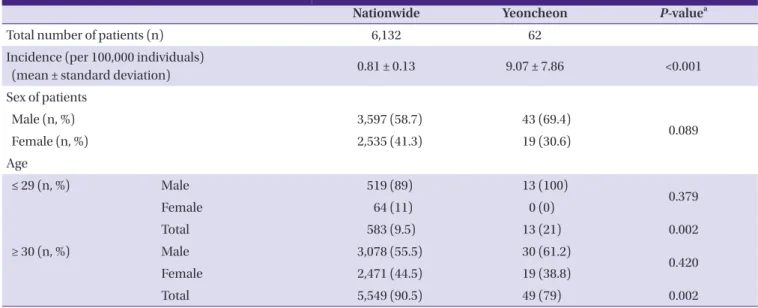
From 2002 to 2016, 6,132 cases of HFRS occurred nation- wide and 62 cases occurred in Yeoncheon. The incidence of
HFRS was significantly higher in Yeoncheon (9.07/100,000 in- dividuals) than nationwide (0.81/100,000 individuals). There was no statistically significant difference in HFRS occurrence according to sex. However, the proportion of patients with HFRS who were under 29 years of age was significantly higher in Yeoncheon (21% vs. 9.5%), and notably, all of the patients were male (Table 1).
Table 2 shows the average monthly incidences of HFRS per 100,000 individuals over 15 years. Except for January, August, November, and December, Yeoncheon showed higher inci- dences in all months than the nationwide data, with statistical significance.
The proportion of HFRS occurrence nationwide was 9.8% in the first quarter, 9.7% in the second quarter, 12.9% in the third quarter, and 67.5% in the fourth quarter. The nationwide oc- currence was higher in the third quarter and the fourth quar- ter than other quarters, whereas Yeoncheon reported occur- rences of 17.7%, 21.0%, 25.8%, and 35.5% in each respective quarter. Although the occurrence in the third and fourth quar- ters in Yeoncheon were slightly higher than those in the other quarters, these differences were small. The proportion of HFRS occurrence in Yeoncheon was significantly higher in the first, second, and third quarters and was significantly lower in the fourth quarter than the respective occurrences reported nationwide (Table 3).
A Poisson generalized linear multivariate regression analy- sis was performed to examine the effects of sex, age, quarter, and time on HFRS occurrence. HFRS incidence has signifi-
Table 1. Comparison of the total number of patients, incidences, and other aspects of hemorrhagic fever with renal syndrome between the nationwide and Yeoncheon cohorts
Nationwide Yeoncheon P-valuea
Total number of patients (n) 6,132 62
Incidence (per 100,000 individuals)
(mean ± standard deviation) 0.81 ± 0.13 9.07 ± 7.86 <0.001
Sex of patients
Male (n, %) 3,597 (58.7) 43 (69.4)
0.089
Female (n, %) 2,535 (41.3) 19 (30.6)
Age
≤ 29 (n, %) Male 519 (89) 13 (100)
0.379
Female 64 (11) 0 (0)
Total 583 (9.5) 13 (21) 0.002
≥ 30 (n, %) Male 3,078 (55.5) 30 (61.2)
0.420
Female 2,471 (44.5) 19 (38.8)
Total 5,549 (90.5) 49 (79) 0.002
aStatistical significance was tested by the Mann-Whitney U test for continuous variables and by the Ɠ2 or Fisher’s exact tests for categorical variables.
cantly increased by 1.121-fold over 15 years in Yeoncheon, whereas no significant increase was observed nationwide. The relative risk (RR) according to sex was significantly higher in males, by 1.419-fold nationwide and by 2.263-fold in Yeo- ncheon. The RR of age over 30 years was significantly higher, by 5.474-fold nationwide. However, the RR of age over 30 years was not statistically significant in Yeoncheon. The RR according to quarter nationwide was 1.322 in the third quarter and 6.903 in the fourth quarter, with significance. However, the RR according to quarter in Yeoncheon was not statistically significant (Table 4).
The Poisson regression analysis, which was performed to ex- amine the effects of each quarter on HFRS occurrence in indi- viduals who were either under 29 years of age or over 30, showed that the RR according to quarter in the nationwide
cohort was 3.901 in fourth quarter in the younger age group and 1.328 and 7.372 in third quarter and fourth quarters, re- spectively, in the older age group. However, in Yeoncheon, the RR of each quarter for HFRS occurrence did not significant differ by age group (Table 5).
Figure 1 shows the monthly trends of HFRS incidence in the nationwide and Yeoncheon cohorts, by the total population and by each age group. In the nationwide group, the HFRS oc- currence was noticeably increased from October to December in all age groups. However, unlike the nationwide data, the in- cidence of HFRS in Yeoncheon was not limited to the period from October to December in all age groups. A seasonal varia- tion pattern did not appear in any of the age groups in Yeo- ncheon.
Table 2. Comparison of the monthly incidence averages of hemorrhagic fever with renal syndrome between the nationwide and Yeoncheon cohorts.
Nationwide (per 100,000 individuals)a
Yeoncheon
(per 100,000 individuals)a P-valueb
January 0.042 ± 0.013 0.876 ± 1.382 0.113
February 0.020 ± 0.006 0.292 ± 0.770 <0.001
March 0.017 ± 0.006 0.437 ± 1.223 <0.001
April 0.016 ± 0.007 0.440 ± 0.911 0.004
May 0.029 ± 0.013 0.879 ± 1.620 0.026
June 0.033 ± 0.014 0.585 ± 1.302 0.004
July 0.029 ± 0.011 1.027 ± 2.482 0.004
August 0.029 ± 0.015 1.169 ± 1.825 0.113
September 0.046 ± 0.020 0.146 ± 0.565 <0.001
October 0.173 ± 0.041 0.586 ± 1.005 0.026
November 0.258 ± 0.067 1.615 ± 1.943 0.754
December 0.119 ± 0.025 1.021 ± 1.819 0.113
aAll variables are expressed as mean ± standard deviation.
bStatistical significance was tested by the t -test or the Mann-Whitney U test.
Table 3. Comparison of hemorrhagic fever with renal syndrome occurrence by quarter between the nationwide and Yeoncheon cohorts.
Nationwidea Yeoncheona P-valueb
First quarter (January-March)
600 (9.8) 11 (17.7) 0.037
Second quarter (April-June)
597 (9.7) 13 (21.0) 0.003
Third quarter (July-September)
793 (12.9) 16 (25.8) 0.003
Fourth quarter (October-December)
4,142 (67.5) 22 (35.5) <0.001
aAll variables are expressed as number (percentage).
bStatistical significance was tested by Ɠ2 or Fisher’s exact tests.
Discussion
This study compared the incidence and occurrence pattern of HFRS between Yeoncheon and nationwide cohorts, and Yeoncheon is known as the endemic region for HFRS [13, 16].
In this study, the incidence of HFRS in Yeoncheon was higher than that observed nationwide. A previous study on the epi- demiology of HFRS in Korea, which was conducted from 2001 to 2010, revealed that the incidence of HFRS was higher in males (57.0%) and in those aged 40 years or older (82.1%). In
Table 4. Poisson multivariate regression model for the analysis of the effects of sex, age, quarter, and time on the occurrence of hemorrhagic fever with renal syndrome in the nationwide and Yeoncheon cohorts
Relative risk (95% CI) P-value
Timea Nationwide 1.002 (0.996-1.007) 0.572
Yeoncheon 1.121 (1.053–1.192) <0.001
Sex
Nationwide Male 1.419 (1.349–1.493) <0.001
Female Reference .
Yeoncheon Male 2.263 (1.319–3.883) 0.003
Female Reference .
Age
Nationwide ≤29 Reference .
≥30 5.474 (5.026–5.962) <0.001
Yeoncheon ≤29 Reference .
≥30 1.665 (0.903–3.070) 0.102
1st quarter Nationwide Reference .
Yeoncheon Reference .
2nd quarter Nationwide 0.995 (0.888–1.114) 0.931
Yeoncheon 1.182 (0.529–2.638) 0.683
3rd quarter Nationwide 1.322 (1.189–1.470) <0.001
Yeoncheon 1.455 (0.675–3.134) 0.339
4th quarter Nationwide 6.903 (6.337–7.520) <0.001
Yeoncheon 2.000 (0.970–4.124) 0.061
aAs a continuous variable, the relative risk is due to an increase each year.
CI, confidence interval.
The dependent variable is the occurrence of hemorrhagic fever with renal syndrome.
Table 5. Poisson multivariate regression model for the analysis of the effect of quarter on the occurrence of hemorrhagic fever with renal syndrome in each age group of the nationwide and Yeoncheon cohorts
Nationwide Yeoncheon
Relative risk
(95% CI) P-value Relative risk
(95% CI) P-value
1st quarter ≤29 Reference Reference
≥30 Reference Reference
2nd quarter ≤29 1.012 (0.745–1.376) 0.938 1.500 (0.251–8.977) 0.657
≥30 0.992 (0.878–1.121) 0.901 1.111 (0.451–2.734) 0.819
3rd quarter ≤29 1.284 (0.960–1.717) 0.092 1.500 (0.251–8.977) 0.657
≥30 1.328 (1.185–1.488) <0.001 1.444 (0.617–3.379) 0.396
4th quarter ≤29 3.901 (3.056–4.980) <0.001 2.500 (0.485– 2.886) 0.273
≥30 7.372 (6.726–8.080) <0.001 1.889 (0.842–4.237) 0.123
CI, confidence interval.
The dependent variable is the occurrence of hemorrhagic fever with renal syndrome.
this study, the proportion of males among patients with HFRS was 58.7% and of the age group over 30 years was 90.5%, which is similar to results of a previous epidemiologic study [16].
Previous studies have reported that the incidence of HFRS shows a seasonal variation pattern, which has a major epi- demic period in autumn and a minor epidemic period in late spring [10-12]. This is presumably because the start of a dry climate in autumn, increased agriculture-related activities such as harvesting, and increased activity of infected rodents [13-15]. A study that investigated the influence of climatic fac- tors on the development of HFRS and leptospirosis shows that increasing daily minimum temperatures induced higher inci- dences of HFRS [19], and rainfall or humid environments in- duced lower incidences of the disease [19, 20]. The authors
hypothesized that rodent behaviors change according to tem- perature, humidity, and weather. Also, they reported that lon- ger exposer to sunshine induces a higher incidence of HFRS [19]. The authors suspect that plant flowering and seed pro- duction increases as sunshine time prolongs, which would contribute to an increase in the population and density of ro- dents [19, 21]. These findings suggest that HFRS seasonal vari- ations might be due to increased activity of and frequency of contact between humans and infected rodents in autumn.
However, the results of this study showed that the incidenc- es of HFRS showed little variations by season in Yeoncheon, and the Poisson generalized linear regression analysis showed that seasons did not significantly increase the risk of HFRS outbreaks in Yeoncheon. This suggests that the occurrence of HFRS in Yeoncheon does not show a seasonal variation pat-
Figure. 1. Monthly trends of hemorrhagic fever with renal syndrome (HFRS) occurrences, in the total study population and in each age group. (A) Monthly trends of HFRS incidences in the nationwide cohort. (B) Monthly trends of HFRS incidences in Yeoncheon cohort.
A
B
tern. The factors that can influence the occurrence of HFRS are thought to be human behavior factors and rodent behav- ior factors. The number of military personnel who perform many outdoor activities, regardless of the season, is higher in Yeoncheon than in other regions because Yeoncheon on the border of North Korea. In this study, the proportion of male patients with HFRS who were under 29 years of age was high- er in Yeoncheon than in the national population (Table 1).
This may be because of Yeonechon’s large military population.
However, the Poisson regression analysis (Table 5) and the monthly HFRS occurrence trends (Fig. 1) showed no seasonal variation patterns in both age groups in Yeoncheon, which suggests that the HFRS occurrence patterns do not differ be- tween the military population and the general population, which is mostly composed of farmers. This may indicate that the absence of HFRS seasonal variations in Yeoncheon is not because of human behavioral factors.
Ryou et al. investigated the seropositive rates of Hantavirus in wild rodents in five areas, except Yeoncheon, in Korea (Hwaseong, Yesan, Hapcheon, Gurye, and Jeonju). The sero- positive rates of Hantavirus in wild rodents were high from March to May and from October to December, and the inci- dence of HFRS in humans was high from October to Decem- ber, which showed that the seasonal pattern of seropositive rates in wild rodents affects the seasonal pattern of HFRS oc- currence in humans [15]. On the other hand, the seropositive rates of Hantavirus in wild rodents in the area near Yeo- ncheon was 21.7% in spring, 22.4% in summer, 26.3% in au- tumn, and 18.1% in winter, and these rates showed no season- al variation pattern [22]. Therefore, the absence of seasonal variation in HFRS occurrences in Yeoncheon may be affected by rodent behavior factors, which are thought to be more of a regional characteristic than human behavior factors.
This study has some limitations. First, this study was con- ducted through the HFRS report statistics of KCDC and lacks information on the exact viruses that were identified in con- firmed patients. The Seoul virus is known to have no seasonal variation patterns. The lack of a seasonal variation in Yeo- ncheon cannot excluded the possibility of Seoul virus infec- tion. However, previous studies have shown that Yeoncheon is an indigenous region of Hantaan virus [22, 23], so it is unlike- ly that the results have changed with the type of viruses. Sec- ond, there is no specific information about the occupation of patients with HFRS. Human activity patterns are important in the induction of Hantavirus infection, from rodents to hu- mans, and occupation is related to human activity patterns.
However, 25.7% of the total population in Yeoncheon is en-
gaged in agriculture [18]. Generally, in the rural population, a seasonal HFRS occurrence pattern has been observed be- cause of increased activity in autumn [3, 19, 21]. In addition, this study divided the population by age as under 29 years or over 30 years, considering the military population in Yeo- ncheon, and no seasonal patterns in either age group were observed. Considering these factors, the occupational charac- teristics of the Yeoncheon population may not have a signifi- cant effect on HFRS occurrence patterns. Third, the total num- ber of HFRS patients during the 15 years, from 2002 to 2016, was 62, which was relatively small. This suggests that the oc- currences of one or two patients in Yeoncheon may impact the occurrence pattern and disease incidence, due to the small sample size. In addition, the statistical significance of RR according to quarter in the Poisson regression analysis may have also been affected by the small sample size. However, even if the RRs had been significant, the RRs were higher in the second and third quarters and lower in the fourth quarter in Yeoncheon, compared to nationwide observations. There- fore, Yeoncheon still does not have a distinct seasonal varia- tion pattern, compared to the nationwide results. Although this study was conducted by collecting relatively long-term data for 15 years, the limited number of patients is inevitable because of the small area of Yeoncheon, and it is difficult to find methods to overcome this limitation.
In conclusion, this study confirmed the lack of a distinct sea- sonal variation of HFRS occurrence in Yeoncheon. Clinicians generally suspect HFRS in the autumn, when they treat a pa- tient with an unexplained fever, but in other seasons, the dis- ease may be missed or misdiagnosed. In the case of HFRS, it is important to perform active conservative managements and diagnose the disease early. Failure to make such a diagnosis may result in serious risks. Therefore, in Yeoncheon, serologic tests should be performed in other seasons, including au- tumn, if a patient complains of an unexplained fever. This study is meaningful, as it provided objective data for perform- ing serologic tests in patients with HFRS with unexplained fe- ver in other seasons than autumn in Yeoncheon. Furthermore, in other regions where HFRS is endemic, HFRS may arise without seasonal variation, similar to its that in Yeoncheon. In the future studies, it will be necessary to investigate whether this seasonal variation is observed in other regions where HFRS is endemic.
Conflicts of interest
No conflicts of interest.
ORCID
Yo Han Park https://orcid.org/0000-0001-7416-1841
References
1. Schmaljohn CS, Hasty SE, Dalrymple JM, LeDuc JW, Lee HW, von Bonsdorff CH, Brummer-Korvenkontio M, Va- heri A, Tsai TF, Regnery HL. Antigenic and genetic proper- ties of viruses linked to hemorrhagic fever with renal syn- drome. Science 1985;227:1041-4.
2. LeDuc JW. Epidemiology of Hantaan and related viruses.
Lab Anim Sci 1987;37:413-8.
3. Lee HW, van der Groen G. Hemorrhagic fever with renal syndrome. Prog Med Virol 1989;36:62-102.
4. Tsai TF. Hemorrhagic fever with renal syndrome: mode of transmission to humans. Lab Anim Sci 1987;37:428-30.
5. Lee HW, Baek LJ, Johnson KM. Isolation of Hantaan virus, the etiologic agent of Korean hemorrhagic fever, from wild urban rats. J Infect Dis 1982;146:638-44.
6. Lee HW, Lee PW, Johnson KM. Isolation of the etiologic agent of Korean hemorrhagic fever. 1978. J Infect Dis 2004;190:1711-21.
7. Lee HW, Johnson KM. Laboratory-acquired infections with Hantaan virus, the etiologic agent of Korean hemor- rhagic fever. J Infect Dis 1982;146:645-51.
8. Noh JY, Cheong HJ, Song JY, Kim WJ, Song KJ, Klein TA, Lee SH, Yanagihara R, Song JW. Clinical and molecular epidemiological features of hemorrhagic fever with renal syndrome in Korea over a 10-year period. J Clin Virol 2013;58:11-7.
9. Kim HJ, Han SW. Diagnostic challenge of hemorrhagic fe- ver with renal syndrome on admission before its serologi- cal confirmation. Korean J Nephrol 2004;23:82-91.
10. Lee HW. Hemorrhagic fever with renal syndrome in Ko- rea. Rev Infect Dis 1989;11 (Suppl 4):S864-76.
11. Park JH, Yeh MH, Hwang YJ, Dixon KE. A case-control study of risk factors for hemorrhagic fever with renal syn- drome in Korean soldiers. Korean J Epidemiol 1994;16:41- 53.
12. Yang CW, Jang DH, Cho YH, Bang BK, Lee HW. Epidemio- logic study of hemorrhagic fever with renal syndrome in Ko- rean military: 1985-1990. Korean J Intern Med 1992;42:802-8.
13. Song JY, Chun BC, Kim SD, Baek LJ, Kim SH, Sohn JW, Cheong HJ, Kim WJ, Park SC, Kim MJ. Epidemiology of
hemorrhagic fever with renal syndrome in endemic area of the Republic of Korea, 1995-1998. J Korean Med Sci 2006;21:614-20.
14. Mills JN, Gage KL, Khan AS. Potential influence of climate change on vector-borne and zoonotic diseases: a review and proposed research plan. Environ Health Perspect 2010;118:1507-14.
15. Ryou J, Lee HI, Yoo YJ, Noh YT, Yun SM, Kim SY, Shin EH, Han MG, Ju YR. Prevalence of hantavirus infection in wild rodents from five provinces in Korea, 2007. J Wildl Dis 2011;47:427-32.
16. Lee SH, Chung BH, Lee WC, Choi IS. Epidemiology of hemorrhagic fever with renal syndrome in Korea, 2001- 2010. J Korean Med Sci 2013;28:1552-4.
17. Korea Center for Disease Control and Prevention (KCDC).
Hemorrhagic fever with renal syndrome: statistical system of the national notifiable disease surveillance system (2002-2016). Available at: http://is.cdc.go.kr/dstat/index.
jsp. Accessed 7 September 2017.
18. Korea National Statistical Office. A comprehensive analy- sis of the population and household census (2008-2016).
Available at: http://www.census.go.kr/mainView.do. Ac- cessed 7 September 2017.
19. Joshi YP, Kim EH, Cheong HK. The influence of climatic factors on the development of hemorrhagic fever with re- nal syndrome and leptospirosis during the peak season in Korea: an ecologic study. BMC Infect Dis 2017;17:406.
20. Bi P, Wu X, Zhang F, Parton KA, Tong S. Seasonal rainfall variability, the incidence of hemorrhagic fever with renal syndrome, and prediction of the disease in low-lying areas of China. Am J Epidemiol 1998;148:276-81.
21. Aars J, Ims RA. Intrinsic and climatic determinants of pop- ulation demography: the winter dynamics of tundra voles.
Ecology 2002;83:3449-56.
22. Klein TA, Kang HJ, Gu SH, Moon S, Shim SH, Park YM, Lee SY, Kim HC, Chong ST, O’Guinn M, Lee JS, Turell MJ, Song JW. Hantaan virus surveillance targeting small mammals at Dagmar North Training Area, Gyeonggi Province, Re- public of Korea, 2001-2005. J Vector Ecol 2011;36:373-81.
23. Klein TA, Kim HC, Chong ST, O’Guinn ML, Lee JS, Turell MJ, Sames WJ, Gu SH, Kang HJ, Moon S, Lee SY, Chun Y, Song JW. Hantaan virus surveillance in small mammals at firing points 10 and 60, Yeoncheon, Gyeonggi Province, Republic of Korea. Vector Borne Zoonotic Dis 2012;12:674- 82.