• 검색 결과가 없습니다.

The Changes of Health Care Utilization and Cause of Outpatients at an Oriental Medicine Hospital

N/A
N/A
Protected

Academic year: 2021

Share "The Changes of Health Care Utilization and Cause of Outpatients at an Oriental Medicine Hospital"

Copied!
9
0
0

로드 중.... (전체 텍스트 보기)

전체 글

(1)

Introduction

As the concept of primary health care, western medical hospitals and clinics, oriental medical hospitals and clinics, public health centers and drug stores are usually utilized by people in Korea. The choice of primary health care insti- tutions is entirely up to patients who consume medical care. However, under the current situation of the medical system without the unification of medical care, the collaborative

diagnosis or consultation system for western and oriental medical care has not been established yet except at very limited hospitals and clinics, and both kinds of medical care are separated

1,2)

. Under these current circumstances, the appr- opriateness of patients in selecting medical institutions, overlapped diagnosis and the evalu- ations for unnecessary dual diagnosis have not been made. In addition, the western medical care system has always been indifferent to the oriental medical care. However, the oriental medical care system evidently exists as the one taking a certain size of the current medical care system.

By the year 1996, 6,253 oriental medical hospitals and clinics were located around the country, and the size was approximately 40 % of 15,744 western medical hospitals and clinics

3,4)

.

received : 8 November 2007

received in revised from : 10 November 2007 accepted : 30 November 2007

Correspondence to : Ji-Yong Kim

Department of Family Medicine, Dongguk University Bun- dang Oriental Hospital, Sunae-dong Bundang-gu, Seongnam- si Kyeonggi-do, Korea

(Tel : +82-31-710-3745 / Fax : +82-31-710-3779 E-mail : [email protected])

The Changes of Health Care Utilization and Cause of Outpatients at an Oriental Medicine Hospital

Ji-Yong Kim

1

, Seong-Sik Park

2

1

Department of Family Medicine, Medical College, Dongguk University

2
Department of Sasang Constitutional Medicine, Dongguk University Original Article

Objectives : The aim of this study was to investigate the changes of attitude toward the oriental medicine for 10 years.

Methods : A questionnaire was done about general characteristic of patient, the decision-maker of use and the reason of choice or alteration for oriental medicine hospital.

Results : The results of this survey are as follows: For 10 years, sex ratio of outpatients is similar, but age distribution is even at all ages. The choice for oriental medicine is more determined by oneself than by others. The recommenders are more variable increasingly. The most common cause of moving from western medicine is to get the more effective treatment. The more the concomitant users are increasing, the more the patients that did not give notice to the western doctor about the dual therapies is increasing, also. The most frequent reason without a notice is “being afraid of western doctor's bias”.

Conclusions : The appropriate transfer system between oriental and western clinic must be constructed and the proper recognition about dual therapies will be needed among patients and especially dual doctors.

Key Words : oriental medicine, concomitant user, health behavior

(2)

However the numbers of doctors in oriental medical care system were only 9,299, which took up approximately 16 % of 59,397 in western medical care system

3)

. In the year 2005, the total oriental medical hospitals and clinics were counted to be 9,911, and the western medical hospitals and clinics were counted to be 26,673. The numbers of doctors in the oriental medical care system were 15,271 and the number of western medical doctor was counted to be 85,369

3)

. Namely, the increase of hospitals and numbers of doctors for the last 10 years did show similar trends of change in both of oriental and western medical systems with the similar increment ratio of 1.5.

In reviewing the proportion of medical expenses, the medical expenses paid to general hospitals and clinics are approximately 120,330 hundred million won in 1997, but only the 10,089 hundred million won (9.0 %) was paid to oriental medical hospitals and clinics

5)

. If it was calculated from the aspect of the primary medical care that is primarily accessed by the nation’s people and if the proportion taken up by the hospitals more than the level of general hospitals in western medical hospitals (53,910 hundred million won) was subtracted, the size of oriental medical care from the aspect of primary health care takes up quite large proportion from overall perspectives.

Therefore, the definitive understanding for the patients’ utilization status of oriental medical care is necessary from the side of the western medical care system which consistently showed indifference to the oriental medical care system

1,2)

. Namely, under the current binary medical care circumstances, the understanding and attention of western medical care system regard toward the patients’ motivations and backgrounds in

selecting oriental medicine and the patients’

concomitant utilization status of western and oriental medical cares are necessary.

Therefore we took this study for those patients who visited oriental medical hospitals. The causes of selecting oriental medical institutions and the concomitant utilization status of oriental and western medical cares have been investigated.

The result was then compared and reviewed with the results collected from 10 years ago to analyze the trend of the change.

Materials and Methods

During two months from November 1998, a survey was conducted for 1,234 new outpatients who visited a University oriental medicine hospital located in SeongNam by requesting them to self fill in a questionnaire asking their chief complaints, general characteristic (such as age, sex, educational level), information of recommended person to visit the hospital and the utilization status of western medical facilities. If the patient could not answer by himself because of severe disability or young age, the helper filled in the answers instead of the patient. Any omitted categories were completed by investi- gators. The disease group for the patient was determined with the insurance code described by the physician. The same survey was conducted for 1,025 new outpatients who newly visited the same hospital during two months from October 2007, and the results were compared to the previous results. Some data were analyzed by

χ

2

-test.

Results

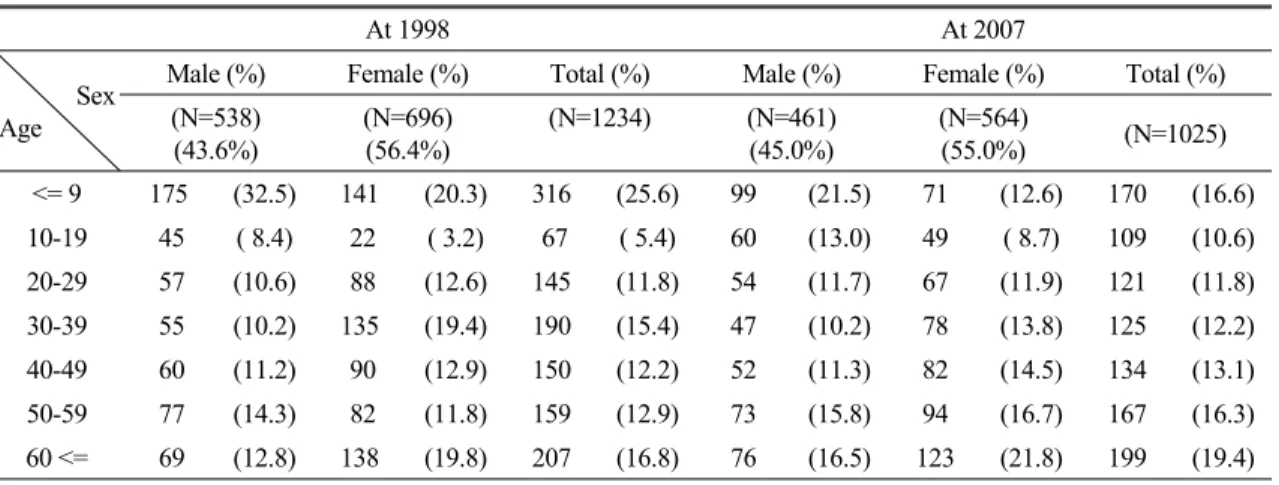
During the investigation periods, total 1,234

patients newly visited the hospital at the

(3)

investigation conducted in 1998, and 1,025 patients newly visited the hospital at the investigation in 2007. Female patients were larger in number than male patients in both investigations. The hospital utilization status was most frequent in the ages below 9 years old in the investigation conducted in 1998 and over 60 years old at the investigation conducted in 2007, but no statistically significant difference was found. The distribution of age is more even in the investigation conducted in 2007 than in 1998 (Table 1).

Contrary to the result that 411 patients (33.3

%) responded the visit was determined by himself in the investigation conducted in 1998, the population of self determined patients was increased to 531 patients (51.8 %) in the invest- igation conducted in 2007 (Table 2).

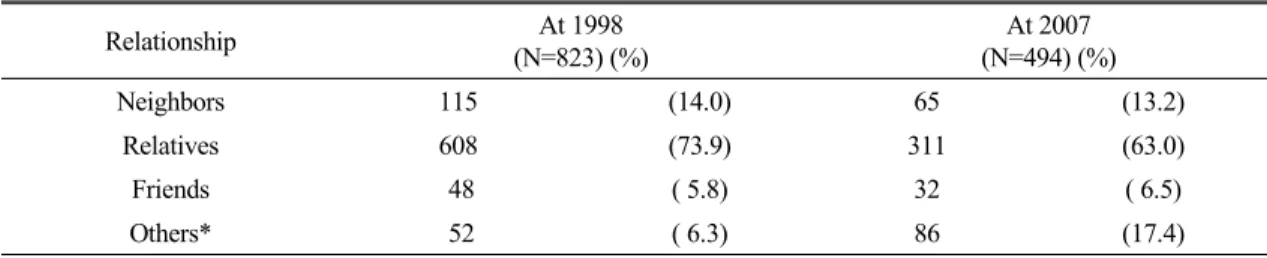
As it shows in Table 3, the recommendation of

‘relatives’ was the largest followed by the

‘neighbors’ and ‘friends’ for the newly visited patients. The visits by using internet information and information exchange were noticeably increased cases listed in the ‘other’category of hospital visit recommended by others.

As it shows in Table 4, ‘respiratory disease’

was the most common symptom in the year 1998, but ‘musculoskeletal disease’ was the most common symptom in the year of 2007.

Other than these, ‘neurosensory disease’, ‘nons- pecific symptom’ and ‘cardiovascular disease’

were the next popular symptoms.

When the western and oriental medical care utilization status for the same symptom was reviewed, the patient populations who ‘initially utilized oriental medical care’ and who ‘conco-

At 1998 At 2007

Sex Age

Male (%) Female (%) Total (%) Male (%) Female (%) Total (%)

(N=538) (43.6%)

(N=696) (56.4%)

(N=1234) (N=461)

(45.0%)

(N=564)

(55.0%) (N=1025)

<= 9 175 (32.5) 141 (20.3) 316 (25.6) 99 (21.5) 71 (12.6) 170 (16.6)

10-19 45 ( 8.4) 22 ( 3.2) 67 ( 5.4) 60 (13.0) 49 ( 8.7) 109 (10.6)

20-29 57 (10.6) 88 (12.6) 145 (11.8) 54 (11.7) 67 (11.9) 121 (11.8)

30-39 55 (10.2) 135 (19.4) 190 (15.4) 47 (10.2) 78 (13.8) 125 (12.2)

40-49 60 (11.2) 90 (12.9) 150 (12.2) 52 (11.3) 82 (14.5) 134 (13.1)

50-59 77 (14.3) 82 (11.8) 159 (12.9) 73 (15.8) 94 (16.7) 167 (16.3)

60 <= 69 (12.8) 138 (19.8) 207 (16.8) 76 (16.5) 123 (21.8) 199 (19.4) χ

2

-test > 0.05 by age, sex

Table 1. General Characteristics of Enrolled Patients

Determined At 1998 At 2007

Number (%) Number (%)

By oneself 411 (33.3) 531 (51.8)

By another person 823 (66.7) 494 (48.2)

χ

2

-test < 0.01

Table 2. The Determinant to Visit the Oriental Mecine Hospital for the Outpatient

(4)

mitantly used oriental and western medical care’

have increased in the investigation in 2007 than in the investigation in 1998.

If both patient populations were reviewed, the patient populations who ‘initially utilized oriental medical care’ were found to be more likely to have the diseases of ‘nonspecific symptom’, ‘urogenital disease’ and ‘musculoskeletal disease’. However, the patient population who ‘used oriental medical care after using western medical care, tended to have higher development rates of ‘dermatologic

disease’ and ‘respiratory disease’. Contrary to the finding, the patients who ‘concomitantly used oriental and western medical cares’ revealed to have higher development rate of ‘endocrine disease’ and ‘cardiovascular disease’.

At both of the investigations conducted in 1998 and in 2007, the largest number of patients transferred to oriental medical care due to the

‘absence of therapeutic effects’ and the reason showed an increasing trend with time (Table 5).

As it shows in Table 6, among the total 86

Relationship At 1998

(N=823) (%)

At 2007 (N=494) (%)

Neighbors 115 (14.0) 65 (13.2)

Relatives 608 (73.9) 311 (63.0)

Friends 48 ( 5.8) 32 ( 6.5)

Others* 52 ( 6.3) 86 (17.4)

χ

2

-test < 0.01

* : such as internet user

Table 3. General Characteristic of Recommender

Classification

At 1998 Number (%)

At 2007 Number (%) Initially

Oriental

After

Western Concomitant Total Initially Oriental

After

Western Concomitant Total Respiratory 82 (30.9) 176 (66.4) 7 ( 2.6) 265 (21.5) 54 (47.0) 51 (44.3) 10 ( 8.7) 115 (11.2) Musculoskeletal 165 (66.0) 65 (26.0) 20 ( 8.0) 250 (20.2) 170 (58.2) 87 (29.8) 35 (12.0) 292 (28.5) Neurosensory 123 (62.8) 64 (32.7) 9 ( 4.6) 196 (15.9) 134 (60.4) 66 (29.7) 22 ( 9.9) 222 (21.7) Nonspecific 139 (76.4) 31 (17.0) 12 ( 6.6) 182 (14.7) 113 (69.8) 24 (14.8) 25 (15.4) 162 (15.8) Cardiovascular 51 (46.8) 45 (41.3) 13 (11.9) 109 ( 8.8) 45 (70.3) 6 ( 9.4) 13 (20.3) 64 ( 6.2) Urogenital 67 (72.8) 18 (19.6) 7 ( 7.6) 92 ( 7.5) 41 (71.9) 5 ( 8.8) 11 (19.3) 57 ( 5.6) Gastrointestinal 48 (53.3) 30 (33.3) 12 (13.3) 90 ( 7.3) 48 (63.2) 23 (30.3) 5 ( 6.6) 76 ( 7.4) Dermatological 3 (10.3) 23 (79.3) 3 (10.3) 29 ( 2.4) 7 (31.8) 14 (63.6) 1 ( 4.5) 22 ( 2.1) Endocrine 0 ( 0.0) 9 (75.0) 3 (25.0) 12 ( 1.0) 0 ( 0.0) 10 (100) 0 ( 0.0) 10 ( 1.0)

Neoplasm 3 (33.3) 6 (66.7) 0 ( 0.0) 9 ( 0.7) 0 ( 0.0) 5 (100) 0 ( 0.0) 5 ( 0.5)

Total 681 (55.2) 467 (37.8) 86 ( 7.0) 1234 (100) 612 (59.7) 291 (28.4) 122 (11.9) 1025 (100)

Table 4. Distribution of Use of Oriental and/or Western Medicine of Outpatient by disease group

(5)

patients, 54 patients (62.8 %) responded that the western doctors did not know of the patients use of the oriental medical care in 1998, and such cases were found in 98 patients (80.3 %) at the investigation conducted in 2007 showing significant increase. In case of reviewing the patients’ diseases, the western doctors of the patients having ‘respiratory disease’, ‘nonspecific symptom’, ‘urogenital disease’, and ‘dermatologic disease’ did not know that their patients are seeing oriental doctors. However, the patients having

‘musculoskeletal disease’ and ‘cardiovascular disease’ resulted to show that their western doctors highly recognized that their patients are seeing oriental doctors.

In case when the western doctors recognize the use of oriental medical care institutions, many of them agreed upon the concomitant use of oriental and western medicines. However the proportion of ‘no response’ increased as indicated in Table 7.

Among the patients who responded that At 1998

(N=467) (%)

At 2007 (N=291) (%)

Difficulty in use 6 ( 1.3) 0 ( 0.0)

Absence of therapeutic effects 298 (63.8) 220 (75.6)

Don't agree with western medicine 44 ( 9.4) 23 ( 7.9)

Recommended by others 42 ( 9.0) 17 ( 5.8)

The others 77 (16.5) 31 (10.7)

χ

2

-test < 0.01

Table 5. Causes of Moving to Oriental Medicine from Western Medicine

Notification to Western Doctor Classification

At 1998 Number (%)

At 2007 Number (%)

Yes No Total Yes No Total

Respiratory 0 ( 0.0) 7 (100) 7 1 (10.0) 9 (90.0) 10

Musculoskeletal 12 (60.0) 8 (40.0) 20 13 (37.1) 22 (62.9) 35

Neurosensory 3 (33.3) 6 (66.7) 9 2 ( 9.1) 20 (90.9) 22

Nonspecific 0 ( 0.0) 12 (100) 12 0 ( 0.0) 25 (100) 25

Cardiovascular 8 (61.5) 5 (38.5) 13 5 (38.5) 8 (61.5) 13

Urogenital 0 ( 0.0) 7 (100) 7 2 (18.2) 9 (81.8) 11

Gastrointestinal 6 (50.0) 6 (50.0) 12 1 (20.0) 4 (80.0) 5

Dermatological 0 ( 0.0) 3 (100) 3 0 ( 0.0) 1 (100) 1

Endocrine 3 (100) 0 ( 0.0) 3 - - 0

Neoplasm - - 0 - - 0

Total 32 (37.2) 54 (62.8) 86 24 (19.7) 98 (80.3) 122

Table 6. Notification to Western Doctor for Oriental Medicine by Disease Group

(6)

western doctors do not know their use of oriental medicine institutions, the reason was asked and the most of them didnot notice the status of using oriental medical care because of the worry of

‘unfavorable response’ from doctors , and the trend increased in 2007 compared to the result acquired in 1998 (Table 8).

Discussion

According to the investigation result of ‘Study on the Supply and Demand of Oriental Medical Care in 1995' reported by Song KY et al. of Korea Institute for Health and Social Affairs (below KIHASA)(1996)

6)

, female and old age are the two major variables affecting the increase of oriental medical care. In the ‘Study on the Oriental Medical Care Utilization of Korea’

conducted by Nam EW et al.(1994)

7)

, female and old age took large proportions showing a similar pattern to the above study. The present study

result revealed higher proportion of female compared to male population by showing thatthe utilization ratio by sex was similar to the results as previously reported by others

6-8)

. However, the age distribution of the oriental medical care users revealed balanced distribution in all age groups in 2007 compared to the result acquired in 1998.

In reviewing the causes of choosing oriental medical care institutions, the KIHASA study reported 41.5 % of the patients mostly chose oriental medical care hospitals and clinics by the recommendations of close relatives, the choice by the patients themselves and closeness of oriental hospitals were followed by 34.6 % and 23.5 %, respectively

6)

. At the present study conducted in 1998, the recommendation by neighbors was the first reason by taking up 66.7

% of the causes of visiting oriental medical care institutions. However, the choice by patients themselves increased to 51.8 % in the study

At 1998 At 2007

Contents Number (%) Number (%)

Unfavorable response 17 (53.1) 10 (41.7)

Favorable response 6 (18.8) 3 (12.5)

No response 9 (28.1) 11 (45.8)

χ

2

-test > 0.05

Table 7. The Response of Western Doctor After Information

At 1998 At 2007

Contents Number (%) Number (%)

Be afraid of western doctor's bias 23 (42.6) 53 (54.1)

Had no specific reason 16 (29.6) 32 (32.7)

Assume that it was not necessary 10 (18.5) 12 (12.2)

The others 5 ( 9.3) 1 ( 1.0)

χ

2

-test < 0.05

Table 8. The Causes of Not Informed to Western Doctor

(7)

conducted in 2007 showing the change of general populations’ recognition toward oriental medicine.

The disease distribution pattern of the patients using oriental medical care institutions reported by KIHASA showed that musculoskeletal disease was the most highly distributed disease by taking up 50.1 %, which was followed by 9.6

% of cardiovascular disease, 6.3 % of respi- ratory disease, and 6.2 % of gastrointestinal disease

6)

. According to the study result of Eun Woo Nam, the supplementary of general weakness was the most highly distributed disease by taking up 43.5 %, which was foll- owed by 19.2 % of musculoskeletal disease, 14.6 % of gastrointestinal disease, and 8 % of neurosensory disease

7)

. The present study cond- ucted in 1998 suggested ‘respiratory disease’

was the most highly distributed disease, but

‘musculoskeletal disease’ and ‘neurosensory disease’ were found to be prevalent types of diseases in 2007 by showing similar patterns in other study results. However, the proportion of patients hoping to have supplementary prescri- ptions of oriental medicine was significantly low. Although, the result may be attributable to the fact that the investigation was not conducted in oriental medical care clinics but a hospital, and the characteristics of medical staffs of the investigated hospital must have been reflected in the result. However, the result may have reflected a gradually increasing trend of using oriental medicine in overall ranges of diseases.

Such facts could be found that the patient distribution of using oriental medicine from the start of treating the ‘musculoskeletal disease’,

‘neurosensory disease’ and ‘nonspecific symptom’

was high in other studies

9,10)

as well as the present study result, but the high trend of

selecting oriental medicine after initially using western medicine was observed in ‘respiratory disease’. According to the investigation result for patients having ‘respiratory disease’, most of them selected the oriental medicine due to the

‘absence of therapeutic effect in western medi- cine’. This is the phenomenon that patients select oriental medicine as an alternative medicine for the diseases to have definitive effects and are difficult to treat in western medicine.

The result investigating the recognition of western doctors for the patients’ concomitant use of oriental and western medicine could be utilized as the basic data to review the problems of a binary medical care system. According to the present study result conducted in 1998, 62.8

% of patients who concomitantly used oriental

and western medicines responded that the

western doctors did not know the patients were

using oriental medical care. However it was

possible to observe that the ratio was rapidly

increased to 80.3 % in the investigation conduc-

ted in 2007. Especially when the patients are

using oriental medical care due to the ‘muscul-

oskeletal disease’ and ‘cardiovascular disease’,

the recognition of western doctors was high,

which is contrary to the lower recognition of

western doctors for the diseases of ‘respiratory

disease’ and ‘nonspecific symptom’. Namely,

patients concomitantly using oriental and western

medical cares, they noticedthe use of oriental

medicine for the diseases where the general

utility of oriental medicine was well recognized

in common knowledge, but for the diseases that

the general utility of oriental medicine was not

recognized in common knowledge, it could be

regarded that the patients did not notify doctors

of the use of oriental medicine. Such interpr-

etation could be made from the patients’

(8)

response of not notifying the use of oriental medical care was ‘unfavorable response of western doctors’, and it was possible to know that such trend was deepened at the investigation conducted in 2007.

When the oriental and western medical care were concomitantly used by the selection of patients themselves, it will be important to share both oriental and western medical information for the correct collaborative diagnosis system

9,10)

. So, the open minded attitude of western doctors toward oriental medical care and the active medical interview for the utilization of oriental medical care are thought to be necessary.

The limitations of this paper are as follows;

First, the study was performed in one oriental medicine hospital and in a specific area and time, so the generalization of the results may be over-estimated. But the number of study and the duration of investigation were enough to give a meaning and take an interpretation. The only one study may have the selection bias from the area and the time. But if two studies were performed under the same condition (such as area, time, questionnaire, investigator) and compared, many biases can be corrected.

Second, the results of this paper were very superficial to insist on the paradox of the dual system in Korea. But this study was performed to alert the western medical doctors to accept the status of the health behavior of patients, so let them to have an open mind to co-work with oriental medicine. In this respect, this paper is a first step to perceive the status in vivo. More studies investigating an appropriate co-work system, the approval and make-up of the dual certified doctor, co-education system in the both colleges et al. will be needed.

Conclusion

The investigation for the selection motivation and background along with the concomitant utilization status of oriental and western medi- cines was conducted in 1998 for those new patients of an oriental medical hospital, and the same investigation was conducted in 2007 by adopting the same procedure to compare the results.

1. The study conducted in 1998 subjected 1,234 newly visited patients, and 1,025 patients were subjected for the investigation in 2007.

Among the subjected patient populations, female population took up the largest proportion and the patients’age distribution was observed to show balanced distribution in 2007 more than in 1998.

2. Among the newly visited patients, 411 patients (33.3 %) responded that the visit was determined by patients themselves at the investigation in 1998, but 531 patients (51.8 %) responded the visit was self determined in 2007 showing the increasing trend. Although patients’

families and relatives recommended the oriental medical care, it was possible to know the increase of patient’s visits by using internet information.

3. In the patients’ distribution by disease,

‘respiratory disease’ took up the largest propo- rtion in 1998, but ‘musculoskeletal disease’ took up the largest proportion in 2007. Other than these diseases, the proportion of ‘neurosensory disease’ and ‘nonspecific symptom’ was high.

4. In reviewing the western medical care

utilization status for the same symptoms, the

patient ratio of using oriental medicine after

using western medicine was lowered, but the

patient ratios of ‘utilizing oriental medicine from

(9)

the start of treating the symptoms’ and ‘concom- itantly use of both oriental and western medical cares’ were increased.

5. By the same chief complaint, patients who transferred from western medical care to oriental medical care responded that the ‘absence of therapeutic effects’ was the major reason of the transfer, and the proportion was also found to be increased at the comparison investigation.

6. Among the patients who concomitantly use oriental and western medicines, 62.8 % respo- nded that the western doctors did not know the patients’utilization status of oriental medical medicine in the investigation conducted in 1998, but the proportion was increased up to 80.3 % in 2007 investigation. As the cause of not notifying the status of using oriental medicine, 42.6 % of the patients selected the ‘unfavorable response’

of western doctors as the major reason in 1998, but the proportion was increased up to 54.1 % in the 2007 investigation.

When reviewing the above investigation results, it was possible to know the overlapping and wasteful utilization of medical care by the random utilization of medical care, which does not follow the normal transfer system due to the binary medical care system. The phenomenon was deepened gradually. So, the recognition and establishment for an appropriate medical care system are considered to be urgently necessary.

Reference

1. Cho KS. The difference in Behavior of Utilization on Western and Oriental Medical Cares in Korea. The Graduate School of

Yonsei Univ. Seoul: 2001:8-25.

2. Kim PS. A Research into medical care Utilization of patients visiting the collabo- ration Oriental-Western medical centers. The Graduate School of Health & Environmental Univ. Seoul: 2000:6-42.

3. NSO. Current Status of Medical Staff from 1993 to 2005. Available from: URL: http://

www.nso.go.kr/

4. The List of Hospital in Korea. Korean Hospital Association. 1996:262.

5. Sin JO, Lim JY, Kang SH. Data on trend of the medical cost for people and medical institute. Korean Industrial and Health Insti- tute. 1997:312.

6. Nam EW, Hong KS, Bae SK. Study on the Oriental Medical Care Utilization of Korea.

Health and Science Institute in Kosin Univ.

Pusan: 1994:1-130.

7. Song KY, Hong SK. Study on the Supply and Demand of Oriental Medical Care in 1995. Korea Institute for Health and Social Affairs. Seoul: 1996:13-25.

8. Choi JS, Nam JJ, Kim TJ, Kyoe HB. A survey on the health and behavior of the Korean in 1995. Korea Institute for Health and Social Affairs. Seoul: 1995:132.

9. Jung ES, Kang HC, Kwon SS, Oh CD, Yang SR, Lee HH. A Baseline Study on Satisfa- ction Rate and Cognition Rate on Oriental Care and Occidental Medilcal Care. J of Family Medicine. 1992;13(11):891~900.

10. Kim DH. A study on affecting factors on Utilization and Selection for Western Medi- cine and Korean Traditional Medicine. The Graduate School of Inje Univ. Seoul: 2006:

65-72.

수치

Table 1. General  Characteristics  of  Enrolled  Patients
Table 3. General  Characteristic  of  Recommender
Table 6. Notification  to  Western  Doctor  for  Oriental  Medicine  by  Disease  Group
Table 7. The  Response  of  Western  Doctor  After  Information

참조

관련 문서

Eighty six point five percent of the subjects felt that the most important factor was visiting a hospital, but combining alternative medicine with hospital

Keywords: unused and expired medications, UEM, home pharmaceutical care service, prescription medicines, active collection of UEM.. between the number of

The fast disintegrating tablet (FDT) containing oriental herbal medicine was prepared by using a freeze-drying method.. To improve taste and morphology of

Therefore, nurses should be responsible for the relations to resolve the needs of care between nurses and patients and through communication with the patients,

This study aims to lower turnover of child-care teachers' who are the most important in the site of child-care, and improves child-care teachers' working environment

The staff of outstanding hospitals (doctors, nurses, administrative personnel) provide proper medical services that meet the

The number of migrating individuals of the Oriental Honey Buzzard by hour (A: Hong island, B: Eocheong island, C: Socheong island, D: Busan and Geoje island) ···92

Through a review of electronic medical records, we analyzed the applied BCSs, perioperative hematologic changes, and morbidity and mortality in JW patients