239
© Copyright The Korean Academy of Asthma, Allergy and Clinical Immunology • The Korean Academy of Pediatric Allergy and Respiratory Disease http://e-aair.org INTRODUCTION
Breastfeeding is widely recommended to reduce the risk of sensitization, eczema, and asthma.1 However, the role of breast- feeding in the prevention of allergic diseases is uncertain, with some studies reporting favorable outcomes associated with breastfeeding and others reporting no effects. Cluster of differ- entiation 14 (CD14) is a well-established susceptibility gene for atopic sensitization,2 but it has demonstrated inconsistent re- sults in its relationship with atopy and breastfeeding.
CD14C-159T is the promoter region of the CD14 gene. Previ- ous genetic studies have indicated that CD14C-159T polymor- phisms might interact with environmental factors and contrib- ute to the development of atopy and allergic diseases.3 Although the mechanisms of gene-environmental factor interactions are largely unknown, a polymorphism in the promoter region of a gene might exert its effect by modulating gene expression.4 Re- cent reports have shown that the effect of breastfeeding on food sensitization can be modified by single nucleotide polymor- phisms in the IL-12 receptor β1, toll-like receptor 9, and thymic stromal lymphopoietin receptor genes.5 However, to date there
Breastfeeding Might Have Protective Effects on Atopy in Children With the CD14C-159T CT/CC Genotype
So-Yeon Lee,
1Mi-Jin Kang,
2Ji-Won Kwon,
3Kang-Seo Park,
4Soo-Jong Hong
5*
1Department of Pediatrics, Hallym University Sacred Heart Hospital, Hallym University College of Medicine, Anyang, Korea
2Asan Institute for Life Sciences, Seoul, Korea
3Department of Pediatrics, Seoul National University Bundang Hospital, Seongnam, Korea
4Department of Pediatrics, Presbyterian Medical Center, Jeonju, Korea
5Department of Pediatrics, Childhood Asthma Atopy Center, Asan Medical Center, University of Ulsan College of Medicine, Seoul, Korea
is no evidence that the effect of breastfeeding on sensitization to aeroallergens is modulated by the CD14C-159T genotype.
Therefore, we investigated whether the relationship between breastfeeding and sensitization to aeroallergens is modified by the CD14 genotype.
MATERIALS AND METHODS
We distributed questionnaires pertaining to breastfeeding to the homes of 1,828 schoolchildren aged 9-12 years from 10 ele- mentary schools in urban (Seoul) and rural areas (Jeongeup) of Korea. Of the 1,828 potential subjects, 1,749 (95.7%) returned the questionnaires. Demographics and information on wheth-
Brief Communication
Allergy Asthma Immunol Res. 2013 July;5(4):239-241.
http://dx.doi.org/10.4168/aair.2013.5.4.239 pISSN 2092-7355 • eISSN 2092-7363
Breastfeeding is widely recommended to reduce risk of sensitization, eczema and asthma. However, the role of breastfeeding in prevention of aller- gic diseases is uncertain. We aimed to investigate whether the relationship between breastfeeding and sensitization to aeroallergens is modified by cluster of differentiation 14 (CD14) genotype. This study included 1,828 school children aged 9-12. We administered a detailed questionnaire and genotyped the CD14C-159T polymorphism. Skin prick tests for 12 aeroallergens were performed. School children who had been breastfed were less likely sensitized to aeroallergens (adjusted odds ratio [aOR] 0.712, 95% confidence interval [CI]: 0.555-0.914). There was no significant association between CD14C-159T genotype and atopy. Breastfeeding was associated with a decreased risk of atopic sensitization in children with CT/CC geno- type (aOR 0.667, 95% CI: 0.463-0.960). Our data might identify the gene-environment interaction between the CD14C-159T polymorphism and breast- feeding in relation to aeroallergen sensitization.
Key Words: Breastfeeding; cluster of differentiation 14 (CD14); gene-environmental interaction; sensitization to aeroallergens
This is an Open Access article distributed under the terms of the Creative Commons Attribution Non-Commercial License (http://creativecommons.org/licenses/by-nc/3.0/) which permits unrestricted non-commercial use, distribution, and reproduction in any medium, provided the original work is properly cited.
Correspondence to: Soo-Jong Hong, MD, PhD, Department of Pediatrics, Childhood Asthma Atopy Center, Asan Medical Center, University of Ulsan College of Medicine, 88 Olympic-ro 43-gil, Songpa-gu, Seoul 138-736, Korea.
Tel: +82-2-3010-3379; Fax: +82-2-473-3725; E-mail: [email protected] Received: July 20, 2012; Revised: October 24, 2012;
Accepted: November 13, 2012
•There are no financial or other issues that might lead to conflict of interest.
Lee et al.
Allergy Asthma Immunol Res. 2013 July;5(4):239-241. http://dx.doi.org/10.4168/aair.2013.5.4.239 Volume 5, Number 4, July 2013
240 http://e-aair.org
er the child breastfed and for how long were obtained through the following questions: “Did you breastfeed your child?” and
“How long did you breastfeed?”. A breastfed child was defined as having been breastfed for ≥4 months. Skin prick tests for 12 aeroallergens were performed: Dermatophagoides pteronyssi- nus (D. pteronyssinus [D.p]), Dermatophagoides farinae (D. fari- nae [D.f]), dog epithelium, cat epithelium, cockroach, grass, mixed tree pollen -1 and -2, alternaria, aspergillus, ragweed, and mugwort. Atopy was defined as a positive skin reaction (wheal diameter, ≥3 mm after subtraction of a negative control). Geno- typing of the CD14 polymorphism (-159C/T, rs2569190) was performed using the TaqMan fluorogenic 5’ nuclease assay (ABI, Foster City, CA, USA). Genotyping was performed on 1,227 (67%) schoolchildren for whom parental consent for ge- netic studies was obtained.
The study was approved by the human ethics committees of Hallym University and Ulsan University. Written informed con- sent was obtained from the parents of all children.
Data were categorized and analyzed using SPSS version 14.0 (SPSS, Inc., Chicago, IL, USA). Multivariate models evaluating the effects of breastfeeding and genetic factors on atopy were adjusted for predefined covariates, including sex, age, place of
residence, parental history of allergic disease, income, and body mass index. A P value of less than 0.05 was considered signifi- cant.
RESULTS
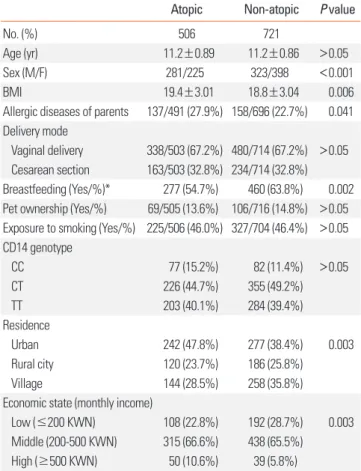
We analyzed data from 506 atopic children and 721 nonatopic children (Table 1). Overall, schoolchildren who had been breast- fed were less likely to be sensitized to aeroallergens (adjusted odds ratio [aOR], 0.712; 95% confidence interval [CI]: 0.555- 0.914). This effect was greatest in children breastfed for more than 4 months (aOR, 0.731; 95% CI: 0.555-0.962). There was no significant association between the CD14C-159T genotype and sensitization to aeroallergens. Breastfeeding was associated with a decreased risk of sensitization to aeroallergens in chil- dren with the CT/CC genotype (aOR, 0.667; 95% CI: 0.463-0.960) (Table 2).
DISCUSSION
To the best of our knowledge, this is the first study to show that the effect of breastfeeding on sensitization to aeroallergens var- ies according to the CD14C-159T polymorphism. Our results show that breastfeeding might have protective effects on sensi- tization to aeroallergens in children carrying the CD14C-159T CT/CC genotype.
Reduced soluble CD14 (sCD14) levels in breast milk have been associated with the development of atopy in 4-year-old chil- dren.6 The CD14C-159T promoter genotype may alter gene transcription, thereby affecting sCD14 levels.7 T allele homozy- gotes had higher circulating levels of sCD14 at baseline. How- ever, following an inhalational challenge with low-dose endo- toxin,8 the levels of sCD14 increased more in individuals with the C allele, such that there was no difference in sCD14 levels between genotype groups after the challenge. This suggests that carriers of the C allele are more responsive than T allele homo- zygotes to endotoxin exposure. Therefore, it is possible that car- riers of the C allele may react more effectively to breastfeeding.
Table 1. Subject characteristics
Atopic Non-atopic P value
No. (%) 506 721
Age (yr) 11.2±0.89 11.2±0.86 >0.05
Sex (M/F) 281/225 323/398 <0.001
BMI 19.4±3.01 18.8±3.04 0.006
Allergic diseases of parents 137/491 (27.9%) 158/696 (22.7%) 0.041 Delivery mode
Vaginal delivery 338/503 (67.2%) 480/714 (67.2%) >0.05 Cesarean section 163/503 (32.8%) 234/714 (32.8%) Breastfeeding (Yes/%)* 277 (54.7%) 460 (63.8%) 0.002 Pet ownership (Yes/%) 69/505 (13.6%) 106/716 (14.8%) >0.05 Exposure to smoking (Yes/%) 225/506 (46.0%) 327/704 (46.4%) >0.05 CD14 genotype
CC 77 (15.2%) 82 (11.4%) >0.05
CT 226 (44.7%) 355 (49.2%)
TT 203 (40.1%) 284 (39.4%)
Residence
Urban 242 (47.8%) 277 (38.4%) 0.003
Rural city 120 (23.7%) 186 (25.8%)
Village 144 (28.5%) 258 (35.8%)
Economic state (monthly income)
Low (≤200 KWN) 108 (22.8%) 192 (28.7%) 0.003
Middle (200-500 KWN) 315 (66.6%) 438 (65.5%)
High (≥500 KWN) 50 (10.6%) 39 (5.8%)
*Breastfeeding was defined as a condition in which children had breastfed for
≥4 months.
BMI, body mass index; CD14, cluster of differentiation 14; KWN, Korean Won.
Table 2. Relationship between CD14 genotype and breastfeeding with regard to sensitization to aeroallergens
Schoolchildren
Atopic Non-atopic OR (95% CI) P value
No BF/CD14 TT 96 111 1
No BF/CD14 CT+CC 133 150 1.071 (0.721-1.589) >0.05 Yes BF/CD14 TT 107 173 0.803 (0.541-1.192) >0.05 Yes BF/CD14 CT+CC 170 287 0.667 (0.463-0.960) 0.029 Adjusted by age, sex, BMI, residence, parental allergic disease, and income.
Multivariate logistic regression.
CD14, cluster of differentiation 14; BF, breastfeeding; OR, odds ratio; CI, confi- dence interval.
The Effect of Breastfeeding on Atopy
Allergy Asthma Immunol Res. 2013 July;5(4):239-241. http://dx.doi.org/10.4168/aair.2013.5.4.239 AAIR
241 http://e-aair.org The association between breastfeeding and sensitization to
aeroallergens in childhood may vary significantly depending on the CD14C-159T genotype. Although our study included ob- jective measurements such as genotyping and sensitization, the limitations of cross-sectional studies in elucidating biologic mechanisms are well recognized. Nevertheless, our results sup- port the need for further investigation into the gene-environ- ment interaction of the CD14C-159T polymorphism and breast- feeding in relation to aeroallergen sensitization.
ACKNOWLEDGMENTS
The study has been funded by grants from the Korea Centers for Disease Control and Prevention (2008-E00356-00) and the Korea Healthcare Technology R&D Project, Ministry of Health and Welfare, Republic of Korea (A092076).
REFERENCES
1. Greer FR, Sicherer SH, Burks AW; American Academy of Pediatrics Committee on Nutrition; American Academy of Pediatrics Section on Allergy and Immunology. Effects of early nutritional interven- tions on the development of atopic disease in infants and children:
the role of maternal dietary restriction, breastfeeding, timing of in- troduction of complementary foods, and hydrolyzed formulas. Pe- diatrics 2008;121:183-91.
2. Vercelli D. Discovering susceptibility genes for asthma and allergy.
Nat Rev Immunol 2008;8:169-82.
3. Leynaert B, Guilloud-Bataille M, Soussan D, Benessiano J, Guéné- gou A, Pin I, Neukirch F. Association between farm exposure and atopy, according to the CD14 C-159T polymorphism. J Allergy Clin Immunol 2006;118:658-65.
4. Ege MJ, Bieli C, Frei R, van Strien RT, Riedler J, Ublagger E, Schram- Bijkerk D, Brunekreef B, van Hage M, Scheynius A, Pershagen G, Benz MR, Lauener R, von Mutius E, Braun-Fahrländer C; Parsifal Study team. Prenatal farm exposure is related to the expression of receptors of the innate immunity and to atopic sensitization in school-age children. J Allergy Clin Immunol 2006;117:817-23.
5. Hong X, Wang G, Liu X, Kumar R, Tsai HJ, Arguelles L, Hao K, Pear- son C, Ortiz K, Bonzagni A, Apollon S, Fu L, Caruso D, Pongracic JA, Schleimer R, Holt PG, Bauchner H, Wang X. Gene polymor- phisms, breast-feeding, and development of food sensitization in early childhood. J Allergy Clin Immunol 2011;128:374-81.e2.
6. Savilahti E, Siltanen M, Kajosaari M, Vaarala O, Saarinen KM. IgA antibodies, TGF-beta1 and -beta2, and soluble CD14 in the colos- trum and development of atopy by age 4. Pediatr Res 2005;58:1300- 5.
7. LeVan TD, Guerra S, Klimecki W, Vasquez MM, Lohman IC, Marti- nez FD, Halonen M, Wright AL. The impact of CD14 polymor- phisms on the development of soluble CD14 levels during infancy.
Genes Immun 2006;7:77-80.
8. Levan TD, Michel O, Dentener M, Thorn J, Vertongen F, Beijer L, Martinez FD. Association between CD14 polymorphisms and se- rum soluble CD14 levels: effect of atopy and endotoxin inhalation.
J Allergy Clin Immunol 2008;121:434-40.e1.