Non-tuberculous mycobacteria (NTM) account for almost a tenth of specimens smear positive for acid-fast bacilli in Korea (1). Of these, half are Mycobacterium avium complex (MAC) (2). Clarithromycin, a macrolide drug, forms the cor- nerstone of MAC treatment (3) and is the only drug recom- mended by the Clinical and Laboratory Standards Institute (CLSI) for drug susceptibility testing (DST) of MAC (4).
The oxidation-reduction dye, 2,3-diphenyl-5-thienyl-(2)- tetrazolium chloride (STC) has advantages for rapid and con- venient DST. The compound allows easy identification of po- sitive cultures by producing dark precipitates that change the solution from colorless to pink after solubilization; further, even when added to media before inoculation, STC has no in- hibitory effect on microorganisms (5). Some studies present the advantages of STC-containing media to identify the grow- th of microorganisms in 96-well microplates (5, 6). Therefore, we applied a modification of standard methods to test the dr- ug susceptibility of slowly growing mycobacteria (4) by ad- ding STC.
A total of 119 MAC strains (56 M. avium and 63 M. intra- cellulare) isolated from clinical specimens, which had been stored at -70℃at the Korean Institute of Tuberculosis (KIT), were used. All isolates were subcultured initially on a slant of Löwenstein-Jensen medium and thereafter in Middlebrook 7H9 broth (DIFCO Laboratory, Detroit, MI, U.S.A.) supple- mented with 10% oleic acid-albumin-dextrose-catalase (O ADC; BBL, Becton Dickinson, Sparks, MD, U.S.A.) at 37℃ for 5 days before DST. The bacterial suspension was adjust- ed to McFarland No. 0.5 by adding sterile medium accord- ing to CLSI guidelines (4). For susceptibility testing, STC- containing and STC-free 7H9 broth was dispensed into mi- croplate wells. The STC was purchased from Tokyo Kansei Kogyo (Tokyo, Japan). Then, clarithromycin (Hanmi Pharm.
Co., Ltd, Seoul, Korea) stock solution was added to the wells followed by serial dilutions to create the final concentrations of 64 to 1 μg/mL. The last three wells of each lane were filled with 7H9 broth alone without clarithromycin for growth con- trol. Later, 100 μL of bacterial suspension was added to the
511
Young Kil Park1, Won-Jung Koh2, Shin Ok Kim1, Sonya Shin3, Bum Joon Kim4, Sang-Nae Cho5, Sun Min Lee6, and Chulhun L. Chang6,7
Korean Institute of Tuberculosis1, Seoul; Samsung Medical Center2, Sungkyunkwan University College of Medicine, Seoul; Division of Social Medicine and Health Inequalities3, Brigham and Women’s Hospital, Boston, MA, USA; Seoul National University Hospital4, Seoul; Yonsei University College of Medicine5, Seoul;
Department of Laboratory Medicine6, School of Medicine, and Medical Research Institute7, Pusan National University, Busan, Korea
Address for correspondence Chulhun L. Chang, M.D.
Department of Laboratory Medicine, Pusan National University Yangsan Hospital, Beomeo-ri, Mulgeum-eup, Yangsan 626-770, Korea
Tel: 82.55-360-1870, Fax: 82.55-360-1880 E-mail: [email protected]
*This study was supported by a grant from the Korean Health 21 R and D Project, Ministry of Health and Welfare, Republic of Korea (01-PJ10-PG6-01GM03- 0002).
J Korean Med Sci 2009; 24: 511-2 ISSN 1011-8934
DOI: 10.3346/jkms.2009.24.3.511
Copyright � The Korean Academy of Medical Sciences
Clarithromycin Susceptibility Testing of Mycobacterium avium
Complex Using 2,3-Diphenyl-5-thienyl-(2)-tetrazolium Chloride Microplate Assay with Middlebrook 7H9 Broth
A series of 119 Mycobacterium avium complex isolates were subjected to clar- ithromycin susceptibility testing using microplates containing 2,3-diphenyl-5-thienyl- (2)-tetrazolium chloride (STC). Among 119 isolates, 114 (95.8%) were susceptible to clarithromycin and 5 were resistant according to the new and the standard method.
STC counts the low cost and reduces the number of procedures needed for sus- ceptibility testing.
Key Words : Tetrazolium; Microtiter Method; Mycobacterium Avium Complex; Clarithromycin; Susceptibility Testing
Received : 15 April 2008 Accepted : 17 July 2008
� BRIEF COMMUNICATION�
wells. The final volume of each well was 200 μL, and the final concentration of bacterial inoculum was approximately 1.5
×105CFU/mL. In STC-containing medium, the final STC concentration was 50 μg/mL. Before incubation, a suspension of one antibiotic-free well was plated onto Middlebrook 7H10 agar (DIFCO) supplemented with 10% OADC (BBL) to de- termine the inoculum size. Then, the microplates were incu- bated at 37℃until the control media wells (6-9 days) deve- loped dark precipitates secondary to STC reduction. At that point, the bacterial growth in the antibiotic-containing wells was determined by adding 50 μL of solubilizing agent. Sus- ceptibility was defined by minimal inhibitory concentration (MIC): susceptible at≤16 μg/mL, intermediate at 32 μg/mL, and resistant at ≥64 μg/mL at a broth pH of 6.8, as recom- mended by CLSI (4). The MIC was defined as the lowest drug concentration that prevented a change in the medium from colorless to pink.
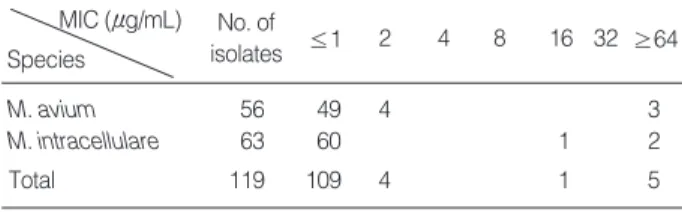
The inoculation quantities of all 119 MAC isolates were optimal according to confirmation on 7H10 agar media (data not shown). The STC-containing and STC-free media resul- ted in completely identical MICs in all tested strains. Among the 119 MAC isolates, 114 (95.8%) were inhibited at con- centrations ≤16 μg/mL and therefore were classified as clar- ithromycin-susceptible with no significant difference bet- ween M. avium and M. intracellulare. Among these suscepti- ble isolates, 109 were inhibited at 1 μg/mL, 4 at 2 μg/mL, and only 1 at 16 μg/mL. Only 5 MAC isolates were resistant (Table 1). The decision for microbial growth in the micro- plate wells was easier in STC-containing medium than in STC-free medium because of the color indicator.
Initial isolates from patients with previously untreated MAC lung disease should be tested for clarithromycin susceptibil- ity to establish baseline values, and many strains isolated from different situations are reserved for DST (7, 8). Although the MAC response to some antimicrobial agents may not be pre- dicted reliably on the basis of current in vitro susceptibility test methods, clinical response correlates with DST for the macrolides (azithromycin and clarithromycin) (8). Therefore, CLSI recommends that susceptibility of MAC isolates should be evaluated for these drugs only (4). In the current study, among 114 clarithromycin-susceptible isolates, all except one were inhibited at ≤2 μg/mL of clarithromycin. This is
consistent with the finding of Kawata et al. (9). STC, unlike other tetrazolium compounds, can be added to the medium before inoculation of bacteria (5) and avoids cumbersome pro- cesses such as putting tetrazolium into the well to view cul- tures after growth and adding extraction buffer to confirm color change (10).
In conclusion, we demonstrate that >95% of MAC isolates from Korea are susceptible to clarithromycin, and that mod- ification of the CLSI-recommended microplate DST method using STC is useful.
REFERENCES
1. Jeon K, Koh WJ, Kwon OJ, Suh GY, Chung MP, Kim H, Lee NY, Park YK, Bai GH. Recovery rate of NTM from AFB smear-positive sputum specimens at a medical centre in South Korea. Int J Tuberc Lung Dis 2005; 9: 1046-51.
2. Koh WJ, Kwon OJ, Jeon K, Kim TS, Lee KS, Park YK, Bai GH.
Clinical significance of nontuberculous mycobacteria isolated from respiratory specimens in Korea. Chest 2006; 129: 341-8.
3. Heifets LB. Clarithromycin against Mycobacterium avium complex infections. Tuber Lung Dis 1996; 77: 19-26.
4. Clinical and Laboratory Standards Institute. Susceptibility testing of mycobacteria, Norcardiae, and Other Aerobic Actinomycetes; App- roved Standard. CLSI document M24-A. Wayne, Pa. USA: CLSI;
2003.
5. Shin JH, Choi JC, Lee JN, Kim HH, Lee EY, Chang CL. Evaluation of a colorimetric antifungal susceptibility test by using 2,3-diphenyl- 5-thienyl-(2)-tetrazolium chloride. Antimicrob Agents Chemother 2004; 48: 4457-9.
6. Lee SM, Kim J, Jeong J, Park YK, Bai GH, Lee EY, Lee MK, Chang CL. Evaluation of the broth microdilution method using 2,3-diphenyl- 5-thienyl-(2)-tetrazolium chloride for rapidly growing mycobacteria susceptibility testing. J Korean Med Sci 2007; 22: 784-90.
7. American Thoracic Society. Diagnosis and treatment of disease caused by nontuberculous mycobacteria. Am J Respir Crit Care Med 1997; 156: S1-25.
8. Griffith DE, Aksamit T, Brown-Elliott BA, Catanzaro A, Daley C, Gordin F, Holland SM, Horsburgh R, Huitt G, Iademarco MF, Ise- man M, Olivier K, Ruoss S, von Reyn CF, Wallace RJ Jr, Winthrop K. An official ATS/IDSA statement: diagnosis, treatment, and pre- vention of nontuberculous mycobacterial diseases. Am J Respir Crit Care Med 2007; 175: 367-416.
9. Kawata N, Kawahara S, Tada A, Takigawa N, Shibayama T, Soda R, Takahashi K. Antimycobacterial susceptibility against nontuber- culous mycobacteria using brothmic NTM. Kekkaku 2006; 81: 329- 35.
10. Gomez-Flores R, Gupta S, Tamez-Guerra R, Mehta RT. Determi- nation of MICs for Mycobacterium avium-M. intracellulare complex in liquid medium by a colorimetric method. J Clin Microbiol 1995;
33: 1842-6.
512 Y.K. Park, W.-J. Koh, S.O. Kim, et al.
MIC (μg/mL) Species
No. of
isolates ≤1 2 4 8 16 32 ≥64
M. avium 56 49 4 3
M. intracellulare 63 60 1 2
Total 119 109 4 1 5
Table 1.MICs of clarithromycin for 119 M. avium complex iso- lates determined by STC-containing and STC-free 7H9 micro- plate methods
MIC, minimal inhibitory concentration.