141 Corresponding author: [email protected]✽
배합사료의 다양한 첨가제가 넙치
(Paralichthys olivaceus
)치어의 성장
,혈액 성상
,지방산 조성
,유전자 발현 및
조직 성상에 미치는 영향
김경덕・서주영
1・홍수희
2・김정호
3・변희국
2・김강웅・손맹현・이상민
2✽국립수산과학원 사료연구센터, 1강원도 해양심층수 수산자원센터,
2강릉원주대학교 해양생물공학과, 3강릉원주대학교 해양자원육성학과
Effects of Dietary Inclusion of Various Additives on Growth Performance, Hematological Parameters,
Fatty Acid Composition, Gene Expression and Histopathological Changes in Juvenile Olive Flounder Paralichthys olivaceus
Kyoung-Duck Kim, Joo-Young Seo1, Su-Hee Hong2, Jeong-Ho Kim3, Hee-Guk Byun2, Kang-Woong Kim, Maeng Hyun Son and Sang-Min Lee2*
Aquafeed Research Center, National Fisheries Research and Development Institute, Pohang 791-923, Korea
1Gangwon-Do Deep Sea Water & Fishery Resource Center, Goseong 219-812, Korea
2Department of Marine Biotechnology, Gangneung-Wonju National University, Gangneung 210-702, Korea
3Department of Marine Resources Development, Gangneung-Wonju National University, Gangneung 210-702, Korea
This feeding experiment was conducted to investigate the effects of dietary inclusion of various additives on growth performance, hematological parameters, fatty acid composition, gene expression and histopathological changes in juvenile olive flounder (Paralichthys olivaceus). Eleven isonitrogenous (49%
crude protein) and isolipidic (10% crude lipid) experimental diets were formulated: no additives (Con);
5% kelp meal (Ke); 10% krill meal (Kr); 1% garlic powder (Ga); 1% citrus meal (Ci); 3% onion powder (On); 1% ginger powder (Gi); 1% mugwort powder (Mu); 1% licorice powder (Li); 1% wasabi powder (Wa); and a mixture (Mix) of these additives. Three replicate groups of juvenile flounder (average weight of 8.5 g) were fed one of the experimental diets to visual satiety twice a day for 15 weeks. The dietary inclusion of additives did not affect survival, weight gain, specific growth rate feed efficiency, daily feed intake, daily protein intake, protein efficiency ratio, hepatosomatic index and visceralsomatic index of the fish. Plasma triglyceride levels were significantly lower in fish fed the Ke, Ga, On, Gi, Mu, Li, and Mix diets than in fish fed the control diet. Plasma glucose, glutamic oxaloacetic transaminase and total cholesterol did not differ among dietary treatments. No significant difference was observed in fatty acid composition and lipid content of the dorsal muscle in fish fed the experimental diets. Myosin gene expression did not differ significantly among treatments after 5 weeks but was significantly lower in fish fed the Kr, Ci, Li, and Mix diets than in control group after 15 weeks. Histopathological analysis showed mild gill hyperplasia and mild necrosis of liver parenchymal cells in several individuals of each experimental group.
These conditions were also observed in the control group and were not thought to be related to the inclusion of feed additives. The present findings indicate that the dietary inclusion of additives did not affect growth performance, fatty acid composition, gene expression, and histopathological changes in juvenile flounder.
However, plasma triglyceride content may be reduced by supplementation with 5% kelp meal, 3% onion powder, 1% garlic powder, 1% ginger powder, 1% mugwort powder, and the additive mixture.
Key words: Flounder, Dietary additives, Growth, Gene expression, Hematological parameter, Histopathological Change
서 론
우리나라의 해수어류 양식 생산량은 꾸준히 증가되고 있 는 실정이다. 특히 넙치는 1970년대 이후로 종묘생산과 양식
기술이 확립되면서 양식 생산량이 현저히 증가되었으며, 현 재 경제적 가치와 소비자의 선호도가 가장 높은 어종으로 인식되고 있다. 지금까지 넙치의 효율적이고 안정적인 양식 경영을 위해 기호성과 영양 요구량을 만족시킬 수 있는 배합 사료 조성비에 관한 연구가 중점적으로 수행되어 왔으며 (Lee et al., 2000; Lee et al., 2002; Lee et al., 2003; Lee and Kim, 2005; Yoo et al., 2006; Lee et al., 2008b), 배합사료의 우수성 또한 증명되면서 (Seo, et al., 2007; Kim et al., 2009b) 배합사료 에 대한 양어가들의 관심과 신뢰가 높아지고 있어 향후 그 사용량은 증가될 것이다.
그러나 최근 들어 소비자들의 생활수준이 향상되고 식품에 대한 기호성이 달라지면서 건강 웰빙 식품들이 각광받고 있는 실정이며, 이러한 이유로 양식어류에 대한 안전성과 기능성 등 품질에 대한 관심 또한 높아지고 있다. 현재 성장과 사료 이용성에 중점을 두고 수행되어 오던 연구들이 어류의 면역 저항성과 육질의 품질 개선을 함께 고려하는 방향으로 전환되 고 있으며, 이는 배합사료의 품질 개선을 위한 또 하나의 과제 를 제시하고 있다. 이처럼 대상종의 성장이나 사료효율 뿐 아니 라 면역생리 효능을 향상시킬 수 있는 배합사료의 조성비를 지속적으로 개선하고 값비싼 영양소의 첨가수준을 최소화하 는 등 배합사료의 품질 개선을 위한 연구는 지속되어야 한다.
어류의 성장을 증진시키거나 육질 개선을 위한 연구의 일 환으로 효능이 있는 것으로 알려진 물질이나 원료를 배합사 료에 첨가하여 대상 어류의 성장, 사료효율, 면역능력 및 체조 성 등에 대한 개선 가능성을 조사하는 것은 배합사료 품질 향상에 도움이 될 수 있다. 최근 각종 사료 첨가제를 사용하여 성장, 사료효율 및 항병력을 향상시키려는 노력은 어류 양식 분야에서도 활발하게 시도되고 있으며, 다양한 식물, 광물, 미생물 또는 이들의 추출물을 각종 어류에게 투여하여 사료 첨가제로서의 효과를 알아보려는 연구가 진행되고 있다 (Fernández-Navarro et al., 2008; Li et al., 2008; Ma et al., 2008).
특히, 생약제 (Kim et al., 1998), 송강약돌 (Choi et al., 2004), 녹차 (Cho et al., 2006), 목초액 (Lee et al., 2008a) 및 해조류 혼합물 (Kim et al., 2009c) 등은 넙치용 배합사료 첨가제로서 그 효능이 연구된 바 있다. 이러한 첨가제 외에도 다양한 원료 들을 대상으로 그 효능을 조사하기 위한 연구들이 수행되고 있는데, 켈프 (Heo et al., 2005), 마늘 (Yang, 2007), 감귤 (Ahn et al., 2007), 양파 (Jeong et al., 2009), 생강 (Ji et al., 1997), 약쑥 (Kim et al., 1994), 감초 (Woo et al., 2006), 고추냉이 (Shin, 2001) 및 크릴 (Im et al., 2007) 등은 선행 연구를 통해 항암, 항균, 항산화 및 면역 효능을 가지는 생리활성 물질로 증명되 면서 사람 혹은 다른 동물에게 약제나 건강식품으로서 이미 사용되고 있어, 이들 원료들은 넙치 치어 배합사료 첨가제로 서 이용할 가치가 있을 것으로 보인다.
본 연구에서는 기존에 수행된 넙치의 영양소 이용성에 관 한 연구결과들을 토대로 배합사료를 설계하여 다양한 첨가제 가 넙치 치어의 성장, 혈액 성상, 지방산 조성, 유전자 발현 및 조직 성상에 미치는 영향을 조사하고자 수행하였다.
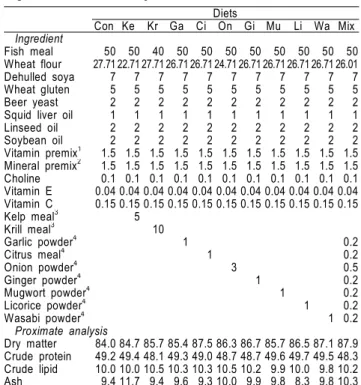
Table 1. Composition (% of dry matter basis) of the experimental diets for juvenile olive flounder
Diets
Con Ke Kr Ga Ci On Gi Mu Li Wa Mix Ingredient
Fish meal 50 50 40 50 50 50 50 50 50 50 50 Wheat flour 27.71 22.71 27.71 26.71 26.71 24.71 26.71 26.71 26.71 26.71 26.01
Dehulled soya 7 7 7 7 7 7 7 7 7 7 7
Wheat gluten 5 5 5 5 5 5 5 5 5 5 5
Beer yeast 2 2 2 2 2 2 2 2 2 2 2
Squid liver oil 1 1 1 1 1 1 1 1 1 1 1
Linseed oil 2 2 2 2 2 2 2 2 2 2 2
Soybean oil 2 2 2 2 2 2 2 2 2 2 2
Vitamin premix1 1.5 1.5 1.5 1.5 1.5 1.5 1.5 1.5 1.5 1.5 1.5 Mineral premix2 1.5 1.5 1.5 1.5 1.5 1.5 1.5 1.5 1.5 1.5 1.5 Choline 0.1 0.1 0.1 0.1 0.1 0.1 0.1 0.1 0.1 0.1 0.1 Vitamin E 0.04 0.04 0.04 0.04 0.04 0.04 0.04 0.04 0.04 0.04 0.04 Vitamin C 0.15 0.15 0.15 0.15 0.15 0.15 0.15 0.15 0.15 0.15 0.15
Kelp meal3 5
Krill meal3 10
Garlic powder4 1 0.2
Citrus meal4 1 0.2
Onion powder4 3 0.5
Ginger powder4 1 0.2
Mugwort powder4 1 0.2
Licorice powder4 1 0.2
Wasabi powder4 1 0.2
Proximate analysis
Dry matter 84.0 84.7 85.7 85.4 87.5 86.3 86.7 85.7 86.5 87.1 87.9 Crude protein 49.2 49.4 48.1 49.3 49.0 48.7 48.7 49.6 49.7 49.5 48.3 Crude lipid 10.0 10.0 10.5 10.3 10.3 10.5 10.2 9.9 10.0 9.8 10.2 Ash 9.4 11.7 9.4 9.6 9.3 10.0 9.9 9.8 8.3 9.8 10.3
1Vitamin premix contained the following amount which were diluted in cellulose (g/kg premix): Thiamin hydrochloride, 2.7; riboflavin, 9.1; pyridoxine hydrochloride, 1.8; niacin, 36.4; Ca-D-pantothenate, 12.7; myo-inositol, 181.8;
D-biotin, 0.27; folic acid, 0.68; p-aminobenzoic acid, 18.2;
menadione, 1.8; retinyl acetate, 0.73; cholecalciferol, 0.003;
cyanocobalamin, 0.003.
2Mineral premix contained the following ingredients (g/kg premix): MgSO4·7H2O, 80.0; NaH2PO4·2H2O, 370.0; KCl, 130.0; Ferric citrate, 40.0; ZnSO4·7H2O, 20.0; Ca-lactate, 356.5; CuCl, 0.2; AlCl3·6H2O, 0.15; KI, 0.15; Na2Se2O3, 0.01; MnSO4·H2O, 2.0; CoCl2·6H2O, 1.0.
3Provided by Fisheries Co-op Feeds Co., Ltd. Gyeong-Nam province, Korea.
4Purchased in the market.
재료 및 방법
실험사료
실험사료의 주요 단백질원으로 어분과 대두박, 탄수화물 원으로 소맥분 그리고 지질원으로 오징어간유, 아마인유 및 대두유를 각각 사용하였다 (Table 1). 다양한 첨가제의 효과를 조사하기 위하여 대조사료 (Con)의 어분 대신 10% 크릴 (Kr), 소맥분 대신 5% 켈프 (Ke), 3% 양파 (On) 그리고 마늘 (Ga), 감귤 (Ci), 생강 (Gi), 약쑥 (Mu), 감초 (Li) 및 와사비 (Wa)를 각각 1%씩 분말형태로 첨가하여 넙치의 영양소 요구량 (CP 50%, CL 10%)을 충족시키는 (Kim et al., 2004; Lee and Kim, 2005) 총 11종류의 실험사료를 설계하였다. 이와 같이 설계된 원료들을 잘 혼합한 후 원료 100 g 당 물 40 g 정도를 첨가하여 moist pellet 제조기로 압출성형 하였다. 제조된 실험사료는
실온에서 24시간 건조한 후, -30℃에서 보관하면서 넙치에게 공급하였다.
실험어 및 사육관리
전북 고창의 개인 양식장에서 생산된 넙치 치어를 구입하 여 강릉원주대학교 해양생물연구교육센터로 수송한 후 상품 사료로 2주간 예비 사육하였다. 평균체중 8.8±0.23 g 전후의 실험어를 무작위로 선별하여 총 33개의 수조 (50 L 사각수조) 에 40마리씩 3반복으로 수용하여 15주간 사육실험 하였다.
실험사료는 1일 2회 (09:00 h, 17:00 h) 실험어가 먹을 때 까지 만복으로 공급하였다. 각 수조마다 약하게 폭기시켜 산소를 공급하였고, 여과된 자연해수를 각 실험수조마다 분당 2 L로 조절하여 흘려주었으며, 사육기간 동안의 수온은 20.9±1.2℃
(평균±표준편차)였다. 그리고 사료공급 1시간 후, 사육수를 환수시켜 배설물과 사료찌꺼기를 제거해 주었으며, 각 수조 에서 죽은 개체는 매일 제거해 주었다.
시료 채취 및 성분분석
사육실험 시작시와 종료시에는 측정 전일 절식시킨 후 MS-222 100 ppm 수용액에 마취시켜 수조에 수용된 모든 실험 어의 무게를 측정하였다. 실험사료 및 근육의 조단백질 (N×6.25)은 Auto Kjeldahl system (Buchi, Flawil, Switzerland)을 사용하여 분석하였고, 조지방은 ether를 사용하여 추출하였으 며, 수분은 105℃ dry oven에서 6시간 동안 건조 후 측정하였 고, 조회분은 600℃ 회화로에서 4시간 동안 태운 후 정량하였 다. 지방산 분석은 Folch et al. (1957)의 방법에 따라 클로로포 름과 메탄올 혼합액 (2:1)으로 총 지질을 추출하여 14%
BF3-MeOH (Sigma, St Louis, MO, USA) 용액으로 지방산을 methylation 시킨 후, capillary column (SPTM-2560, 100 m × 0.25 mm i.d., film thickness 0.20 μm, Supelco, Bellefonte, PA, USA) 이 장착된 gas chromatograph (HP-6890N, Hewlett-Packard, Palo
Alto, CA, USA)로 지방산을 분석하였다. Carrier gas는 헬륨을 사용하였으며, oven 온도는 최초 140℃에서 240℃까지 4℃
/min씩 증가시켰다. 이때, injector와 detector (FID) 온도는 26 0℃로 각각 설정하였으며, 표준 지방산으로 37개 지방산 혼합 물 (PUFA 37 Component FAME Mix, Supelco)을 사용하였다.
혈액의 성상 변화를 조사하기 위해 각 실험구당 넙치를 5마리 씩 무작위로 추출하여 헤파린이 처리된 3 ml 주사기로 실험어 의 미부 혈관에서 채혈하였으며, 원심분리 (3,500 rpm, 10분) 하여 얻은 혈장을 동결보존 (-70℃)하였다. 혈장내 total protein 은 biuret법으로, glucose는 효소법으로, glutamic oxaloacetic transaminase (GOT)는 kinetic UV법으로, total cholesterol은 COD-POD법을 사용하여 각각 분석하였다.
Myosin 유전자 발현 분석
실험사료 공급에 따른 myosin 유전자의 발현을 분석하기 위하여 사육 5주와 15주 후 처리구마다 9마리의 넙치를 MS-222 200 ppm 수용액에 마취시켜 두신 (head kidney)을 취 하여 액체질소에 동결시킨 후 -80℃에서 보관하였다. 보관하 던 조직을 액체질소 하에서 분쇄한 후 Trizol reagent (Invitrogen)를 사용하여 total RNA를 분리, 4 μg의 RNA를 Oligo-dT 프라이머를 사용하여 mRNA만을 cDNA로 합성한 후 Real-time PCR 분석에 사용하였다. Real-time PCR은 SyBr
Table 2. Primer lists used for Real-time PCR analysis Gene Accession No. Primer Sequence (5’-3’) Tm
(℃) Myosin Gi:5018506 Myosin F AGCCCTACAATCGCTTCCTACA 56.7
Myosin R GCTACGTCGTCCTGGAAACC 55.8 Heat shock
cognate 70 Gi:154782721
HSC70 F CCGCACCCAACACCTAAAGT 56.1 HSC70 R CTGTTGCCCTGGTCATTGG 55.8
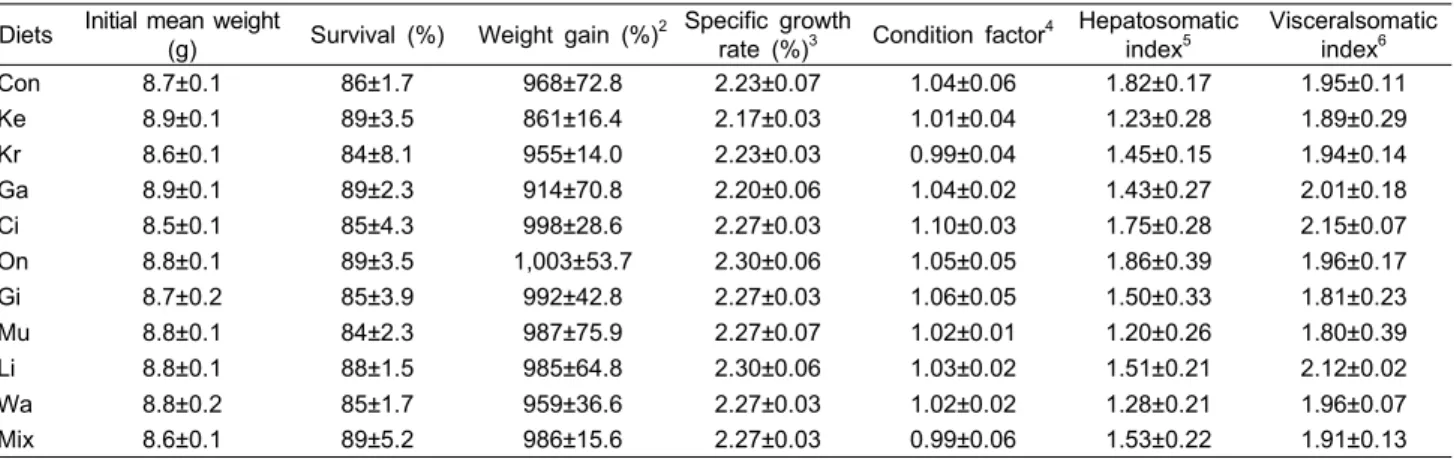
Table 3. Growth performance of juvenile olive flounder fed the experimental diets for 15 weeks1 Diets Initial mean weight
(g) Survival (%) Weight gain (%)2 Specific growth
rate (%)3 Condition factor4 Hepatosomatic index5
Visceralsomatic index6
Con 8.7±0.1 86±1.7 968±72.8 2.23±0.07 1.04±0.06 1.82±0.17 1.95±0.11
Ke 8.9±0.1 89±3.5 861±16.4 2.17±0.03 1.01±0.04 1.23±0.28 1.89±0.29
Kr 8.6±0.1 84±8.1 955±14.0 2.23±0.03 0.99±0.04 1.45±0.15 1.94±0.14
Ga 8.9±0.1 89±2.3 914±70.8 2.20±0.06 1.04±0.02 1.43±0.27 2.01±0.18
Ci 8.5±0.1 85±4.3 998±28.6 2.27±0.03 1.10±0.03 1.75±0.28 2.15±0.07
On 8.8±0.1 89±3.5 1,003±53.7 2.30±0.06 1.05±0.05 1.86±0.39 1.96±0.17
Gi 8.7±0.2 85±3.9 992±42.8 2.27±0.03 1.06±0.05 1.50±0.33 1.81±0.23
Mu 8.8±0.1 84±2.3 987±75.9 2.27±0.07 1.02±0.01 1.20±0.26 1.80±0.39
Li 8.8±0.1 88±1.5 985±64.8 2.30±0.06 1.03±0.02 1.51±0.21 2.12±0.02
Wa 8.8±0.2 85±1.7 959±36.6 2.27±0.03 1.02±0.02 1.28±0.21 1.96±0.07
Mix 8.6±0.1 89±5.2 986±15.6 2.27±0.03 0.99±0.06 1.53±0.22 1.91±0.13
1 Values presented are mean±SE of three replications.
2 (Final fish wt.-initial fish wt.)×100/initial fish wt.
3 (ln (Final fish wt.)-ln (initial fish wt.))×100/days of feeding.
4 Fish wt.×100/total body length3.
5 Liver wt.×100/fish weight.
6 Viscera wt.×100/fish weight.
green premix (Takara) 10 μL, cDNA 2 μL 및 Primer 각각 10 pM을 사용하여 ABI 7200 실시간 중합효소 연쇄 반응기를 사용하여 측정하였다. 발현분석에는 myosin (NCBI GenBank Accession No. gi5018506) 유전자와 house keeping 유전자인 HSC70 (heat shock cognate 70, NCBI GenBank Accession No.
gi154782721) 유전자를 사용하였다 (Table 2). 각각의 유전자 는 매회 반응 시마다 dissociation curve를 확인하여 프라이머 의 비특이적 결합 및 genomic DNA 오염을 확인하였다.
Real-time PCR로 측정된 Ct값은 HSC70 유전자의 Ct값을 사용 하여 normalize하였으며, 2-ΔΔCt (Kenneth et al., 2001) 분석법 을 사용하여 대조사료와 첨가제 함유 사료와의 발현차이를 fold change로 나타내었다.
조직분석
실험사료 공급에 따른 넙치 각 장기의 병리조직학적 변화 를 관찰하기 위해, 실험 개시 이전에 무작위로 5마리를 채집 하여 MS-222 200 ppm에 마취시킨 후 방혈하여 Bouin's solution (포화 picric acid 수용액: 포르말린 원액: 빙초산 = 15: 5: 1) 고정액에 하루 이상 고정하였다. 사육실험 5주 및 15주 후 각 처리구별로 5마리씩 무작위로 채집하여 동일한 방법으로 처리하였다. 이후, 탈수 및 포매 과정을 거쳐 5 ㎛ 두께의 파라핀 절편을 각 장기별로 제작하여 Hematoxylin and Eosin 염색을 한 후 광학현미경으로 관찰하였다.
통계처리
결과의 통계 처리는 SPSS Version 14.0 (SPSS, Michigan Avenue, Chicago, IL, USA) program을 사용하였다. 성장, 사료 이용효율, 어체 일반성분, 혈액성상 및 지방산 조성을 One-way ANOVA-test를 실시한 후, Duncan`s multiple range test (Duncan, 1955)로 평균간의 유의성 (P<0.05)을 검정하였 다. 유전자 발현에서 측정된 데이터는 non-parametric Mann-Whitney test를 실시하여 대조사료 공급구와 첨가제 공 급구 사이의 유의적인 차이를 확인하였다. 통계분석은 P<0.05 (two-sided)인 경우만 유의하게 판정하였으며, 데이터 는 median±SD로 표기하였다.
결과 및 고찰
성장 및 사료이용효율
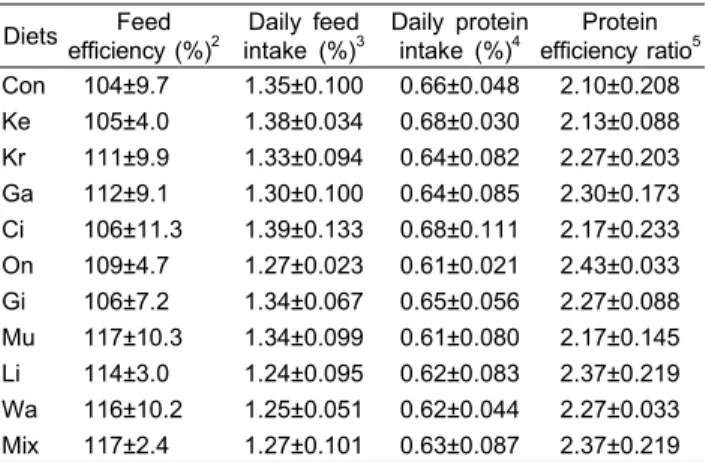
평균 체중 8.7 g의 넙치를 15주간 사육 실험한 결과를 Table 3과 4에 나타내었다. 생존율, 증중율, 일간성장율, 비만도, 간 중량지수 및 장 중량지수는 모든 실험구간에 유의한 차이가 없었다 (P>0.05). 사료효율, 일일사료섭취율, 일일단백질섭취 율 및 단백질효율 또한 실험사료 첨가제에 영향을 받지 않았 다 (P>0.05).
이와 같이 본 연구에 사용된 첨가제가 넙치 치어의 성장과 사료 이용효율을 개선시키지 못한 것은 아마도 다음과 같은 관점에서 설명할 수 있을 것이다. 실험사료에 사용된 사료의 원료나 조성비가 넙치 치어의 성장과 생리적 기능에 필요한 영양 요구량을 충분히 만족시켰기 때문으로 판단된다. 품질
Table 4. Feed utilization of juvenile olive flounder fed the experimental diets for 15 weeks1
Diets Feed efficiency (%)2
Daily feed intake (%)3
Daily protein intake (%)4
Protein efficiency ratio5 Con 104±9.7 1.35±0.100 0.66±0.048 2.10±0.208 Ke 105±4.0 1.38±0.034 0.68±0.030 2.13±0.088 Kr 111±9.9 1.33±0.094 0.64±0.082 2.27±0.203 Ga 112±9.1 1.30±0.100 0.64±0.085 2.30±0.173 Ci 106±11.3 1.39±0.133 0.68±0.111 2.17±0.233 On 109±4.7 1.27±0.023 0.61±0.021 2.43±0.033 Gi 106±7.2 1.34±0.067 0.65±0.056 2.27±0.088 Mu 117±10.3 1.34±0.099 0.61±0.080 2.17±0.145 Li 114±3.0 1.24±0.095 0.62±0.083 2.37±0.219 Wa 116±10.2 1.25±0.051 0.62±0.044 2.27±0.033 Mix 117±2.4 1.27±0.101 0.63±0.087 2.37±0.219
1 Values presented are mean±SE of three replications.
2 (Weight gain×100)/feed intake (dry matter).
3,4 Feed (protein) intake (dry matter)×100/(initial fish wt.+final fish wt.+dead fish wt.)×days fed/2.
5 Weight gain/protein intake.
이 우수하고 양식 대상종이 요구하는 영양소가 충분히 함유 된 사료에 첨가제를 사용하는 것은 예상했던 만큼 그 효능을 발휘하지 못할 수 있다 (Lee and Lim, 2000). 또한, 본 연구에 사용된 첨가제의 첨가 농도가 대상종의 요구에 적합하지 않 았을 수 있다. 효능이 있다고 해서 첨가제의 농도를 적정함량 이상 또는 그 이하로 사용하는 것은 첨가제의 종류에 따라서 오히려 부작용이 나타나거나 첨가 효과가 없을 수 있다 (Shiau and Yu, 1999). 이전 연구 (Kim and Lee, 2008)는 2%와 4%
켈프 첨가가 넙치 치어의 성장에 영향을 미치지 않았으나, 6% 첨가는 무첨가구에 비해 성장이 낮아지는 결과를 보여주 었다. 그리고 참돔의 경우, 사료에 5% 켈프 첨가 (Nakagawa et al., 1997)로 성장이 향상된 반면, 10% 이상 첨가 (Yone et al., 1986)시 오히려 성장에 부정적인 영향을 미치는 것으로 나타나 첨가 농도에 따른 상반된 연구결과가 보고된 바 있다.
또한, 일일사료섭취율이 차이를 보이지 않은 것으로 보아 본 연구에 사용된 첨가제의 농도가 넙치 치어의 기호성 향상에 도 영향을 미치지 않는 것으로 보인다. 그리고 사료 첨가제의 효능은 대상종과 사료조성에 따라 다르게 영향을 미칠 수 있기 때문이다 (Lindsay et al., 1984; Kono et al., 1987; Shiau and Yu, 1999). 본 연구에 사용된 첨가제는 넙치 치어에는 유의한 영향을 미치지 않았지만, 배합사료에 켈프 첨가가 참 돔의 성장에, 마늘분 첨가는 catfish (Schram et al., 2008)와 육성 비육돈 (Kwon et al., 2005)의 사료효율과 단백질 효율에, 크릴 첨가는 나일틸라피아 (Gaber, 2005)의 성장과 사료효율 에, 감귤 발효액 (Song et al., 2002)은 넙치의 성장에 각각 효과 적이었으나, 양파 (Kim and Kim, 2004), 인진쑥 (Kim et al., 2009a) 및 생강 (Shin et al., 2002) 첨가가 흰쥐와 비육기 암퇘 지의 생체중에 영향을 미치지 않았다.
이처럼 본 연구에 사용된 첨가제들은 유용한 생리활성 물 질을 함유하고 있기는 하지만, 첨가 농도, 대상종 및 사료
조성에 따라 효능이 다르게 작용할 수 있기 때문에 첨가제 사용시 이에 대한 고려가 수반되어야 할 것이다.
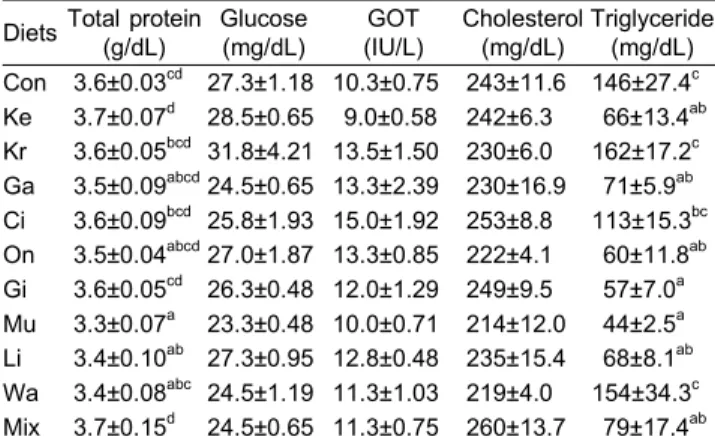
Table 5. Hematological change of the plasma in juvenile olive flounder fed the experimental diets for 15 weeks1 Diets Total protein
(g/dL)
Glucose (mg/dL)
GOT (IU/L)
Cholesterol (mg/dL)
Triglyceride (mg/dL) Con 3.6±0.03cd 27.3±1.18 10.3±0.75 243±11.6 146±27.4c Ke 3.7±0.07d 28.5±0.65 9.0±0.58 242±6.3 66±13.4ab Kr 3.6±0.05bcd 31.8±4.21 13.5±1.50 230±6.0 162±17.2c Ga 3.5±0.09abcd24.5±0.65 13.3±2.39 230±16.9 71±5.9ab Ci 3.6±0.09bcd 25.8±1.93 15.0±1.92 253±8.8 113±15.3bc On 3.5±0.04abcd27.0±1.87 13.3±0.85 222±4.1 60±11.8ab Gi 3.6±0.05cd 26.3±0.48 12.0±1.29 249±9.5 57±7.0a Mu 3.3±0.07a 23.3±0.48 10.0±0.71 214±12.0 44±2.5a Li 3.4±0.10ab 27.3±0.95 12.8±0.48 235±15.4 68±8.1ab Wa 3.4±0.08abc 24.5±1.19 11.3±1.03 219±4.0 154±34.3c Mix 3.7±0.15d 24.5±0.65 11.3±0.75 260±13.7 79±17.4ab
1Values (mean±SE of three replications) in the same column not sharing a common superscript letter are significantly different (P<0.05).
혈액 성상변화
어체의 미부동맥에서 추출한 혈액의 성상변화를 Table 5에 나타내었다. Total protein 함량은 Ke와 Mix 공급구에서 높게 나타났고, Mu 공급구에서 가장 낮았다 (P<0.05). 비록, total protein 함량이 실험구간에 유의한 차이를 보이긴 하였지만, 전체 함량 범위 (3.3~3.7 g/dL)는 수치상으로 큰 차이를 보이지 않았으며 이전 연구결과 (Kim et al., 2002)에서 보고된 함량과 유사하였다. Triglyceride 함량은 Ke, Ga, On, Gi, MU, Li 및 Mix 공급구가 Con 공급구보다 유의하게 낮았으며 (P<0.05), glucose, GOT 및 cholesterol 함량은 사료 첨가제에 영향을 받 지 않았다 (P<0.05). 마늘, 양파, 생강, 약쑥 및 감초 등은 흰쥐 를 대상으로 수행된 이전 연구에서도 (Kim and Wang, 1997;
An et al., 2001; Shin et al., 2002; Ryu et al., 2006; Choi et al., 2008) 혈중 triglyceride 함량 저하에 효능을 보인다고 보고 된 바 있다. 이것은 첨가제들이 함유하고 있는 특정 생리활성 물질이 지질합성에 관여하는 효소의 활성을 억제 또는 감소 시켰기 때문으로 생각된다. 하지만, 아직까지 정상범위에 해 당하는 혈액성상의 값들이 어종별로 확립되어 있지 않기 때 문에 사용된 첨가제의 효능을 혈액학적으로 정확히 파악하기 는 어려울 뿐 아니라, 어류의 혈중 성분이 환경조건이나 건강 상태에 따라 달라질 수 있으므로 혈액의 화학성분을 분석하 기 위해서는 이에 대한 고려가 필요할 것이다.
Myosin 유전자의 발현
Myosin의 전사는 rainbow trout (Overturf and Hardy, 2001)와 spotted wolffish (Imsland et al., 2006) 등 어류의 근육 성장에 잠재적인 생화학적 marker로 사용되고 있다. 본 연구에서는 각 첨가제에 따른 넙치 치어의 성장을 myosin mRNA의 발현 을 통하여 확인하였다 (Fig. 1과 Fig. 2). 첨가제를 함유한 사료
Fig. 1. Effects of dietary inclusion of additives on myosin gene expression after 5 weeks in olive flounder head kidney.
*Significantly different from control group (P<0.05).
Fig. 2. Effects of dietary inclusion of additives on myosin gene expression after 15 weeks in olive flounder head kidney.
*Significantly different from control group (P<0.05).
Fig. 3. Histopathological change of liver of juvenile olive flounder fed the experimental diets containing additives after 15 weeks.
를 공급한 5주 후에는 실험구간에 유의한 차이를 보이지 않았 으나 (P>0.05), 15주 후, Kr, Ci, Li 및 Mix 공급구에서 Con 공급구보다 myosin 유전자의 발현이 유의적으로 감소하였다 (P<0.05).
각 장기의 조직학적 분석
사료 첨가제 투여군 별로 각 장기의 조직표본을 광학현미 경으로 관찰한 결과, 첨가제 투여에 따른 특징적인 조직의 이상은 관찰되지 않았다. 일부 실험군의 개체에서 아가미 상 피세포의 미약한 증상이 관찰되었으나 특정 첨가제 투여군에 서만 관찰되지는 않았으며, 유사한 소견이 대조군에서도 관
찰되었다. 또한, 대부분의 실험군에서 일부 개체의 간세포에 서 미약한 괴사가 관찰되었으나, 이는 사료 첨가제의 종류와 관계없이 채집한 모든 실험군의 일부 개체에서 관찰되었으 며, 대조군의 일부 개체에서도 동일한 소견이 관찰되었다 (Fig. 3). 사료첨가제를 장기간 양식어류에게 투여하였을 경 우, 종류에 따라서 간장에 병리조직학적 변화를 유발하는 사 실이 보고되어 있다. 예를 들어, 장기간 과량의 식물성 오일을 사료에 첨가하여 양식어류에 투여하면 지방간이 유도되는 것으로 알려져 있다 (Caballero et al., 2004; Benedito-Palos et al., 2008). 이러한 병리조직학적 변화는 첨가량의 조절에 따라 회복이 가능한 가역적 변화로 알려져 있다. 본 연구의 일부 개체에서 관찰된 간 실질세포의 미약한 괴사는 대조군에서도 관찰된 것으로 보아 특정 사료첨가제의 과다 투여에 의한 것은 아닌 것으로 판단된다.
Table 6. Fatty acids (% of total fatty acids) and crude lipid (% of dry matter basis) compositions of dorsal muscle in juvenile olive flounder fed experimental diet for 15 weeks1
Diets
SEM2 Con Ke Kr Ga Ci On Gi Mu Li Wa Mix Fatty acids
C16:0 23.0 23.1 23.9 23.4 23.7 22.9 23.8 23.6 23.4 23.9 23.1 0.36 C16:1 0.2 0.2 0.2 0.3 0.2 0.2 0.2 0.2 0.2 0.2 0.3 0.01 C17:0 0.1 0.1 0.2 0.1 0.2 0.1 0.1 0.1 0.1 0.1 0.2 0.05 C17:1 0.5 0.4 0.2 0.2 0.1 0.4 0.2 0.2 0.4 0.4 0.4 0.04 C18:0 6.4 6.5 7.0 4.7 5.7 7.0 4.6 4.6 4.7 4.9 7.0 0.48 C18:1n-9 13.9 13.6 13.3 14.2 14.0 13.4 13.7 13.7 13.5 13.7 13.5 0.12 C18:2n-6 19.9 18.2 18.1 18.7 16.8 18.0 18.2 18.1 17.9 17.9 18.6 0.24 C18:3n-3 6.7 6.0 6.4 6.8 5.6 6.4 6.5 6.6 6.4 6.1 6.1 0.13 C18:3n-6 0.2 0.1 0.3 0.2 0.3 0.3 0.2 0.2 0.2 0.3 0.4 0.02 C20:3n-3 0.1 0.1 0.3 0.2 0.2 0.1 0.1 0.1 0.3 0.2 0.2 0.02 C20:4n-6 0.6 0.6 0.6 0.5 0.7 0.7 0.7 0.6 1.0 0.6 0.6 0.05 C20:5n-3 5.3 5.8 5.7 5.7 4.6 5.7 5.9 5.7 5.7 5.5 5.2 0.09 C22:1n-9 0.2 0.2 0.2 0.2 0.3 0.2 0.2 0.2 0.2 0.2 0.3 0.01 C22:6n-3 22.9 25.1 23.6 24.8 22.9 24.5 25.6 25.9 26.0 25.9 24.3 0.34 n-3HUFA3 28.3 31.0 23.6 30.7 27.7 30.4 31.6 31.7 32.0 31.6 29.7 0.41 Crude lipid 3.0 3.3 3.6 2.5 3.2 3.9 3.0 3.6 2.7 2.9 2.4 0.13
1Values presented are mean±SE of three replications.
2Standard error of the treatment mean calculated from the residual mean square in the analysis of variance.
3High unsaturated fatty acids (C≥20).
등근육의 지방산 및 일반성분 분석
등근육 지방산 조성 및 지질함량 (Table 6)은 사료 첨가제에 영향을 받지 않았다 (P>0.05).
이상의 결과들로 보아, 본 연구에 사용된 첨가제들은 넙치 치어의 성장, 사료 이용성, 성장 유전자 발현 및 조직 성상에 는 영향을 미치지 않았으나, 켈프 5%, 양파 3%, 그리고 마늘, 생강, 약쑥 및 혼합물의 1% 첨가는 혈장내 중성지질 함량을 감소시키는데 유용하게 사용될 것으로 판단되며, 이러한 결
과는 넙치치어 배합사료의 품질개선을 위한 사료 조성시 유 익한 정보로 이용될 수 있을 것이다.
사 사
본 연구는 국립수산과학원 (고효율 배합사료 개발 및 실용 화 연구, RP-2010-AQ-054)의 지원에 의해 수행되었으며, 이에 감사드립니다.
참고문헌
Ahn MS, Kim HJ and Seo MS. 2007. A study on the antioxidative and antimicrobial activities of the Citrus Unshju peel extracts. Kor J Food Culture 22, 454-461.
Benedito-Palos L, Navarro JC, Sitja-Bobadilla A, Bell JG, Kaushik S and Perez-Sanchez J. 2008. High levels of vegetable oils in plant protein-rich diets fed to gilthead seabream (Sparus aurata L.,): growth performance, muscle fatty acid profiles and histological alterations of target tissues. Br J Nutr 100, 992-1003.
Caballero MJ, Izquierdo MS, Kjorsvik E, Fernandez AJ and Rosenlund G. 2004. Histological alterations in the liver of sea bream, Sparus aurata L., caused by short- or long-term feeding with vegetable oils.
Recovery of normal morphology after feeding fish oil as the sole lipid sources. J Fish Dis 27, 531-541.
Cho SH, Lee SM, Park BH, Ji SC, Kwon MG, Kim YC, Lee JH, Park SG and Han HK. 2006. Effects of dietary inclusion of various sources of green tea on immune system and challenging test of juvenile olive flounder Paralichthys olivaceus. J Aquacult 19, 84-89.
Choi HT, Kim ES, Ham SS, Park SY and Chung HY.
2008. Effects of complex food ingredient composed of garlic and fermented soybean hypocotyl on the serum lipid profiles of the rats fed high-fat diet. Kor J Food Sci Technol 40, 215-219.
Choi SM, Ko SH, Park GJ, Lim SR, Yu GY, Lee JH and Bai SC. 2004. Utilization of Song-Gang stone as the dietary additive in juvenile olive flounder, Paralichthys olivaceus. J Aquacult 17, 39-45.
Duncan DB. 1955. Multiple-range and multiple F tests.
Biometrics 11, 1-42.
Fernández-Navarro M, Peragón J, Amores V, De La Higuera M and Lupiáñez JA. 2008. Maslinic acid added to the diet increases growth and protein-turnover rates in the white muscle of rainbow trout (Oncorhynchus mykiss). Comp Biochem
Physiol C Toxicol Pharmacol 147, 158-167.
Folch J, Lees M and Stanley GHS. 1957. A simple method for the isolation and purification of total lipids from animal tissues. J Biol Chem 226, 496-509.
Gaber MMA. 2005. The effect of different levels of krill meal supplementation of soybean-based diets on feed intake, digestibility, and chemical composition of juvenile nile tilapia Oreochromis niloticus, L. J World Aquacult Soc 36, 346-353.
Heo SJ, Park PJ, Park EJ, Cho SK, Kim SK and Jeon YJ. 2005. Antioxidative effect of proteolytic hydrolysates from Ecklonia cava on radical scavenging using ESR and H2O2-induced DNA damage. Food Sci Biotechnol 14, 614-620.
Im JT, Park IK and Koh TS. 2007. Effect of dietary krill meal levels on the cell mediated immunity in intra-muscularly croton oil injected broiler chicks. J Anim Sci Technol 49, 599-610.
Imsland AK, Le François NR, Lamarre SG, Ditlecadet D, Sigurosson S and Foss A. 2006. Myosin expression levels and enzyme activity in juvenile spotted wolfish (Anarhichas minor) muscle: a method for monitoring growth rates. Can J Fish Aquat Sci 63, 1959-1967.
Jeong CH, Heo HJ, Choi SG and Shim KH. 2009.
Antioxidant and anticancer properties of metanolic extracts from different parts of white, yellow and red onion. Food Sci Biotechnol 18, 108-112.
Ji WD, Jeong HC, Lee SJ and Chun YG. 1997.
Antimicrobial activity and distilled components of garlic and ginger. J Agric Chem Biotechnol 40, 514-518.
Kenneth JL and Thomas DS. 2001. Analysis of relative gene expression data using real-time quantitative PCR and the 2-ΔΔCT method. Methods 25, 402-408 Kim DS, Kim JH, Jong CH, Lee SY, Lee SM and Moon YB. 1998. Utilization of obosan (dietary herbs) Ⅰ.
Effects on survival, growth, feed conversion ratio and condition factor in olive flounder, Paralichthys olivaceus. J Aquacult 11, 213-221.
Kim IS, Jin SK and Kang SN. 2009a. Effects of mugwort powder supplementation on carcass and meat characteristics in the finishing period of gilts. Kor J Food Sci Ani Resour 29, 188-193.
Kim JH and Wang SG. 1997. Effects of Mugwort, dry orange peel and duchung on lipid metabolism in hyper-lipidemia rats. Kor J Nutr 30, 859-903.
Kim KD, Kang YJ, Lee HY, Kim KW, Jang MS, Kim SK and Son MH. 2009b. Evaluation of extruded
pellets containing different protein and lipid levels, and raw fish-based moist pellet for growth of flounder (Paralichthys olivaceus). Kor J Fish Aquat Sci 42, 476-480.
Kim KD, Lee SM, Park HG, Bai SC and Lee YH. 2002.
Essentiality of dietary n-3 highly unsaturated fatty acids in juvenile Japanese flounder Paralichthys olivaceus. J World Aquacult Soc 33, 432-440.
Kim SK and Kim MK. 2004. Effect of dried poders or ethanol extracts of onion flesh and peel on lipid metabolism, antioxidative and antithrombogenic capacities in 16-month-old rats. Kor J Nutr 37, 623-632.
Kim SS and Lee KJ. 2008. Effects of dietary kelp (Ecklonia cava) on growth and innate immunity in juvenile olive flounder Paralichthys olivaceus.
Aquacult Res 38, 1687-1690.
Kim SS, Jang JW, Song JW, Lim SJ, Jeong JB, Lee SM, Kim KW, Son MH and Lee KJ. 2009c. Effects of dietary supplementation of alga mixtures (Hizikia fusiformis and Ecklonia cava) on innate immunity and disease resistance against Edwardsiella tarda in olive flounder. Kor J Fish Aquat Sci 42, 614-620.
Kim YS, Kim MN, Kim JO and Lee JH. 1994. The effect of hot water-extract and flavor compounds of mugwort on microbial growth. J Kor Soc Food Nutr 23, 994-1000.
Kono M, Matsui T and Shimizu C. 1987. Effect of chitin, chitosan, and cellulose as diet supplements on the growth of cultured fish. Nipp Sui Gakkai 53, 125-129.
Kwon OS, Cho JH, Min BJ, Kim HJ, Chen YG, Yoo JS, Kim IH, La JC and Park HK. 2005. Effect of supplemental medicinal plants (Artemisia, Acanthopanax and Garlic) on growth performance, IGF-1 and meat quality characteristics in growing-finishing pigs. Kor J Food Sci Ani Resour 25, 316-321.
Lee SH, Park GJ and Bai SC. 2008a. Effects of dietary wood vinegar supplementation on growth and immune responses of juvenile olive flounder, Paralichthys olivaceus. J Kor Fish Soc 41, 248-252.
Lee SM and Kim KD. 2005. Effect of various levels of lipid exchanged with dextrin at different protein level in diet on growth and body composition of juvenile flounder Paralichthys olivaceus. Aquacult Nutr 11, 435-442.
Lee SM and Lim TJ. 2000. Effects of herb as an additive in formulated diet on growth and body composition
of larval ayu (Plecoglossus altivelis). J East Coastal Res 11, 35-42.
Lee SM, Cho SH and Kim KD. 2000. Effects of dietary protein and energy levels on growth and body composition of juvenile flounder (Paralichthys olivaceus). J World Aquacult Soc 31, 306-315.
Lee SM, Kim KD and Lall SP. 2003. Utilization of glucose, maltose, dextrin and cellulose by juvenile flounder (Paralichthys olivaceus). Aquaculture 221, 427-438.
Lee SM, Park CS and Bang IC. 2002. Dietary protein requirement of young Japanese flounder Paralichthys olivaceus fed isocaloric diets. Fish Sci 68, 158-164.
Lee SM, Seo JY, Choi KH and Kim KD. 2008b. Apparent amino acid and energy digestibilities of common feed ingredients for flounder Paralichthys olivaceus. J Aquacult 21, 89-95.
Li Y, Wang YJ, Wang L and Jiang KY. 2008. Influences of several non-nutrient additives on nonspecific immunity and growth of juvenile turbot, Scophthalmus maximus L. Aquacult Nutr 14, 387- 395.
Lindsay GJM, Walton MJ, Adron JW, Fletcher TC, Cho CY and Cowey CB. 1984. The growth of rainbow trout (Salmo gairdneri) given diets containing chitin and its relationship to chitinolytic enzymes and chitin digestibility. Aquaculture 37, 315-334.
Ma JJ, Xu ZR, Shao QJ, Xu JZ, Hung SSO, Hu WL and Zhuo LY. 2008. Effect of dietary supplemental L-carnitine on growth performance, body composition and antioxidant status in juvenile black sea bream, Sparus macrocephalus. Aquacult Nutr 14, 464-471.
Nakagawa H. Unimo T and Tasaka Y. 1997. Usefulness of Ascophyllum nodosum as a feed additive for red sea bream, Pagrus major. Aquaculture 151, 275-281.
Overturf K and Hardy RW. 2001. Myosin expression levels in trout muscle: a new method for monitoring specific growth rates for rainbow trout Oncorhynchus mykiss (Walbaum) on varied planes of nutrition.
Aquacult Res 32, 315-322.
Ryu SP, Kwon TD, Yeo YG, Kim BS and Lee SC. 2006.
Effects of licorice-root-extracted food components ingestion on blood lipids concentration during exercise in rats. The Kor J Physic Edu 45, 707-713.
Schram E, Pedrero Z, Cámara C, Van der Heul JW and Luten JB. 2008. Enrichment of African catfish with functional selenium originating from garlic. Aquacult Res 39, 850-860.
Seo JY, Choi J, Lee JH and Lee SM. 2007. Development of extruded pellet for growth of flounder (Paralichthys olivaceus) in commercial scale feeding trials. J Aquacult 20, 114-120.
Shiau SY and Yu YP. 1999. Dietary supplementation of chitin and chitosan depresses growth in tilapia, Oreochromis niloticus × O. aureus. Aquaculture 179, 439-446.
Shin IS. 2001. Bactericidal activity of sawa-wasabi (Wasabia japonica) against the fish pathogenic bacteria. J Fish Sci Tech 4, 252-256.
Shin JH, Lee SJ and Sung NJ. 2002. Effects of Zingiber mioga, Zingiber mioga Root and Zingiber officinale on the lipid concentration in Hyperlipidemic rats. J Kor Soc Food Sci Nutr 31, 679-684.
Song YB, Moon SW, Kim SJ and Lee YD. 2002. Effect of EM-fermented orange in commercial diet on growth of juvenile flounder, Paralichthys olivaceus.
J Aquacult 15, 103-110.
Woo KS, Jang KI, Kim KY and Lee HB. 2006.
Antioxidative activity of heat treated licorice (Glycyrrhiza uralensis Fisch) extracts. Kor J Food Sci Technol 38, 355-360.
Yang ST. 2007. Antioxidant activity of extracts of aged black garlic on oxidation of human low density lipoprotein. J Life Sci 17, 1330-1336.
Yone Y, Furuichi M and Urano K. 1986. Effects of dietary wakame Undaria penatifida and Ascophyllum nodosum supplements on growth, feed efficiency, and proximate compositions of liver and muscle for red sea bream. Nipp Sui Gakka 52, 1465-1468.
Yoo GY, Choi SM, Kim KW and Bai SC. 2006. Apparent protein and phosphorus digestibilities of nine different dietary protein sources and their effects on growth of juvenile olive flounder, Paralichthys olivvaceus. J Aquacult 19, 254-260.
2011년 1월 12일 접수 2011년 3월 29일 수정 2011년 4월 6일 수리