317
Copyright © 2016 The Korean Society of Fisheries and Aquatic Science pISSN:0374-8111, eISSN:2287-8815
서 론
영양소중에서지질은단백질이나탄수화물보다에너지가가 높아값비싼사료단백질을절약할수있으며
,
필수지방산과지 용성비타민의공급원으로양식대상종의성장과체내대사에 필수적인역할을하는중요한영양소이다(NRC, 1993).
특히성 장이활발히진행되는어린시기에정상성장을위해서는대상 종이요구하는필수지방산을사료에첨가해주어야한다(Sar- gent et al., 1999).
어류는그들이요구하는지방산의종류와함 량이수온이나염분도등과같은서식환경에영향을받기때문 에양식어류가요구하는필수지방산의종류와요구량을구명하기위한연구들이꾸준히수행되어왔다
(Castell et al., 1972;
Kim et al., 2002).
따라서양식대상종이나서식환경에따른지 방산요구량의차이를밝혀이를충족시킬수있도록사료를설 계하는것은매우중요하다.
이러한지방산들은체내에서세포 막의효소활성등생리적인기능에중요한역할을담당하는것 으로보고되어있다(Baud et al., 1989; German et al., 1987;
Lokesh et al., 1989; Stubbs and Smith, 1984).
오징어간유나 대구간유와같은어유에는어류가요구하는eicosapentaenoic acid (EPA)
와docosahexaenoic acid (DHA)
와같은n-3
계열 의 고도불포화지방산(highly unsaturated fatty acids, HUFA)
이다량함유되어있을뿐아니라
EPA/DHA
비가적절히함유사료 지질원이 비단잉어( Cyprinus carpio var. koi) 치어의 성장 및 체조성에 미치는 영향
김이오
∙ 이상민1*
충청북도내수면연구소, 1강릉원주대학교 해양생물공학과
Influences of Different Dietary Lipid Sources on the Growth, Body Composition, and Fatty Acid Profiles of
Juvenile Fancy Carp Cyprinus carpio var. koi
Yi-Oh Kim and Sang-Min Lee
1
*Department of Inland Fisheries Research Institute, Chungju 27432, Korea
1
Department of Marine Biotechnology, Gangneung-Wonju National University, Gangneung 25457, Korea
This study was carried out to investigate the effects of various dietary lipid sources on the growth performance, body composition, and fatty acid profiles of juvenile fancy carp ( Cyprinus carpio var. koi). Three replicate groups of fish (initial mean body weight, 15.1±0.18 g) were fed one of five experimental diets containing fish oil (SLO), soybean oil (SO), linseed oil (LO), lard (LA), or a mixture of SLO, SO, and LO (Mix) for 8 weeks. Fish fed the LA diet gained less weight than did fish fed the LO diet. The feed efficiency and protein efficiency ratio of fish fed the LA and Mix diets were lower than those of fish fed the SO and LO diets. The body lipid content of fish fed the SO diet was lower than those of the other groups. Whole-body fatty acid compositions reflected the fatty acid compositions of dietary lipid sources. Fish fed the SO diet had high concentrations of linoleic acid and arachidonic acid, whereas fish fed the LO diet were rich in linolenic acid. Fish fed the SLO diet had significantly higher levels of eicosapentaenoic acid and docosahexaenoic acid compared with fish fed the SO, LO, and LA diets. The results of this study suggest that SO or LO could be used as a replacement for SLO in the diets of juvenile fancy carp without any negative effects on growth and feed utilization when the dietary essential fatty acid requirements are satisfied for juvenile fancy carp.
Key words: Fancy carp, Dietary lipid source, Fatty acids, Cyprinus carpio var. koi
This is an Open Access article distributed under the terms of the Creative Commons Attribution Non-Commercial Licens (http://creativecommons.org/licenses/by-nc/3.0/) which permits unrestricted non-commercial use, distribution, and reproduction in any medium, provided the original work is properly cited.
http://dx.doi.org/10.5657/KFAS.2016.0317 Korean J Fish Aquat Sci 49(3) 317-322, June 2016
Received 5 February 2016; Revised 4 April 2016; Accepted 5 April 2016
*Corresponding author: Tel: +82. 33. 640. 2414 Fax: +82. 33. 640. 2955
E-mail address: [email protected]
되어있으므로
(Lee, 2001; Kalogeropoulos et al., 1992)
어류의n-3HUFA
요구를충족시켜주기위해어유를사료지질원으로많이사용하고있다
.
하지만어유는가격이비쌀뿐아니라어 유를구성하는지방산중의고도불포화지방산은산화되기쉽 고,
비타민E
의요구량이증가되는등의문제점이잠재되어있 다(Watanabe et al., 1981).
따라서어유를대체할수있는값싸 고저장이용이한지질원의탐색및그이용성을조사하는것 이필요하다.
비단잉어는아름다운체색
,
다양한무늬,
안정적인체형및화 려한지느러미를가지고있을뿐아니라,
사육수온및pH
와같 은수질환경변화에도강한내성을지녀사육관리가다른관상 어에비하여용이한장점을가지고있다.
비단잉어는우리나라 를비롯한일본,
미국,
유럽등과같은선진국에서인기가매우 높은품종이어서양식기술및성장에관한지속적인연구가필 요하다(Hancz et al., 2003).
하지만비단잉어양식사료개발을 위한영양요구에관한연구는매우제한적인실정이다.
따라서 본연구는비단잉어사육에적합한배합사료를개발하기위한 영양요구에관한연구의일환으로사료의지질원이비단잉어 치어의성장및체조성에미치는영향을조사하였다.
재료 및 방법
실험사료
실험사료의원료조성과영양소분석결과를
Table 1
에나타내 었다.
실험사료의단백질원으로카제인및명태어분을사용하 였고,
지방산조성이다른지질원에따른비단잉어의이용성을 조사하기위하여지질원으로오징어간유,
대두유,
아마인유,
돈 지를각9%
씩첨가하고오징어간유,
대두유및아마인유를3%
씩첨가한사료로총
5
종류의실험사료(SLO, SO, LO, LA
및Mix)
를설계하였다.
이와같이설계된원료들을잘혼합한후,
원료100 g
당물40 g
을첨가하여펠렛제조기로성형한후실온에서
24
시간건조한후-30℃
에보관하면서필요시공급하였다
.
건조된사료는실험어의입의크기에맞게망크기가다른 채로선별한후,
냉장보관하면서사용하였다.
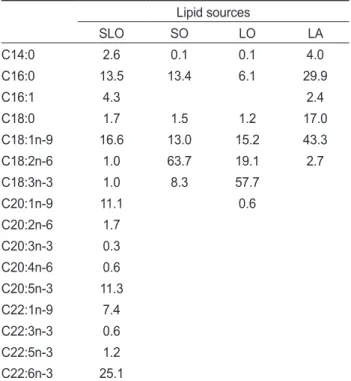
지질원으로사용 된원료의지방산조성은Table 2
에나타내었다.
실험어 및 사육관리
실험어로 충청북도내수면연구소에서종묘생산된비단잉어
(Fancy Carp, Cyprinus carpio var. koi)
사용하였으며,
상품사 료를30
일간공급하면서예비사육하였다.
외형적으로건강한 평균체중15.1±0.18 g
의비단잉어치어를선별하여20 L
사각 수조에각각30
마리씩3
반복으로수용하여8
주간사육하였다.
수조내여과시스템은반순환여과방식으로2 L/min
의물이순 환되도록수중펌프를사용하여흘려주었다.
또한매일전체사 육수의20%
를환수하였으며,
사육수온을27℃
로유지하였다.
각수조마다약하게폭기시켜산소를공급하였다.
실험사료는1
일2
회(09:00, 17:00)
만복으로공급하였다. 성분 분석
실험종료시에는
24
시간절식시킨각실험수조의비단잉어치어를즉사시켜분석을위해냉동보관
(-75℃)
하였다.
실험사료및어체의일반성분은표준방법
(AOAC, 1995)
에따라분석하였는데
,
조단백질(N×6.25)
은Auto Kjeldahl System (Buchi B-324/ 435/412, Switzerland)
을 사용하여 분석하였고,
조지 질은ether
를사용하여추출하였으며,
수분은105℃ dry oven
에서6
시간동안건조후측정하였고,
회분은600℃
에서4
시 간 동안태운후 정량하였다.
지방산분석을위한 총지질은Folch et al. (1957)
의방법에준하여추출하였다.
분리된지질 Table 1. Ingredient and proximate composition of experimental dietsIngredients (%) Diets
SLO SO LO LA MIX
Casein 30.0 30.0 30.0 30.0 30.0
Pollack fish meal 8.0 8.0 8.0 8.0 8.0
Corn gluten meal 15.0 15.0 15.0 15.0 15.0
Potato starch 33.3 33.3 33.3 33.3 33.3
Squid liver oil 9.0 3
Soybean oil 9.0 3
Linseed oil 9.0 3
Lard 9.0
Kelp meal 2.0 2.0 2.0 2.0 2.0
Vitamin premix1 1.0 1.0 1.0 1.0 1.0
Mineral premix2 1.0 1.0 1.0 1.0 1.0
Vitamin C (50%) 0.3 0.3 0.3 0.3 0.3
Vitamin E (25%) 0.2 0.2 0.2 0.2 0.2
Choline salt (50%) 0.2 0.2 0.2 0.2 0.2 Nutrient content (%, dry matter basis)
Crude protein 45.8 46.5 44.2 45.5 44.6
Crude lipid 9.7 9 9.7 9.7 9.2
Ash 5.9 5.5 5 5.7 5.7
SLO, squid liver oil; SO, soybean oil; LO, linseed oil; LA, lard.
1Vitamin premix contained the following amount which were diluted in cellulose (g/kg mix): thiamin hydrochloride, 2.7; ri- boflavin, 9.1; pyridoxine hydrochloride, 1.8; niacin, 36.4; Ca-D- pantothenate, 12.7; myo-inositol, 181.8; D-biotin, 0.27; folic acid (98%), 0.68; p-aminobenzoic acid, 18.2; menadione, 1.8; retinyl acetate, 0.73; cholecalciferol, 0.003; cyanocobalamin, 0.003.
2Mineral premix contained the following ingredients (g/kg mix):
MgSO4·7H2O, 80.0; NaH2PO4·2H2O, 370.0; KCl, 130.0; Ferric citrate, 40.0; ZnSO4·7H2O, 20.0; Ca-lactate, 356.5; CuCl, 0.2;
AlCl3·6H2O, 0.15; KI, 0.15; Na2Se2O3, 0.01; MnSO4·H2O, 2.0;
CoCl2·6H2O, 1.0.
에
benzene 2 mL
와14% BF
3-methanol 2 mL
를가하고80℃
water bath
에서30
분간가열하여methylation
시켰다. SP-2560 capillary column (100 m×0.25 mm i.d., film thickness 0.20 m; Supelco, Bellefonte, PA, USA)
이부착된gas liquid chro- matography (Clarus 600, PerkinElmer, Shelton, CT, USA)
로 지방산을분석하였다.
통계처리
결과의통계처리는
SPSS Version 19 (SPSS, Michigan Ave- nue, Chicago, IL, USA) program
을사용하여One-way ANO-
VA-test
를실시한후, Duncan's multiple range test (Duncan,
1955)
로평균간의유의성을검정하였다.
결과 및 고찰
평균체중
15.1 g
의비단잉어8
주간사육실험한후의생존율,
증체율,
사료효율및단백질효율을Table 3
에나타내었다.
사육실험기간동안의모든실험구의생존율은
100%
였으며,
증중율
,
사료섭취율,
사료효율및단백질효율이사료에혼합된지질 종류에영향을받았다(P<0.05).
증체율은LO
실험구가LA
실험구보다높았지만
SLO, SO
및Mix
실험구와는유의차가없었다
. SO
와LO
사료를섭취한어류의사료효율및단백질효율 은LA
와Mix
사료를섭취한어류보다높았다(P<0.05).
일일사 료섭취율은LA
와Mix
실험구가SO
와LO
실험구보다높았다(P<0.05).
본실험의사육실험기간중에모든실험구에서성장과사료 효율차이외의폐사나외적인결핍증상이관찰되지않았다
.
이 로보아본실험조건에서비단잉어는필수지방산결핍에반응 이느린것으로보인다.
타어종의경우,
필수지방산이부족한사 료를먹인송어, Salmo gairdneri (Castell et al., 1972)
의경우 성장및사료효율의저하와더불어피부의탈색이나지느러미 부식과같은결핍증상이나타났고, n-3HUFA
가부족한turbot, Scophthalmus maximus (Bell et al., 1985)
과은어, Plecoglos- sus altivelis (Kanazawa et al., 1982)
에서도폐사율이높았다 는보고가있다.
일반적으로사료에첨가되는 지질의종류에따라양식어류 의성장과사료이용효율이달라지는것으로보고되고있는데
(Fountoulaki et al., 2009),
이는지질을구성하고있는지방산 의종류가다르기때문이다.
즉,
사료에첨가되는지질을구성하 는지방산중에대상어종이요구하는필수지방산의충족여부 에따라성장이달라진다(Lee, 2001).
특히성장속도가빠른어 린시기에필수지방산을부족하게섭취하면이에대한결핍증 상이빠르게나타날수있으므로대상어류에필요한지방산의 Table 2. Major fatty acid composition (% of total fatty acids) ofdietary lipid sources
Lipid sources
SLO SO LO LA
C14:0 2.6 0.1 0.1 4.0
C16:0 13.5 13.4 6.1 29.9
C16:1 4.3 2.4
C18:0 1.7 1.5 1.2 17.0
C18:1n-9 16.6 13.0 15.2 43.3
C18:2n-6 1.0 63.7 19.1 2.7
C18:3n-3 1.0 8.3 57.7
C20:1n-9 11.1 0.6
C20:2n-6 1.7
C20:3n-3 0.3
C20:4n-6 0.6
C20:5n-3 11.3
C22:1n-9 7.4
C22:3n-3 0.6
C22:5n-3 1.2
C22:6n-3 25.1
SLO, squid liver oil; SO, soybean oil; LO, linseed oil; LA, lard.
Table 3. Growth performance and feed utilization of juvenile fancy carp Cyprinus carpio var. koi fed the diets for 8 weeks
Diets Survival (%) WG (%)1 FE (%)2 DFI (%)3 DPI (%)4 PER (%)5
SLO 100 108±4.88ab 54.7±2.64ab 2.29±0.04ab 1.11±0.02a 1.13±0.05ab
SO 100 116±6.02ab 60.5±2.92b 2.17±0.03a 1.07±0.02a 1.23±0.06b
LO 100 124±3.11b 60.1±1.89b 2.27±0.05a 1.13±0.02a 1.21±0.04b
LA 100 103±3.08a 49.1±1.03a 2.47±0.01b 1.26±0.01b 0.96±0.02a
Mix 100 110±7.11ab 52.6±3.51a 2.41±0.06b 1.21±0.03b 1.05±0.07a
SLO, squid liver oil; SO, soybean oil; LO, linseed oil; LA, lard. Values (mean±SE of replications) in the same column not sharing a com- mon superscript are significantly different (P<0.05). 1Weight gain=(final fish wt.-initial fish wt.)×100/initial fish wt. 2Feed efficiency=fish wet weight gain×100/ feed intake (dry matter). 3Daily feed intake=feed intake (dry matter)×100/[(initial fish wt.+final fish wt.+dead fish wt.)/2×days fed]. 4Daily protein intake=protein intake×100/[(initial fish wt.+final fish wt.+dead fish wt.)×days reared/2]. 5Protein efficiency ratio = fish wet weight gain/protein intake.
종류와요구량이충족되도록사료를설계하여야한다
(Sargent et al., 1999).
어류는그들이요구하는지방산의종류와양이수 온이나염분도등과같은서식환경에따라다르다(NRC, 1993).
담수어종인무지개송어
, Salmo gairdneri
와틸라피아, Tilapia zilli
는 필수지방산으로18:3n-3
과18:2n-6
을 각각 요구하며(Castell et al., 1972; Kanazawa et al., 1980),
해산어류인넙치, Paralichthys olivaceus
는DHA
와EPA
를필수지방산으로요구 한다고보고되어있다(Kim et al., 2002).
본실험에서와같이어 유와식물성지질을첨가한실험구간에성장과사료이용효율 이서로차이가없는것은이들실험사료에함유된필수지방산 의종류와량이비단잉어의요구에만족되었기때문으로판단 된다.
이전의연구들에서도필수지방산이요구량이상으로사 료에함유되면,
성장과사료이용효율이사료의지질원에영향 을받지않는다고보고하였다(Aminikhoei et al., 2013; Bell et al., 2003; Peiedecausa et al., 2007).
반면에돈지첨가사료를섭 취한비단잉어의성장이낮아진것은비단잉어사료의지질원 으로돈지와같은동물성지방은적합하지않았기때문으로생 각된다.
다른어류에서도돈지나우지와같은동물의지방을혼합한사료를섭취한경우
,
성장과사료효율이저하된다고보고되었다
(Lee, 2001).
이와같이결과들로부터아마인유와대두유에다량함유된
18:3n-3
이나18:2n-6
또는어유에많이함유 된DHA
및EPA
와같은n3-HUFA
가비단잉어의필수지방산 으로작용하는것으로보인다.
기존의연구에서잉어의필수지 방산은18:3n-3
과18:2n-6
이라고보고되어있다(Takeuchi and Watanabe, 1977; Watanabe et al., 1975).
사육실험종료후
,
전어체의일반성분분석결과를Table 4
에 나타내었다.
전어체의수분,
조단백질및회분은사료의지질 종류에영향을받지않았다(P>0.05).
반면에SO
사료를섭취 한실험구의지질함량은다른실험구보다유의하게낮은값을 보였다(P<0.05).
일반적으로필수지방산함량이충족된사료 를섭취한실험어류체성분은사료의지질원에영향을받지않 는경향을보인다(Aminikhoei et al., 2013).
하지만,
본연구에 서처럼대두유첨가군의체지방함량이다른실험구들에비해 낮은것은비단잉어가대두유에많은비율로함유된18:2n-6
과같은특정지방산을잘이용할수있기때문으로추측되지 만,
비단잉어의지질이용성에관한상세한연구는금후계속Table 4. Proximate composition (%) of the whole body in juvenile fancy carp Cyprinus carpio var. koi fed the diets containing different lipid source for 8 weeks
Diets Moisture Crude protein Crude lipid Ash
SLO 71.3±0.43ns 14.5±0.15ns 11.2±0.27b 2.1±0.09ns
SO 72.8±1.58 14.2±0.36 8.8±0.51a 2.0±0.25
LO 72.2±0.98 15.8±1.09 12.2±0.08b 1.6±0.10
LA 70.4±0.57 16.4±0.34 11.6±0.40b 2.4±0.28
Mix 70.6±1.59 16.7±0.23 11.9±1.98b 2.0±0.21
SLO, squid liver oil; SO, soybean oil; LO, linseed oil; LA, lard. Values (mean±SE of replications) in the same column not sharing a common superscript are significantly different (P<0.05).
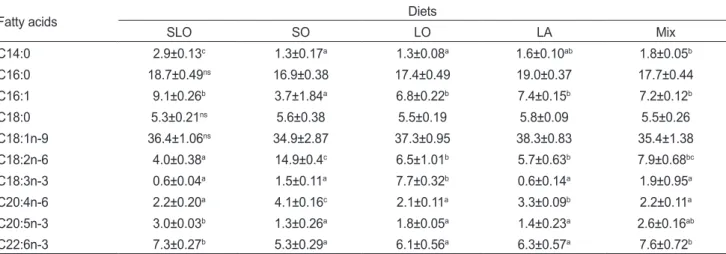
Table 5. Major fatty acid composition (% of total fatty acids) of whole body in juvenile fancy carp Cyprinus carpio var. koi fed the diets containing different lipid source for 8 weeks
Fatty acids Diets
SLO SO LO LA Mix
C14:0 2.9±0.13c 1.3±0.17a 1.3±0.08a 1.6±0.10ab 1.8±0.05b
C16:0 18.7±0.49ns 16.9±0.38 17.4±0.49 19.0±0.37 17.7±0.44
C16:1 9.1±0.26b 3.7±1.84a 6.8±0.22b 7.4±0.15b 7.2±0.12b
C18:0 5.3±0.21ns 5.6±0.38 5.5±0.19 5.8±0.09 5.5±0.26
C18:1n-9 36.4±1.06ns 34.9±2.87 37.3±0.95 38.3±0.83 35.4±1.38
C18:2n-6 4.0±0.38a 14.9±0.4c 6.5±1.01b 5.7±0.63b 7.9±0.68bc
C18:3n-3 0.6±0.04a 1.5±0.11a 7.7±0.32b 0.6±0.14a 1.9±0.95a
C20:4n-6 2.2±0.20a 4.1±0.16c 2.1±0.11a 3.3±0.09b 2.2±0.11a
C20:5n-3 3.0±0.03b 1.3±0.26a 1.8±0.05a 1.4±0.23a 2.6±0.16ab
C22:6n-3 7.3±0.27b 5.3±0.29a 6.1±0.56a 6.3±0.57a 7.6±0.72b
SLO, squid liver oil; SO, soybean oil; LO, linseed oil; LA, lard. Values (mean±SE of replications) in the same row not sharing a common superscript are significantly different (P<0.05).
되어야할것이다
.
실험종료시의비단잉어전어체의지방산조성은사료의지질
원에영향을받아그조성비가다르게나타났다
(Table 5).
어체의
EPA
및DHA
는SLO
실험구에서, 18:2n-6
및20:4n-6
은SO
실험구에서, 18:3n-3
은LO
실험구에서다른실험구보다유의 하게높았다(P<0.05).
본연구에서전어체의16:0
이나18:0
와 같은포화지방산과18:1n-9
와같은단일불포화지방산은사료 의지질원에큰영향을받지않았지만18:2n-6, 18:3n-3, 20:4n- 6, EPA
및DHA
와같은탄소수18
개이상의다불포화지방산 들의어체조성이사료의지방산조성에직접적인 영향을받 았다.
다른연구에서도이와유사한경향을보였다(Kim et al.,
2012).
이러한현상은체내에서 지방산의전환능력에관련된것으로판단된다
.
즉포화지방산과단일불포화지방산들은체 내에서신장되거나불포화되어생성될수있지만, 18:1n-9
에서18:2n-6
으로불포화되지못하기때문에18:2n-6
이나18:3n-3
은먹이로부터공급되어야하는필수지방산으로존재한다.
대두유첨가사료를섭취한비단잉어의
20:4n-6
의조성비가 타실험구보다유의하게높은결과를보였는데,
이는섭취된사 료의대두유에 다량함유된18:2n-6
이20:4n-6
으로합성되어증가된것으로판단된다
. 20:4n-6
는세포막의중요한구성성분으로서인간이나동물의필수지방산이다
(Burr and Burr, 1930;
Alfin-Slater and Aftergood, 1968; Holman, 1968). 20:4n-6
는 생체내에서prostaglandin
의전구물질로서n-6
계의매우중요 한고도불포화지방산이다(German et al., 1987; Kaley et al., 1985; Maroussem et al., 1985).
참돔(Fujii et al., 1976)
과gil- thead bream (Kalogeropoulos et al., 1992)
의실험에서 사료의지방산조성에따라간극성지질중의
20:4n-6
의조성비가증가되었다고보고하였으며
,
이지방산의증가는18:2n-6
이나20:2n-6
에서전환되었기때문으로생각된다.
이상의결과로보아
,
비단잉어사료내오징어간유와같은어 유대신대두유나아마인유와같은식물성기름을사용할수있 을것으로보이며,
사용하는기름에따라어체의지방산조성이 영향을받는것으로나타났다.
사 사
본연구는해양수산부해양바이오지역특화선도기술개발사 업
(
과제번호D11413914H480000100)
에의해수행되었으며,
이에감사드립니다.
References
Alfin-Slater RB and Aftergood L. 1968. Essential fatty acids re- investigated. Phys Rev 48, 758-784.
Aminikhoei Z, Choi J, Lee SM and Kim KD. 2013. Effects of different dietary lipid sources on growth performance, fatty acid composition and antioxidant enzyme activity of juve- nile rockfish, Sebastes schlegeli. J World Aquacult Soc 44,
716-725. http://dx.doi.org/10.1111/jwas.12070.
AOAC (Association of Official Analytical Chemists). 1995. Of- ficial Methods of Analysis, 16th edition. Association of Of- ficial Analytical Chemists, Arlington, Virginia, USA.
Baud I, Oudinet JP, Bens M, Noe L, Peraldi MN, Rondeau E, Etienne J and Ardaillou R. 1989. Production of tumor ne- crosis factor by rat mesangial cells in response to bacterial lipopolysaccharide. Kidney Int 35, 1111-1118.
Bell JG, McGhee F, Campbell PJ and Sargent JR. 2003. Rape- seed oil as an alternative to marine fish oil in diets of post- smolt Atlantic salmon Salmo salar: changes in flesh fatty acid composition and effectiveness of subsequent fish oil “wash out”. Aquaculture 218, 515-528. http://dx.doi.
org/10.1016/S0044-8486(02)00462-3.
Bell MV, Henderson RJ, Pirie BJS and Sargent JR. 1985. Effects of dietary polyunsaturated fatty acid deficiencies on mortal- ity, growth and gill structure in the turbot, Scophthalmus
maximus. J Fish Biol 26, 181-191.
Burr GO and Burr MM. 1930. On the nature and role of the fatty acids essential in nutrition. J Biol Chem 86, 587-621.
Castell JD, Sinnhuber RO, Wales JH and Lee DJ. 1972. Essen- tial fatty acids in the diet of rainbow trout (Salmo gairdneri):
growth, feed conversion and some gross deficiency symp- toms. J Nutr 102, 77-86.
Duncan DB. 1955. Multiple-range and multiple F tests. Biomet- rics 11, 1-42.
Folch J, Lees M and Stanley GHS. 1957. A simple method for the isolation and purification of total lipids from animal tis- sues. J Biol Chem 226, 497-509.
Fujii M, Nakayama H and Yone Y. 1976. Effect of ω3 fatty acids on growth, feed efficiency and fatty acid composition of red sea bream (Chrysophrys major). Report of Fishery Research Laboratory, Kyushu Univ 3, 65-86.
German JB, Lokesh B and Kinsella JE. 1987. Modulation of zy- mosan stimulated leukotriene release by dietary unsaturated fatty acids. Prostaglandins Leukotrienes Med 30, 69-76.
Hancz C, Magyary I, Molnar T, Sato S, Horn P and Taniguchi N. 2003. Evaluation of color intensity enhanced by paprika as feed additive in goldfish and koi carp using computer-as- sisted image analysis. Fish Sci 69, 1158-1161. http://dx.doi.
org/10.1111/j.0919-9268.2003.00740.x.
Holman RT. 1968. Essential fatty acid deficiency, a long scaly tale. Prog Chem Fats Other Lipids 9, 279-348.
Kaley G, Hintze TH, Panzenbeck M and Messina EJ. 1985.
Role of prostaglandins in microcirculatory function. In:
Serneri GGN, McGiff JC, Paoletti R and Born (Eds) GVR, Advances in prostaglandin, thromboxane, and leukotriene research, Vol 13. Raven Press, New York, U.S.A., 27-35.
Kalogeropoulos N, Alexis MN and Henderson RJ. 1992. Effect of dietary soybean and cod-liver oil levels on growth and body composition of gilthead bream (Sparus aurata). Aqua- culture 104, 293-308.
Kanazawa AS, Teshima M, Sakamoto and MA Awal, 1980. Re- quirement of Tilapia zilli for essential fatty acids. Fish Bull Jpn Soc Sci Fish 46, 1353-1356.
Kanazawa A, Teshima SI and Sakamoto M. 1982. Require- ments of essential fatty acids for larval ayu. Fish Bull Jpn Soc Sci Fish 48, 587-590.
Kim KD, Lee SM, Park HG, Bai SC and Lee YH. 2002. Essenti- ality of dietary n-3 highly unsaturated fatty acids in juvenile Japanese flounder Paralichthys olivaceus. J World Aquacult Soc 33, 432-440.
Kim DK, Kim KD, Seo JY and SM Lee. 2012. Effects of dietary lipid source and level on growth performance, blood param- eters and flesh quality of sub-adult olive flounder (Paralich-
thys olivaceus). Asian-Aust J Anim Sci 25, 869-879. http://
dx.doi.org/10.5713/ajas.2011.11470.
Lee SM. 2001. Review of the lipid and essential fatty acid re- quirements of rockfish (Sebastes schlegeli). Aquac Res 32, 8-17.
Maroussem DD, Pippy B, Beraud M, Derache P and Matieu JR.
1985. [1-14C] Arachidonic acid incorporation into glycero- lipid and prostaglandin synthesis in peritoneal macrophage:
effect of chloramphenicol. Biochim Biophys Acta 834, 8-22.
Lokesh BR, Black JM and Kinsella JE. 1989. The suppression of eicosanoid synthesis by peritoneal macrophages is influ- enced by the ratio of dietary docosahexaenoic acid to lin- oleic acid. Lipids 24, 389-593.
NRC (National Research Council), 1993. Nutrient requirements of fish. National Academy Press, Washington DC, U.S.A.
Piedecausa MA, Mazón MJ, García García B and Hernández MD. 2007. Effects of total replacement of fish oil by veg- etable oils in the diets of sharp snout sea bream (Diplo-
dus puntazzo). Aquaculture 263, 211-219. http://dx.doi.
org/10.1016/j.aquaculture.2006.09.039
Sargent JR, Bell JG, McEvoy LA, Tocher D and Estevez A.
1999. Recent developments in the essential fatty acid nutri- tion of fish. Aquaculture 177, 191-199.
Stubbs CD and Smith AD. 1984. The modification of mamma- lian membrane polyunsaturated fatty acid composition in re- lation to membrane fluidity and function. Biochim Biophys Acta 779, 89-137.
Takeuchi T and Watanabe T. 1977. Requirement of carp for es- sential fatty acids. Fish Bull Jpn Soc Sci Fish 43, 893-898.
Watanabe T, Takeuchi T and Wada M. 1981. Dietary lipid levels and ∝-tocopherol requirement of carp. Fish Bull Jpn Soc Sci Fish 47, 1585-1590.
Watanabe T, Takeuchi T and Ogino C. 1975. Effect of dietary methyl linoleate and linolenate on growth of carp-II. Fish Bull Jpn Soc Sci Fish 41, 263-269.