서 론
취미생활 중에서 관상어 사육에 대한 관심과 투자가 꾸준히 증가되고 있으며, 이와 함께 관상어 관련 동호회와 회원수도 계속 증가되고 있다. 관상어 산업에서 가치가 높은 관상어의 선정은 매우 중요한 요인이며, 세계적으로 700여종의 어류가 관상용으로 생산되고 있다(Chapman et al., 1997). 관상용 대 상 어류 중에 비단잉어는 우리나라 비롯하여 다른 국가에서도 관심이 높은 종으로 각광을 받고 있다(Hancz et al., 2003). 비 단잉어는 아름다운 색과 다양한 무늬를 가지고 있을 뿐 아니라 수질변화에도 내성이 강해서 사육 관리가 용이한 장점을 가지 고 있기 때문에 애호가들이 선호하는 어종이다.
비단잉어의 시장 가치는 체색, 체형, 지느러미 형태 및 크 기 등에 달려있다(Paripatananout et al., 1999). 특히 표피의 색은 비단잉어의 시장 가격 형성에 영향을 끼치는 가장 중요 한 요소 중의 하나이며, 체색이 밝고 짙은 붉은색을 가지고
있는 어류에 선호도가 높다. 어류의 근육 및 표피의 붉은색은 carotenoid 색소에 의해 결정되는데, 대부분의 경골어류들은 carotenoid를 합성하지 못하기 때문에 먹이를 통해 carotenoid 가 공급되어야 한다(Goodwin, 1984; Guillaume et al., 2001).
비단잉어 체색을 향상시키기 위하여 유용한 색소원료를 사료 에 첨가하여 비단잉어에 공급한 연구가 일부 진행되고 있지만 (Hancz et al., 2003) 색소 원료 및 그 함량에 따른 비단잉어 색 택에 대한 연구는 제한적이다. 그래서 본 연구는 사료에 4종 류 carotenoid 원료를 선정하고, 그 첨가량을 달리 사료에 혼 합하여 비단잉어의 체색과 성장에 미치는 영향을 조사하기 위 해 수행되었다.
재료 및 방법
실험사료
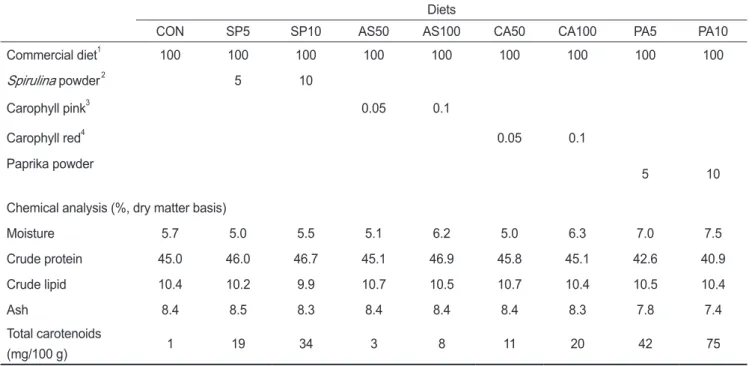
Table 1에 표시한 바와 같이 상품사료에 색소원료를 첨가하 지 않은 대조사료와 대조사료에 색소 원료의 종류와 농도를
*Corresponding author: [email protected]
43
Spirulina, Astaxanthin, Canthaxanthin 및 Paprika 함유 사료가 비단 잉어( Cyprinus carpio var. koi) 홍백 치어의 체색에 미치는 영향
김이오 . 이상민1*
Effects of Dietary Inclusion of Spirulina, Astaxanthin, Canthaxanthin or Paprika on the Skin Pigmentation of Red- and White-
colored Fancy Carp Cyprinus carpio var. koi
Inland Fisheries Research Institute, Chungju 380-250, Korea
1Department of Marine Bioscience and Technology, Gangneung-Wonju National University, Gangneung 210-702, Korea
A feeding trial was conducted to investigate the effects of dietary carotenoid source and level on growth and skin color of red- and white-colored fancy carp Cyprinus carpio var. koi. Nine experimental diets (designated as CON, SP5, SP10, AS50, AS100, CA50, CA100, PA5 and PA10) were formulated to contain 5-10% Spirulina powder, 5-10% paprika powder, 50-100 ppm astaxanthin and 50-100 ppm canthaxanthin. The CON diet without supplementation of carotenoid source was considered as the control diet. Each experimental diet was fed to three replicate groups of fish (3.6 g/fish) to visual satiation three times a day for 8 weeks. Survival, growth and feed efficiency of fish were not significantly affected by dietary inclusion of carotenoid source and level (P>0.05). After 8 weeks feeding period, the values of a*, L*and b* of fish skin were significantly changed by dietary carotenoid source (P<0.05), but not carotenoid level. The a* value of fish fed the diets containing CA and PA was higher than control and SP diets (P<0.05). Based on the results of this study, it can be concluded that dietary inclusion of 50 ppm canthaxanthin or 5% paprika powder could increase the redness of red-and white-colored fancy carp fingerling.
Key words: Red- and white-colored fancy carp, Paprika, Astaxanthin, Canthaxanthin, Pigmentation
Yi-Oh Kim and Sang-Min Lee1*
충북내수면연구소, 1강릉원주대학교 해양생물공학과
달리 첨가한(5-10% Spirulina, 5-10% paprika, 50-100 ppm astaxanthin, 50-100 ppm canthaxanthin) 9 종류의 실험사료 를 설정하였다. 시판하는 잉어용 상품사료(조단백질 45%, total carotenoids 1 mg/100 g)를 대조사료(CON)로 사용하였 으며, 나머지 8가지의 실험사료는 대조구 사료에 Spirulina분 말(Hainan Xiongxin Bioengineering Co., LTD. China) 5%
(SP5)와 10% (SP10), 10%의 astaxanthin이 함유된 carophyll pink (DSM Nutritional Products Ltd, Basel, Switzerland) 500 ppm (astaxanthin 50 ppm 함유, AS50)과 1,000 ppm (astaxanthin 100 ppm 함유, AS100), 10%의 canthaxanthin이 함유된 carophyll red(DSM Nutritional Products Ltd, Basel, Switzerland) 500 ppm (canthaxanthin 50 ppm 함유, CA50)과 1,000 ppm (canthaxanthin 100 ppm 함유, CA100), paprika 5% (PA5)와 10% (PA10)를 혼합하여 사용하였다.
실험어 및 사육관리
실험어로 충청북도내수면연구소에서 종묘 생산된 비단잉어 치어를 사용하였으며, 실험 시작 2주 전부터 실험조건에 순 치된 비단잉어(평균체중: 3.6 g)를 각 수조(100 L)마다 20마 리씩 임의로 수용하였다. 실험구별로 3반복으로 사육하였으 며, 8주의 실험기간 동안 하루에 3회 만복으로 실험사료를 공 급하였다.
사육장치는 반순환 여과 방식으로 한 개의 저수조와 27개의 실험수조로 구성하였다. 저수조에서 수중펌프를 사용하여 각 실험수조에 2 L/min의 물이 순환되도록 흘려주었고, 저수조에 는 매일 전체 사육수의 약 20%에 해당하는 깨끗한 물을 환수 하였으며, 사육수온은 27℃로 유지하였다.
일반성분 및 총카로티노이드 분석
실험사료의 일반성분은 AOAC (1995) 방법에 따라, 조단백질 (N×6.25)은 Auto Kjeldahl System (Buchi B-324/435/412, Switzerland)을 사용하여 분석하였고, 조지질은 ether를 사용 하여 추출하였으며, 수분은 105℃의 dry oven에서 6시간 건조 후 측정하였다. 회분은 600℃의 회화로에서 4시간 동안 태운 후 측정하였다.
실험사료와 실험종료 후 어체의 total carotenoids (TC) 함량 은 Lee and Lee (2008)가 사용한 방법과 동일하게 분석하였다.
실험사료와 비단잉어 표피를 동결건조 후, acetone:methanol (1:1, v/v)의 혼합액으로 암소에서 3회 반복 추출하였다. 추출액에 petroleum ether와 다량의 물로써 분리 조작하여 carotenoids 를 petroleum ether로 전용시킨 후, petroleum ether층을 무수 Na2SO4로 탈수시키고, 40℃ 이하에서 감압 농축하여 petroleum ether로 100 mL정량하여 UV-spectrometer 측정 시료로 사용하 였다.
Table 1. Composition of the experimental diets
Diets
CON SP5 SP10 AS50 AS100 CA50 CA100 PA5 PA10
Commercial diet1 100 100 100 100 100 100 100 100 100
Spirulina powder 2 5 10
Carophyll pink3 0.05 0.1
Carophyll red4 0.05 0.1
Paprika powder
5 10
Chemical analysis (%, dry matter basis)
Moisture 5.7 5.0 5.5 5.1 6.2 5.0 6.3 7.0 7.5
Crude protein 45.0 46.0 46.7 45.1 46.9 45.8 45.1 42.6 40.9
Crude lipid 10.4 10.2 9.9 10.7 10.5 10.7 10.4 10.5 10.4
Ash 8.4 8.5 8.3 8.4 8.4 8.4 8.3 7.8 7.4
Total carotenoids
(mg/100 g) 1 19 34 3 8 11 20 42 75
1Commercial diet containing 45% crude protein and 10% lipid.
2Spirulina powder (Hainan Xiongxin Bioengineering Co., LTD. China).
3Carophyll Pink containing 10% astaxanthin (DSM Nutritional Products Ltd, Basel, Switzerland).
4Carophyll Red containing 10% canthaxanthin (DSM Nutritional Products Ltd, Basel, Switzerland).
(CON)와 Spirulina powder 첨가구들(SP5, SP10)의 사육 8주 후 L* 값인 60.9-62.2보다 유의하게 낮았다(P<0.05).
실험 종료시 비단잉어 홍백 표피 붉은색 부위의 붉은색 (redness) a* 값을 Fig. 2에 나타내었다. 대조구의 a* 값은 사육 기간이 경과함에 따라 5.53에서 1.91로 감소하는 경향을 보인 반면, 색소제 첨가구들은 사육 4주까지 1.21-3.31의 값을 보이 며 감소하다가 8주 후에는 2.83-9.21의 범위로 증가하였으며, 특히 carophyll red 및 paprika 첨가구들(CA50, CA100, PA5, PA10)에서 5.28-9.21로 현저히 증가되었다. 사육 8주 후, 대 조구와 Spirulina powder 첨가구들(SP5, SP10)의 a* 값이 가 장 낮았으며, CA50, CA100, PA5 및 PA10의 값들은 높았다 (P <0.05).
실험 종료시 비단잉어 홍백 표피 붉은색 부위의 노랑색(yellow- ness) b* 값을 Fig. 3에 나타내었다. 대조구와 carophyll pink 첨가 구들(AS50, AS100)의 b*값은 사육 시작시(25.6)와 종료시(25.7- 26.2)에 비슷한 수준을 유지한 반면에, Spirulina powder 첨가구 들(SP5, SP10)과 carophyll red 첨가구들(CA50, CA100)의 값들 은 사육 종료시에 29.8-32.6로 증가하는 경향을 보였다. 사육 종 료시 대조구, AS50 및 AS100의 b* 값이 25.7-26.2로 가장 낮았 으며, SP5, SP10, CA50 및 CA100의 값들이 29.8-32.6으로 유 의하게 높았다(P<0.05).
실험 종료시 비단잉어 홍백 표피의 total carotenoid 값을 Fig. 4 에 나타내었다. 대조사료를 섭취한 비단잉어 표피의 total carot- enoid 함량이 3.04 mg/100 g으로 가장 낮았으며, SP5, SP10, CA50 및 PA10를 섭취한 비단잉어 표피의 total carotenoid 함량 은 4.05-5.58 mg/100 g으로 대조구보다 높았다(P<0.05).
색도분석
색도분석을 위해 사육실험 종료후 전 개체에 대하여 색차계(Mi- nolta Chroma Meter CR-400, Japan)를 이용하여 Skrede (1987) 및 Gouveia et al. (2003)의 방법에 따라 L* (lightness), a* (red- ness) 및 b* (yellowness)를 측정하였다. 이때 비단잉어 등쪽 표 피의 빨간색 부위를 3회 반복하여 측정하였다.
통계처리
결과의 통계 처리는 SPSS Version 12 (SPSS, Michigan Avenue, Chicago, IL, USA) program을 사용하여 one-way ANOVA-test를 실시 한 후, Duncan's multiple range test (Duncan, 1955)로 평 균간의 유의성을 검정하였으며, two-way ANOVA-test로 carotenoid 의 종류 및 농도에 대한 상관요인을 분석하였다.
결 과
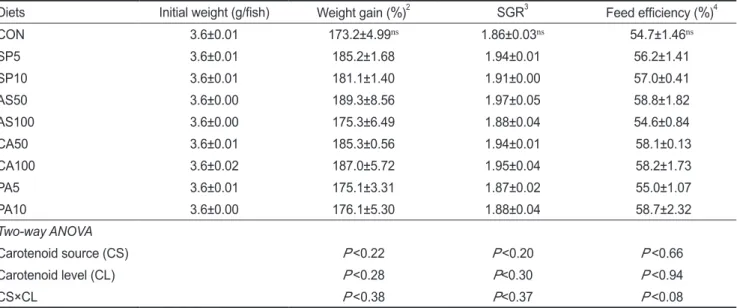
사육실험 8주 후, 사육실험 기간 동안의 모든 실험구의 생존 율은 100%였다. 비단잉어 홍백의 증체율, 일간성장율 및 사료 효율은 모든 실험구에서 유의한 차이가 없었다(Table 2).
사육실험 종료시의 비단잉어 홍백 표피 붉은색 부위의 밝 기(lightness) L* 값을 Fig. 1에 나타내었다. 사육 8주 후에 carophyll과 paprika 첨가구들(AS50, AS100, CA50, CA100, PA5, PA10)의 L* 값은 56.7-58.1의 범위로 나타나 실험 시작시 의 60.8에 비해 낮아진 경향을 보였으며, 또한 이값들은 대조구
Table 2. Growth performance and feed efficiency of red- and white-colored fancy carp Cyprinus carpio var. koi fed the diets containing various carotenoids source and level for 8 weeks1
Diets Initial weight (g/fish) Weight gain (%)2 SGR3 Feed efficiency (%)4
CON 3.6±0.01 173.2±4.99ns 1.86±0.03ns 54.7±1.46ns
SP5 3.6±0.01 185.2±1.68 1.94±0.01 56.2±1.41
SP10 3.6±0.01 181.1±1.40 1.91±0.00 57.0±0.41
AS50 3.6±0.00 189.3±8.56 1.97±0.05 58.8±1.82
AS100 3.6±0.00 175.3±6.49 1.88±0.04 54.6±0.84
CA50 3.6±0.01 185.3±0.56 1.94±0.01 58.1±0.13
CA100 3.6±0.02 187.0±5.72 1.95±0.04 58.2±1.73
PA5 3.6±0.01 175.1±3.31 1.87±0.02 55.0±1.07
PA10 3.6±0.00 176.1±5.30 1.88±0.04 58.7±2.32
Two-way ANOVA
Carotenoid source (CS) P<0.22 P<0.20 P<0.66
Carotenoid level (CL) P<0.28 P <0.30 P<0.94
CS×CL P<0.38 P <0.37 P<0.08
1Values are mean±SE of three replications.
2Weight gain (%)=(final body weight-initial body weight)×100/initial body weight.
3Specific growth rate (%)=(In final weight-In initial weight)×100/days.
4Feed efficiency (%)=Fish wet weight gain×100/feed intake (dry matter).
로 판단된다. 잉어를 대상으로 한 다른 실험에서도 색소원 첨 가에 따른 생존 및 성장은 차이가 없었고(Gouveia et al., 2003;
Gouveia and Rema, 2005), 타 어종을 대상으로 수행된 연구에 서도 사료의 색소가 성장이나 사료효율에 영향을 미치지 않았 다고 보고하고 있다(Kim et al., 2006; Kalinowski et al., 2005;
Lee and Lee, 2008; Lee et al., 2009; Rehulka, 2000; White et al., 2003; Wang et al., 2006). 반면에 사료의 색소 첨가 함량에 따른 성장 차이가 나타난다는 보고(Lee et al., 2010)도 있어 사 육 대상 어종, 사료 내 색소 첨가량이나 환경에 따라 차이가 나
고 찰
사료의 carotenoid 함량은 여러 어류의 생존과 성장에 영향 을 미치는 것으로 보고되고 있다(Amar et al., 2001; Chien and Shiau, 2005; Segner et al., 1989). 하지만, 본 연구에서는 사 료의 색소에 따른 생존율, 성장 및 사료이용 효율이 차이가 없 는 것으로 나타나 본 실험의 조건에서 사용된 사료의 색소 종류 와 함량이 비단잉어의 생존과 성장에 영향을 미치지 않는 것으 Fig. 1. Skin lightness (L*) of red- and white-colored fancy carp Cyprinus carpio var. koi fed the diets containing various carotenoids source and level for 8 weeks. Values (mean±SE of three replications) with different letter are significantly different (P<0.05).
Fig. 4. Skin total carotenoid of red- and white-colored fancy carp Cyprinus carpio var. koi fed the diets containing various carotenoid source and level for 8 weeks. Values (mean±SE of three replications) with different letter are significantly different (P<0.05).
50
Diets Diets
CON SP5 SP10 AS50 AS100 CA50 CA100 PA5 PA10
CON SP5 SP10 AS50 AS100 CA50 CA100 PA5 PA10
55 60 65 70
0-week 4-week 8-week
L* Value
Fig. 3. Skin redness (b*) of red- and white-colored fancy carp Cyprinus carpio var. koi fed the diets containing various ca- rotenoid source and level for 8 weeks. Values (mean±SE of three replications) with different letter are significantly differ- ent (P<0.05).
Diets
CON SP5 SP10 AS50 AS100 CA50 CA100 PA5 PA10
40
35
30
25
20
b* Value
7 6 5
4 3 Total carotenoid (mg/100 g DM) 2
Fig. 2. Skin yellowness (a*) of red- and white-colored fancy carp Cyprinus carpio var. koi fed the diets containing various carotenoid source and level for 8 weeks. Values (mean±SE of three replications) with different letter are significantly different (P<0.05).
Diets
CON SP5 SP10 AS50 AS100 CA50 CA100 PA5 PA10
12 10 8 6
4 2 0
a* Value
0-week 4-week 8-week
0-week 4-week 8-week
타날 수 있을 것으로 예상된다.
대조구의 비단잉어 a* 값은 사육기간 동안 점차 감소하는 경 향을 보였는데, Kim et al. (2008)의 실험에서 비단잉어를 8주 간 사육한 대조구에서도 유사한 결과를 나타내었다. Hancz et al. (2003)도 색소제를 첨가하지 않은 대조사료를 섭취한 금붕 어의 적색도가 사육기간 동안 감소하는 결과를 나타내었다고 보고하였다. 이처럼 색소제가 첨가되지 않은 대조구의 비단잉 어 표피에 붉은 색의 농도가 낮아지는 것은 비단잉어가 사료의 carotenoid 함량에 영향을 받았기 때문으로 해석된다. 반면에, Hancz et al. (2003)의 실험에서 사육실험 기간 동안 대조구의 비단잉어 표피의 적색도가 변화하지 않았다고 보고하였다. 이 러한 차이는 사육실험 전에 공급된 사료 내 색소 함량, 실험 어 류 상태 등의 사육 환경에 영향을 받았기 때문으로 해석된다.
예를 들면, Hancz et al. (2003)은 평균 69.1 g의 비단잉어와 2.1 g 금붕어를, Kim et al. (2008)은 1.9 g 비단잉어를, 그리고 본 연구에서는 3.6 g 비단잉어를 대상으로 실험하여 연구자마 다 어체 크기가 다른 실험어를 사용하였으며, 어종과 어체크기 에 따른 사료의 색소 농도나 사육기간 등을 고려한다면 여러가 지 상호적인 변수가 고려되어야 할 것이다.
Spirulina의 주요 carotenoid 성분은 β-carotene, zeaxanthin 및 myxoxanthophyll이며, 이 중 zeaxanthin이 비단잉어의 붉 은색을 강화시키는데 효과적이라고 보고 된 바 있으며, 비단잉 어의 착색제로 사용 잠재력이 있을 뿐 아니라 필수아미노산, 비타민 및 미네랄이 풍부하기 때문에 사료의 기능성 첨가제이 기도 하다(Becker and Venkataraman, 1984; Nandeesha et al., 1998, Nandeesha et al., 2001; Matsuno et al., 1979). 이러한 효능이 가진 Spirulina를 첨가한 사료를 섭취한 본 연구의 비단 잉어는 성장이나 표피의 적색도가 대조구나 다른 색소 첨가구 에 비해 개선되는 결과를 나타내지는 않았다.
Astaxanthin은 돔류, 연어, 새우류 등의 체색을 붉게 하 는 carotenoid로 알려져 있다(No and Storebakken, 1991;
Tejera et al., 2007). Katayama et al. (1973)은 비단잉어에서 는 zeaxanthin이 astaxanthin으로 산화되지만, β-carotene은 astaxanthin으로 산화되지 않고, astaxanthin을 섭취하면 체내 에 저장된다고 보고하였다. 최근에 astaxanthin을 이용한 비단 잉어와 금붕어의 착색에 대한 연구가 수행된바 있다(Gouveia et al., 2003). 본 연구에서 사육 8주 후, astaxanthin이 50-100 ppm 함유된 AS50과 AS100 사료를 섭취한 비단잉어 표피의 a* 값은 대조구보다 증가되어 적색도의 개선 효과가 있는 것으 로 나타났다. Gouveia et al. (2003)은 astaxanthin을 첨가한 사 료를 공급한 비단잉어의 표피 적색도가 Spirulina 첨가구보다 높았다고 보고하였다.
본 실험에서 canthaxanthin이 50-100 ppm 함유된 carophyll red 첨가 사료(CA50, CA100)를 공급한 비단잉어 표피의 a*와 b* 값 은 대조구보다 현저히 증가된 것으로 보아 canthaxanthin이 붉은 색과 노랑색 향상에 효과가 있는 것으로 판단된다.Canthaxanthin 은 gilthead seabream(Gomes et al., 2002)의 체색 개선에 효과적
인 carotenoid로 알려져 있다.
본 연구에서 paprika 10% 첨가 실험구의 비단잉어 표피 적색 도가 가장 높은 것으로 나타났으나, paprika 5%, canthaxanthin 50-100 ppm 실험구와 차이를 나타내지 않은 것으로 나타나, 본 연구에서 canthaxanthin과 paprika가 비단잉어 적색도를 높 이는데 가장 효과적인 carotenoids원으로 판단된다. Paprika는 carotenoid 함량이 높고 가격이 비교적 저렴하기 때문에 합성 색소제의 대체 원료로 고려되고 있으며(Deli et al. 2001, Lee and Lee, 2008, Lee et al., 2010), capsanthin을 다량 함유하여 금붕어와 비단잉어의 체색 개선에 효과적인 원료로 보고된 바 있다(Tsushima et al., 1999; Hancz et al., 2003).
Astaxanthin, canthaxanthin 그리고 paprika를 첨가한 실험 구의 비단잉어 적색도는 8주째에서 대조구에 비해 유의하게 높은 결과를 나타내었다. 또한, 본 실험의 결과에서는 같은 carotenoids 종류에서는 농도차에 의한 비단잉어 적색도의 차 이를 보이지 않았다. 경제적인 측면을 고려한다면, 본 연구에 서 사용된 사료내의 carotenoid 농도 범위 내에서 낮은 함량 (canthaxanthin 50 ppm 또는 paprika 5%)을 첨가할 수 있을 것으로 판단된다. 이전 연구에서, 금붕어에서의 astaxanthin 45-120 ppm (Gouveia and Rema, 2005) 및 비단잉어에서의 astaxanthin 40-100 ppm, Spirulina 4-10% (Kim et al., 2008) 범위 내에서 적색도 차이는 없었다고 보고되었다.
어체 내의 carotenoid 축적은 사료의 carotenoid 원료의 종류, 색소 함량, 지질 함량, 어체 크기, 성성숙, 유전적인 요인 및 환 경적인 요인에 영향을 받는다고 알려져 있다(Guillaume et al., 2001). 본 실험에서 색소 첨가 사료를 섭취한 비단잉어의 TC 함량은 대조구에 비해 증가하는 경향을 나타내고 있어 다른 연 구결과와도 일치한다(Gouveia et al., 2003; Kim et al. 2008).
본 연구의 carotenoid 원료 및 농도에 따른 비단잉어 홍백 치 어의 성장 및 체색에 미치는 영향을 알아보기 위한 실험에서, 사료에 canthaxanthin 50 ppm 또는 paprika 5%를 첨가하면 비 단잉어의 체색을 개선할 수 있을 것으로 전망된다.
사 사
본 연구는 농림수산식품부의 연구개발사업비 지원에 의해 수 행되었으며, 이에 감사드립니다.
참 고 문 헌
Amar EC, Kiron V, Satoh S and Watanabe T. 2001.Influence of various dietary synthetic carotenoids on bio-defence mechanism in rainbow trout, Oncorhynchus mykiss (Wal- baum). Aquac Res 32, 192-163.
AOAC (Association of Official Analytical Chemists). 1995.
Official Methods of Analysis, 16th Ed. Association of Of- ficial Analytical Chemists, Arlington, Virginia, USA.
Becker EW and Venkataraman LV. 1984. Production and uti- lization of blue-green alga, Spirulina in India. Biomass 4, 105-125.
Chapman F, Fitzcoy S, Thunberg E and Adams C. 1997. Unit- ed States of American trade in ornamental fish. J World Aquacult Soc 28, 1-10.
Chien YH and Shiau WC. 2005. The effects of deitary sup- plementation of algae and synthetic astaxanthin on body astaxanthin, survival, growth, and low dissolved oxygen stress resistance of kuruma prawn, Marsuoenaeus japoni- cus Bate. J Exp Mar Biol Ecol 318, 201-211.
Deli JP, Molnar Z and Toth G. 2001.Carotenoid composition in the fruit of red paprika (Capsicum annuum var. lyco- persiciforme rubrum) during ripening; Biosynthesis of carotenoids in red paprika. J Agric Food Chem 49, 1517- 1523.
Duncan DB. 1955. Multiple-range and multiple F tests. Bio- metrics 11, 1-42.
Gomes E, Dias J, Silva P, Valente L, Empis J, Gouveia JB and Young A. 2002. Utilization of natural and synthetic sources of carotenoids in the skin pigmentation of gilt- head seabream (Sparus aurata). Eur Food Res Technol 214, 287-293.
Goodwin TW. 1984. The Biolochemistry of the carotenoids vol. I Animals (2nd. ed.), Chapman & Hall, London, 244.
Gouveia L, Rema P, Pereira O and Empis J. 2003. Colouring ornamental fish (Cyprinus carpio and Carassiusau ratus) with microalgal biomass. Aquacult Nutr 9, 123-129.
Gouveia L and Rema P. 2005. Effect of microalgal concen- tration and temperature on ornamental goldfish (Carassi usau ratus) skin pigmentation. Aquacult Nutr 11, 19-23.
Guillaume J, Kaushik S, Bergot P and Metailler R. 2001. Nu- trition and feeding of fish and crustaceans. Springer Ver- lag, 183-196.
Hancz C, Magyary I, Molnar T, Sato S, Horn P and Tanigu- chi N. 2003. Evaluation of color intensity enhanced by paprika as feed additive in goldfish and koi carp using computer-assisted image analysis. Fish Sci 69, 1158-1161.
Kalinowski CT, Robaina LE, Fernandez-Palacios H, Schuchardt D and Izquierdo MS. 2005. Effect of differ- ent carotenoid sources and their dietary levels on the red porgy (Pagrus pagrus) growth and skin colour. Aquacul- ture 244, 223-231.
Katayama T, Shintani K and Chichester CO. 1973. The bio- synthesis of astaxanthin. Comp Biochem Physiol 448, 253-257.
Kim SR, Lee CR and Lee SM. 2006. Effects of dietary sup- plementation of paprika and Spirulina on pigmentation of swiri Coreoleuciscus splendidus. J Aquacult 19, 261-266.
Kim YO, Jo JY and Oh SY. 2008. Effects of dietary Spirulina, chlorella and astaxanthin on the body color of red- and white-colored carp, Cyprinus carpio. J Kor Fish Soc 41, 193-200.
Lee CR and Lee SM. 2008. Effect of dietary supplementation of pigment sources on pigmentation of the round tailed paradise fish Macropodus chinensis and pale chub Zacco platypus. J Aquacult 21, 213-217.
Lee CR. Bae KM and Lee SM. 2009. Effect of paprika and zooplankton supplementation in the diets on carotenoid deposition and skin pigmentation of the rose bitterling Rhodeus ocellatus. J Aquacult 22, 100-104.
Lee CR, Pham MA and Lee SM. 2010. Effects of dietary pa- prika and lipid levels on growth and skin pigmentation of pale chub (Zacco platypus). Asian-Aust J Anim Sci 23, 724-732.
Matsuno T, Nagata S, Iwahashi M, Koike T and Okada M.
1979. Intensification of color of fancy red carp with zea- xanthin and myxoxanthophyll, major carotenoid consti- tute of spirulina. Bull Jap Soc Sci Fish 45, 627-632.
Nandeesha MC, Gangadhara B, Varghese TJ and Keshavana- th P. 1998. Effect of feeding Spirulina platensis on the growth, proximate composition and organoleptic quality of common carp, Cyprinus carpio L. Aquac Res 29, 305- Nandeesha MC, Gangadhara B, Manissery JK and Venkata-312.
raman LV. 2001. Growth performance of two Indian ma- jor carp, catla (Catla catla) and rohu (Labeo rohita) fed diets containing different levels of Spirulina platensis.
Bioresour Tech 80, 117-120.
No HK and Storebakken T. 1991. Pigmentation of rainbow trout with astaxanthin at different water temperatures.
Aquaculture 97, 203-216.
Paripatanamont T, Tangtrongpairoj J, Sailasuta A and Chan- sue NK. 1999. Effect of astaxanthin on the pigmentation of goldfish Carassius auratus. J World Aquacult Soc 30, 454-460.
Rehulka J. 2000. Influence of astaxanthin on growth rate, condition, and some blood indices of rainbow trout, On- corhynchus mykiss. Aquaculture 190, 27-47.
Segner H, Arend P, Poeppinghaussen KV and Schmidt H.
1989. The effect of feedingastaxanthin to Oreochromis niloticus and Colisa labiosaon thehistology of the liver.
Aquaculture 79, 381-390.
Skrede G. 1987. Rapid analysis in food processing and food control. In: Proceedings of the Fourth European Confer- erce on Food Chemistry, 1-4.
Tejera N, Cejas JR, Rodriguez C, Bjerkeng B, JerezS, Bala- nos A and Lorenzo A. 2007. Pigmentation, carotenoid, lipid peroxides and lipid composition of skin of red porgy (Pagrus pagrus) fed diets supplemented with different astaxanthin sources. Aquaculture 270, 218-230.
Tsushima M, Nemoto H and Matsuno T. 1999. The accumu- lation of figments from paprika and other souces in the integument of gold fish Carassius auratus, Fish Sci 64, 656-657.
Wang YJ, Chien YH and Pan CH. 2006. Effects of dietary
2011년 11월 30일 접수 2012년 1월 29일 수정 2012년 2월 10일 수리 supplementation of carotenoids on survival; growth, pig-
mentation and antioxidant capacity of characins, Hyphes- sobrycon callistus. Aquaculture 261, 641-648.
White DA, Moody AJ, Servata RD, Bowen J, Soutar C, Young AJ and Davies SJ. 2003. The degree of carotenoid esterification influences the absorption ofastaxanthin in
rainbow trout, Oncorhynchus mykiss (Walbaum). Aqua cult Nutr 9, 247-251.