337
서 론어류 근육이나 표피의 노란색이나 붉은색 발현은
carotenoid
와 같은 색소에 의존적이다.Carotenoid
색소는 자연계에 널리 분포하고 있으며, 식물이나 박테리아, 효모와 같은 미생물에 의해서 합성된다. 그러나 어류를 포함한 대부분의 척추동물들 은carotenoid
를 체내에서 합성할 수 없기 때문에 먹이를 통해 공급받아 체내에 축적한다(Goodwin, 1984; Guillaume et al., 2001; Hancz et al., 2003)
. 또한,carotenoid
는vitamin A
전 구체, 항산화력, 면역 증강 등 많은 영양학적 기능을 가진 물질 로 발표되면서 건강기능성 첨가제로도 연구되고 있다(Akhtar et al., 1999; Waagbo et al., 2003)
. 동물 체내에carotenoid
축 적은 색소 종류 및 농도, 사육기간 등 여러 가지 요인에 영향 을 받는다. 일반적으로carotenoid
는 지용성이기 때문에 이들의 소화, 흡수, 이동 및 축적에 대한 연구가 사료의 색소 종류 와 함량, 지질 종류와 함량과 상호 관계를 고려하여 수행되어 야 할 것이다
(Christiansen and Wallace, 1988; Nickell and Bromage, 1998; Lee et al., 2010)
.관상어류뿐 아니라 연어 및 송어와 같은 양식 어류의 상품 가치를 향상시키기 위하여 각종 색소원이 사용되고 있는 데,
carophyll pink
나red
와 같은 합성된 상품이 사료에 첨가되고 있다. 이러한 합성 색소제는 가격이 비싸고 대부분이 수입되 고 있어, 국내에서 이를 대체할 수 있는 원료를 탐색하여 그 이 용성을 조사하는 것은 매우 중요하다. 대상 색소 원료 중에서paprika
는capxanthin
이나capsorbin
과 같은 색소를 풍부하게 함유하고 있을 뿐 아니라 시중에서 판매되고 있는 합성 색소보 다 가격이 싸기 때문에 사료의 색소원 첨가제로 많이 고려되 고 있다(Tsushima et al., 1999; Hancz et al., 2003; Lee et al.,
사료의 지질 및 파프리카 함량이 비단잉어(
Cyprinus carpio var.
koi ) 홍백 치어의 성장 및 체색에 미치는 영향김이오 . 이상민
1*
Effects of Dietary Lipid and Paprika Levels on Growth and Skin Pigmentation of Red- and White-colored Fancy Carp Cyprinus carpio
var. koi
A feeding trial was conducted to investigate effect of three paprika levels (0
%, 5
%and 10
%) with two lipid levels (4
%and 10
%) in diets on growth performance and skin coloration of red- and white-colored fancy carp, Cyprinus carpio var. koi. Two replicate groups (an average body weight of 4.3±0.2 g) of fish fed one of eight experimental diets for 8 weeks. Survival, weight gain and feed efficiency of the fish were not significantly affected by both dietary paprika and lipid levels (P>0.05). After 8 weeks feeding period, the values of a * , L * and b * of fish skin were significantly changed by dietary paprika level (P<0.05) but not lipid level. The a * value of fish fed the diets containing paprika was higher than that of fish fed control diet (P<0.05). Additional inclusion of 50-100 ppm canthaxanthin in diets containing 5
%and 10
%paprika did not improve a * value of fish skin. Based on the results of this study, it can be concluded that dietary inclusion of 5
%paprika powder could increase the redness of red- and white-colored fancy carp fingerling.
Key words: Cyprinus carpio var. koi, Red- and white-colored fancy carp, Paprika, Skin coloration
Yi-Oh Kim and Sang-Min Lee1
*
충북내수면연구소, 1강릉원주대학교 해양생물공학과
Department of Inland Fisheries Research Institute, Chungcheongbukdo, Chungju 380-250, Korea
1
Department of Marine Bioscience and Technology, Gangneung-Wonju National University, Gangneung 210-702, Korea
Article history;
Received 8 March 2012; Revised 19 June 2012; Accepted 3 August 2012
*Corresponding author: Tel: +82. 33. 640. 2414 Fax: +82. 33. 640. 2955 E-mail address: [email protected]
Kor J Fish Aquat Sci 45(4) 337-342, August 2012 http://dx.doi.org/10.5657/KFAS.2012.0337 pISSN:0374-8111
ⓒ The Korean Society of Fishereis and Aquatic Science. All rights reserved
2010)
. 본 연구는 관상어로 각광을 받고 있는 비단잉어 홍백을 대상으로 사료내paprika
농도 및 지질 함량이 성장 및 체색에 미치는 영향을 알아보기 위해 수행되었다.재료 및 방법
실험사료
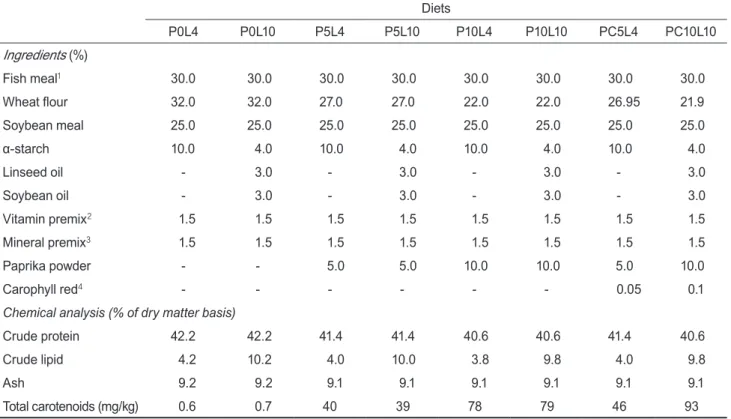
Table 1
에 표시한 바와 같이 단백질 함량이41
%, 지질함량 이4
%와10
% 전후가 되도록 실험사료를 설계하였다. 실험 사 료에 첨가된paprika
는 시판되고 있는red paprika
를 상온에 서 건조한 후에 분말로 분쇄하여 사용하였다. 지질함량이 다른 각 사료에 색소원이 첨가되지 않은 대조사료(P0L4, P0L10)
,paprika 5
% 첨가사료(P5L4, P5L10)
및paprika 10
% 첨가 사료(P10L4, P10L10)
,canthaxanthin
이10
% 함유된caro- phyll red 0.05-0.1
%와paprika 5-10
% 혼합 첨가 사료(PC5L4, PC10L10)
들를 설계하여 모두8
개의 실험사료를 제조하였다.실험사료는 모든 원료를 잘 혼합한 후, 원료
100 g
당 증류수40 g
를 첨가하여 초파로 압출 성형한pellet
을 냉동(-25
℃)
보 관하면서 공급하였다. 대조사료의total carotenoid
함량은0.7 mg/kg diet
이하로 나타났으며, 동일한 색소원을 첨가한 사료 에서는 첨가 함량이 증가할수록total carotenoid
함량도 증가 하였다.실험어 및 사육관리
비단잉어 홍백치어는 충청북도내수면연구소에서 종묘 생산 된 치어를 사용하였다. 실험 시작
2
주 전에 실험조건에 순치된 비단잉어(
평균체중: 4.3±0.2 g)
를100 L
플라스틱 실험수조에 각 수조당20
마리씩 임의로2
반복 배치하였다. 실험사료를 8 주간의 실험기간 동안 하루에3
번 만복으로 공급하였다. 사육 장치는 반순환 여과 방식으로 한 개의 저수조와24
개의 실험수 조로 구성하여 관리하였었다. 저수조에서 수중펌프를 사용하 여 각 실험수조에2 L/min
의 물을 흘려 주었고, 저수조에는 깨 끗한 물을 공급하여 매일 전체 사육수의 약20
%를 환수하였으 며, 사육수온은27
℃로 유지하였다.Table 1. Composition of the experimental diets
Diets
P0L4 P0L10 P5L4 P5L10 P10L4 P10L10 PC5L4 PC10L10
Ingredients (%)
Fish meal1 30.0 30.0 30.0 30.0 30.0 30.0 30.0 30.0
Wheat flour 32.0 32.0 27.0 27.0 22.0 22.0 26.95 21.9
Soybean meal 25.0 25.0 25.0 25.0 25.0 25.0 25.0 25.0
α-starch 10.0 4.0 10.0 4.0 10.0 4.0 10.0 4.0
Linseed oil - 3.0 - 3.0 - 3.0 - 3.0
Soybean oil - 3.0 - 3.0 - 3.0 - 3.0
Vitamin premix2 1.5 1.5 1.5 1.5 1.5 1.5 1.5 1.5
Mineral premix3 1.5 1.5 1.5 1.5 1.5 1.5 1.5 1.5
Paprika powder - - 5.0 5.0 10.0 10.0 5.0 10.0
Carophyll red4 - - - - - - 0.05 0.1
Chemical analysis (% of dry matter basis)
Crude protein 42.2 42.2 41.4 41.4 40.6 40.6 41.4 40.6
Crude lipid 4.2 10.2 4.0 10.0 3.8 9.8 4.0 9.8
Ash 9.2 9.2 9.1 9.1 9.1 9.1 9.1 9.1
Total carotenoids (mg/kg) 0.6 0.7 40 39 78 79 46 93
1
Imported from Chile, steam-dried.
2
Vitamin mix. contained the following diluted in cellulose (g/kg mix): ascorbic acid, 92.7; α-tocopheryl acetate, 14.5;
thiamin, 2.1; riboflavin, 7.0; pyridoxine, 1.4; niacin, 27.8; Ca-D-pantothenate, 9.7; myo-inositol, 139.1; D-biotin, 4.2; folic acid, 0.5;p-amino benzoic acid, 13.9; K3, 1.4; A, 0.6; D3, 0.002; choline chloride, 278.3; cyanocobalamin, 0.003.
3
Mineral mix. contained the following ingreients (g/kg mix): MgSO
4.7H
2O, 80; NaH
2PO
4.2H
2O, 370; KCl, 130; Ferric citrate, 40; ZnSO
4.7H
2O, 20; Ca-lactate, 356.5; CuCl, 0.2; AlCl
3.6H
2O, 0.15; KI, 0.15; Na
2Se
2O
3, 0.01; MnSO
4.H
2O, 2;
CoCl
2.6H
2O, 1.
4
Carophyll red containing 10% canthaxanthin (DSM Nutritional Products Ltd, Basel, Switzerland).
일반성분 및 총카로티노이드 분석
실험사료의 일반성분은
AOAC (1995)
방법에 따라, 조단백 질(N×6.25)
은Auto Kjeldahl System (Buchi B-324/435/412, Switzerland)
을 사용하여 분석하였고, 조지질은ether
를 사용 하여 추출하였으며, 수분은105
℃의dry oven
에서6
시간 건 조 후 측정하였다. 회분은600
℃의 회화로에서4
시간 동안 태 운 후 측정하였다.실험사료와 실험종료 후 어체의
total carotenoids (TC)
함량 은Lee and Lee (2008)
가 사용한 방법과 동일하게 분석하였다.실험사료와 비단잉어 표피를 동결건조 후,
acetone:methanol (1:1, v/v)
의 혼합액으로 실온의 암소에서3
회 추출하였다. 추 출액에petroleum ether
와 다량의 물로써 분리 조작하여ca- rotenoids
를petroleum ether
로 전용시킨 후,petroleum ether
층을 무수Na
2SO
4로 탈수시키고,40
℃ 이하에서 감압 농축하 여petroleum ether
로100 mL
정량하여UV-spectrometer
시 료로 사용하였다.색도분석
색도분석을 위해 실험 종료 후 전 개체에 대하여 색차계
(Mi- nolta Chroma Meter CR-400, Japan)
를 이용하여Skrede (1987)
및Gouveia et al. (2003)
의 방법에 따라L* (lightness), a* (redness)
및b* (yellowness)
를 측정하였다. 이때 비단잉 어 등쪽 표피의 빨간색 부위를3
회 반복하여 측정하였다.통계처리
결과의 통계 처리는
SPSS Version 12 (SPSS, Michigan Avenue, Chicago, IL, USA) program
을 사용하여One-way ANOVA-test
를 실시 한 후, Duncan`s multiple range test (Duncan, 1955)
로 평균간의 유의성(P<0.05)
을 검정하였다.결과 및 고찰
사육실험
8
주 후의 비단잉어 홍백 치어의 생존, 성장 및 사료 효율을Table 2
에 표시하였다. 생존율, 최종평균체중, 증체율 및 사료효율은 모든 실험구에서 유의한 차이는 없었다. 사육실 험4
주차 이후에 기생충 감염으로 일부 개체가 폐사하였으나, 포르말린100 ppm
으로1
시간 약욕처리 후 사육실험을 계속 실 시하였으며, 평균 생존율은75
% 이상으로 나타났다.사료의
paprika
함량과 지질 함량을 달리하여8
주 동안 사육 한 비단잉어 홍백 표피 붉은색 부위의 밝기(lightness) L *
값을Fig. 1
에 나타내었다.L *
값이 실험 시작시65
였는데, 사육4
주까지는L *
값이64-67
범위로 큰 변화가 없었지만, 사육8
주 후에는 모든 실험구에서 비단잉어 홍백 표피의L *
값이56-62
범위로 감소하는 경향을 보였다. 사육8
주 후의 비단잉어 홍백 표피의L *
값은 사료 지질이나paprika
함량에 의해 특별한 경 향을 보이지 않았지만,P10L4
와PC10L10
실험구에서56-58
로 타실험구들보다 낮은L *
값은 보였다(P<0.05).
실험 종료시 비단잉어 홍백 표피 붉은색 부위의 붉은색
(red- ness) a *
값을Fig. 2
에 나타내었다. 실험시작시2.1
이었던a *
값이 모든 실험구에서 사육 기간이 경과함에 따라 사육4
주 후 에는2.8-6.1
까지 증가하였다. 사육8
주 후의a *
값은3.9-14.2
로 사육기간이 경과 함에 따라 계속 증가하는 경향을 보였으 며, 특히paprika
첨가구들의a *
값이9.9-14.2
범위로 대조구 의3.9-5.2
보다 현저히 높은 값을 보였다(P<0.05). PC10L10
실험구의a *
값이14.2
로 가장 높았고, 이 값은P5L10, P10L4, P10L10
및PC5L4
실험구의11.9-13.1
과 유의한 차이는 없었 다. 사료내paprika
첨가량이 동일한 경우, 사료의 지질 함량에 따른 실험구들의a *
값은 차이를 보이지 않았다.실험 종료시 비단잉어 홍백 표피 붉은색 부위의 노랑색
(yel- lowness) b *
값을Fig. 3
에 나타내었다. 사육 종료시b *
값은21-28
의 범위로 사육 시작시의21
보다 높아진 경향을 보였으Table 2. Growth performance and feed efficiency of red- and white- colored fancy carp Cyprinus carpio var. koi (initial average weight 4.3±0.2 g) fed diets containing various carotenoids source for 8 weeks
1Diets Survival (%) Final body weight
(g/fish)
Weight gain
(%)2 Feed efficiency (%)3
P0L4 75±5.0 9.4±0.03ns 119±19.2ns 30±1.5ns
P0L10 93±7.5 8.7±1.80 102±41.7 44±5.9
P5L4 93±2.5 10.6±0.81 147±18.8 44±0.6
P5L10 90±10.0 9.8±0.06 127±1.4 41±0.2
P10L4 83±7.5 9.7±0.46 126±10.7 34±1.8
P10L10 95±5.0 8.0±0.27 97±4.3 37±3.2
PC5L4 90±10.0 9.1±0.45 129±11.3 39±2.5
PC10L10 100±0.0 9.4±0.22 111±10.5 38±6.0
1
Values are mean ± SE of replications.
2
Weight gain (
%) = (final body weight - initial body weight)×100/initial body weight.
3
Feed efficiency (
%) = fish wet weight gain×100/feed intake (dry matter).
며, 사육 종료시에
paprika
첨가구들의b *
값은25-28
로 대조 구의21-24
보다 높았다. 또한,paprika 10
% 첨가구들(P10L4, P10L10, PC10L10)
의 비단잉어 홍백 표피b *
값(27-28)
이 대 조구보다 높았다(P<0.05)
. 사료내paprika
첨가량이 동일한 경우, 실험구들의b *
값은 사료의 지질 함량에 영향을 받지 않 았다.다양한 색소원료 중에서
paprika
는 합성 색소제보다 비교적 가격이 저렴하고carotenoid
함량이 높아서 어류 색택 개선을 위해 많이 연구되고 있다(Deli et al. 2001, Lee and Lee, 2008, Lee et al., 2010; Tsushima et al., 1999; Hancz et al., 2003;
Yuangsoi et al., 2011)
. 또한paprika
는capsanthin
을 다량 함유하여 금붕어와 비단잉어의 체색 개선에 효과적이라고 보 고된 바 있다(Tsushima et al., 1999; Gouveia et al., 2003;
Hancz et al., 2003, Kim et al., 2008)
. 색소원을 달리 첨가하여 비단잉어 홍백을 대상으로 수행된
Kim and Lee (2012)
의 연구에서도carophyll red
와paprika
가 첨가된 사료를 섭취한 비단잉어 표피의 적색도가 높게 나타났다. 본 연구에서도 사육4
주후부터paprika
무첨가구보다paprika
첨가구들의 금붕어 표피의a *
값이 유의하게 높았으며, 사육기간이 길어짐에 따라 더 뚜렷한 차이가 나타나는 것으로 보아, 사료에paprika
분말 을 첨가하는 것은 금붕어의 체색을 붉게 하는 것에 도움이 될 것으로 판단된다.본 연구에서 비단잉어 홍백치어의 성장, 생존 및 사료이용 효율이 사료의
paprika
함량에 영향을 받지 않았지만, 사료에 함유된carotenoids
는 어류의 성장 또는 생존율을 향상시킨다 는 보고도 있어(Amar et al., 2001; Chien and Shiau, 2005;
Segner et al., 1989)
, 본 연구의 성장 결과와 차이를 보였다.반면에 사료의
carotenoid
원료 및 농도에 따라서 어류의 성장 이나 사료효율이 영향을 받지 않는다는 보고도 있어(Rehulka, 2000; White et al., 2003; Kalinowski et al., 2005; Wang et al., 2006),
어종이나 실험 조건에 따라 차이가 날 수 있음을 예 상할 수 있다.어류의 성장이나 사료효율은 사료의 지질 함량에 영향을 받 는다고 알려져 있지만
(Lee et al., 2002; Kim and Lee, 2005)
, 본 연구의 비단잉어 홍백치어의 성장과 사료효율은 사료의 지 질 함량에 영향을 받지 않았다. 이와 같이 비단잉어의 성장과 사료효율이 사료의 지질 함량에 영향을 받지 않은 것은 잉어 의 식성과 관련된 것으로 보인다. 예를 들면, 잡식성인 잉어 는 육식성 어류에 비해 지질 이용성이 낮아 본 연구에서 첨가 된 사료의 지질 함량이 성장에 영향을 미치지 않은 수준인 것 으로 해석된다.어류의
carotenoids
축적은carotenoids
원료, 구조, 안정성, 색소량, 지질원 및 농도, 어체크기 및 연령, 성성숙, 유전적 인 요인 및 환경적인 요인에 영향을 받는다고 보고되고 있다Fig. 1. Skin lightness (L
*) of red- and white-colored fancy carp
Cyprinus carpio var. koi fed the diets containing various ca- rotenoids source and level for 8 weeks. The L
*value of skin at the beginning of feeding trial was 65. Values (mean ± S.E.
of replications) with different letter are significantly different (P<
0.05).
Fig. 3. Skin yellowness (b
*) of red- and white-colored fancy carp Cyprinus carpio var. koi fed the diets containing vari- ous carotenoids source and level for 8 weeks. The b
*value of skin at the beginning of feeding trial was 21. Values (mean ± S.E.
of replications) with different letter are significantly different (P<
0.05).
35 30
25 20
15 POL4 POL10 P5L4 P5L10 Diets
b* value
P10L4 P10L10 PC5L4 PC10L10 4-week
ab a
bc bc c c bc c
4-week 8-week S-week
Fig. 2. Skin redness (a
*) of red- and white-colored fancy carp Cyprinus carpio var. koi fed the diets containing various ca- rotenoids source and level for 8 weeks. The a
*value of skin at the beginning of feeding trial was 2.1. Values (mean ± S.E.
of replications) with different letter are significantly different (P<
0.05).
16 14 12 10 8 6 4 2
0 POL4 POL10 P5L4 POL10 P10L4 P10L10 PC5L4 PC10L10 Diets
a* value a
a
b bc c bc c c
4-week 8-week 70
65 60 55
50 POL4 POL10 P5L4 P5L10 Diets
L* value
P10L4 P10L10 PC5L4 PC10L10
bc c
b b
a c
ab a 4-week 8-week
(Guillaume et al., 2001)
. 특히carotenoids
의 흡수와 축적에 관한 지질원과 지질함량의 상호 관계에 대한 연구가 수행되어 왔다(Torrisen, 1985; Lee et al., 2010)
. 본 연구에서 지질함 량4
% 첨가 실험구간에서 대조구에 비해paprika
의 첨가함량 이 증가함에 따라 비단잉어의 적색도가 유의하게 증가하였나, 지질함량10
% 첨가 실험구간에서는paprika 5
% 첨가구까지 만 유의하게 증가하였다. 비단잉어 홍백 치어를 대상으로 지질10
% 함유 사료에paprika
첨가 함량을 달리 첨가하여 실험한Kim and Lee (2012)
의 결과에서도,paprika 5
%와10
% 첨가 구간의 표피 적색도는 차이가 없었다. 이와 같이 사료에 지질 함량을10
%로 높여 주는 것은paprika
첨가량을 절약 할 수 있 음을 암시하고 있어 차후 지질 함량과 색소의 소화, 흡수 및 축 적에 관해 상세한 연구가 수행 되어야 할 것이다.이상의 결과로부터, 비단잉어 홍백 치어의 성장과 사료이용 효율은 본 연구에서 사용된 사료 지질 함량
(4-10
%)
과paprika
함량(5-10
%)
에 영향을 받지 않았다. 비단잉어 홍백 치어의 표 피 적색도는 사료 지질 함량이4
%인 경우paprika 10
% 첨가 가 적합할 것으로 판단되나, 사료 지질을10
%로 증가시키면paprika
를5
% 첨가하여도 양호한 결과를 얻을 수 있어, 비단 잉어 홍백 치어의 표피 적색도를 높이는데 더 경제적인 사료 조 성이 될 것으로 판단된다.사 사
본 연구는 농림수산식품부의 연구개발사업비 지원에 의해 수 행되었으며, 이에 감사 드립니다. 실험어 관리에 도움을 주신 충북내수면연구소 황규덕 박사님과 색소분석을 도와준 강릉원 주대학교 이충열 박사, 사료 제조 및 분석을 도와준 강릉원주 대학교 박사과정 최진 및 어류영양대사연구실 부원들에게 감 사 드립니다.
참고문헌
Akhtar P, Gray JI, Cooper TH, Garling DL and Booren AM.
1999. Dietary pigmentation and deposition of α-tocopherol and carotenoids in rainbow trout muscle and liver tissue. J Food Sci 64, 234-239.
Amar EC, Kiron V, Satoh S and Watanabe T. 2001. Infiuence of various dietary synthetic carotenoids on bio-defence mech- anism in rainbow trout, Oncorhynchus mykiss (Walbaum).
Aquacult Res 32, 192-163.
AOAC (Association of Official Analytical Chemists). 1995.
Official Methods of Analysis, 16th edition. Association of Official Analytical Chemists, Arlington, Virginia, USA.
Christiansen JS and Wallace JC. 1988. Deposition of canthax- anthin and muscle lipid in two size groups of rctic charr,
Salvelinus alpinus. Aquaculture 69, 69-78.
Chien YH and Shiau WC. 2005. The effects of deitary supple- mentation of algae and synthetic astaxanthin on body astax- anthin, survival, growth, and low dissolved oxygen stress
resistance of kuruma prawn, Marsuoenaeus Japonicus Bate. J Exp Mar Biol Ecol 318, 201-211.
Deli JP, Molnar Z and Toth G. 2001. Carotenoid composition in the fruit of red paprika (Capsicum annuum var. lycopersici-
forme rubrum) during ripening; Biosynthesis of carotenoids
in red paprika. J Agric Food Chem 49, 1517-1523.Duncan DB. 1955. Multiple-range and multiple F tests. Bio- metrics 11, 1-42.
Goodwin TW. 1984. The Biolochemistry of the carotenoids vol.
I Animals (2nd edn. ed.), Chapman & Hall, London, UK, 244.
Gouveia L, Rema P, Pereira O and Empis J. 2003. Colouring ornamental fish (Cyprinus carpio and Carassius auratus) with microalgal biomass. Aquacult Nutr 9, 123-129.
Guillaume J, Kaushik S, Bergot P and Metailler R. 2001. Nutri- tion and feeding of fish and crustaceans. Springer Verlag, London, UK, 183-196.
Hancz C, Magyary I, Molnar T, Sato S, Horn P and Taniguchi N. 2003. Evalution of color intensity enhanced by paprika as feed additive in goldfish and koi carp using computer- assisted image analysis. Fish Sci 69, 1158-1161.
Kalinowski CT, Robaina LE, Fernandez-Palacios H, Schucha- rdt D and Izquierdo MS. 2005. Effect of different carotenoid sources and their dietary levels on the red porgy (Pagrus
pagrus) growth and skin colour. Aquaculture 244, 223-231.
Kim IO and Lee SM. 2005. Effects of the dietary protein and lipid levels on growth and body composition of bagrid cat- fish, Pseudobagrus fulvidraco. Aquaculture 243, 323-329.
Kim YO, Jo JY and Oh SY. 2008. Effects of dietary Spirulina, chlorella, and astaxanthin on the body color of red- and white-colored carp, Cyprinus carpio. J Kor Fish Soc 41, 193-200.
Kim YO and Lee SM. 2012. Effects of dietary inclusion of Spi-
rulina, astaxanthin, canthaxanthin or paprika on the skin
pigmentation of red- and white-colored fancy carp Cypri-nus carpio var. koi. Kor J Fish Aquat Sci 45, 43-49.
Lee CR and Lee SM. 2008. Effect of dietary supplementation of pigment sources on pigmentation of the round tailed para- dise fish Macropodus chinensis and pale chub Zacco platy-
pus. J Aquacult 21, 213-217.
Lee CR, Pham MA and Lee SM. 2010. Effects of dietary papri- ka and lipid levels on growth and skin pigmentation of pale chub (Zacco platypus). Asian-Aust J Anim Sci 23, 724-732.
Lee SM, Jeon IG and Lee JY. 2002. Effects of digestible protein and lipid levels in practical diets on growth, protein utiliza- tion and body composition of juvenile rockfish (Sebastes
schlegeli). Aquaculture 211, 227-239.
Nickell DC and Bromage NR. 1998. The effect of lip- id level on variation of flesh pigmentation in rainbow trout(Oncorhynchus mykiss). Aquaculture 161, 237-251.
Rehulka J. 2000. Influence of astaxanthin on growth rate, con- dition, and some blood indices of rainbow trout, Oncorhyn-
chus mykiss. Aquaculture 190, 27-47.
Segner H, Arend P, Poeppinghaussen KV and Schmidt H. 1989.
The effect of feeding astaxanthin to Oreochromis niloticus and Colisa labiosa on the histology of the liver. Aquacul- ture 79, 381-390.
Skrede G. 1987. Rapid analysis in food processing and food Control. In: Proceedings of the Fourth European Confer- erce on Food Chemistry, 1-4.
Tsushima M, Nemoto H and Matsuno T. 1999. The accumu- lation of figments from paprika and other souces in the integument of gold fish Carassius auratus, Fish Sci 64, 656-657.
Torrissen OJ. 1985. Pigmentation of almonids: factors affecting carotenoid deposition in rainbow trout (Salmo gairdneri).
Aquaculture 43, 133-143.
Waagbo R, Hamre K, Bjerkas E, Berge R, Wathne E, Lio O and
Torstensen B. 2003. Cataract formation in Atlantic salmon,
Salmo salar L., smolt relative to dietary pro- and antioxi-
dants and lipid level. J Fish Dis 26, 213-229.Wang YJ, Chien YH and Pan CH. 2006. Effects of dietary sup- plementation of carotenoids on survival; growth, pigmenta- tion and antioxidant capacity of characins, Hyphessobrycon
callistus. Aquaculture 261, 641-648.
White DA, Moody AJ, Servata RD, Bowen J, Soutar C, Young AJ and Davies SJ. 2003. The degree of carotenoid esterifi- cation influences the absorption of astaxanthin in rainbow trout, Oncorhynchus mykiss (Walbaum). Aquacult Nutr 9, 247-251.
Yuangsoi B, Jintasataporn O, Areechon N and Tabthipwon P.
2011. The pigmenting effect of diferent carotenoids on fan- cy carp (Cyprinus carpio). Aquacult Nutr 17, e306-e316.