238 황주애·김정은·이정호·김대희·김형수
서 론
비단잉어는 우리나라를 비롯하여 일본, 미국, 유럽 등에서 가장 인기 있는 관상어 품종이며, 홍백은 특히 일본에서 가장 선호하는 품종으로 현재까지 보고된 비단잉어의 색상은 13~
14가지이다(Kuroki, 1981; Tamadashi, 1990). 고품질 비단잉어 의 평가는 체형과 피부 무늬를 포함한 색상의 선명도가 중요 한 판단기준으로 사용되고 있다. 이 중 비단잉어의 체색은 비 단잉어의 품질을 높이기 위한 품목으로 비단잉어 표피의 선명 도를 향상시키기 위한 다양한 연구결과가 보고되었다(Kim et al., 2008; Kim and Lee, 2012, 2014, 2015). 특히 홍백 비단잉 어의 적색무늬 비율은 홍백 비단잉어의 가치를 판단하는 중요 한 기준으로 비단잉어 홍-백 무늬에 관한 연구로는 Image anal- ysis를 이용한 적색색소 비율 분석 방법(Gomelsky et al., 1996;
Gomelsky et al., 2003; David et al., 2004; Novelo and Gomelsky,
2009)과 색소 표현형에 따른 유전자 다양성과 관련된 마커 개 발(Ber covich et al., 2012)이 보고되어 있다. 홍잉어는 중국에서 선발육종 및 다양성연구에 많이 사용되는 품종이며, 양식생산 성과 관련해 경제적으로 중요한 이점을 가지고 있다(Wang et al., 2006). 최근에 본 연구 그룹에서는 비단잉어와 홍잉어의 교배종이 KHV 바이러스에 대해 생존율과 임상증상이 개선되 는 결과를 보고한 바 있다(Hwang et al., 2017).
비단잉어 홍-백 무늬에 관한 연구는 보고되어 있으나 상대 적으로 비단잉어와 홍잉어 교배종에 관한 보고는 없는 실정이 다. 따라서 본 연구는 비단잉어×홍잉어 교배종(F1)에 대하여 성장도와 홍-백 무늬의 색소 분포 및 색소 비율을 분석하여 고품질 비단잉어의 중요한 기준이 되는 색택 선발에 관한 기 초 자료를 제공하고자 한다.
재료 및 방법
비단잉어와 홍잉어의 교배종을 생산하기 위해 국립수산과학
—238 — http://www.fishkorea.or.kr
* Corresponding author: Hyeong Su Kim Tel: 82-55-540-2720, Fax: 82-55-546-6292, E-mail: [email protected]
KOREAN JOURNAL OF ICHTHYOLOGY, Vol. 30, No. 4, 238-241, December 2018 ISSN: 1225-8598(Print), 2288-3371(Online)
Received: November 21, 2018 Revised: December 12, 2018 Accepted: December 16, 2018
홍백 비단잉어와 홍백 비단잉어 ×홍잉어 교배종의 적색소 분석
황주애·김정은·이정호·김대희1·김형수
*
국립수산과학원 중앙내수면연구소 내수면양식연구센터, 1국립수산과학원 중앙내수면연구소
Analysis of Red Coverage in Red- and White-koi Carp (Cyprinus carpio) and Red- and White-koi Carp (C. carpio) × Red Common Carp (C. carpio) Cross Progenies
by Ju-ae Hwang, Jung Eun Kim, Jeong-Ho Lee, Dae-Hee Kim1 and Hyeong Su Kim*(National Institute of Fisheries Science, Inland Fisheries Research Institute, Inland Aquaculture Research Center, Changwon 51688, Republic of Korea; 1National Institute of Fisheries Science, Inland Fisheries Research Institute, Gapyeong 12453, Republic of Korea)ABSTRACT The purpose of this study was to investigate color pattern and growth in cross proge- nies between kois and red common carp (Cyprinus carpio). Coverage of red color patches in skin was investigated in koi×koi (KK), koi×red common carp (KR) and red common carp×koi (RK) progenies in 170 days post-hatching (DPH) by analysis of digital photographs. KR cross group had higher length (P
<0.05) and the mean weight than in the KK but there were no significant difference between KR and RK. All groups consisted of three color pattern white, white-red and red. The percentage of red-area coverage in skin was 64% in KK progenies, 56% in KR and 36% in RK. The red coverage (30~50%) was highly in KR (15%) than in KK (10%) and RK (12%). The application of red-area body coverage analysis may suggest potentially useful tool for ornamental fish selection.
Key words: Koi, red common carp, red- and white-koi carp, red coverage
홍백 비단잉어와 홍백 비단잉어×홍잉어 교배종의 적색소 분석 239
원 중앙내수면연구소 내수면양식연구센터에서 사육관리 중인 홍백 비단잉어(koi carp) 어미 암컷(전장 516.9±58.5mm, 전 중 2082.6±63.6g), 수컷(전장 452.5±57.4mm, 전중 1275.8±
57.9g)과 홍잉어(Red common carp) 어미 암컷(전장 516.9±
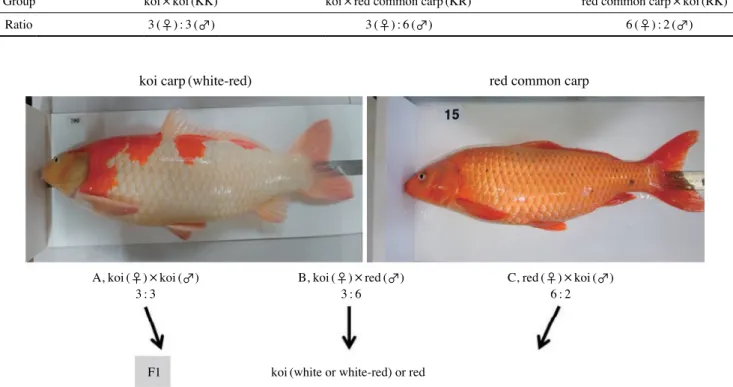
58.5mm, 전중 2082.6±63.6g), 수컷(전장 452.5±57.4mm, 전중 1275.8±57.9g)을 교배에 사용하였고 교배정보는 Table 1, Fig. 1과 같다. 자연 산란 후 사육온도는 24°C를 유지하였고 수정란은 수정 후 56시간부터 부화를 시작하였다. 부화 자어는 색택 분석이 가능한 시기까지 수온 24°C 내외의 조건에서 5회/
1일(어체중의 5%) 사료를 공급하며 사육 관리하였다. 비단잉 어 홍-백 색소의 비율에 관한 분석은 Gomelsky et al.(2003)이 보고한 적색 색소의 분포비율 분석법에 따랐다. 비단잉어 치어 의 홍-백 색소 분석의 시기를 결정하기 위해 일령별로 무늬의 발현 정도를 분석하였고 색소패턴이 선명해진 부화 후 170일 령부터 색택 분석을 수행하였다. 적색 색소의 비율은 score 0~
5까지 비율별로 구분하여 수치화하였다. 분석에 사용된 비단잉 어 치어는 집단 별로 100개체씩 MS-222로 마취 후 측면 사진 을 디지털 카메라(5D Mark II; Canon, Korea)로 촬영하여 분석 하였다. 동시에 집단별 성장도 비교를 위하여 계측형질(전장, 체 장, 체고 및 전중)을 측정하였다(n=100). 통계처리는 SPSS (SPSS 5.0; SPSS Inc., Chicago, IL, USA) program을 사용하여 one-way ANOVA-test를 실시하였고, Duncan’s multiple range test(Duncan, 1955)로 평균 간의 유의성을 검정하였다(P<0.05).
결과 및 고찰
부화 후 170일령(days post hatching; DPH) 비단잉어×비단 잉어(KK), 비단잉어×홍잉어(KR)와 홍잉어×비단잉어(RK) 교배집단에서 생산된 치어의 성장도를 분석하였다. Table 2와 같이 각 집단별 평균 전장 및 전중은 KK 집단(14.5±3.1mm, 54.2±35.6g), KR 집단(15.9±2.8mm, 59.2±30.3g), RK 집단 (15.4±2.6mm, 53.9±28.2g)이었다. 비단잉어×홍잉어(KR) 집단의 전장과 전중은 비단잉어×비단잉어(KK)집단보다 유 의하게 높았다(P<0.05). 전장의 성장도는 두 교배 집단에서 모두 비단잉어만 교배한 집단(KK)보다 빠른 것으로 나타났다.
그러나 체장, 체고 및 전중은 교배 집단 간 유의적인 차이는 없 었다(P>0.05). 비단잉어 치어의 성장은 체형과 더불어 비단잉 어 상품어의 선별에 있어서 중요한 결정요소이며(Kim et al., Table 1. Breeding combination in koi(Cyprinus carpio) and red common carp(C. carpio)
Group koi×koi(KK) koi×red common carp(KR) red common carp×koi(RK)
Ratio 3(♀):3(♂) 3(♀):6(♂) 6(♀):2(♂)
koi carp (white-red)
A, koi(♀)×koi(♂)
3:3 B, koi(♀)×red(♂)
3:6
koi(white or white-red) or red F1
C, red(♀)×koi(♂) 6:2
red common carp
Fig. 1. Breeding combination in koi(Cyprinus carpio) and red common carp(C. carpio).
Table 2. Comparison of growth in koi and koi×red common carp progenies at 170 DPH
Group Total length(mm) Body length
(mm) Body height
(mm) Body weight (g) KK 14.5±3.1a 11.6±2.6ns 3.9±0.9ns 54.2±35.6ns KR 15.9±2.8b 12.6±2.4 3.9±0.8 59.2±30.3 RK 15.4±2.6ab 12.3±2.2 4.0±1.6 53.9±28.2
*The values are presented the mean VSD(n=100). The values that do not share a superscript letters are significantly different(P<0.05) and nsnot significant (P>0.05).
240 황주애·김정은·이정호·김대희·김형수
2008) 고가의 비단잉어를 빠르게 성장시키는 것은 사료나 인 건비 등의 경제적 손실을 줄일 수 있는 방법이다.
Gomelsky et al.(2003)은 비단잉어의 적색색소의 분포범위
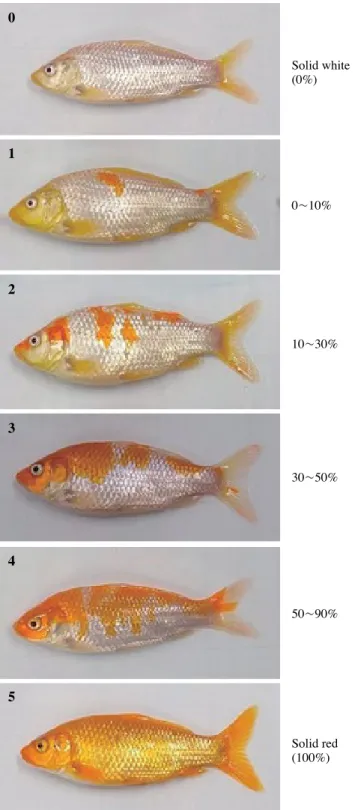
에 따라 무늬를 분석하는 방법을 제안하였다. 홍백 비단잉어 어미의 적색색소 범위는 12.8~45%까지 다양한 것으로 알려 져 있는데(Novelo and Gomelsky, 2009) 본 연구에 사용된 홍 백 비단잉어 어미의 적색무늬의 범위는 30~50%로 나타났다 (Fig. 1). 비단잉어 집단과 비단잉어×홍잉어 교배 집단의 적색 색소 패턴은 흰색, 적색-흰색, 적색의 3가지로 나타났으며 세 집단의 적색무늬 범위는 10~90%로 다양하였고 적색무늬의 비율은 KK 집단 64%, KR 집단 56%, RK 집단 32%로 KK 집 단에서 가장 높은 것으로 확인되었다. 적색무늬의 발현율의 범위가 30~50%인 집단의 비율은 KK 집단 10%, KR 집단 14%, RK 집단 12%로 KR 집단에서 발현율이 가장 좋았다 (Fig. 2, Table 3). Kim et al.(2017)은 비단잉어의 색도분석을 위해 색차계(Minolta Chroma Meter CR-400, Japan)를 사용한 색소분석방법을 사용하였고 이는 비단잉어 등쪽 표피의 빨간 색 부위에 대한 L(lightness), a(redness), b(yellowness)를 구 분하여 분석하는 방법이다(Skrede, 1987; Gouveia et al., 2003). 색차계를 사용한 분석법은 적색색소의 선명도를 분석 하는 방법으로 적색색소의 분포범위를 분석하여 패턴을 비교 하는 분석법과는 차이가 있다. 따라서 추후 분석에서는 이를 반영하여 비단잉어의 교배 집단 간 적색색소의 패턴과 색차계 를 이용한 적색색소의 선명도를 비교 분석한다면 보다 고품질 의 비단잉어를 선별할 수 있을 것으로 사료된다.
요 약
본 연구는 고품질 비단잉어 생산을 위해 비단잉어와 홍잉어 교배종의 성장과 적색색소의 빈도분석을 통해 비단잉어 색도 를 분석하였다. 색소 및 성장도 분석을 위해 부화 후 170일령 비단잉어를 각 교배 집단별로[비단잉어×비단잉어(KK), 비단 잉어×홍잉어(KR)와 홍잉어×비단잉어(RK)] 100개체씩 분석 하였다. 성장도 분석 결과 비단잉어×홍잉어(KR) 교배집단에 서 전장과 전중의 성장이 가장 높았다. 교배 그룹 모두 흰색, 적색-흰색, 적색의 3가지 색소 패턴을 보였다. 적색색소 분포는 KK 집단이 64%, KR 집단이 56%, RK 집단이 36%였다. 적색 Table 3. Distribution of red coverage in breeding combination as determined by 170 DPH
Red coverage (%)
KK KR RK
No. % No. % No. %
0%(solid white) 9 18 5 10 6 12
0~10% 5 10 10 20 3 6
10~30% 16 32 11 22 6 12
30~50% 5 10 7 14 6 12
50~90% 6 12 0 0 1 2
100%(solid red) 9 18 17 34 28 56
Solid white (0%)
0~10%
10~30%
30~50%
50~90%
Solid red (100%)
0
1
2
3
4
5
Fig. 2. Color variability with regard to red coverage in koi×red common carp(KR). 0; solid white, 1; white-red 0~10%, 2; white-red 10~30%, 3; white-red 30~50%, 4; white-red 50~90%, 5; solid red 100%.
홍백 비단잉어와 홍백 비단잉어×홍잉어 교배종의 적색소 분석 241
색소 범위의 빈도분석 결과 적색색소 30~50%를 차지하는 비 율이 KK 집단이 10%, RK 집단이 12% 그리고 KR 집단이 14%
로 가장 높았다. 비단잉어 적색색소 빈도 분석에 관한 연구는 비단잉어 선별을 위한 분석 도구로서 활용이 가능할 것으로 판단된다.
사 사
이 논문은 2018년도 국립수산과학원 수산시험연구사업 담 수 수산생물 종보존 및 복원연구(R2018036)의 지원으로 수행 된 연구입니다.
REFERENCES
Bercovich, D., S. Korem, L. Shauder and G. Degani. 2012. Genetic diversity of color phenotypes in the koi(Cyprinus carpio L.) as identified by moleculaar markers. J. Bio. Chem., 3: 249- David, L., S. Rothbard and I. Rubinstein. 2004. Aspects of red and 255.
black color inheritance in the Japanese ornamental(Koi) carp (Cyprinus carpio L.). Aquaculture, 233: 129-147.
Duncan, B. 1955. Multiple-range and multiple F tests. Biometrics, 11: 1-42.
Gomelsky, B., N.B. Cherfas, N. Ben-Dom and G. Hulata. 1996.
Color inheritance in ornamental(koi) carp(Cyprinus carpio L.) inferred from color variability in normal and gynogenetic progenies. Isr. J. Aqua.-Bamidgeh., 48: 219-230.
Gomelsky, B., N.B. Cherfas, G. Hulata and S. Dasgupta. 2003. In- heritance of the white-red(Kohaku) color complex in orna- mental(Koi) carp(Cyprinus carpio L.). Isr. J. Aqua.-Bami- dgeh., 55: 147-153.
Gouveia, L., P. Rema, O. Pereira and J. Empis. 2003. Colouring or- namental fish(Cyprinus carpio and Carassius auratus) with microalgal biomass. Aquacult. Nutr., 9: 123-129.
Hwang, J.A., J.E. Kim, H.S. Kim and J.H. Lee. 2017. Immune res- ponse to Koi herpesvirus(KHV) of Koi and Koi×red com- mon carp(Cyprinus carpio). Dev. Reprod., 4: 361-370.
Kim, Y.O. and S.M. Lee. 2012. Effects of dietary inclusion of Spiru- lina, astaxanthin, canthaxanthin or paprika on the skin pig- mentation of red- and white-colored fancy carp Cyprinus carpio var. koi. Korean J. Fish. Aquat. Sci., 45: 43-49. (in Korean)
Kim, Y.O. and S.M. Lee. 2014. Effects of dietary carotinoids soutces on growth and skin color of red- and white-colored fancy carp white-colored fancy carp Cyprinus carpio var. koi. Ko- rean J. Fish. Aquat. Sci., 47: 790-795. (in Korean)
Kim, Y.O. and S.M. Lee. 2015. Influence of Spirulina level in diet on skin of red- and white-colored fancy carp Cyprinus carpio var.
koi. J. Kor. Soc. Fish. Mar. Edu., 27: 414-421. (in Korean) Kim, Y.O., J.Y. Jo and S.Y. Oh. 2008. Effects of dietary Spirulina,
Chlorella, and astaxanthin on the body color of red- and white-colored carp, Cyprinus carpio. J. Kor. Fish. Soc., 41:
193-200. (in Korean)
Kim, Y.O., S.Y. Oh and S.M. Lee. 2017. Growth and skin color of red-and white-colored fancy carp Cyprinus carpio var. koi reared at different water temperatures. Korean J. Fish. Aquat.
Sci., 50: 257-262. (in Korean)
Kuroki, T. 1981. The latest manual to nishikigoi, Shimonoseki-city, Japan. Shin-Nippon-Kyoiku-Tosho Co. Ltd., 272pp.
Novelo, N. and B. Gomelsky. 2009. Comparison of two methods for measurement of red-area coverage in white-red fish for anal- ysis of color variability and inheritance in ornamental(koi) carp Cyprinus carpio. Aqua. Living Resour., 22: 113-116.
Skrede, G. 1987. Rapid analysis in food processing and food control.
In: Proceedings of the Fourth European Conference on food Chemistry, pp. 1-4.
Tamadashi, M. 1990. The cult of the koi. 2nd edition, Neptune, New Jersey, USA, TFH Publications Inc., 288pp.
Wang, C.H., S.F. Li, S.P. Xiang, J. Wang, Z.G. Liu, Z.Y. Pang, J.P.
Duan and Z.B. Xu. 2006. Addictive, dominance genetic ef- fects for growth-related traits in common carp, Cyprinus carpio L. Aquacult. Res., 37: 1481-1486.