745
Copyright © 2017 The Korean Society of Fisheries and Aquatic Science pISSN:0374-8111, eISSN:2287-8815
서 론
전세계관상어류중비단잉어
(Cyprinus carpio)
의전체시장 규모는약3
조원정도로추정된다.
비단잉어총생산량의94%
가일본에서생산되고있으며
,
이스라엘과대만등에서소량생 산되고있다(Kim, 2004).
국내의비단잉어는충북,
경기,
전남 그리고경남등전국적으로생산되어유통되고있으며,
규모가 큰곳은충북진천의진천관상어조합으로1991
년부터영어조 합법인이설립되어미국과유럽으로수출되고있다.
하지만비 단잉어의품종다양성및생산량부족으로해외바이어의주문 조건을충족시키지못해수출량감소및국내경기침체로어려 움을겪고있는실정이다(Kim, 2004).
비단잉어는우리나라를비롯한일본
,
미국,
유럽등과같은선 진국에서인기가매우높은품종이어서양식기술및성장에관 한지속적인연구를통해생산성향상이뒷받침된다면,
부가가 치가매우높은양식어종대상으로각광을받을수있을것으로전망된다
(Hancz et al., 2003).
일반적으로비단잉어와같은관 상어는양식생산에있어서성장속도가중요하게고려되지않고 있으며,
오히려성장이느린것이좋다고알려져있는데,
이는 수족관에서취미생활로관상어류를사육할경우에해당된다.
관상어양식현장에서는어류를판매할수있는크기까지건강 하게빨리키울수있는사육환경조성과사료공급체계가중 요하며,
이에대한연구가필요하다(Kim and Lee, 2010).
어류의사료섭취는사육환경
,
사료조성,
사료형태및사료공 급체계등에영향을받기때문에(Lee et al., 2000a; Lee et al.,
2000b),
이러한요인들을고려한사육환경과사료품질향상연구및공급체계를규명하는것은어류의성장및사료효율을개 선시킬수있을뿐아니라
(Lee et al., 2000b; Ng et al., 2000),
양식생산량향상과수질오염감소에도도움이된다.
그동안비 단잉어용양식사료개발을위한영양요구와사료공급체계에관 한연구는제한적으로수행되어왔다. Kim and Lee (2010)
가 시판되는담수어부상사료를이용한사료공급에대한실험을사료의 지질함량과 공급횟수가 비단잉어( Cyprinus carpio var. koi) 치어의 성장 및 체조성에 미치는 영향
김이오·이상민
1*
충청북도내수면산업연구소, 1강릉원주대학교 해양생물공학과
Influence of Dietary Lipid Level and Feeding Frequency on the Growth and Body Composition of Juvenile Fancy Carp Cyprinus carpio var. koi
Yi-Oh Kim and Sang-Min Lee1*
Chungcheongbuk-do Inland Fisheries Research Institute, Chungju 27432, Korea
1Department of Marine Biotechnology, Gangneung-Wonju National University, Gangneung 25457, Korea
We investigated the effects of different dietary lipid levels (7% or 14%) and feeding frequency (1-4 meals per day) on the growth performance and body composition of juvenile fancy carp Cyprinus carpio var. koi . Three replicate groups of fish (initial mean weight, 11.7 g) were fed to visual satiety with sinking dry pellet diets for 8 weeks. Neither feeding frequency nor lipid level affected fish survival. Weight gain was affected by feeding frequency but not dietary lipid level. Weight gain significantly increased with increased feeding frequency. Feed efficiency and protein efficiency ratio were affected by feeding frequency, but not dietary lipid level. Daily feed intake was affected by feeding fre- quency and dietary lipid level. Whole body moisture, crude lipid and ash contents were affected by feeding frequency, but not dietary lipid level. Based on these results, we conclude that the appropriate feeding frequency for the optimum growth of fancy carp fingerlings is four meals per day using sinking dry pellet.
Key words: Cyprinus carpio var. koi , Fancy carp, Feeding frequency, Dietary lipid level
This is an Open Access article distributed under the terms of the Creative Commons Attribution Non-Commercial Licens (http://creativecommons.org/licenses/by-nc/3.0/) which permits unrestricted non-commercial use, distribution, and reproduction in any medium, provided the original work is properly cited.
https://doi.org/10.5657/KFAS.2017.0745
Korean J Fish Aquat Sci 50(6) 745-749, December 2017
Received 6 November 2017; Revised 27 November 2017; Accepted 29 November 2017
*Corresponding author: Tel: +82. 33. 640. 2414 Fax: +82. 33. 640. 2955
E-mail address: [email protected]
수행하였으나증체율이예상보다매우낮게나타났다
.
이는공 급된사료형태등이비단잉어에적합하지못한것등에원인 이있었던것으로판단되며,
사료형태에따른사료공급기술에 대한체계적인연구가꾸준히수행되어야할것이다.
비단잉어 는잡식성으로바닥에떨어진사료도잘먹는습성이있기때문 에부상사료보다는침강사료가생태적으로더적합할수있으 므로침강되는펠렛사료의공급체계에대한연구가필요하다.
사료의지질은단백질이나탄수화물보다에너지가가높아값 비싼사료단백질을절약할수있으며
,
필수지방산과지용성비 타민의공급원으로양식대상종의성장과체내대사에필수적인 역할을하는중요한영양소이다(NRC, 1993).
일반적으로사료 의지질함량에따라사료의에너지함량이달라지고,
이러한사 료의에너지함량은먹이섭취량에영향을미치는것으로알려 져있다(Kim and Lee, 2005).
사료의지질함량과사료공급량 의상호작용에대한효과를조사하여사료품질개선및사료공 급체계에도움을줄수있는정보가필요하다.
따라서본연구 는비단잉어치어를대상으로침강펠렛사료의지질함량에따 른적정공급횟수를조사하기위하여수행되었다.
재료 및 방법
실험어 및 사육관리
실험어로 충청북도내수면산업연구소에서종묘생산되어사 육되고있는비단잉어
(Fancy Carp Cyprinus carpio var. koi)
를사용하였으며,
상품사료를공급하면서예비사육하였다.
외형적으로건강한평균체중
11.7 g
의비단잉어치어를선별하여20 L
사각수조에각각20
마리씩3
반복으로수용하여8
주간사 육하였다.
반순환식으로여과된물을수조마다2 L/min
씩흘려 주었으며,
수중펌프를사용하여 여과시스템내의물을순환시 켜주었다.
실험수조를청소하면서전체사육수의20%
를매일 환수하였으며,
사육수온을24℃
로유지하였다.
각수조마다약 하게폭기시켜산소를공급하였다.
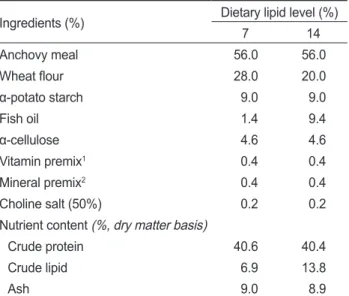
Table 1
에표시한바와같이단백질함량이40%,
지질함량이7%
와14%
전후가되도록실험사료를설계하였다.
실험사료는원료들을잘혼합한후원료혼합물
100 g
당물30 g
을가하고moist pellet
제조기로압출성형하여실온에서24
시간동안건 조하였다.
건조된사료는실험어의입의크기에맞게망크기 가다른채로선별한후,
냉장보관하면서실험어에게공급하 였다.
사료공급횟수는1
일4
회(09:00, 11:30, 15:00, 17:00), 1
일3
회(09:00, 13:00, 17:00), 1
일2
회(09:00, 17:00)
및1
일1
회(09:00)
만복으로공급하였다.
어체측정 및 성분분석
어체측정은사육실험시작시와종료시에측정전일절식시 킨후
tricaine methanesulfonate (MS 222, Sigma, St. Louis,
MO, USA) 100 ppm
수용액에마취시켜실험어의무게를측정하였다
.
무게측정후어체의성분분석을위하여각실험수조 에서10
마리씩시료로취하여냉동보관(-75℃)
하였다.
실험사 료및어체의일반성분은표준방법(AOAC, 1995)
에따라분석 하였는데,
조단백질(N×6.25)
은Auto Kjeldahl System (Buchi B-324/ 435/412, Switzerland)
을사용하여분석하였고,
조지질 은ether
를사용하여추출하였으며,
수분은105℃ dry oven
에 서6
시간동안건조후측정하였고,
회분은600℃
에서4
시간동 안태운후정량하였다.
통계처리
결과의통계처리는
SPSS Version 19 (SPSS, Michigan Ave- nue, Chicago, IL, USA) program
을사용하여One-way ANO- VA-test
를실시한후, Duncan’s multiple range test (Duncan,
1955)
로처리평균간의유의성을검정하였다.
결과 및 고찰
평균체중
11.7 g
의비단잉어8
주간사육실험한후의증체율,
사료효율,
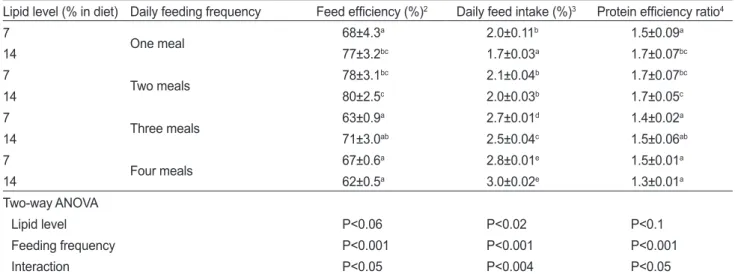
사료섭취율및단백질효율을Table 2
와Table 3
에나Table 1. Ingredient and proximate composition of experimental diets
Ingredients (%) Dietary lipid level (%)
7 14
Anchovy meal 56.0 56.0
Wheat flour 28.0 20.0
α-potato starch 9.0 9.0
Fish oil 1.4 9.4
α-cellulose 4.6 4.6
Vitamin premix1 0.4 0.4
Mineral premix2 0.4 0.4
Choline salt (50%) 0.2 0.2
Nutrient content (%, dry matter basis)
Crude protein 40.6 40.4
Crude lipid 6.9 13.8
Ash 9.0 8.9
1Vitamin premix contained the following amount which were diluted in cellulose (g/kg mix): DL-α-tocopheryl acetate, 18.8; thiamin hy- drochloride, 2.7; riboflavin, 9.1; pyridoxine hydrochloride, 1.8;
niacin, 36.4; Ca-D-pantothenate, 12.7; myo-inositol, 181.8; D- biotin, 0.27; folic acid (98%), 0.68; p-aminobenzoic acid, 18.2;
menadione, 1.8; retinyl acetate, 0.73; cholecalciferol, 0.003; cya- nocobalamin, 0.003. 2Mineral premix contained the following ingre- dients (g/kg mix): MgSO4·7H2O, 80.0; NaH2PO4·2H2O, 370.0; KCl, 130.0; Ferric citrate, 40.0; ZnSO4·7H2O, 20.0; Ca-lactate, 356.5; CuCl, 0.2; AlCl3·6H2O, 0.15; KI, 0.15; Na2Se2O3, 0.01; MnSO4·H2O, 2.0;
CoCl2·6H2O, 1.0.
타내었다
.
사육실험기간동안의모든실험구의생존율은98%
이상으로실험구간에유의차가없었다
.
증중율,
일간성장률,
사 료효율,
일간사료섭취율및단백질효율은사료공급횟수에모 두영향을받았으며(P<0.001),
증중율,
일간성장률및일간사료 섭취율은사료공급횟수가증가함에따라유의하게증가하는경 향을보였다(P<0.05).
사료효율및단백질효율은1
일2
회실험 구가유의하게높은결과를나타내었다(P<0.05).
경제적이고친환경적인비단잉어양식을위해서는적정사료 공급횟수를조사하는것이매우중요하다
.
양식경영비의높은비중을차지하는사료를적절히공급하는것은어류의성장및 사료이용성증가로경제적측면에서큰이득이될뿐만아니라
,
사료유래의수질오염원을감소시킬수있어환경적측면에서 도이득이된다(Kim and Lee, 2010).
본실험에서사료공급횟 수가증가함에따라성장이높아지는것으로보아,
비단잉어치 어를양성할때성장속도를높이기위해서는하루에4
회까지배 합사료를공급하는것이바람직할것으로판단된다.
반면에사 료효율의결과를감안하면,
수질오염이나경제성을고려한측 면에서는하루2
회사료를공급하는것도의미가있다고판단되Table 3. Feed utilization of juvenile fancy carp Cyprinus carpio fed the diets containing different lipid level with different feeding frequency for 8 weeks1
Lipid level (% in diet) Daily feeding frequency Feed efficiency (%)2 Daily feed intake (%)3 Protein efficiency ratio4
7 One meal 68±4.3a 2.0±0.11b 1.5±0.09a
14 77±3.2bc 1.7±0.03a 1.7±0.07bc
7 Two meals 78±3.1bc 2.1±0.04b 1.7±0.07bc
14 80±2.5c 2.0±0.03b 1.7±0.05c
7 Three meals 63±0.9a 2.7±0.01d 1.4±0.02a
14 71±3.0ab 2.5±0.04c 1.5±0.06ab
7 Four meals 67±0.6a 2.8±0.01e 1.5±0.01a
14 62±0.5a 3.0±0.02e 1.3±0.01a
Two-way ANOVA
Lipid level P<0.06 P<0.02 P<0.1
Feeding frequency P<0.001 P<0.001 P<0.001
Interaction P<0.05 P<0.004 P<0.05
1Values (mean±SE of three replications) in the same column not sharing a common superscript are significantly different (P<0.05). 2Wet weight gain×100/feed intake. 3Feed intake×100/[(initial fish wt+final fish wt+dead fish wt)×days reared/2]. 4Wet weight gain/protein intake.
Table 2. Growth performance of juvenile fancy carp Cyprinus carpio fed the diets containing different lipid level with different feeding frequency for 8 weeks1
Lipid level
(% in diet) Daily feeding
frequency Survival (%) Initial mean weight (g) Finial mean weight (g) Weight gain (%)2 SGR (%)3
7 One meal 98±1.6ns 11.7±0.08ns 32.9±0.35a 180±4.2a 1.4±0.02a
14 98±1.6 11.7±0.13 32.2±0.88a 174±7.2a 1.4±0.03a
7 Two meals 98±1.6 11.5±0.01 41.9±1.23b 264±10.2ab 1.8±0.03b
14 98±1.6 11.6±0.01 42.1±0.92b 263±7.4b 1.8±0.02b
7 Three meals 100±0.0 11.8±0.12 45.3±0.82c 283±9.8b 1.9±0.03b
14 98±1.6 11.8±0.18 49.9±2.10d 321±23.6c 2.0±0.08c
7 Four meals 98±1.6 11.8±0.01 59.3±0.44f 403±3.8d 2.3±0.01d
14 100±0.0 11.6±0.18 55.7±0.46e 378±4.2d 2.2±0.01d
Two-way ANOVA
Lipid level P<1.0 P<0.9 P<0.8 P<0.8 P<0.8
Feeding frequency P<0.8 P<0.1 P<0.001 P<0.001 P<0.001
Interaction P<0.7 P<0.7 P<0.01 P<0.06 P<0.09
1Values (mean±SE of three replications) in the same column not sharing a common superscript are significantly different (P<0.05). 2(Final fish wt.-initial fish wt.)×100/initial fish wt. 3Specific growth rate=[ln (final fish weight)–ln (initial fish weight)]×100/days reared.
므로사육목적에따라사료공급횟수를적절히조정할수있을 것으로보인다
.
또한사료의물성에있어이전시판부상사료를 공급했을때에는증중률이낮았으나(Kim and Lee, 2010),
침 강사료형태의본실험결과에서는증중률이174-403%
로상대 적으로높은값을나타내어부상사료보다침강사료형태의사 료가비단잉어치어사육에는더효율적이라는것을알수있다.
어류의최대성장을위한적정사료공급횟수는어종,
어체크 기,
사료조성및사료공급율등에따라다르다고보고되어있다(Wang et al., 1998; Company et al., 1999).
여러연구자들은사 료의공급횟수가증가함에따라성장과사료공급량이증대된 다고보고하고있다(Kayano et al., 1993; Dwyer et al., 2002).
본연구결과에서도공급횟수가증가할수록좋은성장결과를나 타내었다
.
타어종의적정사료공급횟수를조사한연구들에 서, 1
년생무지개송어(400-700 g)
의성장은1
일4
회공급구까 지증가하였으며(Ruohonen et al., 1998),
틸라피아(183 g)
는1
일3
회(Riche et al., 2004),
산천어는1
일2
회(Seong and Kim, 2008),
조피볼락(6 g)
은1
일1
회(Lee et al., 2000b)
가적합하다 고보고되었다.
어류의성장이나사료효율은사료의지질함량에영향을받는 다고알려져있다
(Lee et al., 2002; Kim and Lee, 2005).
본연 구에서는사료지질함량이성장에영향을미치지않았으나,
사 료효율은1
일1
회공급구에서지질14%
실험구가7%
실험구보 다유의하게높은결과를나타내었는데,
이는사료공급량이낮 을수록에너지함량이높은사료가사료이용성이높기때문으로 추정된다.
즉,
사료공급횟수저하에따라섭취되는에너지함량 이부족해지므로에너지함량이높은고지질사료에서사료효 율이더높아진것으로판단된다.
전어체의수분
,
단백질,
지질및회분함량을Table 4
에나타내 었다.
전어체의수분,
지질,
회분함량은사료공급횟수에영향을받았으며
,
수분과회분은사료공급횟수가증가함에따라감소 하는경향을나타내었으며,
지질함량은사료공급횟수가증가 함에따라증가하는경향을나타내었다.
이처럼사료공급량이 많아질수록어체의지질함량이증가하는것은타어종에서도 많이보고되고있는일반적인현상이며(Yao et al., 1994; Lee et
al., 1996),
비단잉어를대상으로한실험에서도일치된결과를나타내었다
(Kim and Lee, 2010).
이상의결과들을종합하면
,
비단잉어치어의성장을높이기 위한사육에는침강사료를1
일4
회까지공급하는것이좋을것 으로보이며,
사료효율을최대화하기위해서는1
일2
회사료를 공급하는것이바람직할것으로판단된다.
References
AOAC (Association of Official Analytical Chemists). 1995. Of- ficial Methods of Analysis, 16th edition. Association of Offi- cial Analytical Chemists, Arlington, Virginia, U.S.A. https://
doi.org/10.1016/0924-2244(95)90022-5.
Company R, Calduch-Giner JA, Kaushik S and Perez-Sanchez J. 1999. Growth performance and adiposity in gilthead sea bream (Sparus aurata): risks and benefits of high energy diets. Aquaculture 171, 279-292. https://doi.org/10.1016/
s0044-8486(98)00495-5.
Duncan DB. 1955. Multiple-range and multiple F tests. Biomet- rics 11, 1-42.
Dwyer KS, Brown JA, Parrish C and Lall SP. 2002. Feeding fre- quency affects food consumption, feeding pattern and growth of juvenile yellowtail flounder (Limanda ferruginea). Aqua- culture 213, 279-292. https://doi.org/10.2307/3001478.
Hancz C, Magyary I, Molnar T, Sato S, Horn P and Taniguchi N. 2003. Evaluation of color intensity enhanced by paprika Table 4. Proximate composition (%) of the whole body in juvenile fancy carp Cyprinus carpio fed the diets containing different lipid level with different feeding frequency for 8 weeks1
Lipid level (% in diet) Daily feeding frequency Moisture Crude protein Crude lipid Ash
7 One meal 75.2±0.57c 15.5±0.24abc 7.0±0.31a 2.0±0.22ns
14 74.9±0.32c 16.0±0.36bc 8.4±0.54bc 2.1±0.06
7 Two meal 74.8±0.27bc 14.8±0.07a 8.5±0.12bc 2.2±0.09
14 75.2±0.21c 14.9±0.23ab 8.2±0.38ab 2.1±0.03
7 Three meal 71.7±0.62a 16.2±0.50c 9.6±0.32cd 1.9±0.09
14 73.6±1.16abc 14.7±0.15a 8.3±0.74bc 1.9±0.13
7 Four meal 72.9±0.64ab 15.7±0.61abc 10.1±0.09d 1.8±0.07
14 72.7±0.74a 14.7±0.45a 9.9±0.17d 1.4±0.38
Two-way ANOVA
Feeding frequency P<0.001 P<0.1 P<0.001 P<0.03
Lipid level P<0.3 P<0.1 P<0.7 P<0.4
Interaction P<0.03 P<0.06 P<0.03 P<0.3
1Values (mean±SE of replications) in the same column not sharing a common superscript are significantly different (P<0.05).
as feed additive in goldfish and koi carp using computer- assisted image analysis. Fish Sci 69, 1158-1161. https://doi.
org/10.1016/s0044-8486(02)00224-7.
Kayano Y, Yao S, Yamamoto S and Nakagawa H. 1993. Ef- fect of feeding frequency on the growth and body constitu- ents of young red-spotted grouper, Epinephelus akaara.
Aquaculture 110, 271-278. https://doi.org/10.1016/0044- 8486(93)90375-9.
Kim IO and Lee SM. 2005. Effects of the dietary protein and lipid levels on growth and body composition of bagrid cat- fish, Pseudobagrus fulvidraco. Aquaculture 243, 323-329.
https://doi.org/10.1016/j.aquaculture.2004.11.003.
Kim YO. 2004. Dietary Spirulina, chlorella and astaxanthin on the body color and growth of red and white colored carp, Cyp-
rinus carpio. Ph. D. Thesis, Pukyong National University,
Busan, Korea. https://doi.org/10.5657/kfas.2008.41.3.193.Kim YO and Lee SM. 2010. Effects of feeding frequency and satiation rate on the growth and body composition of Red- and White-colored carp, Cyprinus carpio var. koi. Ko- rean J Fish Aquat Sci 43, 320-324. https://doi.org/10.5657/
kfas.2010.43.4.320.
Kim YO and Lee SM. 2012. Effects of dietary lipid and paprika levels on growth and skin pigmentation of Red- and White- colored carp, Cyprinus carpio var. koi. Korean J Fish Aquat Sci 45, 337-342. https://doi.org/10.5657/kfas.2012.0337.
Lee SM, Kim SH, Jeon IG, Kim SM and Chang YJ. 1996. Ef- fects of feeding frequency on growth, feed efficiency and body composition of juvenile Korean rockfish (Sebastes
schelgeli). J Aquacult 9, 385-394.
Lee SM, Cho SH and Kim DJ. 2000a. Effects of feeding fre- quency and dietary energy level on growth and body com- position of juvenile flounder (Paralichthys olivaceus).
Aquaculture 31, 917-921. https://doi.org/10.1046/j.1365- 2109.2000.00505.x.
Lee SM, Hwang UG and Cho SH. 2000b. Effects of feeding fre- quency and dietary moisture content on growth, body com- position and gastric evacuation of juvenile Korean rockfish
Sebastes schlegeli. Aquaculture 187, 399-409. https://doi.
org/10.1016/s0044-8486(00)00318-5.
Lee SM. Jeon IG and Lee JY. 2002. Effects of digestible pro- tein and lipid levels in practical diets on growth, protein utilization and body composition of juvenile rockfish (Se-
bastes schlegeli). Aquaculture 211, 227-239. https://doi.
org/10.1016/s0044-8486(01)00880-8.
NRC (National Research Council), 1993. Nutrient requirements of fish. National Academy Press, Washington, D.C., U.S.A.
https://doi.org/10.17226/2115.
Ng WK, Lu KS, Hashim R and Ali A. 2000. Effects of feeding rate on growth, feed utilization and body composition of a tropical bagrid catfish. Aquacult Int 8, 19-29.
Riche M, Haley DI, Oetker M, Garbrecht S and Garling DL.
2004. Effects of feeding frequency on gastric evacuation
and the return of appetite in tilapia Oreochromis niliticus.
Aquaculture 234, 657-673. https://doi.org/10.1016/j.aqua- culture.2003.12.012.
Ruohonen KJ, Vielman J and Grove DJ. 1998. Effects of feed- ing frequency on growth and food utilization of rainbow trout (Oncorhynchus mykiss) fed low-fat herring or dry pellets. Aquaculture 165, 111-121 https://doi.org/10.1016/
s0044-8486(98)00235-x.
Seong KB and Kim DH. 2008. Effects of feeding frequency on the optimum growth of cherry salmon, Oncorhynchus
masou. J Kor Fish Soc 41, 343-345. https://doi.org/10.5657/
kfas.2008.41.5.343.
Wang N, Hayward RS and Noltie DB. 1998. Effects of feeding frequency on food consumption, growth size variation and feeding pattern of age-0 hybrid sunfish. Aquaculture 165, 261-267. https://doi.org/10.1016/s0044-8486(98)00266-x.
Yao SJ, Umino T and Nakagawa H. 1994. Effects of feeding fre- quency on lipid accumulation in ayu. Fish Sci 60, 667-671.
https://doi.org/10.2331/fishsci.60.667.