257
Copyright © 2017 The Korean Society of Fisheries and Aquatic Science pISSN:0374-8111, eISSN:2287-8815
서 론
관상어사육은사진촬영과함께가장각광받는대중적취미생 활이기때문에관상어의선택은매우중요하다
.
전세계적으로700
여종의관상어류가있는데이들중95%
가미국플로리다 와동남아시아에서생산되고있다(Gouveia and Rema, 2005).
우리나라에서는가장대표적인관상어로비단잉어와금붕어를 들수있으며
,
애호가들사이에높은가격으로거래되고있다.
비단잉어의상품성을결정하는요인들은체색
,
체형그리고 어체크기등을들수있으며,
이중가장중요한것은체색이 다(Paripatananont et al., 1999).
어류의체색에영향을미치는 요소에는어류의크기,
연령,
사료조성,
사료공급기간,
사료 의carotenoid
종류및농도,
성성숙,
유전적인요인등이있으 며,
수온이나광도등의환경적인요인도체색에영향을미친 다(Torrissen et al., 1989; Storebakken and No, 1992).
수온은어류의성장
,
생존및생리대사에가장큰영향을미치는외부 환경요인으로알려져있으며(Brett and Groves, 1979; Jobling, 1997; Johnston, 2006),
사료섭취에도직접적인영향을미쳐사 료효율및사료이용성에영향을주는중요한요소이다(Yama- moto et al. 2007; Bogevik et al. 2010).
대상어류에적합한수온 에서는사료섭취,
소화및사료이용성이향상되지만(Bogevik et al., 2010),
적합한수온이하에서는사료섭취및성장의감소 되고(Bendiksen et al., 2002),
효소활성및삼투압조절변화가 초래된다(Mccormick et al., 1996).
반면에너무높은수온에서 사육되는어류는대사장애및먹이섭취감소등의부작용이초 래된다(Sun and Chen, 2009; Bermudes et al., 2010).
따라서,
고가의비단잉어를상품크기까지경제적으로빨리키울수있 는사육수온의규명이필요하다.
이와더불어,
비단잉어의색소원료로많이이용되는
Arthrospira
는그품종이다양하므로Arthrospira
종,
배양방법및가공방법에따라영양성분이달라사육수온에 따른 비단잉어 홍백(Cyprinus capio) 치어의 성장 및 체색 변화
김이오·오승용
1·이상민
2*
충청북도내수면연구소, 1한국해양과학기술원 생태기반연구센터, 2강릉원주대학교 해양생물공학과
Growth and Skin Color of Red- and White-colored Fancy Carp Cyprinus carpio var. koi Reared at Different Water Temperatures
Yi-Oh Kim, Sung-Yong Oh1 and Sang-Min Lee2*
Department of Inland Fisheries Research Institute Chungcheongbuk-do, Chungju 27329, Korea
1Marine Ecosystem and Biological Research Center, Korea Institute of Ocean Science and Technology, Asan 15627, Korea
2Department of Marine Biotechnology, Gangneung-Wonju National University, Gangneung 25457, Korea
This study was conducted to investigate the growth and skin color of red- and white-colored fancy carp Cyprinus car- pio var. koi juvenile reared at different water temperatures (21, 24, 27, and 30°C) for eight weeks. Two experimental diets were prepared to contain 10% Arthrospira platensis or 10% Arthrospira pacifica powder. After the feeding trial, survival was 100% in all group. Weight gain of fish reared at 24, 27, and 30°C was higher than 21°C group. Feed ef- ficiency was not affected by water temperature and dietary Arthrospira sp. Daily feed intake tended to increase with water temperature. The a* value of skin coloration was affected by Arthrospira sp., but not by water temperature.
Fish fed the diet containing A . pacifica powder reared at 27°C had the highest a * value among the groups. Total ca- rotenoids were highest in fish fed the diet containing A . pacifica powder reared at 21°C. Based on the results of this study, we conclude that 24-30°C water temperature was the optimal range for growth, and dietary inclusion of A . pacifica improved the skin redness of red- and white-colored fancy carp reared at 27°C.
Key words: Fancy carp Cyprinus caripo var. koi, Water temperature, Growth, Skin coloration, Arthrospira species
This is an Open Access article distributed under the terms of the Creative Commons Attribution Non-Commercial Licens (http://creativecommons.org/licenses/by-nc/3.0/) which permits unrestricted non-commercial use, distribution, and reproduction in any medium, provided the original work is properly cited.
https://doi.org/10.5657/KFAS.2017.0257
Korean J Fish Aquat Sci 50(3) 257-262, June 2017
Received 8 May 2017; Revised 30 May 2017; Accepted 5 June 2017
*Corresponding author: Tel: +82. 33. 640. 2414 Fax: +82. 33. 640. 2955
E-mail address: [email protected]
져어류의성장과체색에영향을미칠수있다
.
비단잉어체색 을개선시키기위한목적으로Arthrospira
첨가(Kim and Lee, 2015)
와다른색소원과의비교실험(Kim and Lee, 2012; Kim and Lee, 2014)
은수행되었으나, Arthrospira
종간의직접적인 비교실험은없었다.
현재까지수온과피부착색과의상호관계에대한실험은금붕어를대상으로수행된바있으나
(Gouveia
and Rema, 2005),
그외종에대해서는연구가매우제한적이 다.
그래서본연구는비단잉어홍백을양식하기위한사육기술 중성장에적합한수온범위를조사하고,
사육수온과사료에첨 가되는Arthrospira
종에따른비단잉어표피의색택변화를조 사하기위해수행하였다.
재료 및 방법
실험사료 및 성분분석
Table 1
에표시한바와같이분말사료에Arthrospira platensis (Hainan Xiongxin Bioengineering Company, China)
와Ar- throspira pacifica (Cyanotech Company, USA)
를각각10%
첨가한
2
종류(SPC, SPU)
의실험사료를제조하였다.
실험사 료에사용된분말상품사료(
조단백질45%, Total carotenoids 1 mg/100 g)
는시판되고있는담수어육성용을구입한것이다.
분 말사료와Arthrospira
를혼합한사료조성물에적당량의물을첨 가하여다시혼합하여사료제조기로pellet
형태로사료를성형 하였다.
성형된각각의실험사료를건조후-25℃
의냉동고에보 관하면서실험어에게공급하였다.
실험사료의일반성분분석은AOAC (1995)
은방법에따라실시하였다.
조단백질(N×6.25)
은Auto Kjeldahl System (Buchi B-324/435/412, Switzerland)
을사용하여분석하였고,
조지질은ether
를사용하여추출하였 으며,
수분은105℃
의dry oven
에서6
시간건조후측정하였다.
회분은600℃
의회화로에서4
시간동안태운후측정하였다. 실험어 관리 및 색도분석
실험어는 충청북도내수면연구소에서종묘생산된비단잉어 홍백
((fancy carp Cyprinus carpio var. koi)
치어를사용하였다.
실험시작2
주전부터실험조건에순치된비단잉어(2.8 g/fish)
를각수조마다20
마리씩3
반복으로수용하여1
일3
회만복으 로실험사료를8
주간공급하였다.
어류사육은히터를장착한 가온수조와여과시스템을갖춘시설에서수행되었는데,
가온 수조에서21℃, 24℃, 27℃
및30℃
로조절된사육수를각실 험수조마다2 L/min
씩흘려주었다.
어체의무게측정은사육 실험시작시와종료시에측정전일절식시킨후tricaine meth- anesulfonate (MS222, Sigma, St. Louis, MO, USA) 100 ppm
수용액에마취시켜실시하였다.
색도분석을위해실험종료후 실험수조에생존한전개체에대하여색차계(Minolta Chroma Meter CR-400, Japan)
를이용하여Skrede (1987)
및Gouveia et al. (2003)
이사용한방법에따라L* (lightness), a* (redness)
및
b* (yellowness)
를측정하였다.
이때비단잉어등쪽표피의 빨간색부위를3
회반복하여측정하였다.
Total carotenoids 분석
실험에사용된사료와어류표피의
total carotenoids
함량은Kim and Lee (2012)
가사용했던방법과동일하게분석하였다.
즉,
시료를동결건조후,
아세톤과메탄올혼합액(1:1, v/v)
으 로암소에서3
회에걸쳐조지질을추출하였다.
추출액에petro- leum ether
와다량의물로분리하여carotenoids
를petroleum ether
로전용시킨후무수Na
2SO
4로탈수시키고, 40℃
이하에 서 감압농축하고, petroleum ether
로100 mL
정량하여UV- spectrometer
사용하여total carotenoids
함량을계산하였다. 통계처리
결과의통계처리는
SPSS (SPSS, Michigan Avenue, Chi- cago, IL, USA) program
을 사용하여One-way
와Two-way ANOVA-test
를실시하고, Duncan`s multiple range test (Dun- can, 1955)
로평균간의유의성을검정하였다.
결과 및 고찰
8
주간의사육실험후,
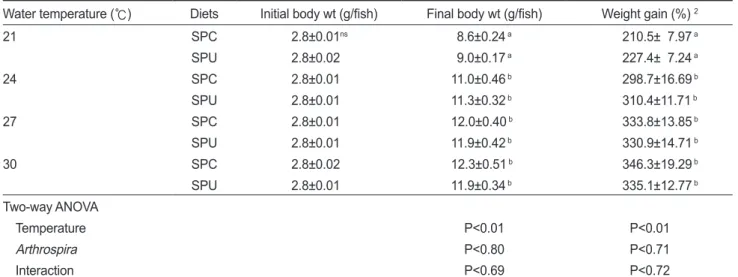
성장및사료이용성에대한결과를Ta- ble 2
와3
에각각나타내었다.
사육실험기간동안의생존율은100%
로나타났다.
최종평균체중및증체율은사육수온에영향 을받았으며(P<0.05),
사료에첨가된Arthrospira
종에는영향 은받지않았다(P>0.05).
사육수온과Arthrospira
종사이에서 상호작용은없었다(P>0.05).
사육수온24℃, 27℃
및30℃
실험구들의증체율은사육수온
21℃
실험구보다유의하게높았다
(P<0.05).
동일한사육수온에서사료에첨가된Arthrospira
Table 1. Ingredient and proximate composition of experimental dietDiets
SPC SPU
Ingredients (%)
Commercial diet1 90 90
Arthrospira platensis powder2 10 -
Arthrospira pacifica powder3 - 10
Chemical analysis (dry matter basis)
Crude protein (%) 46.7 46.2
Crude lipid (%) 9.9 9.4
Ash (%) 8.3 9.5
Total carotenoids(mg/100g) 36.9 38.4
1Commercial bind meal for carp produced in Purinafeed incorpora- tion (Seongnam, Korea). 2Obtained from Hainan Xiongxin Bioen- gineering Company, China. 3Obtained from Cyanotech Company, Kailua-Kona, Hawai, USA.
종에따른성장차이는없었다
.
사료효율은모든실험구간에서 유의한차이를보이지않았다.
일일사료섭취율은사육수온과 사료에첨가된Arthrospira
종에모두영향을받았지만,
사육수 온과Arthrospira
종사이에서상호작용은보이지않았다.
일일 사료섭취율은사육수온이증가할수록증가하는경향을보였으 며, Arthrospira pacifica
첨가구에서높은경향을보였다.
단백 질효율은사육수온에영향을받았지만,
사료에첨가된Arthro- spira
종에는영향은받지않았은며,
사육수온과Arthrospira
종사이에서상호작용은보이지않았다
.
수온은어류의성장,
번식,
대사,
삼투압조절및면역등에영향을미치는중요한요인이 다(Ishioka, 1980; Davis and Parker, 1990; Iwata et al., 1994).
일반적으로 온수성인 어류는수온이낮아지면 사료섭취량이 줄어들뿐아니라성장속도가감소하고
,
수온이높아질수록어 류의대사율이증가되고먹이섭취가촉진되어성장도향상되 는것으로보고되어있다(Seikai et al., 1986; Fonds, 1979).
본 실험에서의사육수온21℃
에서비단잉어홍백치어의일일사 Table 2. Growth performance of red- and white- colored fancy carp Cyprinus carpio var. koi fed diets containing two Arthrospira species reared at different water temperatures for 8 weeks1Water temperature (℃) Diets Initial body wt (g/fish) Final body wt (g/fish) Weight gain (%) 2
21 SPC 2.8±0.01ns 8.6±0.24 a 210.5± 7.97 a
SPU 2.8±0.02 9.0±0.17 a 227.4± 7.24 a
24 SPC 2.8±0.01 11.0±0.46 b 298.7±16.69 b
SPU 2.8±0.01 11.3±0.32 b 310.4±11.71 b
27 SPC 2.8±0.01 12.0±0.40 b 333.8±13.85 b
SPU 2.8±0.01 11.9±0.42 b 330.9±14.71 b
30 SPC 2.8±0.02 12.3±0.51 b 346.3±19.29 b
SPU 2.8±0.01 11.9±0.34 b 335.1±12.77 b
Two-way ANOVA
Temperature P<0.01 P<0.01
Arthrospira P<0.80 P<0.71
Interaction P<0.69 P<0.72
1Values (mean±SE of three replications) in the same column not sharing a common superscript are significantly different (P<0.05). 2Weight gain (%)=(final body weight-initial body weight)×100/initial body weight. nsNot significant (P>0.05).
Table 3. Feed efficiency (FE), daily feed intake (DFI) and protein efficiency ratio (PER) of red- and white- colored fancy carp Cyprinus carpio var. koi fed diets containing two Arthrospira species reared at different water temperatures for 8 weeks1
Water temperature (℃) Diets FE (%)2 DFI3 (%) PER4(%)
21 SPC 73.7±1.99 ns 2.5±0.11 a 2.3±0.08 b
SPU 69.8±2.31 2.7±0.05 b 2.1±0.05 ab
24 SPC 75.6±3.46 2.8±0.07 bc 2.1±0.07 ab
SPU 75.5±0.57 2.9±0.05 bc 2.1±0.02 ab
27 SPC 75.4±2.80 3.0±0.11 bc 2.1±0.08 a
SPU 74.0±2.85 3.0±0.08 cd 2.1±0.06 a
30 SPC 75.6±1.68 3.0±0.05 cd 2.1±0.04 a
SPU 71.3±0.91 3.1±0.07 d 2.0±0.03 a
Two-way ANOVA
Temperature P<0.14 P<0.01 P<0.02
Arthrospira P<0.39 P<0.04 P<0.16
Interaction P<0.76 P<0.56 P<0.51
1Values (mean±SE of three replications) in the same column not sharing a common superscript are significantly different (P<0.05). 2Fish wet weight gain×100/feed intake (dry matter). 3Feed intake×100/[(initial fish wt.+final fish wt.+dead fish wt.)×days reared/2]. 4Wet weight gain/
protein intake. ns Not significant (P>0.05).
료섭취율이낮은값을나타내었으며
,
증중량도낮은값을나타 내었다.
이는낮은수온으로인하여체내대사가감소했기때 문으로판단된다.
온수성담수어류인잉어를대상으로수온별(15-25℃)
로사육실험한결과,
수온이증가함에따라성장도증가하였고
, 25℃
와30℃
사육구간에는서로차이가없었다고 보고하였다(Suzuki et al., 1977).
수온에따른잉어치어의성장실험에서
24-30℃
범위에서큰차이는없었지만최대성장율은
27℃
에서나타났다고보고되었다(Goolish and Adelman,
1984).
본실험의비단잉어에서도수온21℃
에서는성장이낮았으나
,
수온24-30℃
에서는성장이좋아지는결과를나타내어앞에서언급한연구결과와비슷한결과를나타내었다
.
성장결과를고려하여보면
, 24-30℃
의수온은비단잉어홍백의사료섭취
,
사료이용및성장에적합한범위로판단된다.
비단잉어의 경우표피의빨간색을짙고선명하게나타나도록하는것이비 단잉어의상품성을높이는방법이다.
비단잉어의색상개선을 위해Arthrospira
가주로사용되고있다(Kim and Lee, 2012;
Kim and Lee, 2015). Arthrospira
는여러가지carotenoids
를 함유하고있으며,
그중에서zeaxanthin
의함량이높아서4-ke- tozeaxanthin
과idoxanthin
을 거쳐astaxanthin
으로대사되어 비단잉어표피의빨간색을짙고선명하게형성하는데효과적 이다(Matsuno et al., 1979).
그러나Arthrospira
의종,
배양방 법및가공방법에따라그들의영양성분이달라져어류의성장 에영향을미칠수있다고보고되었다(Nandeesha et al., 1998).
또한
,
사육환경중수온이체색에영향을미친다고보고되었다(Gouveia and Rema, 2005).
본연구에서사육
8
주후,
비단잉어홍백표피의밝기(light- ness) L*
값,
붉은색(redness) a*
값및노랑색(yellowness) b*
값 을Table 4
에표시하였다. L*
값은사육수온및Arthrospira
종에의한영향은받았으며
,
수온과Arthrospira
종사이에서상호 작용은보이지않았다. a*
값은사육수온에영향은받지않았으 나, Arthrospira
종에의한영향은받았으며,
수온과Arthrospira
종 사이에서상호작용은보이지않았다. b*
값은수온및Ar- throspira
종에의한영향은받았으며,
수온과Arthrospira
종사 이에서상호작용은보이지않았다. Arthrospira
는A. maxima, A. platensis, A. pacifica
등종류가다양하여Arthrospira
의종 류,
배양및가공방법에따라어류의성장및체색개선에미치는 영향이달라진다고보고되었다(Peimin et al., 1999, Kim and Lee, 2012; Kim and Lee, 2014).
수온27℃
에서SPU
실험구 의a*
값이다른실험구보다유의하게높은값을나타내었으며,
수온30℃
의SPU
실험구와는유의차가없었다. Gouveia et al.
(2003)
의첨가실험에서는Arthrospira maxima
를사용하였고, Kim et al.(2008)
의실험에서는A. platensis
를사용하였으며, Kim and Lee(2012)
과Kim and Lee(2014)
의실험에서는A.
pacifica
를사용하였다.
이전의실험에서도Arthrospira maxi- ma (Gouveia et al., 2003)
과A. platensis (Kim et al., 2008)
를 사용한실험구의a*
값은대조구와유의차가없었으나, A. paci- fica (Kim and Lee, 2012; Kim and Lee, 2014)
를첨가한실험 구는대조구보다a *
값이유의하게높아진다는결과를발표한 바있다.
또한,
금붕어를대상으로한수온20-30℃
에서의색소 원료첨가실험에서도수온28℃
에서가장높은a*
값이나타났 다고보고되었다(Gouveia L and Rema P, 2005).
본연구에서 사육8
주후,
비단잉어홍백표피의total carotenoid
값은Table 5
에나타내었다. Total carotenoid
값은사육수온과Arthrospira
종에의한영향을받았으며,
수온과Arthrospira
종사이에서상 호작용은 보이지않았다.
수온21℃
의SPU
실험구에서total carotenoid
값이가장높았으며,
동일한수온에서는SPU
실험 Table 4. Skin value of red- and white- colored fancy carp Cyprinus carpio var. koi fed diets containing two Arthrospira species reared at different water temperatures for 8 weeks1Water temperature (℃) Diets L* value a* value b* value
21 SPC 66.8±0.13 ab 8.9±0.08 a 23.7±0.20cd
SPU 65.4±0.17 a 9.3±0.19 a 26.9±1.18 e
24 SPC 68.8±0.20 c 9.3±0.20 a 22.2±0.36bc
SPU 68.2±0.83 bc 9.1±0.53 a 24.0±0.71cd
27 SPC 67.2±1.01 abc 8.9±0.31 a 20.8±0.08 b
SPU 65.9±0.80 a 10.2±0.19b 25.7±0.19 de
30 SPC 68.3±0.50 bc 8.9±0.12 a 18.3±0.55 a
SPU 67.1±0.51 abc 9.8±0.35 ab 23.1±1.05 c
Two-way ANOVA
Temperature P<0.01 P<0.43 P<0.01
Arthrospira P<0.02 P<0.01 P<0.01
Interaction P<0.93 P<0.05 P<0.10
1Values (mean±SE of three replications) in the same column not sharing a common superscript are significantly different (P<0.05).
구의
total carotenoid
값이높아지는경향을보였다.
어류체내 에carotenoids
축적은carotenoids
원료,
구조,
안정성,
색소량,
사료지질함량,
어체크기,
성성숙,
유전,
환경적인요인등에영 향을받는다고보고되었다(Guillaume et al., 2001).
본실험에 서두종류의Arthrospira
첨가실험구모두에서수온21℃
실험 구의carotenoids
함량이다른수온실험구(24℃, 27℃, 30℃)
보다높은결과를나타내었는데,
이는어체의크기에따른차이 로생각된다.
즉수온21℃
실험구가다른수온실험구(24℃,
27℃, 30℃)
보다성장이유의하게낮은결과를나타내었는데,
기존의연구에서비단잉어의체중이증가함에따라
total carot- enoid
값이낮아진다고보고하고있어(Kim et al., 2008),
이러 한판단을뒷받침해준다.
이상의결과로부터
,
비단잉어치어의성장과사료효율측면에 서는수온24-30℃
에서사육하는것이좋을것으로보이며,
붉 은색을개선시키기위해서는수온27℃
에서Arthrospira pa-
cifica
가첨가된사료를사용하는것이더효과적일것으로판단된다
.
References
AOAC (Association of Official Analytical Chemists). 1995. Of- ficial Methods of Analysis, 16th edition. Association of Of- ficial Analytical Chemists, Arlington,Virginia, U.S.A.
Bendiksen EA, Jobling M and Arnesen AM. 2002. Feed intake of Atlantic salmon parr Salmo salar L. in relation to tem- perature and feed composition. Aquacult Res 33, 525-532.
https://doi.org/10.1046/j.1365-2109.2002.00737.x.
Bermudes M, Glencross B, Austen K and Hawkins W. 2010.
The effects of temperature and size on the growth, energy budget and waste outputs of barramundi (Lates calcarifer).
Aquaculture 306, 160-166. https://doi.org/10.1016/j.aqua- culture.2010.05.031.
Bogevik AS, Henderson RJ, Mundheim H, Waagbo R, Tocher DR and Olsen RE. 2010. The influence of temperature on the apparent lipid digestibility in Atlantic salmon (Salmo
salar) fed Calanus finmarchicus oil at two dietary levels.
Aquaculture 309, 143-151. https://doi.org/10.1016/j.aqua- culture.2010.08.016.
Brett JR and Groves TDD. 1979. Physiological energetics. Fish Physiol 8, 279-352.
Davis KB and Parker NC. 1990. Physiological stress in striped bass: effect of acclimation temperature. Aquaculture 91, 349-358. https://doi.org/10.1016/0044-8486(90)90199-w.
Duncan DB. 1955. Multiple-range and multiple F tests. Biomet- rics 11, 1-42. http://doi.org/10.2307/3001478.
Fonds M. 1979. Laboratory observations on the influence of temperature and salinity on development of the eggs and growth of the larvae of Solea solea. Mar Ecol Prog Seri 1, 91-99. https://doi.org/10.3354/meps001091.
Goolish EM and Adelman IR. 1984. Effects of ration size and temperature on the growth of juvenile common carp (Cyprinus carpio L.). Aquaculture 36, 27-35. https://doi.
org/10.1016/0044-8486(84)90051-6.
Gouveia L and Rema P. 2005. Effect of microalgal biomass con- centration and temperature on ornamental goldfish (Caras-
sius auratus) skin pigmentation. Aquacult Nutr 11, 19-23.
https://doi.org/10.1111/j.1365-2095.2004.00319.x.
Gouveia L, Rema P, Pereira O and Empis J. 2003.Colouring or- namental fish (Cyprinus carpio and Carassius auratus) with microalgal biomass. Aquacult Nutr 9, 123-129. https://doi.
org/10.1046/j.1365-2095.2003.00233.x.
Guillaume J, Kaushik S, Bergot P and Metailler R. 2001.Nutri- tion and feeding of fish and crustaceans. Springer Verlag, London, UK, 183-196.
Ishioka H. 1980. Stress reactions in the marine fish-I. Stress re- actions induced by temperature chang. Bull. Jpn. Soc. Sci.
Fish 46, 523-532. https://doi.org/10.2331/suisan.46.523.
Iwata N, Kikuchi K, Honda H, Kiyono M and Kurokurg M.
1994. Effects of temperature on the growth of Japanese flounder. Fish Sci 60, 527-531.
Jobling M. 1997. Temperature and Growth: Modulation of Growth Rate Via Temperature Change. Cambridge Uni- versity Press, Cambridge, UK. https://doi.org/10.1017/cbo 9780511983375.010.
Johnston IA. 2006. Environment and plasticity of myogen- esis in teleost fish. J Exp Biol 209, 2249-2264. https://doi.
org/10.1242/jeb.02153.
Kim YO, Jo JY and Oh SY. 2008. Effects of dietary Spirulina, Chlorella, and Astaxanthin on the body color of Red- and Table 5. Skin total carotenoids of red- and white- colored fancy
carp Cyprinus carpio var. koi fed diets containing two Arthrospira species reared at different water temperatures for 8 weeks1 Water temperature (℃) Diets Total carotenoids
(mg/100g DM)
21 SPC 2.9±0.15bc
SPU 3.1±0.29c
24 SPC 2.1±0.08a
SPU 2.5±0.06ab
27 SPC 2.1±0.21a
SPU 2.5±0.16ab
30 SPC 2.0±0.19a
SPU 2.4±0.10ab Two-way ANOVA
Temperature P<0.01
Arthrospira P<0.01
Interaction P<0.89
1Values (mean±SE of three replications) in the same column not sharing a common superscript are significantly different (P<0.05).
White-colored carp, Cyprinus carpio. J Kor Fish Soc 41, 193-200. http://dx.doi.org/10.5657/kfas.2008.41.3.193.
Kim YO and Lee SM. 2012. Effects of dietary inclusion of Spi-
rulina, astaxanthin, canthaxanthin or paprika on the skin
pigmentation of red- and white-colored fancy carp Cyprinuscarpio var. koi. Korean J Fish Aqua Sci 45, 43-49. http://
dx.doi.org/10.5657/kfas.2012.0043.
Kim YO and Lee SM. 2014. Effect of dietary carotenoids sourc- es on growth and skin color of red- and white-colored fancy carp Cyprinus carpio var. koi. Korean J Fish Aqua Sci 47, 790-795. http://dx.doi.org/10.5657/kfas.2014.0790.
Kim YO and Lee SM. 2015. Influence of Spirulina level in diet on skin color of red- and white-colored fancy carp Cypri-
nus carpio var. koi. Kor Soc Fish Mar Sci Edu 27, 414-421.
https://doi.org/10.13000/jfmse.2015.27.2.414.
Matsuno T, Nagata S, Iwahashi M, Koike T and Okada M. 1979.
Intensification of color of fancy red carp with zeaxanthin and myxoxanthophyll, major carotenoid constitute of spiru-
lina. Bull Jap Soc Sci Fish 45, 627-632.
Mccormick SD, Shimpton JM and Zydlewski JD. 1996. Tem- perature effects on osmoregulatory physiology of juvenile anadromous fish. Society for experimental biology seminar series. Cambridge university press, New York, U.S.A., 279- Nandeesha MC, Gangadhara B, Varghese TJ and Keshavanath 301.
P. 1998. Effect of feeding Spirulina platensis on the growth, proximate composition and organoleptic quality of common carp, Cyprinus carpio L. Aquacult Res 29, 305-312. https://
doi.org/10.1111/j.1365-2109.1998.tb01135.x.
Paripatanamont T, Tangtrongpairoj J, Sailasuta A and Chansue NK. 1999. Effect of astaxanthin on the pigmentation of goldfish Carassius auratus. J World Aquacult Soc 30, 454- 460. https://doi.org/10.1111/j.1749-7345.1999.tb00993.x.
Peimin, H., Z. Yinjiang and H. Wenhui, 1999. Effect of the spi- rulina feed on the growth and body color of Crucian carp.
Journal of Fisheries China/Shuichan Xuebao, 23, 162-168.
Seikai M, Tanangonan JB and Tanaka M. 1986. Temperature influence on larval growth and metamorphosis of the Japa- nese flounder Palalichthys olivaceus in the laboratory. Bull Jpn Soc Sci Fish 52, 977-982. https://doi.org/10.2331/su- isan.52.977.
Skrede G. 1987. Rapid analysis in food processing and food control. In: Proceedings of the Fourth European Conference on food Chemistry., 1-4.
Storebakken T and No H. 1992. Pigmentation of rainbow trout.
Aquaculture 100, 209-229. https://doi.org/10.1016/0044- 8486(92)90372-r.
Sun L and Chen H. 2009. Effects of ration and temperature on growth, fecal production, nitrogenous excretion and energy budget of juvenile cobia (Rachycentron canadum). Aqua- culture 292, 197-206. https://doi.org/10.1016/j.aquaculture.
2009.04.041.
Suzuki R, Yamaguchi M and Ishikawa K. 1977. Differences in growth rate in two races of the common carp at various wa- ter temperature. Bull Fresh Fish Res Lab 27, 21-26.
Torrissen O, Hardy R and Shearer K. 1989. Pigmentation of sal- monids-carotenoid deposition and metabolism. Rev Aqua- cult Sci 1, 209-225.
Yamamoto T. Shima T. Furuita H. Sugita T. and Suzuki N.
2007. Effects of feeding time, water temperature, feeding frequency and dietary composition on apparent nutrient di- gestibility in rainbow trout Oncorhynchus mykiss and com- mon carp Cyprinus carpio. Fish Sci 73, 161-170. https://doi.
org/10.1111/j.1444-2906.2007.01314.x.