JFM SE, 26(2), pp. 245 256, 2014. www.ksfme.or.kr 수산해양교육연구 제 권 제 호 통권 호, 26 2 , 68 , 2014. http://dx.doi.org/10.13000/JFMSE.2014.26.2.245
. Introduction
Ⅰ
The barbel of the fish is the protrusion of the mouth skin being histologically similar with skin (Harder, 1975; Hibiya, 1982). Fish barbels have the ability to taste (gustatory) and sense texture (tactile). That is, fishes having taste buds in the barbel are swimming slowly and almost benthic species, and these barbels are used to lure the prey. So, barbels are used for navigation and
searching for prey (Kappor & Bhargava, 1967; Kim et al., 2001; Park et al., 2005). Also, the barbel of some fish have a light-emitting organ and beard with a light emitting end, and may be used to lure prey (Bone et al., 1995). The fish barbel of the castle kidney structure represents the difference between the various species form, number, length, and location in each time (Harder, 1975; Kim et al., 2001). Especially, the barbel of catfish is reported to have the ability to sense touch and
Histological Observation of the Barbel in Common Carp, Cyprinus carpio and Bagrid Catfish, Pseudobagrus fulvidraco
Sang-Gu LIM Hyoung-Kyun HAN Hye-Jung PARK* In-Seok PARKㆍ ㆍ ㆍ , (National Fisheries Research & Development Institute *ㆍ Korea Maritime and Ocean University)
잉어, Cyprinus carpio와 동자개, Pseudobagrus fulvidraco 수염의 조직학적 관찰
임상구 한형균 박혜정* 박인석
국립수산과학원
( *한국해양대학교)
Abstract
잉어, Cyprinus carpio와 동자개, Pseudobagrus fulvidraco의 상악 하악 수염을 조직학적으로 조사하였․ 다 동자개의 수염은 연골성 증축. (axial rod of cartilage), 신경섬유다발(bundle of nerve fiber), 표피
평활근 층 및 미뢰 로 구성되었으며 잉어의 수염은 표피
(epidermis), (smooth muscle layer) (taste bud) , ,
신경섬유다발 혈관, (blood vessel) 및 미뢰로 구성되었다 수염 길이에서 잉어는 상악 바깥쪽 수염.
이 상악 안쪽 수염 보다 길게 나타났으며 동자개는 하
(second maxillary barbel) (first maxillary barbel) ,
악 안쪽(inner mandibular barbel), 상악 위쪽(upper maxillary barbel), 하악 바깥쪽(outer mandibular
상악 아래쪽 순으로 길게 나타났다
barbel), (lower maxillary barbel) (P<0.05). 미뢰의 수를 고려하였을 때 동자개와 잉어간의 미각에 대한 유의적 차이가 없었다, (P>0.05). 아울러 두 어종의 모든 수염에서 , 수염 상부의 미뢰 수가 하부의 미뢰 수 보다 높게 나타났다(P<0.05). 본 연구 결과 동자개의 수염은 , 딱딱하며 굴절성인 수염(flexible and stiff type)이었으며 잉어의 수염은 연하고 유연한 수염(tender and
으로 파악되었다
yielding type) .
Key words : Bagrid catfish, Barbel, Common carp, Histological observation
Corresponding author : Tel., +82-51-410-4321; E-mail, [email protected]
taste food in the function of recognition (Park et al., 2004a; Park & Kim, 2005).
Common carp, Cyprinus carpio belong to the Cyprinidae, Cypriniformes taxonomically. It inhabits Asia and most of Europe's freshwater (Lee & Kim, 2006). The look is similar to crucian carp, Carassius carassius but the body is longer than crucian carp, has lower body height and two pairs of barbels around the mouth and on average common carp reach 50 to 120 centimeters in length, the dorsal is yellowish brown and the belly a silvery-white color. Their body shape and color are dependent on the environmental difference. The scales of a carp are large and round roof shaped.
Also, it has excellent adaptability and can live in a variety of environments, but it mainly lives in mud and slow flowing water such as that in a river or lake floor (Chun et al., 1983). At present, the common carp is mostly raised in Jeollabuk-do and Kyungsangnam-do, Korea, and for the cultivation of fish, the common carp is mainly a farming fish (Lee & Kim, 2006).
Bagrid catfish, Pseudobagrus fulvidraco belong to the Siluriformes, Bagridae taxonomically (Park &
Lee, 1996). It is found throughout Asia and in Korea, they commonly inhabit the west sea and south sea flows into the midstream and downstream of the river (Park & Lee, 1996; Kim & Park, 2002; Lim et al., 2012). Bagrid catfish do not have scales on the body and the head is flat. Also, it is mainly a carnivorous fish. As it prefers to eat at night it is a nocturnal fish (Lee, 1993; Lim et al., 2012). Furthermore, the bagrid catfish has been known to be spectacular in taste and is widely used as the main ingredient of fresh-water spicy fish stew such as catfishes or carps, and thus its demand is also increasing. Recently, the development of a culture method for bagrid catfish
resulted in a huge seed production and culture in the Jeollabuk-do and Chungcheongnam-do, Korea (Shin et al., 2000; Lim et al., 2012).
There are studies for common carp concerning the comparison of amino acid profiles and lipids, comparisons of amino acid sequences of β-globin gene, correlation and sensitivity of acute toxicity of pesticides and so on (Kang et al., 1992; Jin, 1998;
Bae et al., 2012). There are studies for cytogenetic analysis, effect of oral tamoxifen on growth and survival and sex differentiation and hormonal sex reversal in bagrid catfish (Park & Lee, 1996; Park et al., 2003; Park et al., 2004b).
Common carp and catfish, two species has the barbels, but the barbels of two species is each different types, and the number of barbel in two species is different, too. In addition, the structure of the barbell in common carp and bagrid catfish has not been reported histologically, therefore, we conducted an experiment on the histological structure of the maxillar and mandibular barbel in common carp and bagrid catfish.
. Materials and methods
Ⅱ
1. Experimental fish's collected and management In this study, we used common carp, Cyprinus carpio and bagrid catfish, Pseudobagrus fulvidraco, which were acquired from Southern Island Fishery Research Institute of National Fisheries Research &
Development Institute, Korea and were collected from the Han River, Nakdong River, Young-san River and Geum River of Korea (Fig. 1).
Common carp and the bagrid catfish were accommodated in a rearing tank at Fisheries Genetics and Breeding Sciences Laboratory, Korea Maritime and Ocean University, Busan, Korea (n=50).
[Fig. 1] Sampling location of common carp, Cyprinus carpio and bagrid catfish, Pseudobagrus fulvidraco among rivers of Korea on Korean map and satellite map. Hantan river (a): Gomun-ri, Yeoncheon-eup, Yeoncheon-gun, Gyeonggi-do, Korea (38° 03' 41.29'' N, 127° 07' 20.80'' E); Imjin river (b):
Wondang-ri, Jangnam myeon, Yeoncheon gun, Gyeonggi-do, Korea (37° 57' 57.82'' N, 126° 53' 15.11'' E); Han river (c): Haengjuoe-dong, Deokyang-gu, Goyang-city, Gyeonggi-do, Korea (37° 35' 31.13'' N, 126° 49' 09.56'' E); Kum river (d): Seochang-ri, Ganggyeong-eup, Nonsan-city, Chungcheongnam-do, Korea (36° 09' 44.21'' N, 127° 00' 31.86'' E); Youngsan river (e): Sinhak-ri, Sijong-myeon, Yeongam-gun, Jeollanam-do, Korea (34° 48' 35.44'' N, 126° 36' 17.67'' E); and Nakdong river (f):
Doyo-ri, Saengnim-myeon, Gimhae-city, Gyeongsangnam-do, Korea (35° 21' 55.21'' N, 128° 53' 13.39'' E).
Dissolved oxygen in the rearing tank is 5.0 mL/L longer, pH is 6.8 to 7.6 and water temperature was maintained at 23±0.5 .℃
2. Measurement of barbel's length
Standard length (SL) and head length (HL) of common carp and bagrid catfish were demonstrated in Fig. 2. The SL and HL in formaline fixed
common carp and bagrid catfish was measured by scale. Each barbels of common carp and bagrid catfish were demonstrated in Figs. 3 and 4.
We investigated the position and number of barbels. Barbels of common carp and bagrid catfish were measured to the nearest 0.01 cm using digital vernier calipers (CD-20CP; Mitutoyo, Japan). The measured length of each barbel was analyzed
[Fig. 2] External morphology of common carp, Cyprinus carpio (A) and bagrid catfish, Pseudobagrus fulvidraco (B). HL: head length; and SL: standard length.
relative to standard length and head length, respectively.
3. Histological observation
Before the experiment, the common carp and bagrid catfish were starved for 24 hrs in order to make histological specimens. Also, barbels of common carp and bagrid catfish were cut and were first fixed in 10% neutral formalin solution(100 mL formalin, 6.5 g Na2HPO4․12H2O, 4.5 g KH2PO4,, 900 mL DW). At 24 hrs after first fixation, each sample was refixed by a 10% neutral formalin solution. Then, each sample was fixed in Bouin's solution during the day. Tissues were then washed in flowing water. For decalcification, they were processed in decalcification solution for 24 hrs and then, again washed in flowing water. 70% alcohol (Sigma, USA), 80% alcohol, 95% alcohol and 100% alcohol were used for dehydration for each 1 hr. Clearing as xylene, for impregnation they were treated with soft paraffin and hard paraffin for 18 hrs each. After impregnation, samples were embedded, trimmed and cut. At this time, each barbel of the upper, central and lower part was cut by a 6~9 µm thickness into crosswise and longitudinally. Afterwards, they were stained with hematoxylin-eosin (Sigma, USA) staining. Samples were mounted with Canadian balsam and all processes were ended. We took pictures in an optical microscope camera (Axiocam MR, Carl Zeiss, Germany) after scrutinizing by optical microscopy.
4. Statical analysis
We measured each epidermis thickness from longitudinal cutting specimens for the maxillar and mandibular barbel of the upper, central and lower
part of common carp and bagrid catfish. They were expressed as a percentage. The number of taste buds was counted per unit length (0.5 mm). A statistical t-test was conducted at the level of P<0.05 for significance testing of 30 common carps and 30 bagrid catfishes. Experiments are in triplicate. So, we analyzed 90 carp and 90 catfishes in triplicate experiments.
. Results and Discussion
Ⅲ
The standard length and head length of common carp, Cyprinus carpio and bagrid catfish, Pseudobagrus fulvidraco were 22.3±8.54 cm, 9.5±2.95 cm and 16.4±2.77 cm, 3.9±0.77 cm, respectively. Common carps have four obvious barbels of two pairs on their maxillary (Fig. 3) and bagrid catfish have eight noticeable barbells of two pairs on their maxillary and mandibular (Fig. 4). Barbels show considerable variations in their structures among fishes. Also, the number of the barbel, length of the barbel and position of the barbel were variable among fishes (Kim et al., 2001), and these barbels has ability to detect chemical substances and sense texture (Park & Kim, 2005; Park et al., 2005).
This detection is mainly performed by taste buds existing in mouth and pharynx of the fish (Sâto, 1941; Evans, 1952; Miller & Evans, 1965).
According to Pfeiffer (1963) the club cell of the epidermis on the barbel of carps and part of catfishes were non-existent or rare. The lateral line canal is supported by a discontinuous sheath of fibrous tissue, which is only present at the location of the neuromasts organs (Agarwal & Rajbanshi, 1965). Mucilage cells secreting mucus that protect the skin, enhance the immunity and help to escape from enemy was not detected in the barbel of common carp and bagrid catfish. Likewise, the
mucilage cell was not detected in striped catfish, Plotosus lineatus being in the same order of Siluriformes and Korean torrent catfish, Liobagrus andersoni (Park et al., 2005; Park et al., 2006).
However, the mucilage cell was detected in the end surface of the epidermis of far eastern catfish, Silurus asotus, bagrid catfish, Rita rita and the spined loach, Iksookinia lingicorpo (Singh &
Kapoor, 1967; Kim et al., 2001; Park & Kim, 2005).
[Fig. 4] Direct distance for morphometric measurements of barbels on bagrid catfish, Pseudobagrus fulvidraco. A:
upper side of bagrid catfish’s head region; and B: lower side of bagrid catfish’s head region. UBR: upper maxillary barbel of right side; LBR: lower maxillary barbel of right side; OBR:
outer mandibular barbel of right side;
IBR: inner mandibular barbel of right side; UBL: upper maxillary barbel of left side; LBL: lower maxillary barbel of left side; OBL: outer mandibular barbel of left side; and IBL: inner mandibular barbel of left side. Bars indicate 1 cm.
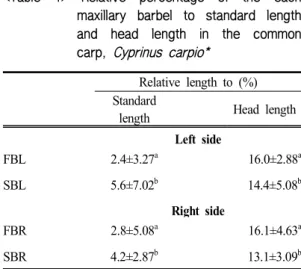
As shown in Table 1, the length of the barbel relative ratio to the standard length and head length of common carp were presented. The second maxillary barbel of the right side (SBR) and the second maxillary barbel of the left side (SBL) were longer than the first maxillary barbel of the right side (FBR) and the first maxillary barbel of the left side (FBL) in common carp (Table 1, P<0.05).
As shown in Table 2, the length of the barbel relative ratio to the standard length and head length of bagrid catfish were presented. The barbels in bagrid catfish were decreased in order of the lower maxillary barbel of both sides (LBR and LBL), outer mandibular barbel of both sides (OBR and OBL), upper maxillary barbel of both sides (UBR [Fig. 3] Direct distance for morphometric
measurements of barbels on common carp, Cyprinus carpio. A: upper side of common carp’s head region; and B: lower side of common carp’s head region. FBL: first maxillary barbel of left side; SBL: second maxillary barbel of left side; FBR: first maxillary barbel of right side; and SBR: second maxillary barbel of right side. Bars indicate 2 cm.
Relative length to (%) Standard
length Head length Left side
FBL 2.4±3.27a 16.0±2.88a
SBL 5.6±7.02b 14.4±5.08b
Right side
FBR 2.8±5.08a 16.1±4.63a
SBR 4.2±2.87b 13.1±3.09b
*Mean±SD (n=90) values are shown. Experiments are triplicate (sample's number of each experiment are 30). Means sharing the same letter superscript on given dates are not significantly different (t-test, P<0.05). FBL: first maxillary barbel of left side; SBL: second maxillary barbel of left side;
FBR: first maxillary barbel of right side; and SBR: second maxillary barbel of right side.
<Table 1> Relative percentage of the each maxillary barbel to standard length and head length in the common carp, Cyprinus carpio*
and UBL) and inner mandibular barbel of both sides (IBR and IBL, P<0.05). Values of length for the barbel relative to the standard length in the lower maxillary barbel of both sides are 23.4±5.99% and 23.1±5.87% (Table 2).
Table 3 presented the number of taste buds for the upper and middle part, shown in the lower part of each common carp barbel. Each distribution of barbels in the common carp was increasingly less than the upper to the lower part (P<0.05). Table 4 shows the number of taste buds of the upper and middle part, shown in the lower part of each bagrid catfish barbel. Each distribution of barbels in bagrid catfish was increasingly less than the upper to the lower part (P<0.05). In case of bagrid catfish, more taste buds in the mandibular barbel were distributed than those in the maxillary barbel (Tables 3 and 4, P<0.05). In accordance to Park et
al. (2005), in case of the front regarding the upper part of the barbel, more taste buds were found in the mandible of striped sea catfish than those in the maxillary, and likewise, in case of behind the upper and lower part of the barbel, more taste buds were found in the mandible than those in the maxillary. The number of taste buds in the lower part of Korean torrent catfish was fewer than those in the upper part, and the number of taste buds in the maxillary of barbel was more than those in the
Relative length to (%) Standard
length Head length Left side
UBL 10.5±4.12b 44.2±14.97b
LBL 23.1±5.87d 97.6±21.12d
OBL 14.9±5.71c 62.6±21.00c
IBL 29.7±4.05a 40.9±15.83a
Right side
UBR 10.4±4.95b 43.3±18.79b
LBR 23.4±5.99d 99.0±20.31d
OBR 15.3±5.71c 64.1±20.43c
IBR 19.6±4.40a 40.2±17.00a
*Mean±SD (n=90) values are shown. Experiments are triplicate (sample's number of each experiment are 30). Means sharing the same letter superscript on given dates are not significantly different (t-test, P<0.05). UBR:
upper maxillary barbel of right side; LBR: lower maxillary barbel of right side; OBR: outer mandibular barbel of right side; IBR: Inner mandibular barbel of right side; UBL: upper maxillary barbel of left side; LBL: lower maxillary barbel of left side; OBL: outer mandibular barbel of left side; and IBL: Inner mandibular barbel of left side.
<Table 2> Relative percentage of each barbel to standard length and head length in the bagrid catfish, Pseudobagrus fulvidraco*
Number of taste bud for each part
Upper Middle Lower
Left side
FBL 9.3±02.52c 06.3 ± 2.78b 4.4 ± 2.45a SBL 27.0±16.79c 12.0 ± 5.64b 8.2 ± 3.58a
Right side
FBR 6.7±2.24c 05.7 ± 1.37b 3.2 ± 1.31a SBR 16.3±4.04c 09.3 ± 3.09b 3.0 ± 0.98a
*Mean±SD (n=90) values are shown. Experiments are triplicate (sample's number of each experiment are 30). Number of taste bud accounted along with the unit of 0.5 mm barbel length at each parts of mandibular barbel in the carp. Means sharing the same letter superscript on given dates are not significantly different (t-test, P<0.05).
FBR: first maxillary barbel of right side; SBR:
second maxillary barbel of right side; FBL: first maxillary barbel of left side; and SBL: second maxillary barbel of left side.
<Table 3> Number of taste bud for each part in the common carp, Cyprinus carpio*
mandible of barbel (Part et al., 2006).
Considering the number of taste buds, utilization and function of barbels were not significantly different between common carp and bagrid catfish (P>0.05), and considering tactile and sense of detecting chemicals in all barbels, the upper parts of all barbels were higher than the lower parts of all barbells (P<0.05). Moreover, since many of taste buds exist on both sides of the lower maxillary barbel and both sides of the inner mandibular barbel, these barbels are thought to play an important role. Taste buds simultaneously function as chemicals acceptance and taste, some species only have one of two functions, and there are some species with even tactile and temperature sensing capabilities (Moore, 1950).
As shown in Fig. 5, the cross section of the upper barbel right UBR (Fig. 5, A), lower barbel
Number of taste bud for each part
Upper Middle Lower
Left side
UBL 06.5±3.50c 04.7±1.51b 02.2±1.05a LBL 15.1±8.21c 12.9±4.22b 10.1±3.11a OBL 19.6±11.89c 16.4±3.54b 13.1±2.81a IBL 23.8±3.83c 20.2±4.23b 15.8±3.55a
Right side
UBR 06.7±2.24c 05.5±2.24b 03.7±2.01a LBR 16.3±4.04c 12.1±3.12b 10.3±2.64a OBR 09.3±2.52c 07.2±2.52b 05.1±1.12a IBR 27.0±16.79c 14.0±4.76b 10.7±3.12a
*Mean±SD (n=90) values are shown. Experiments are triplicate (sample's number of each experiment are 30). Means sharing the same letter superscript on given dates are not significantly different (t-test, P<0.05). UBR:
upper maxillary barbel of right side; LBR: lower maxillary barbel of right side; OBR: outer mandibular barbel of right side; IBR: Inner mandibular barbel of right side; UBL: upper maxillary barbel of left side; LBL: lower maxillary barbel of left side; OBL: outer mandibular barbel of left side; and IBL: Inner mandibular barbel of left side.
<Table 4> Number of taste bud for each part in the bagrid catfish, Pseudobagrus fulvidraco*
right LBR (Fig. 5, B), outer barbel right OBR (Fig.
5, C), inner barbel right IBR (Fig. 5, D), longitudinal section of upper barbel right UBR (Fig.
5, E), lower barbel right LBR (Fig. 5, F), outer barbel right OBR (Fig. 5, G) and inner barbel right IBR (Fig. 5, H) in bagrid catfish were presented.
As shown in Fig. 6, the cross section of upper barbel left UBL (Fig. 6, A), lower barbel left LBL (Fig. 6, B), outer barbel left OBL (Fig. 6, C) and inner barbel left IBL (Fig. 6, D), longitudinal section of upper barbel right UBR (Fig. 6, E),
[Fig. 6] Histological appearance of bagrid catfish, Pseudobagrus fulvidraco. A: cross section of upper maxillary barbel of left side (UBL); B: cross section of outer mandibular barbel of left side (OBL); C:
cross section of lower maxillary barbel of left side (LBL); D: cross section of inner mandibular barbel of left side (IBL); E: longitudinal section of upper maxillary barbel of left side (UBL); F:
longitudinal section of outer mandibular barbel of left side (OBL); G: longitudinal section of lower maxillary barbel of left side (LBL); and H: longitudinal section of inner mandibular barbel of left side (IBL).
Abbreviations, ar: axial rod of cartilage;
ep: epidermis; nf: bundle of nerve fibers;
sm: smooth muscle layer; and tb: taste bud. Bars indicate 100 m. µ
[Fig. 5] Histological appearance of bagrid catfish, Pseudobagrus fulvidraco. A: cross section of upper maxillary barbel of right side (UBR); B: cross section of lower maxillary barbel of right side (LBR); C: cross section of outer mandibular barbel of right side (OBR); D: cross section of inner mandibular barbel of right side (IBR); E: longitudinal section of upper maxillary barbel of right side (UBR); F:
longitudinal section of lower maxillary barbel of right side (LBR); G: longitudinal section of outer mandibular barbel of right side (OBR); and H: longitudinal section of inner mandibular barbel of right side (IBR). Abbreviations, ar: axial rod of cartilage; ep: epidermis; nf: bundle of nerve fibers; sm: smooth muscle layer;
and tb: taste bud. Bars indicate 100 m.µ
lower barbel right LBR (Fig. 6, F), outer barbel left OBL (Fig. 6, G) and inner barbel left IBL (Fig. 6, H) in bagrid catfish were presented. The epidermis (Figs. 5 and 6, ep), axial rod of cartilage (Figs. 5 and 6, ar), smooth muscle layer (Figs. 5 and 6, sm), bundle of nerve fibers (Figs. 5 and 6, nf) and taste buds (Figs. 5 and 6, tb) were observed in the barbel of bagrid catfish. The axial rod of cartilage was cartilaginous tissue positioned in the center of the barbel, and each cartilaginous cell had nucleus formed irregularly. Cartilaginous cell included few fibers, and had blood vessel on center. The axial rod of cartilage was elongated along with length of barbel, and had axis functioning. The axial rod of cartilage was surrounded by circular smooth muscle layer formed crosswise. Taste buds were located on the exterior of the epidermis to basophilic cells, and consist of sensory cells, supporting cells and nerve cells.
Figure 7 was the cross section of first barbel left FBL (Fig. 7, A), first barbel right FBR (Fig.
7, B), second barbel left SBL (Fig. 7, C) and second barbel right SBR (Fig. 7, D), longitudinal section first barbel left FBL (Fig. 7, E), first barbel right FBR (Fig. 7, F), second barbel left SBL (Fig.
7, G) and second barbel right SBR (Fig. 7, H) by carp. The barbel of common carp was observed on the epidermis (Fig. 7, ep), bundle of nerve fibers (Fig. 7, nf), taste buds (Fig. 7, tb) and blood vessels (Fig. 7, bv). The barbel included few fibers, had blood vessels on center and taste buds were located on the exterior of the epidermis to basophilic cells by common carps.
Baecker (1926) separated barbels into two types:
(1) tender and yielding barbell had not cartilageous rod in the axis and blood vessel are interspersed in dermis, (2) motionless or flexible and stiff barbel does not move and has the axis of the bone
[Fig. 7] Histological appearance of common carp, Cyprinus carpio. A: cross section of first maxillary barbel of left side (FBL); B:
cross section of first maxillary barbel of right side (FBR); C: cross section of second maxillary barbel of left side (SBL);
D: cross section of second maxillary barbel of right side (SBR); E: longitudinal section of first maxillary barbel of left side (FBL); F: longitudinal section of first maxillary barbel of right side (FBR); G:
longitudinal section of second maxillary barbel of left side (SBL); and H:
longitudinal section of second maxillary barbel of right side (SBR). Abbreviations, bv: blood vessel; ep: epidermis; nf:
bundle of nerve fibers; and tb: taste bud.
Bars indicate 100 m.µ
composition, refractive barbel were said to have a cartilaginous axis. In addition, Sâto (1937) divided barbels into two groups: (1) barbel on skin does not have taste buds (2) the taste buds buried in skin. In case of (2), depending on the type of the central axis of the barbel: (a) without a cartilaginous rod (carp type) (b) existing cartilaginous rod (catfish, goatfish and mudfish types) and (c) rod in striated muscle (ploymixia type) were subdivided (Sâto, 1937). Taking into account the classification criteria of the above, the barbel of common carp does not have a cartilaginous rod and taste buds exist on the skin of the barbel, so it is revealed as a carp type. The barbels of bagrid catfish have a cartilaginous rod and taste buds on the skin of the barbel, so it is revealed as a catfish type. These results are consistent with Baecker (1926).
Acknowledgment
This work was funded by the Conservation and Restoration of Fish Species for Aquaculture (RP-2013-BT-004) from the Inland Aquaculture Research Center, National Fisheries Research &
Development Institute (NFRDI), Korea. The authors thank the technical staff of the Inland Aquaculture Research Center, NFRDI, Korea, and the Laboratory for Fishery Genetics and Breeding Sciences at Korea Maritime and Ocean University, Korea, for their helpful support, and the anonymous reviewers who greatly improved the quality of this manuscript. We declare that all experiments in this study complied with the current laws of Korea (Ordinance of Agriculture, Food and Fisheries, No.
1, and the Law Pertaining to Experimental Animals, No. 9932).
Reference
Agarwal, V. P. and Rajbanshi, V. K.(1965). Morphology and histology of the cutaneous sense organs of Mystus vittatus (Bl.), Proceedings of the Indian National Science Academy Part B 61, 39~48.
Bae, C. H. Park, Y. K. Kim, Y. S. Cho, K. W.
Lee, S. H. Jung, C. K. and Lee, K. S.(2012).
Correlation and sensitivity of acute toxicity of pesticides on the common carp (C. carpio) and killifish (O. latipes), Journal of the Korean Society of Pesticide Science 16, 78~83.
Baecker, R.(1926). Beitrage zür histologie der barteln der fische. Jahrb Morphol U Mikrosk Anat Abt 2vi, 489~507.
Bone, Q. Marshall, N. B. and Blaxter, J. H.
S.(1995). Biology of Fishes, Chapman & hall, London, 332.
Chun, S. K. Park, S. W. and Jung, Y. S.(1983).
Drug-resistant bacteria isolated from Nakdong river and carp-ponds, Bulletin of the Korean Fish Society 16, 17~24.
Evans, H. E.(1952). The correlation of brain pattern and feeding habits in four species of Cyprinid fishes, Journal of Comparative Neurology 97, 133~142.
Harder, W.(1975). Anatomy of Fishes, E.
Schweizerbart’sche Verlags~buchhandlung (Nagele U. Obermiller) Stuttgart, Hans Richarz, Pubikations- Service, 5205 Sankt Augustin, 612.
Hibiya, T.(1982). An Atlas of Fish Histology, Gustav Fisher Verlag, Wollgrasweg, 147.
Jin, D. H.(1998). Comparisons of amino acid sequences of -globin gene between carp and other vertebrates,β Korean Journal of Life Science 8, 249~256.
Kang, S. J. Choi, B. D. and Jeong, W. G.(1992).
Comparison of amino acid profiles and lipids of two strains of common carp, Cyprinus carpio, Journal of Aquaculture 5, 167~175.
Kapoor, B. G. and Bhargava, S. C.(1967). A study on the barbels of a marine catfish, Arius thalassinus (Rupp.), Japanese Journal of Ichthyology 14, 201~298.
Kim, I. S. and Park, J. H.(2002). Freshwater Fishes of Korea, Kyo-Hak Publ. Co., Ltd., Seoul, 252~259.
Kim, I. S. Kim, S. Y. and Park, J. Y.(2001). Histological
observation of the barbel in the spined loach, Iksookimia longicorpa (Cobitidae), Korean Journal of Ichthyology 13, 24~27.
Lee, C. Y.(1993). About Korean endemic bagridae fishes, Kor J Ichthyol 5, 133~134.
Lee, J. -S. and Kim, D. Y.(2006). The current status and future directions of Korean inland freshwater aquaculture, Journal of Fisheries Business Administration 37, 1~17.
Lim, S. G. Han, H. K. Gil, H. W. and Park, I.
S.(2012). Temperature-dependent index of mitotic interval (τ0) for chromosome manipulation in Korean bullhead, Pseudobagrus fulvidraco, Develeopment and Reproduction 16, 321~327.
Miller, R. J. and Evans, H. E.(1965). External morphology of the brain and lips in Catostomid fishes, Copeia 4, 467~487.
Moore, G. A.(1950). The cutaneous sense organs of barbeled minnows adapted to life in the muddy water of the Great Plains Region, Transactions of the American Microscopical Society 69, 69~95.
Park, I. -S. and Kim, C. H.(2005). Characteristics of histological structure of the mandibular barbels of two species of catfish (Siluridae) from Korea, Korean Journal of Ichthyology 17, 36~42.
Park, I. -S. and Lee, C. L.(1996). Cytogenetic analysis of bagrid catfish, Pseudobagrus fulvidraco (Teleostomi:
Siluriformes), Korean Journal of Ichthyology 8, 10~15.
Park, I. -S. Im, J. H. and Hur, J. W.(2004a).
Morphometric characteristics of catfish (Siluridae) in Korea, Korean Journal of Ichthyology 16, 223~228.
Park, I. -S. Kim, J. H. Cho, S. H. and Kim, D.
S.(2004b). Sex differentiation and hormonal sex reversal in the bagrid catfish Pseudobagrus fulvidraco (Richardson), Aquaculture 232, 183~193.
Park, I .-S. Oh, H. S. and Koo, J. G.(2003). Effect of oral tamoxifen on growth and survival in the bagrid catfish Pseudobagrus fulvidraco, Aquaculture Research 34, 1471~1474.
Park, I. -S. Seol, D. W. Im, S. Y. Kim, C. H. Kang, E. J. and Gong, Y. G.(2006). Histological structure of the barbels of Liobagrus andersoni and L.
obesus (Amblycipitidae: Pices) from Korea, Journal of Korean Fisheries Society 39, 338~343.
Park, I.- S. Seol, D. W. Kim, E. M. Kim, Y. J.
and Lee, Y. D.(2005). Histology of the barbels of striped sea catfish, Plotosus lineatus (Thünberg), Journal of Korean Fisheries Society 38, 158~163.
Pfeiffer, W.(1963). Alarm substances, Experientia 19, 113~123.
Sâto, M.(1937). On the barbels of a Japanese sea catfish, Plotosus anguillaris, Science Reports of the Tohoku Imperial University Biology 11, 323~332.
Sâto, M.(1941). A comparative observation of the hind-brain of fish possessing barbels, with special reference to their feeding habits, Science Reports of the Tohoku Imperial University Biology, 16, 157~164.
Shin, Y. C. Kim, Y. G. and Park, S. W.(2000).
Classification and ultrastructural observation of leucocytes in Korean bullhead fish (Pseudobagrus fulvidraco), Fisheries Science Research 16, 13~24.
Singh, C. P. and Kapoor, B. G.(1967). Histological observations on the barbels of a bagrid catfish, Rita rita (Ham.), Japanese Journal of Ichthyology 14, 197~202.
논문접수일 : 2014년 01월 29일 심사완료일 : 1차 - 2014년 03월 02일 게재확정일 : 2014년 03월 07일