1. 서 론
1.1 연구의 배경 및 목적
2020년경 ITU-R (International Telecommunica- tion Union Radio communication Sector)은 서비스 상용화를 목표로 환경 제약이 없으며 사람 간 또는 다수의 사물 간 모든 사용자들에게 저지연인 Gbps급 의 이동 통신 서비스를 제공하는 목적으로 5G를 IMT-2020이라 명명하였다[1]. 이러한 디지털 네트 워크 시대의 환경 속에서 우리의 시지각 공간은 우리 의 보는 방법까지도 변화시키고 있다.
지금의 4차 산업혁명 시대는 인공지능, 빅데이터, 로봇 등에 관한 핵심 기술에 의해 데이터 분석이 필 수적인 분석 기술로써 데이터 마이닝(Data Mining) 에 대한 수요가 더욱 증가할 것으로 보인다. 따라서 국가 경쟁력 확보를 위한 데이터 마이닝 분야의 전문
인재 양성에 대한 필요성이 지속적으로 제기되고 있 다[2]. 이러한 시대적 특성을 고려할 때 알고리즘의 원리나 동작 과정을 가시화하는 알고리즘 시각화 자 료(Algorithm Visualization)를 도입한다면 학습 효 율을 제고할 수 있다[3]. 하지만 기술적 변화속도에 따른 다양한 공학연구에 비해 융합적 차원의 예술적 관점에서 본 미디어 변화에 대한 연구나 해석은 전무 한 상태이다. 융합기술에 있어서 인간의 삶과 시지각 적 감각에 관한 연관관계는 AI기술의 발전과 더불어 중요한 연구부분으로 판단된다. 또한 사회변화의 가 속화 속에서 기술은 예술을 통해 인간의 삶속에서 자연스럽게 동화될 수 있고 그러한 변화는 우리 삶의 방향과 사회적 프레임을 제시해 주기도 한다.
21세기 영상 미디어의 특징들을 살펴보면 우선 LED나 프로젝트 등의 물리적인 관점과 VR(virtual reality), AR(Augmented Reality), MR(Mixed Real-
5G기반 VR/AR/MR/Hologram의 공간에서 나타나는 21세기형 시각 알고리즘 구축
임 상 국†
Construction of 21st Century Visual Algorithm in 5G-based VR/AR/MR/Hologram
Sang Guk Lim†
ABSTRACT
4th industrial age! 5G-based video content has changed rapidly. How do you view and understand VR/AR/MR/holograms in the age of convergent technology media represented by digital convergence in the 21st century beyond the modern visual system of Descartes? It predicts extension to an interactive visual system. This study proposes a methodology to visualize the Lacanian visual acuity after applying it to the L-System and to understand the visual system of the 21st century.
Key words: VR/AR/MR/Hologram, Visuality, Algorithm, Digital Convergence, L-System
※ Corresponding Author : Sang Guk Lim, Address:
Korea Busan Sooyeong-goo Sooyeong-ro776 The Sharp Centum Fore Apartment 103dong 1001ho, TEL: +82-51- 540-7360, FAX : +82-51-540-7193, E-mail: gooki7680@
naver.com.
Receipt date : Aug. 5, 2019, Revision date : Sep. 10, 2019 Approval date : Sep. 18, 2019
†
School of Culture Contents, Major in Virtual Reality Contents, Youngsan University
※ This work was supported by Youngsan University
Research Fund of 2018.
ity), 홀로그램(hologram) 등의 융합적 관점 그리고 인간과 기계의 관계로서 본 피지컬 컴퓨팅을 통한 인터액션적 관점으로 분류 할 수 있다[4]. 본 연구자 는 근대적 시각체계를 바탕으로 한 라깡의 시선도해 를 통해 VR/AR/MR/홀로그램의 시각체계를 분석하 였다. 하지만 시각도판만으로는 시각체계의 원리나 변화과정을 이해하기가 어려운 부분이 있다. 따라서 시각도판을 통해 분석된 패턴을 알고리즘 기반의 문 자 시각화를 통해 기능적이면서 동시에 예술적 이미 지로 시각화하는 방법을 제안하고 실험적 연구 결과 를 보고하고자 한다. 또한 그 결과로써 5G시대 데이 터 마이닝 분야의 예술전문 인재 양성 및 알고리즘 시각화 자료(Algorithm Visualization)를 통한 문화 학습 효율을 제고할 수 있다. 끝으로 과거 절대적 진 리로써 군림해 온 데카르트의 원근법주의에 대해 17 세기∼20세기를 거쳐 오던 다양한 시각성 변화의 비 판적 움직임들을 이어갈 21세기의 명확한 판단적 근
거를 마련하고 그 역사성을 이어갈 수 있는 계기를 마련하고자 한다.
2. 이론적 고찰
2.1 근대적 시각체계의 디지털 시각화 사례
‘본다는 것‘은 그 대상을 전제로 볼 때 보이는 것과 보이지 않는 것으로 구분 될 수 있는데 그러한 관점 에서 응시는 회화 및 시각성에 대한 오늘날의 논의에 서 중요한 용어이다[5]. 응시에 관한 논의를 살펴보 면 사르트르의 <존재와 무(Being and Nothing)>, 라 깡의 <정신 분석의 네가지 기본 개념들>의 내용에 이르기까지 주체시각의 관점에 기반을 두고 이론화 됨을 알 수 있다[6]. 이에 반해, 20세기 니시다로 부터 니시타니에 이르러서는 그 변화의 위치를 “공허함 (blankness)”이나 “공(emptiness) 혹은 무(nihility)”
로 번역되는 순야타(sunyata)라는 용어로 표현된다.
Table 1. Lacan's notion of the Real gaze
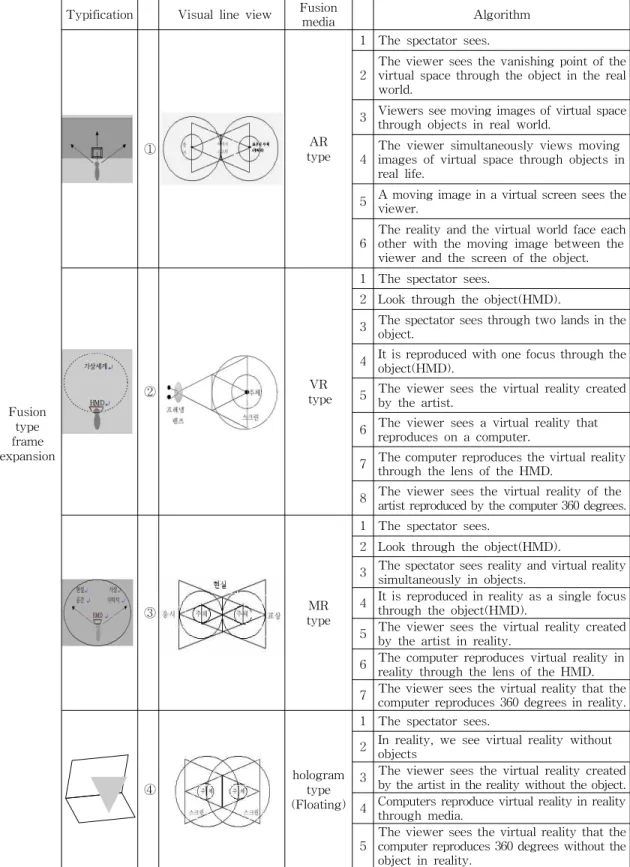
Table 2. Visualization of types of convergent media expansion
Convergent visuality expansion
① AR type
② VR type
③ MR type
④ Hologram type
(Floating method)
또한 주체의 시각 경험에 관한 라깡의 ‘위협’이란 측 면에서도 ‘주체는 어디에 남아있게 되는가’ 하는 개 념적 변형이 요구된다[7].
이러한 주체적 시각성에 대한 반론들 속에서 근대 적 방식의 시각화 사례들을 살펴보면 다음과 같다. 첫 번쨰, 원근법적 시각성을 통한 사례이다[6]. 그러 나 원근법적 시각체계로서 논의된 것은 알베르티의
<회화론>에서 체계화되었다. 이러한 원근법의 환영 주의(Illusionism)는 현전성을 중심으로 한 재현의 역사로 볼 수 있다[8]. 두 번째, 카메라 옵스큐라이다.
유클리드와 아리스토텔레스, 로저 베이컨과 레오나 르도 다빈치 등 다양한 사상가들이 시대의 변화에 따라 이것을 언급했다.
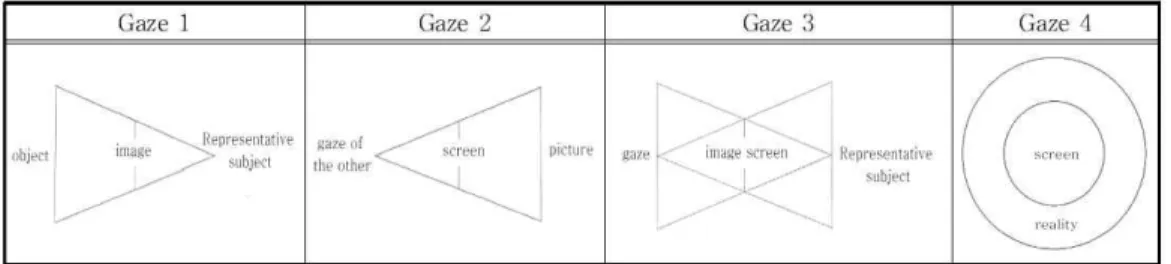
세 번쨰, “응시”에 관한 논의이다. 응시는 라깡에 의해 제시되는 관점으로써 라캉의 설명은, 다른 보는 자, 즉 인격화된 다른 존재의 침입이 아니라 시각 장 에서의 기표의 침입에 의존한다는 것이다. 그러한 관 점에서 라깡은 스크린을 던져진 그림자로 암점 (scotoma), 얼룩이라고 부른다. 네 번째, 파노라마적 시각은 프레스코 벽화, 스크린 영상작업 등 가상공간 속 체험식 시각체계이다. 이러한 파노라마의 특징을 볼프 강 켐프 (Wolfgang Kemp)는 "현존의 공간(A Space OF Presence)”이라고 표현했다[9]. 연구자는 이러한 4가지 근대적 시각성 사례의 특징을 라깡의 시선도해를 통해 21세기의 디지털 시각성으로 Table 1과 같이 시각화 하였다.
Table 1을 토대로 디지털 예술에서 나타나는 시각 적 특징들을 라깡의 시선도해를 바탕으로 살펴보면 [10] 첫째 led 모니터, 빔 프로젝트에 의한 물리적 유 형, 둘째 인간과 가상 매체(AR/VR/MR/홀로그램)기 기의 관계를 통한 4가지의 융합적 유형, 셋째 매체와 인간의 상호작용을 통한 인터액션적 유형이다. 그중 에서 인간과 가상 매체(AR/VR/MR/홀로그램)기기 의 관계를 통한 4가지의 융합적 유형을 통해 시선도 해화 하면 다음 Table 2와 같다.
2.2 알고리즘화 사례연구
Ramsay는 텍스트를 비평적으로 유용한 방향으로 변형(deformance)하는데 컴퓨터 테크놀로지가 유용 할 수 있다고 주장한다. 그는 이러한 과정을 Algor- ithmic Criticism이라 부른다[10]. 정보전달에 있어 서 컴퓨터를 사용하여 텍스트를 새로운 관점에서 바
라보게 하는 주된 방법은 시각화(visualization)라고 할 수 있다. 현재 거의 대부분의 정보전달에 있어서 텍스트 시각화에서 쓰이고 있는 시각적 도구로는 인 포그래픽스(infographics)을 들 수 있다. 그 안에 많 이 쓰이고 있는 chart나 bar graph 그리고 word map 등을 통해 텍스트를 시각화한다고 볼 수 있다. 반면 L- System은 1968년에 Aristid Lindenmayer 라는 사람에 의해 개발된 문자열 재작성 시스템으로 1984 년에 Alvy Ray Smith에 의해 컴퓨터 그래픽에 도입 되었다. 그 후 주로 식물의 성장 등을 절차적으로 (procedural) 모델링하는 데 유용하게 쓰이고 있다 [11]. 관련 국내 연구로 (김주섭, 2013)은 텍스트 중 시 라는 문학 장르에 국한하여 알고리즘 기반 모델링 (procedural modeling)을 사용하여 각각의 시를 그 고유의 특성을 반영하는 자연의 유기적인 나무 형태 로 디지털 공간에서 재창조해 내는 방법을 제안하였 다. 또한 박진완의 ’Visual Genealogy’는 한국의 족보 를 시각화하여 나타냄으로써 기능성이나 심미성 보 다는 그 안에서 새로운 이야기를 창출해내는 용도로 시각화되었다[12]. 특히 (김주섭, 2013)에 따르면 L-System은 심볼들과 심볼들을 대체하는 규칙으로 이루어져 있다고 설명한다[13].
Fig. 1. Example of branch generation using L-System
(김주섭, 2013)은 이러한 L-System에서의 문자열 은 알고리즘적으로 Fig. 1을 그리는 일련의 명령들로 서 작용하게 된다. 즉 “ F -> F [+F] F ” 로 현재 규칙의 문자열에서 모든 ‘F‘ 심볼을 “F [ +F ] F”로 대체한다. 위와같은 규칙을 두 번 적용하여 다음의 문자열로 확장하게 된다.
“F -> F [+F] F -> F [+F] F [+F [+F] F] F [+F] F”
다음으로 각 심볼들에 기하학적 의미를 부여하면, F : 현재 위치에서 오른쪽으로 ‘_’ 그리기 + : 45도 시계 반대방향으로 방향을 바꾸기 [ : 현재 위치 저장하기
] : 마지막에 저장된 위치로 돌아가기로 정의할 수 있다는 것이다.
이처럼 텍스트의 시각화나 문자열 재작성 시스템
을 통한 이미지의 해석방식 등이 활용되고 있다. 그 중 이미지를 텍스트화 하는 과정을 통해 시각성 도판 을 텍스트로 알고리즘화 해 보고자 한다.
3. L-System을 이용한 알고리즘화
3.1 근대적 시각체계을 통해서 본 알고리즘화 근대적 시각체계를 라깡의 시선도해를 통해 4가
지 유형으로 분류하였다. 그 시각체계를 과정별로 세 분화하고 정보전달의 명확한 이해를 돕기 위한 문자 열 재작성 시스템을 적용한다. 즉 알고리즘 기반 모 델링(procedural modeling)을 사용하여 시선도해를 문자화 하고자 한다. 그 결과로써 원근법적 시각체 계, 옵스큘라적 시각체계, 응시에 관한 시각체계, 파 노라마에 관한 시각체계를 L-System을 이용해 알고 리즘화 하면 Table 3과 같다.
Table 3. An algorithm of modern visual system using L-System
1 The spectator sees the picture. 1 The spectator sees.
2 Objects (frame frames) I see through. 2 The spectator can take a hole (monocular) I see through.
3 Look at the image (picture). 3 Screen (frame frame) see.
4 I see the vanishing point of the artist's drawing. 4 Reproduced image (picture)see.
1 The spectator sees.
1 The spectator sees.
2 The viewer sees a vanishing point through an object (frame frame).
2 The spectator turns around see.
3 The spectator sees an image (picture) on the screen.
3 The spectator is in a 360 degree space
Look at the frame.
4 The in-screen image (picture) I see the spectators.
5
With the screen in between Image of spectator and artist (Figure) faces.
4 Image of artist in frame (See figure).
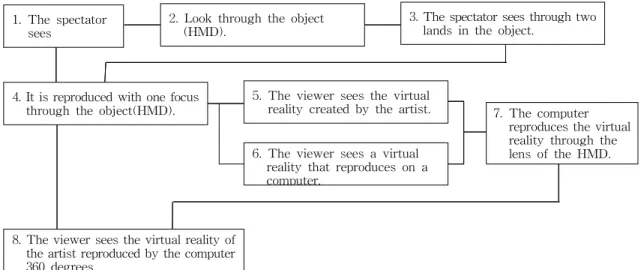
1. The spectator
sees 2. Look through the object
(HMD). 3. The spectator sees through two
lands in the object.
4. It is reproduced with one focus
through the object(HMD). 5. The viewer sees the virtual reality created by the artist.
6. The viewer sees a virtual reality that reproduces on a computer.
7. The computer reproduces the virtual reality through the lens of the HMD.
8. The viewer sees the virtual reality of the artist reproduced by the computer 360 degrees.
Table 4. VR visual system algorithm using L-System
Table 5. Fusion type using L-System Algorithmization of visual system
Fusion frame type expansion
Typification Visual line view Fusion
media Algorithm
① AR
type
1 The spectator sees.
2 The viewer sees the vanishing point of the virtual space through the object in the real world.
3 Viewers see moving images of virtual space through objects in real world.
4 The viewer simultaneously views moving images of virtual space through objects in real life.
5 A moving image in a virtual screen sees the viewer.
6 The reality and the virtual world face each other with the moving image between the viewer and the screen of the object.
② VR
type
1 The spectator sees.
2 Look through the object(HMD).
3 The spectator sees through two lands in the object.
4 It is reproduced with one focus through the object(HMD).
5 The viewer sees the virtual reality created by the artist.
6 The viewer sees a virtual reality that reproduces on a computer.
7 The computer reproduces the virtual reality through the lens of the HMD.
8 The viewer sees the virtual reality of the artist reproduced by the computer 360 degrees.
③ MR
type
1 The spectator sees.
2 Look through the object(HMD).
3 The spectator sees reality and virtual reality simultaneously in objects.
4 It is reproduced in reality as a single focus through the object(HMD).
5 The viewer sees the virtual reality created by the artist in reality.
6 The computer reproduces virtual reality in reality through the lens of the HMD.
7 The viewer sees the virtual reality that the computer reproduces 360 degrees in reality.
④ hologram
(Floating) type
1 The spectator sees.
2 In reality, we see virtual reality without objects 3 The viewer sees the virtual reality created by the artist in the reality without the object.
4 Computers reproduce virtual reality in reality through media.
5 The viewer sees the virtual reality that the
computer reproduces 360 degrees without the
object in reality.
위 4가지 결과를 살펴보면 근대적 시각체계에서 Gaze1.의 경우 시선의 주체는 관람자가 바라보고 있 지만 작가가 주체자로써 재현하는 원근법적 소실점 을 바라보고 있다. Gaze2.의 경우는 하나의 구멍을 통해 투과되는 빛에 의해 스크린에 재현되는 이미지 를 관람자는 객관적인 관점에서 바라보고 있다. Gaze3.의 경우는 관람자의 시선과 마주보는 이미지 의 관찰자적 시선이 스크린을 사이에 두고 서로를 마주보는 관계로써 설명되고 있다. 관람자는 원근법 적 시선인 소실점을 보려 하지만 그 앞을 가로막는 이미지(관찰자)의 등장으로 관람자와 이미지(관찰 자)는 서로 마주하게 된다. 끝으로 Gaze4.의 경우는 관람자가 360도 공간 안에서 스스로 공간을 둘러보 면서 작가가 보여주는 원근법적 공간을 보고 있다. 위 알고리즘 분석사례를 통해서 알 수 있듯이 근대적 관점에서 우리의 시각체계는 시각 주체의 관점에서 볼 때 원근법에 따라 시각주체가 고정되어 있고 관람 자는 주체적 관점이 아님을 알 수 있다.
3.2 디지털 시각체계을 통해서 본 알고리즘화 디지털시대 미디어의 기술적 변화는 다양한 보는 방식을 제안하고 있다. 디지털 시각체계의 가장 큰 특징으로는 움직이는 이미지의 등장이라고 볼 수 있 다. 근대적 시각체계에서는 고정적이었던 이미지가 영상시대 움직이는 이미지의 등장으로 우리의 시각 성과 시각 주체에 다양한 변화를 가져왔다. 앞서 제 시된 사례를 바탕으로 21세기 디지털 시각체계를 유 형화한 후 융합형 미디어 방식에서의 시각체계를 4 가지 사례들로 세분화하고 그 결과를 알고리즘화 하 고자 한다. 라깡의 시선도해를 통해 AR형, VR형, MR형, 홀로그램형으로 분류한 사례들 중 VR형을 시각적으로 유형화 하면 Fig. 2와 같은 원리로 재현 할 수 있다.
H M D
Virtual world
Fig. 2. VR reproduction principle and typification
Fig. 2는 21세기 시각체계의 사례 중 VR형을 라깡 의 시선도해를 통해 유형화한 사례이다. 근대적 시각 체계에서는 작가의 정지된 그림 속 소실점을 관람자가 바라보는 형태였다면 21세기의 미디어에서 나타 나는 시각체계에는 작가의 작품 속 소실점이 아닌 움직이는 이미지[14]를 관람자는 바라보게 된다. 또 한 그 움직임은 컴퓨터라는 미디어가 관계하여 움직 이는 이미지를 재현하는 이중적 시각체계를 형성한 다는 것을 알 수 있었다. 그 시각재현 원리를 문자열 재작성 시스템인 L-System을 통해 알고리즘화 하면 다음 Table 4와 같다.
4. 결 론
앞서 밝혀진 VR시각체계의 알고리즘화 결과를 살펴보면 근대적 시각체계에서의 문자시각화 과정 과는 차이점이 발견된다. 그것은 관람자와 작가의 작 품 관계에서 단일시각체계였던 근대적 시각체계 방 식에서 디지털 시대 컴퓨터라는 미디어의 개입으로 이중적 시각체계가 나타난다는 것이다. 따라서 앞서 VR시각체계의 알고리즘화 결과를 바탕으로 융합형 미디어 방식의 AR형, VR형, MR형, 홀로그램형을 L-System을 이용해 문자 시각화로 알고리즘화 하면 Table 5와 같다.
결과적으로 융합형 영상 미디어의 AR형, VR형, MR형, 홀로그램형의 융합형 영상 미디어의 변화를 L-System을 이용해 문자 시각화로 알고리즘화 해보 면 21세기 시각성의 변화 과정은 다음과 같은 결과로 이해할 수 있다. 1. 21세기 시각성 변화에서 근대적 관점의 소실점에서 움직이는 이미지로 시선주체가 변화되었다. 2. 시선주체는 단일구조였던 근대적 관 점에서 디지털 시대로 오면서 이중구조화 되었다. 3.
21세기 시각체계의 변화를 라깡의 시선도해 방식을 토대로 L-System을 이용해 문자 시각화로 알고리즘 화하는 과정은 예술적 관점을 공학적 체계를 통해 명확히 밝히는 계기와 새로운 방법론을 제안하게 되 었다. 또한 피지컬 컴퓨팅을 통한 터치스크린 기반의 비물질적 오브제나 Haptic을 통한 촉각적 VR재현등 에 이 방법론을 통해 향후 21세기 시각체계의 주축이 될 인터액션적인 관점의 시각체계에 대한 연구가 필 요함을 밝히고자 한다[15].
REFERENCE
[ 1 ] J.Y. Lee, M.D. Kim, and H.G. Jung, “Millimeter Wave and 5G Mobile Communication –Intro-
duction of Millimeter Wave Propagation Characteristics for Mobile Communication Access Networks,” KICS Information &
Communication Magazine -Open Lecture Series, Vol. 34, No. 1, pp. 51-58, 2017.
[ 2 ] Future Talent Comes from Data Science(2018).
http://www.comworld.co.kr/news/article- View.html?idxno=49399 (accessed September 24, 2019).
[ 3 ] M.S. Kim, W.S. Choi, and S.Y. Joung, “Des- ign and Implementation of Cluster Analysis Learning System based on Algorithm Visual- ization,”Proceedings of the Korean Informa- tion Science Society, pp. 933-935, 2018.
[ 4 ] S.G. Lim and C.Y. Kim, “A Study on the Change of Digital Visuality in the 21st Century through Lacanian Perspective ; From the Perspective of Digital Frame Expansion,”
Journal of Korea Multimedia Society, Vol. 21, No. 5. pp. 638-647, 2018.
[ 5 ] H. Foster, Y.H. Choi Translation,Visual and Visuality, Kyungsung University Press, Busan, 2012.
[ 6 ] M. Jay, “Modern Visual Systems,”Visual and Visuality, Kyungsung University Press, Busan, 2012.
[ 7 ] B. Norman, “Take a Look at the Expanded Chapter,” Visual and Visuality, Kyungsung University Press, Busan, 2012.
[ 8 ] E.H. Gombrich, M.L. Art & Illusion, Yeolh WaDang, Seoul, 2004.
[ 9 ] G. Olive, Virtual Art: From Illusion to Immersion, MIT Press, London, 2003.
[10] S. Ramsay, Reading Machines: Toward an Algorithmic Criticism, University of Illinois Press, Chicago, Illinois, 2011.
[11] D. S. Ebert, F. K. Musgrave, D. Peachey, K.
Perlin, and S. Worley, Texturing & Model- ing: A Procedural Approach, Morgan Kauf- mann Publisher, San Francisco, Calif., 2013.
[12] H.Y. Kim and J.H. Park, “A Study on Expression Material and Approach of Text
Data Visualization,” The Korea Contents Association Journal, Vol. 13, No. 1, pp. 64-72, 2013.
[13] J.S. Kim, “de Fremery, Wayne A Study on Visualization Method Using Algorithm- based Modeling,” Digital Design Studies, Vol. 13, No. 4, pp. 61-70, 2013.
[14] S.G. Lim and C.Y. Kim, “A Study on the Movement Production Method of Media-art with Immaterial Objects; Focusing on Media Art Practices,”J ournal of Korea Multimedia Society, Vol. 19, No. 3, pp. 673-679, 2016.
[15] S.G. Lim and C.Y. Kim, “A Research on Conceptual Expandability and the Guidelines on Video Analysis of Moving Images from the Perspectives of Objects,” J ournal of Korea Multimedia Society, Vol. 19, No. 9, pp. 1738- 1746, 2016.
임 상 국