Korean J. Environ. Biol. 33(2) : 153~159(2015) http://dx.doi.org/10.11626/KJEB.2015.33.2.153
INTRODUCTION
Freshwater oligochaetes live in a broad range of aquatic environments worldwide and include about 1,100 species of 13 families (Martin et al. 2008). The family Naididae is a large group of freshwater oligochaete (Milbrink 1987;
Chapman 2001; Smutná et al. 2008). Of these the subfamily Naidinae appears in a wide range of habitats, ranging from rivers, pools, and estuaries (Timm and Martin 2015). These worms are generally smaller than other aquatic oligochaete families and they have a very soft body, pale body color and unique chaetae from other oligochaetes. Naidinae comprises 238 freshwater species (Martin et al. 2008) of which about 26 species belong to the genus Nais. Thirty-two species of Naididae have been reported from Korea with only 3 species from the genus Nais: N. communis, N. variabilis, N. pardalis
(Jung 2011; Jung 2012; Park et al. 2013a, b; Lee and Jung 2014a, b). Key characteristics for identification of Nais spe- cies are the chaetae shape and number per bundle (Envall et
al. 2012). Most species of Nais have ventral bundles with bifid and sigmoid crotchets. Some species have giant chae- tae in the ventral bundles of some segments. The dorsal chaetae begin in segment VI and include long, thin hair chaetae, as well as short, bifid or sin gle pointed needle chae- tae (Brinkhurst and Jamieson 1971). In this study, we newly found 6 Nais species living in Korea.
MATERIALS AND METHODS
We collected Nais specimens from fine sand and muddy sediment with high organic material at the waterside of 4 locations in Korea (Jungrang-gu; Namyangju; Paju; Yang- yang) using a plankton hand net or hand shovel from April 2013 to September 2014. Samples have been brought to the laboratory while they were alive. Then, they were sorted under the stereomicroscope (Motic, SMZ-168, Hong Kong).
For detailed observation, specimens were fixed in 5% form- aldehyde or 80% ethanol solution and mounted in Canada balsam according to the protocol described by Erséus in 1994. BX41 research microscope (Olympus, Tokyo, Japan)
* Corresponding author: Jongwoo Jung, Tel. 02-3277-2616, Fax. 02-6937-0733, E-mail. [email protected]
ⓒ2015. Korean Society of Environmental Biology.
Six Korean New Records of the Nais Species
(Annelida, Clitellata, Naididae)
Jeounghee Lee
1and Jongwoo Jung
1,2,*
1
The Division of EcoCreative, Ewha Womans University, Seoul 120-750, Korea
2
Department of Science Education, Ewha Womans University, Seoul 120-750, Korea
Abstract - The oligochaete worms in the genus Nais are common to freshwater habitats. These worms have a highly-developed prostomium and pigmented eye spots. All species have hair chaetae, bifid or single pointed needle chaetae on the dorsal side and ventral chaetae beginning in II with bifid crotchets. Most species of Nais genus live in areas where bottom is covered by sand, gravel or organic matter in aquatic plants. Currently, 26 species of Nais have been recorded worldwide.
From the recent faunal studies, 3 species of Nais have been newly reported in Korea. Here, we newly report 6 species of Nais with diagnosis, illustrations and identification keys to Korean Nais species: N. behningi, N. pseudobtusa, N. simplex, N. bretscheri, N. stolci and N. elinguis.
Key words: Nais, Naididae, oligochaeta, Clitellata, Annelida, Korea
RESULTS AND DISCUSSION Phylum Annelida Linnaeus, 1758
환형동물문Class Clitellata Linnaeus, 1740
환대강Order Haplotaxida Grube, 1850
지렁이목Family Naididae Ehrenberg, 1828
물지렁이과Subfamily Naidinae Ehrenberg, 1828
물지렁이아과Genus Nais Muller, 1773
물지렁이속1.
Nais behningi Michaelsen, 1923
큰낫물지렁이(
신칭) (Fig. 1A, B)
Synonyms: Nais behningi Michaelsen, 1923: 34.
Material examined: Korea: 1, Toegyewon-myeon, Nam- yangju-si, Gyeonggi-do, 37˚38′33.01″N, 127˚9′1.65″E, 22 Sep 2013, collected by Lee JH.
Diagnosis: Length 0.18 mm, width at V 0.14 mm, number of segments 22.
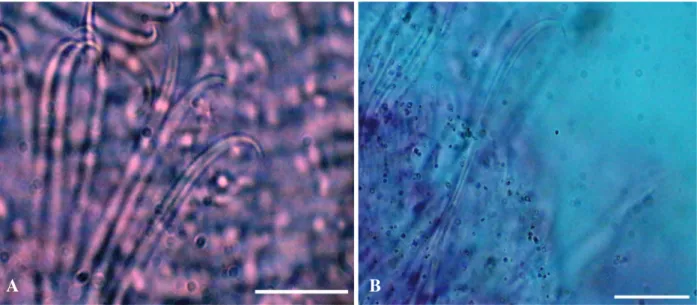
Eyes present. Dorsal chaetae with hair and needle chaetae 1~2 per bundle, needles thin and hair-like distally. Ventral chaetae of II-V, 5~10 per bundle, with long, strong curved
am. Bottom of this site consists of sandy and gravel bottom with some water plants.
World distribution: Holarctic.
Deposition: NIBR No. KOSPIV0000193710.
Identifiers: Jeounghee Lee, Jongwoo Jung.
2.
Nais pseudobtusa Piguet, 1906
머리털물지렁이(
신칭) (Fig. 2A-D)
Synonyms: Nais obtuse (Gervais) var. pseudobtusa Piguet.
Piguet, 1906: 238.
Nais pseudobtusa Piguet. Piguet, 1909: 193.
Material examined: Korea: 1, Geumchon-dong, Paju-si, Gyeonggi-do, 37˚45′59.37″N, 126˚46′27.01″E, 27 Aug 2013, collected by Lee JH.
Diagnosis: Length 0.28 mm, width at V 0.03 mm, number of segments 37.
Eyes present. Dorsal bundles with 1~3 straight, long hairs and long needle chaetae bearing distinct nodulus (Fig. 2A).
Ventral chaetae by 2~5, upper tooth thinner than lower tooth and up to 1.5 times as long as lower (Fig. 2B, D); sli-
A B
Fig. 1. Nais behningi. A, Ventral chaetae bundle of XIX; B, Ventral chaetae of VI. Scale bars: A, B=3μm.
ghtly thicker from VI (Fig. 2C).
Remarks: N. pseudobtusa is hard to distinguish from Nais simplex, N. barbata, N. alpine (Van Haaren T and J Soors, 2012). All worms have simple point needle tips. Dorsal needles in N. pseudobtusa are thinner, sharper tipped, and normally hair-like, as compared to other species.
Habitat: This species from the roots of waterweeds at the edge of streams covered with sand or organic matter.
World distribution: Common, Asia, Africa, America, Eu- rope, Africa, Afghanistan.
Deposition: NIBR No. KOSPIV0000193709.
Identifiers: Jeounghee Lee, Jongwoo Jung.
3.
Nais simplex Piguet, 1906
둥근털물지렁이(
신칭)
(Fig. 3A-C)
Synonyms: Nais variabilis var. simplex Piguet, 1906: 260.
Nais simplex Piguet. Piguet, 1909: 202.
Material examined: Korea: 1, Myeonmok-dong, Jungrang-
gu, Seoul, 37˚34′52.87″N, 127˚4′41.74″E, 22 Sep 2013, col- lected by Lee JH.
Diagnosis: Length 0.28 mm, and width at V 0.067 mm, num- ber of segments 29.
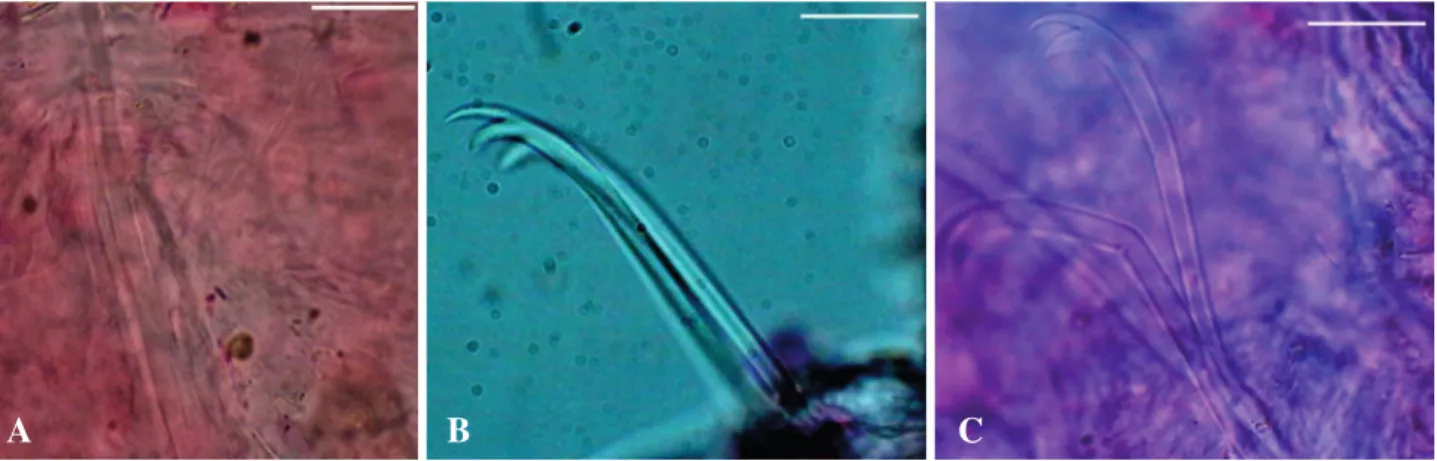
Dorsal hair chaetae and needles 1~2 per bundle, needles simple pointed (Fig. 3A). Ventral chaetae of II-V, 2~6 per bundle, longer, straighter and thinner, with nodulus proximal and upper tooth nearly twice the length of the lower one (Fig.
3B, C). Dorsal vessel to the left of the middle line. Swims with spiral movements.
Remarks: Nais simplex is very difficult to distinguish from N. pseudobtusa, N. barbata, N. alpina (Van Haaren and Soors 2012). N. simplex have round end tips, as compared with N. pseudobtusa.
Habitat: Bottom of collected site is sludge such as soft mud and organic matter.
World distribution: Europe, Asia, North America, South America.
Deposition: NIBR No. KOSPIV0000206591.
A B C D
Fig. 2. Nais pseudobtusa. A, Needle chaetae of VII; B, ventral chaetae of IV; C, Ventral chaetae VI; D, Ventral chaetae of XIX. Scale bars:
A-D=1μm.
Fig. 3. Nais simplex. A, Needle chaetae X; B, Ventral chaetae VII; C, Ventral chaetae XXIII. Scale bars: A-C=3μm.
A B C
Material examined: Korea: 1, Beopsuchi-ri, Hyeonbuk- myeon, Yangyang-gun, Gangwon-do, 37˚53′57.89″N, 128˚
36′51.57″E, 9 Sep 2014, collected by Lee JH.
Diagnosis: Length 0.14 mm, width at V 0.019 mm, number of segments 14.
Eyes present. Dorsal chaetae and needles 1~2 per bun- dle; hair chaetae single, short, 1~2 needle, with quite long parallel teeth (Fig. 4A, D). Ventral chaetae of II-V, 4~6 per bundle, thin and straight, with upper tooth about double the length of lower; those of the following segments 1~6 per bundle (Fig. 4C). Giant chaetae beginning from VII, 2 per bundle, thick, straight, and very short (Fig. 4B).
shallow water. The streambed consists of various types of sand with some organic matter.
World distribution: Cosmopolitan.
Deposition: NIBR No. KOSPIV0000216560.
Identifiers: Jeounghee Lee, Jongwoo Jung.
5.
Nais stolci Hrabe, 1981
작은손물지렁이(
신칭)
(Fig. 5A-C)
Synonyms: Nais stolci Hrabe, 1981: 33.
Material examined: Korea: 1, Beopsuchi-ri, Hyeonbuk- myeon, Yangyang-gun, Gangwon-do, 37˚53′57.89″N, 128˚
Fig. 4. Nais bretscheri. A, Body form; B, Giant chaetae VII; C, Ventral chaeta; D, Dorsal chaetae. Scale bars: A=2μm, B-D=5μm.
A B C D
Fig. 5. Nais stolci. A, Ventral chaetae III; B, Ventral chaetae VII, VIII; C, Dorsal needle III. Scale bars: A-C=10μm.
A B C
36′51.57″E, 9 Sep 2014, collected by Lee JH.
Diagnosis: Length 0.162 mm, width at V 0.043 mm, num- ber of segments 24.
In II-V ventral chaetae by 3~5 with upper tooth twice as long. From VI on, 3~4 enlarged chaetae per bundle, upper tooth up to 4 times longer (Fig. 5A, B). Dorsal chaetae be- ginning in VI, including 1 hair, 1~2 needle with long par- allel teeth (Fig. 5C).
Remarks: Specimens of posterior ventral chaetae shape looked similar to N. pardalis or N. bretsheri. They have gi- ant chaetae. N. bretsheri have giant chaetae from VII, while N. pardalis and N. stolci beginning from VI. Hair chaetae of N. stolci are longer than N. pardalis. So, these chaetae shapes correspond with those of N. stolci. This is the first report on this species from Asia.
Habitat: This site is up the river which is clear, cool and shallow water. The streambed consists of various types of sand with some organic matter.
World distribution: Europe.
Deposition: NIBR No. KOSPIV0000216600.
Identifiers: Jeounghee Lee, Jongwoo Jung.
6. Nais pardalis Piguet, 1906
시골물지렁이Synonyms: Nais pardalis Piguet, 1906: 253.
Nais pardalis Park et al., 2013a: 511.
7.
Nais elinguis Müller, 1773
하천물지렁이(
신칭)
(Fig. 6A-C)
Synonyms: Nais elinguis Müller, 1773: 22.
Material examined: Korea: 1, Toegyewon-myeon, Nam- yangju-si, Gyeonggi-do, 37˚38′33.01″N, 127˚9′1.65″E, 22 Sep 2013, collected by Lee JH.
Diagnosis: Length 0.10 mm, width at V 0.013 mm, number of segments 12.
Dorsal chaetae 1~2 hairs and needles 1~3 per bundle, long parallel teeth (Fig. 6A, B). Ventral chaetae 2~5 per bundle, with upper tooth 1.5~2 longer and thinner than low- er (Fig. 6C, D). Swims with lateral movements.
Remarks: Previous studies, this species is frequently found in brackish water, abundant in organically enriched sediment.
But this specimen collected in relatively clean water with some organic sediment.
Habitat: The sample was collected along the edges of stre- am. Bottom of this site consists of sandy and gravel bottom with some water plants.
World distribution: Cosmopolitan.
Deposition: NIBR No. KOSPIV0000216623.
Identifiers: Jeounghee Lee, Jongwoo Jung.
8. Nais communis Piguet, 1906
보통물지렁이Synonyms: Nais communis Piguet, 1906: 247.
Nais communis Park et al., 2013a: 511.
9. Nais variabilils Piguet, 1906
물지렁이Synonyms: Nais variabilis Piguet, 1906: 253.
Nais variabilis Jung, 2011: 408.
Fig. 6. Nais elinguis. A, Dorsal chaetae of VII; B, Dorsal chaetae of XI; C, Ventral bundles of III; D, ventral chaetae of VII. Scale bars:
A-C=10μm
A B C D
the short lower teeth ···N. behningi*
2′. Ventral chaetae, long and thin, with very long upper teeth strongly curved over the short lower teeth ···3 3. Ventral chaetae with upper teeth thinner and longer than
the lower. Needle chaetae hair-like with a thin tip ···
···N. pseudobtusa*
- Ventral chaetae with upper tooth twice longer than the lower. Dorsal chaetae with 1~2 hair, 1~2 broad tipped simple pointed needles ···N. simplex*
4. Giant chaetae present ···5 - Giant chaetae absent ···7 5. Ventral chaetae of II-V, with upper tooth about double
the length of lower. Giant chaetae beginning from VII with 2 per bundle, thick, straight, with very short ···
···N. bretscheri*
5′. Giant chaetae beginning from VI, without any signifi- cant difference between VI and VII ···6 6. Ventral chaetae with upper teeth thinner, up to 2 times as
long as lower. Chaetae of VI on slightly thicker ···
··· N. stolci*
- Ventral of VI on thicker, more curved, upper tooth slight- ly longer and thinner, sometime single giant chaetae per bundle ···N. pardalis 7. Ventral chaetae with all upper teeth longer than lower.
Needle with long parallel teeth ··· N. elinguis*
7′. Needle chaetae short, with distinct diverging teeth ···8 8. Oesophagus gradually leading into mid-gut ···
···N. communis - Oesophagus abruptly leading into mid-gut ···
···N. variabilils
* Species of present study.
ACKNOWLEDGEMENT
We would like to thank Christer Erséus (Gothenburg, Sweden), and Patrick Martin (Brussel, Belgium) for their kind information on the habitat conditions of specimens,
REFERENCES
Brinkhurst RO and BGM Jamieson. 1971. Aquatic Oligochaeta of the world. Oliver and Boyd. Edinburgh.
Chapman PM. 2001. Utility and relevance of aquatic oligocha- etes in ecological risk assessment. Hydrobiologia 463:149- Envall I, LM Gustavsson and C Erséus. 2012. Genetic and 169.
chaetal variation in Nais worms(Annelida, Clitellata, Na- ididae). Zool. J. Linnean. Soc. 165:495-520.
Hrabě S. 1981. Vodní máloštětinatci(Oligochaeta) Českoslov- enska[Aquatic annelids(Oligochaeta) of Czechoslovakia].
Acta. Univ. Carol. Bio. 9:1-167.
Jung J. 2011. Naidid oligochaetes(Annelida: Clitellata) from the Seokhyeoncheon and Changreungcheon Steams with new record of Nais variabilis. Korean J. Limnol. 44:407- Jung J. 2012. New record of a naidid oligochaete species, 410.
Ripistes parasita(Annelida: Clitellata: Naididae) from Ko- rea. Anim. Syst. Evol. Divers. 28:137-139.
Lee J and J Jung. 2014a. Four unrecorded species of tubificid oligochaetes(Annelida: Clitellata) in Korea. Anim. Syst.
Evol. Divers. 30:240-247.
Lee J and J Jung. 2014b. Two aquatic oligochaete species, Dero dorsalis and Allonais pectinata(Annelida: Clitellata:
Naididae), new to Korea. Anim. Syst. Evol. Divers. 30:119- Martin P, E Martínez-Ansemil, A Pinder, T Timm and MJ 123.
Wetzel. 2008. Global diversity of oligochaetous clitellates (“Oligochaeta”; Clitellata) in freshwater. Hydrobiologia 595:117-127.
Michaelsen W. 1899. Beitrage zur Kenntniss der Oligochäten.
Zool. Jb. Syst. 12:105-144.
Michaelsen W. 1923. Die Oligochaeten der Wolga. Arb. Biol.
Wolga-Stat. Saratow. 7:30-43.
Milbrink G. 1987. Biological characterization of sediments by standrdized tubificid bioassays. Hydrobiologia 155:267- 275.
Müller OF. 1773. Vermivm terrestrium et fluviatilium, seu, An- imalium infusoriorum, helminthicorum et testaceorum, non marinorum, succincta historia / auctore Othone Friderico Müller. et Lipsiae : apud Heineck et Faber.
Park HJ, T Timm and YJ Bae. 2013a. Aquatic oligochaete (Annelida: Clitellata) fauna from the Jungnang Stream in Seoul, Korea, with Eight New Korean Records. Korean J.
Limnol. 46:507-512.
Park HJ, T Timm and YJ Bae. 2013b. Taxonomy of the Korean freshwater oligochaeta(Annelida) with eight species new to Korea. Bull. Entomol. Res. 29:180-188.
Piguet E. 1906. Observations sur les Naïdidées et révision systématique de quelques espèces de cette famille. Rev.
Suisse. Zool. 14:185-315.
Piguet E. 1909. Nouvelles observations sur les Naïdidées. Rev.
Suisse. Zool. 17:171-218.
Smutná M, K Hilscherová, V Pašková and B Maršálek. 2008.
Biochemical parameters in Tubifex tubifex as an integral part of complex sediment toxicity assessment. J. Soil. Sed- iment. 8:154-164.
Timm T and P Martin. 2015. Clitellata: Oligochaeta. p.529-549.
In: Rogers JHTC, editor. Thorp and Covich’s Freshwater Invertebrates(Fourth Edition). Academic Press. Boston.
Van Haaren T and J Soors. 2012. Aquatic Oligochaeta of the Netherlands and Belgium - Identification key to the Oligo- chaetes. Zeist, The Netherlands: KNNV Publishing.
Received: 21 May 2015 Revised: 10 June 2015 Revision accepted: 10 June 2015