Abstract
This study contributes to addressing the problem of an aging population by providing important information that determines feasible monthly payments for the clients of Chinese reverse mortgage products and by promoting the implementation of re- verse mortgages in China.
The variables used in this study include mean values ob- tained from time series data, of the rate of increase of housing prices, and the probability value, interest rate, and mortality rate obtained through the geometric Brownian motion (GBM). For mortality rates, China Life Insurance female mortality rates (2000-2003) were used.
This study aims to apply the main variables that affect re- verse mortgage products in a monthly payment model based on Chinese financial market conditions, and determine loan values.
In this study, Shanghai’s reverse mortgage monthly payments, by age levels, were calculated through the loan-to-value (LTV) and payment (PMT) methods to evaluate the value of the re- verse mortgages.
Based on the optimal combination of the three factors of pay- ment amount, loan interest rates, and the level of acceptance of prices, efforts must be made to extract the best value for the elderly. Only in this way can the interests of both lenders and borrowers be protected, by increasing the market share and economies of scale of the reverse mortgage industry and effec- tively improving the living standards of the elderly.
Keywords: Reverse Mortgage, Loan-to-Value, Payment, China, Geometric Brownian Motion.
JEL Classifications: D6, E3, F65, G12.
* First Author and Corresponding Author, Department of Industrial &
Information Systems, Graduate School of Public Policy and Information Technology, Seoul National University of Science and Technology, Korea. [Tel: +82 10-6824-3999, Email: [email protected]]
** Professor, Graduate School of Public Policy and Information Technology, Seoul National University of Science and Technology, Korea. [Email: jp [email protected]]
1. Introduction
With the rapid growth of the Chinese economy in recent years, the living standards of its population have improved greatly. Moreover, owing to the one-child policy and medical im- provements, the birth and death rates have simultaneously decreased. Consequently, because of an increase in life expect- ancy, the Chinese population is rapidly aging. According to in- ternational standards, a country becomes an aging society if its population aged over 60 is at least 10% of the entire population or that aged over 65 constitutes at least 7% of the total population. Therefore, China has been an aging society since 1999, which is somewhat earlier than other developing countries.
In addition, since China has the largest number of elderly per- sons in the world and accounts for one-fifth of the world’s eld- erly population, China’s aging population is closely aligned with the world’s aging population. According to statistics, by 2020, the Chinese population aged60 and over will exceed 248 million and constitute 17.17% of the total Chinese population. The eld- erly population will exceed 450 million by 2050, and the pro- portion of this population will exceed 32% (China National Committee on Ageing, 2006).
The reverse mortgage system is a loan system that involves holding the houses of borrowers (elderly house owners) as securities. It is used as a means through which senior citizens, while residing in their homes, can receive a fixed amount of pension every month. It was established to help senior citizens with no income to finance their living expenditures. Countries with aging societies and developed countries, such as the United States and several European countries, have managed reverse mortgage products for a long time. The most prominent reverse mortgage program is the Home Equity Conversion Mortgage (HECM) program in the United States and, in the case of South Korea, since 2007, the housing pension program operated by the Korea Housing Finance Corporation. Reverse mortgage loans provide stable financial support to senior citizens until their death or until the disposal of the house due to the cancellation of the contract. Thus, it can be seen that the im- plementation of the reverse mortgage system can significantly contribute to a stable residential life and the stability of post-re- tirement living standards (Ma, 2008; Scholen, 1996; Rodda et al., 2000; Kim, 2007). Wang and Kim (2014) analyze the Chinese housing market environment. After determining the vari- Print ISSN: 2288-4637 / Online ISSN 2288-4645
doi: 10.13106/jafeb.2014.vol1.no4.5.
The Value of Reverse Mortgage Loans: Case Study of the Chinese Market
1)
Ping Wang*, Ji-Pyo Kim**
[Received: August 13, 2014 Revised: October 23, 2014 Accepted: November 11, 2014]
ables that affect the establishment of reverse mortgage markets, the study investigated the order in which the reverse mortgage system was adopted by administrative areas in China, through principal component analysis. To address the problem of an ag- ing population, the Chinese government plans to adopt a pilot program comprising a reverse mortgage pension system in Beijing, Shanghai, Guangzhou, and Wuhan by March 31, 2016.
However, reverse mortgages are long-term financial products and have many risks associated with future uncertainty (Kim and Ma, 2006). Moreover, in the process of managing the re- verse mortgage system, lending financial institutions face the risks of decreasing housing prices, rising interest rates, and the longevity of borrowers. If these risks are directly incorporated in the loan terms, increases in the borrowing interest rate and de- creases in the loan-to-value (LTV) ratio are inevitable.
Consequently, problems arise because of the significant deterio- ration in the efficiency of the reverse mortgage system. Thus, the reverse mortgage system is evaluated very differently, de- pending on the assumptions made regarding the average house price growth rate, average interest rate, and loan termination probability (Lee et al., 2010). Studies on reverse mortgages so far in China have only introduced the system or discussed its effectiveness (Wang and Kim, 2014) there are very few studies on the pricing model. This study aims to derive the main varia- bles determining a reverse mortgage, according to Chinese fi- nancial market conditions, and apply them to a monthly pay- ment model. Hence, this study hopes to provide assistance in the effective adoption and implementation of the reverse mort- gage system in the Chinese market.
This paper is organized in the following manner. In Section 1, Introduction, the goal and importance of this study are pre- sented, along with its direction. In Section 2, Theoretical Discussion, a summary of the reverse mortgage system and the formula and main variables affecting reverse mortgages are explained. Section 3 outlines the methodology of the study.
Section 4,Empirical Analysis, analyzes the value of reverse mortgages in the Chinese housing market based on the model developed in Section 3. Finally, Section 5, Conclusion, summa- rizes the study and explains its significance and limitations.
2. Theoretical Discussion
2.1. The HECM of the United States and Housing Pension of South Korea
Although the reverse mortgage system in the United States was adopted in the 1960s, it became more active after warran- ties were offered through the Federal Housing Affairs (FHA) of- fice, a branch of the Department of Housing and Urban Development (HUD), in 1989. In the HECM program warranted by the FHA, losses incurred by financial institutions because of reverse mortgage loans remain, although in the case of bank- ruptcy, the promised monthly loan payment is still made to the borrower. Reverse mortgage products sold in the United States
include the HECM; "Home Keeper" of the Federal National Mortgage Association (Fannie Mae); and "Cash Account"of Financial Freedom, a private financial institution. Among these, the HECM holds more than 80% of the reverse mortgage market. In South Korea, private reverse mortgages were ad- ministered by banks such as Ma, S.R., Synn, J.W han Bank and Kookmin Bank, but the frequency of their usage dropped significantly because of problems such as non-guaranteed per- manent residences and loan-to-value ratios being less than gen- eral housing mortgage rates. In July 2007, the housing pension system, which is a reverse mortgage product administered through a guarantee from the Korea Housing Finance Corporation, began as part of a social safety network. The Korean housing pension is a financial product, guaranteed by the government, in which people aged 60 or older use their homes as security, and receive monthly retirement funds in the form of a pension until their death. The Korea Housing Finance Corporation issues guarantee certificates to the banks for the pension subscribers (borrowers), after which the banks disburse the housing pensions to the borrowers. When both individuals in a married relationship die, any remaining pension amount is in- herited by the heirs (Korea Housing Finance Corporation, 2013).
With reverse mortgage products, the senior house owner may choose the method of receiving loans, taking into account the value of the house, age, and health and fiscal status.
Additionally, the loan payment method can be from several classifications. The HECM classifies the methods into the life annuity payment method, fixed term annuity payment method, limited borrowing method, and hybrid method combining all these categories (Ma, 2006b). In South Korea, there is the an- nuity payment method, through which monthly payments can be received without setting a withdrawal limit, and the hybrid meth- od, through which a withdrawal limit is set and any remaining amount is paid monthly (Korea Housing Finance Corporation, 2013). If the annuity payment method or the hybrid method is selected, the type of monthly pension payments may be chosen depending on the borrower’s fiscal status (as in Table 1).
<Table 1> Method of loan
Division HECM House Pension
Joining Age 62 60
Method of loan
Tenure Payment
Tenure Payment Term Payment
Line of CreditModified Modified Tenure
2.2. Determination of the Reverse Mortgage Payment Amount
In the HECM model (Szymanoski, 1994),if the loan balance exceeds the house price at the end of the loan, the loan amount is determined at the point where the expected losses are equal to the expected guarantee fees to be paid during the borrower’s lifetime. With the use of the trial and error method, the loan amount is determined with the condition that the pres-
ent value of the expected losses corresponds to the present value of the expected premium. Since the calculation process of the loan amount can be applied for any given age of the bor- rower and expected interest rate, it is possible to derive the LTV ratio of each mortgage loan. The monthly loan payments are calculated by applying the amount of the interest rate and guar- antee fee rate in the LTV formula obtained using house prices (Park, 2012). The Korean house pension model, similar to the HECM model, is a method through which the appropriate amount of loan payments can be calculated using the balance of earn- ings and expenditures, in which the present value of the ex- pected amount of damage from reverse mortgages is matched against the present value of expected guarantee fees (Ma, 2008).
∑
×
(1)
= present value of the expected reverse mortagage insurance (guarantee)fees
= present value of the expected losses of reverse mortagage
= initial guarantee fees at time t = 0
= time left for the borrower at age to live until the maximum age limit of 100
= monthly guarantee fee = ×
= monthly payment(pension) = monthly guarantee fees
= accumulated debt of the borrower at period t(loan balance)
= ×
= expected interest rate
= probability that the loan of the borrower at age a will survive until age a+t
= probability that the monthly payments to a borrower will end at age a+t
= house price at time t =×
= average appreciation rate of house price
Equation (1) can be also presented as a diagram as shown in Fig. 1.
<Figure 1> Reverse mortgage payment method
2.3. Main Variables of the Reverse Mortgage Model 2.3.1. Appreciation Rate of House Prices
Considering the fact that reverse mortgages are long-term
contract products, long-run predictions about the fluctuation of housing prices over the next ten years would be very important in designing a reverse mortgage product (Ma and Synn, 2009).
In the HECM model, the geometric Brownian motion (GBM) is used in modeling the effective trends of possible long-term housing prices (Szymanoski, 1994). The GBM is a model that is commonly used when modeling the stochastic process of real estate, stock prices, and exchange rates. It is also a stochastic model when house prices follow a lognormal distribution. Ifthe house price, H, follows the GBM, the stochastic model of hous- ing prices is as shown in Equation (2).
(2)
= House Price
= Expected Appreciation Rate of House Price
= Volatility of the Appreciation Rate of House Price
= wiener process
With the assumptions in Equation (2), the returns for house prices are deemed to be normally distributed and the rate of in- crease in house prices is considered equal to the expected rate, while the factors that deviate from the mean rate of in- crease in house prices are explained by volatility ().
Meanwhile, the annual appreciation rate of each property can be considered as an independent observation derived from the normal distribution with mean μ and standard deviation . Asσ such, the cumulative appreciation rate, depending on the time span, also follows normal distribution; here, the mean is t andμ the standard deviationbecomes .
The expected house price at a future time period (E(H(N))), derived from the aforementioned GBM of house prices, is shown in Equation (3) (Appendix).
(3)
In the equation above, and are constants. In the HECM model, = 4%, = 10% are applied. In the study of Cha and Jung (2008), = 4.03%, = 3.43% were obtained through time series data of the house price composite index given by the Kookmin Bank of South Korea.
2.3.2. Interest Rate
The pension-calculated interest rate is a rational assumption used to estimate the size of optimum monthly payments, based on the actual expected short-term loan interest rates, which would be applied throughout the mortgage loan term (Lee et al., 2010). The two types of expected interest rates used in the HECM are fixed interest rates and floating interest rates. With the fixed interest rate method, the expected lending interest rate is determined by adding the margin of the fixed interest rate to 10-year government bond yields. However, most HECM loans have floating interest rates and the margin of the fixed interest rate is added to the one-year government bond yields set to the sterling interbank rates(the London interbank offered rate
(LIBOR)). Every year, the applicable interest rate is adjusted through fluctuations in LIBOR. In the case of the mortgage pen- sions in South Korea, the borrower’s interest rate is aligned to the current interest rate by applying floating interest rates, equiv- alent to 1.1% being added to the 91-day certificate of deposit (CD) bond yield. The discount rate to be used for pension cal- culations is obtained from the 10-year Treasury bond, which is 6.33%. Since the lending interest rates are added to the loan balance by the loan-issuing financial institution one month after the disbursement of the monthly payments, the borrowers do not directly pay the interest rate through the monthly payment they receive (Korea Housing Finance Corporation, 2013). The monthly payments of the housing pension may increase or de- crease depending on the fluctuation of CD interest rates.
Moreover, owing to an increase in the interest rate, there may be a lack of collateral earlier than expected (Lee, 2011).
2.3.3. Mortality Table
Since the loan period is not defined for reverse mortgages, mortality tables are used to predict the number of people who will pay guarantee fees in the future and the number of people who become deceased after losses have started to occur during their lifetimes. The mortality rates are used for the predictions of expected losses. As life expectancy increases, the monthly pay- ments decrease, and if the ratio of the expected survival rate to actual survival rate increases, the larger are the losses incurred by the Korea Housing Finance Corporation. The mortality tables consist of the probability of death (mortality) and the expected re- maining life expectancy by age and gender. Mortality tables used for housing pensions are prepared through comparisons with the central population, based on the number of people who die in a certain year, as reported to the National Statistical Office.
In the case of the HECM, the national female mortality rates are used in the program’s mortality tables. This is because, among consumers of reverse mortgage products before the im- plementation of the HECM program, approximately 75% of them were single, with 63% being female and 12% being male. When the HECM was implemented, there were no previous surveys for determining the probability of the termination of loans on reasons other than death; thus, assuming that this probability would sim- ply be 0.3 times the female mortality rate, the probability of termi- nation of reverse mortgage loans was assumed to be 0.3 times the female mortality rate. The monthly payments of the housing pensions are calculated using the National Female Mortality Table from 2010 (Korea Housing Finance Corporation, 2013).
2.3.4. Guarantee Fees
In terms of guarantee fees, the HECM model involves an ini- tial premium, which is 2% of the house price at the start of the reverse mortgage and paid as a lump sum, and monthly guar- antee fee, which is 0.5% of the annual interest added to the to- tal loan amount (Ma, 2006b). The total loan amount of the bor- rower includes the initial subscription fees at the start of the re- verse mortgage, monthly guarantee fees for the reverse mort- gage, and service fees, interest, and other fees that the bor-
rower needs to pay, in addition to the loan principal. A single premium structure, such as this system, applies equally to all reverse mortgage products, regardless of the age of the bor- rower, house price, and the payment method of the reverse mortgage. In the case of the housing pension in South Korea, the fee includes an initial guarantee fee (subscription fee) and an annual guarantee fee. The initial guarantee fees, which are 2% of the house price, are paid on the first pension payment date. The annual guarantee fees are paid monthly and are 0.5% of the guarantee balance for the year. Financial institutions are paid by the borrowers the financial institutions are required to pay the guarantee fees to agencies, such as the Korea Housing Finance Corporation, and this is added to the total pension amount (loan balance) (Korea Housing Finance Corporation, 2013). The loan terms for reverse mortgages end for reasons such as the borrower’s death, relocation, or early refund of the payment. However, with housing pensions, while there is no prepayment fee, borrowers cannot reclaim the initial guarantee fees that they have already paid. In the reverse mort- gage system, the initial guarantee fees levied, and other initial costs, are used to discourage the early refund of reverse mort- gage loans.
2.4. Literature Review
There have been many theoretical and empirical discussions on reverse mortgage loans. Researchers have conducted studies mainly on the risks borne by the suppliers of reverse mortgage products or the risk associated with guarantees. International studies have been conducted, for example, by Boehm and Ehrhardt (1992), Szymanoski (1994), Chinloy and Megbolugbe (1994), Quercia (1997), and Shiller and Weiss (2000). These studies were conducted largely on the HECM program, the American reverse mortgage system with public guarantees. The most prominent studies on reverse mortgages conducted in South Korea include that of Ma (2006a, 2008, 2011), Kim and Ma (2006), Ma and Lew (2008), Cha and Jung (2008), Ma and Synn (2009), Min and Cho (2009), and Chang et al. (2011).
These studies have been conducted largely for analyzing the risk management plans for the guarantees relating to reverse mortgages. From the consumers’ perspective, studies that eval- uate the cost and usefulness of the reverse mortgage system include those by Lew and Ma (2012). According to Park (2012), reverse mortgages are a highly risky financial product with high uncertainty. In reality, when evaluating reverse mortgages,
"overestimation" or "underestimation" can occur in the evaluation process owing to differences in incentives, expertise of the ex- aminers, characteristics of the evaluated asset, insufficient accu- rate information, and asymmetric information.
Ma et al. (2007) evaluated the value of reverse mortgages by applying the 1-factor Vasicek model. Chang et al. (2011) applied the 3-factor linear term structure model and Lee-Carter mortality rate model to evaluate the value of housing pensions, analyzing the corresponding changes in the monthly payments of housing pensions and guarantee fee rates. To identify the adequacy of the main variables of the current reverse mortgage model, Lee
et al. (2010) reviewed the actuarial model by analyzing the risk associated with such variables. They verified the market risk im- plied in the housing pension model by using house prices and a stochastic interest rate generator model. By proposing security measures to mitigate such risks, they provided an alternative method for eliminating market risk. This study analyzed the val- ue of Chinese reverse mortgages, using a reverse mort- gage-pricing model suggested by Cha and Jung (2008).
3. Methodology
To calculate monthly reverse mortgage payments in China, the city of Shanghai was chosen for the study and age levels were set at 60, 65, 70, 75, and 80. The PMT formulas were calculated using a house price of 100 Yuan. This study was conducted as shown in Fig. 2.
<Figure 2> Steps for computing reverse mortgage PMT To evaluate the value of reverse mortgages, it is necessary to make assumptions on increases or decreases in housing prices. This study used Equation (3) to calculate expected hous- ing prices. To estimate the parameter values of Equation (3), the rate of house price appreciation, , and volatility of the rate of house price appreciation, , were used. The elements and
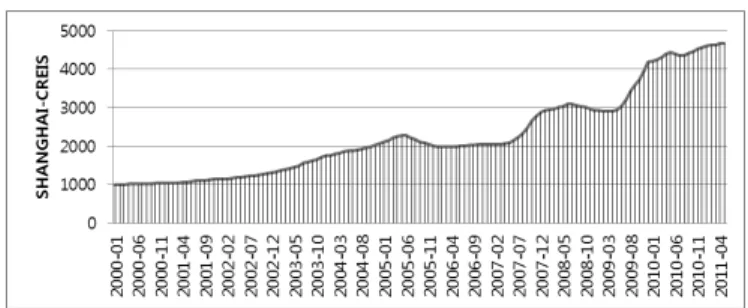
were estimated using the data from the home sales price in- dex for Shanghai, from January 2001 to May 2011 (137 months), as announced by the China Real Estate Index System (CREIS).
The Chinese financial markets apply the deposit and lending rates within the range set by the government. This study, there- fore, uses fixed interest rates. For mortality rates, China Life Insurance female mortality rates (2000-2003) were used. The ini- tial guarantee fee rate and annual guarantee fee were set at 2% and 0.5%, respectively, and these were assumed to be the same as those used in the American HECM program and the Korean housing pension.
In order to calculate the monthly reverse mortgage payments, the maximum LTV ratio and the net borrowing limit must be cal- culated first. The LTV becomes the house price at the end, dis- counted to the present value of the net borrowing limit of the reverse mortgage (PV), and to do this, the expected house price and discount rate at maturity should be calculated. The LTV is obtained by dividing the initial borrowing limit by the cur- rent house price and using this value, the PV may be de-
termined, considering the initial costs. Based on the calculated PV, the monthly pension payments until a future time period may be determined. In this study, the LTV was calculated using the following equation (Equation (4)).
(4)
= maximum reverse mortagage loan ratio
= expected house price at the future time of expiration
= interest rate
Once the borrower’s maximum reverse mortgage loan ratio (LTV) is determined by age level, the net borrowing limit (PV) of the reverse mortgage can be obtained by multiplying the house price at the time of lending (=0) by LTV, as in Equation (5), taking into account the initial guarantee fees.
× (5)
= present value of the net borrowing limit of the reverse mortagage
= house price at current period (=0)
= maximum reverse mortagage loan ratio
= initial guarantee fees
In this study, the following equation (Equation (6)) was used to calculate the monthly payments.
∑
(6)
= monthly payment of the lifetime annuity payment method
= present value of the net borrowing limit of the reverse mortagage
= expected remaining life expectancy (months)
= calculated pension interest rate
4. Empirical Analysis 4.1. Empirical Analysis
Fig. 3 shows the time series data on the comprehensive housing sales index from January 2001 to May 2011 (137 months), from the housing sales price index in Shanghai pre- sented by the CREIS (National Bureau of Statistics of China, 2013).
<Figure 3> CREIS (Shanghai 2001.1-2011.5)
The statistical results of the comprehensive home sales index are shown in Table 2. The average annual appreciation rate of house prices, was 4.6% (Table 2).
<Table 2> Descriptive analysis
Mean Std err Std dev Min Max Range
4.6% 93 1094 1003 4673 3670
The volatility () of the appreciation rate of house prices was obtained by using the equation for historical fluctuations (Equation 7) and it was fixed at 5.91% per year.
∑
(7)
= historical fluctuations from time T
= n months
= the return at time T
= average of the return
In this study, the expected interest rate to be applied in re- verse mortgages, of 6.5%, which was the interest rate an- nounced by the People’s Bank of China in 2013, was applied as a fixed rate (Fig. 4) (The People’s Bank of China, 2013).
<Figure 4> Change in real estate loans of China
4.2. Calculation of LTV and PMT by Age Levels
The LTV was obtained by using the model chosen in the previous section and applying the average time at maturity by age level (expected remaining life expectancy, N, Table 3). The results of the LTV estimations are shown in Table 4.
<Table 3> Age-specific maturity
(unit: year) Age Average term to maturity Using maturity
60 25.44 25
65 21.06 21
70 16.97 17
75 13.25 13
80 9.99 10
<Table 4> Age-specific expected house prices, interest rate, LTV (unit: Yuan) Age N Expected house prices Interest rateE(H(t)) r LTV
0 10,000,000 6.5% -
1 10,489,031 6.5% 98.49%
2 11,001,977 6.5% 97.00%
3 11,540,008 6.5% 95.53%
4 12,104,351 6.5% 94.09%
5 12,696,291 6.5% 92.67%
6 13,317,180 6.5% 91.27%
7 13,968,431 6.5% 89.89%
8 14,651,531 6.5% 88.53%
9 15,368,037 6.5% 87.19%
80 10 16,119,581 6.5% 85.87%
11 16,907,879 6.5% 84.58%
12 17,734,727 6.5% 83.30%
75 13 18,602,011 6.5% 82.04%
14 19,511,707 6.5% 80.80%
15 20,465,890 6.5% 79.58%
16 21,466,736 6.5% 78.37%
70 17 22,516,526 6.5% 77.19%
18 23,617,655 6.5% 76.02%
19 24,772,632 6.5% 74.87%
20 25,984,090 6.5% 73.74%
65 21 27,254,794 6.5% 72.63%
22 28,587,638 6.5% 71.53%
23 29,985,662 6.5% 70.45%
24 31,452,055 6.5% 69.38%
60 25 32,990,158 6.5% 68.34%
The calculation showed that if reverse mortgage loans are re- ceived initially according to LTV, borrowers of age 60 would be able to borrow up to 68.34%; age 65, up to 72.63%; age 70, up to 77.19%; age 75, up to 82.04%; and age 80, up to 85.87%. The borrower’s net borrowing limit (PV), when applying 2% as the loan guarantee fee rate (subscription fees included), is calculated using Equation (5). The results of the monthly pay- ments that are calculated using Equation (6), based on the cal- culated net borrowing limit (PV), are shown in Table 5.
Table 5 shows the monthly payments if the borrowers aged 60, 65, 70, 75, and 80 own houses that are worth over one million Yuan; those aged 60, for example, would receive month- ly payments of 4,522 Yuan. This income would not only im- prove the current income and quality of life of the elderly, but would also help alleviate the pressure on the Chinese social se- curity system, which is a significant concern that the Chinese government sought to address by launching the reverse mort-
gage industry. Based on the optimal combination of the three factors of payment amount, loan interest rates, and the level of acceptance of prices, efforts must be made to extract the best value for the elderly. Only in this way can the interests of both lenders and borrowers be protected, by increasing the market share and economies of scale of the reverse mortgage industry and effectively improving the living standards of the elderly.
<Table 5> Regional mortgage payments
(unit: Yuan)
Division 60 65 70 75 80
1,000,000 1,000,000 1,000,000 1,000,000 1,000,000 Residual life
(month) 300 252 204 156 120
Interest rate
(%) 6.5% 6.5% 6.5% 6.5% 6.5%
2% 2% 2% 2% 2%
PV 669,732 711,774 756,462 803,992 841,426 LTV (%) 68.34% 72.63% 77.19% 82.04% 85.87%
PMT 4,522 5,184 6,136 7,647 9,554
4.3. Sensitivity Analysis
In order to observe the sensitivity due to fluctuations in the rate of increase in house prices, the appreciation rate of a house price was calculated from 1% and the results are shown in Table 6.
<Table 6> Sensitivity analysis for housing prices
Age
LTV PMT LTV PMT LTV PMT
60 53.22% 3,458 68.34% 4,522 87.74% 5,789 65 58.87% 4,142 72.63% 5,184 89.60% 6,380 70 65.12% 5,120 77.19% 6,136 91.49% 7,289 75 72.04% 6,662 82.04% 7,647 93.43% 8,696 80 77.70% 8,596 85.87% 9,554 94.90% 10,549
According to the results of the sensitivity analysis in Table 6 (for age 60), when setting a low appreciation rate for a house price, the LTV decreases by 15.12% and the PMT decreases by 1,064 Yuan. On the other hand, when setting a high appre- ciation rate for a house price, the LTV increases by 19.4% and the PMT increases by 1,267 Yuan. This demonstrates that re- verse mortgage products are highly sensitive to the rate of in- crease in house prices.
<Table 7> Sensitivity analysis for interest rate
Age r-1% r r+1%
LTV PMT LTV PMT LTV PMT
60 86.51% 5,190 68.34% 4,522 54.10% 3,850 65 88.51% 5,798 72.63% 5,184 59.68% 4,552 70 90.62% 6,696 77.19% 6,136 65.85% 5,547 75 92.74% 8,155 82.04% 7,647 72.65% 7,103 80 94.37% 10,024 85.87% 9,554 78.21% 9,046
To observe the sensitivity due to fluctuations in the interest rate, the interest rate was calculated from ±and the results are shown in Table 7.
The analytical results show that the lower the fixed interest rate, the higher the LTV and the PMT, and that if the interest rate falls, a higher pension amount is possible.
5. Conclusion
This study, by using the LTV and PMT formulas to evaluate reverse mortgages, calculated the reverse mortgage monthly payments in China’s major city Shanghai, by age levels. The age levels were divided into 60, 65, 70, 75, and 80. The house price was set at one million Yuan. The variables used included fluctuations, an increase in the house price, interest rate, and mortality rate, and they were applied according to the Chinese financial market conditions.
The volatility of house prices and the house price apprecia- tion rate were calculated to be 5.91% and 4.6%, respectively, using the comprehensive home sales index (January 2001 to May 2011) from the home sales price index of Shanghai pro- vided by the CREIS. Mortality rates from the Chinese mortality tables were used, assuming fixed interest rates and future mor- tality rates at a certain time period.
This study showed that if reverse mortgage loans are initially received as LTV, borrowers aged 60 can borrow up to 68.34%;
those aged 65, up to 72.63%; those aged 70, up to 77.19%;
those aged 75, up to 82.04%; and those aged 80, up to 85.87%. By conducting a sensitivity analysis using a floating house price appreciation rate and interest rate, it was concluded that the actual pension amount that can be disbursed varies significantly, depending on how the house price appreciation rate and the interest rate fluctuate. The results indicate that re- verse mortgages would greatly improve the quality of life of the elderly. The empirical results have important implications, and serve as a useful reference for the Chinese authorities in the future implementation of reverse mortgage policies.
The limitations of this study and potential future research areas are as follows. 1) The loan term was estimated using mortality rates from Chinese mortality tables. However, with de- velopments in medical technology and the environment, these mortality tables need to be revised. 2) The average annual ap- preciation rate of house prices and the volatility of interest rates are influenced by complex changes in several variables at a specific point in time therefore, to accurately predict the future, a more in-depth study of historical volatility is needed.
Therefore, further studies would be necessary to provide more information on the above issues.
References
Boehm, T.P., & Ehrhardt, M.C. (1992). Are reverse mortgages suitable bank investments. Real Estate Review, 22(3), 40-45.
Cha, I.K., & Jung, H.J. (2008). A Study on the Pricing Model in Reverse Mortgage Insurance Using Option. The Journal of Risk Management, 19(1), 3-49.
Chang, W.W., Eom, Y.H., & Kim, K.H. (2011). On the Guarantee Fee and Monthly Payments of the Reverse Mortgage Loans: an Application of the Interest Rate Risk and Longevity Risk Models. Korean Insurance Academic Society, 89, 1-39.
China National Committee on Ageing (2006). China's aging pop- ulation trends forecast research report, http://en.cncaprc.
gov.cn/, Accessed 17 Jun 2013.
Chinloy, P., & Megbolugbe, I.F. (1994). Reverse mortgages:
contracting and crossover risk. Real Estate Economics, 22(2), 367-386.
Kim, A.N. (2007). Effects of Reverse Mortgage on the Reduction of Elderly Poverty. Korean Assoc. of Welf. Policy, 30, 371-391.
Kim, G.T., & Ma, S.R. (2006). Risk of Reverse Mortgages Resulting from Cycles of Housing Prices and Interest Rates. Korea Insurance Research Institute, 17(2), 61-97.
Korea Housing Finance Corporation (2013). Reverse mortgage Monthly, http://www.hf.go.kr/.
Lee, J.E., (2011). A Study on the Risk and Cointegration of Housing Reverse Mortgage. Journal of the Korean Regional Development Association, 23(5), 145-170.
Lee, S-Y., Koh, S-S., & Kim, J-H. (2010). A Study on the Appropriateness of the Major Variables of the Reverse Mortgage Model through Simulation Analysis. The Korean Regional Science Association, 26(3), 41-61.
Lew, K.O., & Ma, S.R. (2012). A Study on Evaluating Total Loan Cost Rate (TLCR) of the Reverse Mortgage Products. Korean Association for Housing Policy Studies, 20(2), 77 102.–
Ma, S.R. (2006a). Comparison of the Money`s Worth Ratios be- tween Reverse Mortgages and Single Premium Immediate Annuity. The Journal of Risk Management, 17(2), 103 132.–
Ma, S.R. (2006b). Insurance Premium Structure and Cost Efficiency of Reverse Mortgage. The Journal of Risk Management, 17(1), 29-78.
Ma, S.R. (2008). Securitization of Insurer`s Risk in Reverse Mortgages. Korean Insurance Academic Society, 80, 63-90.
Ma, S.R. (2011). Estimating VaR of Reverse Mortgages and a Plan for Risk Alleviation. The Journal of Risk Management, 22(2), 3 39–
Ma, S.R., Kim, G., & Lew, K. (2007). Estimating reverse mort- gage insurer’s risk using stochastic models. Asia-Pacific Risk and Insurance Association Annual Meeting 2007.
Ma, S.R., & Lew, K. (2008). Estimating Guarantor's Risk Embedded in Reverse Mortgage Pension Scheme for
Korean Farmers. 12th Annual Conference of APRIA in Sydney, Australia.
Ma, S.R., & Synn, J.W. (2009). Impact of Changes in Prepayment Rate and Mortality Rate on the Risks borne by the Insurer of Reverse Mortgage. Korean Association for Housing Policy Studies, 17(4), 5-32.
Min, I., & Cho, M. (2009). A Study on the Cross-Over Risk and Potential Demand for Reverse Annuity Mortgage. Korean Association for Housing Policy Studies, 17(3), 161-187.
National Bureau of Statistics of China (2013). China Statistical Yearbook, 2013, http://www.stats.gov.cn.
Park, S.K. (2012). A Study on Valuation of Reverse-Mortgage Loan`s Collateral Property. Korea real estate review, 22(3), 37-58.
Quercia, R.G. (1997). House Value Appreciation among Older Homeowners: Implications for Reverse Mortgage Programs. Journal of Housing Research, 8(2), 201-223.
Rodda, D.T., Herbert, C., & Lam, H.K. (2000). Evaluation Report of FHA’s Home Equity Conversion Mortgage Insurance Demonstration. Apt Associates, Cambridge, MA.
Scholen K. (1996). Your New Retirement Nest Egg: A Consumer Guide to the New Reverse Mortgages. Nchec Press, (The National Commission For Health Education Credentialing), United States
Shiller, R.J., & Weiss, A.N. (2000). Moral Hazard in Home Equity Conversion. Real Estate Economics, 28(1), 1-31.
Szymanoski, E.J. (1994). Risk and the home equity conversion mortgage.Real Estate Economics, 22(2), 347-366.
The People's Bank of China (2013). http://data.bank.hexun.com /ll/dkll.aspx.
Wang, P., & Kim, J. (2014). Analysis of Chinese Provinces for Introduction of Reverse Mortgage Scheme Using Principal Component Analysis. Journal of the Korean Institute of Industrial Engineers, 40(2), 205-214.
Appendix
Derivation of Equation (3)
1) Definition and Assumptions of Variables
= house price at "period t"
= initial house price at "period t=0"
=
=
= loan balance at "period t"
= then =
If then
Thus, obtaining is the same as obtaining . First, is assumed to follow the GBM process, and thus from period t has the average of and the standard devia- tion of , following normal distribution.
Further, follows the GBM process and log-normal distribution.
Thus, at time t=1, the mean and the standard deviation of are and .
is the random variable of the set of observation and is the random variable of the set of observation .
2) Derivation of E(X)
If then
Thus, the expected value of the random variable is equal to the expected value of the function . The expected value of the function is as follows:
∞ ∞ ∞ ∞ (1)
Note that is the probability distribution function of Y
is the probability density function of Y.
As is assumed to be normally distributed,
(2)
Equation (2) is a normally distributed probability density func- tion of mean and standard deviation .
∞ ∞ (3) To standardize , if it is substituted into , Equation (3) can be defined as follows:
∞ ∞ (4) The value of is 1.
≡ (5) Through Equations (4) and (5),
(6)
For variable and constants and , time is a function therefore, Equation (6) can be defined as follows:
.