• 검색 결과가 없습니다.

Clinical Features of Pregnancy-associated Retinal and Choroidal Diseases Causing Acute Visual Disturbance

N/A
N/A
Protected

Academic year: 2022

Share "Clinical Features of Pregnancy-associated Retinal and Choroidal Diseases Causing Acute Visual Disturbance"

Copied!
8
0
0

로드 중.... (전체 텍스트 보기)

전체 글

(1)

© 2017 The Korean Ophthalmological Society

This is an Open Access article distributed under the terms of the Creative Commons Attribution Non-Commercial License (http://creativecommons.org/licenses /by-nc/3.0/) which permits unrestricted non-commercial use, distribution, and reproduction in any medium, provided the original work is properly cited.

Original Article

Clinical Features of Pregnancy-associated Retinal and Choroidal Diseases Causing Acute Visual Disturbance

Young Joo Park

1,2

, Kyu Hyung Park

1

, Se Joon Woo

1

1

Department of Ophthalmology, Seoul National University Bundang Hospital, Seoul National University College of Medicine, Seongnam, Korea

2
Department of Ophthalmology, Seoul National University Hospital, Seoul National University College of Medicine, Seoul, Korea

Purpose: To report clinical features of patients with retinal and choroidal diseases presenting with acute visual disturbance during pregnancy.

Methods: In this retrospective case series, patients who developed acute visual loss during pregnancy (in- cluding puerperium) and visited a tertiary hospital from July 2007 to June 2015, were recruited by searching electronic medical records. Patients were categorized according to the cause of visual loss. Clinical features and required diagnostic modalities were analyzed in the retinal and choroidal disease group.

Results: Acute visual loss occurred in 147 patients; 49 (38.9%) were classified into the retinal and choroidal group. The diagnoses included central serous chorioretinopathy (22.4%), hypertensive retinopathy with or without pre-eclampsia (22.4%), retinal tear with or without retinal detachment (18.4%), diabetic retinopathy progression (10.2%), Vogt-Koyanagi-Harada disease (4.1%), retinal artery occlusion (4.1%), multiple evanes- cent white dot syndrome (4.1%), and others (14.3%). Visual symptoms first appeared at gestational age 25.9

± 10.3 weeks. The initial best-corrected visual acuity (BCVA) was 0.27 ± 0.39 logarithm of the minimum angle of resolution (logMAR); the final BCVA after delivery improved to 0.13 ± 0.35 logMAR. Serious visual deteri- oration (BCVA worth than 20 / 200) developed in two patients. Differential diagnoses were established with characteristic fundus and spectral-domain optical coherence tomography findings in all cases.

Conclusions: In pregnant women with acute visual loss, retinal and choroidal diseases are common and could be vision threatening. Physicians should be aware of pregnancy-associated retinal and choroidal diseases and their clinical features. The differential diagnosis can be established with non-invasive techniques.

Key Words: Central serous chorioretinopathy, Choroidal diseases, Pregnancy, Puerperium period, Retinal dis- eases

Women are more prone to various diseases, including retinal and choroidal diseases, during pregnancy. Retinal

and choroidal diseases may occur spontaneously in preg- nancy, or pre-existing conditions may worsen or change during pregnancy [1]. Retinal and choroidal diseases in- clude conditions such as central serous chorioretinopathy, hypertensive retinopathy (HTR), and rhegmatogenous reti- nal detachment, whereas pre-existing conditions include diabetes mellitus, Vogt-Koyanagi-Harada (VKH) disease, and white dot syndrome.

Received: August 1, 2016 Accepted: September 6, 2016

Corresponding Author: Se Joon Woo, MD. Department of Ophthal- mology, Seoul National University Bundang Hospital, Seoul National University College of Medicine, #82 Gumi-ro 173beon-gil, Bundang-gu, Seongnam 13620, Korea. Tel: 82-31-787-7377, Fax: 82-31-787-4057, E-mail:

[email protected]

(2)

During pregnancy, cardiac output increases as the prod- uct of stroke volume and heart rate increase over the course of the pregnancy [2], and many angiopoietic factors increase with hormonal fluctuations, such as changes in progesterone [3]. The combination of these factors plays a role in the initiation or aggravation of retinal and choroidal diseases.

For pregnancy-associated retinal and choroidal diseases, there is a paucity of data regarding the incidence of diseas- es and evidence on which to base the diagnosis and treat- ment strategies. Further, pregnant women often refuse to undergo invasive diagnostic tests such as fundus fluoresce- in angiography (FA), which makes the diagnosis more dif- ficult. Therefore, recognizing the retinal and choroidal dis- eases that occur during pregnancy and knowing how to diagnose them in the setting of pregnancy, without inva- sive tests, are important.

Herein, we analyzed the clinical features of pregnancy- associated retinal and choroidal diseases by investigating a series of patients who presented with acute visual distur- bance during or after pregnancy.

Materials and Methods

This study was approved by the institutional review board of Seoul National University Bundang Hospital (SNUBH). The electronic medical records of all female pa- tients of childbearing age who visited SNUBH from July 2007 to June 2015 were screened. The keywords “delivery”

and “pregnancy” was used for the search. The inclusion

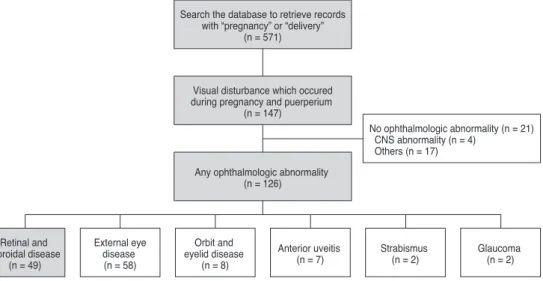
criteria were female patients who developed acute visual loss during pregnancy or within 8 weeks postpartum. All diagnoses were established by ophthalmologists at SNUBH (Fig. 1).

The collected data were patient age, coexisting ocular and/or systemic diseases, initial and final best-corrected visual acuity (BCVA), and intraocular pressure as deter- mined by noncontact tonometry. Information regarding parity, last menstrual period, delivery date, mode of deliv- ery, and obstetric complications such as pre-eclampsia were also gathered. For cases in which the date of delivery was not clarified, gestational age (GA) 40 weeks was as- sumed to be the delivery date.

Ophthalmologic examinations including fundus photog- raphy, FA, and optical coherence tomography (OCT; Spec- tralis OCT, Heidelberg Engineering, Heidelberg, Germany) were performed. Structural changes in the choroidal layer were examined using the enhanced depth image (EDI) mode of OCT. FA was performed for patients who provid- ed informed consent.

Results are presented as mean ± standard deviation for continuous variables and as percentage for categorical variables. The Mann-Whitney U-test was used to investi- gate the relationship between initial symptom onset (GA) and diagnosis.

Results

A total of 147 of 571 pregnant women reported acute vi- sual loss during pregnancy and puerperium, and 126 of

No ophthalmologic abnormality (n = 21) CNS abnormality (n = 4)

Others (n = 17)

Retinal and choroidal disease

(n = 49)

External eye disease (n = 58)

Orbit and eyelid disease

(n = 8)

Anterior uveitis

(n = 7) Strabismus

(n = 2) Glaucoma

(n = 2) Search the database to retrieve records

with “pregnancy” or “delivery”

(n = 571)

Visual disturbance which occured during pregnancy and puerperium

(n = 147)

Any ophthalmologic abnormality (n = 126)

Fig. 1. Search process for the

subject group. CNS = central

nervous system.

(3)

these patients were diagnosed with ocular diseases. These patients were classified into the following six disease groups: Retinal and choroidal disease (49 cases), external eye disease (58 cases), orbit and eyelid disease (eight cases), anterior uveitis (seven cases), strabismus (two cases), and glaucoma (two cases) (Fig. 1).

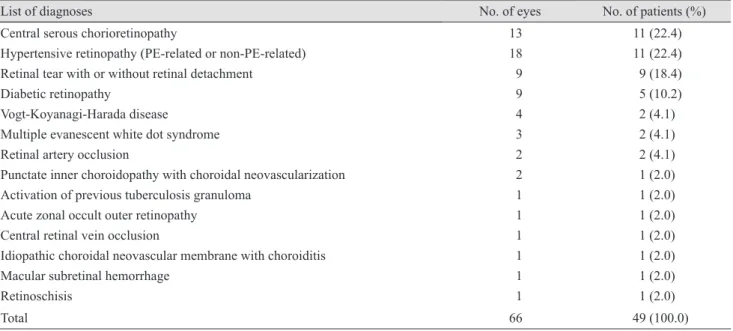
We analyzed the 49 patients (66 diseased eyes) in the retinal and choroidal disease group. The mean age ± stan- dard deviation of the retinal and choroid disease group was 33.1 ± 4.2 years (range, 21 to 41 years), and the mean fol- low-up period was 8.6 ± 14.7 months. The clinical features and non-invasive examinations, including fundus photog- raphy and spectral domain-OCT with EDI mode findings, were adequate for establishing detailed diagnoses in all cases. FA was performed on six patients who provided in- formed consent during pregnancy, but this did not affect the diagnosis or treatment plan. The retinal diagnoses in- cluded central serous chorioretinopathy (CSC) (n = 11, 22.4%), HTR with or without pre-eclampsia (n = 11, 22.4%), retinal tear with or without retinal detachment (n = 9, 18.4%), diabetic retinopathy (DR) progression (n = 5, 10.2%), VKH disease (n = 2, 4.1%), multiple evanescent white dot syndrome (n = 2, 4.1%), retinal artery occlusion (n

= 2, 4.1%), punctate inner choroidopathy with choroidal neovascularization (n = 1, 2.0%), activation of previous tu- berculosis granuloma (n = 1, 2.0%), acute zonal occult outer

retinopathy (n = 1, 2.0%), central retinal vein occlusion (n = 1, 2.0%), idiopathic choroidal neovascular membrane with choroiditis (n = 1, 2.0%), macular subretinal hemorrhage (n

= 1, 2.0%), and retinoschisis (n = 1, 2.0%) (Table 1). The clinical characteristics of each disease group are described in Table 2, and representative images are shown in Fig. 2A, 2B, 3, 4A, 4B, 5.

The mean GA at symptom onset was 25.9 ± 10.3 weeks.

The distribution of initial symptom onset is shown in Fig. 6.

During the third trimester (from GA 27 to 40 weeks), 81.8

% cases of HTR, 54.5 % of CSC, and 50.0% of VKH oc- curred, whereas DR progression (16.7%), retinal tear with or without retinal detachment (11.1%), and retinal artery occlusion (none) showed a much lower incidence in the third trimester. Statistically, the symptom onset of the HTR group was different from those of the other disease groups (GA, 32.8 ± 3.9 weeks; p = 0.002; Mann-Whitney U-test), whereas significant differences were not observed among the other groups.

The mean BCVA ± standard deviation of the retinal and choroidal disease group was 0.27 ± 0.39 logarithm of the minimum angle of resolution (logMAR) at the initial exam and improved to 0.13 ± 0.35 logMAR at the last follow-up exam. The visual prognosis was excellent in most of the cases (Table 2). Serious visual deterioration (BCVA worse than 20 / 200) developed in two patients (4.1%) in whom

Table 1. Diagnoses in the retinal and choroidal disease group

List of diagnoses No. of eyes No. of patients (%)

Central serous chorioretinopathy

Hypertensive retinopathy (PE-related or non-PE-related) Retinal tear with or without retinal detachment

Diabetic retinopathy

Vogt-Koyanagi-Harada disease

Multiple evanescent white dot syndrome Retinal artery occlusion

Punctate inner choroidopathy with choroidal neovascularization Activation of previous tuberculosis granuloma

Acute zonal occult outer retinopathy Central retinal vein occlusion

Idiopathic choroidal neovascular membrane with choroiditis Macular subretinal hemorrhage

Retinoschisis

13 18 9 9 4 3 2 2 1 1 1 1 1 1

11 (22.4) 11 (22.4) 9 (18.4) 5 (10.2) 2 (4.1) 2 (4.1) 2 (4.1) 1 (2.0) 1 (2.0) 1 (2.0) 1 (2.0) 1 (2.0) 1 (2.0) 1 (2.0)

Total 66 49 (100.0)

PE = pre-eclampsia.

(4)

Ta ble 2 . C lin ica l m an ife st at io ns o f r et in al a nd c ho ro id al d ise as es a cc or di ng to d ia gno sis Diagnosis Central serous chorioretinopathy

Hy pe rte nsi ve re tin op at hy with or without pre- eclampsia

Retina tear with or without retinal Vogt-Koyanagi-Harada Retinal artery Mul tipl e e va ne sc ent Diabetic retinopathy Other disease occlusion white dot syndrome detachment No. of patients (%) 11 (22.4) 11 (22.4) 9 (18.4) 5 (10.2) 2 (4.1) 2 (4.1) 2 (4.1) 7 (14.3) Initial BCV A 0.12 ± 0.40 0.17 ± 0.20 0.37 ± 0.38 0.36 ± 0.20 0.99 ± 0.50 (logMAR) –0.18 In branch RAO, NLP in central RAO 0.08 ± 0.02 0.34 ± 0.64 Final BCV A (logMAR) 0.04 ± 0.37 0.02 ± 0.08 0.14 ± 0.14 0.36 ± 0.20 0.09 ± 0.17

0.1 In branch RAO, NLP

in central RAO –0.09 ± 0.07 0.25 ± 0.57 Clinical manifestation Extraocular symptom/sign

Headache, hypertension, proteinuria Headache, tinnitus, vitiligo

Bilaterality (%) 18.2 63.6 0 80 100 0 50 - Average symptom onset (GA, wk)

29.0 32.8 15.9 21.08 27.4 29.4 34.9 16.6 Fundus finding

Central round serous detachment

Retinal hemorrhages, macular edema, cotton wool spots, constriction of retinal arterioles, serous retinal detachments Bullous, detached retina involving with peripheral tear or break Retinal nonperfus

ion, retinal

neovascularization, cotton wool spots, vitreous hemorrhage, macular edema, disc swelli

ng

Disc swelling, multiple and extensive serous retinal detachment, intraocular inflammation Ischemic retina with or without visible emboli Multifocal gray-white lesions, orange-yellow fovea with granularity

OCT finding

Subretinal fluid collection, thick choroid W ith or without serous retinal detachments Detached retina expanding from periphery Macular edema, retinal exudates Extensive serous retinal d eta chm en ts, bre tin al su

inflammatory material, choroidal folds and thickening with peripapillary elevation

Edema and hyperreflectivity of inner retina

Inne r se gm ent -out er

segment junction discontinuity in acute phase, thinning of outer nuclear layer

Treatment Observation

Medications, induction of delivery in presence of severe pre-eclampsia close monitoring in milder cases

Barrier laser , scleral buckling or vitrectomy

Panretinal photocoagulation, intravitreal anti- -VEGF injection, vitrectomy Topical or systemic corticosteroid treatment

Observation

Systemic corticosteroid treatment

Va lu es a re p re se nt ed a s m ea n ± st an da rd d ev ia tio n un le ss o th er w ise in di ca te d. BC VA = be st- cor re ct ed v isu al a cu ity ; l og M A R = lo ga rit hm o f t he m in im um a ng le o f r es ol ut io n; R A O = re tin al a rte ry o cc lu sio n; N LP = no li gh t p er ce pt io n; G A = ge st at io na l a ge ; O CT = o pt ica l c oh er en ce tomo gr ap hy ; V EG F = va sc ula r e nd ot he lia l g ro w th fa ct or .

(5)

central retinal artery occlusion and acute zonal occult out- er retinopathy occurred, respectively. The visual acuities improved as the subretinal fluid was resolved in CSC and HTR cases, and total disappearance of subretinal fluid was

observed only after delivery in all CSC and HTR cases.

Various treatment strategies were applied to the patients:

medical treatment (n = 5, 10.2%), surgical treatment (n = 9, 18.4%), prophylactic laser treatment (n = 4, 8.2%), and in- travitreal bevacizumab injection (n = 2, 4.1%). Preterm de- livery with labor induction or caesarian section was per- formed in 11 patients (22.4%). The others were observed for spontaneous improvement (n = 18, 36.7%). In the surgi- cally treated group, nine patients (18.4%) underwent oph- thalmic surgeries, which included pars plana vitrectomy for three patients (one for vitreous hemorrhage, one for tractional retinal detachment, and one for rhegmatogenous retinal detachment) and scleral buckling for six patients (all for rhegmatogenous retinal detachment). In the medically treated group, four patients (8.2%) were treated with oral prednisolone (two for VKH disease, one for central retinal vein occlusion with macular edema, and one for multiple evanescent white dot syndrome), and one patient (2.0%) started systemic anticoagulant treatment after being diag- nosed with acute zonal occult outer retinopathy. In the la- ser-treated group, three patients with DR (6.1%) were treat- ed with prophylactic laser panretinal photocoagulation, and one patient (2.0%) underwent barrier laser treatment for retinal tear without retinal detachment. Two patients were treated with intravitreal bevacizumab (one for dia- betic macular edema and one for choroidal neovasculariza- tion).

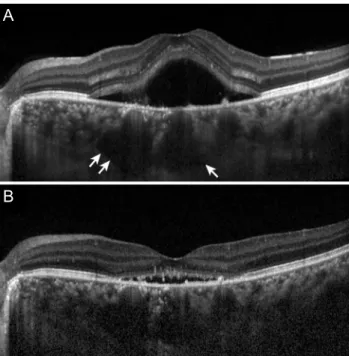
Fig. 2. Optical coherence tomography images in enhanced depth image mode of a patient who was diagnosed with central serous chorioretinopathy at gestational age 25 weeks. (A) The image obtained at gestational age 25 weeks. The dilated large choroidal vessels (arrows), which are characteristic of central serous cho- rioretinopathy, are visible. (B) The image obtained at 2 weeks postpartum.

A

B

Fig. 3. Sequential images of a patient who was diagnosed with and underwent treatment for high-risk proliferative diabetic retinopathy

during pregnancy (the sequential images were obtained at gestational age (GA) 22 weeks, GA 29 weeks, 5 weeks postpartum, and 10

weeks postpartum). This patient underwent panretinal photocoagulation at GA 22 weeks and received intravitreal injection of bevaci-

zumab at GA 29 weeks. Wide-angle fundus photographs show rapid progression of tractional membrane and the development of pre-

retinal hemorrhage, and the optical coherence tomography images show aggravation and relief of diabetic macular edema. The patient

underwent pars plana vitrectomy for tractional retinal detachment 7 months after delivery.

(6)

Discussion

According to our results, 49 of 147 (33.3%) patients with acute visual disturbance during pregnancy and puerperi- um were diagnosed as having retinal and choroidal diseas- es. Among them, 31 patients required treatment. These findings indicate that ophthalmologists should not overlook suspicion of retinal diseases.

CSC is a well-known disease that arises during pregnan- cy due to hormonal fluctuations, such as changes in pro- gesterone level. HTR is another typical disease during pregnancy, and this condition is induced by severe vascu- lar spasm from pre-eclampsia or eclampsia [4]. In our case series, CSC (n = 11) and HTR (n = 11) occurred only after GA 19 weeks (Fig. 6). When a pregnant patient reports acute visual disturbance in the second half of pregnancy, CSC with unilateral manifestation and HTR with bilateral manifestation should be considered. In all CSC and HTR cases, fetal delivery was followed by spontaneous resolu-

tion of subretinal fluid. Although we can confirm that prompt delivery can be a good solution for these cases, it is not regarded as an emergency requirement because the overall visual outcome is generally excellent in these pa- tients. DR is known to progress transiently through preg- nancy and can manifest as sudden-onset vitreous hemor- rhage or papillitis. Our search revealed five cases of rapid progression of DR, and two of these patients underwent vitrectomy. Conversely, VKH disease is predicted to im- prove during pregnancy because of steroid production and immune depression, but flare-ups during pregnancy are also reported [5,6]. We reported two cases of sudden mani- festation of VKH disease, which were controlled with sys- temic corticosteroid treatments. Differential diagnosis with CSC can be achieved by characteristic choroidal appear- ance (darkening and thickening) on EDI-OCT images.

Retinal arterial occlusion is reported in pregnant women in association with migraines, Protein S deficiency, eleva- tion of factor VIII level, and primary antiphospholipid an-

Fig. 5. Fundus photograph and optical coherence tomography im- age of patient 14, who was diagnosed with central retinal artery occlusion at gestational age 18 weeks. The images were obtained 1 week after the onset of the event, and the acute ischemic chang- es of the inner retina are apparent.

Fig. 4. Images of a patient diagnosed with incomplete Vogt-Koy- anagi-Harada during pregnancy. (A) Enhanced depth image optical coherence tomography image of the left eye at gestational age 20 weeks revealing serous retinal detachment with subretinal exudation and choroidal thickening (arrows). (B) Enhanced depth image optical coherence tomography image at gestational age 22 weeks revealing that the subretinal fluid resolved after adminis- tration of systemic corticosteroid.

A

B

(7)

tibody syndrome [7,8]. Routine blood analysis did not re- veal any underlying causes of retinal arterial occlusion in the two cases in our series. The development or recurrence of choroidal neovascularization related to punctate inner choroidopathy has been reported during pregnancy, but a definite causal relationship has not been established [9].

Purtscher retinopathy, which is caused by multiple emboli, has also been reported in pregnancy, but we did not have any such cases in our series [10].

Pregnant women sometimes refuse to undergo diagnos- tic processes such as FA. Therefore, we focused on the role of spectral domain-OCT with EDI mode as a powerful and noninvasive diagnostic tool for evaluating retinal diseases in pregnant patients. EDI-OCT does not show vascular dy- namics, but its high-resolution and enhanced-depth imag- ing made it possible to diagnose conditions without FA in all cases, especially for CSC and VKH. Further, we re- viewed the potential effects of each diagnostic process on fetomaternal health (Fig. 7). Regarding treatment, most retinal diseases regress spontaneously after delivery, but when the condition rapidly deteriorates before approaching full-term, a treatment decision should be made by consid- ering the pros and cons of each treatment modality. Subse- quent labor induction or caesarian section can be consid-

Gestational week

HTR CSC DR RT RAO Others

40

20 30

10

0

Fig. 6. Initial symptom onset in each disease category. HTR = hy- pertensive retinopathy; CSC = central serous chorioretinopathy;

DR = diabetic retinopathy; RT = retinal tear with or without reti- nal detachment; RAO = retinal artery occlusion. Symptom onset was significantly different in the HTR group compared with that in the other disease groups (p = 0.002 by the Mann-Whitney U-test), but no differences were observed with the other groups.

Fig. 7. Consultation for potential effects of diagnostic process on fetomaternal health [11,12]. HCl = phenylephrine hydrochloride; FDA =

Food and Drug Administration (United States); OCT = optical coherence tomography; FA = fluorescein angiography.

(8)

ered in cases of pre-eclampsia-related retinopathy or VKH syndrome, while consulting an obstetric professional. In cases of DR progression, the condition progresses rapidly to vitreous hemorrhage in a few months, so laser photoco- agulation should be performed promptly at the time of di- agnosis.

The limitations of this study are the retrospective design and the small number of patients. Further, with the excep- tion of DR cases, the pre-conception ophthalmologic state was not documented. Finally, 14 patients did not revisit the ophthalmologic clinic after delivery because the symptom disappeared.

In conclusion, when a pregnant woman visits an oph- thalmologic clinic for acute visual loss, the doctor should evaluate the patient with suspicion of retinal and choroid disease. In most cases, the differential diagnosis can be ob- tained using non-invasive techniques including spec- tral-domain OCT. We believe that physicians will find our detailed description of the clinical features and visual out- comes useful.

Conflict of Interest

No potential conflict of interest relevant to this article was reported.

Acknowledgements

This study was supported by the National Research Foundation of Korea grant 2016R1D1A1B03934724, fund- ed by the Korean government (Ministry of Science, ICT and Future Planning [MSIP]).

References

1. Errera MH, Kohly RP, da Cruz L. Pregnancy-associated retinal diseases and their management. Surv Ophthalmol 2013;58:127-42.

2. Thornburg KL, Jacobson SL, Giraud GD, Morton MJ. He- modynamic changes in pregnancy. Semin Perinatol 2000;

24:11-4.

3. Schocket LS, Grunwald JE, Tsang AF, DuPont J. The ef- fect of pregnancy on retinal hemodynamics in diabetic ver- sus nondiabetic mothers. Am J Ophthalmol 1999;128:477- 84.

4. Saito Y, Tano Y. Retinal pigment epithelial lesions associat- ed with choroidal ischemia in preeclampsia. Retina 1998;18:103-8.

5. Doi M, Matsubara H, Uji Y. Vogt-Koyanagi-Harada syn- drome in a pregnant patient treated with high-dose system- ic corticosteroids. Acta Ophthalmol Scand 2000;78:93-6.

6. Rabiah PK, Vitale AT. Noninfectious uveitis and pregnan- cy. Am J Ophthalmol 2003;136:91-8.

7. Acheson JF, Gregson RM, Merry P, Schulenburg WE. Va- so-occlusive retinopathy in the primary anti-phospholipid antibody syndrome. Eye (Lond) 1991;5 (Pt 1):48-55.

8. Greven CM, Weaver RG, Owen J, Slusher MM. Protein S deficiency and bilateral branch retinal artery occlusion.

Ophthalmology 1991;98:33-4.

9. Sim DA, Sheth HG, Kaines A, Tufail A. Punctate inner choroidopathy-associated choroidal neovascular mem- branes during pregnancy. Eye (Lond) 2008;22:725-7.

10. Grant AD, Chung SM. The eye in pregnancy: ophthalmo- logic and neuro-ophthalmologic changes. Clin Obstet Gy- necol 2013;56:397-412.

11. Mackensen F, Paulus WE, Max R, Ness T. Ocular changes during pregnancy. Dtsch Arztebl Int 2014;111:567-75.

12. American Academy of Pediatrics Committee on Drugs.

Transfer of drugs and other chemicals into human milk.

Pediatrics 2001;108:776-89.

수치

Fig. 1. Search process for the  subject group. CNS = central  nervous system.
Table 1. Diagnoses in the retinal and choroidal disease group
Table 2. Clinical manifestations of retinal and choroidal diseases according to diagnosis  Diagnosis Central serous  chorioretinopathy
Fig. 2. Optical coherence tomography images in enhanced depth  image mode of a patient who was diagnosed with central serous  chorioretinopathy at gestational age 25 weeks
+3

참조

관련 문서

Two lane roadway with raised median (left turn egress only from intersection or driveway)... 4-Way

Prevention of coronary and stroke events with atorvastatin in hypertensive patients who have average or lower-than-average cholesterol concentrations, in

Page 22 Figure 4 Storage moduli( E’ ) at 100 and 200 °C of PLA blends with Li-SPS and Na-SPS ionomers as a function of weight % of the ionomer in blends, measured at 1 Hz..

The Incomplete diffuse type PVD found primarily in patients with diabetic retinopathy and retinal detachment and complete diifuse type PVD found primarily in patients

For Kummell’s disease with persistent pain and without neurological symptoms, percutaneous vertebroplasty (VP) or balloon kyphoplasty (KP) has been known to

Direct potable reuse (DPR): The introduction of reclaimed water (with or without retention in an engineered storage buffer) directly into a drinking water treatment

Transmittance values of toluene/heptane solutions containing heavy oil with/without PS, PSMA copolymer, PSMLi, PSMNa and PSMCs ionomers as a function of revolution time.. Page

(2002) Rapid development of cortical auditory evoked potentials after early