Introduction
Generally, the adrenal medulla releases catecholamines
(CA) chiefly via activation of its nicotinic acetylcholine (ACh) receptors by ACh, which is liberated from the ter- minal of the splanchnic nerve. Binding of ACh to these nicotinic receptors leads to a depolarization of the cell membrane by an influx of Na+ through receptor-gated cation channels, causing an influx of Ca2+ through volt- age-operative Ca2+ channels, which results in CA secre- Original Article
❙ ❙ Vol. 20, No. 2, June 2014 ISSN 2233-8136, eISSN 2233-8454, http://dx.doi.org/10.5646/jksh.2014.20.2.51 Copyright 2014. ⓒ The Korean Society of Hypertension
Comparison of Inhibitory Effects between Enalapril and Losartan on Adrenal Catecholamine Secretion
Hyo-Jeong Lim, MD1,Young-Youp Koh, MD2, Dong-Yoon Lim, MD3
1Division of Pulmonary and Critical Care Medicine, Department of Internal Medicine, Veterans Health Service Medical Center, Seoul; Departments of 2Internal Medicine, 3Pharmacology, Chosun University School of Medicine, Gwangju, Korea
❙ABSTRACT❙
Background: The present study was attempted to compare enalapril, an angiotensin-converting enzyme inhibitor with losartan an angiotensin II (Ang II) receptor blocker in the inhibitory effects on the secretion of catecholamines (CA) from the perfused model of the rat adrenal gland. Methods: The adrenal gland was isolated and perfused with Krebs-bicarbonate.
CA was measured directly by using the fluorospectrophotometer. Results: Both enalapril and losartan during perfusion into an adrenal vein for 90 minutes inhibited the CA release evoked by acetylcholine (ACh), 1.1-dimethyl-4-phenyl piperazinium (DMPP, a selective Nn agonist), high K+ (a direct membrane-depolarizer), 3-(m-chloro-phenyl-carbamoyl-oxy-2-butynyl- trimethyl ammonium (McN-A-343, a selective M1 agonist), and Ang II in a time-dependent manner. Also, in the presence of enalapril or losartan, the CA release evoked by veratridine (an activator of voltage-dependent Na+ channels), 6-dimethyl-3-nitro-4-(2-trifluoromethyl phenyl)-pyridine-5-carboxylate (BAY-K-8644, an L-type Ca– 2+ channel activator), and cyclopiazonic acid (a cytoplasmic Ca2+-ATPase inhibitor) were significantly reduced. Based on the same concentration of enalapril and losartan, for the CA release evoked by ACh, high K+, DMPP, McN-A-343, Ang II, veratridine, BAY-K-8644, and cyclopiazonic acid, the following rank order of inhibitory potency was obtained: losartan > enalapril. In the simultaneous presence of enalapril and losartan, ACh-evoked CA secretion was more strongly inhibited compared with that of enalapril- or losartan-treated alone. Conclusions: Collectively, these results demonstrate that both enalapril and losartan inhibit the CA secretion evoked by activation of both cholinergic and Ang II type-1 receptors stimulation in the perfused rat adrenal medulla. When these two drugs were used in combination, their effects were enhanced, which may also be of clinical benefit. Based on concentration used in this study, the inhibitory effect of losartan on the CA secretion seems to be more potent than that of enalapril. (J Korean Soc Hypertens 2014;20(2):51-67)
Key Words: Enalapril; Losartan; Catecholamine secretion; Adrenal medulla; angiotensin II type-1 receptor blocker;
Angiotensin-converting enzyme inhibitor
Received: 2014.3.14. Revised: 2014.5.13, Accepted: 2014.6.13 Correspondence to: Dong-Yoon Lim, MD
Address: Department of Pharmacology, Chosun University School of Medicine, 309 Pilmun-daero, Dong-gu, Gwangju 501-759, Korea Tel: +82-62-230-6335, Fax: +82-62-227-4693
E-mail: [email protected]
tion by exocytotic mechanism.1-3) Therefore, adrenal chromaffin cells are widely used as a model to study CA secretion in response to stimulation by the sympathetic nervous system.
The renin-angiotensin-aldosterone system (RAAS) is an important mediator in the pathophysiology of hyper- tension, with excessive activity in the RAAS playing a crucial role in target end-organ damage, such as my- ocardial infarction, congestive heart failure, coronary ar- tery disease and end-stage renal disease.4) The valuable influence of angiotensin-converting enzyme inhibitors (ACEIs) and angiotensin II (Ang II) receptors antagonists (ARBs) may be shared by RAAS, as well as sympathetic overactivity inhibition. Ang II, the main effector of the RAAS, was found to activate sympathetic nerve traffic and its sequelae in numerous tissues.5) This facilitatory effect is exerted via Ang II type-1 (AT1) receptors and opposed by AT1 receptor antagonism and the reduction of Ang II production. Furthermore, inhibition of ACE af- fects the bradykinin concentration by peptide degradation to inactive substrates. Therefore, ACEIs are expected to elevate the bradykinin concentration, which has been sug- gested to affect sympathetic tone. It was found that bra- dykinin enhanced the epinephrine (EP) release from the adrenal medulla and norepinephrine (NE) from the ani- mal and human heart, indicating the stimulatory action of the peptide on sympathetic excitation.6-8) A counteraction of bradykinin was also described.9) Consequently, in re- spect to some different mechanisms of action of ACEIs and ARBs, it can be presumed that both drug classes may mediate different effects on sympathetic activity.
Indeed, data regarding sympathetic inhibition during ACEIs therapy in comparison to ARB are sparse and inconsistent. Several studies have shown a similar con- tribution of both drug classes to sympathetic inhibition, while others suggested differences existing in this regard
between drugs.10-13) Different mechanisms of RAAS in- hibition by ACEIs and ARBs mentioned above might at least in part explain existing divergences.
Currently, two classes of drugs that attenuate the action of Ang II and act as antihypertensive agents by different mechanisms are available, which include ACEIs and ARBs. ACEIs act by reducing the biosynthesis of Ang II by blocking the action of ACE on Ang I but do not in- hibit the alternative non-ACE Ang II generating path- ways whereas ARBs block the AT1 receptor-mediated ac- tions of Ang II without inhibiting the synthesis of Ang II. Taking into consideration the alternative pathways of Ang II generation, ARBs reduce the activation of AT1 re- ceptor more effectively than do ACEIs.14) The current place of ARBs in the treatment of essential hypertension is as an alternative to ACEIs in patients who do not tol- erate them due to adverse-effects. But there is constant controversy over the comparative efficacy of ACEIs and ARBs due to the additional advantages of ARBs over ACEIs.15) Hence, the present study was designed to com- pare losartan with enalapril in inhibitory effects on the CA secretion from the perfused model of the isolated rat adrenal medulla.
Subjects and methods
1. Experimental procedure
Male Sprague-Dawley rats, weighing 200 to 300 g, were anesthetized with thiopental sodium (50 mg/kg) intraperitoneally. The adrenal gland was isolated by the methods described previously.16) The abdomen was opened by a midline incision, and the left adrenal gland and surrounding area were exposed by placing three hook retractors. The stomach, intestine and portion of the liver were not removed, but pushed over to the right side and covered by saline-soaked gauze pads and urine in bladder
Hyo-Jeong Lim ․ Young-Youp Koh ․ Dong-Yoon Lim
was removed in order to obtain enough working space for tying blood vessels and cannulations.
A cannula, used for perfusion of the adrenal gland, was inserted into the distal end of the renal vein after all branches of adrenal vein (if any), vena cava and aorta were ligated. Heparin (400 IU/mL) was injected into vena cava to prevent blood coagulation before ligating vessels and cannulations. A small slit was made into the adrenal cortex just opposite entrance of adrenal vein.
Perfusion of the gland was started, making sure that no leakage was present, and the perfusion fluid escaped only from the slit made in adrenal cortex. Then the adrenal gland, along with ligated blood vessels and the cannula were carefully removed from the animal and placed on a platform of a leucite chamber. The chamber was con- tinuously circulated with water heated at 37°C ± 1°C.
2. Perfusion of adrenal gland
The adrenal glands were perfused by means of ISCO pump (WIZ Co., Lincoln, NE, USA) at a rate of 0.33 mL/min. The perfusion was carried out with Krebs-bicar- bonate solution of following composition (mM): NaCl, 118.4; KCl, 4.7; CaCl2, 2.5; MgCl2, 1.18; NaHCO3, 25;
KH2PO4, 1.2; glucose, 11.7. The solution was constantly bubbled with 95% O2 + 5% CO2 and the final pH of the solution was maintained at 7.4 to 7.5. The solution con- tained disodium EDTA (10 g/mL) and ascorbic acid μ (100 g/mL) to prevent oxidation of CA. μ
3. Drug administration
The perfusions of 1.1-dimethyl-4-phenyl piperazinium (DMPP, 10-4 M) and McN-A-343 (10-4 M) for 2 minutes and/or a single injection of ACh (5.32 × 10⁻³ M) and KCl (5.6 × 10⁻² M) in a volume of 0.05 mL were made into perfusion stream via a three-way stopcock, respectively.
Veratridine (10-4 M), BAY-K-8644 (10-5 M), and cyclo-
piazonic acid (10-5 M) were also perfused for 4 minutes, respectively. In the preliminary experiments, it was found that upon administration of the above drugs, secretory re- sponses to ACh, KCl, 3-(m-chloro-phenyl-carba- moyl-oxy-2-butynyl-trimethyl ammonium (McN-A-343), veratridine, 6-dimethyl-3-nitro-4-(2-trifluoromethyl phe– - nyl)-pyridine-5-carboxylate (BAY-K-8644), and cyclo- piazonic acid returned to preinjection level in about 4 mi- nutes, but the responses to DMPP returned in 8 minutes.
4. Collection of perfusate
As a rule, prior to stimulation with various secreta- gogues, the perfusate was collected for 4 minutes to de- termine the spontaneous secretion of CA (background sample). Immediately after the collection of the back- ground sample, collection of the perfusates was continued in another tube as soon as the perfusion medium contain- ing the stimulatory agent reached the adrenal gland.
Stimulated sample’s perfusate was collected for 4 to 8 minutes. The amounts secreted in the background sample have been subtracted from that secreted from the stimu- lated sample to obtain the net secretion value of CA, which is shown in all of the figures.
To study the effect of enalapril and losartan on the spontaneous and evoked secretion, the adrenal gland was perfused with Krebs solution containing quinine for 20 minutes, and then the perfusate was collected for a cer- tain period (background sample). Then the medium was changed to the one containing the stimulating agent or along with enalapril or losartan, and the perfusates were collected for the same period as that for the background sample. The adrenal gland’s perfusate was collected in chilled tubes.
5. Measurement of catecholamines
CA content of perfusate was measured directly using
the fluorometric method of Anton and Sayre17) without the intermediate purification alumina for the reasons de- scribed earlier16) using fluorospectrophotometer (Kontron Co., Milano, Italy). A volume of 0.2 mL of the perfusate was used for the reaction. The CA content in the perfu- sate of stimulated glands by secretagogues used in the present work was high enough to obtain readings several folds greater than the reading of control samples (unstimulated). The sample blanks were also lowest for perfusates of stimulated and non-stimulated samples. The content of CA in the perfusate was expressed in terms of NE (base) equivalents.
6. Statistical analysis
The statistical difference between the control and pre- treated groups was determined by the Student t and anal- ysis of variance tests. A p-value of less than 0.05 was considered to represent statistically significant changes unless specifically noted in the text. Values given in the text refer to the means and the standard errors of the mean. The statistical analysis of the experimental results was made using the computer program described by Tallarida and Murray.18)
7. Drugs and their sources
The following drugs were used: losartan potassium (Merk & Co., Inc. Rahway, Nj, USA), enalapril maleate (MSD Korea, Seoul, Korea), DMPP iodie, ACh chloride, NE bitartrate, potassium chloride (KCl), BAY-K-8644, cyclopiazonic acid, veratridine hydrochloride (Sigma Chemical Co., St Louis, MO, USA), and McN-A-343 chloride (RBI, St Louis, MO, USA). Drugs were dis- solved in distilled water (stock) and added to the normal Krebs solution as required except BAY-K-8644, which was dissolved in 99.5% ethanol and diluted appropriately with Krebs-bicarbonate solution (final concentration of
alcohol was less than 0.1%). Concentrations of all drugs used are expressed in terms of molar base.
Results
1. Effects of enalapril and losartan on catecholamine secretion evoked by ACh, excess K+, DMPP, McN-A-343, and Ang II from the perfused rat adrenal medulla
After the perfusion with oxygenated Krebs-bicarbonate solution for 1 hour, basal CA release from the isolated perfused rat adrenal glands amounted to 21.2 ± 2.1 ng for 2 minutes (n = 6). It was attempted initially to examine the effects of enalapril or losartan itself on CA secretion from the perfused model of the rat adrenal glands.
However, in the present study, enalapril (10-100 M) or μ losartan (20-180 g/mL) itself did not produce any effect μ on basal CA output from perfused rat adrenal glands (data not shown). Therefore, it was decided to investigate the effects of enalapril or losartan on CA secretion evoked by several Secretagogues. Secretagogues were given at intervals of 15 or 20 minutes. Enalapril or los- artan was perfused for 90 minutes after completion of control responses to various secretagogues. When ACh (5.32 × 10⁻² M) in a volume of 0.05 mL was given into the adrenal vein, the amount of CA secreted was 1,261
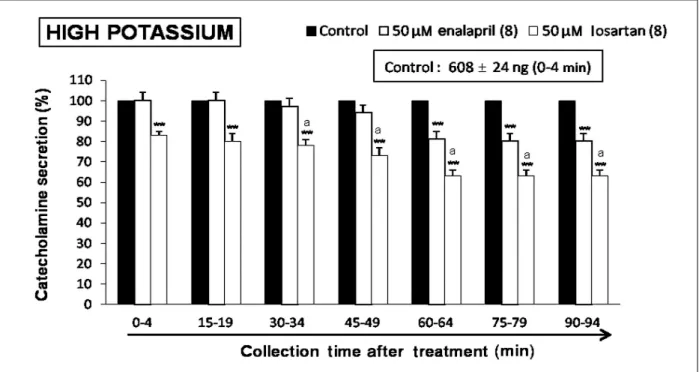
± 32 ng for 4 minutes. However, the pretreatment with enalapril (50 M) or losartan (50 M) for 90 minutes inμ μ - hibited ACh-evoked CA secretion in time-dependent manner. As shown in Fig. 1, in the presence of enalapril or losartan, ACh-evoked CA releasing responses were in- hibited maximally by 85% and 68% of the corresponding control release, respectively. Also, it has been found that a depolarizing agent, high K+ stimulates CA secretion (608 ± 24 ng for 0 to 4 minutes). However, in the pres- ence of enalapril (50 M) or losartan (50 M), excess Kμ μ + (56 mM)-evoked CA secretion was significantly inhibited
Hyo-Jeong Lim ․ Young-Youp Koh ․ Dong-Yoon Lim
Fig. 1. Time-course effects of losartan or enalapril on the secretory responses of CA evoked by acetylcholine from the isolated perfused rat adrenal glands. The CA secretion by a single injection of (ACh, 5.32 × 10⁻³M) in a volume of 0.05 mL was evoked at 15 minutes intervals during loading with losartan (50 μM) or enalapril (50 μM) for 90 minutes as indicated by the arrow marks. Columns and vertical lines represent mean ± standard error. Numbers in the parenthesis indicate number of rat adrenal glands. Ordinate: the amounts of CA secreted from the adrenal gland (% of control).
Abscissa: collection time of perfusate (minutes). Statistical difference was obtained by comparing the corresponding control with losartan- or enalapril-treated group (**), and by comparing the losartan-treated group with enalapril-treated group (a). ACh-induced perfusates were collected for 4 minutes. **p < 0.01, ap < 0.05. CA, catecholamines; ACh, acetylcholine.
Fig. 2. Time-course effects of losartan or enalapril on high potassium-evoked catecholamines (CA) secretion from the isolated perfused rat adrenal glands. The CA secretion by a single injection of high potassium (56 mM) in a volume of 0.05 mL was evoked at 15 minutes intervals during loading with losartan (50 μM) or enalapril (50 μM) for 90 minutes as indicated by the arrow mark. Other legends are the same as in Fig. 1. High potassium-induced perfusates were collected for 4 minutes. **p < 0.01, ap < 0.05.
by 80% and 63% of the control release, respectively (Fig.
2). When perfused through the rat adrenal gland, DMPP (10-4 M), which is a selective neuronal nicotinic receptor agonist, evoked a sharp and rapid increase in CA secre- tion (1,272 ± 38 ng for 0 to 8 minutes). However, as shown in Fig. 3, DMPP-evoked CA secretion during treatment with enalapril or losartan was reduced to 88%
and 71% of the control release, respectively. McN-A-343 (10-4 M), which is a selective muscarinic M1-agonist,19) perfused into an adrenal gland for 4 minutes caused an increased CA secretion (520 ± 27 ng for 0 to 4 minutes).
However, McN-A-343-evoked CA secretion in the pres- ence of enalapril or losartan was markedly depressed to 80% and 67% of the corresponding control secretion, re- spectively (Fig. 4).
Since Hano et al.20) have suggested that Ang II increase EP release from the adrenal medulla via the AT1 re- ceptors, we examined the effect of enalapril or losartan
on Ang II-evoked CA secretion. Ang II (100 nM) sig- nificantly increased the CA secretory response (571 ± 38 ng for 0 to 4 minutes), while in the presence of enalapril (15 M) or losartan (15 M), Ang II-evoked CA secreμ μ - tion was greatly inhibited to 81% and 46% of the corre- sponding control secretion, respectively (Fig. 5).
Interestingly, as shown in Figs. 1-5, there was sig- nificantly statistical difference in inhibitory effect be- tween enalapril and losartan on the CA secretion evoked ACh, high K+, DMPP, McN-A-343, and Ang II, indicat- ing that losartan is more potent inhibitory effect on the CA secretion that enalapril.
2. Effects of enalapril and losartan on catecholamine secretion evoked by BAY-K-8644, cyclopiazonic acid, and veratridine from the perfused rat adrenal medulla
It was of interest to determine the effects of enalapril
Fig. 3. Time-course effects of losartan or enalapril on 1.1-dimethyl-4 -phenyl piperazinium iodide (DMPP)-evoked catecholamines (CA) secretion from the isolated perfused rat adrenal glands. The CA secretion by perfusion of DMPP (10-4M) for 2 minutes was induced at 20 minutes intervals during loading with losartan (50 μM) or enalapril (50 μM) for 90 minutes as indicated by the arrow mark. DMPP-induced perfusates were collected for 8 minutes. Other legends are the same as in Fig. 1.*p < 0.05, **p < 0.01, ap < 0.05.
Hyo-Jeong Lim ․ Young-Youp Koh ․ Dong-Yoon Lim
Fig. 4. Time-course effects of losartan or enalapril on McN-A-343-evoked catecholamines (CA) secretion from the isolated perfused rat adrenal glands. The CA secretion by perfusion of 3-(m-chlloro-phenyl- carbamoyl-oxy-2-butynyl-trimethyl ammonium chloride (McN-A-343, 10-4M) for 4 minutes was induced at 15 minutes intervals during loading with losartan (50 μM) or enalapril (50 μM) for 90 minutes as indicated by the arrow mark. McN-A-343-induced perfusates were collected for 4 minutes. Other legends are the same as in Fig. 1. *p < 0.05, **p < 0.01. ap< 0.05, bp
< 0.01.
Fig. 5. Time-course effects of losartan or enalapril on angiotensin II-evoked catecholamines (CA) secretion from the perfused rat adrenal glands.
The CA secretion by perfusion of angiotensin II (10-7 M) for 4 minutes was induced at 15 minutes intervals during loading with losartan (15 μM) or enalapril (15 μM) for 90 minutes as indicated by the arrow mark. Angiotensin II-induced perfusates were collected for 4 minutes. Other legends are the same as in Fig. 1. **p < 0.01. bp < 0.01.
or losartan on BAY-K-8644-stimulated CA secretion from the isolated perfused rat adrenal glands, since BAY-K-8644 is known to be a calcium channel activator, which enhances basal Ca2+ uptake21) and CA release.22) BAY-K-8644 (10-5 M)-stimulated CA secretion in the presence of enalapril (15 M) or losartan (15 M) was μ μ inhibited to maximally 82% and 73% of the control as compared to the corresponding control release (619 ± 28 ng for 0 to 4 minutes), respectively (Fig. 6).
Cyclopiazonic acid, a mycotoxin from Aspergillus and Penicillium, has been described as a highly selective in- hibitor of Ca2+-ATPase in skeletal muscle sarcoplasmic reticulum.23,24) The inhibitory action of enalapril or los- artan on cyclopiazonic acid-evoked CA secretory re- sponse was observed as shown in Fig. 7. In the presence of enalapril (15 M) or losartan (15 M) in 8 rat adrenal μ μ glands, cyclopiazonic acid (10-5 M)-evoked CA secretion was significantly depressed by 85% and 72% of the con- trol secretory response (536 ± 22 ng for 0 to 4 minutes), respectively.
It has also been known that veratridine-induced Na+ in- flux mediated through Na+ channels increased Ca2+ influx via activation of voltage-dependent Ca2+ channels and produced the exocytotic secretion of CA in cultured bo- vine adrenal medullary cells.25) To characterize the phar- macological action of enalapril and losartan on volt- age-dependent Na+ channels, the effect of enalapril and losartan on the CA secretion induced by veratridine was examined here. As shown in Fig. 8, veratridine greatly produced CA secretion (1,244 ± 24 ng for 0 to 4 mi- nutes). However, in the presence of enalapril (15 M) μ and losartan (15 M), veratridine (100 M)-evoked CA μ μ secretion was inhibited to 90% and 68% of the corre- sponding control release in a time-dependent fashion.
Moreover, there was also statistical difference in in- hibitory effect between enalapril and losartan on the CA secretion evoked BAY-K-8644, cyclopiazonic acid, and
veratridine, as shown in Figs. 6-8. These results demon- strate that losartan shows more potent inhibitory effect on the CA secretion that enalapril.
3. Effects of enalapril plus losartan on
ACh-evoked catecholamine secretion from the perfused rat adrenal medulla
In the present work, enalapril or losartan caused in- hibition in the CA secretion by cholinergic receptor stim- ulation as well as by Ang II from the perfused rat adre- nal gland. Therefore, in order to establish the combined effects of enalapril and losartan on ACh-evoked CA re- lease, we tried to examine enalapril plus losartan-induced inhibitory effects on CA secretion evoked by ACh.
In the simultaneous presence of enalapril (50 M) and μ losartan (50 M) μ for 90 minutes, Ang II (100 nM)-e- voked CA release more slightly inhibited to about 57%
of the corresponding control release (1,261 ± 32 ng for 0 to 4 minutes), compared to the inhibitory effect in- duced by enalapril or losartan alone as shown in Fig. 9.
Also, there was statistical difference in inhibitory effect on ACh-evoked CA secretion between enalapril versus losartan as well as enalapril versus losartan + enalapril, as shown in Fig. 9.
Discussion
The rennin-angiotensin system plays a crucial role in regulation of blood pressure (BP). The primary effector peptide Ang II behaves at two receptors, AT1 and AT2. The AT1 receptor mediates functions like vasoconstriction and aldosterone secretion while the AT2 receptor medi- ates vasodilatation and natriuresis. ACEIs inhibit biosyn- thesis of Ang II whereas ARBs completely block AT1 re- ceptors, and both are effective antihypertensive agents.
But, currently, there is a constant controversy over the comparative efficacy of ACEIs and ARBs due to the pos- sibility of Ang II generation by alternative pathways with
Hyo-Jeong Lim ․ Young-Youp Koh ․ Dong-Yoon Lim
Fig. 6. Time-course effects of losartan or enalapril on 6-dimethyl-3-nitro-4-(2-trifluoromethyl-phenyl)-pyridine-5-carboxylate (BAY-K- 8644)-evoked catecholamines (CA) secretion from the perfused rat adrenal glands. The CA secretion by perfusion of BAY-K-8644 (10-5M) for 4 minutes was induced at 15 minutes intervals during loading with losartan (15 μM) or enalapril (15 μM) for 90 minutes as indicated by the arrow mark. Bay-K-8644-induced perfusates were collected for 4 minutes. Other legends are the same as in Fig. 1. **p < 0.01, bp < 0.01.
Fig. 7. Time-course effects of losartan or enalapril on cyclopiazonic acid-evoked catecholamines (CA) secretion from the perfused rat adrenal glands. The CA secretion by perfusion of cyclopiazonic acid (10-5M) for 4 minutes was induced at 15 minutes intervals during loading with losartan (15 μM) or enalapril (15 μM) for 90 minutes as indicated by the arrow mark. Cyclopiazonic acid-induced perfusates were collected for 4 minutes.
Other legends are the same as in Fig. 1. *p < 0.05, **p < 0.01, bp < 0.01.
Fig. 9. Comparative time-course effects of losartan, enalapril and losartan + enalapril on acetylcholine-evoked catecholamines (CA) secretion from the perfused rat adrenal glands. The CA secretion by a single injection of acetylcholine chloride (5.32 × 10⁻³ M) in a volume of 0.05 mL was evoked at 15 minutes intervals during loading with losartan (50 μM) or enalapril (50 μM), losartan (50 μM) + enalapril (50 μM) for 90 minutes as indicated by the arrow mark. Acetlcholine-induced perfusates were collected for 4 minutes. Other legends are the same as in Fig. 1. **p < 0.01 enalapril-treated group vs. losartan-treated group or enalapril + losartan-treated group.
Fig. 8. Time-course effects of losartan or enalapril on veratridine-evoked catecholamines (CA) secretion from the perfused rat adrenal glands.
The CA secretion by perfusion of veratridine (10-5 M) for 4 minutes was induced at 15 minutes intervals during loading with losartan (15 μM) or enalapril (15 μM) for 90 minutes as indicated by the arrow mark. Veratridine-induced perfusates were collected for 4 minutes. Other legends are the same as in Fig. 1. *p < 0.05, **p < 0.01, bp < 0.01.
Hyo-Jeong Lim ․ Young-Youp Koh ․ Dong-Yoon Lim
the use of ACEIs. Hence, ARBs are said to inhibit the activation of AT1 receptors more effectively than ACEIs.
Therefore, the present study was designed to compare the inhibitory effects of ACEIs with ARBs on adrenal CA secretion. As a prototype and widely used ACEI, enalap- ril was taken for comparison with losartan, which is also prototype ARB and a competitive antagonism at Ang II receptors.
The present study has demonstrated that both enalapril and losartan inhibit the CA secretory responses evoked by activation of both cholinergic and Ang II receptors as well as by direct membrane depolarization in the per- fused model of the isolated rat adrenal medulla. Based on the same concentration used in this study, it seems that the inhibitory effect of losartan on the CA secretion is more potent than that of enalapril. However, when ena- lapril and losartan were given in combination, their in- hibitory effects on ACh-evoked CA secretion were po- tentiated, which may also be clinically advantageous in treatment of cardiovascular diseases. In support of this idea, our study showed that both losartan and enalapril retrogradely perfused into the adrenal medulla sig- nificantly diminished the CA release evoked by chol- inegic stimulation, such as administration of ACh, DMPP (a selective neuronal nicotinic receptor agonist), and McN-A-343 (a selective muscarinic M1 receptor agonist).
However, enalapril showed lower potency in the in- hibitory effect on the CA release compared to losartan.
Previously published experimental work where the adrenal gland has been pharmaceutically stimulated has involved the direct administration of Ang II into the gland via the adrenal artery.26-29) In the present study, Ang II was also administered via the adrenal vein, which resulted in greatly increases in CA release. In compar- ison, direct administration of cholinergic secretagogues such as ACh, DMPP, and McN-A-343 into the gland re-
sulted in much greater increases. However, we did not measure the systemic levels of circulating CA, because the isolated perfused model of the rat adrenal medulla was used in this study. Data from Yamaguchi et al.29) have suggested that adrenal blood levels of basal NE re- lease are 10 times and EP release are 100 times greater than their systemic circulation counterparts. Thus, any systemic contribution during direct stimulation of the adrenal medulla would be of little consequence, as adre- nal CA release is magnitudes greater than the circulating level.
The main reason for using Ang II in the present study was to demonstrate that the perfusion of losartan was pharmacologically active. However, as enalapril acts via a different pathway, blocking the conversion of Ang, the use of Ang II to determine the activity of the preparation of enalapril was inappropriate to compare with that of losartan. Previously, Cavadas et al.30) have demonstrated that AT1 stimulation induces CA secretion from human adrenal chromaffin cells probably by raising cytosolic calcium in primary cultures of human adrenal chromaffin cells.
In this study, losartan and enalapril did not increase basal CA release in this study (data not shown). Also, in other studies where direct drug administration into the adrenal gland has been used, no increase in basal CA re- lease has been reported.29) However, it has been found that the systemic administration of candesartan and ram- ipril increased basal CA release.31) But the systemic ad- ministration of both candesartan and ramipril resulted in quite significant decreases in blood pressure.31) This fall in blood pressure would have been expected to cause some degree of sympathetic response with accompanying release of systemic CAs, predominantly NE from the sympathetic nerve endings. Thus, circulating CAs could have reached levels high enough to influence the adrenal
vein collection.
Losartan may act locally by inhibiting this regulation by blocking the Ang II receptor on the chromaffin cell, while enalapril prevents local conversion of Ang to its active form. Thus, both drugs may act by inhibiting ele- vation of CA release by inhibiting local RAAS modulation. In the present study, it has been shown that these two drugs also have an additive effect as the reduc- tion in the ACh-evoked CA release following their ad- ministration decreased from 15-32% to 57%. This addi- tive effect may be of benefit when treating cardiovascular diseases, such as hypertension or heart failure. Both los- artan and enalapril had inhibitory effects on cholinergic stimulation-evoked CA release evoked by ACh, DMPP and McN-A-343. However, Ang converting enzyme in- hibitors, such enalapril, because they share a common pathway, are known to cause bradykinin accumulation, which has the potential to cause cough.32) Thus, losartan may be advantageous over enalapril because it does not cause cough.
In light of these results, both losartan and enalapril in- hibited cholinergic receptor-stimulated CA release and the most likely explanation seems to be blockade of local modulation by RAAS. This effect may prove beneficial when treating hypertension and heart failure. Enalapril is weaker than losartan in inhibiting CA release evoked by stimulation of cholinergic (both nicotinic and muscarinic) receptors as well as Ang II receptors. In previously pub- lished studies, it has been shown that telmisartan pro- duces a greater reduction in diastolic BP than enalapril and is free from the adverse-effect of dry cough that is commonly encountered with enalapril in patients of es- sential hypertension.33) In hypertensive patients, telmi- sartan was more effective than ACEIs (enalapril, peri- ndopril, ramipril) in BP control and had fewer adverse events than all the included four ACEIs. The ARB telmi-
sartan is more recommendable than the analyzed ACEIs as far as its lowering BP effect is concerned.34) Despite similar BP control between enalapril and telmisartan in hypertensive patients, telmisartan attenuated autonomic balance more effectively than enalapril. But no differ- ences between both drugs in plasma CA were observed.35) Based on the literature included in review, telmisartan and enalapril produced comparable reductions in BP in a broad range of patients with hypertension.
Telmisartan appeared to have a better tolerability profile.36) In terms of these findings, losartan (ARB) also seems to be more powerful in the inhibitory effects on adrenal CA secretion compared to enalapril (ACEI).
In the present study, losartan or enalapril also depressed the CA secretory response evoked by BAY-K-8644, which is known to activate L-type voltage-dependent Ca2+ channels, in a time-dependent manner.21,37) This re- sult indicates that losartan or enalapril may inhibit Ca2+
influx into the rat adrenomedullary cells. In support of this idea, in cultured bovine adrenal medullary cells, nic- otinic (but not muscarinic) receptors mediate the Ca2+-de- pendent secretion of CA.38,39) It has also been known that the activation of nicotinic receptors stimulates the CA se- cretion by increasing Ca2+ entry through receptor-linked and/or voltage-dependent Ca2+ channels in both perfused rat adrenal glands40,41) and isolated bovine adrenal chro- maffin cells.42-44) Wada et al.45) have found that the adre- nomedullary chromaffin cells have 1) nicotinic re- ceptor-associated ionic channels, responsible for carba- chol-induced Na+ influx, 2) voltage-dependent Na+ chan- nels, responsible for veratridine-induced Na+ influx, and 3) voltage-dependent Ca2+ channels, suggesting that the influx of Na+ caused either by carbachol or by veratridine leads to activate voltage-dependent Ca2+ channels by al- tering membrane potentials, whereas high K+ directly ac- tivates voltage-dependent Ca2+ channels without increas-
Hyo-Jeong Lim ․ Young-Youp Koh ․ Dong-Yoon Lim
ing Na+ influx. In the present study, the finding that high K+-induced CA secretory response was depressed by pre- treatment with losartan or enalapril indicates that this in- hibitory effect of losartan or enalapril is exerted by in- hibiting Ca2+ influx into the adrenomedullary cells through the blockade of voltage-dependent Ca2+ channels.
Furthermore, slight elevation in the extracellular potas- sium concentration increases both the frequency of spon- taneous action potentials and the secretion of CA,46) sug- gesting that the influx of Ca2+ that occurs during action potentials is directly linked to the rate of secretion. These findings that losartan or enalapril inhibited the CA secre- tion evoked by BAY-K-8644 as well as by high K+ sug- gest that losartan or enalapril directly inhibits the volt- age-dependent Ca2+ channels. But losartan also elicited more potent inhibitory effects on the CA release evoked by BAY-K-8644 and high potassium than that of enalapril. In accordance with these findings, in the bovine chromaffin cells, stimulation of nicotinic, but not muscar- inic ACh receptors is known to cause CA secretion by increasing Ca2+ influx largely through voltage-dependent Ca2+ channels.47,48) Therefore, the finding that losartan or enalapril inhibited the ACh- and DMPP-evoked CA se- cretion seems to be associated with inhibition of Ca2+ in- flux through voltage-dependent Ca2+ channels. Losartan also more potently inhibited the CA secretion evoked by DMPP and ACh compared to that of enalapril.
The present study has also shown that losartan or ena- lapril also inhibits the CA secretion evoked by cyclo- piazonic acid. Cyclopiazonic acid is known to be a high- ly selective inhibitor of Ca2+-ATPase in skeletal muscle sarcoplasmic reticulum23,24) and a valuable pharmaco- logical tool for investigating intracellular Ca2+ mobi- lization and ionic currents regulated by intracellular Ca2+.49) It has been shown that Ca2+-uptake into intra- cellular storage sites susceptible to caffeine50) is almost
completely abolished by treatment with cyclopiazonic acid during the proceeding of Ca2+ load.49) This is con- sistent with the findings obtained in exposed smooth muscle fibers of the longitudinal layer of the guinea-pig ileum, where Ca2+-uptake was also inhibited by cylopia- zonic acid.51) Suzuki et al.49) have shown that cyclo- piazonic acid easily penetrates into the cytoplasm through the plasma membrane and reduces Ca2+-ATPase activity in sarcoplasmic/endoplasmic reticulum, resulting in in- crease in the subsequent Ca2+ release from those storage sites. Moreover, in bovine adrenal chromaffin cells, stim- ulation of muscarinic ACh receptors is also proposed to cause activation of phosphoinositide metabolism, result- ing in the formation of inositol 1,4,5-trisphosphate, which induces the mobilization of Ca2+ from the intracellular pools.52,53) Therefore, in the present work, it can be speculated that the inhibitory effect of losartan or enalap- ril on CA secretion evoked by McN-A-343 may be asso- ciated with the mobilization of intracellular Ca2+ from the cytoplasmic calcium store. This indicates that the losartan or enalapril has an inhibitory effect on the release of Ca2+
from the intracellular pools induced by stimulation of muscarinic ACh receptors, which is weakly responsible for the secretion of CA. The present results suggest that losartan or enalapril-induced inhibition of the CA secre- tion evoked by McN-A-343 and cyclopiazonic acid may be due to the inhibition of Ca2+ release evoked by stim- ulation of muscarinic ACh receptors from the intra- cellular pools. However, in the present study, it is un- certain whether the inhibitory effect of losartan or ena- lapril on Ca2+ movement from intracellular pools is due to its direct effect on the phosphatidyl inositol response or the indirect effects. Further studies are needed to in- vestigate the true nature of these findings.
In the present study, when both two drugs were com- bined, their inhibitory effect on ACh-evoked CA release
was elevated. In support of this idea, the los- artan-enalapril combination is more effective in decreas- ing blood pressure and increasing plasma active renin than doubling of the enalapril dose in normotensive male volunteers.54) Since synergy was observed only after com- bining low doses of ramipril and candesartan-cilexetil in spontaneously hypertensive rats, prospective clinical trials should be performed on a low-dose combination, reveal- ing the antihypertensive/antiproliferative benefits.55) Moreover, some recent studies have reported that the combination of two agents, ACEi and ARB, that inhibit two consecutive steps, promotes a decrease in myocardial fibrosis and left ventricular hypertrophy.56-59) In addition, experimental and clinical studies indicate that the combi- nation of low doses of ACEi and ARB have a synergic and most effectiveness on left ventricular hypertrophy.55,60) Based on these results, the clinically combined use of both losartan and enalapril may contribute greatly to the improvement of cardiovascular diseases such as hyper- tension, heart failure and angina pectoris.
In conclusion, the results of the present study have demonstrated that both losartan and enalapril inhibits the CA secretion by stimulation of cholinergic nicotinic re- ceptors as well as by membrane depolarization in the per- fused rat adrenal medulla. It is thought that this in- hibitory effect of losartan or enalapril is exerted by blocking influx of both ions through Ca2+ and Na+ chan- nels into the adrenomedullary cells as well as by block- ing the release of Ca2+ from the cytoplasmic calcium store, which are at least partly due to the blockade of lo- cal modulation by rennin-Ang system. Based on the same concentration used in the present study, it seems that los- artan-induced inhibitory effect on CA release is more po- tent than enalapril-induced effect. The combined use of both two drugs may contribute greatly to the improve- ment of cardiovascular diseases such as hypertension,
heart failure and angina pectoris, through inhibition of the CA secretion from adrenomedullary chromaffin cells and consequent reduction of the CA level in the circulation.
Summary
목적: 본 연구는 흰쥐부신의 관류모델에서 카테콜아민
분비에 대한
(catecholamines, CA) 안지오텐신 II (angiotensin
전환효소억제제인 과
II, Ang II) enalapril 안지오텐신Ⅱ
수용체 차단제인 losartan의 억제작용을 비교하는데 목적
이 있다.
방법: 부신을 적출하여 Krebs-bicarbonate 액으로 관류
하였으며 CA는 형광분석기를 이용하여 직접 측정하였다.
결과: Enalapril과 losartan은 다 같이 부신정맥 내로 90 분간 관류하는 동안 아세틸콜린(acetylcholine, ACh), 선택 성 Nn 수용체 작용제(1.1-dimethyl-4-phenyl piperazinium, DMPP), 고칼륨 직접 막탈분극제( ), 선택성 M1 수용체 작 용제(3-(m-chloro-phenyl-carbamoyl-oxy-2-butynyl-tri- methyl ammonium, McN-A-343) 및 Ang II에 의한 CA분 비작용을 시간의존적으로 억제하였다 또한 . enalapril이나
존재상태에서 전압의존성 통로 활성
losartan veratridine( Na
화제), L형 칼슘통로활성화제(6-dimethyl-3-nitro-4-(2-tri- fluoromethyl-phenyl)-pyridine-5-carboxylate, BAY-K-8644),
세포질내형질세망
cyclopiazonic acid( Ca2+ ATPase 억제 제 에 의한 ) CA분비가 유의하게 억제되었다. Enalapril과
의 동일 농도를 근거로 보면 고칼륨
losartan , ACh, , DMPP,
McN-A-343, Ang , veratridine, BAY-K-8644 Ⅱ 및 cyclo-
의 분비에 대한 억제작용을 비교하면
piazonic acid CA
이다 과 동시 존재상
losartan >enalapril . Enalapril losartan
태에서 ACh의 CA분비작용은 enalapril이나 losartan 단독 처치의 경우에 비교하여 현저히 억제되었다.
결론: 위의 결과를 종합하여보면, enalapril과 losartan은 흰쥐관류 부신수질에서 콜린수용체 및 AngII수용체(Ang
II type-1) 흥분에 의한 CA분비를 다 같이 억제하며 두 , 약물은 병용시 억제효과가 상승되었으며 이는 임상적으
로 유용하다고 생각된다 본 연구에서 사용한 농도를 근.
Hyo-Jeong Lim ․ Young-Youp Koh ․ Dong-Yoon Lim
거로 보면 CA분비에 대한 losartan의 억제작용이 enalap- 보다 더욱 강력한 것으로 생각된다
ril .
Conflict of interest
No potential conflict of interest relevant to this article was as reported.
Acknowledgements
This study was supported partly by Academic-Industrial Cooperative Research Fund of Korean Society of Hypertension (2010).
References
1. Douglas WW, Poisner AM. Stimulation of uptake of cal- cium-45 in the adrenal gland by acetylcholine. Nature.
1961;192:1299.
2. Wilson SP, Kirshner N. The acetylcholine receptor of the adrenal medulla. J Neurochem. 1977;28:687-95.
3. Holz RW, Senter RA, Frye RA. Relationship between Ca2+
uptake and catecholamine secretion in primary dissociated cultures of adrenal medulla. J Neurochem. 1982;39:635-46.
4. Gavras I, Gavras H. Angiotensin II-possible adverse effects on arteries, heart, brain, and kidney: experimental, clinical, and epidemiological evidence. In: Robertson JI, Nicholls MG, editors. The renin-angiotensin system. London: Gower Medical Publishing, 1993: 40.
5. Nap A, Balt JC, Mathy MJ, Van Zwieten PA. AT(1)-receptor blockade and sympathetic neurotransmission in car- diovascular disease. Auton Autacoid Pharmacol. 2003;23:
285-96.
6. Feldberg W, Lewis GP. The action of peptides on the adrenal medulla: release of adrenaline by bradykinin and angiotensin.
J Physiol. 1964;171:98-108.
7. Chulak C, Couture R, Foucart S. Modulatory effect of brady- kinin on the release of noradrenaline from rat isolated atria. Br J Pharmacol. 1995;115:330-4.
8. Rump LC, Berlit T, Schwertfeger E, Beyersdorf F, Schollmeyer P, Bohmann C. Angiotensin converting enzyme inhibition unmasks the sympathofacilitatory effect of brady- kinin in human right atrium. J Hypertens. 1997;15:1263-70.
9. Starke K, Peskar BA, Schumacher KA, Taube HD.
Bradykinin and postganglionic sympathetic transmission.
Naunyn Schmiedebergs Arch Pharmacol. 1977;299:23-32.
10. Franchi F, Lazzeri C, Foschi M, Tosti-Guerra C, Barletta G.
Cardiac autonomic tone during trandolapril-irbesartan low-dose combined therapy in hypertension: a pilot project. J Hum Hypertens. 2002;16:597-604.
11. Karas M, Lacourciere Y, LeBlanc AR, Nadeau R, Dube B, Florescu M, et al. Effect of the renin-angiotensin system or calcium channel blockade on the circadian variation of heart rate variability, blood pressure and circulating catechol- amines in hypertensive patients. J Hypertens. 2005;23:
1251-60.
12. Sakata K, Yoshida H, Obayashi K, Ishikawa J, Tamekiyo H, Nawada R, et al. Effects of losartan and its combination with quinapril on the cardiac sympathetic nervous system and neu- rohormonal status in essential hypertension. J Hypertens.
2002;20:103-10.
13. Balt JC, Mathy MJ, Pfaffendorf M, van Zwieten PA.
Inhibition of angiotensin II-induced facilitation of sym- pathetic neurotransmission in the pithed rat: a comparison be- tween losartan, irbesartan, telmisartan, and captopril. J Hypertens. 2001;19:465-73.
14. Randa HD. Renin and angiotensin. In: Brunton LL, Bruce AC, Bjorn CK, editors. Goodman and Gilman’s the pharma- cological basis of therapeutics. 12th ed. New York:
McGraw-Hill, Health Publishing Division, 2011: 721-44.
15. Ball SG, White WB. Debate: angiotensin-converting enzyme inhibitors versus angiotensin II receptor blockers--a gap in evidence-based medicine. Am J Cardiol. 2003;91(10A):
15G-21G.
16. Wakade AR. Studies on secretion of catecholamines evoked by acetylcholine or transmural stimulation of the rat adrenal gland. J Physiol. 1981;313:463-80.
17. Anton AH, Sayre DF. A study of the factors affecting the alu- minum oxide-trihydroxyindole procedure for the analysis of catecholamines. J Pharmacol Exp Ther. 1962;138:360-75.
18. Tallarida RJ, Murray RB. Manual of pharmacologic calcu- lation with computer programs. 2nd ed. New York:
Springer-Verlag, 1987: 110-20, 131-6.
19. Hammer R, Giachetti A. Muscarinic receptor subtypes: M1 and M2 biochemical and functional characterization. Life Sci. 1982;31:2991-8.
20. Hano T, Mizukoshi M, Baba A, Nakamura N, Nishio I.
Angiotensin II subtype 1 receptor modulates epinephrine re- lease from isolated rat adrenal gland. Blood Press Suppl.
1994;5:105-8.
21. Garcia AG, Sala F, Reig JA, Viniegra S, Frias J, Fonteriz R, et al. Dihydropyridine BAY-K-8644 activates chromaffin cell calcium channels. Nature. 1984;309:69-71.
22. Lim DY, Kim CD, Ahn KW. Influence of TMB-8 on secretion of catecholamines from the perfused rat adrenal glands. Arch Pharm Res. 1992;15:115-25.
23. Goeger DE, Riley RT. Interaction of cyclopiazonic acid with rat skeletal muscle sarcoplasmic reticulum vesicles. Effect on Ca2+ binding and Ca2+ permeability. Biochem Pharmacol.
1989;38:3995-4003.
24. Seidler NW, Jona I, Vegh M, Martonosi A. Cyclopiazonic acid is a specific inhibitor of the Ca2+-ATPase of sarcoplas- mic reticulum. J Biol Chem. 1989;264:17816-23.
25. Wada Y, Satoh K, Taira N. Cardiovascular profile of Bay K 8644, a presumed calcium channel activator, in the dog.
Naunyn Schmiedebergs Arch Pharmacol. 1985;328:382-7.
26. Martineau D, Yamaguchi N, Briand R. Inhibition by BMS 186295, a selective nonpeptide AT1 antagonist, of adrenal cat- echolamine release induced by angiotensin II in the dog in vivo. Can J Physiol Pharmacol. 1995;73:459-64.
27. Martineau D, Briand R, Yamaguchi N. Functional evidence for L-type Ca2+ channels controlling ANG II-induced adre- nal catecholamine release in vivo. Am J Physiol. 1996;271(6 Pt 2):R1713-9.
28. Martineau D, Lamouche S, Briand R, Yamaguchi N.
Functional involvement of angiotensin AT2 receptor in adre- nal catecholamine secretion in vivo. Can J Physiol Pharmacol. 1999;77:367-74.
29. Yamaguchi N, Martineau D, Lamouche S, Briand R.
Functional role of local angiotensin-converting enzyme (ACE) in adrenal catecholamine secretion in vivo. Can J Physiol Pharmacol. 1999;77:878-85.
30. Cavadas C, Grand D, Mosimann F, Cotrim MD, Fontes Ribeiro CA, Brunner HR, et al. Angiotensin II mediates cat- echolamine and neuropeptide Y secretion in human adrenal chromaffin cells through the AT1 receptor. Regul Pept.
2003;111:61-5.
31. Critchley L, Ding B, Fok B, Wang D, Tomlinson B, James A, et al. The effects of candesartan and ramipril on adrenal cat-
echolamine release in anaesthetized dogs. Eur J Pharmacol.
2004;489:67-75.
32. Koji T, Onishi K, Dohi K, Okamoto R, Tanabe M, Kitamura T, et al. Addition of angiotensin II receptor antagonist to an ACE inhibitor in heart failure improves cardiovascular func- tion by a bradykinin-mediated mechanism. J Cardiovasc Pharmacol. 2003;41:632-9.
33. Akat PB, Bapat TR, Murthy MB, Karande VB, Burute SR.
Comparison of the efficacy and tolerability of telmisartan and enalapril in patients of mild to moderate essential hypertension. Indian J Pharmacol. 2010;42:153-6.
34. Zou Z, Xi GL, Yuan HB, Zhu QF, Shi XY. Telmisartan versus angiotension-converting enzyme inhibitors in the treatment of hypertension: a meta-analysis of randomized controlled trials. J Hum Hypertens. 2009;23:339-49.
35. Lewandowski J, Abramczyk P, Dobosiewicz A, Bidiuk J, Sinski M, Gaciong Z. The effect of enalapril and telmisartan on clinical and biochemical indices of sympathetic activity in hypertensive patients. Clin Exp Hypertens. 2008;30:423-32.
36. Smith DH. Treatment of hypertension with an angiotensin II-receptor antagonist compared with an angiotensin-convert- ing enzyme inhibitor: a review of clinical studies of telmi- sartan and enalapril. Clin Ther. 2002;24:1484-501.
37. Schramm M, Thomas G, Towart R, Franckowiak G. Novel di- hydropyridines with positive inotropic action through activa- tion of Ca2+ channels. Nature. 1983;303:535-7.
38. Fisher SK, Holz RW, Agranoff BW. Muscarinic receptors in chromaffin cell cultures mediate enhanced phospholipid la- beling but not catecholamine secretion. J Neurochem.
1981;37:491-7.
39. Yanagihara N, Isosaki M, Ohuchi T, Oka M. Muscarinic re- ceptor-mediated increase in cyclic GMP level in isolated bo- vine adrenal medullary cells. FEBS Lett. 1979;105:296-8.
40. Wakade AR, Wakade TD. Contribution of nicotinic and mus- carinic receptors in the secretion of catecholamines evoked by endogenous and exogenous acetylcholine. Neuroscience.
1983;10:973-8.
41. Lim DY, Hwang DH. Studies on secretion of catecholamines evoked by DMPP and McN-A-343 in the rat adrenal gland.
Korean J Pharmacol. 1991;27:53-67.
42. Kilpatrick DL, Slepetis RJ, Corcoran JJ, Kirshner N. Calcium uptake and catecholamine secretion by cultured bovine adre- nal medulla cells. J Neurochem. 1982;38:427-35.