http://dx.doi.org/10.7236/JIIBC.2013.13.6.289
JIIBC 2013-6-38
아케이드 게임비즈니스의 활성화를 통한 한국 게임산업의 글로벌 경쟁력 증진 방안에 관한 연구
A Study on the Promotion of Global Competitiveness of Korean Game Industry through Activation of Arcade Game business
김영욱
*, 장영현
**Young-Wook Kim, Young-Hyun Jang
요 약
아케이드 게임은 2000 년대 초기까지는 국내 게임시장의 대부분을 점유한 영향력 있고 수익성이 높은 게임 산업이었다 . 그러나 2006 년 국내 사행성 게임의 승률조작의 문제점과 심각한 중독성으로 인하여 대대적인 규제가 이 루어졌다 . 때문에 건전한 아케이드 게임까지 비즈니스에 타격을 입게 되었으며 이러한 영향으로 국내 아케이드 게임 은 현재까지도 재기가 불가능한 상황이 되었다 . 본 연구를 통하여 아케이드 게임의 고찰과 함께 국내 아케이드게임 산업의 현황을 분석하며 해외 아케이드 게임 시장의 성공사례를 참고하여 한국 아케이드 게임 산업의 재기 가능성과 세계 경쟁력을 향상 시킬 수 있는 방향성으로 , 인식전환과 기능성게임을 도입하는 대안 제시를 하여 , 국내 아케이드 게임 산업의 발전과 함께 한국의 게임 산업에 다양성과 유연성을 기반으로 하는 신규 비즈니스의 창출을 유도한다 .
Abstract Arcade game up until early 2000 had been highly influential and profitable industry that occupied most of the market share for the Korean domestic game industry. However, extensive and yet tightened restrictions were imposed to the industry in 2006 due to the problems of speculative games such as winning rate manipulation, serious addictiveness, and etc. This resulted in damaging healthy arcade game business and eventually caused it seemingly impossible to comeback up until now. This study is to address the current arcade game industry in Korea along with the best practices in other countries to come up with propositions for the comeback of domestic arcade game industry and improvement of competitiveness. Ultimately it is to develop diversification and flexibility and to induce new business opportunities in the domestic arcade game industry by proposing the ways to convert the bad perception and introduction of functional games.
Key Words : Arcade Game, Gambling, Game Business, Functional Game
*
정회원, 김포대학교, 멀티미디어과
**
정회원, 배화여자대학교, 스마트 IT학과
접수일자 : 2013년 12월 3일, 수정완료 : 2013년 12월 13일 게재확정일자 : 2013년 12월 13일
Received: 3 December, 2013 / Revised:13 December, 2013 / Accepted: 13 December, 2013
**
Corresponding Author: [email protected]
Dept of Smart IT, Baewha Women's University, Korea
Ⅰ. Introduction
Arcade game is commonly called games, in which a game console as H/W and game program as S/W are combined, can be easily found in any game centers.
It was introduced to Korea in 1900s and had been flourished until early 2000s.
In 2005, the representative speculative arcade game
called “Ocean story” came out. It was developed based
upon Pachinco, the renowned speculative gambling
machines as a motive. This game had become popular due to its simple control and monetization manner from game money to real money creating many addicts and problems including winning rate manipulation.
Because of the foregoing, the government started to crack down speculative games extensively in 2006, and enacted regulations on games with vague guidelines affecting healthy arcade games as well. Thereafter the arcade game industry encountered dramatic recession while the industry currently occupies the lowest market share in domestic game industry with barely no improvement.
Ⅱ. History and Analysis on Trend of Arcade Games
1. Development Status of Arcade Games Although the arcade game accounts for the lowest market share in domestic game industry, it was the majority one in the past.
The very first arcade game had started with mechanical type in the 18th century. “Table soccer”, in which it composed of woods, sawtooth, and metal components, is the representative mechanical game and one of the most successful examples. Then, “Pinball”
and “Pachinco” came out later, where winning or losing is not dependant on one's skill but luck creating a problem of speculation.
In 1930s, electric mechanical games, in which electric devices were added to mechanical game machine, were developed. In this game devices, one's game score, start of game, special effects and etc were displayed in automatic manner. Then, new games with new type of controller including “Shooting game” and
“Mole game” came out and became popular.
Video games came out next where a monitor was added to conventional game devices. The very first video arcade game was “Computer space” using a stick and button. It has the most similar framework of nowadays arcade game system. Thereafter, “Pong” had
made a great success in 1972 leading the arcade game gradually into industrialization. Then the famous games including “Galaga”, “Pac-man”, “Tetris” and etc came out and became popular. For quite a long time, the arcade game had accounted for overwhelming portion of the domestic game industry.
2. Corelation of Speculative Games and Arcade Games
Speculative games are the term, in which winning or losing is not dependant on one's skill rather on one's luck, creating mentally strong addictiveness.
The regulations regarding to this speculative acts can be viewed in 3 different manners. Firstly, criminal law shall be applied to the part of speculative acts including gambling and illegal lottery issuances whereas some may be subject to be legalized for permission base. Secondly, all speculative acts shall be banned and allowed only by strict permission system.
Lastly, all the speculative acts shall be liberalized, and the ones that have negative social impact shall be separately regulated
[5]-[8].
It is expected that over all liberalization may cause great negative impact from the social and economic aspects. It is highly probable that the secondary crimes together with serious physical and mental problems of players may occur since the game is too addictive.
However, a total ban is also not the best way to solve the problems while it is perceived to be the best way that in a certain boundary pursues both restrictions and improvement at the same time.
In 2010, the arcade game market slightly gained its share compared to the previous year. It was because arcade game makers had started to develop and service cross-platform games deviating from the conventional arcade platform
[9]-[12].
Recently fast-paced 3D or functional games have
been adopted to arcade games. Nonetheless, the reason
why the arcade game occupies only small portion of the
market is mainly that the numbers of game center have
been decreased. Being said, it is because a virtuous
circle is not properly working where game is developed, distributed and played by players
[13]-[14].
Continuation of this circumstances has led insufficient fund back-up, and lack of information resulting in having trouble in export as well. However, the most important reason for this recession is the vague regulations on speculative games.
In the past, the arcade game had gained its popularity and grown with high growth rate. The gift card system had been adopted to enhance the game industry's development from 2002. Any new game center could conduct business with voluntary registration and without any legit procedures from 2003
[15]-[17].
This series of regulation became the ground for increasing adult game center and for illegal game centers to be dramatically increased in a fast rate. In 2006, the number of adult game centers had increased explosively and caused “Ocean story” controversy leading to imposition of strong regulations on speculative games. Together with controversy on the speculation, this event resulted in turning public perception on the arcade games into very negative.
3. Analysis on Current Status of Korea's Arcade Games
After the “Ocean story” incident in 2006, the public perception towards the arcade games has been very negative and unhealthy rather than it is a resting place for culture experience or escaping from stress. Due to the foregoing, the arcade game market has been regressed in a great degree.
In projection for arcade game business outlook, 64.8% predicts negative outlook for the industry. 45%
relates to confusing relevant policies and regulations, and 33.3% for decreasing in consumers' interest in playing arcade games due to the changes in customer's taste.
There have been many growing opinions insisting that the healthy arcade games are in need of support for diversification and export along with development
of domestic game industry through government budget support and improvement of the relevant system on the arcade game industry.
According to the statistics of the Game White Paper in 2011, The arcade game and game center s accounted for the largest portion in the game market in 2006, but started to dramatically decrease from 2007 whereas the online game industry took its place and accounted for 84% of the entire game market
[4].
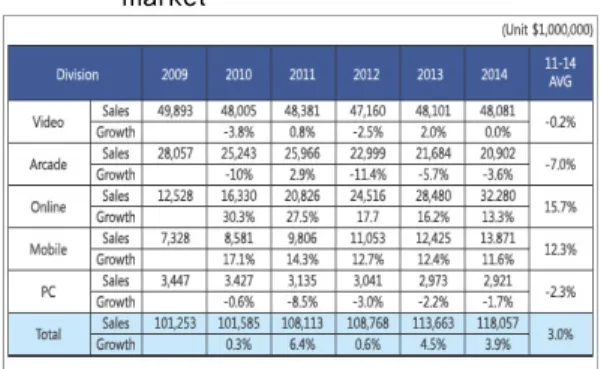
Based on this analysis, Table 1 shows that arcade games are recorded the biggest negative growth rate in 2010 and from 2012 to 2014.
Otherwise, Online and mobile games are recorded the biggest positive growth rate from 2011 to 2014.
표 1. 세계 게임 시장 판매량 및 성장률
Table 1. Sales and Growth for World game market
Online games and mobile games have gained its M/S every year whereas arcade games have relatively lost its ground. It is believed that extensive scale promotion is needed for arcade games, which have continued its strong presence in other counties, to regain its domestic business opportunities and diversification, and to change consumers perspective.
Ⅲ. Analysis on Overseas Game Industry and Revitalization Measure for Domestic Arcade Games
1. Current Status of Overseas Arcade Games
Currently “video games” accounted for the biggest
pie in M/S for worldwide game platform followed by
“arcade games”. However, the market share is expected to display dramatic changes in coming years due to “mobile games” geared up with fast growing rate every year along with increasing numbers of smart phones, and “online games”, which has the fastest growing rate.
One of the important points to be addressed in the Game White Paper in 2011 is that the world arcade game market is the second largest in the entire game market.
Table 2 shows that arcade game is particularly overwhelming in japan. The arcade game ranked the second in Europe and the United States
표 2. 세계 게임 시장 지역별 점유율 (2010)
Table 2. Regional Share of World Game Market (2010)
In the research, korea has shown strong growth in online games whereas the M/S for domestic arcade games was the lowest. It is believed that the regulations on game industry have played a role as development obstacle resulting in low business feasibility and decrease in numbers of game centers.
2. Trend in Overseas Arcade Game Business
Nowadays game centers have broken from the conventional image that “it is simply a place for playing games”, and turned their images into “family entertainment center(FEC hereinafter)”, which is healthy and family-oriented comprehensive culture
space, leading the trend and promising outlook for the overall arcade game business whose M/S has been gradually contracted.
Arcade games in Asia as opposed to that in North and South America accounts for very low market share. Especially for Japanese arcade game market, it's market size has gradually been reduced but recently new growth opportunities has been raised by adopting network system to arcade games. Connecting games in many different game centers by network provokes real time matches and competition among players by letting them identify their play scores, and enables communication among them attracting game users' interests. It is an example of improvement that current technology trend is adopted to the independent play manner of conventional arcade games. Also the industry has taken lead to continuously change for creating fresh impact to game users by continuous program updates.
In China, its size and profitability of the arcade games have been increased. There were strong restrictions imposed on speculative games 10 years ago like Korea, but the government is considerably supporting to develop the arcade game industry by decisively lowering the barriers of regulations.
Especially large scale game centers have been increased, and they are under development of new concept of space where consumers can enjoy various kinds of arcade games from simple graphic games to small scale rides.
It is expected that the possibility for any new changes or improvement are very low in Korea. The regulation regarding “multi-bang” to be enforced in September 2012 is an example. Game centers falls under the same category as “complex game distribution service” with the “multi-bang”, which karaoke room (Norae-bang), PC cafe, and video-bang are combined.
As a result, game centers are applied by the same
regulation as multi-bangs, which became notorious
place for leading teenagers astray and their access is
restricted.
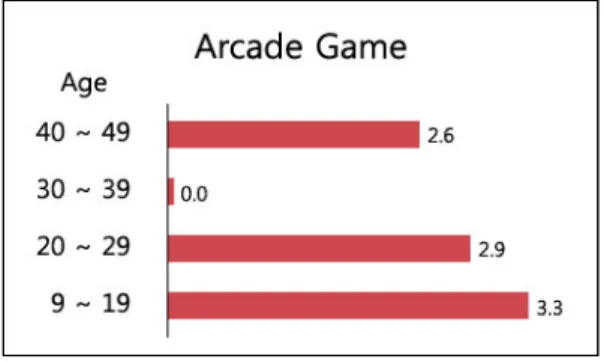
According to the statistics of Game White Paper in 2011, the highest ratios of age band for using game centers is teenager.
그림 1. 연령대별 아케이드 게임 이용도
Fig. 1. Availability of arcade games for Ages