Analysis of Spectral Reflectance Characteristics Using Hyperspectral Sensor at Diverse
Phenological Stages of Soybeans
Seung-Hwan Go
1)·Jin-Ki Park
2)·Jong-Hwa Park
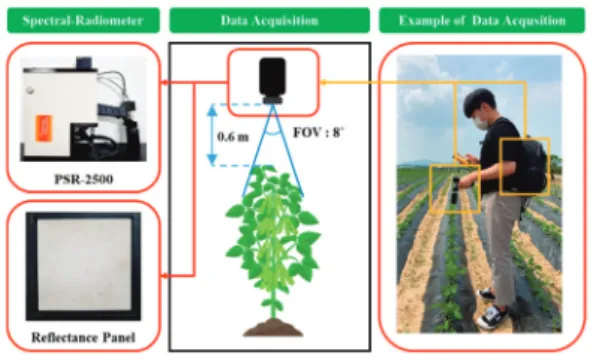
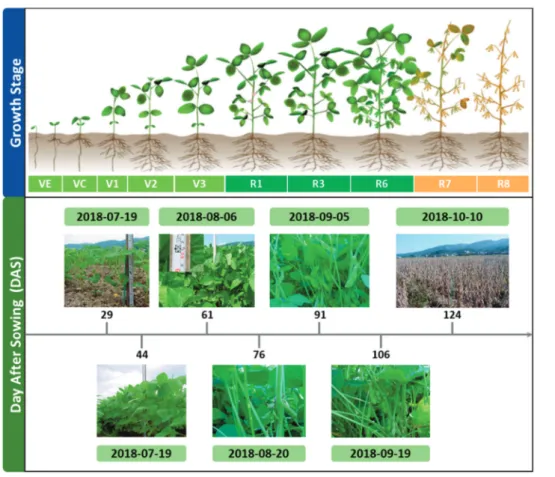
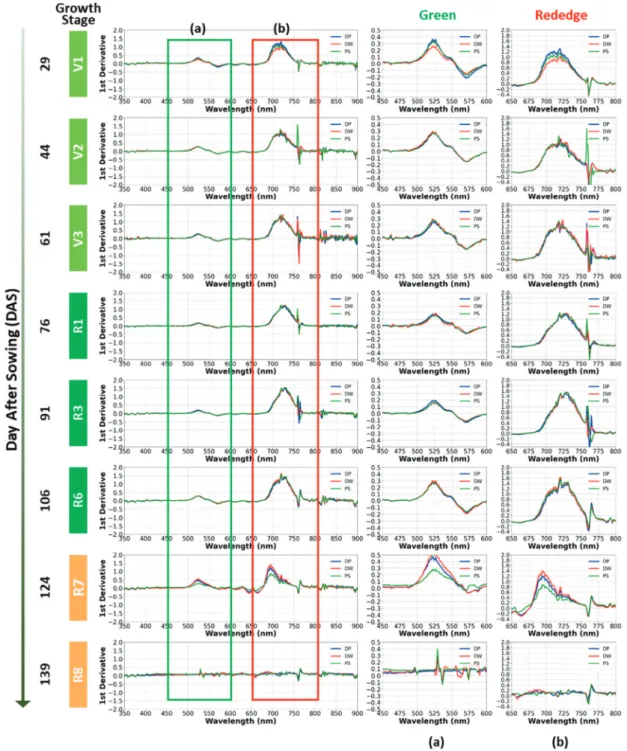
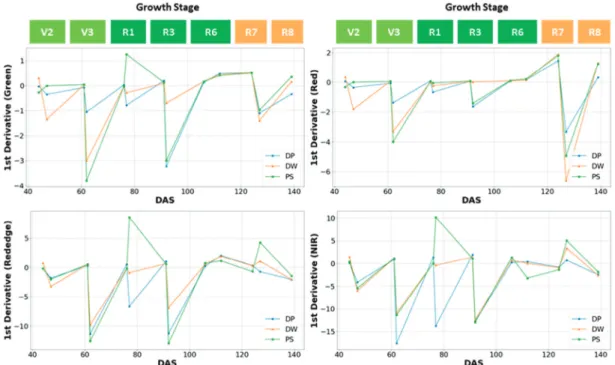
3)†Abstract: South Korea is pushing for the advancement of crop production technology to achieve food self- sufficiency and meet the demand for safe food. A medium-sized satellite for agriculture is being launched in 2023 with the aim of collecting and providing information on agriculture, not only in Korea but also in neighboring countries. The satellite is to be equipped with various sensors, though reference data for ground information are lacking. Hyperspectral remote sensing combined with 1st derivative is an efficient tool for the identification of agricultural crops. In our study, we develop a system for hyperspectral analysis of the ground- based reflectance spectrum, which is monitored seven times during the cultivation period of three soybean crops using a PSR-2500 hyperspectral sensor. In the reflection spectrum of soybean canopy, wavelength variations correspond with stages of soybean growths. The spectral reflection characteristics of soybeans can be divided according to growth into the vegetative (V) stage and the reproductive (R) stage. As a result of the first derivative analysis of the spectral reflection characteristics, it is possible to identify the characteristics of each wavelength band. Using our developed monitoring system, we observed that the near-infrared (NIR) variation was largest during the vegetative (V1-V3) stage, followed by a similar variation pattern in the order of red-edge and visible.
In the reproductive stage (R1-R8), the effect of the shape and color of the soybean leaf was reflected, and the pattern is different from that in the vegetative (V) stage. At the R1 to R6 stages, the variation in NIR was the largest, and red-edge and green showed similar variation patterns, but red showed little change. In particular, the reflectance characteristics of the R1 stage provides information that could help us distinguish between the three varieties of soybean that were studied. In the R7-R8 stage, close to the harvest period, the red-edge and NIR variation patterns and the visible variation patterns changed. These results are interpreted as a result of the large effects of pigments such as chlorophyll for each of the three soybean varieties, as well as from the formation and color of the leaf and stem. The results obtained in this study provide useful information that helps us to determine the wavelength width and range of the optimal band for monitoring and acquiring vegetation information on crops using satellites and unmanned aerial vehicles (UAVs)
Key Words: soybean, hyperspectral, spectral reflectance, vegetative, reproductive Article
Received July 20, 2021; Revised August 9, 2021; Accepted August 13, 2021; Published online August 23, 2021
1)
Master Student, Department of Agricultural and Rural Engineering, Chungbuk National University
2)
Researcher, Crop Production Technology Research Division, Department of Southern Area Crop Science, National Institute of Crop Science, Rural Development Administration
3)
Professor, Department of Agricultural and Rural Engineering, Chungbuk National University
†