DOI http://dx.doi.org/10.12791/KSBEC.2014.23.2.116 eISSN 2288-100X
Selection of Non-Perforated Breathable Film to Enhance Storability of Cherry Tomato for Modified Atmosphere Storage at Different Temperatures
Mohammad Zahirul Islam
1, Mahmuda Akter Mele
1, Han Jong Lee
1, Kyoung Soo Lee
1, Sung Mi Hong
1, Min Jae Jeong
1, Il-Seop Kim
1, Soon-Kwan Hong
2, In-Lee Choi
1,3, Jun Pill Baek
1,3, and Ho-Min Kang
1,3*
1Department of Horticulture, Kangwon National University, Chuncheon 200-701, Korea
2Department of Bio-Health Technology, Kangwon National University, Chuncheon 200-701, Korea
3Agriculture and Life Science Research Institute, Kangwon National University, Chuncheon 200-701, Korea
Abstract. This study was conducted to find out the appropriate packaging materials to extend the storability and main- tain the quality of cherry tomato for modified atmosphere (MA) storage. Tomatoes were grown by hydroponic at a plas- tic house in Gangwon Province. Light red maturity stage tomatoes were harvested and packed with MA condition (10,000; 20,000; 40,000; 60,000; 80,000; and 100,000cc/m2.day.atm O2 permeability film) and perforated film to store at 5oC, 11oC and 24oC. The fresh weight loss was less than 0.6% in all non-perforated breathable films at 5oC, 11oC, and 24oC, but perforated film had less than 2.93% at 5oC, 13.29% at 11oC and 27.24% at 24oC. The 20,000cc at 5oC and 11oC, and the 40,000cc film at 24oC balanced optimum carbon dioxide and oxygen concentration in the package to maintain quality. The 10,000cc film was appeared the significantly highest ethylene concentration at 5oC, 11oC, and 24oC, this film had the lowest O2 permeability. Visual quality, firmness, and soluble solids were maintained in 20,000cc films both at 5oC and 11oC, the 40,000cc film at 24oC. There was no any trend in titratable acidity and vitamin C con- tent of treated packed film types and temperatures at cherry tomatoes packages. Therefore, the appropriate MA condi- tion for 5oC and 11oC is 20,000cc/m2.day.atm O2 permeability film; for 24oC it is 40,000cc/m2.day.atm O2 permeability film because those films extended the storability through the firmness, soluble solids as well as visual quality.
Additional key words : Firmness, soluble solids, vitamin C, and visual quality
Introduction
Modified atmosphere packaging (MAP) is a vigorous process of altering gaseous formation inner package (Caleb et al., 2013). The MAP is a post-harvest technology vastly used to extend and preserve the shelf-life of fresh, enhance the product of the image and lessen waste (Montanez et al., 2010). The MA packaging of refreshing produce depends on modification of the atmosphere inside the package, obtained by the natural reciprocation between two pro- cesses, the respiration of the product and to convey of gases by the packaging that leads to an atmosphere higher in carbon dioxide and lower in oxygen (Mahajan, et al., 2007). An inappropriately designed MA packaging system may be feeble towards extending the storage life of pack- aged produce, if the desired or optimal atmosphere is not formed rapidly innermost the package (Oliveira et al., 2012). Toxic effects may occur if the levels of oxygen and
carbon dioxide are not within the range tolerated by the commodity (Iqbal et al., 2009a). Ignoble temperature together with low and high carbon dioxide levels, are widely adopted to degrade the respiration rate of fresh pro- duce and broaden their shelf life (Iqbal et al., 2009b).
The carbon dioxide (3~4%) and oxygen concentration (16~18%) in ‘Madison’ tomato packages showed proper levels for MA storage in 20,000cc breathable film at 5oC storage (Islam et al., 2011). The optimal conditions to keep high quality of tomato fruits were obtained by MA packaging during storage at 0oC for 29 days, independently of the film thickness, in which the adequate gas composition was carbon dioxide at 4.2%~5.6%, oxygen at 14.3%~14.5%, respectively (Guan et al., 2008).
The MA packaging has some ineffective towards from an improper use and effective from a proper use. Perishable crop needed suitable MA packaging to retain post-harvest quality. We did this experiment because there was no study on O2 permeability film for cherry tomato with different stor- age temperatures. This study was conveyed to find out the proper non-perforated breathable film for MAP to extend the storability of cherry tomato.
*Corresponding author: [email protected]
*Received February 28, 2014; Revised April 30, 2014;
*Accepted June 5, 2014
Materials and Methods
Tomato plants (Lycopersicon esculentum Mill. cv.‘Uni- corn’) were grown by hydroponics during summer at a plastic house in Gangwon province. Supplied nutrient solu- tion was adjusted to EC 2 dS.m−1and pH 5.8~6.2 recom- mended by the Japanese horticultural experiment station (Sato et al., 2006). Tomato plants were maintained with standard practices for training, suckering, pruning lower leaves, cluster pruning (Hochmuth, 1991) along with auxil- iary bud pruning. The plastic house was maintained at maximum 32oC by air circulation and shading system.
Tomatoes were harvested at light red maturity stage pack- aged with 10,000; 20,000; 40,000; 60,000; 80,000; and 100,000cc/m2.day.atm O2 permeability film) as well as per- forated film (100,000cc/m2.day.atm O2 permeability film used as a perforated film by making 0.6cm diameter 4 hole in 12.5cm× 8.2cm × 3.5cm size package) to store at 5oC, 11oC and 24oC with 85% relative humidity.
The fresh weight loss of tomatoes during the storage period was measured by subtracting sample weights from their previous recorded weights, and presented as % of weight loss. Visible quality was subjectively assessed fruits based on visual quality determinants such as freshness, mould growth, decay, shriveling, smoothness, shininess and homogeneity. The scale of visual quality was observed on 1 to 5 (1 = waste; 2 = bad; 3 = good, marketable; 4 = very
good; and 5 = excellent) during 5oC, 11oC, and 24oC stor- age. Five panel members were employed to assess the visual quality of the tomatoes.
The oxygen and carbon dioxide concentrations in pack- ages were measured by PBI Dansensor (Check mate 9900, Denmark). The ethylene was measured by GC 2010 Shi- madzu (Shimadzu corporation, Japan) equipped with BP 20 Wax column (30m× 0.25mm × 0.25µm, SGE analytical science, Australia) and a flame ionization detector (FID).
The detector and injector operated at 127oC along with the ovens were at 50oC, as well as carrier gas (N2) flow rate was 0.67mL/s (Park et al., 2000).
Firmness (N) was measured using a penetrometer (DFT- 01, TR snc, Italy). Soluble solid was measured by refracto- meter (Atago U.S.A.Inc.,U.S.A.) and results were read directly in oBrix. Titratable acidity was measured by Food
& Beverage Analyzer (DL22, Metter Toledo Ltd., and Korea); by using 0.1N NaOH solution and results were reported as % citric acid. Vitamin C measured by RQflex plus (Merck, Germany) with mg/100gFW (Arvanitoyannis et al., 2005).
Statistical Analysis. Graphs were produced using Graph- Pad prism 5 (GraphPad Software, Inc., USA). Fresh weight loss, visual quality, oxygen concentration, carbon dioxide concentration, ethylene concentration was analyzed by Dunnett’s Multiple Comparison Test of one-way ANOVA.
Statistic analyses of firmness, soluble solids, titratable acid-
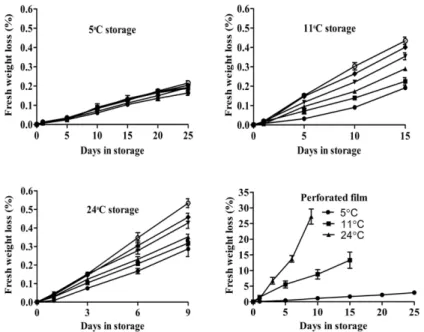
Fig. 1. Changes of fresh weight loss (%) of tomatoes at 5oC, 11oC, and 24oC storage temperature (●:10,000; ■:20,000; ▲:40,000; ▼ :60,000; ◆:80,000; ○:100,000cc/m2.day .atm O2 permeability film and perforated film). Vertical bars represent ± SE of mean (n = 4).
ity, and vitamin C were performed by SPSS V.16 (SPSS Inc., Chicago, USA). Significant differences between mean values were determined using the Duncan’s Multiple Range Test (P = 0.05) following one-way ANOVA.
Results and Discussion
The highest and the lowest fresh weight loss shown by perforated film and 10,000cc/m2.day.atm O2 permeability film, respectively, during the storage period at 5oC, 11oC, and 24oC. The fresh weight loss lower at 5oC, followed by 11oC, and 24oC. So, higher temperature had a negative effect in fresh weight of tomato. Until the final storage day, our result did not exceed the maximum permissible of 7%
fresh weight loss (Kays and Paull, 2004) in MAP which range was 0.16~0.22% at 5oC, 0.19~0.43% at 11oC, 0.30~0.53% at 24oC, but perforated film overlaped the maximum permissible fresh weight loss at 11oC and 24oC.
It is directly related with Valverde et al., (2005) that loss of weight in MAP packaged was very low (< 1%), mainly due to the effect of polypropylene film on expanding by vapor.
But the fresh weight loss of perforated film showed 13.29%, and 27.24%, at 11oC, and 24oC, respectively on the final storage day.
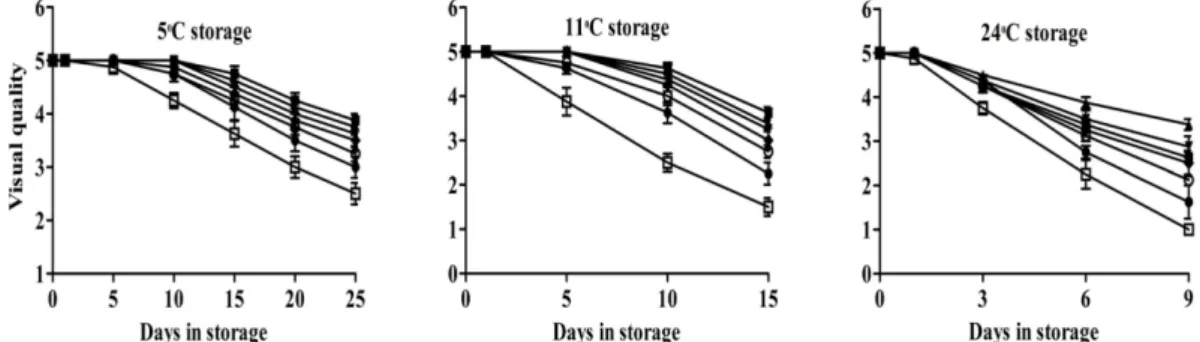
The 20,000cc film proved the best visual quality at 5oC and 11oC. The utmost visible quality performed by the 40,000cc film, whereas the minutest visual quality was pre- sented with the 10,000cc film at 24oC (Fig. 2). The visual quality exhibited more days at 5oC, followed by 11oC, and 24oC. The MAP helps to maintain the visual quality of fresh cut tomato (Gill et al., 2002). The visual quality as well as shelf life of perforated film showed the worst in all storage temperatures than MAP because more fresh weight loss and shriveling.
The 20,000cc which showed the highest visual quality maintained around 5~9% carbon dioxide and 13~16% oxy- gen at 5oC, and 5~12% carbon dioxide and 11~16% oxy- gen at 11oC. Moreover, the 40,000cc also maintained 9- 11% carbon dioxide and 12~14% oxygen at 24oC (Fig. 3).
The concentrations of carbon dioxide and oxygen inside the MA package (0.03 or 0.06mm) were about 4.21~8.17%
and 9.78%~14.45% under steady state during storage 29 days at 0 and 5oC, respectively in mature-red tomato fruits (cv. Pinky World) (Guan et al., 2008). The recommended controlled or modified atmosphere conditions during trans- port and/or storage of ripe tomato is 3~5% oxygen and 3~5%, carbon dioxide at 10~15oC (Kader, 2002). More- over, MA packaging, carbon dioxide at 5 to 10%, added to oxygen level below 5%, is an effective fungistat that can be used for decay control on commodities that do not tolerate 15 to 20% carbon dioxide (Kader, 2002). Rodriguez-Aguil- era and Oliveira, (2009) reported that reduced levels of oxygen and increased levels of carbon dioxide in the atmo- sphere surrounding fresh produce seem to have several positive effects: they preserve product quality because they slow down respiration, and decrease softening rates.
The 10,000cc film showed significantly (p< 0.05) the highest ethylene concentration that was stored at 5oC, 11oC, and 24oC (Fig. 3). Ethylene influenced internal quality such as firmness (Stow et al., 2000) and the threshold for ethyl- ene action in tomato is 0.5ppm (Kader, 2002). However 20,000cc film at 5oC, 11oC and 40,000cc film at 24oC showed moderate ethylene concentration (around 2µL/L) maintained highest visual quality and firmness, because atmosphere conditions of those films were close to proper MA condition (Kader, 2002).
Firmness is an important aspect of fresh tomato quality, and it decreases over time (Islam et al., 2011). The
Fig. 2. Changes of visual quality of tomatoes at 5oC, 11oC, and 24oC storage temperature (□: perforated film, ●:10,000; ■:20,000; ▲ :40,000; ▼:60,000; ◆:80,000; ○:100,000 cc/m2.day.atm O2 permeability film). Visual quality scores were 5: excellent, 4: very good, 3:
good, marketable, 2: bad, 1: waste. Vertical bars represent ± SE of mean (n=4).
20,000cc film both 5oC and 11oC, and the 40,000cc film at 24oC had shown the highest firmness. The 20,000cc film showed the highest firmness in ‘Madison’ tomato at 5oC for 20 days and thereafter 20oC for 5 days storage condi- tion (Islam et al., 2011). The 10,000cc film at 5oC and 11oC, and the perforated film at 24oC have shown the low- est firmness because of higher fresh weight loss, shrivel- ing, softening and lower shelf life in all treatments.
Moreover, the firmness of tomato packed with 10,000cc film at 5oC and 11oC should be affected by higher ethylene concentration in film. There was a significant difference at 5oC of the 20,000cc film and at 24oC of the 40,000cc film compared with perforated film (Table 1).
Both 5oC and 11oC, the 20,000cc film and at 24oC the 40,000cc film had shown the highest soluble solids because those film maintained optimum atmosphere in the MAP
(Table 1). The mean soluble solids value of 5oC, 11oC and 24oC were 6.87, 6.53, and 6.12, respectively at the after storage day. The ripening and storage period progressed, soluble solids increased over a certain period, and decreased significantly (P<0.05) afterwards (Islam et al., 2012). Perfo- rated film showed higher soluble solids in 5oC and 11oC due to concentration effect by fresh weight loss, because fresh weight loss was the highest in perforated film treatment at all temperatures. Choi et al., (2002) reported that the concentra- tion effect of soluble solid that is caused by a large decrease of fresh weight in tangor MAP experiment.
The average titratable acidity was performed at 0.53 for 5oC, 0.33 for 11oC and 0.39 for 24oC after storage day (Table 1). At 5oC tomatoes indicated the highest titratable acidity because of delaying ripeness (data not shown). The higher acidity value of cherry tomatoes was recorded at Fig. 3. Changes of carbon dioxide concentration (%), oxygen concentration (%), and ethylene concentration (µL/L) of tomatoes at 5oC,
11oC, and 24oC storage temperature (●:10,000; ■:20,000; ▲:40,000; ▼:60,000; ◆:80,000; ○:100,000 cc/m2.day.atm O2 permeabil- ity film). Vertical bars represent ± SE of mean (n=4).
5oC than 11oC on the final storage day (Islam et al., 2012).
Islam et al. (2013) indicated that low temperature delayed ripening of tomato (Madison and Unicorn). Changes in acidity are also important in the development of the charac- teristics taste in many fruits, and the organic acid decreased in most fruits during ripening (Kays and Paull, 2004).
The highest vitamin C was performed by 10,000cc film at 5oC and 11oC and 20,000cc film at 24oC, and the lowest showed by 60,000cc film at 5oC, 11oC and 24oC (Table 1).
The vitamin C content of all treated tomatoes decreased during the storage period. The average value of vitamin C was 8.12, 8.46, and 9.52mg/100g fresh weight at 5oC, 11oC and 24oC, respectively. Storage for 6 days in carbon diox- ide-enriched atmospheres resulted in a reduction in ascor- bic acid content of sweet pepper kept at 13oC (Wang, 1977).
Atmospheric modification reduces physiological and chemical changes of fruits and vegetables during storage, and loss of ascorbic acid can be reduced by storing apples in a reduced oxygen atmosphere, and high carbon dioxide concentration in the storage atmosphere caused degrada- tion of vitamin C in fresh-cut kiwifruit slices (Lee and Kader, 2000).
The appropriate MAP condition for both 5oC and 11oC is 20,000cc film, and for 24oC is 40,000cc film because those films increase storability, maintain visual quality, sol- uble solids and retain firmness. Those films would be allowing adequate gas exchanges for tomatoes. Moreover, O2 permeability films can provide fresher tomatoes, safe
public health, help avoid chemicals during storage, and also help to earn foreign currency by satisfying the buyers as well as consumers.
Acknowledgement
This study was supported by Bio-industry Technology Development Program (No. 111080-03), Korea Institute of Planning and Evaluation for Technology in Food, Agricul- ture, Forestry and Fisheries, Ministry for Food, Agricul- ture, Forestry and Fisheries, Republic of Korea.
Literature Cited
Arvanitoyannis, I.S., E.M. Khah, E.C. Christakou, and F.A.
Letsos. 2005. Effect of grafting and modified atmosphere packaging on eggplant quality parameters during storage.
International Journal of Food Science and Technology 40:311-322.
Caleb, O.J., P.V. Mahajan, M. Manley, and U.L. Opara. 2013.
Evaluation of parameters affecting modified atmosphere packaging engineering design for pomegranate arils. Inter- national Journal of Food Science and Technology 48: 2315- 2323.
Choi, Y.H., S.U. Ko, S.H. Kim, S.K. Kang, and C.H. Lee.
2002. Influence of modified atmosphere packaging on fruit quality of ‘Tsunokaori’ tangor during cold storage. Kor. J.
Hort. Sci. Technol. 24:340-344.
Gill, M.I., A.M. Conesa, and F. Artes. 2002. Quality changes in fresh cut tomato as affected by modified atmosphere packaging. Postharvest Biology and Technology 25: 199- Table 1. The firmness, soluble solids, titratable acidity and vitamin C of ‘Unicorn’ tomato at 5oC, 11oC, and 24oC after storage (perfo-
rated film, 10,000; 20,000; 40,000; 60,000; 80,000; 100,000cc/m2.day.atm O2 permeability film).
Firmness (N)
Soluble solids (oBrix)
Titratable acidity (% citric acid)
Vitamin C contents (mg/100gFW) Storage
tempts.
5oC (25days)
11oC (15days)
24oC (9days)
5oC (25days)
11oC (15days)
24oC (9days)
5oC (25days)
11oC (15days)
24oC (9days)
5oC (25days)
11oC (15days)
24oC (9days)
Initial 21.59 ± 1.75 6.33 ± 0.08 0.61 ± 0.02 24.89 ± 0.69
Perforated
film 11.35bz 16.05a 12.69c 7.08abc 6.85a 7.39a 0.63a 0.36ab 0.44ab 7.33b 7.13a 9.47a 10,000cc 10.76b 15.19a 13.90bc 7.07abc 6.51abc 5.87bc 0.57ab 0.38a 0.38ab 9.43a 9.13a 9.53a 20,000cc 13.26a 18.07a 16.78ab 7.25a 6.77ab 5.99bc 0.49b 0.36ab 0.30b 7.87ab 9.10a 9.83a 40,000cc 10.89b 17.29a 18.55a 7.20ab 6.54abc 6.24b 0.49b 0.29b 0.46a 8.30ab 8.93a 9.73a 60,000cc 10.04b 16.09a 17.33ab 6.73cd 6.42bc 6.02bc 0.54ab 0.30ab 0.36ab 6.87b 7.07a 9.13a 80,000cc 9.76b 16.72a 16.03bc 6.56d 6.37c 5.79bc 0.45b 0.34ab 0.42ab 8.73ab 9.10a 9.53a 100,000cc 9.50b 16.43a 15.29bc 6.51d 6.27c 5.55c 0.53ab 0.29b 0.35ab 8.33ab 8.33a 9.40a
ZMean separation within columns by Duncan’s multiple range tests at P < 0.05.
Initial value indicated mean ± SE.
207.
Guan, J.F., H.W. Park, Y.H. Kim, S.H. Kim, H.R. Park, S.A.
Lee, and J.Y. Yoon. 2008. The effect of MA film packaging on storage of mature-red tomato. Acta Hort. (ISHS), 804:469-476.
Hochmuth, G. 1991. Florida greenhouse vegetable production hand book, vol. 3. Fla. Coop. Ext. Serv., Circular SP48, pp.98.
Iqbal, T., F.A.S. Rodrigues, P.V. Mahajan, and J.P. Kerry.
2009a. Mathematical modeling of the influence of tempera- ture and gas composition on the respiration rate of shredded carrots. Journal of Food Engineering 91: 325-332.
Iqbal, T., F.A.S. Rodrigues, P.V. Mahajan, and J.P. Kerry.
2009b. Mathematical modelling of O2 consumption and CO2 production rates of whole mushrooms accounting for the effect of temperature and gas composition. International Journal of Food Science and Technology 44: 1408-1414.
Islam, M.Z., Y.S. Kim, and H.M. Kang. 2011. Effect of breathable film for modified atmosphere packaging mate- rial on the quality and storability of tomato in long distance export condition. Journal of Bio-Environment Control 20(3):221-226.
Islam, M.Z., Y.S. Kim, and H.M. Kang. 2012. Effect of tem- perature on the quality and storability of cherry tomato dur- ing commercial handling condition. Journal of Bio- Environment Control 21(2):88-94.
Islam, M.Z., J.P. Baek, Y.S. Kim and H.M. Kang. 2013. Char- acteristics of chilling symptoms of cherry tomato compared to beefsteak tomato harvested at different ripening stages.
Journal of Pure and Applied Microbiology, Nov. vol. 7(spl.
edn.), p. 703-709.
Kader, A.A. 2002. Postharvest Technology of Horticultural Crops. Third edition, Publication 3311, California.
Kays J.S., and R.E. Paull. 2004. Postharvest Biology. Exon Press, Athens.
Lee, K.S., and A.A. Kader. 2000. Preharvest and postharvest factors influencing vitamin C content of horticultural crops.
Postharvest Biology and Technology 20, 207-220.
Mahajan, V.P., F.A.R. Oliveira, J.C. Montanez, and J. Frias.
2007. Development of user-friendly software for design of modified atmosphere packaging for fresh and fresh-cut pro- duce. Innovative Food Science and Emerging Technologies 8: 84-92.
Montanez, J.C., F.A.S. Rodriguez, P.V. Mahajan, and J.M.
Frias. 2010. Modelling the gas exchange rate in perforation- mediated modified atmosphere packaging: Effect of the external air movement and tube dimensions. Journal of Food Engineering 97: 79-86.
Oliveira, F., M.J. Sousa-Gallagher, P.V. Mahajan, and J.A.
Teixeira. 2012. Evaluation of MAP engineering design parameters on quality of fresh-sliced mushrooms. Journal of Food Engineering 108: 507-514.
Park, K.W., H.M. Kang, and C.H. Kim. 2000. Comparison of storability on film sources and storage temperature for fresh Japanese mint in MA storage. J. Bio. Env. Con. 9(1): 40-46 (in Korean).
Rodriguez-Aguilera, R., and J.C. Oliveira. 2009. Review of design engineering methods and applications of active and modified atmosphere packaging systems. Food Eng Rev. 1:
66-83.
Sato, S., S. Sakaguchi, H. Furukawa, and H. Ikeda. 2006.
Effects of NaCl application to hydroponic nutrient solution on fruit characteristics of tomato (Lycopersicon esculentum Mill.). Scientia Horticulturae 109:248-253.
Stow, J.R., J.C. Dover, and M.P. Genge. 2000. Control of eth- ylene biosynthesis and softening in Cox’s Orange Pippin’
apples during low-ethylene, low-oxygen storage. Posthar- vest Biology and Technology 18: 215-225.
Valverde, M.J., F.N. Guillean, D. Martianez-Romero, S.
Castillo, M. Serrano, and D. Valero. 2005. Improvement of table grapes quality and safety by the combination of modi- fied atmosphere packaging (MAP) and eugenol, menthol, or thymol. J. Agric. Food Chem. 53:7458-7464.
Wang, C.Y. 1977. Effects of CO2 treatment on storage and shelf life of sweet pepper. J. Amer. Soc. Hort. SCI.102, 808- 812.
방울토마토의 MA 저장성 향상을 위한 비천공 breathable 필름 구명
이슬람 모하메드 조히룰
1· 밀리 마하무다 악터
1· 이한종
1· 이경수
1· 홍성미
1· 정민재
1· 김일섭
1홍순관
2· 최인이
1,3· 백준필
3· 강호민
1,3*
1강원대학교 원예학과, 2강원대학교 생명건강공학과, 3강원대학교 농업생명과학연구원
적 요. 본 연구는 방울토마토의 MA 저장시 저장기간 연장과 품질 유지를 위한 비천공 breathable 필름 종류를 구명하고자 진행되었다. 강원도에 위치한 플라스틱 하우스에서 수경재배한 토마토를 담적색기에 수확하여 5oC, 11oC, 그리고 24oC에서 산소투과도가 각기 다른 비천공 breathable 필름(10,000; 20,000; 40,000; 60,000;
80,000; 100,000 cc/m2.day.atm)과 천공필름으로 포장하여 저장하였다. 저장 중 생체중 감소율은 세가지 온도 모 두에서 모든 비천공 breathable 필름처리구에서는 0.6%미만이었으나, 천공필름은 5oC는 2.93%, 11oC는 13.29%, 그리고 24oC에서는 27.24%에 달하였다. 포장내 이산화탄소와 산소 농도를 볼 때 5oC와 11oC에서 20,000 cc 필름, 24oC에서 40,000 cc 필름이 MA 조건에 근접한 수치를 보였다. 에틸렌 농도는 산소투과도가 가장 낮은 10,000 cc에서 모든 온도에서 가장 높았다. 저장 중 외관상 품질과 최종일에 측정한 경도와 당도는 5oC와 11oC의 20,000 cc 필름, 24oC의 40,000 cc 필름이 높은 수치를 나타내었다. 그러나 산도와 비타민 C 함 량은 필름처리에 대한 일정한 경향을 보이지 않았다. 이상의 결과로 보았을 때, MA 저장시 포장내 대기조성 과 저장 종료일의 과실 품질 등을 비교한 결과 방울토마토는 5oC와 11oC에서 20,000 cc 필름, 24oC에서는 40,000 cc 필름이 적합하였다.
추가 주제어 : 경도, 당도, 비타민 C, 외관 품질