반도체디스플레이기술학회지 제19권 제2호(2020년 6월) Journal of the Semiconductor & Display Technology, Vol. 19, No. 2. June 2020.
22
Impact of Sintering Gas Pressure on Deep-red EuSi 2 O 2 N 2 Phosphors
Gemechu Deressa
*,**, Jongsu Kim
**and Gwangchul Kim
***†*
Department of Applied Chemistry, School of Applied Natural Science, Adama Science and Technology University,
**
Department of Display Science and Engineering, Pukyong National University,
***†
Physics Department, School of Liberal Arts, KOREATECH
ABSTRACT
Deep red EuSi
2O
2N
2phosphors were synthesized under various sintering gas pressures (1 atm, 2 atm, and 3 atm).
They were in good agreement with the standard EuSi
2O
2N
2ICSD card # 41-6046 (a monoclinic crystal system with space group of P2
1/a). Their photoluminescence intensities were significantly increased with increasing the gas pressures. They showed a broad band emission peaking at 680 nm due to 4f
65d
1- 4f
7of Eu
2+ion, which can be efficiently excited in the visible range up to 550 nm. The best one at 3 atm was applied for red LED based on blue chip, which showed the strong deep red emission.
Key Words : Red Emission, EuSi
2O
2N
2, Oxynitride, Sintering Gas Pressure, Photoluminescence, LED
1. Introduction
1Europium-doped MSi
2O
2N
2(M= Ca, Sr and Ba) com- pounds, including fully europium-concentrated EuSi
2O
2N
2phosphor, have already been reported to emit tunable blue- green-yellow colors by [1-3]. Their emission colors were tuned from blue up to yellow by kinds of substituents. It is notable that the oxynitride compounds are easy to be synthesized from air-stable oxide and nitride as starting materials at a moderate temperature of about 1300 ℃ (by a general SiC heater) and under an oxygen-protected ambient (in a general alumina tube) unlike nitride phosphors syn- thesized with easily air-oxidized metal or metal-nitride ma- terials under extremely high temperature and pressure con- ditions [4-7]. However, the red emission in all oxynitride series of MSi
2O
2N
2(M= Ca, Sr and Ba) have not been reported up to date, even though the red emission has been observed in many nitride -based phosphors such as Sr
2Si
5N
8: Eu
2+, (Sr, Ca)AlSiN:Eu
2+, LaSi
3N
5:Eu
2+, and SrSiN
2:Eu
2+[8,9].
In this paper, we have, for the first time, presented the
†
E-mail: [email protected]
deep red emission in fully europium-concentrated EuSi
2O
2N
2phosphors, which were reproducibly synthesized under different gas pressures of H
2-N
2mixture through a con- ventional solid-state reaction method with the mixture of Eu
2O
3and Si
3N
4as starting materials. Here the following questions have been raised: why our EuSi
2O
2N
2phosphor does emit the deep red color in spite of the others with the same composition and structure showed the yellow emission in chemical and physical aspects, and what kinds of processing make such big difference in photoluminescence [2-6]. The preliminary answer could be the slight variation in O-N ratio which is very difficult to be detected but can be controlled by ambient gas pressure. Thus, we have examined the effect of N
2gas pressure on the red luminescence of EuSi
2O
2N
2phosphor under different suitable gas pressures (1-3 atm), and compared the optical properties.
2. Experimental 2.1 Synthesis
The deep red emission EuSi
2O
2N
2phosphors were syn-
thesized at different gas pressures. The used raw materials
Impact of Sintering Gas Pressure on Deep-red EuSi2O2N2 Phosphors
Journal of KSDT Vol. 19, No. 2, 2020 23
for synthesis of EuSi
2O
2N
2phosphors were Eu
2O
3powders (99.99 %) and α-Si
3N
4with keeping Eu/Si ratio at 0.5. The mixture was homogeneously wet-mixed by a hand mill for 30 min in acetone. After milling, the mixture was put into a horizontal tube furnace in an alumina crucible, and then vacuumed up to background pressure of 10
-2Torr until the temperature of 800 °C. Subsequently the mixture was sintered at 1300 °C for 4 hours under flowing 95% N
2-5%
H
2gas with pressure ranging from 1 to 3 atm. Finally, the red EuSi
2O
2N
2powders were obtained, exhibiting a sphe- rical shape with a deep red body color.
2.2 Analysis
The crystal structures were analyzed by X-ray powder diffraction (XRD, Rigaku-D/max 2550 PC diffractometer) with Cu-K
λradiation (λ= 0.15405 nm). The XRD data were collected in the range of 10 – 80
oin 2θ scan mode with a step size of 0.02
oand a count time of 10 seconds per step.
The surface morphologies were observed using a Scanning Electron Microscope (SEM JEOL Japan, Jsm-6700F operated at 15.0 KV). The photoluminescence emission (PL) spectra and excitation spectra (PLE) spectra measured by using the spectro-fluorometer PSI (Darsa Pro 5200 SYSTEM) where the sample was excited by a Xenon lamp (150 W).
3. Result and discussion
The recorded XRD patterns of our products were quite similar to that reported in the literature [2-4]. Fig. 1 showed XRD patterns of EuSi
2O
2N
2phosphors annealed at 1300 °C with different pressures (1 atm, 2 atm and 3 atm). The XRD patterns of all three samples agree with that of the standard
Fig. 1. XRD patterns of red EuSi
2O2N2 phosphors sintered at 1300 ℃ conditions under different pressures (1-3 atm), compared to the standard data for EuSi2O2N2 (ICSD NO.41-6046).
patterns of EuSi
2O
2N
2(ICSD Card No. 41-6046), which means that they were well crystallized in a monoclinic crystal system with space group = P2
1/a and crystal lattice parameters of a = 13.151 Å, b = 17.311 Å, c = 7.956 Å [2,3].
No peaks corresponding to other impurities such as SiO
2or Si
3N
4were observed, which means that two end members of Eu
2O
3and Si
3N
4were completely combined to form EuSi
2O
2N
2structure. Our red EuSi
2O
2N
2phosphor sintered at 3 atm pressure showed the highest XRD intensity, indicating the highest crystalline quality so as to cause the improvement in PL intensity.
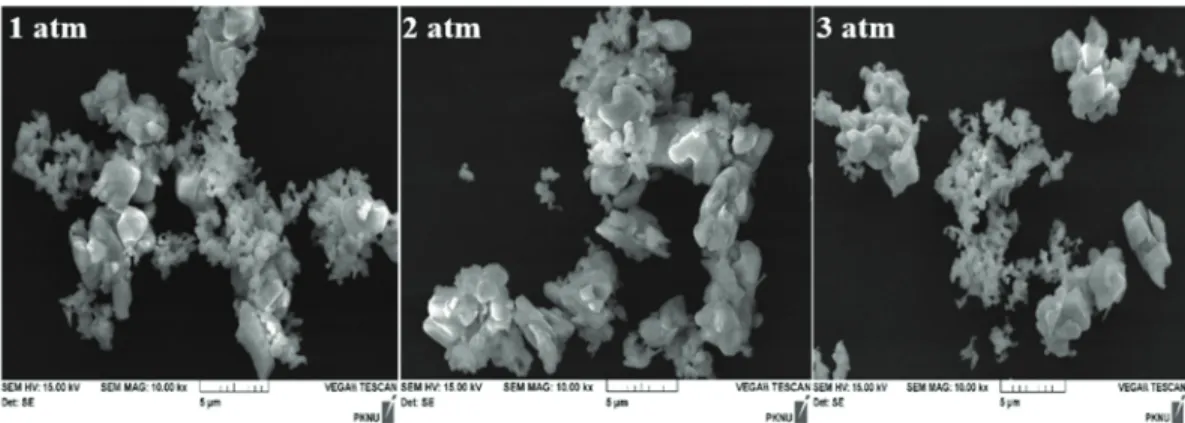
Fig. 2 shows the SEM images of EuSi
2O
2N
2phosphor powders. The sizes of sample (1 atm) and sample (2 atm) were ranging from 500 nm to 2 µm. With increasing pre- paring pressure to 3 atm, the particles got smaller, which is attributed to the prevention of thermal diffusion and
Fig. 2. SEM Images of red EuSi
2O2N2 phosphors sintered at 1300 °C under different pressures (1-3 atm).Gemechu Deressa · Jongsu Kim · Gwangchul Kim
반도체디스플레이기술학회지 제19권 제2호, 2020 24
Fig. 3. Excitation (left) and emission (right) spectra of red EuSi
2O2N2phosphors sintered at 1300 ℃ under different pressure (1-3 atm), where the excitation sources (450 nm and 520 nm) were applied.
aggregation due to strong surface compression caused by the highest gas pressure process.
Fig. 3 shows PLE spectra at left side and PL spectra at right side of three samples sintered at different pressure (1 atm, 2 atm, and 3 atm). It is noted that the PL intensity increases as the sintering gas pressure increases. This PL enhancement is consistent with the crystallinity of the phosphor as conformed by the sharpness of XRD pattern:
the higher PL intensities, the sharper XRD patterns.
The phosphors exhibited a broad red emission with a maximum at 680 nm upon blue (λ
ex= 450 nm) and visible excitation lights (λ
ex= 520 nm), which can be ascribed to the allowed 4f → 5d transitions of Eu
2+. In general, a broad charge-transfer excitation band of Eu
3+lies at wavelengths <
300 nm, and the emission of Eu
3+shows sharp lines, due to optical transitions between levels of the 4f
nconfiguration [8,9]. Therefore, a broad emission band without sharp-line emission indicates that europium ion exists in the divalent state in EuSi
2O
2N
2lattice structure [3,4]. The half widths of the emission bands are almost similar with about 132 nm within a machine error (1 nm) with ranging from 1 atm to 3 atm in pressure. Upon varying the excitation wavelengths (450 nm and 520 nm) there is no significant change in the emission spectra except the emission intensity. It indicates that this red phosphor can be excitable and thus combined with various excitation sources such as blue and green LEDs.
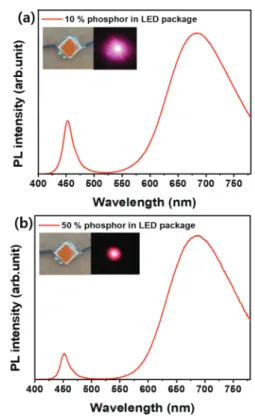
Two red LED were fabricated by combining the 450 nm chip with the red EuSi
2O
2N
2phosphor sintered at 3 atm. Fig.
4 shows the emission spectra of two kinds of red LEDs (10 wt.% (a) and 50 wt.% (b) with respect to epoxy resin), where
Fig. 4. Emission spectra of red LEDs packaged with the red
EuSi2O2N2 phosphor on blue LED chip, where 10 wt.% (a) and 50 wt.% (b) of phosphors with respect to epoxy resin were added.they were operated under voltage of 2.60 V and current 350 mA. The color coordinates were varied together with the amounts of the red EuSi
2O
2N
2phosphor; (0.487, 0.241) in Fig.4 (a) and (0.566, 0.274) in Fig. 4(b). The inset images show the red LED on and off the blue LED. For example, the deep red LED, so-called, blood color, can make some fleshes more vivid and fresh in butcher shop, and thus customers can express a rising desire for such products [10].
In addition, our red LED spectrum is suitable for photosynthesis, and for bio imaging agent due to high transparency on living cell [11,12].
4. Conclusion
Deep red EuSi
2O
2N
2phosphors were synthesized under
various sintering gas pressures (1 atm, 2 atm, and 3 atm)
through a conventional solid state reaction method at 1300
ºC. They all have a monoclinic crystal system with a space
group of P2
1/a. Their particles were fine with less than 2 µm
in size They showed a broad band emission peaking at 680
Impact of Sintering Gas Pressure on Deep-red EuSi2O2N2 Phosphors
Journal of KSDT Vol. 19, No. 2, 2020 25