교신저자 : Sun Jung, Park / (02500) 82 Mang-uro Dongdaemun-gu Seoul, Korea Tel : +82-10-8799-8973, Fax : +82-2-3407-8619, E-mail : [email protected] 접수일 : 2021.08.29 / 수정일 : 2021.09.06 / 게재확정일 : 2021.09.30
국내 간호학과 교육과정 관련 연구동향(2011∼2020년)
양경희1 ․ 고가연2 ․ 박선정3
1원광보건대학교 간호학과, 명예교수 ․ 2강릉영동대학교, 부교수 ․ 3삼육보건대학교 간호학과, 조교수
Trend of Korean Research Papers Related to Nursing Department Curriculum(2011∼2020)
Kyung Hee, Yang1 ․ Ga Yeon, Ko2 ․ Sun Jung, Park3
1
Wonkwang Health Science University, Honorary Professor
2
Gangneung Yeongdong University, Associate Professor
3
Department of Nursing, Sahmyook Health University, Assistant Professor
Abstract
Purpose : The purpose of this study is to systematically verify research related to the curriculum of the nursing
department over the past 10 years through a literature review on the subject area. Method : This study was conducted using the scoping review to identify research trends from January 2011 to December 2020 targeting 11 papers published in domestic journals on curriculum-related topics in the nursing department. Results : As research topics, 3 studies on competency-based curriculum (27.2%), 2 studies on curriculum analysis and operation (18.2%), and 2 studies on curriculum development (18.2%). Two studies related to cultural competency (18.2%), one study on program learning outcomes (9.1%), and one study on the liberal arts curriculum (9.1%).Conclusion : Due to recent changes, abundant medical knowledge, and the expanded role of nurses, a change in
the curriculum is essential. Consideration of the learning outcomes, which are the characteristics of the nursing education certification and evaluation system, major subjects and liberal arts subjects should be rationally developed and operated. For the development of nursing education, it is necessary to identify the educational needs and necessary competency of nurses through continuous research using various research methods, and to develop, operate, and evaluate subjects systematically.Key words : Nursing, Curriculum, Analysis
Ⅰ. 서 론
1. 연구의 필요성
교육의 목표를 달성하기 위하여는 교육내용을 체계 적으로 구성하여 학습활동을 운영하는 교육과정이 매 우 중요하다. 교육과정은 교육기간동안 계획되어진 모 든 활동으로, 학생들에게 어떤 학습경험을 안내할 것인 지를 주요 핵심요인으로 하여 교육방향을 제시하고 교 육행위를 통제하는 설계도 기능을 한다[1]. 교육과정은 교과목의 구성과 편성, 교육방법, 학생 평가를 포함하 지만, 좁은 의미의 교육과정은 교과목 중심의 교과과정 을 의미한다. 교육과정 개발은 교육이 시작되는 시점 이전부터 종료 후 다음 교육과정의 개발에 이르기까지 모든 과정에 많은 교육이론 과 학습 원리 및 절차가 적 절하게 적용되어야 한다. 초 ․ 중등교육을 담당하는 교 사들은 교직교목을 필수교과로 이수하지만, 대학의 교 원들은 교직 교과를 이수하지 않고도 전공과목의 전문 성을 가지고 임용될 수 있기 때문에[2], 교육과정개발 과 운영에 보다 깊은 이해와 논의가 필요하다[3].
4차 산업혁명과 같은 사회의 혁신적 발전에 부합한 교육을 위한 대학 교육의 역할은 단순한 지식 전달이 아 닌 직무 분야에서의 문제를 해결하고 리더십을 발휘할 수 있는 창의성과 의사소통능력 및 고도화된 전문역량 을 겸비한 인재를 양성하여 사회에 배출하는 것이다[4].
간호학과의 교육과정은 4년이라는 기간 동안 제한된 전공학점 내에서 다양한 역할을 수행하는 데 필요한 지 식이 점점 증가되고, 졸업생 직무역량의 수준을 맞추기 위해 요구되는 영역별 범위와 수준을 견지해야 할지에 대해 논의되고 있다. 교과과정을 개선하기 위해서는 시 대적 변화와 역할을 반영하고 간호전문직 직무 역량이 향상될 수 있는 인문학 또는 기초과학적인 전공기초 교 과목들의 균형된 구성과 상호연계성이 있는지, 필요한 보완점이 무엇인지 재고해 보아야 한다. 또한 간호대학 생들의 전공교육과정을 개발하고 평가하는 데는 전공역 량 기반 교육과정 성과관리 준거가 상호연계 과정과 전 문가 간 협의와 연구를 통해 적합하게 개발되어야 한다. 특히 대학에서의 간호교육은 간호대학생이 교육과
정을 마친 후 전문직 간호사로서 건강하거나 질환을 가진 사람들이 그들의 건강문제를 개선 또는 예방하 거나 치유하도록 돕고 가르치는 역할을 충분히 발휘 할 수 있도록 필요한 간호이론과 기술을 습득하는데 궁극적 목표를 두고 있다. 다시 말하면 간호교육은 간 호실무에 필요한 간호방법과 술기를 포함한 핵심역량 을 습득하고 이론과 실제를 통합, 적용하여 간호현상 을 설명하고 예측할 뿐만 아니라 실무를 실행하면서 간호 지식체를 창조해 낼 수 있는 역량을 갖추도록 하 는 것을 목적으로 한다. 따라서 이러한 간호교육 목적 과 목표가 달성되도록 기본적인 교육과정이나 교육기 관의 인프라 구축이 우선되어야 한다.
2011년 고등교육법 개정으로 간호학과는 3년제와 4년 제의 이원화된 학제를 4년제로 일원화하였고, 모든 대학 의 간호교육기관은 질적인 간호교육 평가와 아울러 2018년 입학생부터 의료법 제7조에 의해 국가고시 응시 자격을 부여하도록 한국간호교육평가원(이하 간평원)의 인증 평가를 받아야 한다[4]. 간평원은 2주기(2012∼
2016년) 평가 영역Ⅱ 교육과정에서 부문 2.1 성과기반 교육과정 구성과 체계, 부문 2.2 교과목 운영으로 이미 학습성과기반 교육과정을 개발하여 운영하고 평가하도 록 하였으며, 2018년 3주기부터는 부문 2.3 교육과정 개 선을 추가하여 평가하고 있다[5-6]. 이에 전국의 간호대 학은 간호교육인증 2주기 평가에서 간평원의 학습성과 기반 교육과정을 개발하여 질적 수준을 인증받고, 이를 시행함으로써 이제 안정된 교육과정을 운영하여 간호교 육인증 3주기 평가가 종료되고 있는 상황이다.
간호대학생들은 교육과정을 이수하고 졸업시점에 서 확보하여야 하는 결과들을 중심으로 교육과정을 결정하는 접근법으로 교육의 과정뿐만 아니라 결과를 강조하고, 왜 그것을 해야 하며, 무엇을 알고 있는가 보다는 무엇을 할 수 있느냐와 어떻게 하느냐를 강조 하고 있다. 성과기반 교육과정은 교육이 끝나는 시점 에 학습자들이 달성해야 하는 최종성과(exit outcome) 를 중심으로 학습자의 역량개발을 교육과정의 핵심에 두기 때문에 역량 중심교육과정이라고도 한다[7]. 이 에 교육 개시 전 교육목표 및 학습성과를 포함한 인증 기준 전반에 걸쳐 적용되는 달성목표를 설정하고 반
드시 이를 실행, 평가하고 그 결과를 프로그램 운영과 질 개선에 지속적으로 활용하여 교육수준의 지속적 제고를 요구하고 있다[8]. 또한 학습성과기반 교육과 정은 교육과정 요소들이 학습성과에 의해 하나로 연 결되어 있으므로 학습경험과 교육방법 및 평가방법을 결정하는데 용이한 접근방식으로 실무능력 향상을 위 하여 교육과정과 임상실습 간의 직업전문성(정보화 및 태도교육, 의사소통능력 등)을 강조하고 학습 수준 을 단계적으로 명시함으로써 높은 수준의 학습목표를 효과적으로 달성하는 것이 가능하다[7]. 이에 따라 한 국의 간호학과의 경우 간호교육인증평가를 통해서 학 과가 간호사 핵심역량을 갖출 수 있도록 학생의 학습 성과를 설정하여 교육과정을 운영하고 학습성과를 평 가, 개선하므로 교육의 질과 학생의 학습성과를 연계 하여 교육과정이 선순환적으로 관리되도록 하고 있다.
국내외 보건의료 현장에서 요구하는 간호사 역량을 갖춘 학생을 배출할 수 있도록 학습성과기반의 교육 체제를 구축하고 이에 따른 교육과정 개발, 운영, 평 가에 대한 지속적인 개선 활동을 통한 간호교육이 운 영되고 있는지에 대한 파악은 중요하다. 간평원의 평 가에 의해 간호학의 정체성을 확립되어 전문직 간호 사로서의 역할을 수행할 수 있는 타당한 교육과정 개 발과 운영을 통해 개발 수정 ․ 보완되어 발전해가도록 지속적인 질관리가 이루어지고 있다.
대학교육의 질을 보장하기 위해서는 이론과 절차를 이행하는 데 그치지 않고 다양한 관점을 가진 전문가 들이 참여하며 역동성을 가지고 상호작용을 하면서 최선의 대안을 탐색하여 결정해가야 한다[2].
연구를 수행함에 있어서 주제 범위 문헌고찰 방법 은 특정 주제나 연구 영역에 관한 문헌들을 매핑 (mapping)하여 근거의 유형, 자료, 주요 개념, 연구들에 서의 차이 등을 파악할 수 있게 해준다. 따라서 주제 범위 문헌고찰 방법은 후속 연구자에게 연구의 방향을 제시해 주는데에 유용하며, 향후 수행되게 될 체계적 문헌고찰의 주제 범위를 제시해 준다[10-11]. 주제 범 위 문헌고찰 방법은 연구의 결과들을 체계적으로 정리 하여 활용하기 쉬운 근거의 형태로 제공해 주기 때문 에 최근 그 중요성이 증가되고 있으며, 관련 주제에 대
한 비교적 넓은 범위의 문헌들을 포함하기 때문에 체 계적 문헌고찰 등 다른 문헌고찰 연구와 구별된다[12].
교육과정의 질 관리를 위한 지침을 제공하기 위해서 는 그동안의 교육과정에 대한 연구가 어느 정도 시행되 었는지, 어떤 특정 분야에 대해서 얼마나 다루어졌는지 를 분석하여 교육과정 개발과 운영에 대한 후속 연구의 방향을 제시하는 것이 요구된다[5]. 따라서 간호교육과 정 분야에서 불필요한 반복연구를 피하고, 선행연구로 부터 더욱 정련된 후속연구의 방향을 제시하기 위해서 는 관련 주제로 진행되어 온 연구들에 대한 분석이 필 요하다. 이에 본 연구는 최근 10년 이내 간호학과 교육 과정 연구를 주제 범위 문헌고찰 방법으로 분석, 정리 하여 관련 주제로 진행되어 온 연구의 전반적인 경향을 확인하고자한다. 이와 더불어 간호학과의 학습성과 기 반 교육과정 개발 및 점검을 통한 전문직 간호사로서의 역할을 수행할 수 있는 타당한 교육과정 개발과 운영 그리고 지속적인 질관리를 통해 간호교육의 발전을 꾀 할 수 있는 교육과정 체계의 확립하고자 시도되었다.
2. 연구목적
본 연구의 목적은 최근 10년(2011∼2020년) 동안 간 호학과 교육과정 관련 연구결과를 분석하여 매핑하고 요약하여 분석적인 재해석을 함으로써 차기 간호학과 교육과정 개발과 연구의 방향을 제시하기 위함이다.
Ⅱ. 연구 방법
본 연구는 간호학과 교육과정과 관련된 주제의 논 문의 연구동향을 파악하기 위해 국내 학술지에 게재 된 주제 관련 문헌고찰을 바탕으로 한 범위연구방법 론을 활용한 연구이다. 주제 범위 연구방법은 첫째 연 구 질문 정하기(identifying the research question), 둘째 관련 연구 확인하기(identifying relevant studies), 셋째, 연구 선택(study selection), 넷째 데이터 기록하기 (charting the data), 다섯째 결과를 대조, 요약, 보고하 기(collating, summarizing, and reporting result), 여섯째
Figure 1. Flowchart of included studies through Database Search 협의(consultation)의 6단계로 이루어져 있으며, 각각의
단계마다 권고 사항이 있다[10,13].
1. 연구 질문 정하기
주제 범위 문헌고찰을 수행하기 위해 연구 질문을 통해 분석할 논문의 범주가 정해지므로 질문은 구체 적이고 명료하게 기술되어야 한다[12]. 따라서 연구 질문을 설정할 때 주제 범위 문헌고찰의 초점을 명확 하게 하기 위한 개념, 목표 인구집단, 관심, 건강 결과 와 주제 범위 문헌고찰의 목적을 고려하여야 한다 [15]. 본 연구에서는 간호학 교육과정이 학제의 발전 및 전문직의 실무 요구를 반영하여 개발되는 교육과 정개발의 흐름을 파악하기 위하여 연구 질문은 “간호 학과 교육과정 연구가 어떤 방향으로 이루어졌는가?”,
“간호학과 교육과정의 효과는 무엇인가?”이다.
2. 관련 연구 확인하기
본 연구는 최근 10년 2011년 1월 이후 2020년 12월까 지 간호학과 교육과정 관련 주제로 학술지에 게재된 논 문을 대상으로 하였다. 본 연구의 문헌검색은 온라인 데 이터베이스를 중심으로 하였으며 검색에 사용된 국내데 이터베이스는 한국의학논문데이터베이스(KMbase), 대한
의학학술편집인협의회(KoreaMed), 국가과학기술정보센 터(National Digital Science Library, NDSL), 국회도서관 (National Assembly Library, NAL), 학술연구정보서비스 (Research Information Sharing Service, RISS)이며 논문의 언어는 한국어와 영어로 제한하여 연구자 3인이 수기 검 색을 통해 관련 연구를 최종적으로 확인하였다. 논문 검 색어로는 ‘교육과정’, ‘간호학과 교육과정’, ‘간호 교육과 정’, ‘간호 교육’, ‘nursing curriculum’, ‘curriculum’의 검색 어를 사용하였다. 본 연구의 전문성을 보장하기 위하여 간호교육과정 개발을 주도한 학부장 또는 학과장의 경험 이 있는 연구자로 연구팀이 구성되었다.
3. 연구 선택
주제 범위 문헌고찰의 연구방법[13]에 따라 문헌 선 정 및 배제기준에 관한 결정을 하기 위해 회의를 하였 으며, 3명 연구자인 검토자가 초록 등을 독립적으로 검토하였고 문헌선정의 일치를 확인하였다. 자료선정 기준에 따라 채택된 논문은 총 11편으로 선정과정은 Figure 1과 같다. 검색된 논문 32건 중 2011년 1월 이 전 논문 6건이 검색되어 이를 제외하였고, 교육과정과 관련이 적은 연구 8편과 학위논문 7편을 제외하여 총 11편을 선정하였다(Figure 1).
4. 데이터 기록하기
주제 범위 문헌고찰의 연구방법[12]에 따라 연구자 는 연구질문과 목적에 일치하는 것을 확인하여 선택 된 문헌들의 주제, 공통점 및 차이점을 표로 작성하여 데이터를 기록(추출)하였다. Armstrong 등[14]은 주제 범위 고찰의 기준을 저자, 발행 연도, 연구 지역, 중재 형식, 연구 대상, 연구 목적, 방법의 개괄, 결과 측정, 및 결론 등의 범주로 나눌 것을 제시하였다. 본 연구 에서는 Armstrong 등[14]이 제시한 주제 범위 문헌고 찰의 기준과 기존 문헌을 적용하여 다음의 두 가지 방 법으로 범주를 나누어 데이터를 분석하였다[14,15].
첫 번째는 양적 분석으로 저자, 발행연도, 연구 출처, 연구 설계, 연구 대상 및 연구 현장, 연구결과 측정방 법을 포함하였다. 두 번째는 결론으로 연구결과를 문 헌의 내용에 따라 주제를 나누었다.
Ⅲ. 연구결과
1. 양적분석
1) 연구 연도
2021년도 기준 최근 10년간 전체 11편의 논문을 연 도별로 살펴보면, 2011년 2편(18.1%), 2012년 1편 (9.1%), 2013년 2편(18.2%), 2014년 2편(18.2%), 2015년 2편(18.2%), 2016년 1편(9.1%), 2018년 1편(9.1%)으로 나타났다(Table 1).
2) 연구 출처
연구물의 출처는 한국간호교육학회지 6편(54.5%), 산학기술학회지 1편(9.1%), 한국간호과학회지 1편 (9.1%), 기본간호학회지 1편(9.1%), 한국임상보건과학 회지 1편(9.1%), 한국자료분석학회지 1편(9.1%)으로 한국간호교육학회지에 가장 많이 게재되었다(Table 1).
3) 연구 설계
연구설계 분석결과, 총 11편 중 양적연구 9편(81.8%),
Variable Category n %
Year of Publication
2011 2 18.1
2012 1 9.1
2013 2 18.2
2014 2 18.2
2015 2 18.2
2016 1 9.1
2018 1 9.1
Published Journals
Journal of Korean Academic Society of Nursing Education
6 54.5
Korea academy industrial cooperation society
1 9.1
Journal of korean clinical health sciences 1 9.1 Journal of Korean Academy of Nursing 1 9.1 Korean Academy of Fundamentals of
Nursing
1 9.1
Journal of the Korean Data Analysis Society
1 9.1
Research design
Descriptive research 6 54.5 Experimental research 1 9.1
Triangulation study 2 18.2
Review article 2 18.2
Subject Nursing school 3 27.2
Nursing students 4 36.4
Nursing students, Nurse 1 9.1
Preceptor Nurse 1 9.1
Article 2 18.2
Data analysis method
Descriptive statistical mdthod 3 27.2
T-test, ANOVA 2 18.2
Review article 2 18.2
Descriptive statiscical, Qualitative analysis 2 18.2
Correlation 1 9.1
Comparison analyze 1 9.1
Theme Competency-based nursing curriculum
3 27.2
Curriculum analysis, implementation 2 18.2 Clinical nursing curriculum
development
2 18.2
Cultural competency 2 18.2
Program outcomes 1 9.1
General education curriculum 1 9.1 Table 1. Characteristics of Included Studies (N=11)
문헌고찰 연구 2편(18.2%)이었으며, 양적연구 중 조사 연구 6편(54.5%), 방법론적 다각화연구 2편(18.2%), 실 험연구 1편(9.1%)이었다. 방법론적 다각화 연구는 조사 연구와 질적연구를 혼합한 연구이며, 실험연구는 단일 군 전후설계에 의한 원시실험연구로 나타났다(Table 1).
4) 연구 대상
연구 대상자는 간호대학 연구 3편(27.2%), 간호대학 생 4편(36.4%), 문헌고찰 연구 2편(18.2%), 간호대학생 과 간호사 대상으로 한 연구가 1편(9.1%), 간호사 대 상 1편(9.1%)으로 나타났다(Table 1).
5) 자료분석방법
자료분석방법에 대한 분석은 평균, 표준편차와 빈 도를 파악하는 기술적 분석방법이 3편(27.2%), t-test, ANOVA 분석이 2편(18.2%), 문헌고찰 2편(18.2%), 기 술적분석방법과 질적분석방법을 혼합한 연구가 2편 (18.2%), 상관관계 분석이 1편(9.1%), 비교분석방법이 1 편(9.1%)이었다. 질적분석방법은 내용분석과 Colaizzi’s 방법을 사용하여 분석하였다(Table 1).
2. 연구 주제분석
연구주제는 6개 영역으로 분류되어 역량기반교육 과정에 대한 연구는 3편(27.2%), 교육과정 분석, 운영 에 대한 연구는 2편(18.2%), 교육과정개발 연구는 2편 (18.2%), 문화적 역량과 관련된 연구 2편(18.2%), 프로 그램학습성과에 관한 연구는 1편(9.1%), 교양교육과 정에 관한 연구 1편(9.1%) 이었다(Table 1).
1) 역량기반교육과정
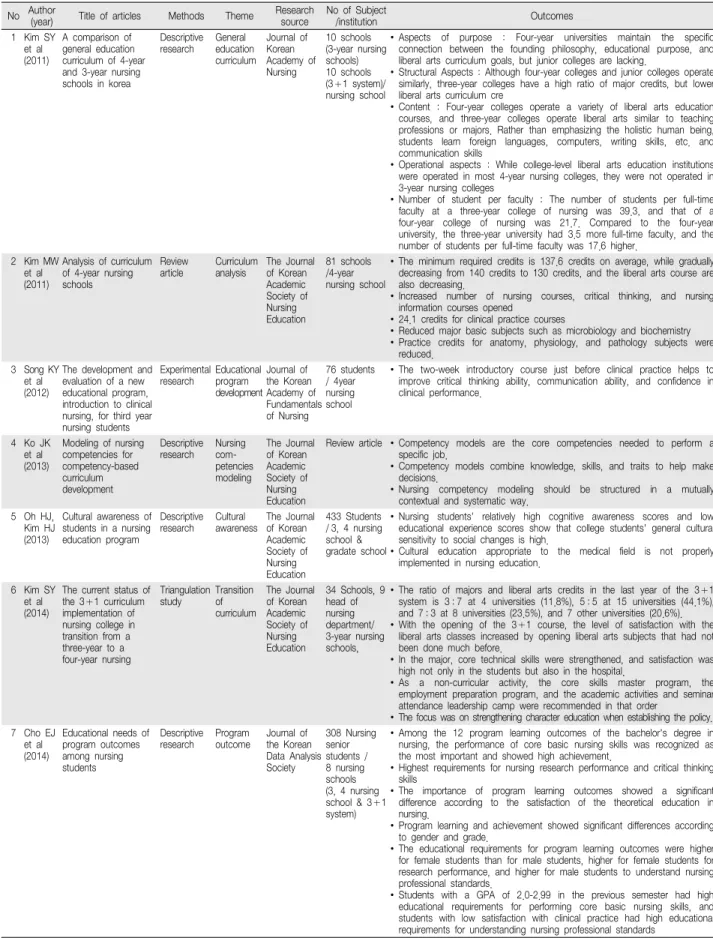
간호역량모델링에 대한 문헌고찰과 질적연구를 통 한 대학의 역량기반 교육과정의 필요성을 제시하였 고, 핵심역량 기반 교육과정 개선전략으로 간호학생 의 핵심역량을 7개 영역, 23개 하부요소로 구분하였 다. 그중 인성과 태도 및 대인관계술이 가장 중요한 역량이며, 의학/간호용어 교과목 및 제3외국어(러시 아, 몽골어 등) 사용능력이 새로이 필요하다고 나타났 다. 핵심역량모델링에 대한 연구로 핵심역량은 기저 역량, 실무역량, 인성역량으로 구분하여 기저역량은 전공과 간호술로, 실무역량은 임상적 판단, 대상자교 육, 의사소통, 환자안전, 질 향상, 병동 및 자원관리 등 으로 구분하였다. 인성역량은 리더십, 책임인식, 협력, 정책변화 대응 등으로 구성되었으며, 핵심역량은 자
기주도적 학습과 비판적 사고능력을 통하여 지속적인 순환관계가 유지되었다. 핵심역량을 가진 간호사는 지식근로자로서 자기 주도적 학습자이며 전문적이고 효율적인 의사소통가로로 나타났다(Table 2).
2) 교육과정 운영 및 실태
4년제 간호학과 교과과정은 한국간호교육과정 평가 원의 평가기준에 맞추어 교육과정을 편성하였으나 최 소 평균 137.6학점으로 140학점에서 130학점으로 점차 감소하는 추세를 보였으며, 교양과목도 감소되었다. 간 호과정, 비판적사고, 간호정보 교과목이 개설, 증가되 었으며, 임상실습교과목은 24.1학점으로 나타났다. 미 생물학, 생화학 등 전공기초과목은 감소하고 해부학, 생리학 병리학의 실습비율이 현저히 낮게 나타났다.
수업연한 4년제 지정 전문대학의 3+1 교육과정은 1 년 운영하는 대학이 14개(41.2%), 2년 간 운영한 대학이 20개(58.8%)로 나타났으며, 79.4%가 성적기준으로 선발 하고 15학점이하∼20학점이상으로 다양하게 운영되었 다. 전공학점 대 교양학점 비율은 5 : 5(44.1%), 7 : 3(23.5%)으로 교양과목 비중이 더 높지 않았다. 전공과 목에 시뮬레이션 실습, 리더십개발, 글로벌 역량간호 등을 포함하고, 교양과목으로 병원의료관리경영, 상담 관련 교과목, 취업 및 직장예절, 생명윤리교과목 등이 필요함을 확인하였다. 또한, 비교과과정 활동으로 핵심 술기 마스터 프로그램, 취업대비 프로그램, 학술활동 및 세미나 참석, 리더십 캠프 순으로 추천하였고, 정책 수립 시 인성교육 강화에 주안점을 두었다(Table 2).
3) 교육과정 개발
교육과정개발 연구는 2주간 간호학 임상실습 입문 교육과정 중재 후 의사소통능력, 자기효능감, 임상수 행 자신감이 높아졌음을 확인하였고, 산업체 및 학습 자 수요 간호교육과정 개발로 교육과정개발에 대한 산업체 요구도는 핵심기본간호술, 간호과정 적용능력, 의사소통능력, 창의적 간호문제해결능력, 인성교육, 외국어 능력으로 나타났다. 학습자의 요구도는 핵심 기본간호술, 간호과정 적용능력, 의사소통능력, 창의 적 간호문제해결능력으로 나타났다(Table 2).
No Author
(year) Title of articles Methods Theme Research
source No of Subject
/institution Outcomes
1 Kim SY et al (2011)
A comparison of general education curriculum of 4-year and 3-year nursing schools in korea
Descriptive research General
education curriculum
Journal of Korean Academy of Nursing
10 schools (3-year nursing schools) 10 schools (3+1 system)/
nursing school
∙ Aspects of purpose : Four-year universities maintain the specific connection between the founding philosophy, educational purpose, and liberal arts curriculum goals, but junior colleges are lacking.
∙ Structural Aspects : Although four-year colleges and junior colleges operate similarly, three-year colleges have a high ratio of major credits, but lower liberal arts curriculum cre
∙ Content : Four-year colleges operate a variety of liberal arts education courses, and three-year colleges operate liberal arts similar to teaching professions or majors. Rather than emphasizing the holistic human being, students learn foreign languages, computers, writing skills, etc. and communication skills
∙ Operational aspects : While college-level liberal arts education institutions were operated in most 4-year nursing colleges, they were not operated in 3-year nursing colleges
∙ Number of student per faculty : The number of students per full-time faculty at a three-year college of nursing was 39.3, and that of a four-year college of nursing was 21.7. Compared to the four-year university, the three-year university had 3.5 more full-time faculty, and the number of students per full-time faculty was 17.6 higher.
2 Kim MW et al (2011)
Analysis of curriculum of 4-year nursing schools
Review
article Curriculum
analysis The Journal of Korean Academic Society of Nursing Education
81 schools /4-year nursing school
∙ The minimum required credits is 137.6 credits on average, while gradually decreasing from 140 credits to 130 credits, and the liberal arts course are also decreasing.
∙ Increased number of nursing courses, critical thinking, and nursing information courses opened
∙ 24.1 credits for clinical practice courses
∙ Reduced major basic subjects such as microbiology and biochemistry
∙ Practice credits for anatomy, physiology, and pathology subjects were reduced.
3 Song KY et al (2012)
The development and evaluation of a new educational program, introduction to clinical nursing, for third year nursing students
Experimental research
Educational program development
Journal of the Korean Academy of Fundamentals of Nursing
76 students / 4year nursing school
∙ The two-week introductory course just before clinical practice helps to improve critical thinking ability, communication ability, and confidence in clinical performance.
4 Ko JK et al (2013)
Modeling of nursing competencies for competency-based curriculum development
Descriptive research Nursing
com- petencies modeling
The Journal of Korean Academic Society of Nursing Education
Review article ∙ Competency models are the core competencies needed to perform a specific job.
∙ Competency models combine knowledge, skills, and traits to help make decisions.
∙ Nursing competency modeling should be structured in a mutually contextual and systematic way.
5 Oh HJ, Kim HJ (2013)
Cultural awareness of students in a nursing education program
Descriptive research
Cultural awareness
The Journal of Korean Academic Society of Nursing Education
433 Students / 3, 4 nursing school &
gradate school
∙ Nursing students' relatively high cognitive awareness scores and low educational experience scores show that college students' general cultural sensitivity to social changes is high.
∙ Cultural education appropriate to the medical field is not properly implemented in nursing education.
6 Kim SY et al (2014)
The current status of the 3+1 curriculum implementation of nursing college in transition from a three-year to a four-year nursing
Triangulation study Transition
of curriculum
The Journal of Korean Academic Society of Nursing Education
34 Schools, 9 head of nursing department/
3-year nursing schools,
∙ The ratio of majors and liberal arts credits in the last year of the 3+1 system is 3 : 7 at 4 universities (11.8%), 5 : 5 at 15 universities (44.1%), and 7 : 3 at 8 universities (23.5%), and 7 other universities (20.6%).
∙ With the opening of the 3+1 course, the level of satisfaction with the liberal arts classes increased by opening liberal arts subjects that had not been done much before.
∙ In the major, core technical skills were strengthened, and satisfaction was high not only in the students but also in the hospital.
∙ As a non-curricular activity, the core skills master program, the employment preparation program, and the academic activities and seminar attendance leadership camp were recommended in that order
∙ The focus was on strengthening character education when establishing the policy.
7 Cho EJ et al (2014)
Educational needs of program outcomes among nursing students
Descriptive research Program
outcome Journal of the Korean Data Analysis Society
308 Nursing senior students / 8 nursing schools (3, 4 nursing school & 3+1 system)
∙ Among the 12 program learning outcomes of the bachelor's degree in nursing, the performance of core basic nursing skills was recognized as the most important and showed high achievement.
∙ Highest requirements for nursing research performance and critical thinking skills
∙ The importance of program learning outcomes showed a significant difference according to the satisfaction of the theoretical education in nursing.
∙ Program learning and achievement showed significant differences according to gender and grade.
∙ The educational requirements for program learning outcomes were higher for female students than for male students, higher for female students for research performance, and higher for male students to understand nursing professional standards.
∙ Students with a GPA of 2.0-2.99 in the previous semester had high educational requirements for performing core basic nursing skills, and students with low satisfaction with clinical practice had high educational requirements for understanding nursing professional standards
Table 2. Research-related information and results of the previous articles
No Author
(year) Title of articles Methods Theme Research
source No of Subject
/institution Outcomes
8 Park JM et al (2015)
Strategy for improving core nursing competency-based education
Triangulation
study Core
nursing competenci es
The Journal of Korean Academic Society of Nursing Education
13 Preceptor nurses, 104 nursing students / hospital, nursing school
∙ Nursing students' core competencies 7 areas, 23 sub-elements
∙ Competencies in which character, attitude, and interpersonal skills are the most important
∙ Newly required ability to use medical/nursing terminology courses and a third foreign language (Russian, Mongolian, etc.)
∙ Nursing students' professional competency and leadership competency levels are different from those of nurses.
9 Kim JA, Ko JK (2015)
Modeling core competencies in the competency-based nursing curriculum
Descriptive research
Core competenci es
Korea academy industrial cooperation society
Review article ∙ Core competencies are broadly classified into basic competencies, practical competencies, and personality competencies.
∙ Base competency is the basis of competency with major(theory+ practical skills) and nursing skills
∙ Practical competency consists of clinical judgment, subject education, communication, patient safety, quality improvement, ward and resource management, etc.
∙ Personality competency consists of leadership, responsibility recognition, cooperation, and policy change response.
∙ Core competencies maintain a continuous cycle through self-directed learning and critical thinking skills.
∙ Nurses with core competencies are knowledge workers, self-directed learners, and professional and efficient communicators.
10 Shin HJ (2016)
A study on industry and learner's demand-based curriculum development on nursing education : A case of P university
Descriptive research
nursing education curriculum
Journal of korean clinical health sciences
94 Nursing students, 80 nurses / 17 Nursing school, 5 hospital
∙ The core competencies of nurses required in hospitals are knowledge, skills, and communication.
∙ The highest order of the hospital's demand for nursing curriculum development is core basic nursing skills, nursing process application ability, communication ability, creative nursing problem-solving ability, personality education, and foreign language ability
∙ The highest order of the learner's needs is core basic nursing skills, ability to apply nursing process, communication ability, ability to use nursing (medical) terminology, personality education, communication ability, and creative nursing problem-solving ability
11 Jang SM, Kim JE (2018)
Current status of transcultural nursing education in nursing baccalaureate programs
Review article
Transcultur al nursing education
The Journal of Korean Academic Society of Nursing Education
185 school / Bachelor's college of nursing
∙ 109 universities(58.9%) open 117 credits of cross-cultural nursing-related courses and operate 109 credits.
∙ In the cross-cultural nursing course, 80 subjects (68.4%) were opened as optional and 37 (31.6%) were opened as compulsory subjects.
∙ The cross-cultural nursing course was opened as a major course (78.6%) rather than a liberal arts course (21.4%)
∙ More major education (78.6%) than liberal arts education were opened.
∙ Multicultural understanding was 39 (33.3%), multicultural nursing was 33 (28.2%), and nursing and culture was 5 (4.3%).
∙ Multicultural nursing was opened the most in Universities, and multicultural understanding was the most in Junior colleges.
∙ Among the four metaparadigms of nursing, subjects belonging to 'environment' accounted for the most with 49 subjects (41.9%), 'nursing' with 47 subjects (40.2%), 'health' with 15 subjects (12.8%), and 'human' with 15 subjects (12.8%). 6 (5.1%)
4) 문화적 역량
간호대학생의 교육과정에 대한 문화적 자각에 대한 연구로 문화적 자각점수는 4.54점로 높은 인지적 자각 점수와 낮은 교육 경험을 나타내어 사회적 변화에 따 른 대학생들의 일반적 문화적 민감도는 높으나 간호 교육에서 의료현장에 적합한 문화교육은 제대로 이루 어지지 않고 있었다.
간호학과 교과과정 내의 횡문화 간호교육 현황에 대한 연구로 횡문화 간호관련 교과목 개설 학과는 109개(58.6%)로 117개 횡문화 간호 관련 교과목을 운 영하고 있으며, 80개 과목(68.4%)은 선택으로 37개 (31.6%)는 필수교과목으로 개설되어 있으며, 교양교 육보다 전공교육(71.8%)으로 많이 개설되었다. 교과 목명은 다문화의 이해가 39개(33.3%), 다문화간호가 33개(28.2%), 간호와 문화 5개(4.3%)였다. 4년제 대학
에서는 다문화간호가 가장 많았으며, 전문대학은 다 문화의 이해가 가장 많았다. 간호의 네 가지 메타패러 다임 중 ‘환경’에 속하는 교과목이 49개(41.9%)로 가 장 많았고 ‘간호’는 47개(40.2%), ‘건강’은 15개 (12.8%), ‘인간’은 6개(5.1%)로 나타났다(Table 2).
5) 프로그램학습성과
간호학 학사학위프로그램 학습성과에 대한 연구는 12개의 간호학 학사학위프로그램 학습성과 중 핵심기 본간호술 수행을 가장 중요하게 인지하고 높은 성취 도를 보였으며, 간호연구 수행능력과 비판적 사고의 요구도가 가장 높게 나타났다. 프로그램학습성과 중 요도는 간호학 이론교육의 만족도에 따라 유의한 차 이를 보였고, 프로그램학습성과 성취도는 성별과 학 년에 따라 유의한 차이를 보였다. 프로그램학습성과
교육 요구도는 여학생이 높았고 여학생은 연구수행능 력에 대한 요구가 높았으며, 남학생은 간호전문직 표 준에 대한 요구가 높았다. 직전학기 성적이 2.0∼2.9인 학생이 핵심기본간호술 수행에 대한 교육 요구도가 높았고 임상실습 만족도가 낮은 학생이 간호전문직 표준 이해에 대한 교육요구도가 높았다(Table 2).
6) 교양교육과정
국내 간호대학과 전문대학의 교양교육과정에 대한 비교 연구는 4가지 측면으로 목적적 측면에서 4년제 대학은 설립이념, 교육목적, 교양교육과정 목표를 구 체적으로 제시하였으나 3년제 전문대학은 제대로 제 시하지 않았다. 구조적 측면에서 4년제 대학과 전문대 학의 졸업학점은 비슷하게 운영되었으나 3년제 전문 대학은 전공학점비율이 높고 교양교육과정 학점은 낮 았다. 내용적 측면에서 4년제 대학은 다양한 교양교육 과정을 운영하였으나 3년제 전문대학은 대부분의 대 학에서 외국어, 컴퓨터, 작문 등 표현력 및 의사소통 강조과목을 운영하고 있었다(Table 2).
Ⅳ. 논의
본 연구는 간호학과 교육과정과 관련된 2011년부터 2020년까지의 연구동향을 파악하고, 앞으로 간호학과 교육과정의 발전을 위한 방향을 모색해 보고자 시도되 었으며, 관련된 연구를 대상으로 연구동향 및 연구주제 를 중심으로 하여 분석하였다. 연구결과 국내의 간호학 과 교육과정 연구는 다양하게 많은 연구가 이루어지지 않았음을 확인하였다. 따라서 교육과정의 발전 및 질적 수준을 향상시킬 수 있는 방안을 모색하여야 할 것이다. 이에 본 연구결과를 통해 다음과 같이 논의하고자 한다.
1. 분석 논문의 일반적 특성
본 연구결과 최근 10년간 전체 11편의 논문을 연도별 로 살펴보면 2011년부터 2018년도까지는 지속적으로
관련 연구가 이루어졌으나 2018년도부터 2021년까지는 연구가 이루어지고 있지 않았다. 우리나라의 간호교육 은 2011년 4년제 일원화와 간호교육 인증평가제를 도입 하고 역량기반 간호교육과정 개선을 위한 노력을 지속 적으로 하고 있으며, 2021년 3주기 간호교육인증평가가 종료되고 2022년부터 4주기 인증평가가 이루어질 예정 임에 따라 간호교육과정 개발과 운영은 매우 중요함을 알 수 있다. 그러나 최근 3년 동안 교육과정과 관련된 활발한 연구가 이루어지지 않았다는 점에서 한국간호 교육평가원에서 제시하는 교육과정운영평가의 중요성 을 고려하여 교육과정 개발이 지속적으로 이루어질 수 있는 연구 활동이 이루어져야 할 것이다. 또한 신규간 호사가 보건의료현장에서 요구되는 역할을 잘 이행하 기 위해서는 간호학과의 교육과정이 간호교육자들이 전문적인 능력을 갖춘 간호사를 양성하기 위한 효율적 인 역량기반 교육과정을 실시하고 그 효과 및 타당성을 입증하는 연구들이 지속적으로 이루어져야 할 것이다.
연구설계는 양적연구가 81%로 주로 이루어졌으며, 조사연구는 54.4%로 확인되었다. 조사연구는 현상에 대한 풍부한 자료를 얻어 객관적으로 현상을 이해하 는데 효과적인 연구방법으로 간호학과 교육과정에 대 한 현상을 탐구하기 위해 조사연구가 주로 진행된 것 으로 알 수 있다. 추후 현상에 대한 심도 깊은 이해를 위해 조사연구가 지속적으로 이루어져야 할 필요가 있으며 또한 조사 연구이외의 변인간의 인과관계 규 명이 가능한 실험연구, 연구자가 인식하지 못한 심층 적인 질적연구, 연구문제의 방향 설정에 도움이 되는 종설연구 등 다양한 연구 설계가 필요하겠다.
연구대상자는 간호대학생 36.4%, 간호대학 27.2%
으로 간호대학생의 비율이 높은 것으로 확인되었으 며, 연구기관은 간호교육기관이 63.6%로 높게 확인되 어 간호 교육과정 연구는 임상 현장을 포함하여 지속 적으로 이루어져야 할 것이다. 간호학생들에게 실제 적이고 효율적인 간호교육과정을 운영하기 위해서는 4년이라는 기간 동안 제한된 전공학점 내에서 졸업생 역량의 수준을 맞추기 위한 교육뿐만 아니라 교수 간, 교수-학생 간, 교수-산학 간 정기적인 의사소통이 필 요하다. 더불어 교육자의 지도능력, 교육환경개선, 교
육과정의 표준화, 역량기반 교육과정프로그램의 개발 및 운영과 관련된 연구들이 이루어져야 할 것이다.
2. 연구 주제별 연구 결과
첫 번째, 역량기반교육과정에 대한 연구가 3편 (27.2%)으로 역량기반 교육과정 개발을 위한 간호역량 모델링에 대한 고찰과 핵심역량교육과정 개선 전략 후 역량기반 교육과정을 개발한 것으로 확인되었다. 역량 기반 간호교육과정은 간호대학에서 간호학을 전공하는 학습자가 궁극적으로 갖추어야 할 역량을 염두에 두고 개발, 운영, 평가하는 교육과정이다. 선행연구에서는 [16-20] 여러 가지 간호역량 중에서 비판적 사고성향, 문제해결능력, 자기주도적학습, 의사소통능력 등이 영 향을 미치는 것으로 확인되고 있지만, 각 간호역량들이 간호대학생들에게 간호사가 되었을 때 어느 정도의 관 계를 가지고 있는지, 얼마정도의 영향을 미치고 있는지 에 대해서는 연구가 활발히 시행되고 있지 않다. 미래 전문적인 간호사로서 간호대학생이 간호학과 교육과정 을 통해 핵심역량을 갖춘 이상적인 간호사의 모습으로 거듭날 수 있도록 간호학과 교육과정을 밑받침으로 주 요 핵심역량을 보다 체계적이며 효율적으로 구성된 역 랑기반 간호교육과정을 적용하여 운영할 필요가 있다. 두 번째, 교육과정 운영 및 실태에 관한 연구가 2편 (18.2%)으로 3, 4년제 간호학과 교육과정 분석과 전문 대학의 3+1교육과정의 운영 실태를 분석하였다. 4년 제 간호학과 교육과정 분석으로 졸업학점 이수를 140 학점에서 130학점 정도로 정하고 있다. 현재 모든 4년 제 간호학과에서 졸업이수 학점을 130학점으로 변경 하고 있음에 따라 대학교육의 제도변화를 비롯한 내외 적인 변화를 끊임없이 수용하며 간호학과의 특성과 관 련하여 교육 내용을 파악하고 간호학과 교육과정에 영 향을 미칠 수 있는 부분을 점검하고 반영해야 할 것이 다. 3+1교육과정은 수업연한 4년제 지정으로 인해 현 재 전문대학 안에서 운영되고 있는 간호학과는 4년제 로 모두 편제된 상태이다. 대학 측에서는 4년제로 개 편됨에 따라 지금까지 직업교육에 치중하여 오던 3년 제 과정과는 차별화된 교육목표와 교육과정을 갖추어
서 운영하고 있으나, 간호학과는 간호교육 인증평가제 를 도입하고 역량기반 간호교육과정을 교육과정으로 운영해야 함에 따라 전문대학 내의 특성과 역량기반 교육과정이 조화를 이루어 실질적인 커리큘럼 파악과 분석이 이루어질 수 있도록 노력하여야 할 것이다.
세 번째, 교육과정개발 연구 2편(18.2%)으로, 임상 실습 입문교육과정과 산업체 및 학습자수요 간호교육 과정 개발 연구로 확인되었다. Song 등[21]의 연구에 서는 임상실습 입문교육과정으로 기본간호 교육과정 에서 학습한 기본적 지식과 기술을 토대로 임상현장 에서 요구되는 지식, 술기 및 태도를 습득함으로써 효 율적인 임상실습이 이루어지도록 준비하는 연계과정 으로 ‘간호학임상실습 입문과정’을 운영하였다. 이 과 정을 통해 간호대학생들의 임상실습의 효율성을 높이 며 비판적 사고능력, 의사소통 능력, 임상수행능력 자 신감 향상에 도움을 준 것으로 확인되었다.
이와 같은 연구결과를 통해 학생들이 강의실과 실습 실에서 배운 지식과 술기를 실제 간호현장에 구체적으 로 적용시키는 방법을 배우고 간호에 대한 가치관과 전 문직 태도를 배우는 교육과정이 요구됨에 따라 지속적 인 프로그램 적용 및 효과를 통해 발전된 교육과정이 제 시되어야 한다. 또한 산업체 및 학습자수요 간호교육과 정 개발은 Shin[22]의 연구에서는 학생들이 졸업 후 취업 예정인 의료기관의 특성 및 현장실무 능력을 키울 수 있 도록 임상현장 실무자들의 수요조사를 통한 교육과정 개발은 중요하다는 연구결과를 나타내고 있다. 전문직 간호사로서의 질적 수준에서 특히 실습교육은 학생들이 습득한 이론적 간호지식을 임상실무현장에서 통합하고 적용하여 실제 활용할 수 있는 산업체가 요구하는 핵심 간호역량을 확인하고 학습자의 교육수요를 파악하여 교 육과정 개발의 기초자료로 제공되어야 할 것이다.
네 번째, 문화적 역량과 관련된 연구는 2편(18.2%) 으로 확인되었다. Oh[23]와 Park[24]의 연구에서는 타 문화권 대상자에게 간호현장에서 간호를 제공하는 간 호사의 경우 다른 문화에 대한 이해, 문화적 차이에 따 른 건강신념 및 건강문제에 대한 대처 및 관리 능력이 필요하다고 제시하였다. 임상현장에서 실무를 담당하 는 간호사는 대상자의 삶과 가치에 공감해야 하고, 대
상자 고유의 문화적 특성에 적합하고 개별화된 간호를 제공해야 하지만, Yang 등[25]의 연구에서는 간호사의 문화적 역량은 전반적으로 낮은 것으로 보고되었으므 로 문화적 역량을 갖춘 간호사를 배출하기 위해서는 간호 교육 현장에서의 교육과정변화가 선행되어야 하 며, 특히 현재의 간호 교육목표, 학습 성과, 교육 과정 이 문화적 다양성을 고려한 문화적으로 역량을 갖춘 간호사를 배출하고 있는지를 평가해야 한다.
다섯 번째, 프로그램학습성과에 관한 연구는 1편으 로 확인되었으며, 현재 간호교육기관은 간호교육 인 증평가제로 운영됨에 따라 프로그램 학습성과의 성취 수준 향상을 도모하기 위한 방안으로 성과기반 교육 과정 개발과 운영이 지속적으로 이루어져야 할 것이 다. Kim 등[26]은 급변하는 현대사회에서 학습자들은 전공교육과정을 통한 전문지식뿐만 아니라, 교양교육 과정을 통한 다양한 관점과 비판적인 사고능력, 균형 있는 가치판단, 변화하는 직무환경에 적응하는 능력 등이 요구된다고 하였다. 이에 따라 다양한 대학의 간 호학과 교양교육 과정을 비교 ․ 분석하여 교육과정 개 발 개편에 도움을 주어야 할 것이다. 교양교과목 중 인문학 교과목으로 간호사로서의 인성과 가치철학을 확립할 수 있도록 고려되어야 한다.
간호교육은 우리나라의 변화되는 보건의료 체계 및 국민의 건강수준 향상, 대상자의 다양한 건강요구, 의 료와 간호기술의 발전 등에 지속적으로 반응하며 변 화되고 있다. 이에 간호대학은 임상현장에서 필요로 하는 전문적인 간호사를 배출할 수 있도록 체계적인 교육과정의 구성과 운영이 필요하다고 본다.
Ⅴ. 결론 및 제언
본 연구는 간호학과 교육과정과 관련된 2011년부터 2020년까지의 연구동향을 파악하고, 앞으로 간호학과 교육과정의 발전을 위한 방향을 모색해 보고자 시도 되었다.
본 연구결과, 간호학과의 교육과정관련 연구는 최 근 10년동안 총 11편으로 현재까지 이루어진 간호교
육의 시기에 비해 미미하다고 해석할 수 있다. 또한, 2019년부터 현재까지는 한편도 이루어지지 않아 연구 가 이루어져야 될 필요성이 있다고 본다. 본 연구에서 확인되어진 주요 연구주제인 역량기반교육과정, 임상 실습 입문교육과정, 산업체 및 학습자수요 간호교육 과정, 문화적 역량, 프로그램학습성과, 교양교육과정 에 대해서는 반복적인 연구를 통해 간호학과의 교육 과정에 대해 확인할 필요가 있으며, 전반적인 교육과 정에 대한 검토와 개선 시 본 연구에서 제시된 연구주 제에 대해 연구가 활발히 이루어져야 할 필요성이 확 인되었다. 또한 전공교과목과 교양교과목에 대한 합 리적인 운영을 위한 연구의 필요성이 대두되었다.
최근 시대의 다양한 변화와 풍부한 의학적 지식, 간 호사의 다양한 역할 확대, 학습자의 특성변화를 고려 하여 21세기 미래 간호사에게 요구되는 효율적인 교 육과정으로의 개선을 위한 간호교육과정의 패러다임 의 변화와 이에 따른 간호교육과정의 개편이 지속적 으로 이루어져야 한다고 생각한다. 특별히 간호학과 는 한국간호교육평가원에서 제시한 학습성과기반 교 육과정이 이루어짐에 따라 이에 대한 내용 및 국가고 시를 잘 치룰 수 있도록 간호교과과정의 기본적 구성 틀에 대한 규명이 필요할 것으로 보인다.
본 연구결과를 바탕으로 다음을 제언하고자 한다.
국내 간호교육과정 관련 연구는 지속적으로 이루어져 야 할 것이며 조사연구뿐만 아니라 다양한 연구방법 을 적용한 연구가 이루어져야 할 것이며, 간호교육 인 증평가제인 프로그램 학습성과에 관한 연구 및 다각 적 측면에서 활발한 연구가 시도되어야 할 것이다. 또 한, 국내의 간호학과 교육과정 연구뿐만 아니라 국외 의 간호학과 교육과정 연구에 대한 분석을 제안한다.
References
1. Kim DY, Lee EH. A study on structural character- istics of undergraduate curriculum.
Journal of Korean Education. 2005;32(2):217-246.
2. Hong HJ. Improvement tasks for university curricu-
lum and classes-The university of the future, Higher Education. 2011;17(1):32-36.
3. Park MJ. Applying Grounded Theory to Study the Problems and Issues in Curriculum Development at the University Level, The Journal of Korean Education. 2018;45(2):31-55.
4. Nam MW. A Study on the Development and Validation of Performance Management Criteria in Major Competency-based Curriculum of University : Based on the PDCA Mode, lCNU Journal of Educational Studies 2020;41(3):289∼317.
5. Seo HJ. The Scoping Review Approach to Synthesize Nursing Research Evidence. Korean Journal of Adult Nurse. 2020;32(5):433-439.
https://doi.org/10.7475/kjan.2020.32.5.433
6. Korean Accreditation Board of Nursing Education.
Handbook for Second half of 2017’s Handbook of Nursing Education Accreditation for Nursing College.
7. Park SH, Park SO. Development of program outcome based nursing curriculum guideline. The Journal of Korean Nursing Research. 2018;2(1):57-118.
8. Song KA, Seo YO, Park OS, Lee YS, Park SY. Kim YJ. Comparison of NCS based curriculum and NCS based curriculum on Nursing Science and Strategies of system reform. Journal of Korean Society of Dental Hygiene. 2019;19(5):635-649
9. Daudt HM, Van MC, Scott SJ. Enhancing the scop- ing study methodology: a large, inter-professional team’s experience with Arksey and O’Malley’s framework. BMC Medical Research Methodology.
2013;13(48):https://doi.org/10.1186/1471-2288-13-48 10. Arksey H, O’Malley L. Scoping studies: towards a
methodological framework. International Journal of Social Research Methodology. 2005;8(1):19-32.
https://doi.org/10.1080/1364557032000119616 11. Davis K, Drey N, Gould D. What are scoping stud-
ies? A review of the nursing literature. International Journal of Nursing Studies. 2009;46(10):1386-400.
https://doi.org/10.1016/j.ijnurstu.2009.02.010
12. Seo HJ, Kim SY. What is scoping review?. Korean Association of Health Technology Assessment. 2018;
6(1):16-21. https://doi.org/10.34161/johta.2018.6.1.003 13. Levac D, Colquhoun H, O’Brien KK. Scoping studies:
advancing the methodology. Implementation Science.
2010;5:69. https://doi.org/10.1186/1748-5908-5-69 14. Armstrong R, Hall BJ, Doyle J, Waters E.
‘Scoping the scope’ of a cochrane review. Journal of Public Health. 2011;33(1):147-150. https://do- i.org/10.1093/pubmed/fdr015
15. Jacobs S. A scoping review examining nursing student peer mentorship. Journal of Professional Nursing. 2017;33(3):
212-223. https://doi.org/10.1016/j.profnurs.2016.09.004 16. Shin YW, Lee HJ, Lim YJ. Predictors of clinical com-
petence in new graduate nurses. Journal of Korean Academy of Nursing Administration. 2010;16(1):37-47.
http://dx.doi.org/10.11111/jkana.2010.16.1.37
17. Chaung SK. Critical thinking disposition, problem solving ability, and clinical competence in nursing students. Journal of Korean Academy of Fundamentals of Nursing. 2011;18(1):71-78.
18. Yang JJ, Park MY. The relationship of clinical com- petency and self-directed learning in nursing students. Journal Korean Academic Society of Nursing Education. 2004;10(2):271-277.
19. Shin KA, Cho BH. Professional self-concept, critical thinking disposition and clinical competence in nurs- ing students. Journal of Korean Academy of Fundamentals of Nursing. 2012;19(1):46-56.
http://dx.doi.org/10.7739/jkafn.2012.19.1.046
20. Lee OS, Gu MO. The relationship between emo- tional intelligence and communication skill, clinical competence & clinical practice stress in Nursing students. Journal of the Korea Academia-Industrial cooperation Society. 2013;14(6):2749-2759.
http://dx.doi.org/10.5762/KAIS.2013.14.6.2749 21. Song KA, Park HJ, Yeom HA, Lee JE, Joo GE, Kim
HJ. The development and evaluation of a new educa- tional program, introduction to clinical nursing, for third year nursing students. Journal of the Korean Academy of Fundamentals of Nursing. 2012;19(3):322-333.
22. Shin HJ. A study on industry and learner’s de- mand-based curriculum development on nursing edu- cation:A case of P university. Journal of Korean Clinical Health Science. 2016;4(4):769-781.
https://doi.org/10.15205/kschs.2016.12.31.769
23. Oh W. Factors influencing cultural sensitivity among nursing students. Journal of Korean Academy of Child Health Nursing. 2011;17(4):222-229.
24. Park JS. Study on cultural competence of nurses working in general hospital [master’s thesis]. Daegu:
Keimyung University; 2011.
25. Yang SO, Kwon MS, Lee SH. The factors affecting cultural competency of visiting nurses and commun- ity health practitioners. Journal of Korean Academy of Community Health Nursing. 2012;23(3):286-295.
26. Kim SY, Joung SE, Hwang CI. A comparison on general education curriculum of 4-year and 3-year nursing schools in korea. Journal of Korean Academy of Nursing. 2011; 41(1):101-109.
https://doi.org/10.4040/jkan.2011.41.1.101
Appendix. Studies Included in Trend of Korean Research Papers Related to Nursing College Curriculum
A1. Kim SY, Joung SE, Hwang JI. A comparison on general education curriculum of 4-year and 3-year nursing schools in korea. Korean Society of Nursing Science. 2011;41(1):101-109.
A2. Kim MW, Park JM, Han AK. Analysis of curricu- lum of 4-year nursing schools. The Journal of Korean Academic Society of Nursing Education.
2011;17(3):414-423.
A3. Song KE, Park HJ, Yeom HA, Lee JE, Joo GE, Kim HJ. The development and evaluation of a new
educational program, introduction to clinical nurs- ing, for third year nursing students. Journal of the Korean Academy of Fundamentals of Nursing.
2012;19(3):322-333.
A4. Ko JK, Chung MS, Choe MA, Park YI, Bang KS, Kim JA, Yoo MS, Jang HY. Modeling of nursing competencies for competency-based curriculum development. The Journal of Korean Academic Society of Nursing Education. 2013;19(1): 87-96.
A5. Oh HJ, Kim HJ. Cultural awareness of students in a nursing education program. The Journal of Korean Academic Society of Nursing Education.
2013;19(3): 446-454.
A6. Kim SY, Lee JY, Joung SI. The current status of the 3+1 curriculum implementation of nursing col- lege in transition from a three-year to a four-year nursing education. The Journal of Korean Academic Society of Nursing Education. 2014;20(2):288-299.
A7. Cho1 EJ, Sun JJ, Kim OH. Educational needs of pro- gram outcomes among nursing student. Journal of the Korean Data Analysis Society. 2014;16(5): 2819-2839.
A8. Park JM, Kim CS, Kim JH, An JY, Pyo EY. Strategy for improving core nursing competency-based education. The Journal of Korean Academic Society of Nursing Education. 2015;21(3):426-439.
A9. Kim JA, Ko JK. Modeling core competencies in the competency-based nursing curriculum. Korea Academy Industrial Cooperation Society.
2015;16(11):7635-7647.
A10. Shin HJ. A study on industry and learner’s de- mand-based curriculum development on nursing ed- ucation : A case of P university. Journal of Koorean Clinical Health Science. 2016;4(4):769-781.
A11. Jang SM, Kim JE. Current status of transcultural nursing education in nursing baccalaureate programs.
Jho MY. An analysis of research on nursing practice education in korea. The Journal of Korean Academic Society of Nursing Education. 2018;24(2):181-189.
![Figure 1. Flowchart of included studies through Database Search협의(consultation)의 6단계로 이루어져 있으며, 각각의 단계마다 권고 사항이 있다[10,13].1](https://thumb-ap.123doks.com/thumbv2/123dokinfo/4736890.267629/4.918.116.800.766.1070/flowchart-database-search협의-consultation-단계로-이루어져-있으며-단계마다.webp)