Social Geography of Poverty and Social Welfare Services
Mi-Ae Bae*
빈곤계층과 사회복지서비스의 공간적 연계성
배미애*
Abstract:The central aim of this paper is to identify the distributional pattern of poverty and to investigate the spatial relationship between poverty and welfare service providers in Busan, Korea. It is intended to explain how the relationship of service-dependency between impoverished people and social welfare services leads to uneven social geography. Welfare services controlled by public or private agencies may support the impoverished people in different ways, generating social outcomes. By exploiting the spatial variations in the incidence of poverty and the provisions of social welfare services, this paper is to understand the dynamics of the geography of poverty from a local scale so that it can help us understand how various governmental and nongovernmental area-based service providers are spatially uneven when they are compared to the distribution of service dependency group such as impoverished people. From this research, it is finally argued that the implications of locational interdependence between such needed groups and social welfare services for their support demand a paradigm for urban social geography that centers on the changing welfare provision structure and the linkages between population and service-provision.
Key Words : poverty, needs, social welfare services, impoverished people, service providers, spatial disparity, multi- care, maternal care, child care, care for the disabled, care for the aged
요약:최근 빈곤에 대한 사회지리학적 연구는 빈곤문제를 완화하고 해결하려는 의지를 반영하여 사회복지서비스와의 연계적 측면 에서 이루어진다. 빈곤계층의 기본적인 욕구를 충족시키기 위한 다양한 사회복지서비스의 제공에도 불구하고 서비스제공자와 서비 스수혜자의 공간적 불일치로 인하여 발생하는 접근성의 문제는 결과적으로 사회복지서비스의 공간적 불평등으로 이어진다. 부산시 를 대상으로 빈곤계층과 사회복지서비스의 연계성을 사회지리학적 입장에서 연구한 본 연구의 결론도 이와 같은 사회복지서비스의 공간적 한계에서 크게 벗어나지 못하고 있다. 1980년대 이후 급성장한 사회복지서비스의 양적 증대에도 불구하고 빈곤계층과 사회 복지서비스시설간의 입지적 불일치는 상대적으로 복지서비스 공급에 있어서 과잉 및 과소지역을 초래하였다. 복지서비스의 과소공 급지역을 중심으로 빈곤계층의 기본적인 욕구를 충족시키고 사회복지서비스의 공간적 불평등을 해결하기 위해서는 빈곤계층의 공 간적 수요를 감안한 사회복지서비스시설의 유연적인 입지적 재분배가 요구된다.
주요어 : 빈곤, 욕구, 사회복지서비스, 복지서비스수혜자, 복지서비스제공자, 공간적 불일치, 종합복지서비스, 모자보건서비스, 아 동복지서비스, 장애인복지서비스, 노인복지서비스
* Research Professor, Institute of Busan Geography, Pusan National University, [email protected]
1. Introduction
The ‘poverty’ from a local and a global scale has been one of the most observable socio- economic phenomenon of the period. Poverty is multidimensional in nature; the poverty problem should therefore be addressed primarily through satisfying basic human needs1) within variously integrated social welfare programs of sustainable development that ensures delivery.
The field of social welfare is vast and complex.
Many people are not aware of their rights and as a result do not get the resonable benefits. The most vulnerable people who are likely to need services most such as impoverished people often have a difficulty in finding their ways around the welfare services. Though social welfare services are not conceived as services only for people living in poverty, they are absolutely service- dependency group. Because the impoverished people are consisted of variable family types, including aged people, children, disabled people, gender etc, they can be the most important clients for variable social welfare services all over the city.
The variety of researches of poverty has been developed in social science. The social geography of poverty has been focused on the impoverished people who have become trapped and isolated both socially and spatially from the rest of society. It has been also concerned with all spatial scales from individual to the global.
One of the key differences in this research is that poverty is no more a dependent subject to study.
We pursue the relationship between poverty and social welfare services. In this social geographical research, we focus on the spatial pattern and the process of social welfare services for impoverished people, generating distribution of
various materials. Our research in this paper focuses on communities of the poor, which are seen as generating their own poverty. In this context, the community-based welfare services is involved to identify linkage with poverty.
This paper is intended to find the geographical patterns and processes of impoverished people and social welfare services in Busan, Korea by considering the recipients of minimum cost of living and the number of public or private social welfare service agencies. This paper starts with a reevaluation of comprehensive definitions of
‘poverty’ and ‘people living in poverty (impoverished people)’ that are based on static characteristics and critical examination of social welfare service agency’s role to meet poverty problem, compiling an extensive listing of service providers from 1968 to 2006 in Busan. It then turns to the spatial distribution and pattern of poverty and social welfare service providers and the spatial relationship between the location of impoverished people and the provision of social welfare services. The five welfare services group considered with the elements of impoverished people and supply of social welfare services show the spatial differences of contents of welfare services in Busan. It finally discusses the spatial disparities between poverty and social welfare services by evaluating oversupplied and undersupplied areas and ways to meet poverty problems by welfare system.
This study includes two important statistical data presenting the spatial relationship between impoverished people and social welfare services.
The material of impoverished people is based on the people under the poverty line who are decided by the Minister of Health and Welfare.
The poverty line means the minimum cost of living(See Table 2). The service providers data
for social welfare are extracted by Fact Sheet for Welfare Policies 2006 which was published by City of Busan. Using the information about the location of each provider, we calculate the number of service providers for study area and chart them as fully as possible. These social welfare services on this paper refer to formal services controlled by city government or other public and private care services which are offered by service providers and community care by social workers. The multiple regression analysis is applied to identify the spatial disparities between impoverished people and service providers and to suggest an ideal allocation of social welfare services considering impoverished people.
2. Geographical Approach to ‘Poverty and Social Welfare Services’
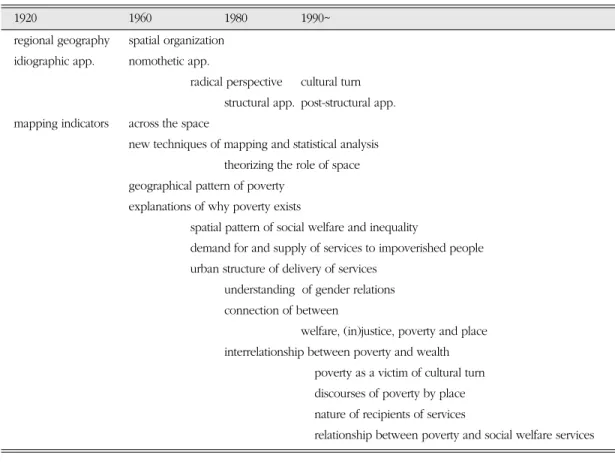
Poverty has been a long-standing interest in social geography. The study trends of poverty and social welfare services in social geographical approach began with an exercise in mapping. It focused on mapping poverty related with social indicators across space(Brunhes, 1920; Watson, 1951), and this was also an important strand in the social geography of the 1960s. Mapping poverty could also lead to an explanation of why poverty exists(Gordon and Spicker, 1999). From early 1970s, some radical approaches attempted more politically and socially concerned analysis.
The social geographers began to think more conceptually about the connections between welfare, (in)justice, poverty and place(Philo, 1995) in order to explain the continued existence of poverty. The inter-relationship between Figure 1. Study area2)(Busan, Korea)
poverty and wealth has been of a central concern, with Marxist geographers in particular arguing that capitalist societies actively produce these opposites. The spatial pattern of social welfare and inequality is a main subject in studying about poverty in welfare approach in social geography. The welfare geographers intended to analyze and evaluate welfare condition by social indicators including various social welfare service provisions to meet poverty problems.
Even most of the studies about demand and supply of services to impoverished people ignored the effects of the existing urban spatial structure. Some parts of a city are more richly endowed than other parts with both formal and informal social services. Such social services may
be either completely absent or inaccessible as a result of geographical barriers like expressways, railroads and a fault of welfare policies.
Smith(1981) demonstrated that attitudes favorable to the development of local social services for the mentally ill were clearly influenced by spatial variations in the social and physical characteristics of residential neighborhoods.
Wolch(1981) suggested that the provisions of welfare services for impoverished people could be facilitated by the existing urban structure, particularly the prevailing patterns of homogeneity and heterogeneity. As a complement to formal attempts to improve the delivery of services and to alter what often appears to be a spatially and socially unjust urban structure, the paper provided the examples
Table 1. Study trends of poverty and social welfare services in geography
1920 1960 1980 1990~
regional geography spatial organization idiographic app. nomothetic app.
radical perspective cultural turn structural app. post-structural app.
mapping indicators across the space
new techniques of mapping and statistical analysis theorizing the role of space geographical pattern of poverty
explanations of why poverty exists
spatial pattern of social welfare and inequality
demand for and supply of services to impoverished people urban structure of delivery of services
understanding of gender relations connection of between
welfare, (in)justice, poverty and place interrelationship between poverty and wealth
poverty as a victim of cultural turn discourses of poverty by place nature of recipients of services
relationship between poverty and social welfare services
of simple interventions that could expand and enhance the informal service delivery at the local level.
Leyshon(1995) argued that poverty problem (study) had been a victim of the recent ‘cultural turn’ in social geography and there had been an associated decline in materially based radical geographies. There has thus been little recent geographical work on poverty as a concept and as an overall condition. However, over the last few years there has been a large amount of work on aspects of poverty by geographers or from a geographical perspective. These studies mostly have identified the relationship between impoverished people and social welfare services they need. Billis and Glennerster(1998) attempted to epitomize the essential characteristics of the supply of and the demand for social welfare services in the modern welfare state. They also emphasized four ‘disadvantaged’ nature of recipients of human services: financially disadvantaged, personally disadvantaged, societally disadvantaged, and community disadvantaged.3) Olagnero et al.(2005) examined the extent to which families living in precariousness in contemporary European cities draw on social support as a key resource in their struggle against poverty and demonstrated the dynamics underlying the phenomenon of social support among precarious families living in deprived urban areas.
The traditional mapping in social geographical approach to explain poverty is applied to understand the distributional patterns of poverty and welfare service providers in this paper. The relationship between impoverished people and service providers in social geography focuses on the spatial inequality as key issue since 1970s. In this paper the welfare approach for poverty is
based on liberalism which is applied to settle the problems of spatial inequality of social welfare provisions and to suggest alternative social policy.
3. Poverty and Access to Social Welfare Services
1) Definitions of poverty and needs for social welfare services
‘Poverty’ can mean different things to different people and societies. Like many key concepts within social geography, there is no one correct, scientific and agreed definition of poverty. We therefore examine different ways of defining poverty4), and argue that these are dependent on time and geography(Pain, 2001).
Two broad approaches to the definition of poverty, being shown in Figure 2, have dominated discussions over a long period, relating the times and places from which definitions have originated. First, ‘the absolute poverty’ are based on definable minimum requirements needed for physical survival (subsistence). The prevalence of absolute poverty can then be measured and compared through the notion of ‘poverty line’ based on survival criteria.5)The absolute measures for poverty have been strongly criticized for ignoring the geographical variations, however. Second, ‘the relative poverty’ relates to the prevailing living standards of the society or community in question. Such a definition is more sensitive than
‘absolute poverty’ to geographical differences.
From this point, it is argued that there is no exact concept of absolute poverty, that is, poverty is always relative to the society in which it occurs.
Recently it has been attempted to incorporate each approach to produce more ‘hybrid’
definitions of poverty: ‘poverty’ has many dimensions beyond subsistence and includes minimum standards of human well-being as perceived by the particular society which has geographically different characteristics. From this point of view, Sen(1983) suggested that the universal needs and capabilities existed in every society, but the means to achieve and express them differed from society to society.
The people living in poverty are characterized by lowest incomes, unstable employment or unemployment, low skills, a limited access to education and the social services, a high incidence of health problems, and dependency on welfare services providers(Robinson and Gregson, 1992). Philo(2000) argued that people who were in poverty had a shortage of financial and other resources and faced difficulties in obtaining and maintaining sufficient nutrition, adequate accommodation and long-term good
health condition. We simply define people in poverty as those with less than half of average incomes after allowing for housing costs(Power, 1996).
Who is living in poverty is culturally, socially and economically determined. Wilson(1987) argued that the emergence and increase of the impoverished people were an inevitable consequence firstly of structural economic changes which create unemployment and unstable labor in the city, and secondly of the various social policies leading to spatial concentrations of impoverished people and making geographical inequality of poverty. Most countries have criteria to identify who is poor in their populations to give social welfare services by various ways. But in general, making the governmental poverty standard of each country suffers from a variety of limitations which are based on local differences in the cost of living and in definitions of poverty etc.
Korean government regards all the people who Figure 2. Definition of ‘poverty’
Source: Pain et al., 2001 hybrid definition of poverty
poverty has many dimensions beyond subsistence and include minimum standards of well-being as perceived by the particular society
- Sen, 1983 - Piachaud, 1987 - Beresford et al., 1999 absolute poverty
based on definable minimum requirements need for physical survival or subsistence
- Lipton, 1983 - Rao, 1982
- MacPherson and Silbum, 1998
relative poverty
relation to the prevailing living standards of the society or community in question
- Rowntree, 1941
- Abel-Smith and Townsend, 1965 - Silbrum, 1998
- Townsend, 1979
live under the poverty line as impoverished people who should be provided with financial benefit regardless of their working ability. But they should not have any person liable to support them, or if there is any, that person should be either be unable or unreliable to support them. The poverty line decided by the Minister of Health and Welfare relates minimum cost of living and is shown in Table 2.
The poverty is considered as relative material deprivation and therefore will be measured in terms of satisfying the basic human needs and accessibility of social services. Even though poverty is defined as need for impoverished people, they are socially and individually limited to access for resources and benefits that fulfil human needs. The need for them basically means needs of food, clothing, housing, education to maintain minimally adequate standards of living.
The social welfare services are provided directly by governmental agencies, by agencies receiving public funds, and by private agencies.
In Korea there is a new paradigm of policies to meet poverty issues. The social welfare policies controlled by Korean government emphasize social responsibility for poverty and has strengthened the rights of the people in the low- income bracket to receive public assistance.
Allowances of living assistance and housing assistance are provided in cash each month for
impoverished people. The amount of these assistances is up to the difference between the minimum cost of living and the income of the recipients. Other major service programs managed by public or private service providers are related to income assistance, education, rehabilitation and medical care, while a variety of smaller-scale programs for the retarded provide further support to dependent population groups.
The people living in poverty in this paper is defined as the people who get financial benefit from National Basic Livelihood Security System as governmental aid policy. Even though impoverished people are basically characterized by lowest incomes, income data are replaced as financial aided people by lack of efficient statistical data in this paper. The social welfare services by various service providers are mostly occupied by people who are in financial aid policy in Korea. This means financial aided people can be representative of impoverished people.
2) Five target social welfare services
There has been diversification of care with recognition that a wider range of need and dependency can be met from different sources.
In this paper we focus on locally based neighborhood care, including the formal organization by government or public agencies Table 2. Minimum cost of living by households(unit Kw)
family members 1 2 3 4 5 6
2004 368,226 609,842 838,796 1,055,090 1,199,637 1,353,680
2005 401,466 668,504 907,929 1,136,332 1,302,918 1,477,800
2006 418,309 700,849 939,849 1,170,422 1,353,242 1,542,382
Source: Fact Sheet for Welfare Policies 2006, City of Busan.
and private care services. We will use five target services as social welfare services6) to take into account existing care provisions as fully as possible. Classifying social providers for social welfare as five target services is based on Fact Sheet for Welfare Policies 2006, City of Busan.
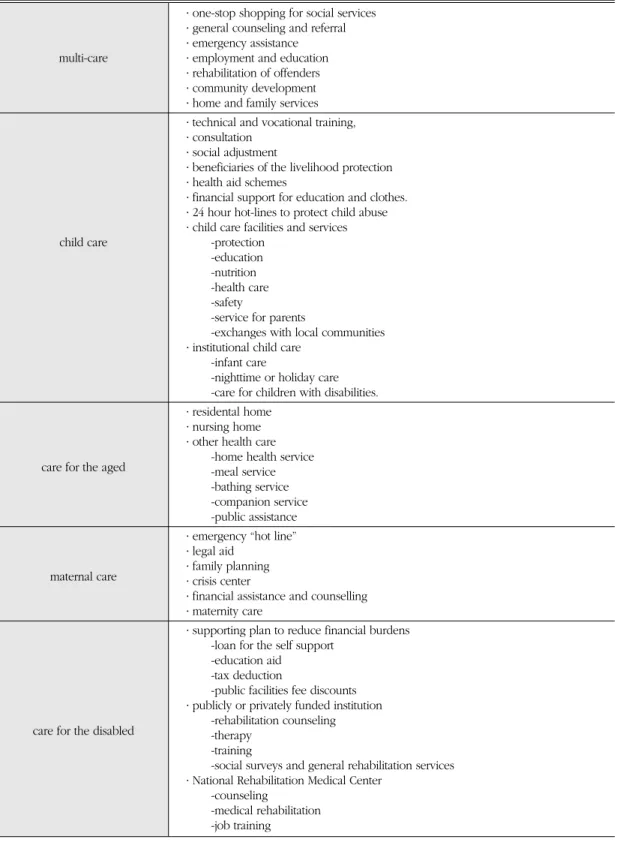
Most service providers being distributed in Busan are included in these criteria. The five target social welfare services include multiple care, child care, care for the aged, care for the disabled and maternal care shown in Table 3.
There are many multi-services providers for impoverished people in Busan. This is identified by variable independent organizations controlled by city government or private agencies offering assistance such as general counseling and referral, emergency assistance, employment and education. The proportion of multi care services is 16.1% of total social welfare services. From early 1980s, multi-services providers rapidly have increased all over Busan and most of them are controlled by city government.
Parents basically assume a primary responsibility for caring child. The young children, however, whose parents are not available for care as a result of unemployment, illness, divorce, death and other circumstances need protection and development7) by other welfare agencies. To protect these children and to promote their better living standards, welfare services let them on the beneficiaries of livelihood protection, health aid schemes and financial support for their education and clothes etc.8)Child care services in Busan usually provide daytime services such as children’s home. But Many agencies make an effort to develop a wide variety of services such as infant care, nighttime or holiday care and care for children with disabilities. In Busan, 302 providers of child care
services are considered as the most important social services, having 40.9% of total social services in proportion. After Infant Care Act of 1991, the number of child care facilities and the children using these facilities has been on the rapid rise.
The aged population has rapidly increased due to better living standards and medical advances.
The public and private welfare service providers supply various senior supporting programs. The services for aged people are generally categorized into residential homes, nursing homes and other health care. The seniors living independently have an opportunity to get non- residential services such as home help service, meal service, bathing service and companion service without payment. 157 providers for aged people are distributed all over the city. The welfare services for aged people account for 21.3% of total social services of Busan and are steadily on increase.
Even though the incidence of disability can be reduced by strengthening maternal and child health care system and by early detection and treatment of disabilities, the number of disabled people are still considerable. The governmental and public agencies of welfare services revise welfare policies and programs to expand more opportunities for people with disabilities. They focus on providing comprehensive protection and expanding income maintenance. They also provide rehabilitation services so that the disabled can build self-supporting capabilities.
Privately or publicly funded service providers are also built for disabled people who have self- supporting capabilities, providing rehabilitation counseling, therapy, training, social surveys and general rehabilitation services. Busan has 112 providers of social services for the disabled
Table 3. Five target social welfare services
·one-stop shopping for social services
·general counseling and referral
·emergency assistance multi-care ·employment and education
·rehabilitation of offenders
·community development
·home and family services
·technical and vocational training,
·consultation
·social adjustment
·beneficiaries of the livelihood protection
·health aid schemes
·financial support for education and clothes.
·24 hour hot-lines to protect child abuse
·child care facilities and services
child care -protection
-education -nutrition -health care -safety
-service for parents
-exchanges with local communities
·institutional child care -infant care
-nighttime or holiday care -care for children with disabilities.
·residental home
·nursing home
·other health care care for the aged -home health service
-meal service -bathing service -companion service -public assistance
·emergency “hot line”
·legal aid maternal care ·family planning
·crisis center
·financial assistance and counselling
·maternity care
·supporting plan to reduce financial burdens -loan for the self support
-education aid -tax deduction
-public facilities fee discounts
·publicly or privately funded institution care for the disabled -rehabilitation counseling
-therapy -training
-social surveys and general rehabilitation services
·National Rehabilitation Medical Center -counseling
-medical rehabilitation -job training
people, which become 15.1% of total services.
The service providers are rapidly increasing from 2000.
The maternal care basically relates to child abuse. The 24 hour emergency hot-lines have been installed and operated for an immediate reporting of child abuse. The maternal care is normally offered to unmarried single mothers so that they can give birth to a baby in a healthy and safe environment. In addition, the crisis centers for the prevention of child abuse are basically at the local community to identify and prevent child abuse. The single mother families with children under age 18 are able to use the dedicated welfare facilities where the government provides financial assistance and counselling services on psychological, educational, and vocational training issues. The 49 providers of maternal care service in Busan operate various programs to prevent child abuse and carefully take care of single mothers with baby. If we agree that welfare services are basically organized for better human life, we can give consequence to these maternal services.
4. Social Geography of Poverty and Welfare Service Provision
1) Distributional patterns of poverty and social welfare services
(1) Where do impoverished people live in Busan?
Figure 3 shows the change in the number of impoverished people and households from 1968 to 2006 in Busan. The population of poverty generally decreased during this period, though the number of them increased for some period.
In the case of households, we can examine the opposite results of population, the increase of the Source: www.mohw.go.kr
Figure 3. Changes of population and households of poverty(1968-2006)
Source: Statistical Annual Report of Busan, 1968-2006
number of households of impoverished people.
It is explained by decreasing family scale in process of time.
City of Busan has an history of poverty from the past. After the Korean War there were many geographical spots of refugees which make patterns of residential segregation. Though some spots have been disappeared by an urban policy of urban redevelopment or other renewal programs controlled by city government, the people who had lived in these places were impoverished in other places inside Busan area which were classified as slum. After the economic fluctuation of Korea in 1997, the impoverished people suddenly increased with the individual bankruptcy. While this situation has been slowly recovered by efforts of Korean government, there are considerable numbers of impoverished people all over the country including Busan. In 2006, there are 112,467 people of 57,134 households living in poverty and getting the benefits from welfare service agencies in Busan.
The impoverished people are spatially distributed all over Busan. In general the poor spots in study area are classified two sectors: in aging city center and in outskirts of Busan. As it
is shown in figure 4, the former areas include Dong-Gu, Joong-Gu and Seo-Gu which are located near downtown of Busan. The latter is related to peripheral region of Busan, including Buk-Gu, Gangseo-Gu, Sasang-Gu and Gijang- Gun which are characterized by agglomeration of manufacturing factory and agricultural land use.
The concentration of impoverished people in aging city center results both from suburbanization of the affluent and from the reliance of the service-dependent population upon place-specific human services provided by the public sector. Such concentration of social welfare services and their users in deteriorating city center and its neighborhoods is general for the larger cities.
In particular, the spatial distribution of impoverished people in 2006 by Dong in Busan is shown in Figure 5. Being compared to Figure 4, the distribution pattern is so similar, varying in different localities. There is a profound spatial inequality of distribution of impoverished people.
In the western outer of Busan near Nakdong River, many Dongs, including Dadae1·2, Hankjang, Mora3, Deokcheon1, Guemgok, have considerable numbers of impoverished people.
The people who are in poverty are found in Gijang-Eub, and Bansong2 that are located in eastern outer of Busan. In urban center both with aging and newing, we can find a large number of impoverished people. Gamcheon2, Buam1·3, and Choeub are included in this areas. In results, it is considered that the majorities of impoverished people are concentrated in urban centers and their neighborhoods and in east and west outskirts of Busan. We think that these distributional patterns of poverty is caused by geography and its social relations and processes.
The geographical patterns of poverty are Figure 4. Spatial distribution of impoverished people
by Gu, 2006(%)
Source: Statistical Annual Report of Busan, 2006 total No of recipient of financial aid / total No of population×100
complex. Philo(1995) wrote that the geography of poverty could be described in terms of environments and regions that were completed with an industrial decline, unemployment, bad housing, deficient services and social problems.
In addition, he referred that in most local scales poverty and wealth were closely intermixed and remained separated by minute distances which kept the poor and rich strangers to one another.
(2) Uneven distributional pattern of social welfare services
The changing social geography of poverty over the past many years, however, has a number of implications for the provision of social welfare services to people who are in service dependency. Of particular concern here is the fact that the impoverished people eligible for assistance are more mobile than the service providers. Thus the service providers must be flexible by changing the number of the impoverished people.
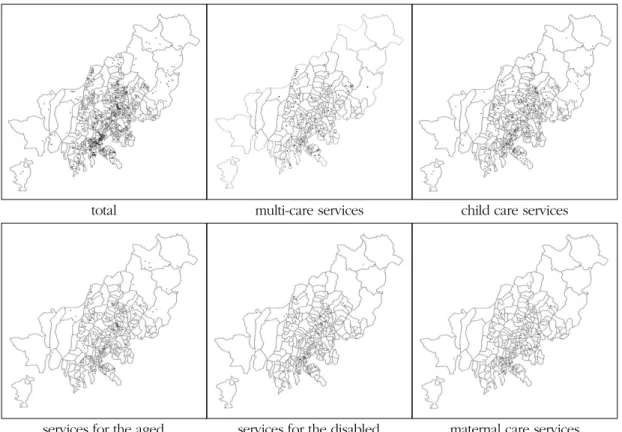
Figure 6 presents the distribution of welfare
service providers in total and five target social services in Busan. The whole service providers are unevenly distributed all over Busan. Most providers of social welfare services concentrate in city center and its neighborhoods. The aging city center and its neighborhoods including Joong-Gu, Dong-Gu, and Seo-Gu have more service providers than newing city center and its neighborhoods, which have Jin-Gu, Yeonje-Gu.
Youngdo-Gu, Nam-Gu, Buk-Gu, Sasang-Gu where there are many service providers in contrast with Haeundae-Gu, Saha-Gu, Geumjung-Gu, and Gijang-Eub located in outskirts of Busan.
In the case of multi care services, the distributional pattern is spatially uneven and really similar to the pattern of any other services.
But the spatial distribution of these centers is mostly dissonant with the place that impoverished people live in. Although Dadae1· 2, and Deokcheon1 have a numerous number of impoverished people, they don't have any multi- services providers for impoverished people. We can find a lack of service providers in Geumjung- Gu, Buk-Gu, Sasang-Gu, Nam-Gu, Saha-Gu and Gijang-Eub, they being compared with the rest areas of Busan.
The service providers of social welfare for child care vary in different localities. Child care services are more concentrated in specific areas than other kinds of social welfare services are.
High service providers in Busan are located in an adjacent aging city center such as Bosu, Daecheong, Youngju1·2, Beomil1, and Joacheon1. Daeyoen3, Choeub, Seodaesin4 are lack of service providers, while some portions of Dongrae-Gu such as Sajik1 and Seo3·4 have many service providers of child care.
Even fewer in number, the distributional Figure 5. Spatial distribution of impoverished people
by Dong (2006)
patterns of welfare providers of social services for aged people are similar to those of providers for child care service. They are concentrated in Seodaesin3, Choryang3·4 and Sumin. These areas are involved in Seo-Gu and Dongrae-Gu.
Joong-Gu has never any providers for the aged, while there are providers for child care, care for the disabled and maternal care. In comparison to other kinds of social services, Gijang-Gun has relatively many service providers for aged people. It is explained by a considerable number of elderly people who live in this area.
Even though social welfare service providers have intended to locate in areas with large number of needed people, the spatial pattern of distribution for service providers for disabled people are mostly uneven in space. Over 50% of
Dong areas don't have any service providers for service dependency people who are physically disabled and live in poverty. Low number of service providers for the disabled are found in Haeundae-Gu, Suyoung-Gu, Geumjung-Gu, Buk- Gu, Sasang-Gu, Saha-Gu and Busanjin-GU. The disabled people who live there have to pay a larger travel cost to get the services.
The spatial distribution of maternal care in Busan are concentrated within or nearby aging central city areas, so the services can't be delivered efficiently. The service providers of social welfare for single mothers and their babies are not found in the north-central, eastern and western portions of Busan. Such a severely uneven distributional pattern is reflected in regardless of dependent people.
Figure 6. Spatial patterns of social welfare service provisions(1dot=1provider)
total multi-care services child care services
services for the aged services for the disabled maternal care services
From these distributional patterns of total and five target services, we can guess that social welfare services should be absolutely located in specific places that are easily accessible, considering where impoverished and needed people live. For the service-dependent people, the journey-to-services costs may form some of the largest travel expenses in the household budget, particularly because many dependent persons such as the aged and the disabled find travel difficult. Many of needed people want to live near the service-delivery site, subjected to economic constraints inherent in the spatial pattern of multi service's provision. Most of them in Busan, however, are in low accessibility for social welfare services. Again, we address that services providers will be located in a nearest concentration of poverty people, so as to be able to deliver assistance as efficiently as possible.
2) Spatial relationship between poverty and social welfare services
Despite the economic growth and decreasing numbers of high poverty neighborhoods in urban areas, poverty and welfare needed group remain concentrated in urban areas. In response to the persistent needs of welfare services, governmental, public and private social service providers offer assistance to low-income populations locating in urban areas, near which disadvantaged populations are most concentrated, and in which services can be delivered most efficiently.
In social geography of poverty related to social welfare services, the most important question is based on the connection between locational independence. The disparities in service provider access, however, are present in most urban areas
and there is no exception in Busan. Thus we should consider that those disparities affect service utilization between impoverished people and access to social services, eventually translating into disparities in welfare outcomes.
The impoverished people and service providers are spatially concentrated in particular site in urban areas. Even when this general suggestion about social services is recognized, we can find out serious spatial disparities between poverty and social welfare services in Busan. We can also intend to show that a strong spatial relationship between social services and dependent groups is to be expected and that it can, in fact, increase the existing inequalities within urban areas.
The multiple regression analysis is more useful to explain the degree of spatial disparities between poverty and social welfare services. This model rests in its utility in explaining how the co- locational relationship of service-dependency between impoverished people and social welfare services relates to social poverty of community.
The impoverished people as dependent variable are controlled by the social welfare services as independent variable. According to a general hypothesis, it is suggested that the relationship between impoverished people and social welfare services is obvious. But there is a spatial inequality between demand of and supply for social welfare services.
Figure 7 shows that the spatial pattern of standardized residuals reveals autocorrelation in the relationship between poverty and social welfare services. The strong positive residuals mean that the observed value exceeds the estimated value. These 'overestimated' areas are spatially dispersive all over the city. The positive residuals are distributed throughout Seodaesin3-
dong, Choryang3-dong, Yangjung1-dong, Gupo3- dong, Mangmi2-dong, Yeonsan9-dong, and Banyeo1-dong which have relatively higher amount of social welfare service providers compared with the impoverished people in these areas. Even though a large majority of those areas are poor, the social welfare services are affluently provided to meet poverty problem and help impoverished people. In contrast with these areas, the negative residuals where the estimated value exceeds the observed value are found in new and old urban centers and their neighborhoods, including Choeub and Juryae2, Gaya3, Bujeon2, Bumcheon4, Danggam2, Buam and Beomjeon.
These ‘underestimated’ areas are also found in outskirts of Busan such as Deokcheon2·3, Mandeok3, Bansong3, Banyeo2·3·4, Hadan1, Gamjeon1 and Gangdong which have relatively lower service providers, compared to the proportion of impoverished people. The impoverished people who live in these areas need more social welfare services than before.
There is strong contiguity between ‘observed’
and ‘estimated’ in Samrak. Deokpo2, Bugok3,
Woo1, Joong1, Jowa2·3, Minrak, Yongho1·2 and Jangan-Eub which have reasonable social welfare services according to client's needs.
Consequently, it is suggested that the social welfare service is an important factor in explaining the spatial diversification of poverty.
From this residuals map, it is suggested that the provision of social welfare services is significantly correlated with poverty and is spatially uneven by an arbitrary location of variable service agencies, not considering where impoverished people live.
5. Conclusions
The contemporary social geography of urban poverty focuses on the relationship between impoverished people and social welfare services for them. In this respect, this paper aims to identify the spatial disparities and disparities between the location of impoverished people and the provision of social welfare services through the spatial distribution and patterns of poverty and social welfare services providers.
The important conclusions associated with the relationship between impoverished people and social welfare services are as follows; First, the five target social welfare services include multiple care, child care, care for the aged, care for the disabled and maternal care. From early 1980s, multi-services providers have rapidly increased all over Busan and most of them are controlled by city government. The child care services are considered as the most important social services.
Since the Infant Care Act became effective in 1991, the number of child care facilities and the children using these facilities has been on the rapid rise. The welfare services for aged people Figure 7. Residual map
is steadily on increase and the service providers for the disabled are rapidly increasing from 2000.
The 49 providers of maternal care service in Busan operate various programs to prevent child abuse and carefully to take care of single mothers with baby.
Second, there is a profound spatial inequality of distribution of impoverished people and it is considered that the majorities of impoverished people are concentrated in urban center and east and west outskirts of Busan. The whole service providers are unevenly distributed all over Busan. Most of them concentrate in an urban center and its neighborhoods. The impoverished people are mostly in low accessibility for services. It means that impoverished people in urban centers have greater spatial access to social services than impoverished people living in suburban areas. Therefore, we address that services providers will be located in a nearest concentration of poverty people, so as to be able to deliver assistance as efficiently as possible.
Third, the disparities in service provider accessibility are present in most urban areas and there is no exception in Busan. We can find out serious spatial disparities between poverty and social welfare services by multiple regression analysis. Even though the social welfare service is an important factor in explaining the spatial diversification of poverty, the provision of social welfare services is spatially uneven by an arbitrary location of variable service agencies, not considering where impoverished people live.
The social welfare agencies as service providers have to know the current distributions and historical concentrations of potentially service-dependent households and people and are able to react to local needs and resources to prevent individual and community deprivation.
Beyond general concerns about the fit between the geography of social welfare services and poverty group in urban areas, program managers of welfare, policy-makers, and etc, the welfare reform should be concerned about how the patterns of social service accessibility may affect to help impoverished people and meet poverty problem. Future studies must emphasize the linkages between the location of service dependent population and governmental, public and private agencies, with efforts to answer some basic questions about the nature and impact of these linkages. This paper, despite some weaknesses, makes a useful contribution to the whole question of what areas of need are not yet adequately met by the variable social welfare service providers in Busan, and it is basically reminded that the social welfare services must be on a humanitarian idea rather than an administrative or supply-based structure.
Notes
1) In this paper, human needs mean goods and services constitute a minimally adequate standards of living to meet poverty.
2) Dong areas in Busan are as follows;
3) The financially disadvantaged people are unable to participate in the normal market exchanges necessary to sustain a viable way of life. The people may suffer personal disadvantage render them unable to exercise rational preferences even if they possess the requisite financial resources. The societally disadvantaged people are ‘stigmatized’ and excluded from the broader community despite generally being able to function well. The community disadvantaged people cannot participate in normal life(Billis and
Glennerster, 1998).
4) Absolute poverty is defined according to an absolute minimum standard, often called the ‘poverty line’.
Relative poverty means that someone is poor in relation to those around him(or her). Income poverty means that someone is poor if he(or she) has less money than the defined poverty line for his country.
Human poverty takes into account other factors, such as life expectancy, infant malnutrition, illiteracy and lack of food of clean water.
117. Geumgok 146. Goijung2 175. Namsan 204. Kwangan1 118. Hwamyong1 147. Goijung3 176. Guseo1 205. Kwangan2 119. Hwamyong2 143. Goijung4 177. Guseo2 206. Kwangan3 120. Hwamyong3 149. Dangri 178. Geumsung 207. Kwangan4 121. Deokcheon1 150. Hadan1 179. Daejeo1 208. Minrak 122. Deokcheon2 151. Hadan2 180. Daejeo2 209. Samrak 123. Deokcheon3 152. Sinpyong1 181. Gangdong 210. Mora1 124. Mandeok1 153. Sinpyong2 182. Myungji 211. Mora2 125. Mandeok2 154. Jangrim1 183. Garak 212. Mora3 126. Mandeok3 155. Jangrim2 184. Noksan 213. Deokpo1 127. Woo1 156. Dadae1 185. Cheonga 214. Deokpo2 128. Woo2 157. Dadae2 186. Geoje1 215. Goibub 129. Jung1 158. Gupyong 187. Geoje2 216. Gamjeon1 130. Jung2 159. Gamcheon1188. Geoje3 217. Gamjeon2 131. Jowa1 160. Gamcheon2189. Geoje4 218. Juryea1 132. Jowa2 161. Seo1 190. Yeonsan1 219. Juryea2 133. Jowa3 162. Seo2 191. Yeonsan2 220. Juryea3 134. Jowa4 163. Seo3 192. Yeonsan3 221. Hakjang 135. Songjung 164. Seo4 193. Yeonsan4 222. Eumgung 136. Banyeo1 165. Geumsa 194. Yeonsan5 223. Gijang 137. Baqnyo2 166. Bugok1 195. Yeonsan6 224. Jangan 138. Banyeo3 167. Bugok2 196. Yeondan7 225. Ilkwang 139. Banyeo4 168. Bugok3 197. Yeonsan8 226. Jungkwan 140. Bansong1 169. Bugok4 198. Yeonsan9 227. Chulma
141. Bamsong2 170. Jangjeon1 199. Namcheon1 142. Bansong3 171. Jangjeon2 200. Namcheon2 143. Jaesong1 172. Jangjeon3 201. Suyoung 144. Jaesong2 173. Sundugu 202. Mangmi1 145. Goijung1 174. Cheonryongnopo 203. Mangmi2 1. Joongang 30. Sujung1 59. Yeonji 88. Sajik1
2. Dongkwang 31. Sujung2 60. Choeub 89. Sajik2 3. Daegheong 32. Sujung3 61. Yangjung1 90. Sajik3 4. Bosu 33. Sujung4 62. Yangjung2 91. Anrak1 5. Bupyeong 34. Sujung5 63. Jeonpo1 92. Anrak2 6. Kwangbok 35. Joacheon1 64. Jeonpo2 93. Myongang1 7. Nampo 36. Joicheon4 65. Jeonpo3 94. Myongang2 8. Youngju1 37. Beomil1 66. Buam1 95. Dayeon1 9. Youngju2 38. Beomil2 67. Buam3 96. Daeyeon2 10. Dongdaesin1 39. Beomil4 68. Danggam1 97. Daeyeon3 11. Dongdaesin2 40. Beomil5 69. Danggam2 98. Daeyeon4 12. Dongdaesin3 41. Beomil6 70. Danggam3 99. Daeyeon5 13. Seodaesin1 42. Namhang 71. Danggam4 100. Daeyeon6 14. Seodaesin2 43. Youngsun1 72. Gaya1 101. Yongho1 15. Seodaesin3 44. Youngsun2 73. Gaya2 102. Yongho2 16. Seodaesin4 45. Sinsun1 74. Gaya3 103. Yongho3 17. Bumin 46. Sinsun2 75. Gaegeum1 104. Yongho4 18. Ami 47. Sinsun3 76. Gaegeum2 105. Yongdang 19. Chojang 48. Bongrae1 77. Gaegeum3 106. Gamman1 20. Chungmu 49. Bongrae3 78. Bumcheon1 107. Gamman2 21. Nambumin1 50. Bongrae4 79. Bumcheon2 108. Uam1 22. Nambumin2 51. Cheonghak1 80. Bumcheon4 109. Uam2 23. Nambumin3 52. Cheonghak2 81. Sumin 110. Munhyun1 24. Amnam 53. Dongsam1 82. Boksan 111. Munhyun2 25. Choryang1 54. Dongsam2 83. Myongryun1 112. Munhyun3 26. Choryang2 55. Dongsam3 84. Myungryun2 113. Munhyun4 27. Choryang3 56. Bujeon1 85. Oncheon1 114. Gupo1 28. Choryang4 57. Bujeon2 86. Oncheon2 115. Gupo2 29. Choryang6 58. Bumjeon 87. Oncheon3 116. Gupo3
5) The criteria to measure absolute poverty are variable such as minimum daily caloric intake, proportion of income spent on food and income levels to purchase a define minimum basket of consumption good etc.
6) Throughout this paper, we use the term ‘social welfare services’, representing general social care for impoverished people.
7) It involves education, nutrition, health, safety for infant and children, service for parents, and exchanges with local communities.
8) Under the Child Welfare Act of 1991, child care services are provided to children under aged 18. The government extends financial support to children in welfare facilities such as group home, and supports personnel expenses of the special trainers at the institutions.
References
Abel-Smith, B. and Townsend, P., 1965, The Poor and the Poorest, Bell, London.
Beresford, P., Green, D., Lister, R., and Woodard, K., 1999, Poverty Firsthand: Impoverished People Speak for Themselves, Child Poverty Action Group, London.
Billis, D. and Glennerster, H., 1998, Human services abd the voluntary sector: towards a theory of comparative advantage, Journal of Social Policy, 27(1), 79-98.
Brunhes, J., 1920, Human Geography : An Attempt at a Positive Classification, Principles and Examples, George G. Harrap, London.
Gordon, D. and Spicker, P., 1999, The International Glossary on Poverty, Zed Books, London.
Leyshon, A., 1995, Missing words: whatever happened to the geography of poverty?, Environment and Planning A, 27, 1021-1028.
Lipton, M., 1983, Poverty, Undernutrition and Hunger, Staff Working Paper 597, World Bank, Washington D.C.
MacPherson, S. and Silbum, R., 1998, The meaning and
measurement of poverty, in Dixon, J. and Macarov, D.(eds.), Poverty: A Persistent Global Reality, Routledge, London.
Olagnero, M., Meo, A., and Corcoran, M. P., 2005, Social support network in impoverished European neighborhoods, European Societies, 7(1), 53-79.
Pain, R., Barke, M., Fuller, D., Gough, J., MacFarlane, R., and Mowl, G., 2001, Introducing Social Geographies, Arnold, London.
Philo, C. (ed.), 1995, Off the Map: The Social Geography of Poverty in the UK, Child Poverty Action Group, London.
Philo, C., 2000, Poverty, in Johnston, R. J., Gregory, D.
Pratt, G., and Watts, M. (eds.), The Dictionary of Human Geography, Blackwell, Oxford.
Piachaud, D., 1987, Problems in the definition and measurement of poverty, Journal of Social Policy, 16(2), 147-164.
Power, A., 1996, Area-based poverty and resident empowerment, Urban Studies, 33(9), 1535-1564.
Rao, V., 1982, Food, Nutrition and Poverty in India, Harvester Wheatsheaf, Hemel Hempstead.
Robinson, F. and Gregson, N., 1992, The “underclass”: a class apart?, Critical Social Policy, 12, 38-51.
Rowntree, S., 1941, Poverty and Progress, Longman, London.
Sen, A., 1983, Poor, Relatively Speaking, Oxford Economics Paper 35.
Smith, C. J., 1981, Urban Structure and the development of natural support systems for service-dependent populations, Professional Geographer, 33(4), 457-465.
Townsend, P., 1979, Poverty in the United Kingdom: A Survey of Household Resources and Standards of Living, Penguin, London.
Valentine, G., 2001, Social Geographies: Space & Society, Prentice Hall, Harlow.
Watson, J. W., 1951, The sociological aspects of geography, in Taylor, G. (ed.), Geography in the Twentieth Century: A Study of Growth, Fields, Techniques, Aims and Trends, Methuen, London.
Wilson, W. J., 1987, The Truly Disadvantaged: The Inner City, The Underclass and Public Policy, University of Chicago Press, Chicago.
Wolch, J. R., 1981, The location of the service- dependent households in urban areas, Economic Geography, 57, 111-129.
Correspondence: Bae, Mi-Ae, Institute of Busan Geography, Pusan National University, San 30, Jangjeon-Dong,
Geumjung-Gu, Busan, 609-735, Korea(e-mail:
[email protected], phone: 051-510-3259)
교신:배미애, 609-735, 부산광역시 금정구 장전동 산 30, 부 산대학교 부산지리연구소(이메일: [email protected], 전화:051-510-3259)
Received January 9, 2007 Accepted June 18, 2007