Background and Purpose There is sparsity of quality evidence for the use of drugs after first-line benzodiazepines in convulsive status epilepticus in children. The aim of the study was to compare the clinical efficacy and safety of intravenous levetiracetam versus intravenous phe- nytoin as second-line drugs in the management of generalized convulsive status epilepticus in children.
Methods This open-label randomized controlled trial was conducted in the Emergency De- partment of The Children’s Hospital and The Institute of Child Health, Multan, Pakistan over a period of 4 years and 6 months from January 2014 to June 2018. This study included 600 children with generalized convulsive status epilepticus: 300 in the 40 mg/kg levetiracetam group, and 300 in the 20 mg/kg phenytoin group. Cessation of a clinical seizure (seizure cessa- tion rate) within 30 minutes after the end of drug administration was the primary outcome in this study, and the presence or absence of adverse effects was noted as the secondary outcome.
Data were analyzed using SPSS (version 20.0).
Results The children in the levetiracetam and phenytoin were aged 3.5±0.2 and 3.4±0.2 years (mean±SD), respectively, their seizure durations before the start of treatment were 25.1±0.6 and 23.8±0.4 minutes, and their treatment efficacies were 278/300 (92.7%) and 259/300 (83.3%). Levetiracetam was significantly more effective than phenytoin (p=0.012), with no sig- nificant difference in safety. Adverse events were observed in eight children in the phenytoin group.
Conclusions Levetiracetam is significantly more effective than phenytoin for the treatment of convulsive status epilepticus in children who have failed to respond to benzodiazepines.
Key Words intravenous levetiracetam, intravenous phenytoin, convulsive status epilepticus, children.
Clinical Efficacy and Safety of Injectable Levetiracetam Versus Phenytoin as Second-Line Therapy in the Management
of Generalized Convulsive Status Epilepticus in Children:
An Open-Label Randomized Controlled Trial
INTRODUCTION
In neurology-related emergency situations, convulsive status epilepticus (CSE) remains the most common life-threatening condition among children. The incidence of pediatric CSE is 20 per 100,000 children, with 22% of patients requiring rapid sequence induction and admission to an intensive care unit.1 Among pediatric CSE patients, 3% to 5% suffer mortality and 34% suffer from neurological sequelae, which result in major long-term de- mands on acute and chronic health-care and social-care resources.2
Amongst the current emergency-care pathways for the management of childhood CSE, the stepwise algorithm advocated in advanced pediatric life support (APLS) is most often Nuzhat Noureena
Saadia Khanb Asim Khursheedc Imran Iqbalb Moallah Maryamb Syed Muhammad Sharibd Neeta Maheshwaryd
a Departments of Paediatric Neurology and
b Paediatrics, The Children Hospital and Institute of Child Health Multan, Multan, Pakistan
c Paediatric Intensive Care Unit, The Children Hospital and Institute of Child Health Multan, Multan, Pakistan
d Medical Affairs Department,
Hilton Pharma Pvt Ltd, Karachi, Pakistan
pISSN 1738-6586 / eISSN 2005-5013 / J Clin Neurol 2019;15(4):468-472 / https://doi.org/10.3988/jcn.2019.15.4.468
Received January 14, 2019 Revised April 11, 2019 Accepted April 11, 2019 Correspondence Nuzhat Noureen, MBBS, FCPS Department of Paediatric Neurology, The Children Hospital and Institute of Child Health Multan, Ab’dali Road, Chowk Fawara, Mohalla Qadirabad, Multan, Pakistan
Tel +92-332-7409471 Fax +0619201064
E-mail [email protected]
cc This is an Open Access article distributed under the terms of the Creative Commons Attribution Non-Com- mercial License (https://creativecommons.org/licenses/by-nc/4.0) which permits unrestricted non-commercial use, distribution, and reproduction in any medium, provided the original work is properly cited.
JCN
Open Access ORIGINAL ARTICLENoureen N et al.
JCN
used in clinical practice. The first-line treatment is two dos- es of a benzodiazepine administered 10 minutes apart. If the child continues to fit at 10 minutes after the second dose of benzodiazepine, APLS recommends phenytoin (PHT) as the first-choice second-line anticonvulsant. However, if the child is allergic to PHT, has previously not responded to it, or has experienced a serious adverse event, phenobarbital is recommended.3
The current standard drug, PHT, is only effective in 60%
of CSE patients and it is associated with considerable adverse effects including fatal cardiac arrhythmias and Stevens-John- son syndrome.4,5 Levetiracetam (LEV) is a broad-spectrum anticonvulsant that is effective in treating generalized tonic- clonic, focal, and myoclonic seizures.6 There is considerable anecdotal evidence that intravenous (IV) LEV is safe and ef- fective in the treatment of acute repetitive seizures and both CSE and non-CSE, with reported seizure cessation rates of between 76% and 100%.7 A systematic review published in 2012 indicated that the efficacy rate ranged from 44% to 94%, and was higher in retrospective studies.8 Reported IV LEV doses range from 20 to 60 mg/kg, with infrequent and mild adverse effects even at the upper limit of the dose range.9 Fur- thermore, LEV can be infused over 5–7 minutes, which sug- gests that CSE can be stopped more rapidly than with PHY.10 It is therefore reasonable to hypothesize that LEV is more effective and safer than IV PHT in stopping CSE. A high- quality randomized controlled trial (RCT) is therefore essen- tial to determine whether PHT or LEV is the ideal drug in CSE.
The objectives of this study were to compare the efficacy and safety of LEV and PHT as a second-line anticonvulsant for the management of childhood CSE.
METHODS
Design
This was an open-label RCT comparing IV LEV and IV PHT in children presenting to an Emergency Department with CSE. The study participants were allocated to the two interven- tion groups at a ratio of 1:1. The study followed the CON- SORT guidelines in reporting the results of the trial.
Setting and participants
The study was conducted in the Emergency Department of The Children’s Hospital and The Institute of Child Health, Multan, Pakistan from January 2014 to June 2018. Male and female patients aged 1–14 years with generalized CSE who did not responding to two doses of diazepam (0.2 mg/kg to a maximum of 10 mg, administered 5 minutes apart) were in- cluded in the study at 5 minutes after the second dose of di- azepam.
The following exclusion criteria were applied:
• Received anticonvulsant treatment other than benzodi- azepine for the acute management of CSE.
• On assisted ventilation.
• Having CSE secondary to hypertensive encephalopathy, head injury, chronic kidney, or liver disease and electrolyte derangement (hypoglycemia, hypocalcemia, hypo/hy- pernatremia, or hypomagnesemia).
• Presence of hypotension symptoms.
Study process and interventions
The study was approved by the ethical committee of The Children’s Hospital and The Institute of Child Health, Mul- tan (approval no. CHICH/EC/DR.NUZHAT NOUREEN/
25-01-2014/109), and was conducted in accordance with the Declaration of Helsinki. Written informed consent was ob- tained from the parents or guardians of the children prior to their inclusion in the study. A specially designed pro for- ma reporting form was used to record all information in- cluding demographics, date and time of presentation, cause of CSE, study drug allocation and treatment, and efficacy and adverse drug reactions. Children were divided into two groups by random allocation for the selection of second-line drug (i.e., LEV and PHT groups).
LEV was used in a dose of 40 mg/kg (maximum of 500 mg) infused over 15 minutes, while the PHT dose was 20 mg/kg (maximum of 250 mg) given over 30 minutes. Both drugs were diluted in normal saline. Supportive treatment (e.g., an- tipyretics and antibiotics) was provided simultaneously to both groups according to the hospital protocol. Emergency resuscitation equipment was available and functional to deal with any untoward reaction.
Outcomes
The primary efficacy outcome of the study was clinical cessa- tion of the seizure within 30 minutes following completion of the administered drug infusion (primary efficacy outcome).
The seizure activity (increased tone, jerking movements, and level of consciousness) was assessed by a clinical investiga- tor or senior treating physician from the start of adminis- tering the study drug until 30 minutes after completing the infusion. The secondary outcome of the study was adverse events or serious adverse events caused by the study drug (primary safety outcome). Adverse reactions were detected by monitoring for changes in baseline arterial blood gases, electrocardiogram, blood pressure, and score on the Glasgow Coma Scale (GCS). These parameters were monitored during drug administration and up to 1 hour after drug adminis- tration.
The following adverse effects were monitored in all of the
Efficacy & Safety of IV Levetiracetam vs. Phenytoin in CSE in Children
JCN
included patients:
• Respiratory depression, defined as the presence of respi- ratory acidosis (PCO2 >45 mm Hg) and hypoxemia (PaO2
<80 mm Hg) in arterial blood gas after drug administra- tion.
• Cardiac depression, defined as the presence of bradyar- rhythmia on an electrocardiogram after drug administra- tion.
• Hypotension, defined as a decrease in blood pressure to the third percentile after drug administration.
• Central nervous system depression, defined as a decrease of ≥3 points in the GCS score from baseline after drug administration.
Sample size
Based on the seizure cessation rates reported by Alvarez et al.11 and Misra et al.,12 152 participants were required to be randomized into each arm for the study to provide a statis- tical power of ≥90% in detecting a total difference of ≥10%
in the seizure cessation rates between LEV and PHT for a significance level (α value) of 0.05. It was initially planned for 300 CSE pediatric patients to be included, but the study du- ration was subsequently extended and the sample size ex- panded to 600 in order to further validate the results and al- low for dropouts.
Randomization
Patients were allocated randomization codes using a simple randomization technique, with a sealed-envelope system used for randomization. Each of the prepared envelopes in- cluded the name of a drug (“PHT” or “LEV” was written on 300 envelopes each). All envelopes were securely sealed and shuffled by a person not involved in the study. These pre- written sealed envelopes containing the drug names were opened at the time of administering the second-line drug for the management of CSE, and the clinical investigator ensured that the drug as specific on each envelope was administered by the clinical staff without bias.
Statistics
Data were analyzed using SPSS (version 20.0; IBM Corp., Armonk, NY, USA). Descriptive statistics were applied to cal- culate the mean±SD values for age and the duration of sei- zures. Frequencies and percentages were calculated for quali- tative variables such as sex, cause of CSE, and efficacy and safety of IV LEV and IV PHT. The efficacy and safety of the two drugs were compared using the chi-square test. A p value of ≤0.05 was considered to indicate statistical significance.
Registration of clinical trial
This open-label RCT is registered on WHO, International Clinical Trial Registry Platform, through the Iranian Registry of Clinical Trials (IRCT), with an IRCT ID of IRCT201706 14034526N2 (search portal: https://irct.ir/trial/33671).
RESULTS
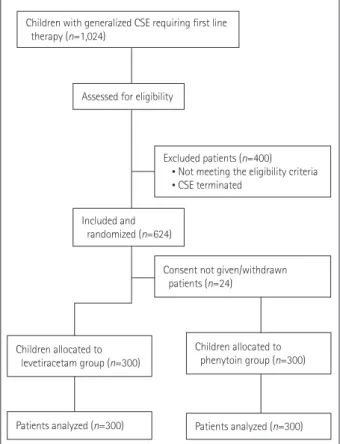
This study screened 1,024 children, of whom 600 (300 in each group) meeting the inclusion criteria were included. The study flow chart is shown in Fig. 1, and the baseline demographic characteristics are provided in Table 1. Most of the children were younger than 5 years, comprising 234 (78%) of those in the LEV group and 242 (80.7%) of those in the PHT group, while 66 (22%) and 58 (19.3%), respectively, were aged 6–14 years. The male:female ratio was 2.5:1 in the LEV group and 1.7:1 in the PHT group.
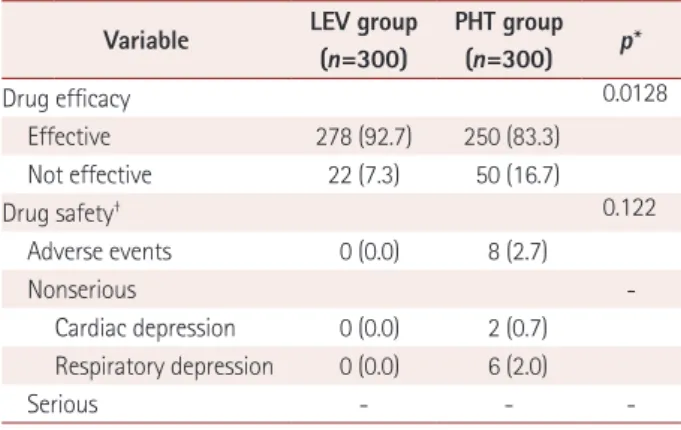
LEV and PHT were found to be effective in stopping CSE seizures in 278 (92.7%) and 250 (83.3%) children, respectively (p=0.0128). LEV was found to be safe in all 300 (100%) chil- dren, while PHT was safe in 292 (97.3%) children. The safety rate did not differ significantly between the two groups (p=
0.122).
Adverse drug reactions were noted in 8 (2.7%) children treated with PHT. Cardiac and respiratory depression were
Children with generalized CSE requiring first line therapy (n=1,024)
Assessed for eligibility
Excluded patients (n=400)
• Not meeting the eligibility criteria
• CSE terminated
Consent not given/withdrawn patients (n=24)
Included and randomized (n=624)
Children allocated to phenytoin group (n=300) Children allocated to
levetiracetam group (n=300)
Patients analyzed (n=300) Patients analyzed (n=300)
Fig. 1. Study flow chart. CSE: convulsive status epilepticus.
Noureen N et al.
JCN
noted in 2 (0.7%) and 6 (2.0%) children who were treated with PHT, respectively. The efficacy and safety in the two groups are compared in Table 2. No serious adverse events were ob- served in either study group.
DISCUSSION
Generalized CSE is the most common life-threatening pedi- atric neurological emergency. However, current treatment protocols acknowledge the lack of robust evidence to guide treatment for CSE after administering first-line benzodiaze- pines in children.13 One systematic review regarded pheno- barbital, PHT, and paraldehyde as suitable second-line drugs for CSE management.14
A few previous small case series have proposed that LEV is a safe and effective antiepileptic for the acute treatment of
seizures in children. Bootsma et al.15 reported that LEV has a good safety profile compared to both older and newer anti- epileptic drugs. Reiter et al.16 demonstrated that IV LEV was effective in managing acute seizures in 79% of their adult pa- tients. Milligan et al.17 concluded that both LEV and PHT de- creased the incidence of postoperative seizures and epilepsy.
Our study provides reliable evidence for the efficacy and safety of LEV in managing generalized CSE in children based on data obtained from a large sample.
Chakravarthi et al.18 conducted a randomized compari- son trial of LEV versus PHT in the management of CSE in 44 children. That study found that LEV and PHT were equally effective with regard to both primary and secondary outcome measures, from which it can be concluded that LEV may be an attractive and effective alternative to PHT for managing CSE. Aiguabella et al.19 assessed the efficacy of IV LEV as an add-on treatment after benzodiazepines plus PHT in CSE in 40 adults in an observational multicenter retrospective study, and found that LEV was effective in 57.5% when used as an add-on therapy and 78.5% when used as the initial second- line treatment.
The appropriate and timely management of CSE is of par- amount importance, and so antiepileptic drugs need to be able to immediately control seizures and also have a good safety profile.20 While the present study has provided further evi- dence that LEV is an effective and safe drug for the manage- ment of CSE in children, there is a need for further prospective studies to validate and justify the role of IV LEV as a second- line antiepileptic drug in this population. The response rates of 92.7% for LEV and 83.3% for PHT in stopping CSE seizures in children are notably higher than those found in previously published series, except for a few retrospective studies.21,22 This difference might have been due to specific characteristics of the present study population.
Table 1. Comparison of baseline parameters between the LEV and PHT groups
Variable LEV group PHT group p*
Age, years 3.52±0.24 3.46±0.22 0.246
Sex
Male 216 (72.0) 190 (63.3) 0.042
Female 84 (28.0) 110 (36.7) 0.051
Duration of seizures, minutes 25.11±0.66 23.88±0.49 0.124
Cause of convulsive status epilepticus
Meningitis/encephalitis 130 (43.3) 120 (40) 0.156
Febrile seizures 18 (6) 20 (6.7) 0.345
Epilepsy 52 (17.3) 50 (16.6) 0.256
Cerebral palsy and epilepsy 58 (19.3) 62 (20.7) 0.215
Neurodegenerative disorders and epilepsy 42 (14) 48 (16) 0.143
Data are mean±SD or n (%) values.
*Chi-square test, with p≤0.05 considered significant.
LEV: levetiracetam, PHT: phenytoin.
Table 2. Comparison of efficacy and safety of intravenous LEV and PHT
Variable LEV group (n=300)
PHT group (n=300) p*
Drug efficacy 0.0128
Effective 278 (92.7) 250 (83.3)
Not effective 22 (7.3) 50 (16.7)
Drug safety† 0.122
Adverse events 0 (0.0) 8 (2.7)
Nonserious -
Cardiac depression 0 (0.0) 2 (0.7) Respiratory depression 0 (0.0) 6 (2.0)
Serious - - -
Data are n (%) values.
*Chi-square test, with p≤0.05 considered significant, †Patients were monitored for acute responses only, which reduced the number of events reported. No serious event was observed during the short study period.
LEV: levetiracetam, PHT: phenytoin.
Efficacy & Safety of IV Levetiracetam vs. Phenytoin in CSE in Children
JCN
While this was one of largest studies to provide clinical- efficacy data for IV LEV and IV PHT in children aged 1–14 years with CSE seizures, it had certain limitations that need to be addressed in future trials, such as 1) only the acute re- sponses related to efficacy and safety of the drugs were stud- ied, which led to underreporting or even no reporting of ad- verse events and 2) the stopping of electric seizures was not measured in the LEV group due to the unavailability of por- table EEG. However, the purpose of this study was to revise or strengthen clinical practices, and its findings will ultimately lead to the strengthening of practices for using IV LEV in par- ticular and PHT infusion as second-line drugs in the manage- ment of acute CSE in children.
In conclusion, IV LEV is significantly more effective than IV PHT as a second-line drug for treating CSE in children who have failed to respond to benzodiazepines. Patients who received IV LEV did not show any respiratory, cardiac, or neurological depression, or hypotension.
Author Contributions
Conceptualization: Nuzhat Noureen, Saadia Khan, Imran Iqbal. Data cu- ration: Nuzhat Noureen, Saadia Khan, Moallah Maryam. Formal analysis:
Nuzhat Noureen, Asim Khursheed, Syed Muhammad Sharib, Neeta Ma- heshwary. Investigation: Nuzhat Noureen, Saadia Khan, Asim Khursheed, Imran Iqbal, Moallah Maryam. Methodology: Nuzhat Noureen, Saadia Khan, Asim Khursheed, Imran Iqbal. Project administration: Nuzhat Nou- reen, Saadia Khan, Asim Khursheed, Moallah Maryam. Supervision: Nu- zhat Noureen, Asim Khursheed, Imran Iqbal. Visualization: Nuzhat Nou- reen, Saadia Khan. Writing—original draft: Nuzhat Noureen, Saadia Khan, Asim Khursheed, Syed Muhammad Sharib, Neeta Maheshwary. Writing—
review & editing: Nuzhat Noureen, Syed Muhammad Sharib, Neeta Ma- heshwary.
ORCID iDs
Nuzhat Noureen https://orcid.org/0000-0002-2232-4650 Saadia Khan https://orcid.org/0000-0002-7594-9945 Asim Khursheed https://orcid.org/0000-0003-4228-9394 Imran Iqbal https://orcid.org/0000-0003-0636-5396 Moallah Maryam https://orcid.org/0000-0002-5966-3760 Syed Muhammad Sharib https://orcid.org/0000-0001-7695-8950 Neeta Maheshwary https://orcid.org/0000-0003-2096-3579 Conflicts of Interest
The authors have no potential conflicts of interest to disclose.
REFERENCES
1. Novorol CL, Chin RF, Scott RC. Outcome of convulsive status epilep- ticus: a review. Arch Dis Child 2007;92:948-951.
2. Raspall-Chaure M, Chin RF, Neville BG, Scott RC. Outcome of pae- diatric convulsive status epilepticus: a systematic review. Lancet Neu- rol 2006;5:769-779.
3. Advanced Life Support Group. APLS 6e manual updates [Internet].
Manchester: Advanced Life Support Group; 2018 [cited 2019 May 1].
Available from: https://www.alsg.org/en/files/APLS/APLS_6e_Man- ual_updates.pdf.
4. Appleton RE, Gill A. Adverse events associated with intravenous phe- nytoin in children: a prospective study. Seizure 2003;12:369-372.
5. Gallop K. Review article: phenytoin use and efficacy in the ED. Emerg Med Australas 2010;22:108-118.
6. Berning S, Boesebeck F, Van Baalen A, Kellinghaus C. Intravenous le- vetiracetam as treatment for status epilepticus. J Neurol 2009;256:
1634-1642.
7. McTague A, Kneen R, Kumar R, Spinty S, Appleton R. Intravenous levetiracetam in acute repetitive seizures and status epilepticus in chil- dren: experience from a children’s hospital. Seizure 2012;21:529-534.
8. Zelano J, Kumlien E. Levetiracetam as alternative stage two antiepilep- tic drug in status epilepticus: a systematic review. Seizure 2012;21:233- 9. Wright C, Downing J, Mungall D, Khan O, Williams A, Fonkem E, 236.
et al. Clinical pharmacology and pharmacokinetics of levetiracetam.
Front Neurol 2013;4:192.
10. Ramael S, Daoust A, Otoul C, Toublanc N, Troenaru M, Lu ZS, et al.
Levetiracetam intravenous infusion: a randomized, placebo-controlled safety and pharmacokinetic study. Epilepsia 2006;47:1128-1135.
11. Alvarez V, Januel JM, Burnand B, Rossetti AO. Second-line status epi- lepticus treatment: comparison of phenytoin, valproate, and leveti- racetam. Epilepsia 2011;52:1292-1296.
12. Misra UK, Kalita J, Maurya PK. Levetiracetam versus lorazepam in status epilepticus: a randomized, open labeled pilot study. J Neurol 2012;259:645-648.
13. Dalziel SR, Furyk J, Bonisch M, Oakley E, Borland M, Neutze J, et al.
A multicentre randomised controlled trial of levetiracetam versus phe- nytoin for convulsive status epilepticus in children (protocol): Convul- sive Status Epilepticus Paediatric Trial (ConSEPT)-a PREDICT study.
BMC Pediatr 2017;17:152.
14. Appleton R, Macleod S, Martland T. Drug management for acute tonic-clonic convulsions including convulsive status epilepticus in children. Cochrane Database Syst Rev 2008;3:CD001905.
15. Bootsma HP, Ricker L, Diepman L, Gehring J, Hulsman J, Lambrechts D, et al. Long-term effects of levetiracetam and topiramate in clinical practice: a head-to-head comparison. Seizure 2008;17:19-26.
16. Reiter PD, Huff AD, Knupp KG, Valuck RJ. Intravenous levetiracetam in the management of acute seizures in children. Pediatr Neurol 2010;
43:117-121.
17. Milligan TA, Hurwitz S, Bromfield EB. Efficacy and tolerability of le- vetiracetam versus phenytoin after supratentorial neurosurgery. Neu- rology 2008;71:665-669.
18. Chakravarthi S, Goyal MK, Modi M, Bhalla A, Singh P. Levetiracetam versus phenytoin in management of status epilepticus. J Clin Neurosci 2015;22:959-963.
19. Aiguabella M, Falip M, Villanueva V, De la Peña P, Molins A, Garcia- Morales I, et al. Efficacy of intravenous levetiracetam as an add-on treatment in status epilepticus: a multicentric observational study. Sei- zure 2011;20:60-64.
20. Abend NS, Dlugos DJ. Treatment of refractory status epilepticus: lit- erature review and a proposed protocol. Pediatr Neurol 2008;38:377- 21. Gámez-Leyva G, Aristín JL, Fernández E, Pascual J. Experience with 390.
intravenous levetiracetam in status epilepticus: a retrospective case se- ries. CNS Drugs 2009;23:983-987.
22. Fattouch J, Di Bonaventura C, Casciato S, Bonini F, Petrucci S, La- penta L, et al. Intravenous levetiracetam as first-line treatment of sta- tus epilepticus in the elderly. Acta Neurol Scand 2010;121:418-421.